|
|
Jordan Wright
November 24th, 2013
Special to The Alexandria Times
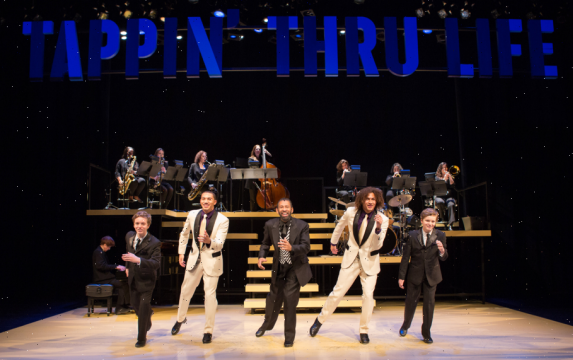 (L-R) Max Heimowitz, John Manzari, Maurice Hines, Leo Manzari and Sam Heimowitz, with members of the DIVA Jazz Orchestra, Photo by Teresa Wood. On a stage flanked by Mondrian-like color block panels reminiscent of 1960’s television shows, a 9-piece all-female orchestra is cranking out the sounds of “Did You Do That”. It’s an old tune by composer Stanley “Kay” Kaufman, an early creator, manager and conductor for the tap dancing brothers, Maurice and Gregory Hines. Back in the day Kaufman founded the original Diva Jazz Orchestra and now a new crop backs up the Broadway legend in “Maurice Hines is Tappin’ Thru Life”. The “Divas” as they are known in jazz circles from Lincoln Center to Birdland to the Apollo Theater, are smokin’ hot and Hines urges them on giving solo turns to noted sax player, Camille Thurman, trumpet player Liesl Whitaker and drummer, Dr. Sherrie Maricle, whom he likens quite accurately to Buddy Rich. Right from the start the joint is jumpin’ and the show has just begun.
The projection panels begin to come alive with intimate family photos, memories of segregation and show biz moments frozen in time. Interspersed between nineteen musical numbers, Hines shares deeply personal stories and his encounters with megastars like Lena Horne, Nat King Cole, Duke Ellington, Judy Garland, Sammy Davis, Jr. and Ol’ Blue Eyes – – the backstory to sixty-five years spent on stage and screen.
 Maurice Hines in Maurice Hines is Tappin’ Thru Life – Photo by Teresa Wood. Hines is captivating and stylish. His movements are silken – – his delivery both hipster and sophisticate. He does a modified “moonwalk”. “I love this step. It’s so sexy,” he croons. And it is. But I am waiting for him to tap. Isn’t everyone? He speaks sotto voce about a recent injury. Later he says, “You know I don’t tap much anymore.” But still, he’s suave in a black and white Armani jacket. And we’re totally enraptured by his shtick. Who doesn’t dig a song stylist with crazy, exquisite phrasing? The kind of phrasing that “owns” a song like Frank and Ella and Dino did. Hines learned it and honed it from the greatest of the greats and it shows as he segues seamlessly from Fats Waller honky-tonk to sophisticated ditties by Cole Porter to ballads like “All the Way”. In jazzed-up classic show tunes from Lerner and Lowe, “I’ve Grown Accustomed to Her Face”, and “Get Me to the Church on Time”, in which Hines gives a thumbs up to DOMA, he lures the audience back to the 1950’s and nights at the Moulin Rouge, the first integrated nightclub in Vegas. Some of the songs even use the familiar Nelson Riddle arrangements. In “Luck Be a Lady” we are transported to Vegas sitting tableside with the Rat Pack at the Flamingo Hotel.
Finally in the eighteenth number Hines does a long spin, some rapid-fire tap moves, and a bit of soft shoe. Not a lot, but perfectly executed. And then the Manzari Brothers come on stage and dazzle, really stun with their electricity. They are formidable as expected. Sam and Max Heimowitz, young twins Hines recently discovered in DC, do a short turn with the virtuosos. Now everyone is tapping and all of a sudden the evening feels like a moment in musical stage history. Oh yes, Maurice. You are too “mahvelous” for mere words.
 (L-R) John and Leo Manzari in Maurice Hines is Tappin’ Thru Life – Photo by Teresa Wood. Through December 29th at Arena Stage, 1101 Sixth St., SW, Washington, DC 20024.
For tickets and information call 202 484-0247 or visit www.ArenaStage.org.
Jordan Wright
November 15, 2013
Special to DC Metro Theater Arts, Broadway Stars, and LocalKicks
Cedar’s Aaron McCloud Creates Amazing Dishes with Olives from Spain
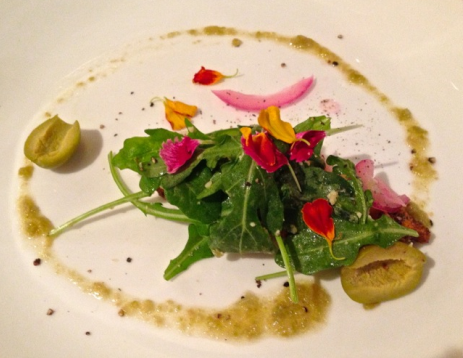 Olive salad at Cedar Restaurant As one of eight U.S. chefs selected to highlight the use of Spanish olives in their cuisine by Olives From Spain, Cedar’s Executive Chef Aaron McCloud staged a spectacular five-course luncheon last week using recipes he devised and pairing the dishes with Spanish wines. Among the other well-known chefs chosen are Seamus Mullen of New York City’s Tertulia; Michael Kornick, Chef/Owner of Chicago’s mk; Ethan Stowell, of Seattle’s Staple & Fancy and Anchovies & Olives; and Giorgio Rapicavoli of Miami’s Eating House. The concept was to show how non-Spanish chefs and home cooks can incorporate Spanish table olives into their recipes. Throughout the season McCloud will be featuring some of these dishes on Cedar’s menu.
McCloud, who gave up studying classical violin with Itzhak Perlman for a life behind the scenes, hails from Michigan and brings with him a farmer’s keen sense of natural ingredients in his approach to cooking.
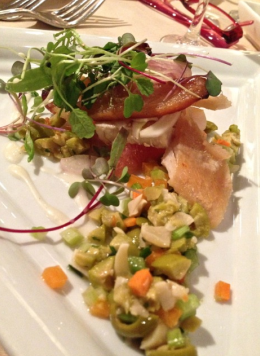 Smoked trout with Meyer lemon and olive relish At a luncheon last week the chef started the meal with a delicately crafted salad of spiced walnuts, arugula, Gordal olives, Manchego cheese and decorated the plate with nasturtiums. Our second course was smoked trout with pickled fennel, grapefruit supremes, preserved Meyer lemon and olive relish which was followed by Merino lamb loins crusted with olive powder and placed in a tart of olives with pickled royal trumpet mushrooms. Spanish Gordal olives made a second appearance stuffed into a roulade of wild boar loin and served with an olive salad and heirloom tomato salad dressed with bacon and olive vinaigrette.
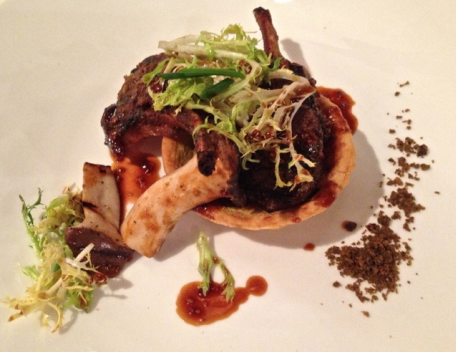 Merino lamb with olive powder and pickled Royal trumpet mushrooms Proving the versatility of the olive with meats isn’t as tricky as it is with sweets. But McCloud overcame the challenge by using the milder type of uncured black olives in a silky panna cotta. The smooth egg-less custard was enhanced with a sweet herb “soup” of made from pineapple sage, lemon verbena and sugar and cooked down to a light syrup and poured over the dish at table and served with a white chocolate olive cookie. McCloud explained, “I decided to make a cookie and thought of substituting the olives for the usual raisins.” Sliced almonds spiced with cardamom, cinnamon, fennel seed and cumin, and baked with maple syrup, provided the unique dessert with a delectable crunchiness. So delectable in fact that I secured the recipe along with a cache to take home.
www.CedarDC.com. And for more information on Spanish olives visit www.OlivesfromSpain.US.
Go With the FLO, Baby
 Jazz Master Marcus Johnson at FLO Wines party What pairs best with wine and friends? Why, jazz of course. So say DC-raised Contemporary Jazz Keyboardist virtuoso Marcus Johnson and his partner Winemaker and Co-Founder Rob Piziali. FLO stands for “For the love of…” and there was a lot of love flowing from the top floor of Georgetown’s chic Puro Café last week when the pair debuted their gently priced Red Blend, Chardonnay and 2011 Moscato wines, all of which are produced and bottled in Napa Valley’s St. Helena. Though the company was launched only a year ago, the popular wines can already be found around our area in stores like Costco, Wal-Mart, Target, Giant, Whole Foods, Harris Teeter, Total Wine and Farm Fresh, and hotels like Marriott and Four Seasons Hotel Washington, DC.
While guests enjoyed nibbles and sips Johnson tickled the ivories for his rapt fans – – one of whom won a lavish gift basket chockfull of gourmet goodies and bottles of FLO Wine. The company has teamed up with Thankfully Yours, a DC-based company, to create festive wine and food gift baskets for the holidays.
Johnson, a Billboard “Top 10” and NAACP Image Award-nominated jazz musician with 15 studio albums to his credit, will be at Blues Alley Jazz Club from December 12th to the 16th.
Visit www.FLOBrands.com to learn more about upcoming wine events in the area. To order their gorgeous gift baskets go to www.ThankfullyYours.com.
A Master Class in Brazilian Wines at DC’s Fogo de Chao
Coming from a family who bought a coffee plantation in Brazil on a whim, I can’t say I ever imagined in my wildest dreams I would be sitting among experts drinking fine wines from Brazil. But that’s what I was doing last week along with area buyers, wine consultants, fellow writers and local sommeliers at a large U-shaped banquet table in DC’s Fogo de Chao restaurant. A dizzying array of fifteen wines and thirteen “churrasco” style barbecued meats were served while Master Sommelier and Wine Educator, Evan Goldstein, kept the enthusiastic sippers engaged with a power point presentation of the regions of Brazil and the development of its industry.
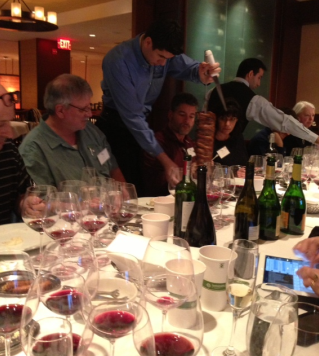 Brazilian wines and churrasco at Fogo de Chao After first reminding us that no less a wine connoisseur than British journalist and wine merchant Steven Spurrier (responsible for the legendary “Judgment of Paris”) had lauded Brazilian wines this year in an article featured in Decanter magazine, Goldstein urged us to begin with a delicate rose-colored sparkler before tasting more serious wines whose grapes are picked from vines brought to Brazil from early Italian and Portuguese settlers who arrived in the country in 1551.
One of the more intriguing factoids about the region’s wines is that Brazil has two harvest seasons every year. By applying a product called Dormex, growers can encourage early ripening that results in two seasons of picking grapes.
There are five dominant wine-growing regions in Brazil, though currently only three have certifications of origin. The main regions are Santa Catarina, Serra Gaucha, Serra do Sudeste and Campanha in the Southern region of the country, and Vale do Sao Francisco in the Northeastern Region near Bahia. Serra Gaucha is considered the most important and largest wine region within Rio Grande do Sul.
We sampled a 2009 Cave Geisse Terroir Nature, a glamorous sparkler made by Maurice Geisse, a Chilean winemaker who once worked for the house of Moet & Chandon and who is now using his considerable talents at his family’s vineyard in the Serra Gaucha region. But an appealing parvenu nipped at its heels. Retailing at half its price, Casa Valduga Brut 130 is a sassy sparkling wine once lauded by former French President Nicolas Sarkozy during a visit to Brazil.
As we progressed to the still whites, I was surprised to hear that Moscatos and Chardonnays dominate the whites. In fact Lidio Carraro Dadivas Chardonnay is made by fifth generation Italians and has been chosen as the “Official Wine of the World Cup”.
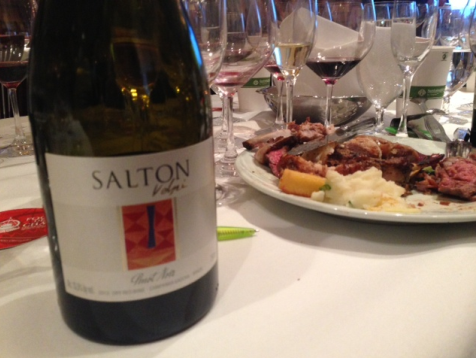 The stellar Salton Pinot Noir Here are the wines that stole my heart and they were all reds. Salton Pinot Noir 2012 (young yet, but holding distinct promise); Salton Desego 2008, a Merlot aged in 50-50 French and American Oak; Perini Marselan 2010, another youthful vintage with the unusual cross of Cabernet Sauvignon and Grenache from a vineyard dating back to the 1870’s; Lidio Carraro, Quorum, a pricey Merlot, Cab, Tannat and Cab Franc blend from 2006; and Pizzato CONCENTUS 2007, a knockout at $25.00.
Look for these at www.FogodeChao.com
Iron Gate – History Restored
The much-anticipated opening of Iron Gate on N Street turned into one the most fabulous private gatherings for a restaurant opening ever. While many guests reminisced about their dining experiences in days past, there was no one present that could have said they were there when it was opened in 1923 by the General Federation of Women’s Clubs. The group whose headquarters are in another historic building next door, is still the Iron Gate’s landlord. To this day the Federation Director’s private residence overlooks the restaurant’s garden from atop the third story.
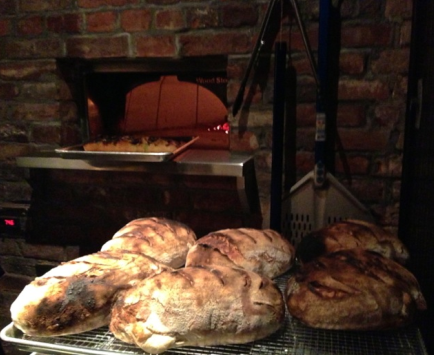 The wood fire oven at Iron Gate For those who may have dined here before the restoration slash remodel, the surprise will be an enclosed and two-story dining space and bar area inside the restaurant’s elegant carriageway. The entrance is now dominated by magnificent lead-framed windows that rise two stories up to meet the building’s original keystones. Iron lanterns, and a pair of repurposed chandeliers retrieved from an old theatre in Baltimore, light the old brick walls. In the bar a massive walnut-framed mirror that was discovered in a garage in Silver Spring, overlooks the 10-seat bar. The large bricked garden, adorned with century old wisteria and still-producing grapevines, sports an electronic awning for inclement weather. A romantic aura fills the main dining area where dark wainscoating, flickering candlelight and a roaring fireplace lend an air of charming intimacy.
The style of cuisine is drawn from the traditional dishes of Greece, Sicily and Sardinia with a menu arranged by category – “Garden”, “Water” and “Pasture”. Diners make their selection from a four- or six-course menu (with or without wine pairings). Some items are available a la carte at the bar or on the patio. Leading a trio of seasoned and award-winning professionals is noted Chef Tony Chittum who left Vermillion in Alexandria’s Old Town to showcase his creativity in this beautiful space. He is flanked by Mixologist Jeff Faile, formerly of Casa Luca and Fiola, and Wine Director Brent Kroll, formerly of Adour at the St. Regis.
At the friends and family opening, plates were piled high with everything from spit-roasted pig, broccoli bruschetta bright with house-made ricotta and garnished with a tiny sardine. Crispy sunchokes with yogurt dipping sauce and light-as-a-feather veal sweetbreads were delectable treats as were the grilled fennel sausages that had an insinuating way of demanding repeat attention. I loved an Ouzo Punch, made with rosemary, ouzo and Galliano. I haven’t seen Galliano in a cocktail since “Golden Cadillacs”, made with the herb-infused yellow Italian liqueur, crème de cacao and cream, were all the rage.
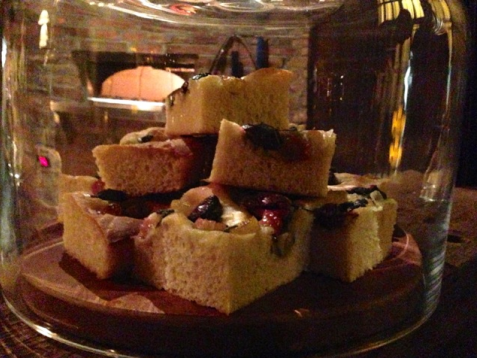 Sweet things await at Iron Gate The sweets were playful – Campari marshmallows, loukamades, hot from the oven and dripping with orange blossom glaze, and Sicilian pistachio buckeyes coated in chocolate. Sheer ambrosia.
With classic architecture, intriguing history, celebrated chef, gorgeous garden, fireplace, separate bar, intimate dining room and sidewalk patio, Iron Gate is truly dressed to impress. www.IronGateRestaurantDC.com
Photos by Jordan Wright
Jordan Wright
November 19, 2013
Special to The Alexandria Times
 Gaylord National’s ICE Santa Reindeer Santa and Company won’t get a moment’s rest this holiday season at the Gaylord National Resort. And neither, it seems certain, will his merry elves. If you haven’t gotten the Christmas spirit yet, a visit to the resort will kick it into high gear. Named one of the “Twelve Most Festive Places to Find Holiday Spirit” by AAA, the Gaylord National’s ICE! is bringing a magical Arctic paradise to our region from now until January 5th.
Who cares if the weather is frightful! Inside this winter wonderland you’ll find twice-nightly indoor snowfalls in the 1½-acre atrium replete with gardens and a small stream set amidst a colonial village and a 60-foot-tall glimmering glass “Tree of Light”. Sit beside a water fountain to watch colorful waterspouts soar three stories while dancing to Christmas carols every hour until nine at night.
 ICE 2013 at Gaylord National Resort & Convention Center Just off the 19-story atrium is the main event — ICE! – – a breathtaking village of larger-than-life ice sculptures hand-carved from two million pounds of real ice. This year’s theme interprets Clement C. Moore’s classic poem, “Twas the Night Before Christmas”. The winter wonderland was created by forty master artisans sculpting 5,000 blocks of ice from China’s Songhua River into the most popular themes of Christmas.
 ICE 2013 Slide Room Roaming through the enormous white tent you’ll see all the trappings of the holiday in living color – – from adorable mice all snug in their beds (actually giant teacups) awaiting Santa’s arrival, to Santa on his sleigh with his nine not-so-tiny reindeer. And you needn’t travel to New York when this year’s highlight is the city-in-ice at Christmas. Just hop inside a bright yellow ice taxi and you’re on your way to Rockefeller Center. The interactive exhibit is kept at an icy 9-degrees so despite the big blue loaner parkas issued at the door, be sure to wear your hat and gloves.
 Gingy’s Gingerbread Decorating But the Christmas spirit doesn’t end there. Beneath the tree is a Peeps & Company old-fashioned “Potomac Express Train” for the little ones and Gingy’s Gingerbread Decorating center where the whole family can create a gingerbread house or gingerbread family together. All the sweetest decorations from icing to gumdrops are provided. A life-size “Gingy” presides over the shop giving out heart-warming hugs to all the children.
Another fun activity is getting up close and personal with King Julien, Alex the Lion and their friends at their Madagascar Crack’ A Lackin’ Cook-in Character Breakfast. These crazy guys are always ready to party while you dine on Madagascar-themed breakfast items including a Flingin’ Chimps chocolate fountain. Afterwards join the self-guided interactive scavenger hunt for clues from the Madagascar movie to solve the puzzle. Shrek, Fionna, Donkey and Puss in Boots are there too sharing the meaning of Christmas.
Up on the rooftop overlooking the Potomac River from the 18th floor, Sunday brunch is served. Reservations are strongly advised for this event that sells out every year. The lavish brunch includes delicious savory selections along with gorgeous desserts like Yule log cakes, peppermint whoopee pies, chocolate chestnut s’mores and sticky toffee pudding. Santa is on hand to pose for keepsake photos.
 Christmas – Nighty Tree Lighting Show Dazzling light displays are everywhere from Christmas trees throughout the lobby to two million twinkling LED lights. At night you can even witness the changing colors of the Northern Lights.
The best view and most romantic spot for viewing the snow cascading down is two stories above the garden level at the Old Hickory Steakhouse bar where you can pass the time while sipping Yule time spirits.
To purchase tickets to ICE! and ‘Brunch with Santa’ or to check on schedules for the hotel’s free events visit http://nationalharbor.com/event/ice-at-gaylord-national for information or call 301 965-4000.
 Potomac Express in Atrium
Jordan Wright
November 11, 2013
Special to The Alexandria Times
 Nyla Rose DeGroat (Ranger Wilson) & Shaina Higgins (Lucy Gale) – photo credit Michael deBlois. Have you ever been curious about what goes on behind the scenes at battle reenactments? A type of “living history” that focuses on a singular moment in a particular battle and requires the participants to live outdoors, dress in hand-stitched period clothing, carry authentic arms, foodstuffs and field medicines, and speak in the manner of the day, it has become a popular pastime. In Shiloh Rules playwright Doris Baizly provides us not only with an intriguing behind-the-scenes interpretation of the type of people that participate in these activities, but also an exciting multi-layered script. As her character, veteran re-enactor Clara May Abbott (Jean Hudson Miller), puts it, “We play by Shiloh rules. There aren’t any.”
Factoid: Though there are more Civil War battlefields in Virginia than anywhere else in the country, the bloodiest of all the battles was the Battle of Shiloh in East Tennessee where 23,000 casualties were sustained. The hallowed land is now called the Shiloh Battlefield Park where the action takes place.
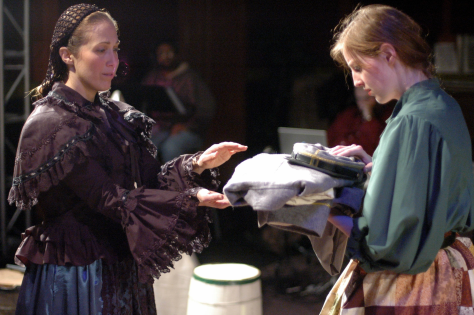 Karen Lawrence (Cecilia) & Shaina Higgins (LucyGale) – photo credit Michael deBlois Director Mary Ayala-Bush has chosen to present the play in the round, a decision that creates a super-charged energy level. Drama and comedy converge when six women meet on the battlefield. Clara May, known as the “Angel of Antietam”, is on the Union side with young Meg (Jennifer McClean), a nursing school student. On the rebel front are Cecelia Delaunay Pettison (Karen V. Lawrence), the embodiment of the iron-fist-in-the-velvet-glove Southern woman, and Lucygale Scruggs (Shaina Higgins), a gung-ho first timer with a taste for blood in her youthful heart. Each describes a wartime profile of their character.
The rules of the re-enactors are created and overseen by the feisty Widow Beckwith (Adriana Hardy), the head of the “Authenticity Committee”, whose penchant for breaking the very rules she invents is outweighed only by her skewed sense of what is authentic. But Beckwith is outranked by Park Ranger Wilson (Nyla Rose DeGroat), a martinet whose adherence to the park’s rules threatens to upset the ladies’ adventures. Nonetheless it is Wilson, an African-American, puzzled by the women’s zeal to open up the old racist wounds of war, who raises the question, “Why keep fighting it?”
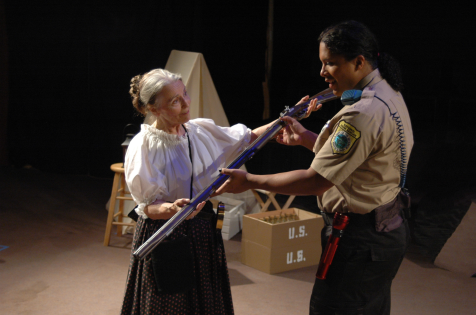 Adriana Hardy (Widow Beckwith) & Nyla Rose DeGroat (Ranger
Wilson) – photo credit Michael deBlois When the battle begins before dawn before the bugler’s signal, all hell breaks loose. The rebels won’t “fall down”, real weapons are drawn and the action becomes all too real.
Ayala-Bush, who is also the Set Designer evokes the encampment with simple canvas tents on either side of the set – – one for the ladies of the North the other for the South.
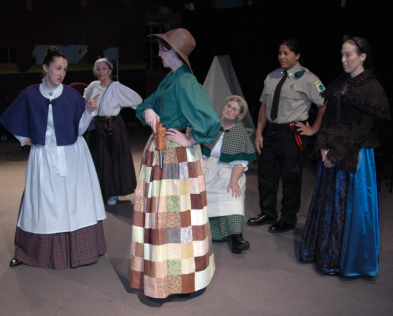 left to right, Jennifer McClean, Adriana Hardy, Shaina Higgins, Jean Hudson Miller, Nyla Rose DeGroat & Karen Lawrence – photo credit Michael deBlois Kudos to the entire cast who are in perfect synch in this outstanding production. Special recognition to Sound Designer Sean Doyle who does a “bang up” job recreating the fusillade of battle.
Highly recommended.
At Port City Playhouse at The Lab at Convergence, 1819 North Quaker Lane, Alexandria, VA 22302. Performances are on the following dates – Nov. 8, 19, 22, 23, 24, 27 & 28 at 8:00 p.m. Matinees on Nov. 16 & 23 at 2pm. For tickets and information visit www.portcityplayhouse.org.
November 11, 2013
Cary Pollak for Whisk and Quill
Whether you’ve been an area resident for a while or are a newcomer, there’s a good chance that the first catering company you ever heard of was Ridgewells. Maybe you’ve been one of the fortunate ones, nabbing an invitation to an event catered by the prestigious company. Certainly you’ve caught a glimpse of the lilac-hued trucks as they tool around the Beltway or seen them parked behind a museum or private home.
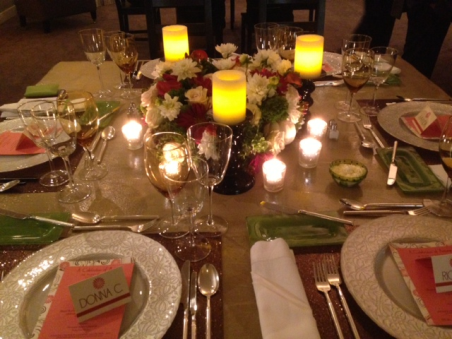 Table setting in the Ridgewells tasting room Recently this stalwart of entertaining expertise celebrated its 85th anniversary with a private dinner party in the tasting room of its Bethesda, Maryland headquarters. It was an evening of showcasing the latest dishes for the fall/winter season and heralding the company’s ambitious plans for their 85th anniversary celebration. To show its appreciation to the region that has supported it for so long, Ridgewells is embarking on a year-long program of “85 Days of Giving”. During the year eighty-five deserving entities will be the recipients of Ridgewells cuisine. It’s their way of giving thanks to community organizations for all of their charitable efforts.
The first gift Ridgewells donated was to cater the gala for Bethesda’s Imagination Stage, a theater they have supported since its inception in 1979. A few days later the company surprised the staff at Kaiser Permanente’s Gaithersburg Chemo Suite with a delivery of gourmet cookies. The company has set up a Twitter account to update its followers on their journey of giving @RIDGEWELLSDC.
 Sausage stuffed quail being prepared for the dining room While dinner guests were learning about this generous outreach program, they were treated to elegant passed hors d’oeuvres of Reuben fritters with spiced Russian dressing, spicy tuna soba noodle spring rolls, sweet pea fritters with apple mint chutney and mini meatball grinders on naan. Once guests were seated dinner began with a fabulous smoked fish fritter topped with kimchee, creme fraiche and an edible, purple sweet potato leaf. Each tidbit packed a unique and assertive flavor, and you might be hard pressed to imagine a better way to “fritter” away your time while the main dinner was being prepared.
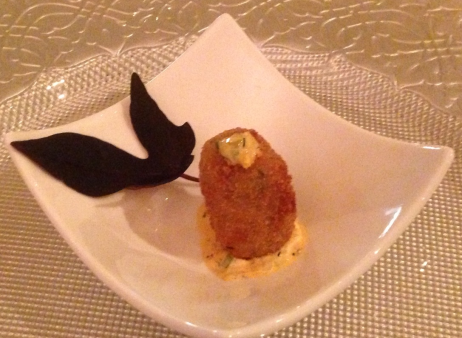 Smoked fish fritter, one of three types of fritter appetizers served One of the features of Ridgewells’ tasting room is a full view of the kitchen through a wall of glass where guests can watch the elegant plating of the evening’s delicacies.
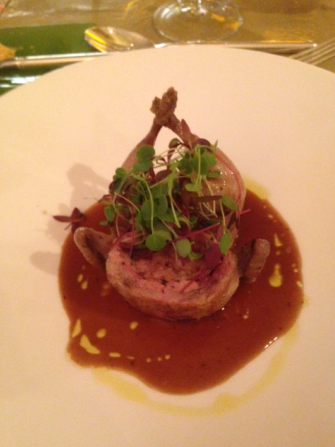 Stuffed quail as presented on the plate Our host was the ebullient Susan Lacz, co-owner of the company since 1997. She and partners, Thomas Keon and Jose Valado, are the most recent additions to a fabled line of ownership that dates back to 1928 when Charlie Ridgewell, a butler on the British Ambassador’s staff and Margueritte Ridgewell, a chef at the French Embassy founded the business. Their daughter, Fifi, and her husband took over the business after World War II, and it remained family owned until 1984, when it was purchased by the Chicago department store chain, Carson, Pirie, Scott and Company.
Ms. Lacz announced that the dinner would be served family style, sometimes known as French service, a style of serving in which servers present large platters to each guest to take whatever amount they would prefer. Dinner consisted of local quail stuffed with sausage and nestled in a lovely demiglaze; risotto studded with Brussels sprouts; slices of red beets and tangerines with a delicate ricotta; quinoa salad with Meyer lemon; and kale Caesar salad.
 Quail surrounded by side dishes Lavish tablescapes showcased an autumn theme. And no site was left unadorned. Pumpkin-studded flower arrangements fit for any dinner party centerpiece even adorned the powder rooms. Another touch of whimsy were deceptively clever desserts disguised as ice cream bars. The luscious Autumn Spiced Cakesicles were filled with cake and pumpkin mousse and served with a poached pear.
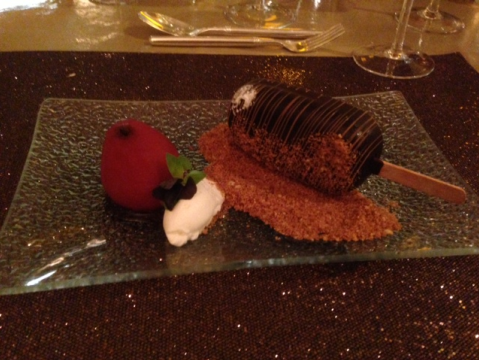 Cakesicle dessert Since Ridgewells first opened its doors, dining and entertaining trends in the National Capital Area have swung from baroque to barbecue and everything in between. Despite changes in political administrations, economic upturns and downturns, and shakeups in the company’s corporate structure, Ridgewells has remained at the top of their game. This year they truly have something to celebrate. Their generous project of 85 Days of Giving is yet another indication of their good taste.
Photo credits: Cary Pollak
Jordan Wright
November 5, 2013
Special to The Alexandria Times
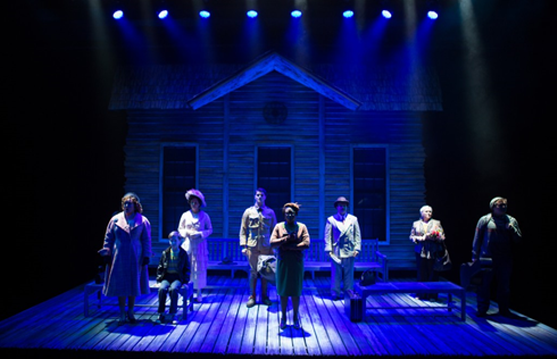 A quiet train station becomes a place of little miracles in Crossing – Photo by Teresa Wood. In the world premiere of Matt Conner’s play Crossing eight people wait at a weathered wood train station. The strangers come from different decades of the past century to share their stories of hope, disillusionment and missed opportunities. The characters are not given names but are loosely defined as Backpacker – 2013, Wealthy Man – 1929, Mother – 1917, Soldier – 1917, Woman with Flowers – 1977, Unknown Woman, Civil Rights Marcher – 1963, Woman in Pink – 1954, Child – 1954. If you’re counting, that’s nine of course. The Unknown Woman, who appears a bit later, seems to be an avatar for hope and change, as in each one hopes the train’s arrival will somehow change their lives. “The easiest journey starts with a small step,” we are reminded.
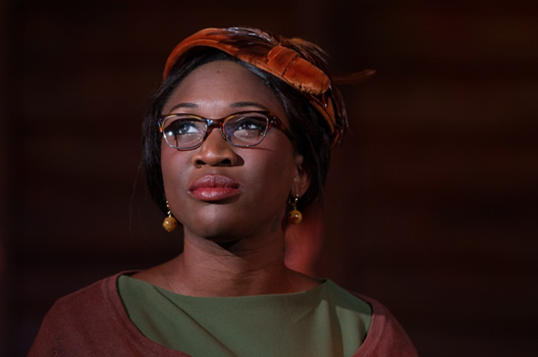 The Civil Rights Marcher (Ines Nassara) waits on her train in Crossing – Photo by Teresa Wood. “Here I Am” is the opening number, a sort of anthem to self-actualization that aims to inspire the traveler, “to seek, to strive, to find, to seek a newer world.” High hopes. There is an undercurrent of American patriotism interwoven throughout the lyrics as well as the immediacy of each individual’s situation. Should the Civil Rights Marcher go to Selma? Should the Wealthy Man break free? “Without my money, who am I?” he queries. Should the Woman with Flowers take back her daughter who’s run off with the Jim Jones’ People’s Temple? Will the Woman in Pink ever get on a train to anywhere? Each has a step to take – – a life lesson to resolve as they wait for the train to pull in to the station.
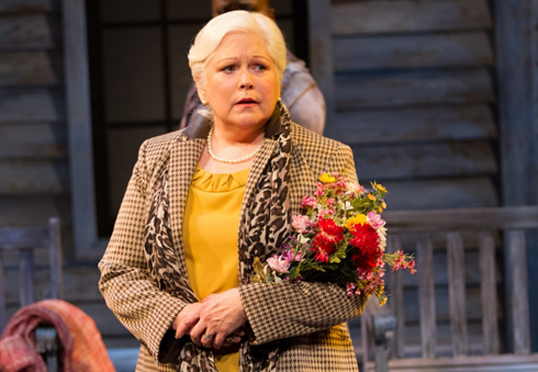 The Woman with Flowers (Florence Lacey) anticipates the return of her estranged daughter in Crossing
– Photo by Teresa Wood. In the number, “Someone, Something, Somewhere” the ensemble seems to agree, “I’m not looking behind. I’m taking what’s mine.”
There is a lot of wishing and hoping and planning and scheming in this set piece. “If you’re tired or hungry or scared, keep going!” the Unknown Woman urges the Civil Rights Marcher, who struggles to believe she alone can make a difference. Unfortunately many lyrics are repetitive, patriotism is a handy conceit, and dreams are ultimately unfulfilled. “Life is just a distraction from Death,” the Wealthy Man decrees. The only hopeful traveler is the Backpacker (Christopher Mueller) who is not hampered by existentialist questions, but is eager to explore the world and seize love where he finds it.
A reappearing butterfly suggested by a spot of orange light on the stage floor becomes a metaphor for freedom and change. But no one appears to be changing or getting liberated. Hoped for love connections are dashed and sage advice is not taken. “If only I were braver – – younger,” the ensemble sings. Ultimately the only happy camper is the Backpacker.
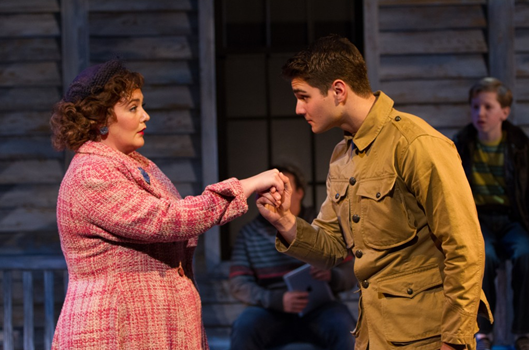 The Woman in Pink (Tracy Lynn Olivera, left) meets the Soldier (Austin Colby) in Crossing – Photo by Teresa Wood. The cast is the bravest element in a show that needs cheering up. Thankfully Christopher Mueller displays the passion and energy to keep the play’s grim reaper in check, while Tracy Lynn Olivera as the Woman in Pink affords us a tender portrayal of a woman who cannot bring herself to commit to a happy future. Nova Y. Payton plays the Unknown Woman, a beacon of light for all the weary travelers in the world. Her spectacular delivery in the reverential solo number “After the Rain”, in which she urges the strangers to find their life’s path, and then a cappella gospel song “Follow the Drinking Gourd”, make you wish you had sat in her train car the entire trip.
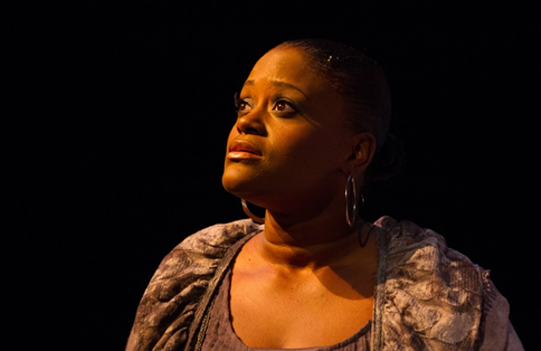 The Unknown Woman (Nova Y. Payton) endows the train station with a touch of magic in Crossing – Photo by Teresa Wood. Through November 24th at Signature Theatre (Shirlington Village), 4200 Campbell Avenue, Arlington, VA 22206. For tickets and information call 703 820-9771 or visit www.signature-theatre.org.
|