Jordan Wright
October 27, 2011
Special to Indian Country Today Media Network
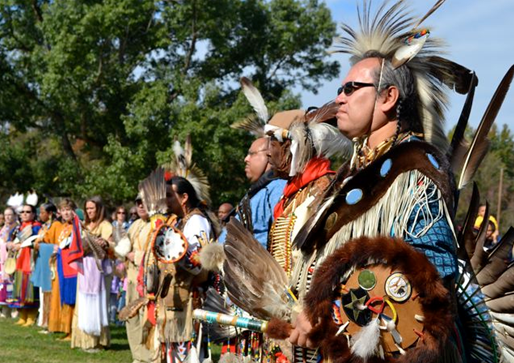 Opening ceremonies at Patuxent River Park's American Indian Festival - photo credit Jordan Wright On an autumn afternoon with the sun at its apex in a clear blue sky, we traveled down a country lane to Maryland’s Patuxent River Park. Silhouetted against the deep green of the pines and American holly, the trees had begun their brilliant burst of color, the crimson of the dogwood, the lemon yellow of the tulip poplar and the pumpkin orange hue of the sugar maple. A tantalizing aroma of venison stew and fry bread hung in the cool crisp air, and cars had begun forming long rows in the freshly mown fields.
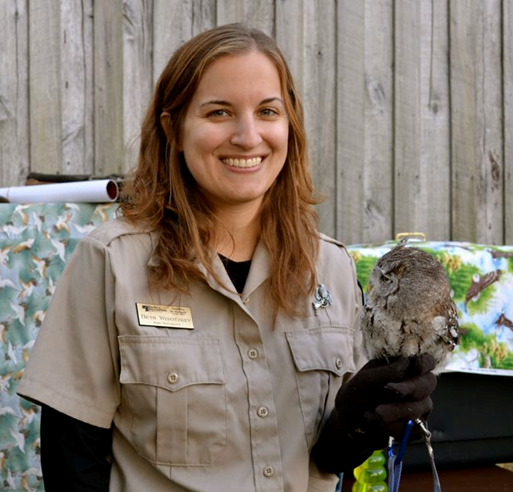
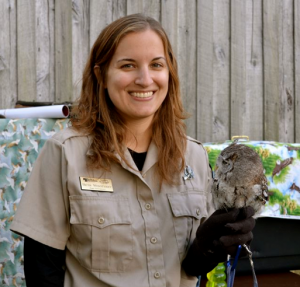 Park Service Naturalist Beth Wisotzsky with baby owl - photo credit Jordan Wright Set on 7,000 acres of protected woodland and watershed, the park meanders along twelve miles of the Patuxent River – a picture of wild natural beauty set on formerly owned Piscataway Indian lands. At the park’s Visitors Center are Indian projectile points, axe heads, and artifacts from colonial times that have been uncovered throughout the sanctuary. As part of the site the Jug Bay Wetlands Sanctuary with its lush vegetation and noted bird sanctuary is a haven for naturalists, especially during fall wildfowl migration.
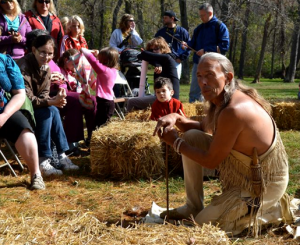 Primitive Life Skills instructor, Daniel "Firehawk" Abbott teaches friction fire - photo credit Jordan Wright The event, billed as 3rd Annual American Indian Festival is not what you’d call a traditional pow wow. It has been created as a promotion and celebration commemorating American Indian and Alaskan Native Heritage Month. The Maryland Natural and Historical Resource Division, who hosted the festival with the Clearwater Nature Center and Watkins Nature Center, directs its attention to non-Natives, reaching out through teaching and hands-on instruction in traditional and modern Native American dancing, artisanal crafts, sports and music. Over 2,000 attendees had gathered, eager to learn everything from weaving and archery to tips on how to research their Native American roots.
“We like to have a lot of hands-on participation and no competition, just cooperation and the sharing of knowledge and lore,” says Karen Marshall the event’s coordinator in Prince George’s County for the National Park Service. “The park service makes sure that all activities are staffed and directed by members of the Indian community,” she adds.
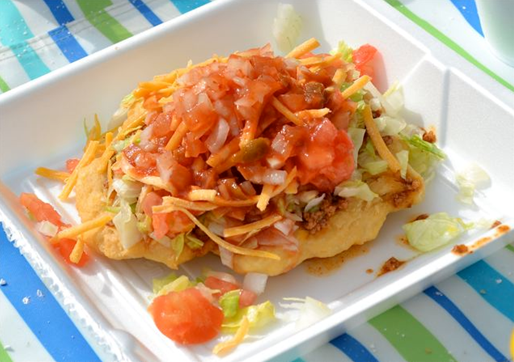
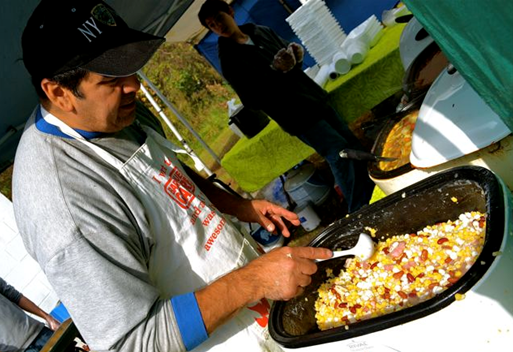
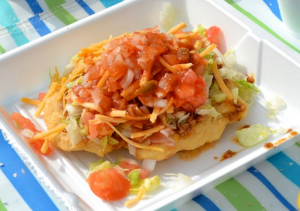 Fry bread taco - photo credit Jordan Wright 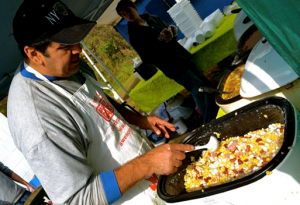 Steven Hill stirs the Ojibwe Corn Soup - photo credit Jordan Wright A large central stage held two groups of performers who sat facing each other in small circles while the Buffalo Hill Singers chanted in unison to the throbbing drumbeats of the Youghtanund and Turtle Creek Drummers, their incantations giving rhythm to the movements of the hoop and jingle dancers. The audience gathered around tapping and bobbing along to the beat.
During the day several nationally known Native Americans were featured in the program including emcee and hoop dancer Dennis Zotigh, of the Kiowa Santee Dakota and Ohkay Owingeh tribes; author and horse trainer Dr. Ray Charles Lockamy Cherokee; genealogist and family historian Margo Lee Williams, Cherokee; and NMAI advisor and local Native American tourism promoter Rico Newman, Piscataway Conoy tribe, who demonstrated the art of beading and finger weaving. Families wandered around the exhibitions or sat near the stage enjoying traditional foods, storytelling and bareback horse riding demonstrations.
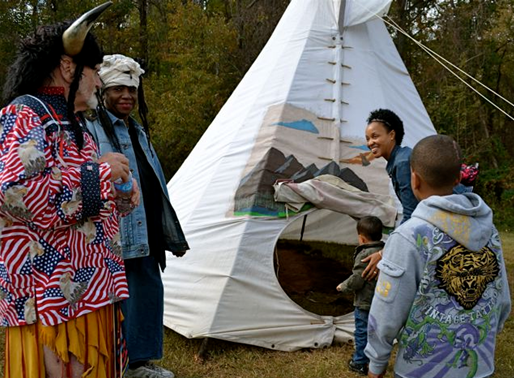
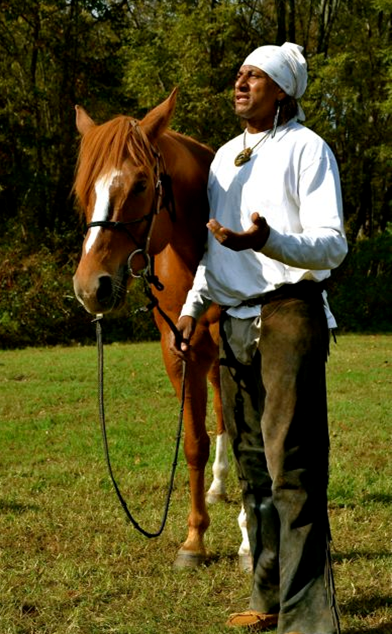
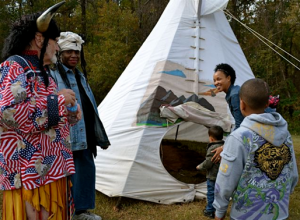 Awaiting entry to the tipi - photo credit Jordan Wright 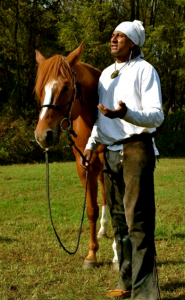 Dr. Ray Charles Lockamy weaves tales of his youth - photo credit Jordan Wright “It’s very important to have a first person interface with those that are knowledgeable in tribal practices and lore and to learn about Indians where they are rather than watching TV or reading books,” advises Dennis Zotigh who works with the National Museum of the American Indian on Native cultural events.
The Clearwater Natural Dye Group brought a spinning wheel to spin wool from the oldest breed of sheep in North America. And there were samples of the Navaho Churro sheep’s wool tinted with natural plant dyes that had been extracted from Osage oranges, achiote and onion skins to create a myriad of soft-hued colors for the weaving of clothes or blankets.
A former dairy barn became a rustic backdrop for park service naturalists and their “Birds of Prey” exhibit featuring a tiny owl, an American bald eagle and a kestrel along with other local species. Scattered around the grounds were long tables staffed by Scout troops and a host of volunteers teaching families how to make cornhusk dolls, weave baskets and string beads as keepsakes.
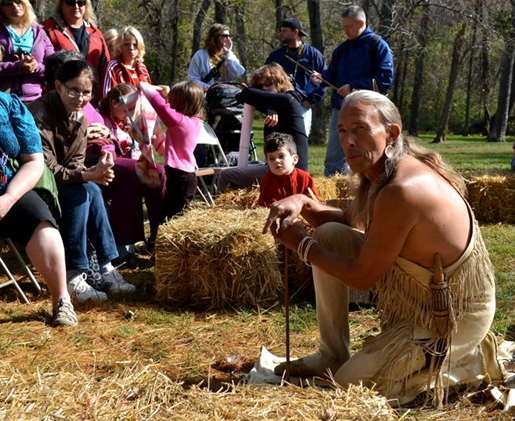
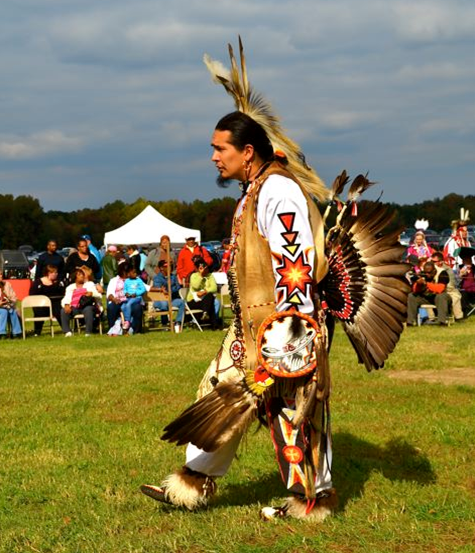
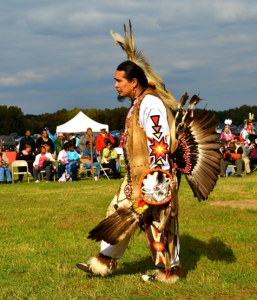 Head Dancer - photo credit Jordan Wright Contributing to a day rich in culture Daniel “Firehawk” Abbott, of the Nanticoke Tribe of Eastern Maryland, a teacher of primitive life skills at Historic Jamestowne in Virginia, was in period deerskin clothing. Encamped beside a wooded area he demonstrated the technique of friction fire and other native skills while families, perched on hay bales, listened raptly. Abbott brought his astonishing private collection of Mid-Atlantic Coast artifacts reflecting an extensive array of museum-quality prehistoric tools, weaponry, animal pelts, basketry, ceramics and model prehistoric shelters for visitors to marvel at and to experience hands on.
Cantering through a field on his chestnut horse, Dr. Ray Charles Lockamy pulled up sharply and dismounted before his awaiting audience. He began to weave stories of his upbringing and the horse in Indian life, explaining its use as both protection from danger (by crouching under its belly) and its use in hunting.
While atop a grassy ridge, an archery range was popular with bow and arrow fanciers who lined up to receive instruction, children waited their turn to clamber inside a tipi. Bob Killen of the Pocomoke Indian Nation, builder of the 14-foot tipi, patiently answered questions about Indian life in the Chesapeake region. Storytellers Zak “Between Two Worlds” and Joseph “Stands With Many” invited others to join them around the fireside with Native-spun tales of how bats came into our world and other curious descriptions of the origins of animal life.
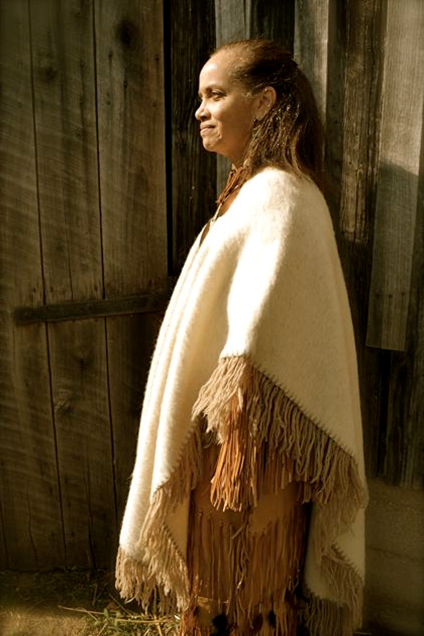
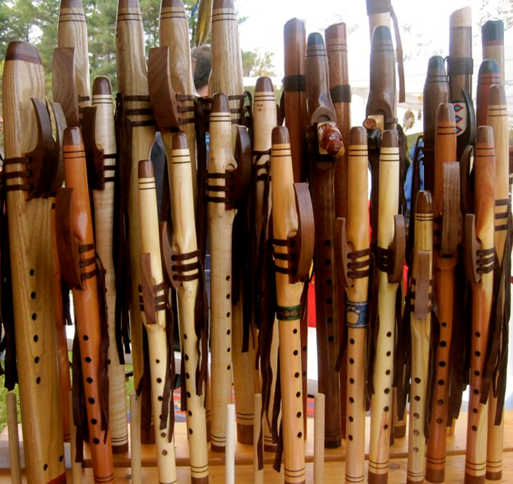
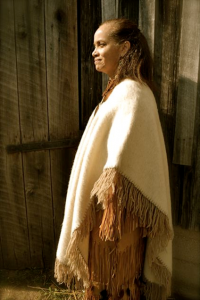 Cherokee historian and genealogist, Margo Williams - photo credit Jordan Wright 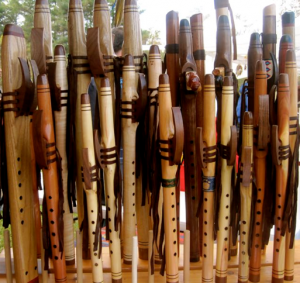 Redbird Flutes handmade by Roger Bennett - photo credit Jordan Wright Closer to the artisans and vendors musical strains could be heard from Master Flute Maker, Roger Bennett of Redbird Flutes and well-known performer and flutist Ron Warren. Shango Chen ‘Mu and ‘Mahdi played a mystical form of World Music with Tibetan bowls, flutes and a modern steel drum called the Hang.
As the day came to a close and artisans packed up their wares, folks drifted back to their modern day vehicles carrying with them their newly made crafts and a wealth of newly acquired knowledge of Native life. We all left with a stronger sense of community from a peaceful afternoon spent in the woods sharing Native American culture.
For information on Patuxent River Park and the Jug Bay Wetlands Sanctuary in Upper Marlboro, MD visit http://www.pgparks.com/page332.aspx
Jordan Wright
October 10th, 2011
Indian Country Today Media Network
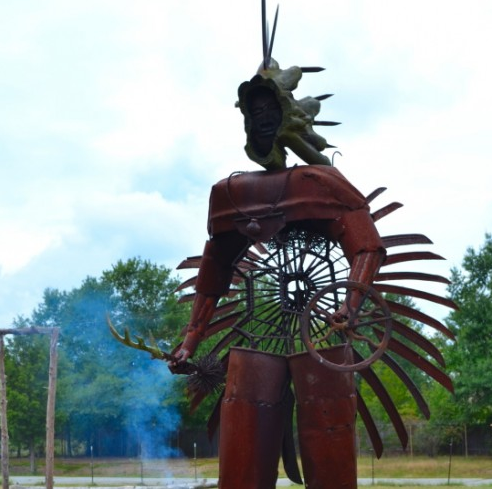 Piscataway Sculpture - Photo credit to Jordan Wright When the harvest moon rises over the Potomac in early autumn, it is a slow aqueous climb that silhouettes the shoreline and turns the river’s blue-green waters into the color of molten obsidian. Under the same amber moon in 10,000 B.C. prehistoric people plied the waters in dugout canoes carved from tulip poplar and built their bonfires along the coastal marshes. They combed the primordial forests hunting for fish and game not unlike the Piscataway tribes who have called these lands their home for over 500 years and whose history still threads through the region like the rivers and creeks that crisscross the land.
The Beaver Clan, as they are known, inhabit a modern world in an area of Southern Maryland, graced with thousands of protected acres of woodland and coastal waters lining the Potomac, Anacostia and Patuxent Rivers and on out to the Chesapeake Bay. It is rich with the history of tribal occupation and the early colonists. Whether you travel by foot, car, bicycle or kayak these are some of the ways the modern explorer can sense, see and relive Maryland’s ancient past while enjoying its fall colors.
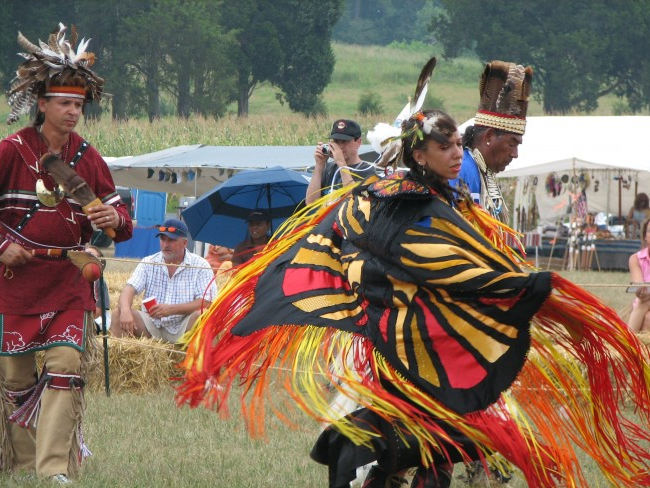 American Indian Heritage Day dancers at Jefferson Patterson Park & Museum Prince George’s County
Late this summer archeologists completed a major dig in the Zekiah Swamp that lies beside Mattawoman Creek, south of Waldorf, MD. Their stunning discovery was the long-lost Zekiah Fort, built in the 17th Century for the Piscataway by Governor Charles Calvert, the third Lord Baltimore, it was used to protect the tribe from incursions by the Susquehanna, Seneca and Iroquois.
The location of the fort offers living proof of Piscataway existence in the region since 1200 A.D. The researchers unearthed Native American pottery and glass trading beads side by side with arrowheads made from English brass, a 17th-century English clay pipe, and a silver belt hanger for an English soldier’s sword. Currently the secret location is under the aegis of St. Mary’s College and the Smallwood Foundation, who as co-sponsor of the excavation, hopes to purchase and protect the 95-acre site.
Along Indian Head Highway just outside the Washington DC area the Bryan Point Road takes you to the Accokeek region where according to Captain John Smith’s map of 1612 the village of Moyaone and Mockley Point the principal place for the Tayac and capitol of the Piscataway Nation. Along the road you’ll pass the Alice Ferguson Foundation at Hard Bargain Farm Environmental Center where Alice Ferguson began excavations on her property in 1935 documenting prehistoric encampments through cutting tools, axes, “atlatls” (forerunner of the bow and arrow), pottery, pipes, post mold remnants revealing early stockades and over 600 human skulls in a single ossuary.
On the same road are the Accokeek Foundation, stewards of the 5,000-acre Piscataway Park, and the National Colonial Farm alongside the Potomac River with a view to George Washington’s Mount Vernon home on the Virginia side. Visitors to the farm and park can traverse upland woods and fenced fields dotted with heirloom breeds of cattle, sheep and pigs. At the river’s edge an historical marker describes the history of the Piscataway whose name translates to “where the waters blend”. It overlooks a large field with a burial site and sweat lodge beyond used by the Piscataway Conoy Confederacy and Subtribes and accessible across the wetlands by a wooden boardwalk. Six marked trails provide spectacular views of the river and woodlands. The foundation hosts monthly events to acquaint the public with Native American and colonial traditions with gardening and cooking classes and environmental film screenings. The park and the surrounding area are home to beavers, bald eagles, deer, fox, wild turkey, egrets, osprey, great blue heron and many more of the area’s species. Fishing and boating are permitted at the park.
Charles County
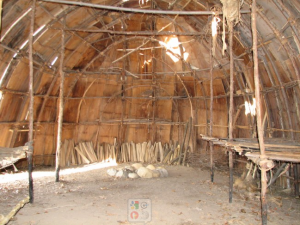
In the nearby town of Waldorf is the home of the Maryland Indian Cultural Center and Piscataway Indian Museum run by the Cedarville Band of Piscataway Indians and directed by tribal chief, Natalie Proctor and her husband Maurice. The five-acre museum site is on an original Nike Missile site. “Moondancer”, a sculpture created by local artist Jim Pollack from old missile parts, reigns beside the fire pit and sweat lodge. The wonderfully informative museum houses hundreds of artifacts from local as well as national tribes and includes descriptions of tribal life in Southern Maryland. A longhouse, the preferred habitation of the local tribes, has been constructed inside the museum. 16816 Country Lane, Waldorf, MD. Visits to the museum are by appointment or during festivals. Call 240 432-5446.
Indian Head, poised at the confluence of the Potomac and the headwaters of the Mattawoman Creek yields further exploration by kayak, standup paddleboat (SUP) or the pedal-driven Hobie kayak along the banks of the Potomac River or on the 23-mile Mattawoman Creek. The nearby Indian Head Rail Trail, designed for walking or cycling, is a 13-mile paved trail one half-mile from the town’s center.
Up The Creek Rentals in Indian Head is open weekends or by reservation during the week and rents all the above equipment. Call 301 743-3733 or 301 743-3506. www.upthecreekrentals.com.
The village of Port Tobacco, once Maryland’s largest seaport and the original site of the Indian settlement of Potomaco is Saint Ignatius Church overlooking the mouth of the Port Tobacco River on a 120-foot bluff. Founded in 1641 it is the nation’s oldest active parish. Inside a unique stained glass window depicts the baptism of Chief Kittamaquund (the “Great Beaver”) – the first Native American Chief to be baptized in the Catholic Church. Piscataway graves can be found in the church’s cemetery and the restored Port Tobacco Courthouse has a small collection of Indian artifacts.
Calvert County
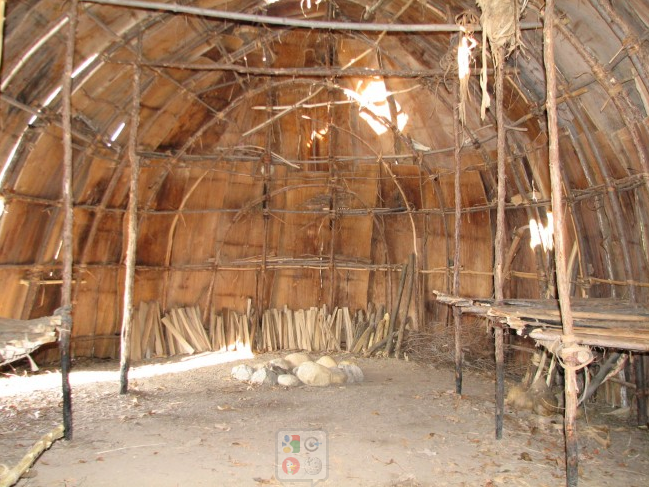
A few miles west of the Chesapeake Bay is the 560-acre Jefferson Patterson Park & Museum in St. Leonard. In 2007 the park recreated an Indian village in commemoration of the 400th anniversary of Captain John Smith’s landing and exploration of the bay and its tidal tributaries. The village, situated beside the Patuxent River, consists of four longhouses, a central fire pit and racks for smoking fish and meat. A cell phone audio tour is available. Activities such as the making of stone tools and clay pots as well as evening campfires are held throughout the year on “Village Days” and the park’s annual American Indian Heritage Day.
The Maryland Archeological Conservation Lab is also located in the park and open to pre-arranged group tours. Over 8 million artifacts are housed here where conservators do restoration and preservation work on site. A Visitors Center provides information on the Paleo-Indians of the region and showcases artifacts from around the state. To plan your visit go to www.jefpat.org.
JORDAN WRIGHT
September 18 & 20, 2011
Indian Country Today Media Network
When the urge to nourish the body as well as the spirit comes to us, we should be ready to receive the signal. Our active lives need periods of rest, relaxation and rejuvenation to stay in balance. When traveling through Indian Country there are plenty of soul-soothing places to choose from, but it’s especially rewarding when a first class spa is found within a deluxe resort.
For the thrill-seeker the casino offers a glittering nightlife and sheer exhilaration – cranking up the endorphins and getting the adrenaline flowing. Gamblers fine-tuned to the bright lights and all-night action feel their pulse quickened over a roulette wheel, gaming table or bank of slots, yet the call for periods of tranquility that appeal to our inner selves, still resonates.
So whether the heat comes off a lucky streak or an aromatic steam bath, you can satisfy both cravings at one of these four casino resorts designed to combine both excitement and healing under one big roof.
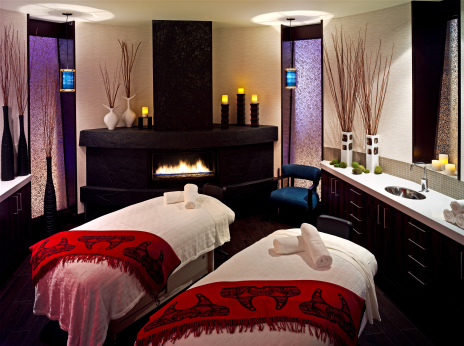 Spa Treatment Room at Mohegan Sun Resort and Casino - photo credit Mohegan Sun Resort and Casion Mohegan Sun – Connecticut
Situated on 240 acres along the Thames River in Uncasville, Connecticut, the Mohegan Sun is one of the largest casinos in the world. A member of the prestigious Preferred Hotels Group, that defines its members as an elite group of independently owned properties, the 32-story hotel was established by the Mohegan Tribe of Connecticut and is a mere 15 minutes from the scenic waterfront of historic Mystic Country.
The resort’s beauty salon and full-service Spa at Elemis debuted in 2003, occupying the entire third floor in the hotel’s Sky section. Here guests enjoy signature ancient healing therapies with authentic Mohegan themes. The Ceremony of the Sacred Sun is a lime and ginger salt glow treatment coupled with a self-tanning treatment that gives an all-over glow to the skin and finishes with a soothing well-being massage.
In the Ceremony of the Strawberry Moon couples enjoy a massage lesson and Exotic Jasmine Flower Bath while being pampered with champagne and chocolate covered strawberries. In addition two spacious couples’ suites, Father Sky and Mother Earth, are equipped with massage tables, Jacuzzi slipper bath, sensory dry float bed and shower.
Among the seven different facial treatments and eight types of massage rituals, The Trail of Life Ritual offers an Elemis facial with eye zone treatment and collagen or sulphur compress, jasmine flower bath, pedicure, manicure, frangipani hair and scalp ritual and styling, along with a choice of either reflexology or full body massage.
Separate facilities for men and women, house a private steam room, sauna, Jacuzzi and relaxation room. The Great Desert Retreat and Great Fresh Water Retreat are among 26 private treatment rooms named for the moons that mark the Tribe’s seasonal changes. An indoor pool and fitness center allow guests to enjoy the spa in all seasons.
For spa reservations outside the hotel call 860 862-4520 or visit www.elemisspa.com.
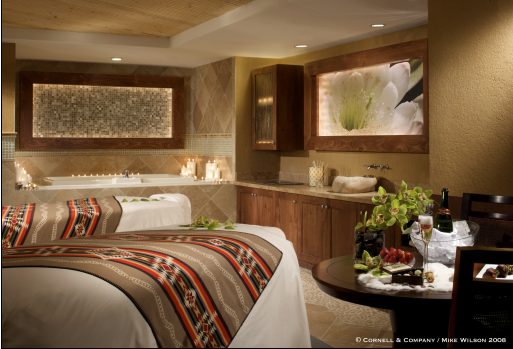 Couples Treatment Room at Wo' Po'in Spa at Buffalo Thunder Resort and Casino - photo credit Buffalo Thunder Resort and Casino Buffalo Thunder Resort and Casino – New Mexico
At the Pueblo of the Pojoaque Reservation surrounded dramatically by the Sangre de Cristo Mountains of New Mexico, you will discover the Buffalo Thunder Resort and Casino with its exquisite Wo’ Po’ in Spa. A mere 15 miles from Santa Fe’s historic plaza and set in the Rio Grande Valley, this splendid resort is also an art-centric destination. Throughout the water-themed property and in the spa itself are original works by well-known Pueblo artists and weavers. A stunning bronze warrior by iconic artist and sculptor, George Rivera, the tribe’s governor, greets you as you arrive at the porte-cochère.
The full-service spa and beauty salon is a serene escape designed to revitalize and renew the body, mind and spirit within 16,000 square feet of sublime sanctuary. The bright colors and geometric motifs of Native American blankets used in the spa punctuate the soft desert-hued interiors. Featuring thirteen private treatment rooms and a dedicated couples room, the spa employs its signature fragrances and skin care line both of which use indigenous flora. Treatments here are geared to reflect indigenous healing elements of the Pueblo heritage and Pojoaque philosophy that consider the experience a journey, or “poeh” meaning pathway, through past, present and future.
In the Red Earth Cocoon Wrap toxins are cleansed from the system with the application of red mud. Afterwards a native essence lotion, scented with copal, cedar, lavender and citrus essential oils is applied to hydrate the skin.
The Pueblo people believe that stones from the earth carry the spirit of their ancestors, and the spa’s Flowing Spirit Hot Stone Massage, popular with the resort’s golfers and hikers, follows that ancient tradition with the use of warm desert stones combined with native plant oils for balance and purification. Reflecting the same attention to sourcing local products, their Flowing River Pedicure employs a seasonal blend of indigenous salts before applying white clay and essential oils with a warm stone massage.
In the Sacred Earth Cocoon Wrap, a massage is followed by a warm mud application infused with birch, vetiver and juniper oils and culminates in a complete body hydration procedure. Here, wraps such as the Aloe Vera Body Wrap, can be followed by a Vichy shower for the ultimate in bliss. Afterwards don a plush terry robe and relax on a lounge among the water-spouting columns beside the indoor pool.
New for fall, the Turbinado Pomegranate Sugar Scrub ends with a luxurious shea butter goat’s milk hydration massage.
For spa reservations outside the hotel call 505 819-2140 or visit www.buffalothunderresort.com.
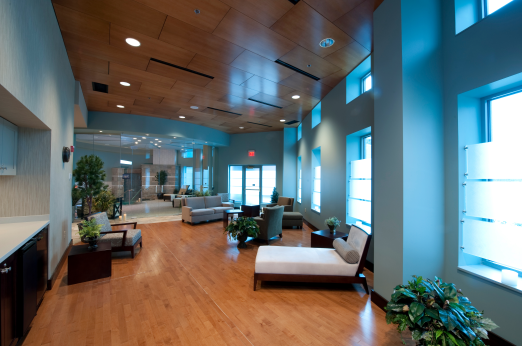 Grand Harmony Spa at the Grand Casino Hinckley - photo credit Grand Casino Hinckley Grand Harmony Spa – Minnesota
Located amid the farms and fields of eastern central Minnesota, named “The Land of 10,000 Lakes”, the Grand Casino Hinckley is one of two resort hotel properties owned by the Band of Mille Lacs Ojibwe Indians. Within the resort’s 8,243 square feet lies the Grand Harmony Spa – a paean to healing waters.
Opened in 2007 the spa’s woodland theme replete with waterfalls invites guests to partake of a myriad of treatments and rituals designed to soothe and stimulate the senses with Asian reflexology, Swedish massage, hot stone applications, and aromatherapy steam rooms. Energy-increasing lemongrass or skin-hydrating milk and honey spa baths are complemented by an initial dry brush exfoliation.
Try the Age-Defying Pumpkin Body Masque amped up with antioxidants like cinnamon, clove and caffeine for cellulite reduction, or the Ultimate Body Butter Drench scented with lavender and pine. There is an extensive menu of services including seven different botanically-based facial treatments, five bath rituals and eight separate body rituals using the spa’s premier Hungarian Éminence line of products made with organic fruits like persimmon and cantaloupe. For facial contouring the spa uses the Zirhafirm line for redefining skin firmness and elasticity with the use of wild jujube and maral root.
Indulge in the refreshing Blueberry Bliss Slimming Body Wrap or Detoxifying Chocolate Wrap. Couples are invited to share the experience with a dedicated couples sanctuary called the Serenity Suite. There’s even a Late Night Remedy that includes the chocolate wrap, neck and back massage and express facial followed by a special “hangover” vitamin cocktail.
The spa uses the organic Jane Iredale line of mineral make-up and skin care. A separate beauty salon is on the resort’s property.
For spa reservations outside the hotel call 320 384-4836 or visit www.grandharmonyspa.com.
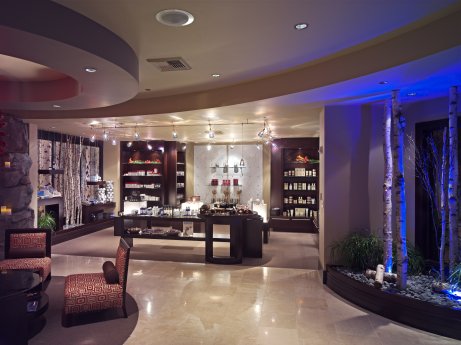 The T Spa - photo credit Tulalip Resort and Casino Tulalip Resort and Casino – Washington
Insiders already know the AAA Four Diamond Tulalip Resort and Casino in Seattle, WA through its exceptional dining and stellar wine program. Surrounded by the waters of the Puget Sound and the Cascade mountain range, the resort is a stunning contemporary hotel incorporating native Salish artwork and The T Spa for men and women. The 14,000 sq. ft. spa blends woodland and ocean themes using natural product lines such as the organic Aroma Floria; Phiten, a Japanese line; Skinceuticals; Thalgo, a marine botanical line; and the hand-crafted organic and bio-dynamically grown Mi’kmaq Collection, created in the ancient traditions of the Miqmaq elders of the Pacific Northwest.
The T Spa brings nature indoors by the use of river rocks, dark walnut and birch, the symbol of renewal. The design theme of this full-service spa is carried throughout the elegant space with cedar saunas, eucalyptus steam rooms, and grotto showers. Sixteen treatment rooms, some outfitted with Italian porcelain jetted Jacuzzis, include three couples suites. The VIP suite features a fireplace and blankets woven with the Tulalip tribal symbol of the blackfish that grace the massage tables.
Its Lava Shells Massage, popular with golfers, uses cut and polished tiger clam shells encasing a sachet that when heated bursts through spontaneous combustion releasing herbal essences specifically selected to induce a muscle-relaxing warmth. Sweetgrass oil, hand made for the spa by the Nova Scotian Mi’kmaw tribe, is used in one of the nine massage treatments. Crushed lavender flowers and juniper berries combine with marine salt crystals in the Deep Tissue Bolus Massage. Employing an age management approach in one of 13 facials offered, birch bud extract is applied to increase skin energy. Another technique employs champagne grapes mixed with an aromatic rose essence.
For spa reservations outside the hotel call 360 716-6350 or visit www.tulalipresort.com
Jordan Wright
August 3, 2011
Special to The Washington Examiner
STAYING GREEN
 Executive Chef Rafael Gonzalez at the Four Seasons Hotel rooftop garden - Photo Credit Jordan Wright The very upscale Four Seasons Hotel Philadelphia has hopped on the green bandwagon by building over a dozen raised bed planters on their rooftop garden overlooking Logan Circle. Spilling over with cute mini-veggies, glorious flowers used in the hotel’s luxe arrangements, and lush with menu-driven herbs like chocolate mint and lemon thyme, the garden-with-a-view uses other green initiatives like beehives and naturally fertilized soil from hotel compost to coddle their plants.
Executive Chef Rafael Gonzalez need only zip up to the 8th floor to pluck fresh ingredients for his exquisite cuisine. The hotel has even enlisted their chief engineer to design a wastewater-recycling program. Four Seasons Hotel Philadelphia, One Logan Sq.; 215 405-2815; www.fourseasons.com/philadelphia
HELLO FARMER!
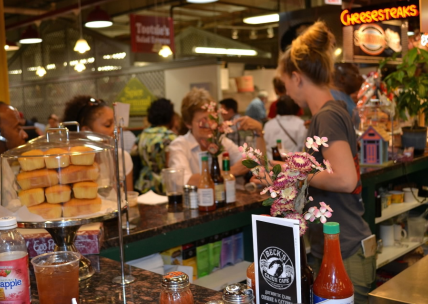
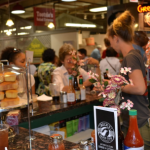 Beck’s Cajun bar at the Redding Terminal - Photo Credit Jordan Wright The restored Reading Terminal Market, originally built in 1893 is the nation’s oldest continuously operating farmer’s market and a great stop to grab lunch and stock up on everything from Lancaster County Amish pickles and jams, crusty breads and pastries, or crab cakes and smoked meat sandwiches from family-run vendors. Try the spicy gumbo at Beck’s or squeeze in at the counter at Pearl’s Oyster Bar for a dozen of the briny mollusks and a cup of Philly’s favorite snapper soup. On the same aisle, the Fair Food Farmstand carries cheeses, herbs, grass-fed meats and organic veggies from more than 90 sustainable small-scale farms. 12th and Arch Sts.
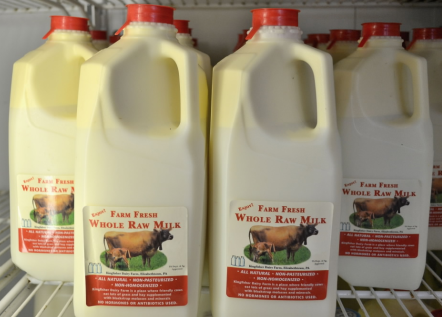
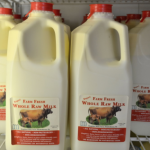 Kingfisher Dairy Farm whole raw milk - Photo Credit Jordan Wright In the West Philly neighborhood, Annie Baum-Stein’s groove-in-the-hood Milk and Honey Market carries Kingfisher Farms raw milk. Savor a frosty glass of the forbidden liquid here, since you can’t buy it in the DC area where it’s still illegal. Another local producer Claudio’s provides creamy ricotta, mozzarella and Italian charcuterie, and Lancaster Farm Fresh Co-op brings in fresh fruits and veggies weekly. Made to order sandwiches like the spicy Thai tofu or the Italian caprese panini go down nicely with a Boylan’s Creamy Red Birch Beer. 4425 Baltimore Ave.
Across the street, Roost, a popular chicken place also owned by Baum-Stein, cooks up roasted or fried birds from Grigg’s Town Farm. 4529 Springfield Ave.
From there it’s a pleasant stroll to The Clark Park Market run by The Food Trust. Open Thursdays from 3-7p.m. and Saturdays from 10-2p.m. Home baked peanut butter or chocolate whoopee pies share space with glistening berries and heirloom vegetables. On Thursdays the Guapos Tacos food truck sells duck, pork or vegetarian tacos topped with guacamole and cotija cheese for a leisurely lunch in the park. 43rd St. and Baltimore Ave.
DINING ON LOCAL
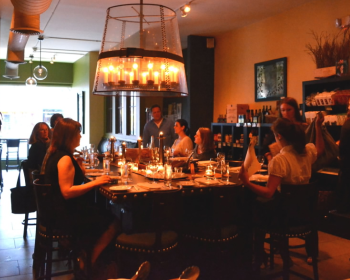
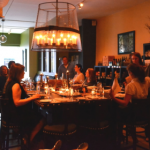 The communal dining table at Fork - Photo Credit Jordan Wright
The nightly communal table at cookbook author Ellin Yin’s Fork in the bustling Old City, is where chef Terence Feury’s New American bistro cooking might feature the daily catch. Feury, named Philadelphia’s “Best Chef 2010” prepared us a whole wild striped bass with local vegetables. Serious anglers can take his guided fishing trips once a month to catch their own and learn how to prepare it. 305 Market St.
MidAtlantic Restaurant and Tap Room, in the University City area is where this hip destination resto serves its reinvented local dishes in a rustic slash modern decor. Chef Daniel Stern, former top toque at Le Bec-Fin, shows off the Pennsylvania Dutch influence with in-house made charcuterie served with exceptional raw cow’s milk cheeses from Chester County’s Birchrun Hills Farm. Order the Welsh rarebit fondue, perfect for dunking Stern’s version of the Philly hot pretzel, or the crab scrapple with pepper jelly and horseradish emulsion. A rich malted milk chocolate mousse cake is the capper. 3711 Market St.
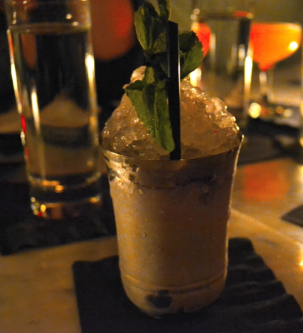
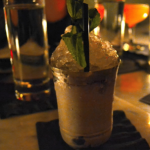 The Mint Julep at Franklin Mortgage and Investment Company - Photo Credit Jordan Wright The stylishly dark and intimate Franklin Mortgage & Investment Company doesn’t make loans in this former speakeasy, but it does make exquisite classic cocktails using a Kold-Draft icemaker for perfectly square cubes. Go for the ‘Serious Misgivings’ Punch – by the cup or bowl – suitable for sharing with fellow connoisseurs; or the ‘Blonde Redhead’ made with cognac, raspberry syrup rosewater and champagne. Mint juleps appear in a proper silver julep cup, and a concoction called ‘Queen Bitch’, uses Guyanese rum tricked up with Cocchi Americano, Genever gin, blanc vermouth and absinthe. 112 So. 18th St.
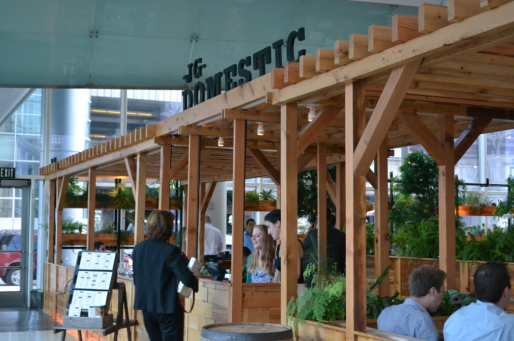
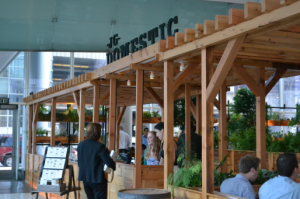 JG Domestic - Photo Credit Jordan Wright Tucked into the atrium of the Cira Centre building is the raw wood farmhouse decor of Iron Chef Jose Garces’ restaurant JG Domestic. The design translates into a distinctive juxtaposition to the ultra-contemporary Cesar Pelli-designed skyscraper. The authentic Americana style, replete with trees and a wall of herbs and greenery, is a harbinger of farm-to-fork cuisine. Think of it as the East Coast’s version of the French Laundry. Begin with Iowa popcorn or hickory smoked Georgia pecans. Continue with cocktails like the Zephyr, made with gin, cucumber, orange cordial. The dinner menu features a section called “Tonight” with “Whole Animal” defining a dish crafted by using a farm raised animal in its entirety such as roast suckling Pennsylvania lamb, roasted leg and shoulder, crispy confit ribs and braised belly; or the indelibly memorable roast chicken. The restaurant serves breakfast, lunch and dinner is adjacent to Amtrak’s 30th Street Station. 2929 Arch St.
URBAN GARDENING
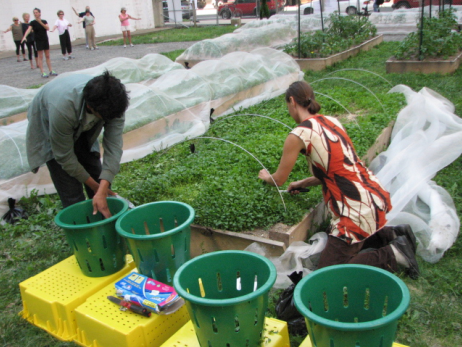
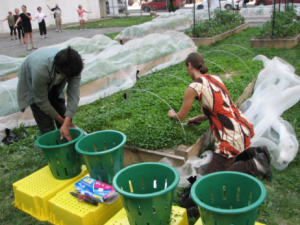 Volunteers from PHS with Tai Chi class - Photo credit Jordan Wright The Pennsylvania Horticultural Society has rescued a scraggy lot at 20th and Market Streets in Center City converting it into a temporary paradise of raised-bed gardens featuring educational workshops for inner city kids. Situated beside Blue Cross Blue Shield’s headquarters the animal topiaries recycled from their famed annual Philadelphia Flower Show put this garden in a special category and reflect a kid-friendly design dynamic. Tai Chi classes and nighttime film screenings share space with arugula and heirloom tomatoes. The program donates veggies to local restaurants to create signature dishes. Proceeds from the sales of these dishes go to City Harvest, to distribute to the city’s food cupboards.
 Marathon Farm - Photo Credit Jordan Wright It takes more than guts to plant a garden in a sketchy down-at-the-heels neighborhood, it takes drive and sweat equity. This spring Patrick Dunn, formerly of the Emerald Street Urban Farm Project, commandeered the space in the Brewerytown neighborhood to raise crops and keep bees for Marathon’s multiple restaurants. A pop-up weekend farmers market caters to the locals. You can keep track of their efforts at www.marathonfarm.com; 27th and Master Sts.
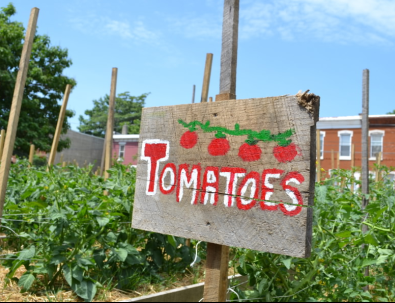
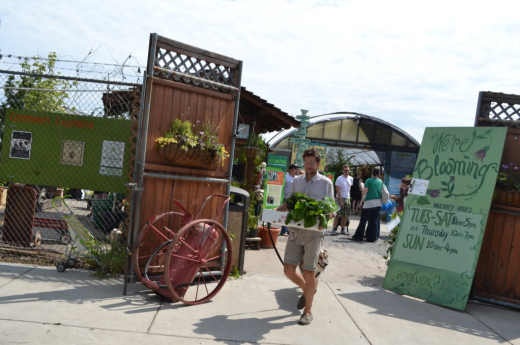
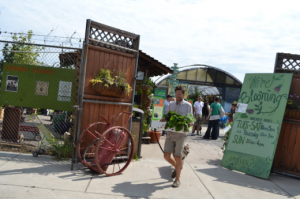 Greensgrow Farm - Photo Credit Jordan Wright In the Kensington section of Philadelphia the laidback vibe at Greensgrow Farm is courtesy of senior citizen and visionary, Mary Seton Corboy. Founder of the Neighborhood Urban Agriculture Coalition, the pixieish former DC resident, along with a battalion of volunteers, found a vacant lot, like the proverbial phoenix emerging from the ashes, created a California-hip organic gardens plus CSA, nursery and educational workshop. The engaging former political scientist turned farmer, is usually found on site dispensing savvy gardening tips to urban gardeners. 2501 East Cumberland St.; www.greensgrow.org.
LOCAL SUDS
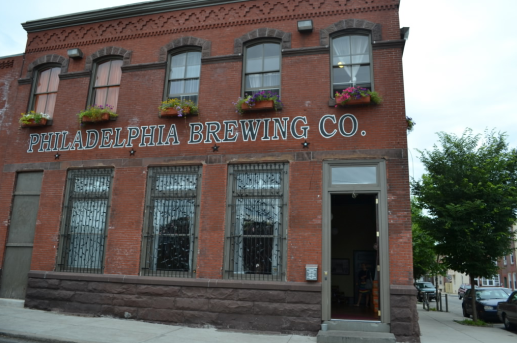
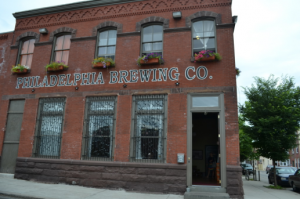 Philadelphia Brewing Company - Photo Credit Jordan Wright At the Philadelphia Brewing Company, housed in the 19th C former Weisbrod & Hess Brewery company, enjoy a tour and taste of their Philly-named beers, like Walt Wit, an unfiltered Belgian White-style ale; Harvest from the Hood; and Kensinger, a smooth golden ale. Named one of the nation’s top five sustainable breweries because they grow their own hops, some from an on-site courtyard garden where you’ll also spot a pedal-powered ‘spaceship’, last year’s entry in the Kinetic Sculpture Derby at the annual East Kensington Arts Fest parade. 2423-2439 Amber St.
STROKING YOUR ECO
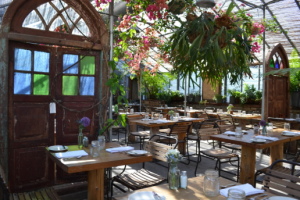 Terrain at Styer’s cafe - Photo Credit Jordan Wright
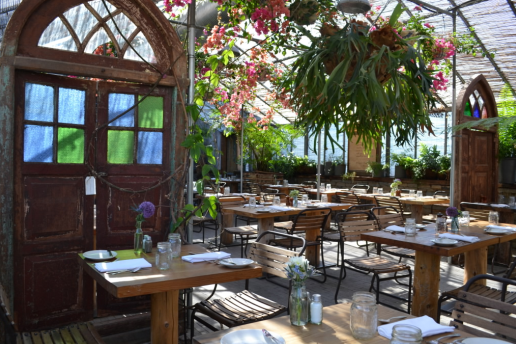
A few miles out of town in Glen Mills, the high end emporium Terrain at Styer’s is a must visit. The stunning store and garden center, brimming with natural spa products, garden furnishings and hand-carved kitchenware, also houses an adorable café. Dine on local seasonal delights such as Kennett Square mushroom skillet with fried egg, or cold minty pea soup in a rustic greenhouse dripping with baskets of fuschia and stag horn ferns. 914 Baltimore Pike; www.styers.shopterrain.com
GETTING THERE
Via Amtrak from Union Station to the Philadelphia’s 30th Street Station is less than 2 hours and around $50.00 each way. By car it’s a straight shot on I-95 to the Center City exit.
Jordan Wright
August 2011
Special to Washingtonian Magazine
Solomons Island – A waterside village with hidden treasures.
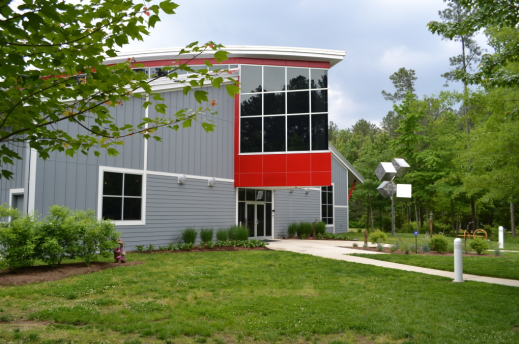
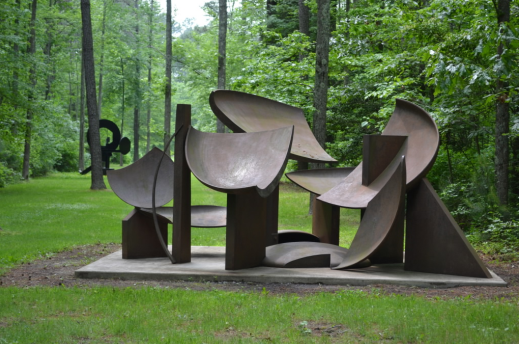
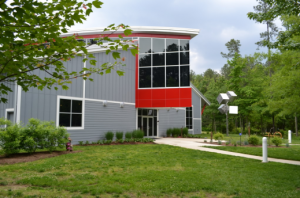 Annmarie Sculpture Garden and Arts Center - Photo Credit Jordan Wright 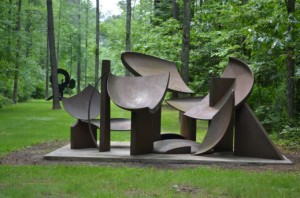 Bronze sculpture at Annmarie Sculpture Garden & Arts Center - Photo Credit Jordan Wright The Scene
Where the Patuxent River meets the Chesapeake Bay sits the village of Solomons Island. The former shipbuilding community has a boardwalk and piers for strolling, antiques shops and art galleries, and bars and restaurants for every taste and a boutique winery to seal the deal.
What to See and Do
Butterflies flit merrily through the border gardens where art and nature coexist at the Annmarie Sculpture Garden & Arts Center. Wend your way along sun-dappled paths to see dramatic bronze and steel sculptures – courtesy of a
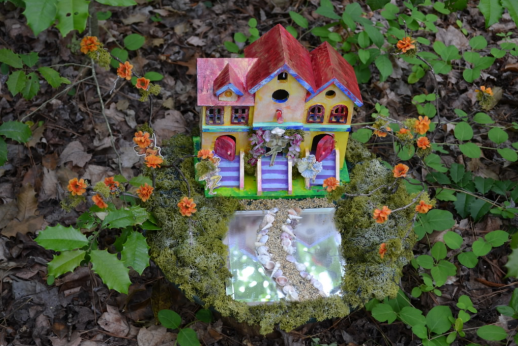
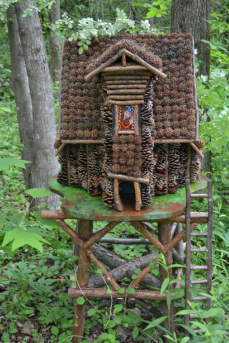
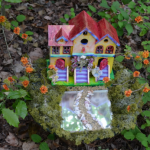 Fairy house 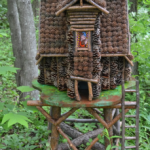 Gnome house partnership with the Smithsonian – displayed throughout the park’s lush 30 acres. A current exhibit, “Fairies in the Garden”, features artists’ fantasies of fairy and gnome houses nestled sweetly in the mossy hollows of trees. Inside the center there’s a small café and works by local artists.
For a day on the water, Bunky’s Charter Boats rents Carolina skiffs and offers fishing excursions; Sail Solomons has 22-foot Catalina capris. Or go to the Patuxent Adventure Center for kayak, canoe and Stand Up Paddleboard rentals.
Where to Eat
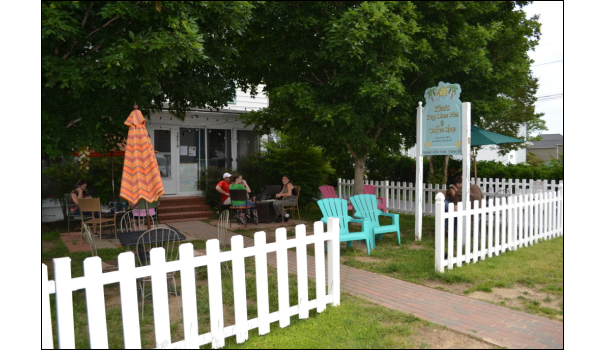
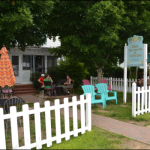 Kim's Key Lime Pies - Photo Credit Jordan Wright Kim’s Key Lime Pie has creative cuisine and sublime pies in a café-like ambience. Across the road Stoney’s Seafood House, famous for its fresh fish and crab cakes, sits on Solomons Pier with beautiful views of the river.
Speed Dial
Annmarie Sculpture Garden & Arts Center, 13480 Dowell Road, Dowell, MD; 410-326-4640. Pet friendly and fully accessible. www.annmariegarden.org.
Bunky’s Charter Boats, 14448 Solomons Island Rd. S.; 410-326-3241 www.bunkyscharterboats.com. Sail Solomons Sailing School and Yacht Charters, 225 Alexander La.; 410-326-4917. www.sailsi.com Patuxent Adventure Center, 13860-C Solomons Island Rd.; 410-394-2770. www.paxadventure.com.
Kim’s Key Lime Pie, 14618 Solomons Island Road S., Solomons Island, MD, 410-326-8469. Stoney’s Seafood House, 1442 Solomons Island Road S., Solomons Island, MD, 410-326-2424
Jordan Wright
August 2011
Special to Washingtonian Magazine
River Riders
408 Alstadts Hill Rd., Harpers Ferry, WVA; 800-326-7238; www.riverriders.com
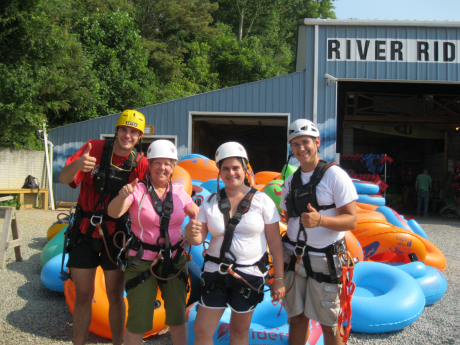
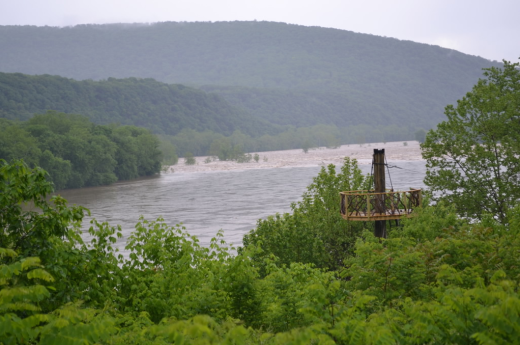 Zipline tower at River Riders, Harpers Ferry - Photo Credit Jordan Wright Harpers Ferry offers lots of outdoor family fun, from hiking to tubing to whitewater rafting. And now, just outside of town, the outfitter River Riders has unveiled its latest adventure: a spectacular zipline canopy tour along the Potomac River.
For three hours, you can fly through the forest and navigate jungle-style suspension bridges alongside breathtaking vistas of river and cliffs. Two guides accompany amateur aerialists to seven giant tower platforms. Try to spot the nest of the resident red-tailed hawk as you soar up to 70 feet. The gravity-defying tour ends in an exhilarating finale as you rappel down to solid ground. If you’ve got more time and energy, River Riders can also set you up on the water: Ply the flatwater in a canoe or kayak, drift in a giant tube, or take on the Class III rapids on a whitewater trip.
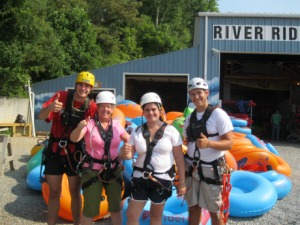 A successful day! Bucket list just got shorter! Hungry? The on-site Front Porch Café, which serves burgers, hot dogs, and other snacks, is your best bet. If you explore Harpers Ferry’s historic district, slide into Scoops Ice Cream Café (173 Potomac St.; 304-535-6654) and get your chill fix with 16 flavors of house-made ice cream.
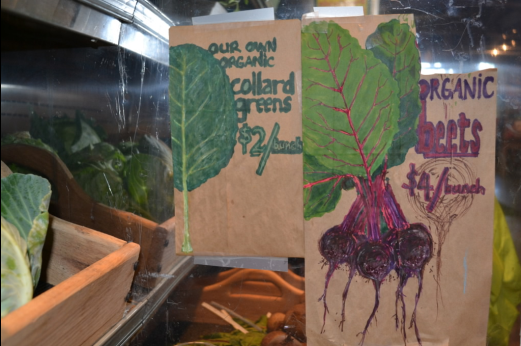
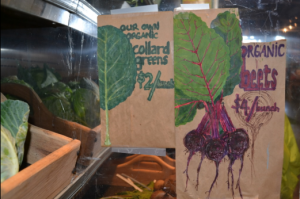 Farm products at Stoneybrook Farm Market - Photo Credit Jordan Wright On the drive to Harpers Ferry or on the way back, you can stop in the tiny town of Hillsboro at Stoneybrook Organic Farm and Market (37091Charlestown Pike; 540-668-9067; www.stoneybrookfarm.org; closed Saturdays), which carries delicious sandwiches and salads, organic produce, artisanal cheeses, and other regional farm products. Get food to go or enjoy lunch on the flagstone patio overlooking the vegetable and flower gardens.
|