Jordan Wright
April 11, 2013
Special to Washington Life
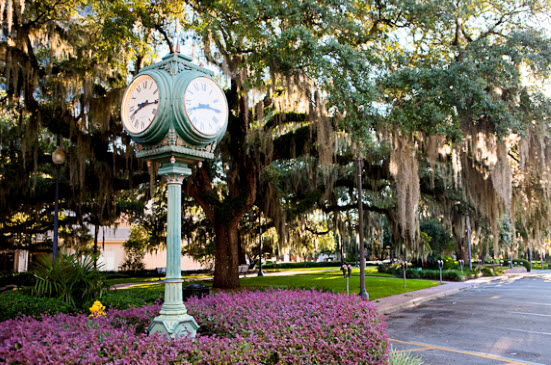 Tally’s Historic District – Park Avenue As Florida celebrates its 500th anniversary of Ponce de Leon’s arrival, visitors to the state should put Tallahassee high on the list of sites to visit. Better known for lobbyists and legislators, Gators and Seminoles, the state capitol is a fascinating historical and recreational locale with as many diversions as a visitor has time to enjoy. “Tally”, as the residents fondly call it, is a surprisingly hip city with restaurants and cafés highlighting both Old and New Southern cuisine.
Along the Native American Heritage Trail archaeology seekers can explore the Lake Jackson Mounds Archaeological State Park with its six earthen temple mounds and imagine the ancient Native culture of the Apalachee Indians, or take in 12,000 year-old paleolithic artifacts in the city’s spectacular history museum. History buffs can trace Hernando de Soto’s Trail of 1539 and his winter encampment in Tallahassee and follow the paths of the early Spanish explorers that traded with the coastal city of St. Augustine.
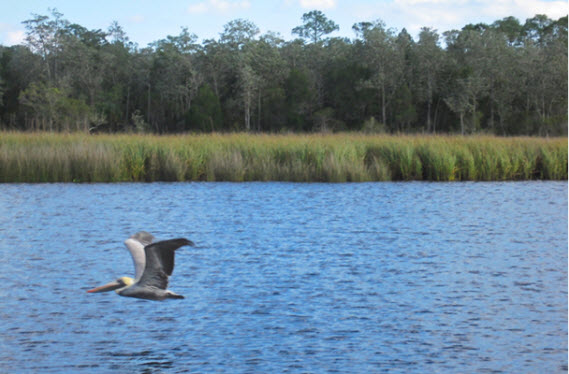 A pelican skims the surface of the St. Marks River – photo credit Jordan Wright Birders can delight in over 372 species of birds that reside in or migrate through this region on one of the country’s major flyways, while eco-tourists can tour thousands of acres of protected wetlands and forests to wonder at the fascinating flora and fauna of the area’s waterways.
First impressions have a way of coloring the traveler’s experience, and Tallahassee gets off on the right foot. To get a sense of how old Florida’s state capitol is, begin in the city’s Park Avenue Historic District with a stroll beneath live oak trees dripping with Spanish moss past Tallahassee’s 19th C architectural gems. If you’re there on a Saturday the “Downtown Marketplace” vibrates with live entertainment, a farmers market, music, arts and crafts, and storytelling for kids. You’ll be on the expansive boulevard known as “Chain of Parks”. From there, go two blocks south to East Park Avenue and tour the William V. Knott House. Built in 1843 and since restored to its 1930’s splendor, this elegant home is where Union troops read the Emancipation Proclamation and where Mrs. Knott wrote quirky poetry that she attached to her furniture.
On South Monroe Street you’ll come up on the Florida Historic Capitol Museum with its magnificent stained-glass dome. A beautifully preserved structure built in 1902 it tells the story of the state’s fascinating political history. Of particular interest is the current “Navigating New Worlds” exhibit featuring the Michael W. and Dr. Linda M. Fisher collection of Old World maps of Florida dating from 1493, one year after Columbus’ arrival on American shores.
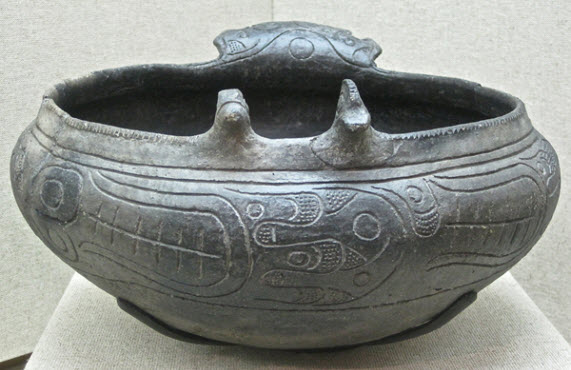 Effigy vessel A.D. 1350-1500 found on Fort Walton Beach on display at the Museum of Florida History – photo credit Jordan Wright On South Bronough Street lies the Museum of Florida History housing exhibits ranging from the prehistoric era to the mid-20th century. With 27,000 square feet of gallery space devoted to over 45,000 artifacts, this remarkable museum is a veritable treasure trove with hands-on exhibits highlighting Spanish exploration and Florida’s indigenous tribes. Be sure to check out the pirates’ booty of diver-discovered jewelry and gold doubloons retrieved form shipwrecks off the coast. Native artifacts and prehistoric skeletal remains are wonderfully displayed and include a full-size mastodon recently discovered in nearby Wakulla Springs. The museum also showcases Floridian curiosities like early antique cars, World War II memorabilia, a collection of early Lily Pulitzer dresses, orange crate labels and unique inventions.
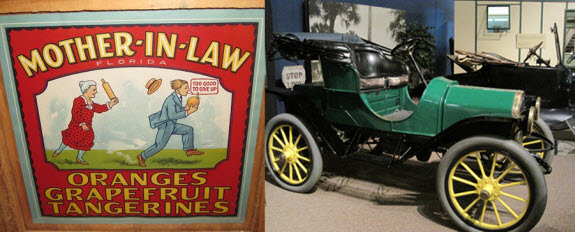 Early orange crate label and 1910 Electric Car at the Museum of Florida History – photo credit Jordan Wright Art lovers can tour the 6,000 square foot permanent exhibit named “Forever Changed: La Florida” highlighting Florida as a colony of both Spain and Great Britain. Current shows include “Reflections: Paintings of Florida from 1865-1965” an impressive 85-piece collection of fine art with Florida subject matter including works by Martin Johnson Heade, N. C. Wyeth and Hudson River School artist, Herman Herzog. The show runs until May 6th.
If you remember the landscape paintings of Old Florida sold by the side of the road between the mid 1950’s to the 1980’s, you’ll appreciate Cici and Hyatt Brown’s collection of the “Florida Highwaymen” paintings that showcases works by 23 of the original 26 artists. Many credit A. E. Backus who taught other young African American students how to paint. For a schedule of lectures, re-enactors and musical performances at the museum go to
Head north and east to South Duval Street and Kleman Plaza, where the Challenger Learning Center boasts a 3-D IMAX theater, a space mission simulator and a 50-foot high Digital Dome Theatre and Planetarium that is out of this world.
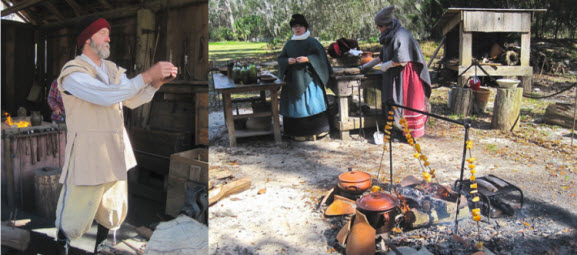 The blacksmith at his forge and pumpkin cooking at the Mission San Luis – photo credit Jordan Wright Three miles from downtown Tallahassee is the Mission San Luis, the westernmost of forty-one missions built by the Franciscan monks in the 17th century. The sprawling 65-acre property consists of the only reconstructed mission of its kind in Florida. There are many buildings to explore and costumed docents to guide you through the living quarters and demonstrate cooking, sewing, blacksmithing and archery typical of early life in the mission. The massive church with its huge oil paintings, a 60-foot high Apalachee council house woven of over 100,000 Sabal palm fronds and numerous outbuildings reveal daily life for its inhabitants. At the blockhouse and stockade, cannons dot the palisade as militia masters demonstrate the art of loading and firing a musket.
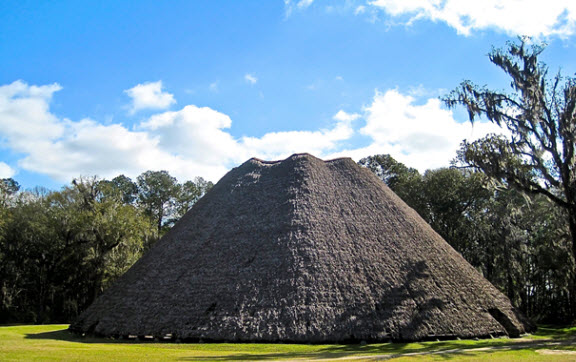 The reconstructed Apalachee Council House at Mission San Luis – photo credit Jordan Wright In 2009 a large Spanish Colonial style visitor center was completed housing an archaeological research center, art gallery, theater, classrooms, gift shop and banquet hall. Groups can call in advance for a catered lunch of authentic paella, from Valencian chef Juan Ten.
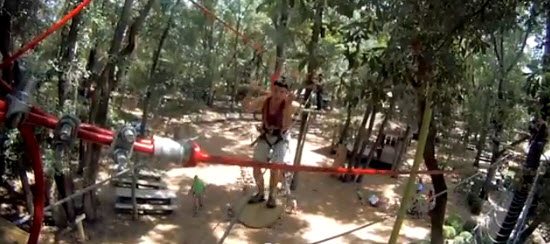 Tree to Tree Adventures Zipline at Tallahassee Museum Minutes from downtown is the Tallahassee Museum – a living museum nestled between Lake Bradford and Lake Hiawatha. From elevated boardwalks it’s easy to spot panthers, bobcats, alligators, black bear and other indigenous Florida wildlife in their natural habitats. Or soar over bald Cyprus swamps on the super cool “Tree to Tree Adventures”. With over 19 zip lines and 70 obstacles, you can view the museum’s 52 acres from the treetops. Back on terra firma join a fossil dig or nature program, or just walk the shaded grounds to see a 1930’s African American church, Jim Gary’s brightly painted metal dinosaur art, Bellevue, the plantation home of George Washington’s great grandniece, a 19th century farm, an 1890’s schoolhouse and the old Shephard’s Mill. You’ll think you stepped into the Florida of days gone by.
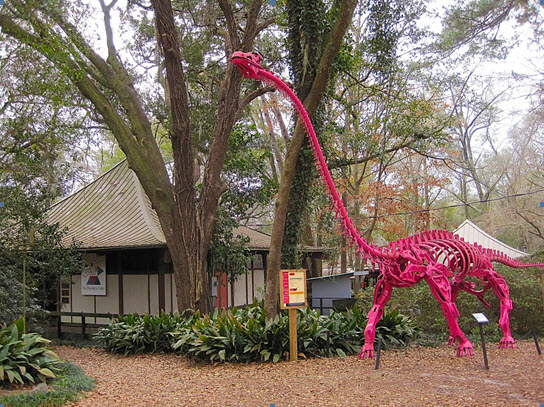 Jim Gary’s metal dinosaurs roam the Tallahassee Museum and Gardens – photo credit Jordan Wright Along the Miccosukee Road is the Goodwood Museum and Gardens. A splendid antebellum house reminiscent of Old Florida, it’s filled to the brim with a vast collection of antiques. The property, which once consisted of 2,400 acres, was a former cotton and corn plantation and the home was built in the 1830’s. Its current twenty acres have eleven historic outbuildings and a reconstructed carriage house that is a favorite spot for weddings, conferences and banquets. The beautifully restored gardens feature vibrant camellias, fragrant magnolias, highly scented freesias and row upon row of roses that peak in April. If you are a rose fancier you’ll be wowed at the 150 varieties on the grounds.
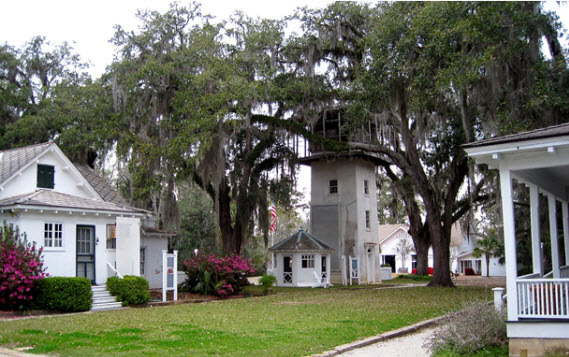 The grounds at Goodwood Museum & Gardens in Tallahassee – photo credit Jordan Wright A handful of historic homes and smaller museums are just as intriguing. Tallahassee Antique Car Museum, Mildred and Claude Pepper Library & Museum, Beadel House at Tall Timbers, John G. Riley Museum of African American History & Culture, Maclay Gardens and State Park, and The Kirk Collection.
STAY
The Sheraton Four Points Downtown is conveniently located in the heart of Tally.
The Hotel Duval is an upscale boutique hotel with a modern, hip dynamic. Visit the rooftop restaurant and Level 8 Lounge for a fabulous sunset view of the city and craftmade cocktails.
DINE
There are a myriad of options for dining in this hip, vibrant city where chefs have caught on to the locavore movement in a big way.
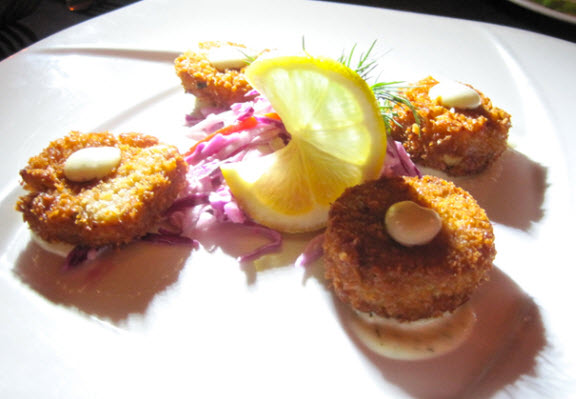 Mini crab cakes at Avenue Eat & Drink – photo credit Jordan Wright Avenue Eat & Drink
Upscale wining and dining in a casual setting. Check the blackboard for specials and let the sommelier pair your meal from their extensive wine cellar. Expect organic meats and local produce from Executive Chef Greg Brown.
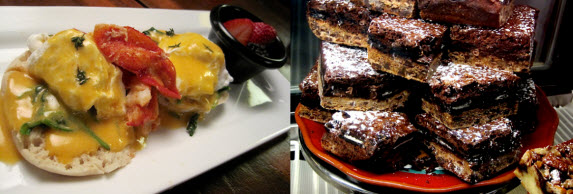 Lobster Benedict and a plate of the “Slutty Brownies” at the Paisley Cafe – photo credit Jordan Wright Paisley Café
This adorable spot in a clapboard house has the best sandwiches and baked goods in Tally. Try their chef-driven brunches on Saturdays and Sundays with Aunt Ruby’s hoe cakes, real Southern biscuits, lobster benedict and housemade berry tea. Take home a bottle of Tupelo honey and a “Slutty Brownie” from the bakery case.
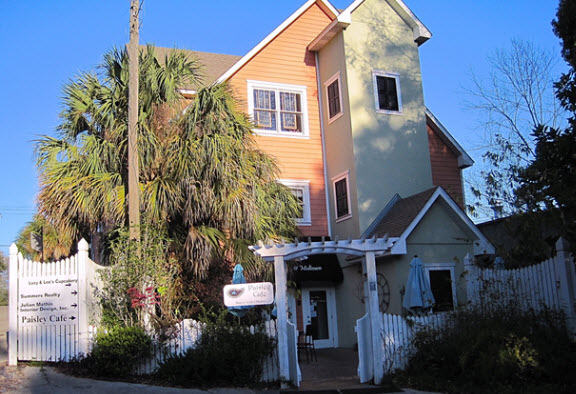 The Paisley Cafe in Tallahassee – photo credit Jordan Wright Cypress
Sophisticated Southern dining with exquisite gourmet dishes and cocktails alongside works from local artists. Order a platter of artisan-made cheeses including Sweet Grass Dairy’s “Green Hill” made in nearby Thomasville, GA. Try a “Gallagher” cocktail made with cane rum, pineapple, ginger and a combination of cherry and apple liqueurs.
Shula’s 347 Grill
Aged Black Angus steaks and double-cut chops get top billing at the Hotel Duval.
Sweet Pea Café
Delicious vegan and vegetarian lunch and dinner till 8pm in a cute tin-roofed barn-red restaurant.
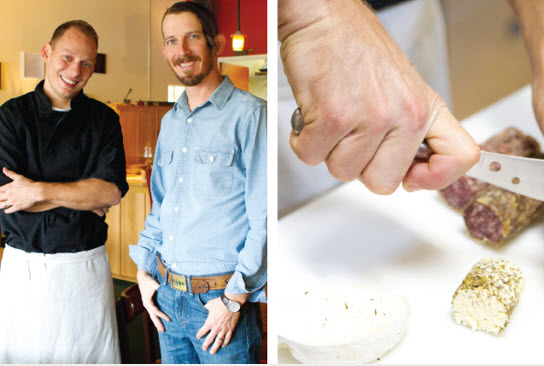 Chef Matt Hagel and Owner Ruben Fields Miccosukee Root Cellar Focuses on Local Flavors –
Photo by Scott Holstein Miccosukee Root Cellar
Farm-to-table dishes from Executive Chef Matt Hagel who sources organic products from over a dozen local farms. Housemade breads, ice creams and desserts plus a collection of craft beers including Big Nose IPA from Swamp Head Brewery of Gainesville, FL. Live music on the weekends.
ST. MARKS AND WAKULLA COUNTY
A side trip to Wakulla County, a 30-minute drive from central Tallahassee to the Gulf, should be on everyone’s itinerary. For nature lovers this area of beaches, marshes and pristine estuaries at the east end of the “Forgotten Coast” is unparalleled. Guided tours of the waterways by kayak or canoe are easily arranged, as are scuba and snorkeling adventures in the blue green waters to explore Wakulla Springs, the deepest and longest known submerged freshwater cave system in the world. Birders take note: It’s a flyover site for the endangered whooping crane.
Of particular interest to historians is the San Marcos de Apalachee Historic State Park situated at the end of the Tallahassee/St. Marks Historic Railroad Trail, an abandoned former rail line to the coast where walkers, equestrians and cyclists enjoy the 19-mile flat-as-a-board pathway. The park sits strategically along the St. Marks and Wakulla Rivers and contains the ruins of a Spanish fort first built of wood in 1679 and fifty years later reconstructed of stone. Civil War buffs will know the presidio as a military post and cemetery for Andrew Jackson’s troops in 1818.
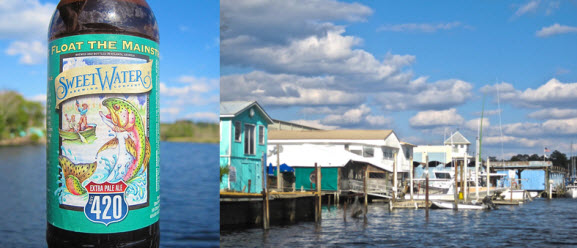 Beer boating along the St. Marks River at the Port – photo credit Jordan Wright At the end of the road is the quaint town of St. Marks, a small port noted for its historic lighthouse and crab processing plants. It is here that you can catch a ride on a peaceful solar-powered boat along the St. Marks River escorted by a Green Guide Master Naturalist. Herons of all varieties as well as manatees, bear, ibises, turtles, alligators and leaping mullet are easy to spot through the long-leaf pines and tupelo trees.
STAY
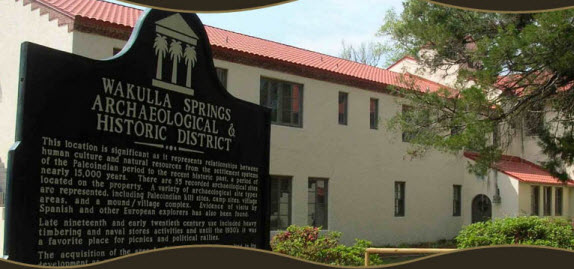 Wakulla Springs Lodge build by Edward Ball 1937 Wakulla Springs Lodge and the Wakulla Springs State Park – Docent and historian, Madeleine Hirsiger Carr has written a fascinating book chronicling the restoration of the magnificent lodge built by Edward Ball in 1937.
The Sweet Magnolia Inn – A charming bed and breakfast constructed of solid rock and coquina shells, that once knew life as a general store, a brothel and even the City Hall. Each room has its own Jacuzzi tub. Bikes are available to rent. On Sundays the inn serves casual food and a jazz band plays till early evening. Call in advance and genial owners Denise and Andy Waters will cater a delicious lunch with wine and beer or a cocktail spread of cheeses and hors d’oeuvres and deliver it to your boat for a sunset cruise. Her shrimp salad is legendary.
Shell Island Fish Camp, the oldest fishing camp in Florida. Anglers can catch speckled trout, red fish, blue fish, tarpon, cobia and more.
DINE
Boat or drive to the Riverside Café for local grouper, Gulf shrimp and mullet. Blue crabs all year and stone crabs from October through mid-May. Wash it down with a frosty 420 IPA from Georgia’s SweetWater Brewing Company.
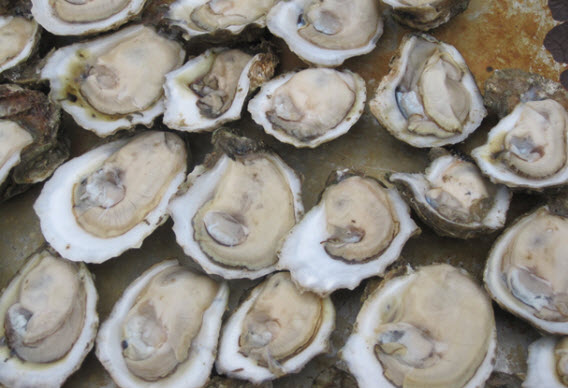 Appalachicola oysters ready for the grill – photo credit Jordan Wright Deal’s Famous Oyster House has its share of seafood too – grouper, flounder, catfish, scallops and plump Apalachicola oysters. After all that’s what we came for. There’s no alcohol served in this family style spot, but the restaurant has a specialty you won’t find anywhere else. Something the old folks call a “pogo stick” which is an old time percussion instrument on a tall stick with a cymbal on top and a drum connected to it. When waitress Zodie Horton bought the place from the Deal family she learned to play it from Mrs. Deal. Expect to hear songs like “Cotton Eyed Joe” and don’t be surprised to see locals joining in on spoons or washboard. On Port Leon Drive next to the post office or access by boat from the St. Marks River.
In nearby Crawfordville try the family-owned Spring Creek Restaurant, another old-line Florida spot where you’ll find oyster stew, crab cakes, fried quail, hushpuppies and tomato pie. Wakulla Adventures now offers a sunset cruise from there.
FESTIVALS
“Wild About Wakulla Week” is a week-long festival bracketed by two popular festivals, The Sopchoppy Worm Gruntin’ Festival held the second Saturday in April and the Wakulla Wildlife Festival. A two-day event held the third weekend in April.
WILDLIFE TOURS
Arrange Wakulla Adventures solar boat tours through Palmetto Expeditions who can also help with certified birding and wildlife guides, fishing and scenic cruises, historical walking tours, scuba and snorkeling gear rentals, and specialized catering.
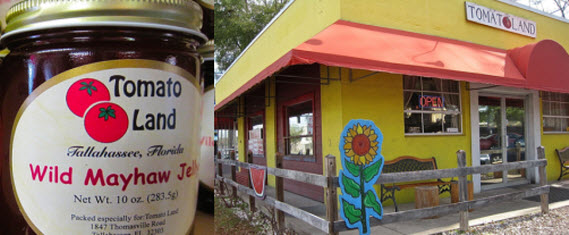 Jars of local mayhaw jelly at Tomato Land – photo credit Jordan Wright On your way back to Tally be sure to stop at Tomato Land for wild mayhaw jelly, pecans, local hot sauces and stone ground grits. The kitchen makes oyster and shrimp po’ boys and fried green tomato sandwiches. Fish Fry Fridays platters come with cheese grits, coleslaw and hushpuppies. A small farmers market with locally grown produce is next to the parking lot.
 Derrick Suwaima Davis (Ken Ross Photography)
As a child growing up in his native Arizona Derrick Suwaima Davis, Hopi/Choctaw, was fairly certain how he fit into life on the reservation. “I got my first dance clothes when I was three. I was always around native songs and dances, but that’s when I considered my life as a dancer official.” For Davis, who was the Head Man Dancer at the grand opening of the National Museum of the American Indian in Washington, D.C. in 2004, dancing was both his destiny and means of escape – a place of imagination where he could use its intricate forms as a means of self-expression. His first hoop dancing championship was in 1992, his most recent in 2010, and he has earned the title of World Champion Hoop Dancer five times. As a member of the pop/rock group Clan/destine he has worked with the Heard Museum, the Phoenix Symphony, the American Dance Theater, Canyon Records and Willie Nelson continuing to share his Hopi culture with thousands of admirers around the world. Davis has been featured on the covers of leading publications like Smithsonian and Native Peoples and was once named Cosmopolitan’s “Man of the Year”.
As one of Arizona’s cultural treasures Davis has been Artistic Director of Native Trails, an intertribal collaborative presented by the Fort McDowell Yavapai Nation and produced by the Scottsdale Center for the Performing Arts in Scottsdale, Arizona. Nine performers including Davis represent the best of the Southwest region, in a twice-weekly free show at the amphitheater at the Scottsdale Civic Center Park where the hour-long performances showcase song and dance using traditional instruments, regalia and stories. Unique indigenous cuisine, like cactus chili, blue corn mush and mesquite muffins, are sold there alongside the more familiar fry bread. Look for the 2013 season to start up again on January 17 and run through April 6 on Thursdays and Saturdays at noon. Visit www.scottsdalenativetrails.com for more information. You can also see Davis perform daily at the Hyatt Regency Scottsdale where for over twenty years he has been part of a three-person 5 p.m. show.
In a recent interview he told ICTMN of his early life with its traditional influences and why he feels the need to share his culture with the world.
What was your childhood like?
My father worked for the Bureau of Indian Affairs and took us a lot of places. I spent part of my life on the Navajo reservation and summers with my grandparents on the Hopi reservation that is surrounded by the Navajo reservation.
When did you first become interested in dancing?
I never thought I would end up in my adulthood being a performer. I just grew up singing and dancing as part of our culture capturing history and expressing gratitude and encouraging good life. It wasn’t until I moved down to the Phoenix Valley and was asked to be part of a Native American dance troupe where we performed at resorts and cultural festivals. I saw how it would be a way to educate people about Native culture.
Who was your greatest influence?
My grandfather as far as information and experiences and putting it all into song and dance. He was well known in Hopi.
How did you develop your own style?
I first saw the dance when I was around the intertribal gatherings in New Mexico. I was already a champion fancy dancer. As a young boy my father made us hoops. I didn’t really understand the significance but it was something I was drawn to. We began to imitate the dance. I continued fancy dancing but later got involved with the Hopi cultural dances. There are a lot of parallels with those two art forms. When I moved to Phoenix I joined the Eagle Spirit Dance Group. I was asked if I would also do intertribal eagle dancing along with hoop dancing and the horsetail dance. I got into it at the Heard Museum where they had the World Championship Hoop Dancing contests. That’s where all us hoop dancers inspired one another.
As I was coming along I really began to understand the story. The origin of the dance goes back to the Healing Dance where the shaman or the patient would pass through the hoop and whatever ailment was disturbing the patient would be dismissed. And although this dance is done in a public and competitive format, it still conveys that message of healing and restoring balance and the Hopi culture and how we talk about First, Second, Third and how we are now in a Fourth World.
At the end of the dance I set down a four-hoop globe. Each time I pick up one of those hoops it acknowledges times of adversity and prosperity, and how through time it’s the plants, the animals and the insects that have taught human beings how to utilize the resources around us. And so, as we are stewards and guardians, it’s through our songs and our dances we ask and encourage everything to be healthy. Because if the environment is healthy, then we are going to be healthy. Through our art forms and with our good intentions we encourage wellbeing. The hoop dance encompasses a large amount of teaching.
Did you learn a specific pattern of dance steps and later interpret it for yourself?
The dance steps and the rhythm are based more on the intertribal pow wow style of music. I used that style of song and dance for most of my hoop dance career. That goes back to the fancy dance style of footwork. The showmanship and athleticism I learned from fancy dance I brought into hoop dancing. There is some crossover. The reason for dancing with five hoops is because in the Southwest we don’t get much rain. In many ways we must do the best we can with the least amount possible so you’re not overharvesting or being selfish with the natural resources. Instead we let the plant community and the animal and insect community be strong and grow in numbers. That’s where a lot of the story in my dancing comes from.
At a young age I was introduced to ‘dry farming’ that we still do at Hopi. In the Southwest we have been in a drought. When I remember the days when I was young and rainfall was plentiful, it’s easy to understand the importance of nature and to encourage everything to be healthy. In the dance, although there may be mechanics involved, there is also the inspiration of what the dance continues to represent. It is filled with its own type of prayer and desire and expressing gratitude. So when I make the various patterns I know how important it is for the insects, like when I make the butterfly, or similarly if I make a hummingbird, or eagle or buffalo. I have learned not only from Hopi, but also from schooling, how important these creatures are and how everything fits into the circle of life, the web of life, which is what the hoop represents.
Do you integrate different forms in your performances? Are there strict guidelines for a contest?
Each one of us hoop dancers has our own story that we like to share. I am one of maybe two dancers who use only five hoops. Everyone else dances with from ten to maybe sixty hoops. It’s not how many hoops you use. Any art evokes some kind of emotion whether it’s a painting, a sculpture, or singing and dancing. They all evoke some kind of emotion. The music and the movement combined make people feel really wonderful. Any talented or gifted artist realizes that we really are just an intermediary between something higher than we are, and as performers we are just a vehicle to share our blessings with those in the audience.
Do you have different feelings when you dance?
Yes. I think that the objective of sharing the dance is always the same, but certainly what we have most recently experienced in our lives shapes how the dance is shared. I always feel that I’ve done the same dance, but people who see it will say that I’ve done something different in it. And of course after a six-minute dance there’s no way I can remember everything I did! I may notice simply that the floor was smoother or uneven or the song was faster or slower. So each performance is unique and influenced by the audience.
Have have you performed outside of the U.S. and what has it meant to you?
Yes, and that’s what I’ve really enjoyed. I’ve been to half of Africa, Singapore, Malaysia, Japan, Denmark, Germany and Spain and up to Alaska and Hawaii, and Canada. I’ve brought our Native Southwestern culture around the world and they have shared their songs and stories with me. It has helped me understand how much alike we are as human beings and the geography and history that have shaped our cultures. There are both similarities and also a uniqueness to the different cultures.
What else are you passionate about?
I was honored to record a PSA for the Arizona Department of Health Services on Diabetes Prevention. It’s an issue that means a lot to me.
Do you have a favorite drum and singer to perform with?
Through the years I’ve worked with various singers. I work with three different singers for the two-man performances. Most are based on the intertribal rhythm and they incorporate the Hopi language as well as our rhythms. It makes it very unique from other hoop dancers.
How would you advise a young person just getting started?
It’s important for young people to really listen to who they are. What I mean by that is we all have a gift, a purpose here in life. As a young boy I experienced contradiction and ideas of wanting to live a healthy life. I want all children to hang on to their innocence, their dignity, and make healthy decisions. Hopefully their songs and dances will be an art that encourages wellbeing. Don’t worry about being unique. Just be yourself. As a father I don’t expect my boys to grow up to be like me. They have a gift and a purpose. So if I live my life with good intentions and I stay true to who I am, then I think that’s a good role model for my boys to stay true to who they are.
Even though I can’t put everything into words our cultural singing and dancing was a way to express myself in this art form. It allowed me to be who I am. I’m fortunate to speak politely and honestly and when I do share my culture I never say that I’m right, but that the power of choice is up to everybody. Hopefully what I do share is an inspiration to people to be who they are and accomplish their goals.
Derrick can be reach through www.TheCharlesAgency.com
Jordan Wright
November 27, 2012
Special to DC Metro Theater Arts, Broadway Stars, and localKicks
Thanks to Visit Rappahannock County Virginia – Office of Tourism
‘Grey Thursday’. Who dreamt this one up? It’s so not right, on so many levels, and affords us little time to catch up with family, trim the tree together or settle in for a bit of football. Turkey sandwiches anyone? ‘Black Friday’ – a miserably stressful experience at best. Enough said. Now we have “Cyber Monday’ and we are urged to buy online. Let’s just say it’s a cheerless marketing ploy devoid of Santa and his adorable elves. Is this what Christmas has become, just a way to buy gifts more efficiently? If the meaning of Christmas is checking off items online, or battling frantic buyers in a department store for the last cashmere sweater, then surely the spirit of the holidays will pass us by. So count me out. I want the old-fashioned Christmas back – that glorious time of year when we greet our neighbors and find a store where we can meet the owner or the talk to the artist. So bundle up and sally forth with good cheer into the chill air. Have a mug of hot spiced cider, or something a bit more fortified. Tis the best season of the year!
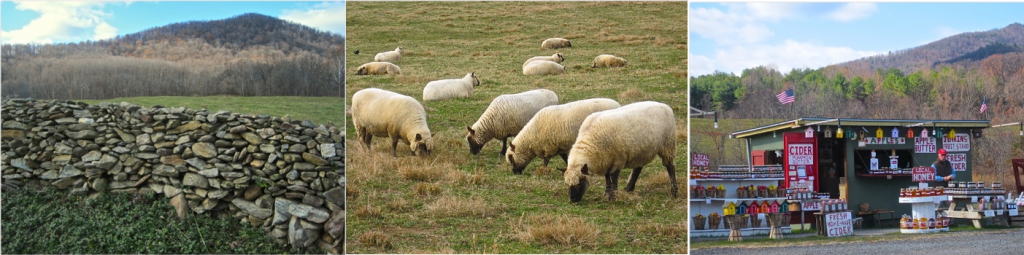 Rappahannock Pasture – Cluneford Sheep – Roadside Cider Shop – Photo credit Jordan Wright I like to inch up on Christmas slowly, smell chestnuts roasting, bake cookies, make tiny marzipan pigs, put up fruit chutneys and fill tureens with homemade pimento cheese. As for shopping I prefer to patronize a local business. Last weekend we decided to take our list with us to Rappahannock County, Virginia and add to it an elegant country manor, a few wineries, galleries, specialty boutiques and a few sips of damn good whiskey.
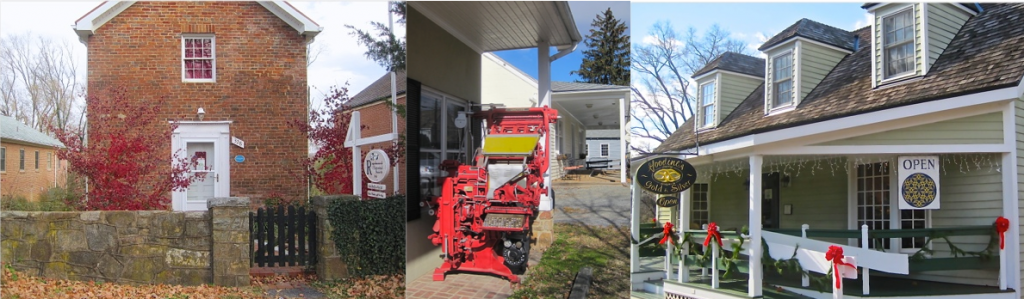 Rappahannock Historical Society – Antique Printing Press – Shops in Washington, VA – Photo Credit Jordan Wright The Friday after Thanksgiving, as department stores and parking lots were filling up with crazed shoppers, we headed west – a quick hour and a half drive from Washington, DC. Soon silhouettes of the Blue Ridge Mountains traced the horizon and we were motoring down country lanes past meadows dotted with Black Angus cattle drinking from placid ponds and on through valleys where horses grazed idly. Weathered red barns and hulking silos chockfull of fodder towered over fallow fields strewn with cylinders of winter hay. Our first stop was a mom-and-pop cider stand to pick up local sorghum and apple butter. Rappahannock County was once one of the nation’s largest apple producers and its rich history of agriculture is still thriving.
Flint Hill
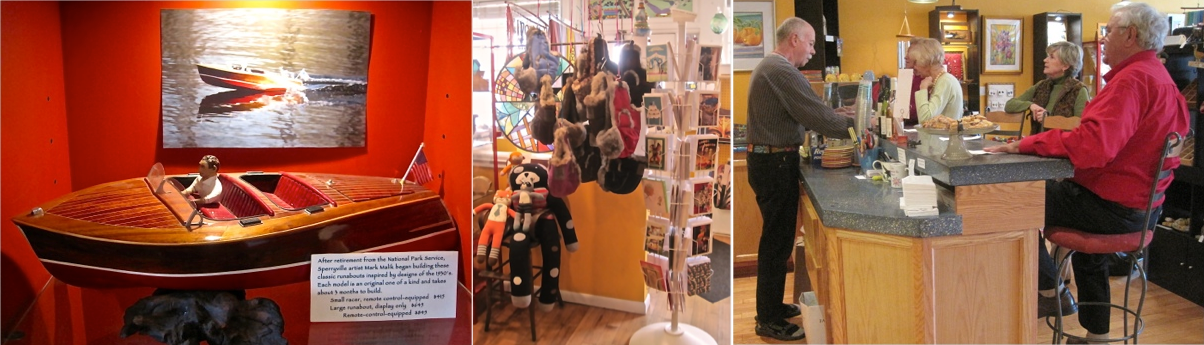
We begin in Flint Hill. The tiny town’s quirky not-to-be-missed 24 Crows boasts an art gallery, gift shop and lunch spot. It’s a friendly place where neighbors linger over a glass of wine and where you can get your hands on an extendable bug zapper or choose from a selection of fine wines, gourmet goodies and hand woven socks. The turquoise and yellow clapboard house also bears an array of gifties like dainty fabric handbags, handmade jewelry and wool scarves. Brightly colored fur trapper’s hats with pull-down flaps float down from the ceiling and handcrafted sock animals await the children on your list. We loved the original greeting cards and hand carved larch wood cutting boards. For the nautically inclined on your list take note of Sperryville artist Mark Malik’s classic one-of-a-kind 1950’s runabout models reminiscent of Henry Fonda’s speedboat in On Golden Pond.
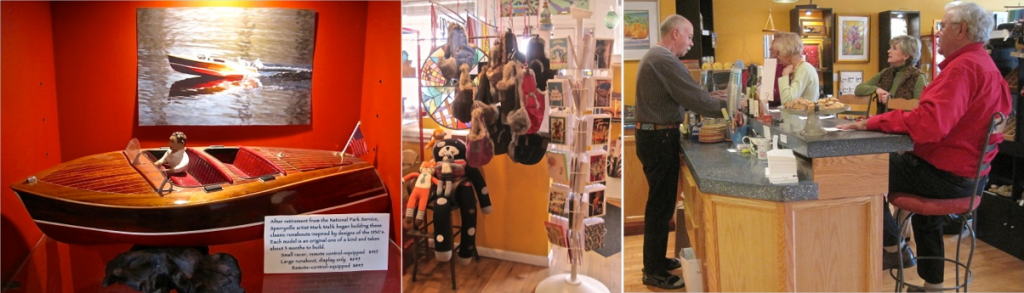 Classic Runabout Model by local artist Mark Malik – Shopping and dining at the counter at 24 Crows – Photo credit Jordan Wright Lunch changes daily according to owner/chefs Heidi and Vinnie’s caprices. From the ingredient-driven lunch menu we chose a Wagyu Beef Burger with Applewood smoked bacon and Maytag blue cheese on a challah bun, and the Curried Chicken Salad with apricots and toasted almonds on organic whole grain bread. End on a sweet note with Heidi’s Handmade Ice Cream. The challenge was in deciding on one of the intriguing flavors like Apricot, Drunk Pumpkin made with Meyers Rum, and Curious George Banana and Peanuts. We opted for a cone of Copper Fox Whiskey Sticky Toffee Ice Cream and didn’t regret a lick of it! Shades of things to come… 24 Crows is open Wednesday through Sunday 11:30 till 2:30pm for lunch only.
Across Zachary Taylor Highway (Route 522) is the Horse N Hound for the pet lover and equestrian on your list. The rustic cottage offers everything you need for riding and rough outdoor wear. A pair of Blundstone paddock boots or a jaunty oilskin equestrian cap would satisfy the sportiest on your list – horse owner or not. For the family dog there’s natural pet food and treats or a new collar and leash engraved in a thrice.
Washington
A few miles further will put you in Washington. The Inn at Little Washington is the cornerstone of the town and has been a destination spot since 20th Century pioneer chef Patrick O’Connell turned a run-down garage in an off-the-the-grid town into a mecca for international gourmands and the landed gentry. O’Connell has since bought up much of the village, turning Pre-Revolutionary homes into bespoke shops and posh accommodations. If you’re lucky enough to secure a reservation to dine there or stay in one of their romantic suites, you will be in for an extravagant bucket list experience. Executive Chef Scott Lyons gave me a tour of the gleaming kitchens and a dinner guest-only box of mignardises nestled in a replica box of the inn.
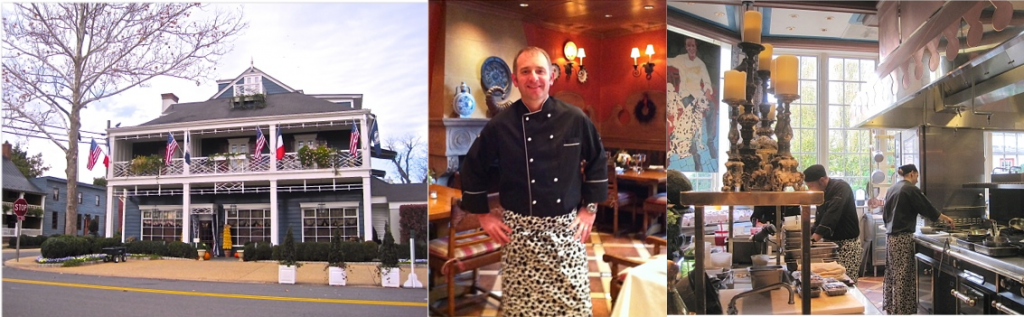 The Inn at Little Washington – Executive Chef Scott Lyons – Chefs prep for dinner service – Photo credit Jordan Wright Housed in a 1740 restored tavern are The Shops at The Inn at Little Washington. Here you can buy souvenirs of the inn including cookies, preserves, and pies sold in a handmade Shaker box or, for the cook that has everything, one of their signature Dalmatian-spotted aprons. Irresistible Susan Carson and Company handbags; soaps and perfumes from the venerable 18th Century French house of Rancé; chic home accessories; fine art or a cocktail table-worthy cookbook from a fine collection in will beckon the discerning shopper. Mystique Jewelers has a small nook with a case of designer baubles. A pair of gold fleur-de-lis earrings caught my eye, as did some pretty silk negligees from Kumi Koocoon and lingerie from Veréna.
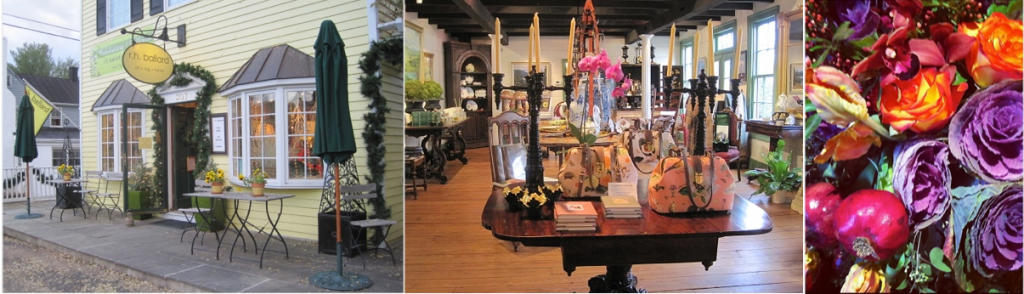 r.h. Ballard Shop – Washington shops – Floral display at the Inn – Photo credit Jordan Wright Stonyman Gourmet Farmer is a unique and beautifully restored 18th Century mercantile, one of the oldest in the Mid-Atlantic region. It boasts a series of enchanting outdoor gardens offering a relaxing respite to enjoy lunch or a plate of farmstead cheeses, pastries and fresh baked breads.
Scour Antiques at Middle Street for vintage pieces and collectibles including clocks, toys and porcelain or seek out French tablecloths, rugs and fine art at r.h. Ballard.
A Currier & Ives Christmas
This Sunday, December 2nd, the historic town will be all aglow with its annual Christmas in “Little” Washington Festival & Holiday Parade. Festivities begin 10am with an Artisans Market featuring over 30 local artists and crafters, along with specialty food and wine vendors. The Market will be at both the Washington Town Hall and the RAAC Community Theatre until 4pm.
The Washington Baptist Church on Gay Street will be the site of the “Hanging of the Greens” services at 10am. A rare Christmas stamp collection will be on display from 12:30 until 7pm.
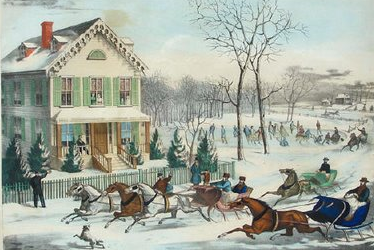
Grand Marshal “George Washington” returns to the first town he surveyed as a young man of 19. Accompanied by other famous Virginia patriots from “The Committee for the Republic,” he leads the Holiday Parade along Main and Gay Streets. The parade begins at 1:00pm and showcases antique cars, homemade floats, a cavalcade of animals and marching bands, and, of course, Santa Claus himself.
At 2pm Stonyman Town Square hosts Santa Claus, who will have a gift for each child who stops by. Also on the Square, the Gold Top County Ramblers will play and sing country and Christmas favorites and visitors can stay warm by the bonfire. Also at 2pm you can experience “living history” as the Virginia Patriots re-enact events from Valley Forge. And for the piece de resistance magician Steve Kish performs at 2:30pm at The Theatre at Little Washington. All events are free and held whatever the weather.
Huntly
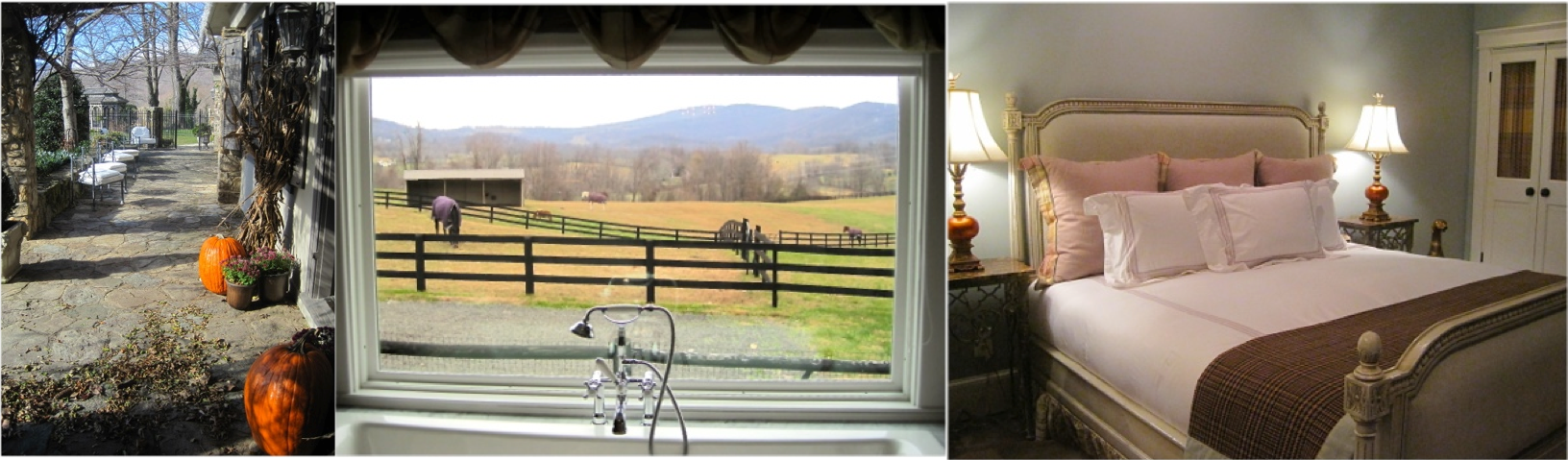
Time for check in and we drive a few short miles to Huntly. A long stacked stone wall signals the entry to Glen Gordon Manor. Don’t look for a sign. The Bed & Breakfast is so understated you won’t see one. Situated below the sight line from the road and beyond a slight rise in the terrain, its discreet profile signals a private country estate. Winter in Virginia’s Piedmont arrives earlier here than in the city and as we come down the long drive we see the neatly stacked cords of wood, covered swimming pool and blanketed horses along with the source of our breakfast, breeds of chickens chosen for the color of their eggshells, skittering around in the backyard.
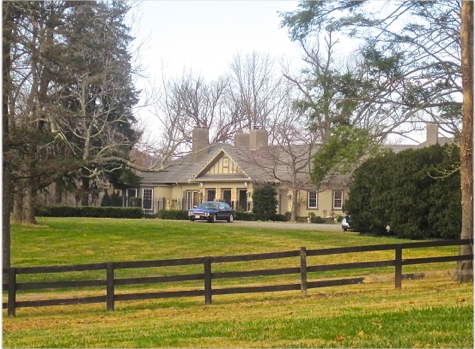 Glen Gordon Manor in Huntly, Virginia – Photo credit Jordan Wright Originally built in 1833 as a Wells Fargo stagecoach stop, the Gordon family later converted the house to a hunting lodge frequented by the Prince of Wales and his wife, Baltimorean socialite Wallis Simpson, and their tony pals. Since then the manor has been lovingly reconfigured from residence to inn without losing any of its aristocratic identity. You enter under an arbor, where we saw the twitching tail of an elusive cat named Oreo, into a large center hall. We are greeted by owner Dayn Smith with a glass of wine and an invitation to relax beside the fire in the grand Hunt Room.
Dayn Smith and his wife, Nancy, are the manor’s proprietors. Full of genuine warmth, they look like they just popped out of the pages of Town and Country. Their nephew Trent, who is equally as charming, helps with cooking, serving and seeing to guests’ needs. Dayn comes to innkeeping through his years as an award-winning executive chef and owner/entrepreneur of several high-profile restaurants in Puerto Rico – his wife from her years as a nurse tending to VIP clientele in an exclusive New York plastic surgeon’s practice. Their gracious manner is reflected in the elegant details of the manor and the sumptuous cuisine. We immediately sense we are in the lap of luxury and we curl up like kittens beside the roaring fireplace.
The inn’s rooms are tastefully adorned with good art, great books, antiques and sumptuous linens, but the piece de resistance is the food. Though open only a short time, the area is already abuzz with talk of Dayn’s refined French cuisine and his delectable sauces. On off nights they host a members-only “Supper Club” that has diners eagerly rebooking as soon as a new evening’s festivities is proposed.
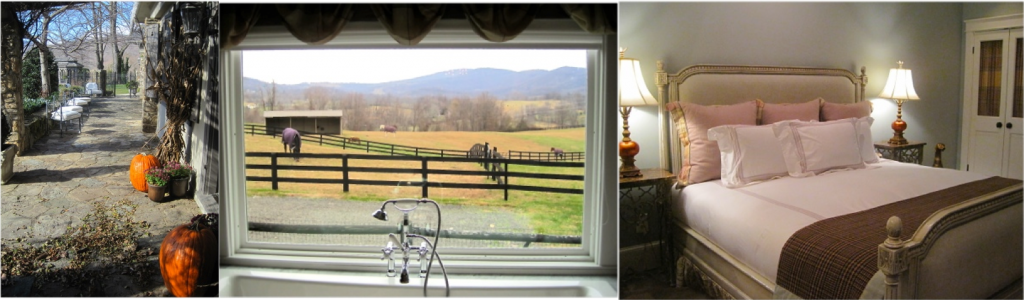 The Windsor Suite at Glencroft Cottage at Glen Gordon Manor – Photo credit Jordan Wright Our quarters are a few hundred feet down the driveway in the recently redesigned Glencroft Cottage Windsor Suite. The suite is tastefully appointed with a lavish bathroom and large tub situated beside a picture window looking out over the mountains, meadows and stables. We dress for dinner. And when we arrive at seven, the dining room is already lively.
Since the menu is chef’s choice the only decision we need to make is if we would like our five-course dinner paired with wines from the manor’s wine cellar. Dayn is partial to French wines, which suits us just fine.
We begin with a Willm Alsatian Blanc de Noir Crémant made from 100% pinot noir grapes. It is accompanied by an amuse bouche in the form of Aleppo-crusted quail with tiny potatoes fried in sumptuous duck fat. We are swooning already. The palate teaser is followed by cream of parsnip soup with chive spuma topped with crispy parsnip chips and paired with another Willm Alsatian wine – a Pinot Blanc Reserve.
A seasonally correct roasted pumpkin salad arrives constructed of local garden greens, jamón Ibérico, Manchego cheese and toasted pepitas dressed in a balsamic reduction. We continue with our fish course – steelhead trout nestled in a tangle of carrots, leeks and fennel and dotted with a dill beurre blanc and complemented by a glass of Bandol, a rosé from Mas de la Rouvière. If I were at home I would have thrown up my hands and called for my uncle, but who would turn down sheer rounds of veal cheek ravioli with truffle and wild mushroom ragout and delicate Brussel sprout leaves served with a Côtes du Rhône, Les Champauvins from Alain Jaume et Fils. And who in their right mind would resist apple gallette with caramel ice cream and caramel Anglaise and apple butter heightened by a Dow’s 10 year-old tawny port? It was an extraordinarily creative and outstandingly sublime meal, prepared with a light yet skilled hand and reflective of the superb ingredients and the chef’s mastery of sophisticated culinary techniques. We resume our contented feline positions after dinner, lingering by the fire and visiting with other equally impressed dinner guests.
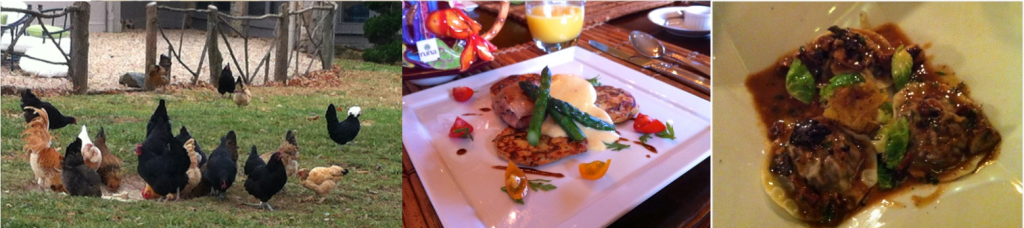 Organic Chicken Egg Layers – Four course breakfast – Five course dinner paired with wines – Photo credit Jordan Wright The following morning a four-course breakfast awaits us in the sunny dining room – fresh orange juice, seven-grain oatmeal with milk spuma, Greek yogurt with raspberries and blueberries and wild rice pancakes topped with an orange yolked poached egg, Hollandaise and asparagus. Thank you little chickens. We are tempted to linger but unfurl ourselves and embark on our mission, armed with gift lists to complete.
Glen Gordon Manor, 1482 Zachary Taylor Highway, Huntly, VA 22640. www.glengordonmanor.com
Sperryville
Though Rappahannock Cellars winery is just around the corner we drive a few miles to the town of Sperryville, which lies beside the curvaceous South Fork of the Thornton River. We head for The Shops at the Schoolhouse where we find Coterie, which is defined by a group of artisans and designers housed in a series of rooms. Look for beautiful handmade leather belts, bags, jackets, medieval-style leather corselettes and dreamy full-length naturally dyed linen dresses perfect for wearing with cowboy boots. In the garden room we find unusual new and vintage outdoor ornaments. The whimsical hand made woolen figures, owls and elves, are particularly enchanting. Pick up a few boxes of Cocoa Bella hot chocolate blend for a perfect hostess gift.
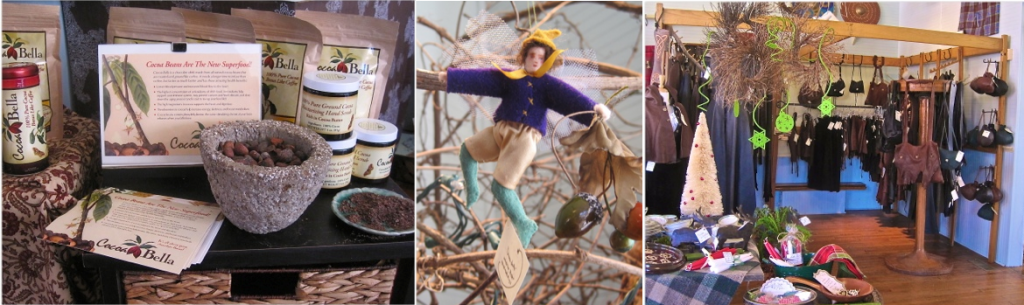 River District Art Shops in Coterie – Cocoa Bella – Monkey Business – Artisans Market – Photo credit Jordan Wright Wandering around I found a few well-priced antique paisley throws, garden artifacts and collectibles in Monkey Business and I meet Rebecca Abecassis proprietor of the Knit Wit Yarn Shop. Rebecca carries an astonishing array of fine yarns and knitting supplies along with fair trade teas, jewelry, handknit hats, gloves and scarves.
Across the way is the River District Arts, an artist collaborative laid out in a series of spaces similar to Alexandria’s Torpedo Factory. Explore the open studios to find original art, photography, pottery and crafts. In the Artisans Market two exhibition galleries showcase regional artists and one-of-a-kind Virginia crafts. You’ll come upon Café Indigo for yummy soups, sandwiches and light fare. Pumpkin cupcakes were the flavor of the day, but the choices vary daily. After the holiday parade in Washington on Sunday, December 2nd they are planning an artist reception featuring the Small Works show. Sip a glass of mulled cider and meet the artists.
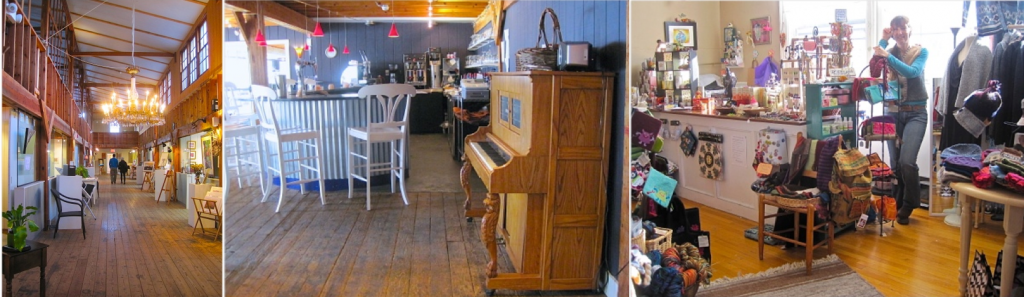 River District Arts – Cafe Indigo – Knit Wit Yarn Shop at Sperryville – Photo credit Jordan Wright In the heart of the historic village is Rudy’s Pizza side by side with Thornton River Grille and the Corner Store. Warning: Do not leave town without having pizza at Rudy’s. It is the gold standard in Italian pies and once you have had it you will be forever comparing other versions to it. Repeat: Have this pizza. You will thank me.
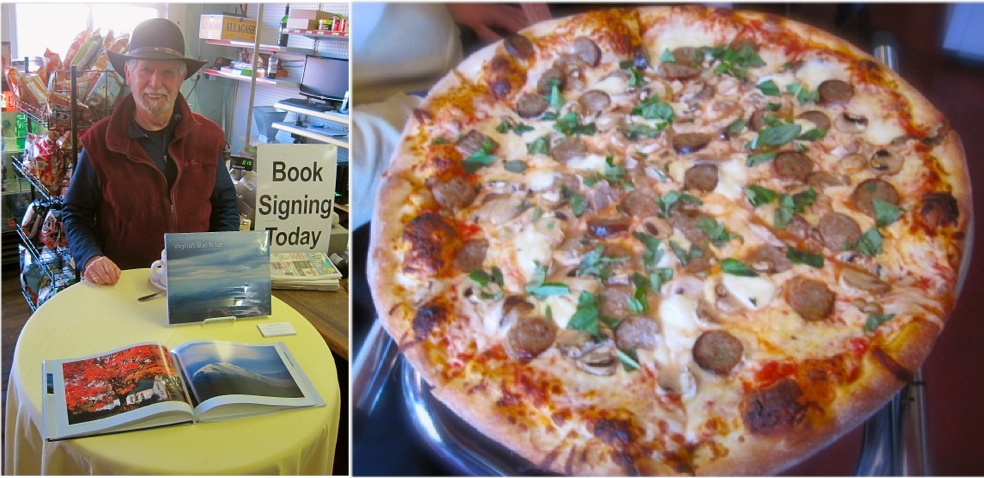 Author Ted Pellagatta signing books at the Corner Store – Rudy’s Pizza in Sperryville – Photo credit Jordan Wright We perused the aisles of the Corner Store discovering freshly made Hatfield pork sausage, Russian black bread, cheeses and local yogurt – picnic provisions for another day – when I ran into WJLA meteorologist and local resident, Bob Ryan, who had dropped by to say hello to his pal, local photographer Ted Pellegatta, at the counter signing his book – Virginia’s Blue Ridge – A Pictorial Journey.
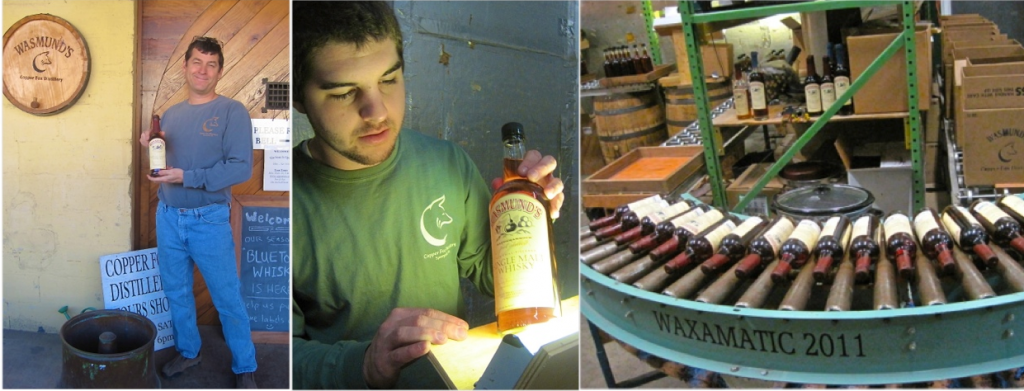 Founder Copper Fox Distillery Rick Wasmund – Bottle Labeler and Wax Cap Sealer – Photo credit Jordan Wright But we are focused on gifts today so we trot down the road a piece to the Copper Fox Distillery for a few bottles of Wasmund’s Applewood Aged Single Malt Whiskey and their Copper Fox Rye Whiskey. Rick Wasmund is an old friend who lives above the distillery with his beautiful new wife and baby daughter. He showed us around the property and proudly told us his small-batch whiskies are now being exported to England and Scotland. Now that should tell you something about the caliber of his product. If you have a few minutes take the complimentary tour where you’ll taste the both the raw and toasted barley and learn about the process of making whiskey. It’s highly informative and the fumes are intoxicating.
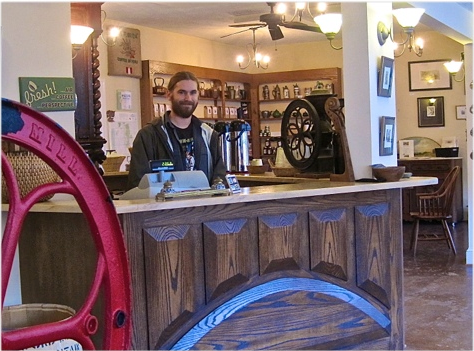 Tucker Rogers musician son of Margaret Rogers owner of Central Coffee Roasters – Photo credit Jordan Wright A mile or so further down Route 211 is the cozy Central Coffee Roasters. Margaret Rogers is the engaging and well-traveled owner who along with her musician son, Tucker, roast the coffee on site, greet visitors and hold tastings.
Amissville
As you head back to DC, drive along Route 522 (which becomes 211) and on to Amissville. There are no little shops to browse but some wonderful tasting rooms where you can pick up a few bottles of wine and wine accoutrements. Wasn’t that on your list too? Stop in at Rappahannock Cellars in Huntly, Narmada Winery and Gray Ghost Vineyards & Winery in Amissville.
Back to the city we go after a thrilling weekend in the country filled with real memories of the holiday spirit and a car laden with treasures. Move over Santa this sleigh is full!
November 2012
Jordan Wright
Special to www.dcmetrotheaterarts.com, www.broadwaystars.com, and www.localkicks.com
The Federalist – A Peaceful Retreat in the Heart of Downtown
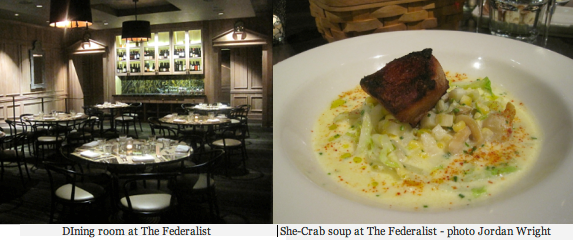
What an eclectic array of events in just the past few weeks! Here are some highlights. We cozy into a leather banquette for a quiet, civilized and very elegant dinner at The Federalist in The Madison hotel where Chef de Cuisine Harper McClure put us in the right frame of mind for our madcap road trip. Soups start us off – cauliflower bisque and an aromatic she-crab soup with nubbins of lump crabmeat. My partner went for the Shenandoah lamb loin with celery root purée while McClure kindly indulged me with a special vegetarian plate of Alsatian braised arrowhead cabbage, sautéed chanterelle mushrooms, roasted Brussels sprouts, glazed cippolini onions, Carolina Gold rice and corn drop biscuits, while I try to pack in a week’s worth of veggies.
Upscale and Downscale on the Road
In the morning we’re off to Atlantic City, New York City, and Long Island too for a quick trip down memory lane. No, we were not the advance team for Hurricane Sandy! But it has felt somewhat eerie this week as we view disaster photos from the very roads we traveled and places where we stayed, trying to keep in contact with our New York friends who have lost power. But for now we are blissfully ignorant of the devastating forces lurking a mere fortnight away.
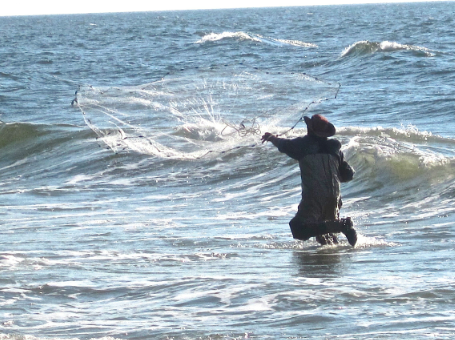 Latino fisherman casts his net into the Atlantic off the coast of Margate, NJ – Photo by Jordan Wright After a sun-drenched ride we disembarked at the glam resort Revel. Its blue glass windows shimmer forty-eight stories skyward upping the wow factor in Atlantic City. The resort has five restaurants from some of the region’s top chefs, but we were headed for Robert Wiedmaier’s Mussel Bar and Michel Richard’s Central Michel Richard both of who have their original outposts here in DC. The plan is to visit each one over the following two evenings.
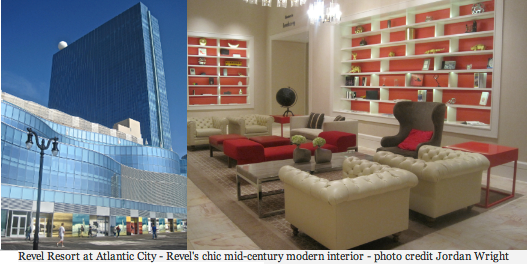
But first a few words about the hotel. It is a breathtaking $2.4 billion curvilinear building designed by Architechtonica – the über modernistic design firm whose Brickell Avenue high-rise offices were featured in “Miami Vice” , setting the tone for that show’s hipster vibe. No glitzy faux-Venetian Vegas-inspired schlock here. This luxury property was decorated in the trendy retro mid-century modern style. I expected to see the Dino and Sammy and the rest of the original rat pack from the “Oceans 11” in their slender-cut suits.
Our first night was spent at Mussel Bar, a Flemish gastro-pub where we found an edgy macho vibe, where Wiedmaier’s Harley Davidson is slung atop the room-length bar and chandeliers are cobbled together from rope and old bottles. Skull graffiti is carved in some of the tables. Skulls are very stylish this year and not on account of Halloween. Try the house private label Belgian beer, Antigoon, a crisp light ale that sports a graphic of a giant with severed hand. No cause for alarm. Brabo, the name of one of Wiedmaier’s Alexandria restos, is a much-revered hero from Belgian mythology.
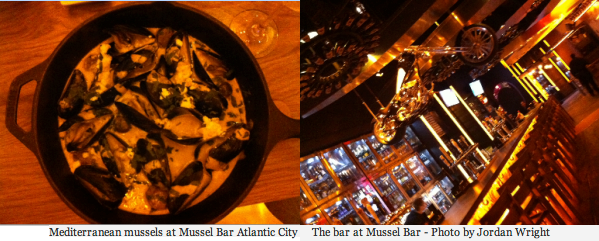
Expect braised meats and root vegetables served en casserole at this time of year; fresh local oysters, clams, lobsters and mussels, of course; as well as house-made charcuterie and addictive pommes frites. It’s Belgian meets American regional.
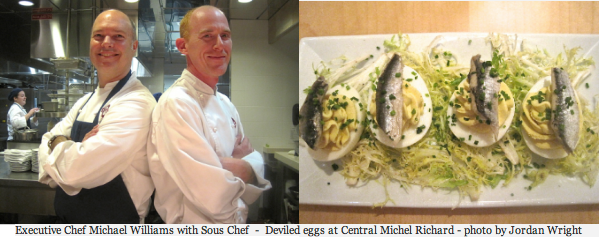
Central Michel Richard is its polar opposite. A brightly lit curvaceous blonde wood nest with an open kitchen, chef’s table and dining bar, it features casual French cuisine. Deviled eggs topped with freshly pickled sardines, a chopped salad with mustard vinaigrette, and a beef filet-derived steak tartare were more than satisfying, especially after a cone filled with Richard’s signature gougeres– melt in your mouth cheese bites perfect for snacking with a martini – or “martillery” as we fondly call them at home.
Lunch took us to White House Subs for an Italian cold cut special made with fresh Italian bread. The 65 year-old temple to naugahyde and formica is a must visit. The walls are lined with celebrity habitués from the 50’s on up – a tribute to its great subs and loyal following. We settled for half a sub each for $6 bucks a pop.
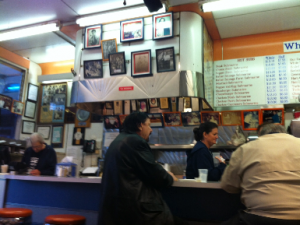 White House Sub Shop in Atlantic City – Photo by Jordan Wright On to New York City to Wall Street and the Battery. We pass the new World Trade Center construction in the pouring rain and walk along one of the rare cobblestone streets left in Manhattan. Our destination was brunch at the 250 year-old Fraunces Tavern. An inn cum history museum, it is one of the most fascinating locales in the city, adjacent to the National Museum of the American Indian’s George Gustav Heye Center, and one I had somehow overlooked in all my years in the city. This pre-revolutionary spot is where George Washington gave his inaugural address and later his farewell address to his officers of the Continental Congress. During the Revolution it was the site of the first U.S. Treasury and the Departments of Foreign Affairs and War. A meeting place for the Sons of the American Revolution it is Manhattan’s oldest surviving building and part of the American Whiskey Trail.
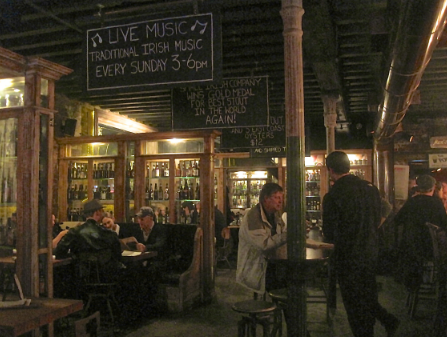 The Bar at Fraunces Tavern – Photo by Jordan Wright Our fixed price brunch allotted us two Bloody Marys, one entree and a dessert. George and Martha, had they partaken, would have approved. I had the creamy smoked haddock chowder and the Irish Breakfast with sausage, blood pudding, bacon, eggs and baked beans, while my partner opted for the tavern’s buttery-crusted turkey pot pie and goat cheese, pear and cranberry salad. After downing two bloodies I forgot to photo the desserts – homemade pie with homemade ice cream.
Later that evening we repaired to the Lower East Side to a Keith McNally spot called Schiller’s Liquor Bar – all white subway-tiled walls with antique fittings and signage from the turn of the 20th C. After seeing the photos from Hurricane Sandy with the neighborhood underwater, I hope the place is still up and running as it was pouring cats and dogs that night and we had to leap over puddles on tiny sidewalks.
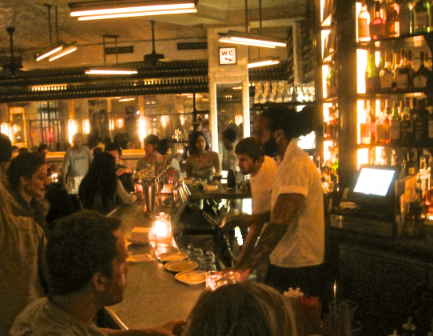 The scene at Schiller’s Liquor Bar on the Lower East Side – photo by Jordan Wright The place was crowded, cold and damp and all about the cocktail. We kept our coats on. Tables were a few feet from the constantly opening door. I vaguely recall a too-sweet bourbon sour, which the bartender crankily corrected. Dinner was forgettable pasta, quickly downed while being stink-eyed by a hostess eager to turn the tables. No dessert. We fled like thieves in the night.
Avant Le Deluge – Dodging an Impending Hurricane Sandy
Morning brought breakfast at a friend’s home on Long Island – real New York Everything bagels, scrambled eggs and baked ham too – before taking off on a tour of the island and my old homestead. It looked exactly the same as we drove up the long circular driveway and begged entry. A surprised and kindly eighty year-old couple were entirely amenable to our visit. Turns out they are the same family that bought the home from my parents and have raised 14 children in a house where we two kids once cavorted like puppies throughout the home’s ten bedrooms.
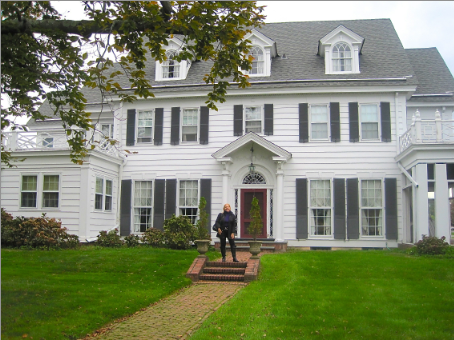 Visiting my childhood home on Long Island – Photo by Roy Wright Around the corner we stop in at The Chowder Bar. Sixty-six years in the same spot, the clapboard cottage perches unceremoniously beside the Maple Avenue Dock,a dozen or so yards from the old ferry boats to Fire Island. They still serve the best clam chowder on the island for a few bucks and warmed the cockles of our hearts on a blustery day.
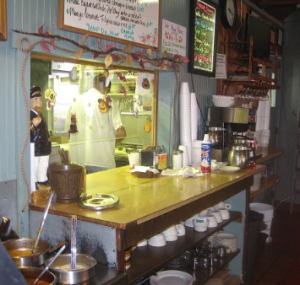 The Chowder House voted the best chowder on Long Island – Photo by Jordan Wright In the evening we took dinner with friends in Massapequa, a small mid-island town that boasts numerous Italian restaurants both high- and low-end. We drive along Broadway, the main drag, past mom-and-pop storefronts with traditional pasta makers, pizza joints, bakers, butchers and delis – all Old Country Italiano. At Fra Amici Pizzeria & Ristorante it’s pasta night and the special three-course dinner is $11.95. Caesar salads crisscrossed with olive oil-drenched anchovies, hearty minestrone soup crammed with zucchini and kale, and baskets of just-baked Italian bread cover the small table. Shortly huge bowls of steaming pasta piled high with meatballs the size of baseballs arrive. The tender orbs of veal and beef in homemade “gravy” as they call marinara sauce in these parts, melt in our mouths.
From a list of over fifteen types of pasta dishes I choose linguini alla vongole. I have eaten this dish all over seaside Italia and anywhere in the United States near a bay or ocean. I’ve had it prepared in the shell with Cherrystones, Little Necks or canned clams. I know my alla vongole like a fish knows its scales. I look down at my plate. There beforeme is a sure half-pound of rough chopped whole fresh clams, whole cloves of tender garlic sautéed in butter and parsley and pasta enough for four. I am thinking Jonah and the Whale. I am thinking I am the big fish and this is my odyssey and as such I need to act my part. Como incredibile!
We all took a deep breath, dove in to our respective pasta and truth be told made room for dessert though I cannot imagine how – cannoli and Italian cheesecake followed by mugs of frothy cappuccino. I am still dreaming of it. Readers, for the love of Mike, please let me know if there is anything in our area with “my-Nonna’s-in-the-kitchen” real-deal Italian dishes like this.
Cookie Monsters at Peace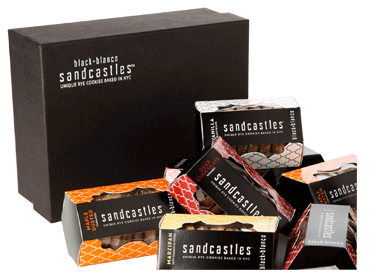
Fueling us along during our time in the car were the heavenly New York City Black + Blanco cookies. We tried all four exotic flavors of the buttery Moroccan-inspired ‘sandcastles’, as they call them. The mad delicious sweets are gluten-free – though Lord knows not calorie-free. Made with rye flour and virgin coconut oil they are entirely vegan. No eggs, no dairy. Choose from Maple Dusted Cardamom, Vanilla Black Sesame, Marzipan or Deep Chocolate Infrared infused with smoked paprika. After each box we were still unable to pick a clear winner. We’ll keep trying till we can.
Chinese Master Hu Comes to the Mandarin Oriental DC
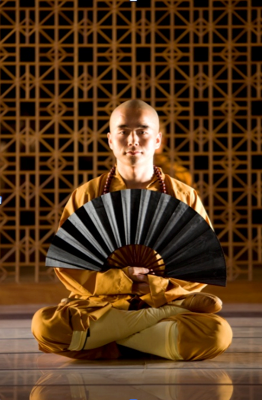 Master Hu
Shaolin Kung Fu Master
Mandarin Oriental, Sanya Back in town an exclusive booking at the Asian-inspired The Spa at Mandarin Oriental with Shaolin Kung Fu Master Hu awaited us. Master Hu is from Henan Province and is a Master of Qi Gong and Medical Qi Gong as well as massage and meditation which are his specialties. Master Hu has been on a multi-city tour, teaching students in both the martial and the cultural arts of China, and he was only in Washington for a few days before traveling on to the Mandarin Oriental in Chicago.
Our private class was an 80-minute Shaolin Zen Tea Ceremony that addressed health and a holistic diet regime. The result is to stimulate the senses and bring the student back to nature through the serving of tea as a means to meditate together. It seeks to harmonize the mind and body through a spiritual experience conducive to finding your inner self.
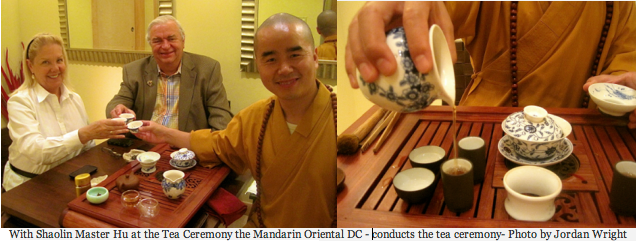
After watching Master Hu’s intricate ceremony of making, steeping and serving several white and green teas – one being the smoky lapsang souchong from the Fujian Province of China – he told me his name means ‘tiger’. I asked him what ‘foo’ means. “It means happy,” he translated. “Oh well, my dog’s name is Foo Foo,” I offered. “Means very, very happy!” he giggled nearly falling off his chair. His charm is contagious. We sipped and grinned right along with him.
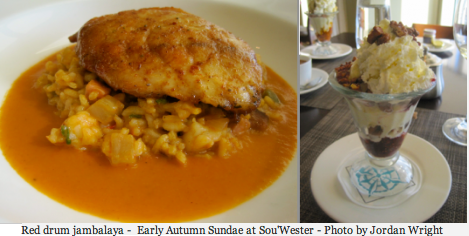
Later we floated off to lunch at the hotel’s Sou’Wester and sat at a table overlooking the harbor while watching the yachts bobbing on the Potomac along Maine Avenue. Feeling blissed out and in a nether realm of consciousness, I dreamily ordered the Pan-Seared Red Drum, a local fish served atop jambalaya and Anson Mills Carolina Gold rice, finishing with the entirely-over-the-top Early Autumn Sundae of port-roasted figs, candied walnuts and clover honey ice cream. We drifted like autumn leaves back to our car and workaday reality, while thoughts of a chestnut sorbet not chosen were luring me back before the season’s end.
Partying with Phoenix – An Insider’s Report
A day of food and fun hosted by friends from the Phoenix CVB was on the agenda earlier this month and I wouldn’t have missed it for the world. A chance to have a private luncheon prepared by Mitsitam’s Executive Chef, Richard Hetzler at the National Museum for the American Indian (NMAI)that I knew would prove to be indelible.
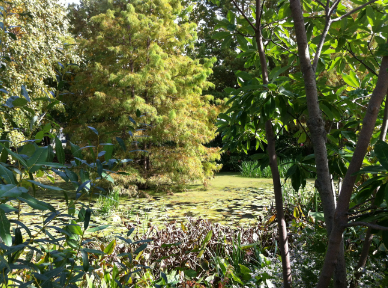 The pond in autumn at NMIA – photo by Jordan Wright Our small group settled into a private dining room off the Main Cafeteria at tables swathed in bronze silks. Host Greg Stanton, the Mayor of Phoenix, had been summoned to the White House that morning, following the previous night’s third Presidential debate, and he was running a tad late. Trays of totopos, appeared with guacamole and peppery spreads with baked vegetable chips. I toyed with a cool prickly pear agua fresca.
Stanton arrived around then apologizing for his late arrival. He’s a good-looking, energetic man-on-a-mission eager to dispel the bad press Arizona has gotten of late. He’d heard one of us had googled up the piece about his experiment to live on a week’s worth of food stamps. I raised my hand. I had been impressed by his sensitivity and drive even before our meeting. He said we probably wouldn’t want to hear about his trip to the White House. My hand shot up again and said, “Yes, please, Mr. Mayor, we would.” “Well,” he recounted, “everyone’s chests were pretty puffed up after the previous evening’s success.” And you could almost feel as though you’d been there too.
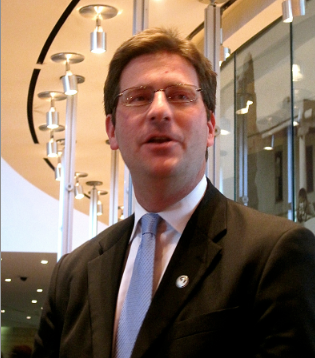 Phoenix Mayor Greg Stanton Lunch began with curls of cedar wrapped around seared salmon belly – the most buttery part of the fish – the poached red roe scattered like confetti over the top, the skin-on filet leaning against butternut squash bread pudding. (Note: Hetzler achieves a crisp skin by first removing, pressing and quick searing it on a flattop grill and then reassembling the whole.)
Later a chestnut-stuffed goose terrine, sweet potato corn pone and wilted Brussels sprout leaves finished the coterie of appetizers smoothly paired with an Argentine Viognier. Buffalo filet came glazed with fig must and clusters of plump shrimp sparkled with aji peppers and yellow yucca causa, a distinctive Peruvian dish derived from the Incans.
Hetzler showed off all the season’s glories with cauliflower-mashed potatoes made with buttermilk and horseradish, and a squash and Barlett pear gratin served in a pretty casserole. We were a feather’s-breadth from heaven sipping a Chilean pinot noir when dessert was presented in the form of an aromatic acorn squash tart perfumed with sage and huckleberry honey plus a don’t-shoot-the-messenger apple crumble. Take note budding chefs! This is how one of our city’s finest chefs celebrates fall’s bounty using indigenous and sustainable foods.
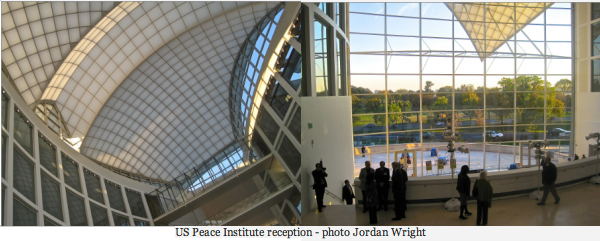
A few hours later a cocktail reception was held at the United States Institute of Peace (USIP). This dramatic ultra-modern winged structure, which took three years to complete, is the newest addition to Constitution Avenue. It features a glorious undulating glass roof called the Ansary Peace Dove. On this night they would throw open the doors for an event that was not a peace-related program or conference and guests were head over heels to see it from the inside.
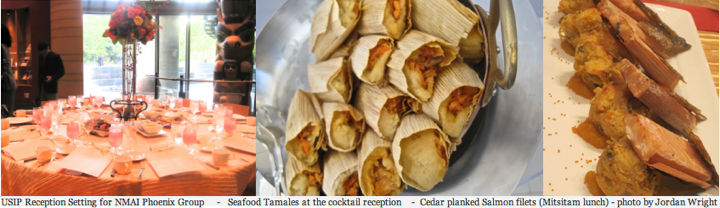
Copper casseroles filled with lavish dishes were set up around the sun-drenched room. What I remember most is the posole, chicken braised in mole sauce, seafood tamales and crab cakes with pumpkin seed aioli, though there were countless other delights in the cavernous space. After thoughtful remarks by the returning Mayor Stanton, Suwaimaa five-time world champion Hoop Dancer accompanied by a native drummer, performed for the riveted guests.
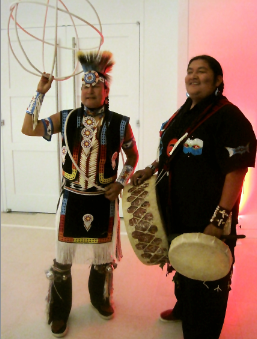 Five-time World Champion Hoop Dancer Suwaima and Drummer – photo Jordan Wright I Love to Eat – James Beard Comes to DC
This is the last weekend for the short run of Round House Theatre’s fabulous I Love to Eat, the one-man show on the life and times of iconic chef James Beard. In 1946 before Julia Child, Guy Fieri and the Food Network, there was Beard, America’s first TV chef. His NBC show was “Elsie’s Kitchen Tips”, named after the show’s sponsor Elsie the Cow, whose messages drop down to the stage á la Groucho Marx’s secret word delivering duck.
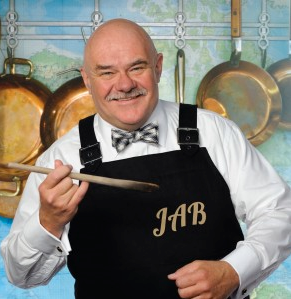 Nick Olcott photo by ClintonBPhotography. James Beard kitchen photo © Krishna Dayanidhi, courtesy of The James Beard Foundation. Actor and successful DC-based director, Nick Olcott, channels Beard in all his catty, charming, culinarily knowledgeable glory. To prepare for the role Olcott prepared dishes from Beard’s many cookbooks and blogged about it – his knife skills on the set confirm his year long rehearsal for the role. The set is Beard’s kitchen. A world map signifying his world travels is hung alongside dozens of gleaming copper pans. Stainless steel worktables frame the stage and retro Princess phones are at every corner.
The gourmand enters grandly through a refrigerator in pomegranate-hued Chinese silk pajamas, frost clouds billowing behind. He takes a call from an admirer in Kansas concerned about her dish. “Gird your apron a little tighter,” he advises. “It’s not Easter – no need to bring it back from the dead!” The dialogue is familiar and intimate and we feel we’re a fly on the wall of his life where in his vernacular nonsense is “twaddle” and approval is “really tops” “You can get away with anything if you are amusing!” he admits. Wise words from a sage cook.
At Round House Theatre, 4545 East-West Highway, Bethesda, MD through November 4th. For tickets and information call 240 644-1100 or visit www.RoundHouseTheatre.org.
Jordan Wright
Special to Washingtonian Magazine – April issue
April 2012
If you think the Philly food scene is all cheesesteaks, snapper soup and Italian water ice – you’ve missed the gastronomic explosion in Love City, although if cheesesteak is your thing Barclay Prime will satisfy for $100 a pop under crystal chandeliers. (www.barclayprime.com) Here are some ways to celebrate the city’s gastronomic delights.
Where to stay
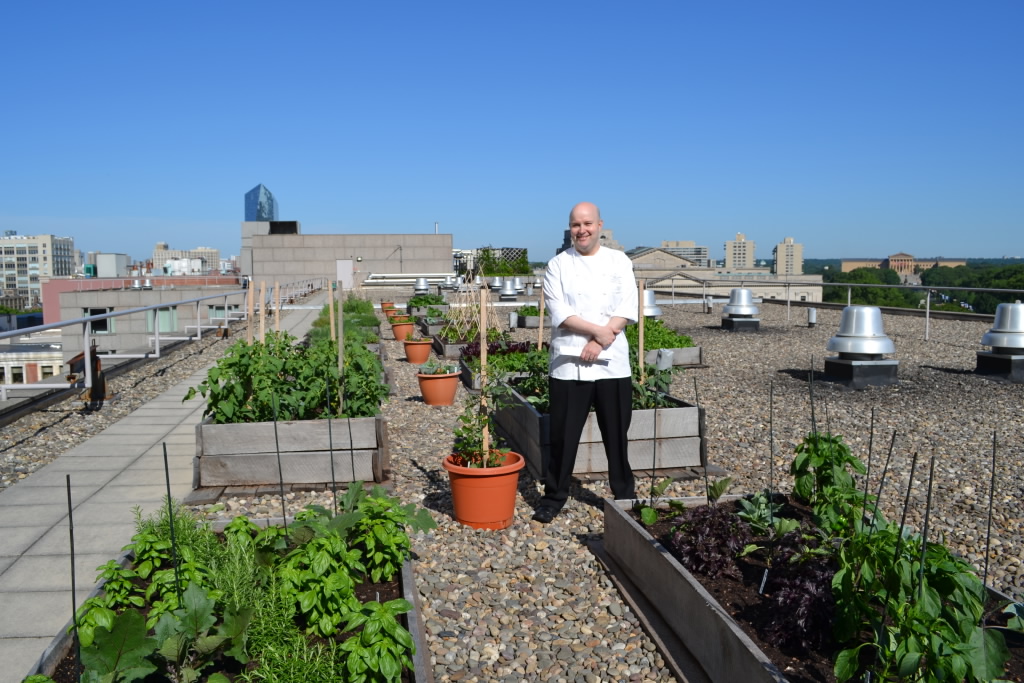 Executive Chef Rafael Gonzalez at the Four Seasons Hotel rooftop garden - Photo credit Jordan Wright Check in at the Four Seasons Hotel, whose executive chef plucks herbs and veggies from their rooftop garden. (www.fourseasons.com/Philadelphia) The luxurious Old World style property is centrally located at Logan Square.
The Hotel Palomar near Rittenhouse Square is modernist chic. Leopard bathrobes and complimentary nightly wine receptions are replete with truffled popcorn. (www.hotelpalomar-philadelphia.com)
Dining and Drinks
The restaurant scene once dominated by Iron Chef Jose Garces known for Amado and Distrito, and the prodigious over-achiever Stephen Starr (of his 20 restos, five opened this year), has upstarts nipping at their heels.
Current scene-stealers are Fish, Fork, La Croix, Bibou, the revamped Oyster House, Meme, White Dog Café and Vetri, though George Perrier’s Le Bec Fin still reigns as the bastion of French haute cuisine.
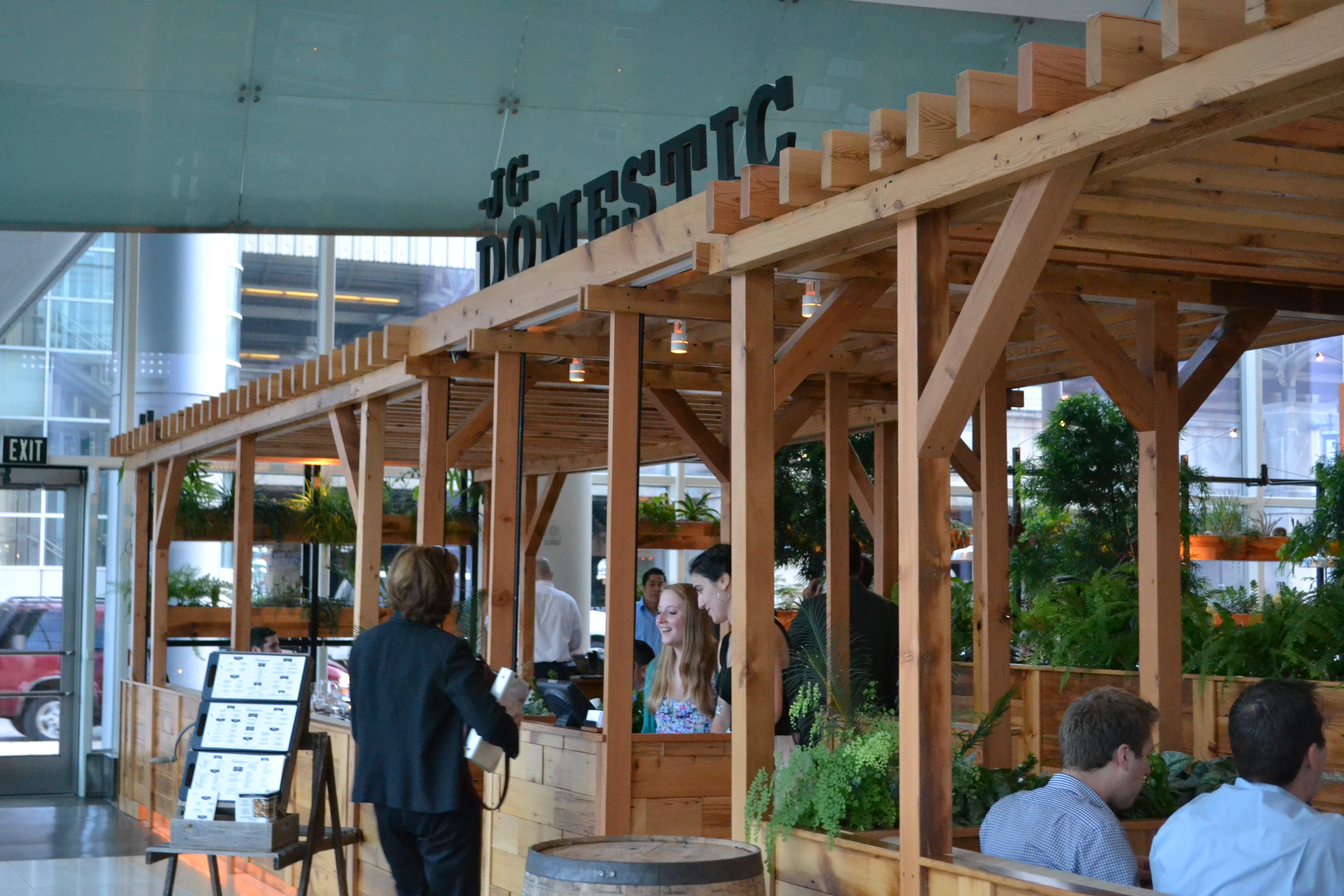
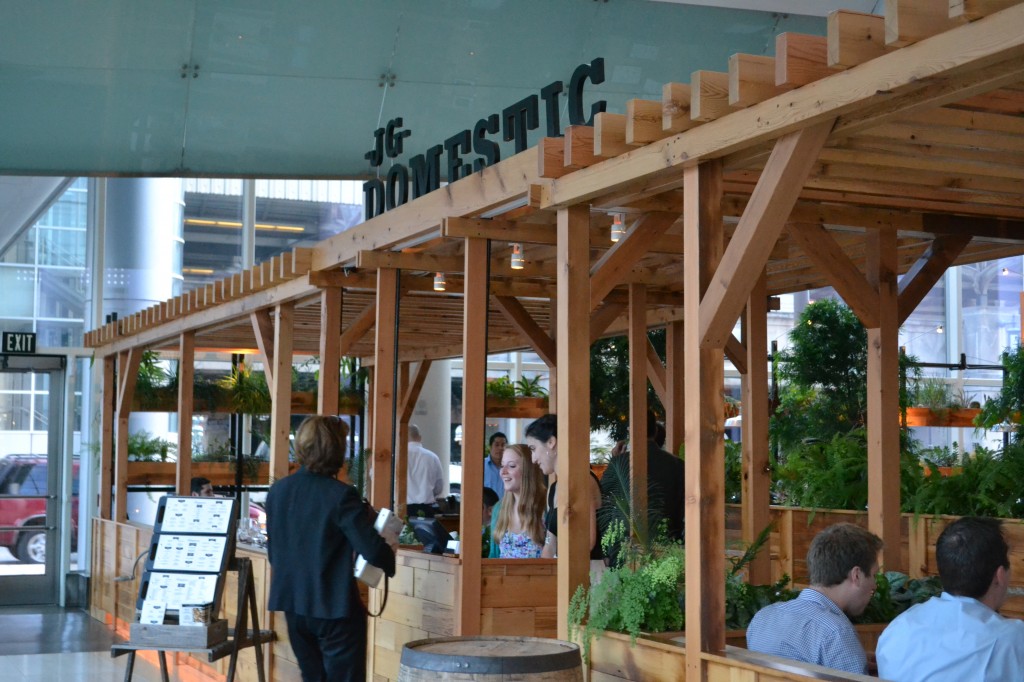 JG Domestic in the Cira Centre - Photo credit Jordan Wright Garces channels The French Laundry at JG Domestic in the Cira Centre for American farm-sourced dining. The menu changes seasonally, but look for Wagyu carpaccio and lobster cappuccino, the Griggstown Farms roast chicken is a standout, plus the yummy bourbon caramel beignets. (www.jgdomestic.com)
Zahav is a modern Israeli-inspired gem. Try the persimmon salad, oxtail soup with fenugreek, Brussel sprouts with whipped feta or a perfect lamb kebab dotted with pistachios. Save room for the hazelnut and date rugelach. (www.zahavrestaurant.com)
Chef, author and television personality, Walter Staib, whose three-time Emmy-winning PBS program “A Taste of History” has been nominated for a James Beard Award this year, is the owner of the elegant City Tavern. Opened in 1773, the original tavern was host to George Washington, John Adams, Benjamin Franklin and Thomas Jefferson, but you can dine there on Staib’s 18th century style gourmet cuisine today. (www.citytavern.com)
On Washington Square the new Talula’s Garden is an enchantingly rustic spot known for their spectacular cheese menu. Try salmon with roasted sunchokes and pancetta or lobster pie with lobster anisette sauce. (www.talulasgarden.com)
In the heart of the theatre district the Walnut Street Supper Club appeals to the Mad Men crowd with a super-glam retro nightclub featuring live entertainment from “I-passed-the-audition!” singing servers. Dishes lean toward Italian specialties and steaks and goes from rack of lamb to lobster ravioli. (www.walnutstreetsupperclub.com)
Around the corner the hot bar scene is El Vez with its dazzling Vegas vibe bar mounted with an illuminated motorcycle. Slip into a plush banquette for a cold Pacifico or blood orange margarita. A ‘50’s draw-draped photo booth for guests documents the visit. (www.elvezrestaurant.com)
Across the street and named number one by National Geographic on their list of the “Top Ten Places in the World to Get Ice Cream”, is Capogiro Gelato Artisans. Try their Cioccolato Scuro, Bananas Foster or Philly Cheesecake flavors. (www.capogirogelato.com)
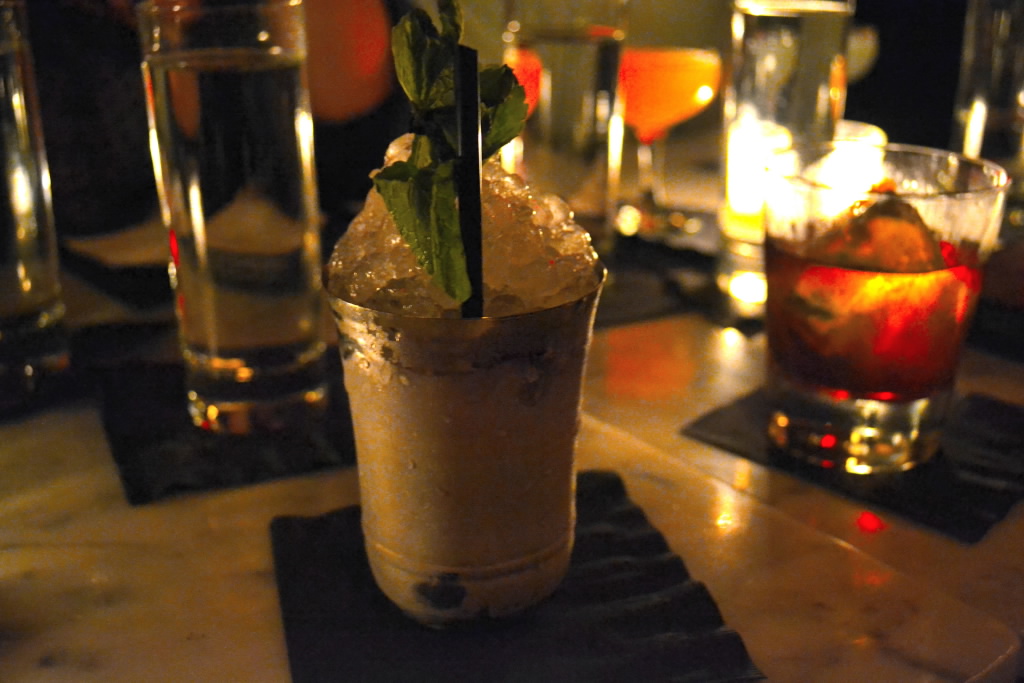 The Mint Julep at Franklin Mortgage and Investment Company - Photo credit Jordan Wright Cocktails are the main attraction at Franklin Mortgage and Investment Co. a one-time Prohibition era speakeasy with upscale ingredients and herbal infusions. Indulge in a ‘Blonde Redhead’ or ‘Drums in the Deep’. (www.thefranklinbar.com)
For the best taps in town sample the suds at Hawthorne’s Beer Boutique or tour the tasting rooms at the Yards or the Philadelphia Brewing Company where the beers are crafted on site.
Farmers Markets
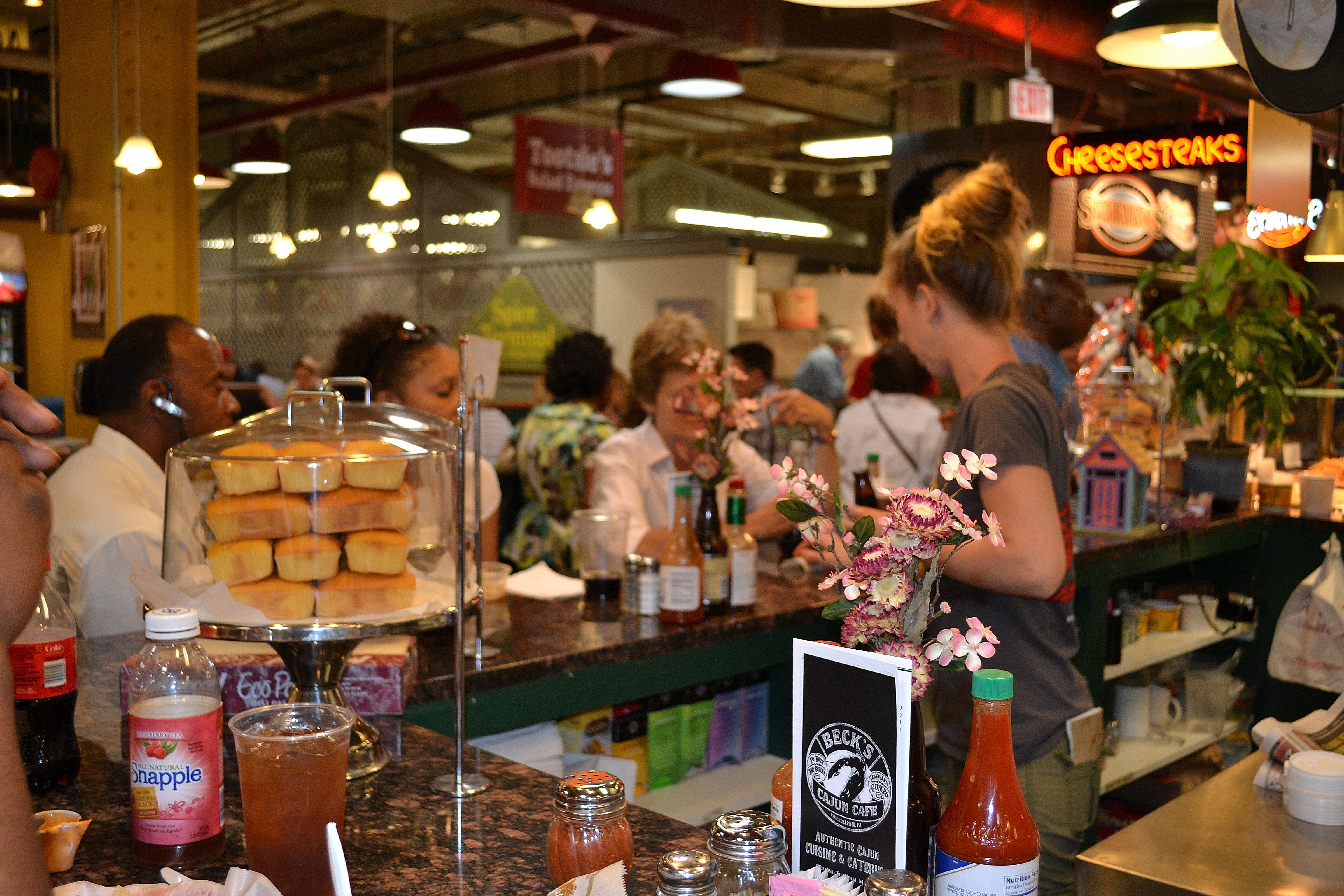
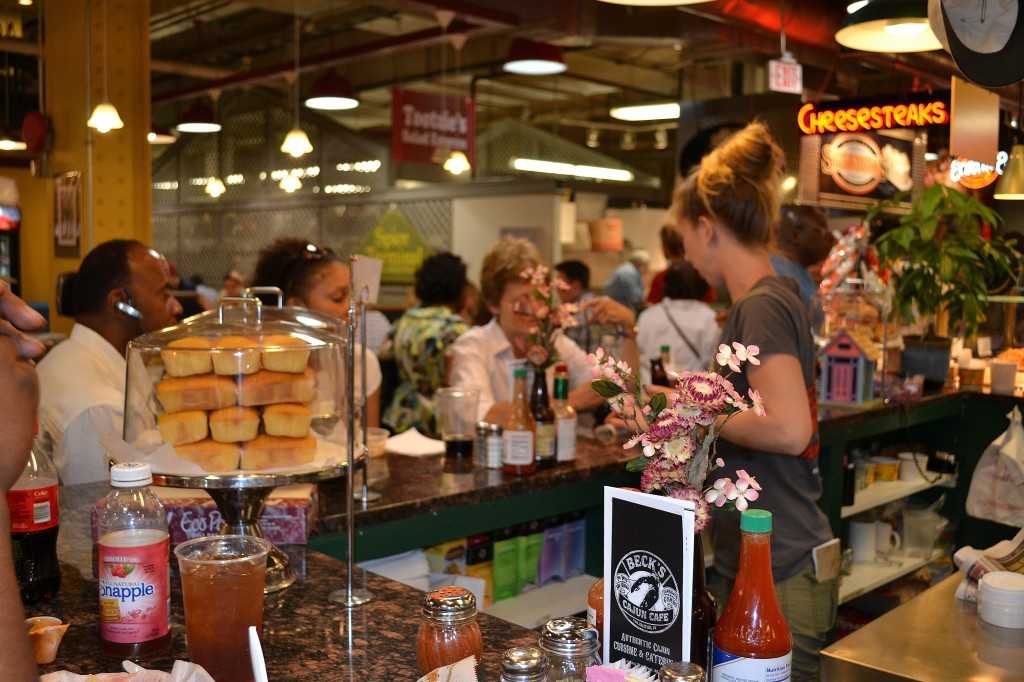 Beck's Cajun Cafe in the Redding Terminal Market - Photo credit Jordan Wright Right in the heart of Philadelphia is the Redding Terminal Market the oldest farmers market in the US. Built in 1893 it’s a bustling bazaar chock-a-block with farm-sourced delicacies from Pennsylvania Dutch cakes and pies to pickles and spices. Chill out with a dozen briny bivalves at Pearl’s Oyster Bar or chow down on Cajun jambalaya, Southern BBQ, French crepes or Italian hoagies at over 15 dining counters.
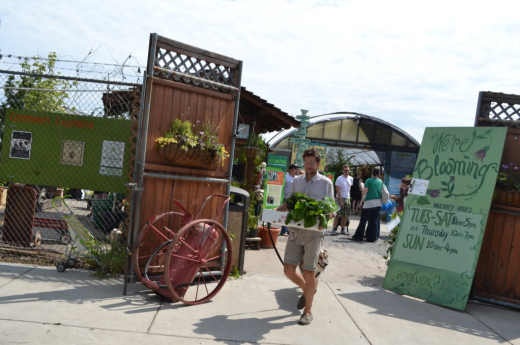 Greensgrow Farm - Photo Credit Jordan Wright While Headhouse Farmers’ Market and Greensgrow Farm grow and sell on site, The Food Trust, with its network of 35 farmers markets around the city, promotes local farmers and budding entrepreneurs.
Over on Baltimore Avenue in what’s know as the University District grab a coffee or Maplehofe Dairy hot chocolate and bagels at the Milk and Honey Market and hit the nearby Clark Park Farmers’ Market on Thursday afternoons and Saturday mornings to satisfy your inner locavore. If the weather permits, you can picnic in the adjoining park.
Current Art Scene
Don’t miss the newly relocated The Barnes Foundation, scheduled to open on Logan Square May 19th. www.BarnesFoundation.org
Or tour the Philadelphia Museum of Art’s “Van Gogh Up Close” exhibit –an exclusive in the US that runs till May 6th. (www.philamuseum.org)
Food Truckers Heat Up the Night
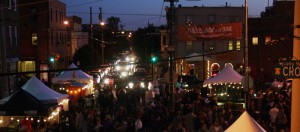 Night Market Philly - photo credit www.nightmarketphilly.org As the weather warms up Night Market Philly kicks off the season with monthly food truck parties. Twitter followers get regular updates. Standout food truckers are Garces’ Guapo’s Tacos, Pitruco for wood-fired pizzas, Mini Trini featuring Trinidadian flavors, Viva Las Vegans for custom veggie burgers, Tyson Bees for Asian fusion, and Bui’s for Vietnamese.
Dessert lovers like Little Baby’s Ice Cream flavors like Cardamom Caramel or Earl Grey’s Sriracha; Sugar Philly for Spicy Mexican Chocolate Cake; or go for French Macarons; and Nutella cupcakes from the Buttercream truck. Former Roots drummer and Philly native, QuestLove, is rumored to be launching a soul food truck featuring Origami Wrapped Buttermilk Fried Chicken.
Sunday Brunch and Italian Market
Linger for Sunday brunch at Daniel Stern’s R2L with sweeping bird’s eye views of the city from the 37th floor of Two Liberty Place on Rittenhouse Square. (www.R2Lrestaurant.com)
The Dandelion Pub is Stephen Starr’s ode to a traditional Irish pub. Sundays feature roast beef and Yorkshire pudding. www.thedandelionpub.com
On the way home stop at Philadelphia’s 100-year old Ninth Street Italian Market. Grab cheeses from Di Bruno’s and Claudios, hand rolled pasta and sauces from Talluto’s and sausages from Fiorella Bros., and specialty game meats and pates from D’Angelo Bros. Open from 8 till 2 on Sundays. (www.phillyitalianmarket.com)
Special to Indian Country Today Magazine
Jordan Wright
March 2012
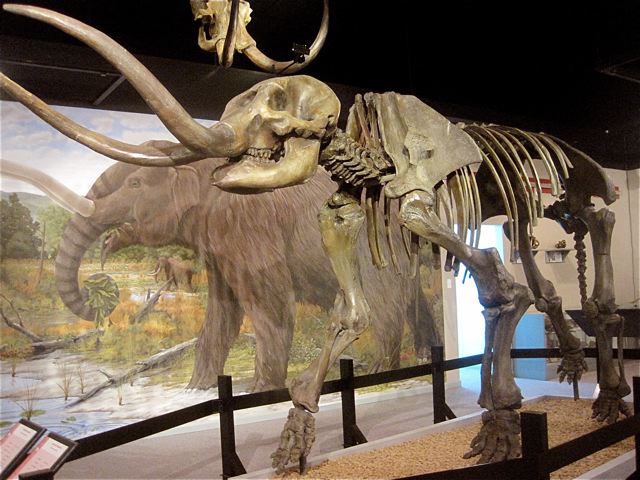 Mastodon skeleton at the Museum of the Middle Appalachians - photo by Jordan Wright “Saltville can probably claim to be the most fascinating two square miles in Virginia, or possibly the eastern United States, owing to its geology, paleontology, history and past industrial production.” Charles Bartlett, American geologist.
Around Halloween last year when the 2,077 residents of Saltville, VA heard the producers of Animal Planet’s“Finding Bigfoot” were coming to investigate a sasquatch in their midst, phones rang off the hook. The program’s host Matt Moneymaker called for a town hall meeting at the Palmer Grist Mill and anyone who had seen Bigfoot up in the Southern Highlands was asked to bear witness. Moneymaker couldn’t attend in person. He was already up near Gum Hill that night with his infrared cameras in search of the “beast”.
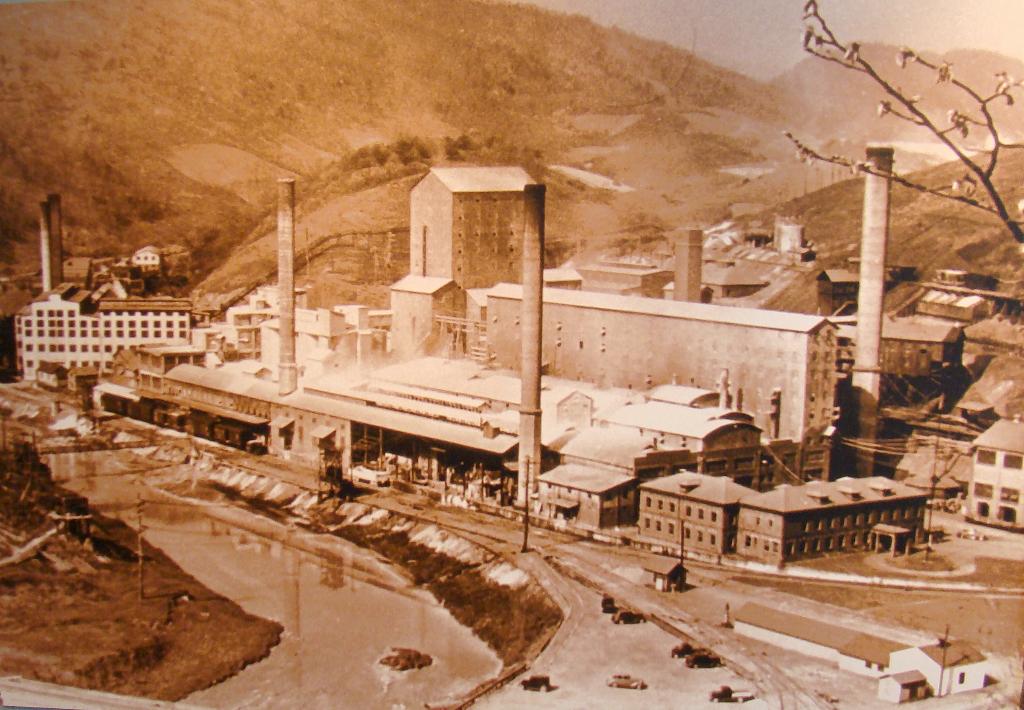 MOMA - Olin Salt Factory But the small town in a quiet valley has known a great deal more excitement than the random sighting of a mythical creature. In a place where the bizarre presence of mallards and Canada geese paddling lazily in salt ponds in the middle of the Blue Ridge Mountains is commonplace, the unexpected is, well,ordinary.
Saltville’s inhabitants have always lived at the crossroads of history because of salt. The quest for the coveted mineral lured prehistoric animals and hunters. Tribes from the region used it for trade and later industrialists made fortunes selling it to the nation. Salt’s powerful influence held sway during the Civil War when Union forces fought a 36-hour battle to capture Saltville and destroy its crucial saltworks. It is not a simple story to tell. It’s a story of war and survival, but also of power and prosperity.
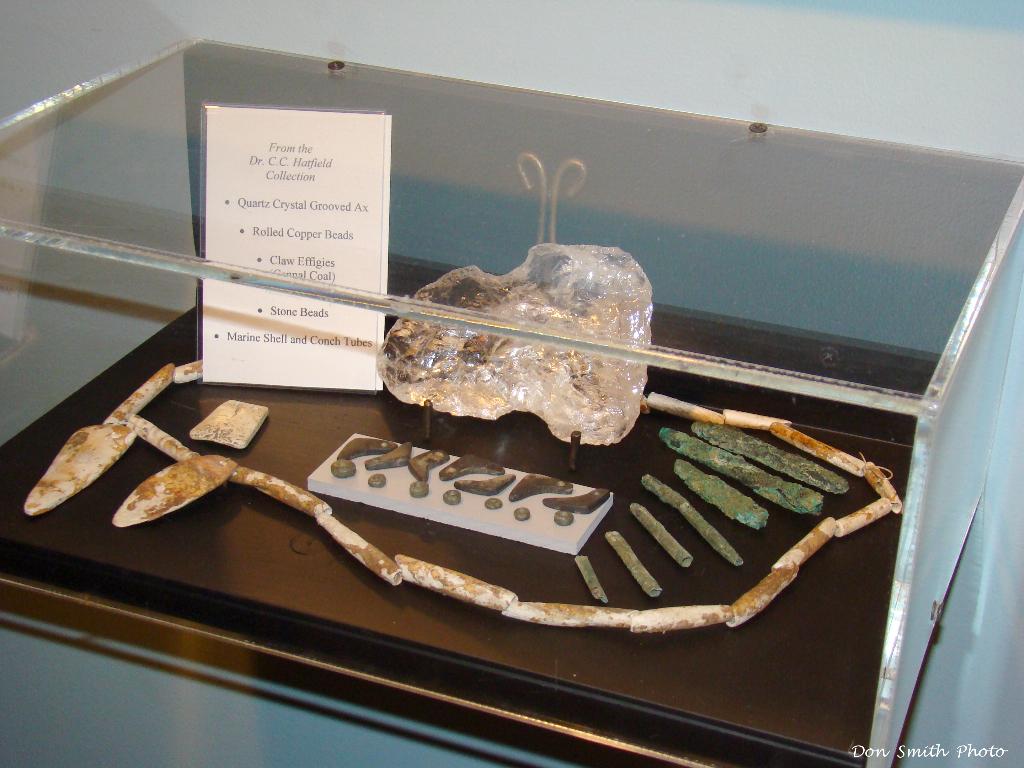 MOMA Indian Artifacts Despite what is found in most American schoolbooks, our early history did not begin with the emergence of the dinosaur and miraculously pop back up with the British landing at Plymouth Rock. Aboriginal people migrated down the continent from Alaska and up from Florida, the Caribbean and Mexico to arrive in this wilderness. In the area of Saltville Paleo-Indians dwelt along the Clinch and Holston rivers in Southwestern Virginia and on across the mountains and valleys into the adjoining territories of what is now known as North Carolina, Kentucky and Tennessee.
In the Pleistocene Age Saltville was a convergent point for prehistoric creatures like the great woolly mammoth, elephant-size ground sloths and hulking mastodons, who came in search of water and salt deposits for their survival. Over millennia these migrating herds carved permanent trails in the earth. Of six major Indian trails in Virginia three are found leading to Saltville, tracing the well-established paths of the animals that came before them.
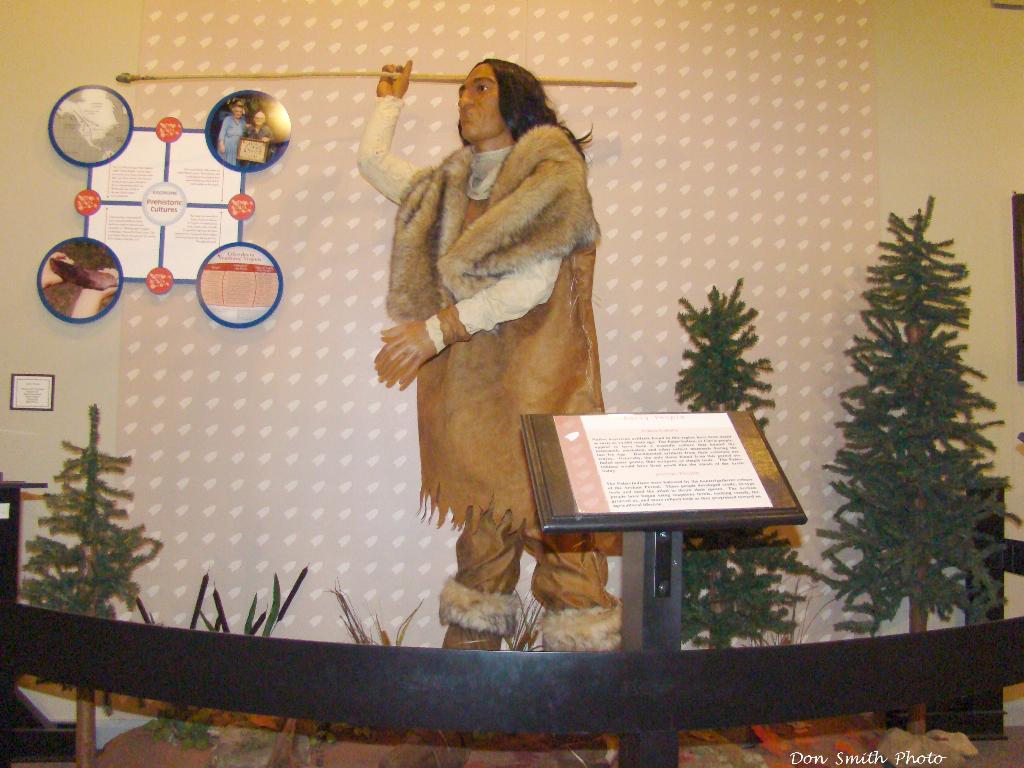 MOMA Exhibit Indigenous Indian Author, archaeologist and professor emeritus at UCal Santa Barbara, Brian Fagan, lists the Saltville area as one of the six worldwide sites of earliest human activity and a known concentration of pre-Clovis spear points made by Ice Age hunters. The discovery of a tool-like bone fragment in the area, made by humans and found beside a mastodon, is evidence of its slaughter by prehistoric man.
For today’s visitor to Saltville, eight miles off I-81 in Smyth County Virginia, a compelling resource helps connect the dots. Chronicling the area’s complex history in a comprehensive timeline, The Museum of the Middle Appalachians is a mecca for archaeologists, paleontologists, historians and the curious.
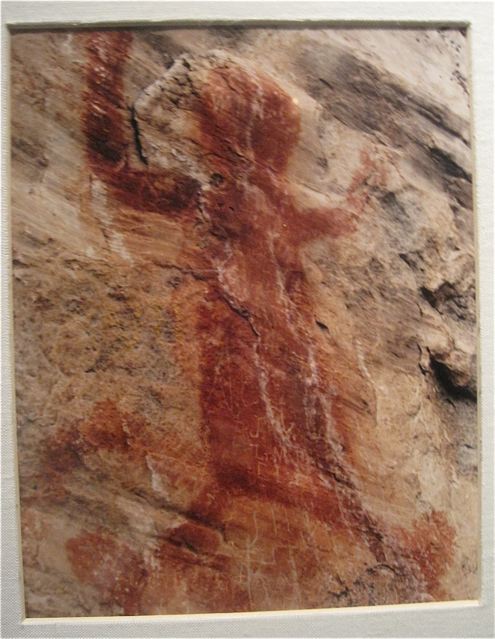 Paint Lick Mountain pictograph taken in nearby Tazewell County - Photo reproduction by John C. Fisher (Museum of the Middle Appalachians) The museum houses thousands of artifacts and archival photographs from the area dating from 14,500 years ago to the present and visitors are greeted with a breathtaking full-size replica of a mastodon skeleton and the jaw of a woolly mammoth. Mineral displays from geologic formations of the Late Ice Age show the earliest evidence of human activity in Eastern America.
The museum begins its American Indian displays in the Late Woodland Period (900 – 1600 BC) when the Chisca, also known as Yuchi, lived beside the nearby Holston River, which they called ‘Hogoheegee’ and their village ‘Maniatique’ where they established salt-powered chiefdoms and traded the precious commodity with tribes along the eastern US. Museum manager, Harry Haynes, says, “There have been more than 20 native village sites found along the Clinch and Holton Rivers within 20 miles of Saltville.”
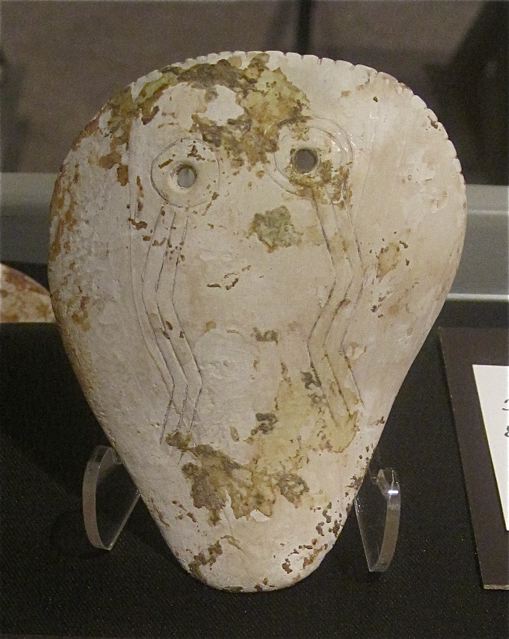 Mask gorget in the Weeping Eye style from the Museum of the Middle Appalachians- photo by Jordan Wright Clay pots, celts, copper and shell beads, including an astonishing 164-inch necklace of marginella beads make up a small part of the extensive Patricia Bass Collection. Mastodon bones, a beautiful quartz crystal grooved axe, and javelin points are other intriguing objects that have been unearthed in the area. Here a giant slothfootprint shares space with rare engraved gorgets, a type of medallion or mask with rattlesnake or turkey designs that were carved from marine shells.
Photographs of cliff walls at nearby Paint Lick Mountain show early pictographs of bird, man and snail. Further testament to Native American skill and craftsmanship, are drawers filled with axes, celtsand arrowheads and a rare platform pipe of steatite, highly characteristic of the region.
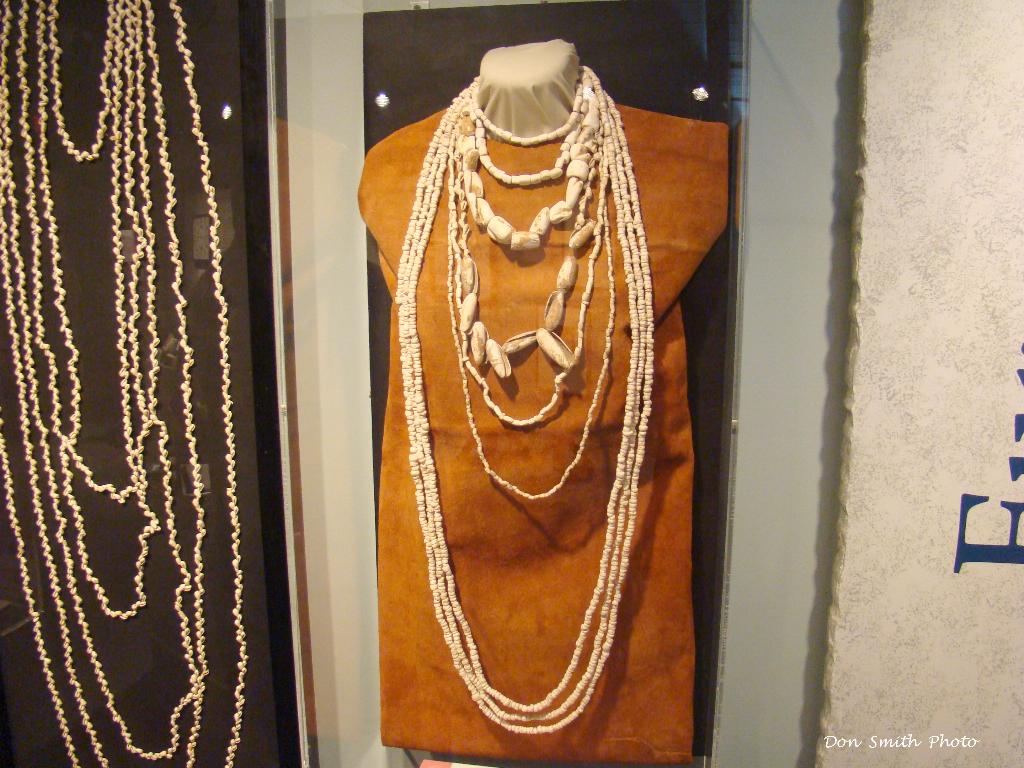 MOMA - Indigenous Indian Bead Craft Since 1782 when Arthur Campbell sent a letter to Thomas Jefferson and enclosed a jaw tooth from a mastodon, referring to “bones of an uncommon size”, researchers have been attracted to the region. In 1917 the Carnegie Institute conducted the first official excavations at Saltville, followed by the Smithsonian Institute whose findings beginning in the 1970’s led to the discovery of well-preserved mastodon skeletons and wooly mammothremains in 2007.
Exhibits reflect its later development as a “company town” under the aegis of the Olin Corporation who purchased the Mathieson Alkali Works that had extracted salt there since 1895.
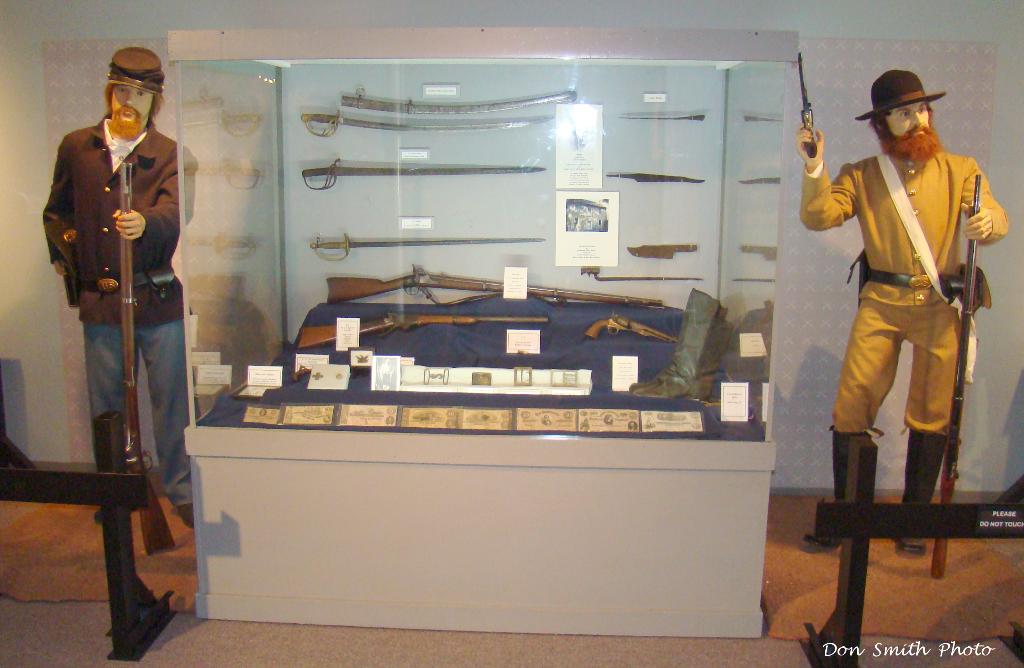 MOMA - Civil War Solders Olin, who continued to harvest salt in the well fields later branched out into chemical production and developed the rocket fuel that took man to the moon. Even today over 23 tons of salt per hour is still produced here and former salt caverns serve as one of the nation’s largest storage facilities for natural gas. The town’s slogan “Preserving history for over 30,000 years from the Ice Age to the Space Age” neatly sums up its dramatic history.
In the 16th century Spanish conquistadors came searching for a mythical chimera other than the ‘sasquatch’. Archives reveal that in 1541 two outriders first set foot in Saltville in search of precious metals and a legendary kingdom of great wealth called ‘Chicora’. Diaries detail encounters with friendly Indians, but reports state that no gold or silver was found. This well documented meeting with the Chiscas was long before Captain John Smith set foot in Jamestown in 1607, and decades before Pocahontas was born.
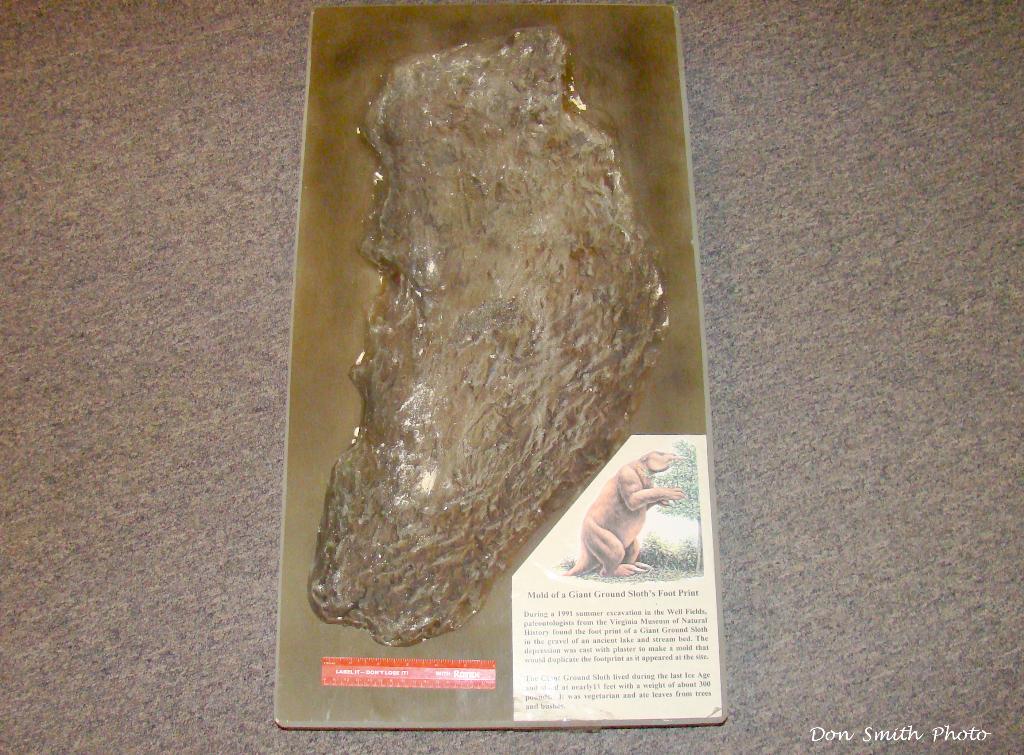 MOMA - Paleo Casting Chemist and professor emeritus from Virginia Tech, Jim Glanville, explains, “The presence of Native Americans in Saltville is the earliest recorded in Virginia’s history. It is well chronicled in Spain’s archives through letters, testimony and diaries. A 1584 petition to King Carlos V of Spain by a Spanish soldier named Domingo De Leon tells of the bloody incursion and destruction of the village of Maniatique by a Spanish sergeant named Hernando Moyano in April of 1567 under orders from the explorer Juan Pardo and,” he emphasizes, cheerfully upsetting colonial historians’ apple cart, “that was forty years before the British landed at Jamestown.” By the time English-speaking settlers reached Saltville 175 years later all the local tribes were gone.
Glanville’s research, prompted by a Google search, pieces together evidence that, “the first Native American woman to be named in Virginia was not Pocahontas [as is commonly accepted] but Luisa Menendez, a resident of Saltville, who as a teenager married a Spaniard and later testified to the Spanish governor in St. Augustine, Florida her knowledge of the destruction of Maniatique.”
Saltville has many remarkable stories to tell along with mysteries and ancient artifacts yet to be revealed. During my stay I stopped along the town’s salt ponds to get directions from a boy and his friend out for a leisurely day of fishing. We spoke for a while of the many artifacts housed in the museum. He assured me that many more are still found close to town. He knew for a fact, he said, because whenever he needs pocket change he goes out and digs them up. Just remember if you decide to go fossil hunting on Gum Hill, keep your eyes wide open. You may catch a glimpse of the elusive bigfoot staking his claim as Saltville’s next chapter in history.
Where to stay
The historic General Francis Marion Hotel is a beautifully restored 80-year old grand hotel in nearby Marion. Complimentary continental breakfast. Lunch and dinner served in the hotel’s Black Rooster restaurant. www.gfm.com
Where to Eat
The Town House in Chilhowie serves upscale, locally sourced American Modern cuisine just off I-81 on the way to Saltville. Open for dinner only. Reservations highly recommended. www.townhouseva.com
In Marion the charming Handsome Molly’s Bistro and Small Wine Shop across from the hotel serves soups, salads, paninis and pizza.
In the area
The Museum of the Middle Appalachians, Saltville. Noted paleontologist Dr. Blaine Schubert of Eastern Tennessee State University conducts archaeological digs open to the public in summer. Visit www.museum-mid-app.org for dig opportunities and museum hours.
Saltville is on Virginia’s Crooked Road music trail and Friday nights are for old time bluegrass and gospel music. From 7 – 10 pm at the Allison Gap Ruritan & Community Center.
The Lincoln Theatre in Marion is one of only three Art Deco Mayan Revival theatres in the country. The $1.8 million dollar renovation has placed it on The National Register of Historic Places. For a schedule of events visit www.thelincoln.org
ICTMN magazine article – Click Here http://indiancountrytodaymedianetwork.com/2012/02/12/the-most-fascinating-two-square-miles-in-the-eastern-united-states-95733
|