Jordan Wright
July 23, 2019
Special to The Alexandria Times
“Fifteen men on the dead man’s chest. Yo-ho-ho and a bottle of rum! Drink and the devil had done for the rest, yo-ho-ho and a bottle of rum!
Set sail for adventure with Synetic Theater’s lively production of Robert Louis Stevenson’s classic tale, Treasure Island, where the peg-legged pirate Long John Silver and his scurrilous band of buccaneers go in search of hidden riches on Skeleton Island. Hired by Captain Smollet, Dr. Livesey, and Squire Trelawney who commissions the voyage, Silver, protégé of the notorious Captain Flint who hid the treasure, pretends to be a lowly cook. Once aboard, Silver convinces the motley crew of scalliwags to switch allegiance, promising them riches beyond their wildest imaginings. At first Silver befriends the beautiful orphan girl Jane Hawkins who has been gifted Flint’s treasure map by the late Billy Bones. Fans of the late 19thcentury adventure novel will note that Jim Hawkins’ role in this production is a female character who develops the ferocity and fearlessness of any seafaring pirate.
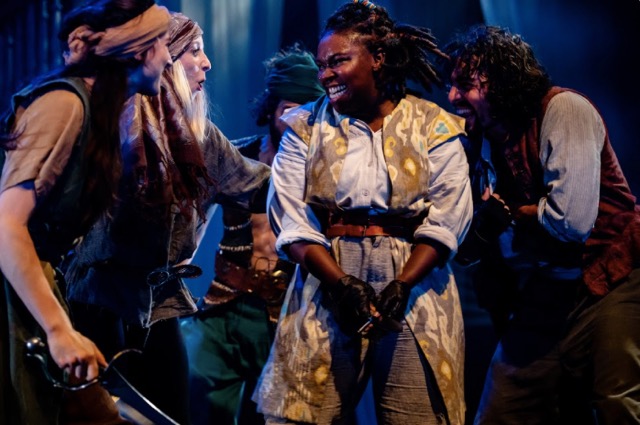 Photo credit Brittnay Diliberto Saving her from a life of servitude at the Admiral Benbow Inn, Silver promises Jane he will watch over her if she will give him the map, but once aboard the Hispaniola, she learns his scheme to keep the treasure for himself. Oh, he’s a wily one. “Treasure is like a disease. It infects the noblest of minds,” he cautions her.
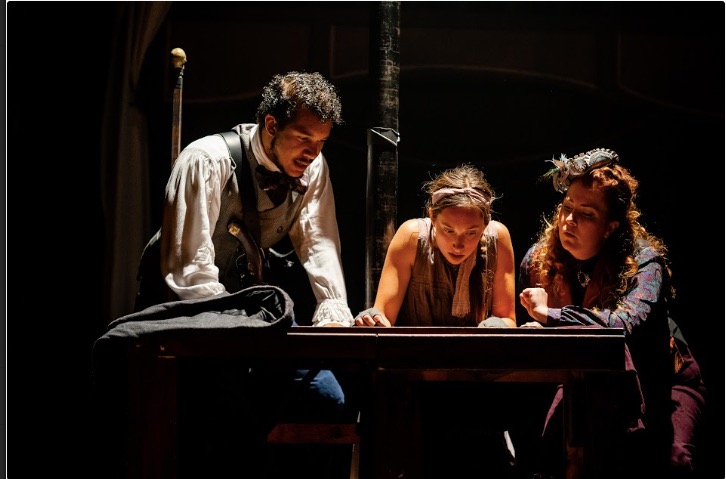 Photo credit Brittnay Diliberto Plotting to outfox our heroes, as well as the brave Jane Hawkins, Silver must figure out how to get the map that Hawkins has given to Dr. Livesey for safekeeping. But nothing goes as planned for either side as it’s criss-cross and double-cross, foul treachery and maritime mutiny, framed by dangerous storms at sea. Jane comes out the hero by turning on Silver one last time even though Silver saves her life from the clutches of his blood-thirsty crew who have locked up the Captain and Trelawney in the stockade.
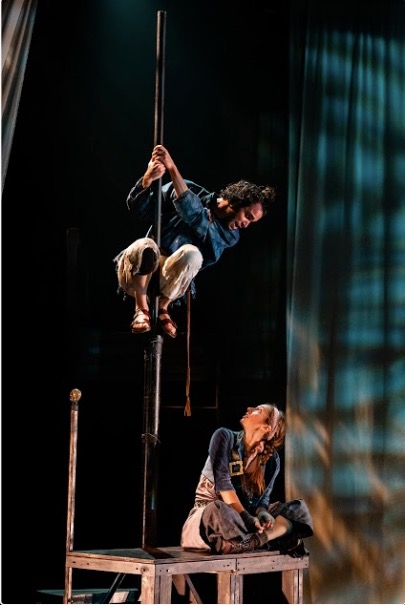 Photo credit Brittnay Diliberto Chris Daileader, a mashup of Leonardo DiCaprio and Johnny Depp, gives a fantastic performance replete with a British pirate’s accent as the crafty pirate Long John Silver. And Anne Flowers’ portrayal of Jane Hawkins makes us believe that a girl can do anything against all odds if she sets her cap to it. Seven more actors, each playing multiple roles, create the illusion that there is a huge cast. Scenes of rum-swilling pirates dancing to Irish jigs will dispel any and all evil spirits of the deep.
Director Tori Tolentino, Set Designer Phil Charlwood, Movement Director Dallas Tolentino, and Sound Designer Thomas Sowers have taken this beloved pirate’s tale into the abstract with fantastical imagery and sheer athleticism, and made the pages of the book come alive with swashbuckling swordfights and fearless swagger. Here, prophesy and foul play transform into a rollicking adventure tailor made for children and as well as their grownup captors!
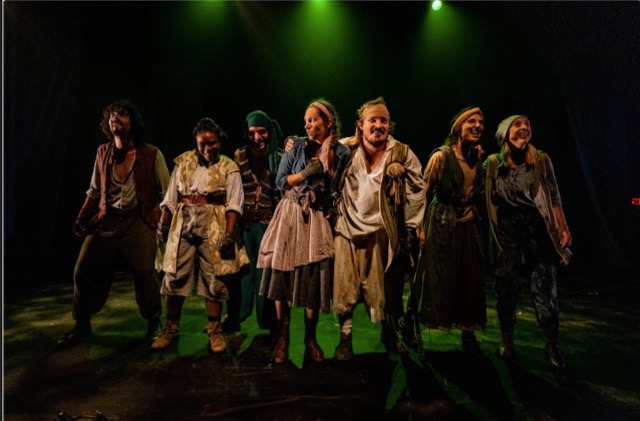 Photo credit Brittnay Diliberto With Karina Hilleard as Squire Trelawney; Da’Von T. Moody as Dr. Levesey; Billie Krishawn as Captain Smollett; Lee Liebeskind as Billy Bones/Israel Hands/Ensemble; Scott Whalen as Ben Gunn/Clem/Ensemble; Anna Lynch as Innkeeper/Morgan/Ensemble; Raven Lorraine as Pew/Merry/Ensemble; Irene Hamilton as Black Dog/Tommie/Ensemble; Conor Donahue as Flint/Gates/Ensemble; and Darius Johnson as Abraham Grey/Tarth/Ensemble.
Adapted by Tori & Dallas Tolentino; Resident Composer Konstantine Lortkipanidze; Costumes by Jeannette Christensen; and Lighting Design by Paul Callahan.
Highly recommended – especially coupled with a visit to Alexandria’s 18thcentury, replica tall ship ‘Providence’ permanently docked at the base of King Street where kids can indulge their own seafaring fantasies.
Through August 18that Synetic Theater, 1800 South Bell Street, Arlington, VA in Crystal City. For tickets and information call 1-866-811-4111 or visit www.synetictheater.org.
Jordan Wright
July 22, 2019
For those of you who love fantasy and adventure with royalty and villains, Disney’s Aladdin sits at the pinnacle of Broadway extravaganzas. I doubt there’s ever been any production with more glitter, more sequins, more light-reflecting crystal beads, fields of chiffon, sky-high feathered turbans and all-around glitz and glamour on one stage since Florence Ziegfeld’s Follies. The pyrotechnics and projections alone make this a must-see.
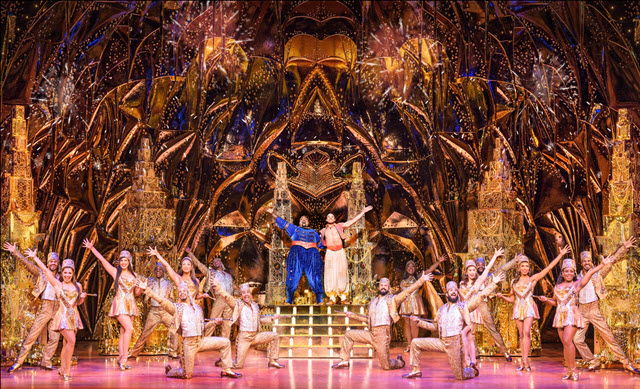 Friend Like Me ~ Aladdin North American Tour. Photo by Deen van Meer Everything you might expect from an Arabian spectacle is all here in eye-popping splendor, thanks to multiple Tony Award-winning Set Designer Bob Crowley. If only desert life was this colorful. Moorish minarets loom over sword swallowers, belly dancers and whirling dervishes as the handsome, oh so impoverished, Aladdin tries to woo the beautiful Princess Jasmine to save her and her kingdom from the clutches of the Sultan’s Grand Vizier, Jafar, and his vertically-challenged sidekick, Iago. Poor Aladdin, our hero is trapped in poverty, while Jasmine is trapped in a gilded cage. Nothing is simple in the kingdom of Agraba, but there’s a lot that’s hilarious. As Genie (played absolutely gloriously by Major Attaway) explains in his usual wry tone, “Everyone here has 0% body fat.”… except for Genie, who is a full-figured, jive-talking bundle of high-stepping, street-smart exuberance who can nail a medley of Disney show tunes as easily as he can grant three wishes.
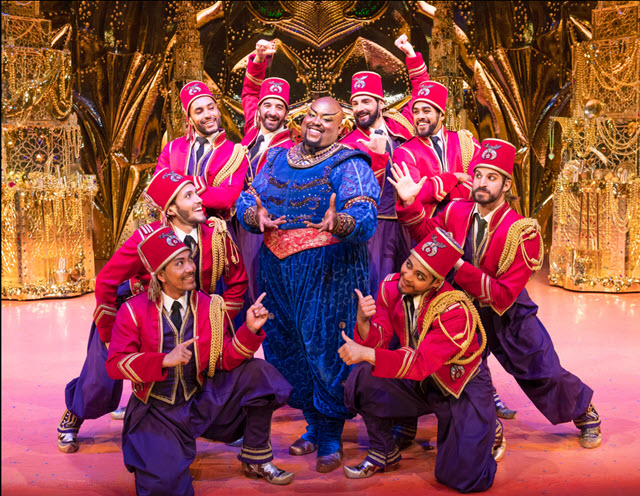 Friend Like Me ~ Major Attaway (Genie) & Ensemble Aladdin North American Tour ~ Photo by Deen van Meer There’s drama and frolic, and frolicsome drama as Aladdin finds himself in the aurelian ‘Cave of Wonders’ having been sent by the wicked Jafar to fetch the Genie’s golden lamp. Predictably, it’s a set up as Jafar plans to do away with our hero and grab the lamp for his own nefarious machinations.
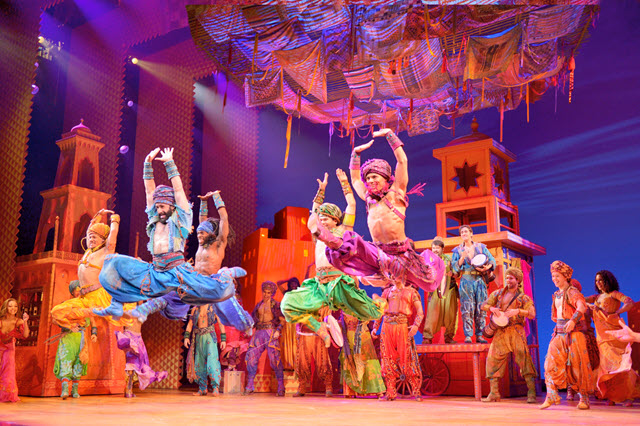 Arabian Nights Men ~ Photo by Deen van Meer But wait. Did I mention the magic carpet? Where would we be without a magic carpet ride to underscore Aladdin and Jasmine’s amorous vows to wed despite all odds? Traveling through the starry sky the pair soar above the stage in a flight of fantasy and wonder professing their love with the musical’s most memorable number, “A Whole New World”.
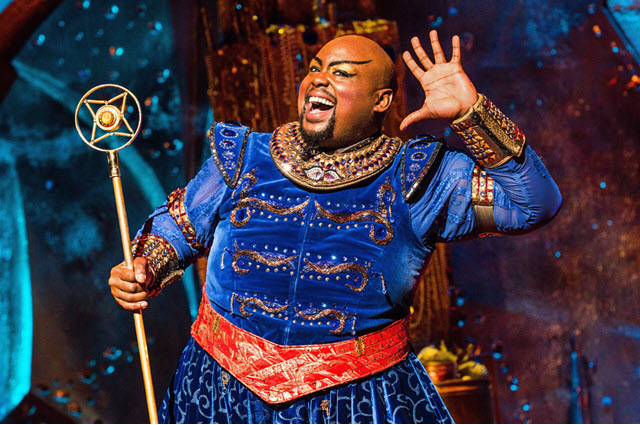 Major Attaway (Genie). Aladdin North American Tour. Photo by Matthew Murphy The score by Alan Menken (Little Shop of Horrors, Beauty and the Beast, Newsies) with lyrics by Tim Rice (Jesus Christ Superstar, Evita with Andrew Lloyd Webber), Howard Ashman (The Little Mermaid, Beauty and the Beast) and Chad Beguelin (The Prom, The Wedding Singer, Elf), is orchestrally wonderful, fulfilling a wide range of musical styles – some you might expect with an Arabian influence and others that trend rock/pop/rap – boosted by a sizzling horn section. The huge sound is from the Aladdin Touring Orchestra joined by the Kennedy Center Opera House Orchestra.
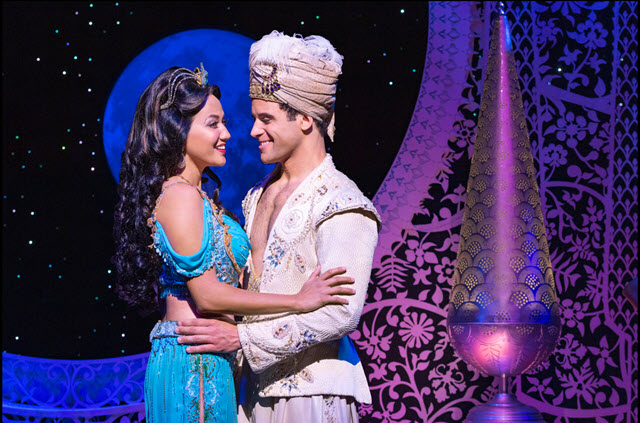 Kaena Kekoa (Jasmine) & Clinton Greenspan (Aladdin). Aladdin North American Tour. Photo by Deen van Meer Highly recommended. This one should be high on your wish list. Go before you run out of wishes.
With Major Attaway as Genie; Clinton Greenspan as Aladdin; Kaenāonalani Kekoa as Princess Jasmine; Jonathan Weir as Jafar; Jerald Vincent as Sultan; Reggie De Leon as Iago; Zach Bencal as Babkak; Ben Chavez as Omar; Colt Prattes as Kassim; and over 20 performers in the ensemble cast.
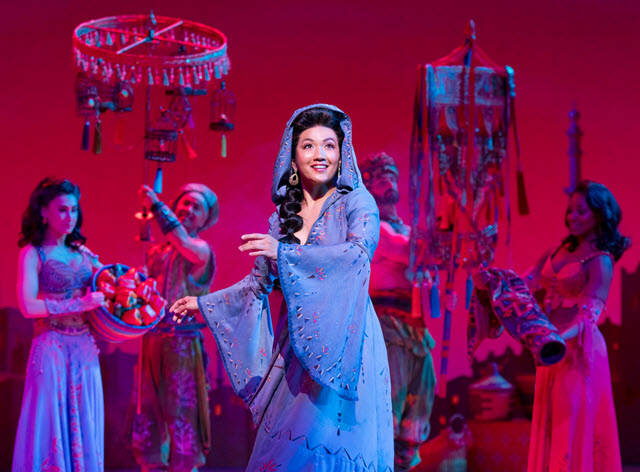 Kaena Kekoa (Jasmine). Aladdin North American Tour. Photo by Deen van Meer Directed and choreographed by Casey Nicholaw; Costume Design Gregg Barnes; Orchestrations by Danny Troob; Music Director/Conductor Faith Seeto; and Lighting Design Natasha Katz.
Through September 7th at the John F. Kennedy Center for the Performing Arts, 2700 F St., NW, Washington, DC. For tickets and information call 202 467.4600 or visit www.Kennedy-Center.org.
Jordan Wright
July 19, 2019
History, or shall we say “herstory”, will remember Ann Richards as one of the most colorful lawmakers in Texas politics… and that’s truly saying something about a state that has had its share of unusually quirky politicians. As a mother of four who never planned to dive into the political arena, she had one of the most notable careers in politics – one made especially memorable by her powerful keynote address at the 1988 Democratic National Convention. As a housewife and member of the Waco Women’s Club, she thought she’d always be a stay-at-home mom. But when her civil rights attorney husband turned down a run for the position of County Commissioner, and friends suggested she run, Richards threw her hat into the proverbial ring and trounced a Republican incumbent. Later this savvy lady parlayed her way into becoming the Texas State Treasurer, and later the governorship by being part cajoler, part charmer, and all business. It didn’t hurt that she had the gift of Southern gab, was warm-hearted and tossed out quotable one-liners to rival any standup comedian.
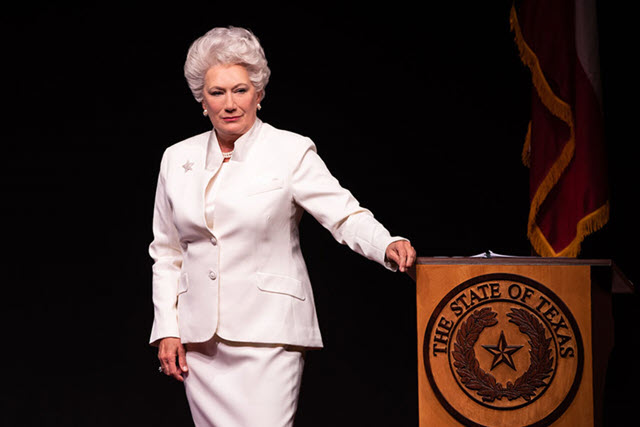 Jayne Atkinson as Ann Richards in “Ann” running July 11 through August 11, 2019 at Arena Stage at the Mead Center for American Theater. Photo by Margot Schulman. After a rocky start due to her love affair with the bottle, she experienced a family intervention, went to rehab, and never looked back. It didn’t hurt that as a girl and daughter of a good old boy who weaned her on bawdy jokes, the family moved to San Diego where she attended her first integrated school. There she developed what she refers to as “a passion for simple fairness” that was to define her life’s work as an advocate for racial justice, women’s rights, and the protection and advancement of social security. “Life isn’t fair, but government should be,” she insisted.
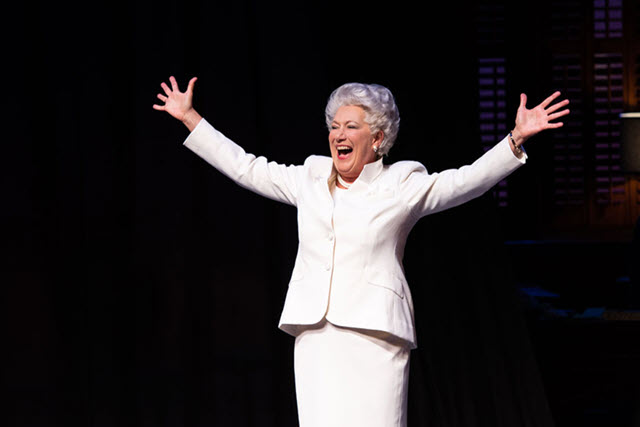 Jayne Atkinson as Ann Richards in “Ann” running July 11 through August 11, 2019 at Arena Stage at the Mead Center for American Theater. Photo by Margot Schulman. Ann, the one-woman, two-acter starring Broadway and TV actor, Jayne Atkinson, crystallizes the political life and bon mots of this feisty force of nature and home-grown feminist. Holland Taylor, a multi-award- winning Broadway, TV and film star who wrote and starred in the original Broadway production, begins Richard’s story before and after her loss of a second gubernatorial term to George W. Bush. The first act focuses on her address to a graduating high school class peppered with recollections of her career and hilarious, yet sage, advice. But it’s in Act Two, set in the governor’s private office, where the play really takes off and her humor ratchets up to warp speed as she fields incoming calls from her disjointed family as well as from her pal, President Clinton, and other influential politicos, while trying to plan a family holiday, a parade appearance, and other routine duties.
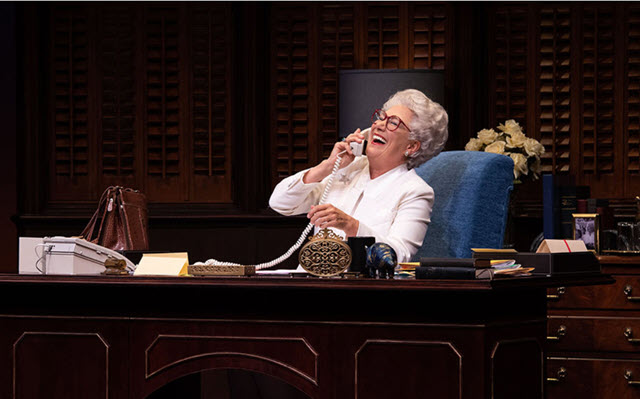 Jayne Atkinson as Ann Richards in “Ann” running July 11 through August 11, 2019 at Arena Stage at the Mead Center for American Theater. Photo by Margot Schulman. Directed by Kristen Van Ginhoven, Set Design by Juliana Von Haubrich, Costume Design by Jess Goldstein, Lighting Design by Andi Lyons, Sound Design by M. L. Dogg.
Highly recommended.
Through August 11th in the Kreeger Theatre at Arena Stage, 1101 Sixth St., SE, Washington, DC 20024. For tickets and information call 202 488-3300 or visit www.ArenaStage.org.
Jordan Wright
July 16, 2019
The Band’s Visit is a timeless musical, a romantic intrigue, and a wryly funny tale based on a true story. You may have seen the movie, but the musical allows the story to be fully fleshed out bringing to life the story of a 7-piece classical Arab band known as the Alexandria Ceremonial Police Orchestra and its conductor, Colonel Tewfiq, and how they all wind up in a dusty desert town in Israel where no one is expecting them. Winner of ten Tony Awards including “Best Musical” and “Best Original Score”, the sultry number “Omar Sharif” was performed on the night of the 2018 awards. Countless other prestigious theater awards have showered down upon this tenderhearted tale with original screenplay written by Eran Kolirin, book by Itamar Moses with composer/lyricist David Yazbek, and beautifully directed by David Cromer. It stars Sasson Gabay, who played the lead in the film version, as well as Chilina Kennedy (Carole King in Beautiful on Broadway), Pomme Koch and Joe Joseph, both of whom were in the Broadway cast.
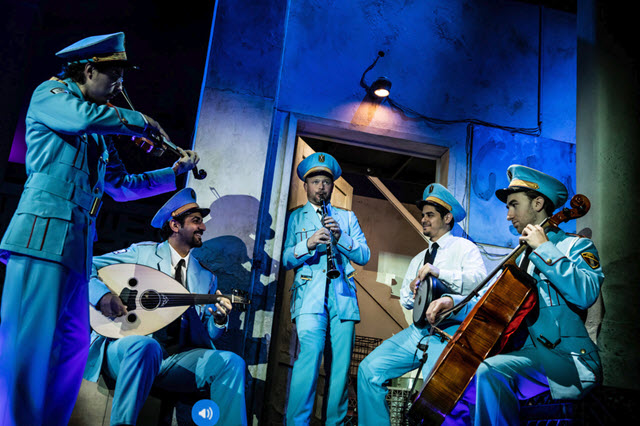 ‘The Band’s Visit,’ now playing at The Kennedy Center. Photo by Matthew Murphy. Imagine Tel Aviv in 1996. Egyptian music and movies have been banned even though generations of Israelis have thrilled to the haunting voice of the internationally famous singer, Umm Kulthum, and films starring the divinely suave and handsome Egyptian box-office idol, Omar Sharif (Lawrence of Arabia and Dr. Zhivago). It is a fraught time, not so different from today, when cultures are separated by politics or war, and borders, real or imagined, are redrawn or redefined. And it is how Tewfiq and Dina find their music connection.
When the youthful Haled purchases the band’s tickets and mistakenly gives the wrong name for their destination, his miscommunication sends the men to Bet Hatikva, a tiny town where nothing ever happens and where the song “Waiting”, sung by the residents of the town, describes their ennui. At the café the musicians meet the lovely and fiery Dina, owner of the town’s sole café, who finds them homes to stay for a single night till the next day’s bus can take them to their correct destination.
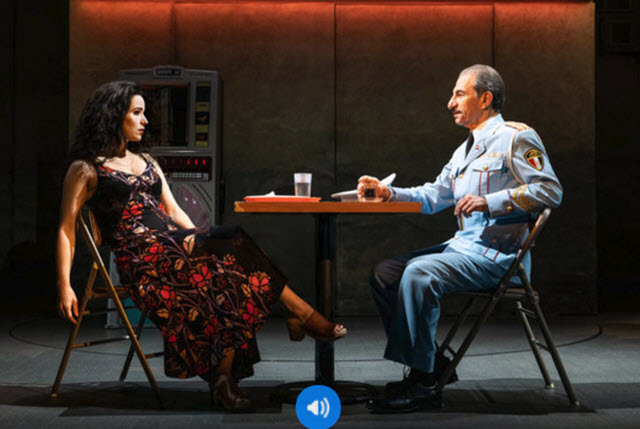 Chilina Kennedy as Dina and Sasson Gabay as Tewfiq in ‘The Band’s Visit.’ Photo by Matthew Murphy. Nine musicians – including players of the traditional Arab instruments oud, darbouka and riq – perform all the numbers onstage in a sort of musical ballet assisted by a rotating center stage. This beautifully expressed musical accompaniment weaves together the characters’ personal stories enhancing their shared communion with their temporary hosts. The story centers around the initial awkwardness of the two separate cultures attempting to understand each other’s cultural differences, ultimately discovering that they are more similar than not, and that love and family and the universality of music are at the heart of the human connection.
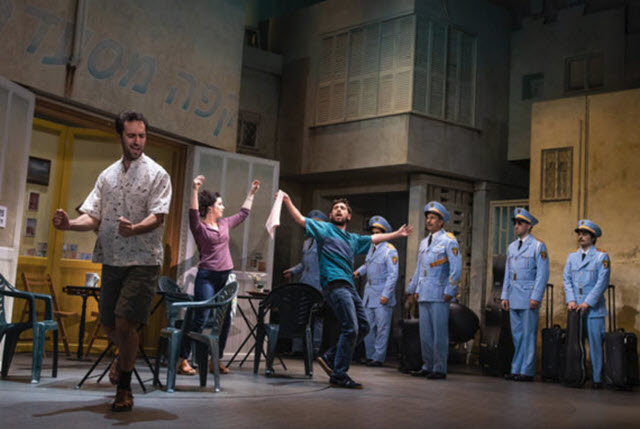 ‘The Band’s Visit,’ now playing at The Kennedy Center. Photo by Matthew Murphy. Highly recommended. Take everyone you know!
With Chilina Kennedy (Carole King in Beautiful on Broadway) as Dina; Sasson Gabay as Tewfiq; Pomme Koch as Itzik; Joe Joseph as Haled; Mike Cefalo as Telephone Guy; Adam Gabay as Papi; Ronnie Malley as Camal; David Studwell as Avrum; Jennifer Apple as Anna; Marc Ginsburg as Sammy; Kendal Hartse as Iris; Sara Kapner as Julia; James Rana as Simon; and Or Schraiber as Zelger. The Band is conducted by Rick Bertone, Music Director – with Tony Bird, George Crotty, Evan Francis, Roger Kashou, and Ronnie Malley.
Choreography by Patrick McCollum; Scenic Design by Scott Pask; Sound Design by Kai Harada; Costume Design by Sarah Laux; Lighting Design by Tyler Micoleau.
Through August 4th at The John F. Kennedy Center for the Performing Arts in the Eisenhower Theater – 2700 F St., NW, Washington, DC. For tickets and information call 202 467-4600 or visit www.Kennedy-Center.org
Jordan Wright
July 8, 2019

Is soul music making a comeback? With the recent success of Ain’t Too Proud – The Life and Times of the Temptations garnering 12 Tony Award nominations this season and Pride & Joy – The Marvin Gaye Musical that played the National Theatre two months ago, I’d say there’s an audience hungry to recapture those funky rhythms, groovy backbeat, slick harmonies and smooth vocals. In Soul Redeemer by composer and lyricist Neal Learner (LIFE: A Comic Opera in Three Short Acts) in collaboration with Paul Handy (a veteran of four Capital Fringe Festival productions), the early 70’s vibe is on point both musically and visually.

The new musical stars Bryce Monroe, as Buddy King, a soul singer who flamed out on drugs in the high-flying 70’s and is looking to get back onto the charts. Unfortunately, Buddy burned a lot of people, including his wife, Jeanine (Isabelle Pickering/Christina McCann), his producer, Jake (Evan Thanicatt), and his two backup singers, Quincy (Anthony Williams) and the sexy Melody (Melanie Lawrence), whom he has the hots for, much to the dismay of his pop singer wife. It’s a tragedy, a romance and a comedy set to soul music with a disco scene thrown in for good measure.
 (l-r) Isabelle Pickering and Bryce Monroe.
Handy conceived the show and Learner wrote all eight of the period songs giving the cast free rein to interpret his music and context resulting in a vibrant collaboration and a convincing freshness to his material. Both Monroe and Williams have strong, soulful voices and hot chops that put this one on your must-see Fringe list.
Nicely directed by Anya Randall Nebel, the talented cast of locals moves to the groove with terrific voices and fierce emotion.
Produced by Don Michael Mendoza of LA TI DO Productions www.latidoproductions.com with Assistant Director Larry O. Grey, Jr., and LeVar Betts and Josh Cleveland Co-Directing. A five-piece kickass band backs up the singers.
Last dates July 20th , 21st , 25th and July 27th at Westminster Presbyterian Church “Pickle”, 400 I Street, SW, Washington, DC 20024.
TWO FOR A SONG ~ PLUS ONE!
 (l-r) Doug Bowles “Warbler” and Alex Hassan “Pianoodler” Doug Bowles and Alex Hassan are back on Maple Avenue’s Creative Cauldron with more laughter, merriment, touching songs and stories, and where they’ll perform the beloved songs you know and some you haven’t yet heard from their research into the lost and forgotten songs of the ‘Great American Song Book’. The show is part of Creative Cauldron’s ‘Cabaret Series’ which features a cabaret or concert every summer weekend.
 Alex Hassan ~ Pianoodler A few notes on the amazing Alex Hassan: As current president of the Northern Virginia Ragtime Society, Alex Hassan has been thoroughly immersed in the musical styles and arrangements of the 20’s and 30’s for over four decades. As a renowned collector of over 50,000 pieces of popular sheet music wedged between the World War I and II, Hassan recreates the spirited and glorious melodies of the Golden Age of popular music.
Amongst the highlights of his musical career, Alex counts performances at the Smithsonian, the Scott Joplin Festival in Sedalia, MO, where he will return this year, New York’s tony Player’s Club, Toronto’s McMichael Art Gallery, Kennedy Center’s Millennium Stage, England’s Aldeburgh Festival, and the Husum, Germany “Piano Rarities” festival.
In the 1990’s and 2000’s, Alex recorded regularly for the UK company, Shellwood. Currently, Hassan has three solo piano CDs that are available on the Operetta Archives label, along with one recorded for the Pittsburgh-based Rivermont Records. Alex has also written program notes for CD reissues of notable 78 rpm performances by syncopating pianists of the past. Alex’s flying fingers will do their usual magic with recent arrangements of his own piano solos.
 Doug Bowles Doug Bowles is a tenor extraordinaire and much sought-after Musical Director with an extensive background in voice and theater who serves on the faculty of both Howard University and the Catholic University and who has directed nearly 200 musical productions. His collaboration with Hassan has taken the performers around the country and across the pond performing songs by 1930s composers from Harold Arlen to Fats Waller to George Gershwin. Bowles’ entertainment company SingCo Music represents Bowles’s hot jazz and swing band “Doug Bowles and his SingCo Rhythm Orchestra”, a multiple Wammy-nominated orchestra that has performed at many venues including the Glen Echo Spanish Ballroom, on The Voice of America, and at The National Archives. Bowles has also appeared with noted, Grammy Award winning band leader, Vince Giordano and his Nighthawks, (Boardwalk Empire, The Aviator, Prairie Home Companion, Bessie). www.dougbowles.com

The guys will be joined by the dulcet voiced actor/singer, Jennifer Timberlake who has performed around the DC area including at The Kennedy Center, Olney Theatre Center, Round House Theatre, The Washington Stage Guild and Adventure Theatre. Timberlake counts both Patsy in Always…Patsy Cline and Carrie in Carousel as her favorite roles.
As usual, the warblers and ‘pianoodler’ will introduce you to amazing “new” songs of the 20’s and 30’s. This performance will also be the world premiere of two new transcriptions/arrangements of songs by beloved 1920’s songstress, recording artist and famed Broadway performer, Esther Walker, as interpreted by the lovely Miss Jenn. Thrill to a rarely heard, but exquisite tune by Jerome Kern, and a fabulous selection of tunes you will no doubt want to sing along with.
You Can’t Go Wrong with Two For a Song!
Two shows only. Friday July 12th at 8pm and Saturday, July 13th at 8pm at Creative Cauldron, 410 South Maple Avenue, Retail 116, Falls Church, VA 22046. For information on this show and upcoming summer cabarets and concerts call 703 436.9948 or visit Creative Cauldron web booking,
|