Full disclosure: I am a descendant of Edward Teach aka Edward Thatch aka Blackbeard.
Okay, now that my admission of partiality is out of the way, I can talk about why the world premiere of Blackbeard is a rousing success. First and foremost, Lyricist John Dempsey (Brother Russia, The Witches of Eastwick, The Fix) and Composer Dana P. Rowe (Dempsey’s collaborator on the same award-winning shows) have chosen the consummate swashbuckling blackguard to lead us into a hilariously unconventional fantasyland of pirates and their amours. Directed by Signature’s Artistic Director Eric Schaeffer, this turbo-charged adventure is based on the legendary exploits of the infamous 18th century privateer.
Awa Sal Secka (Shanti), Kevin McCallister (Caesar), Chris Hoch (Blackbeard), Christopher Mueller (Jake), and Lawrence Redmond (Samuel) in Blackbeard at Signature Theatre. Photo by Christopher Mueller.
Punctuated with dazzling pyrotechnics, the snicker-snack of gleaming swords, and booming cannons so thunderous that the floor actually quakes beneath your feet, this lusty new musical introduces us to the life of the dastardly pirate, Blackbeard.
Maria Egler (Morgan), Lawrence Redmond (Samuel), Christopher Mueller (Jake), Ben Gunderson (Garrick), Awa Sal Secka (Shanti), and Kevin McAllister (Caesar) in Blockbeord at Signature Theatre. Photo by Margot Schulman.
Conceiving a plan to conquer the British navy and achieve notoriety, Blackbeard seeks out his former lover, Dominique, a dazzlingly alluring temptress who rules the high seas. His aim: To gain access to her sorcery and recruit an army of the undead. Her aim: To secure her freedom from the island where he abandoned her and conscript him to bring her three precious jewels. To achieve this perilous feat, Blackbeard must travel to the kingdoms of Japan and India and confront the Norse gods of Scandinavia.
Nova Y. Payton (Dominique) in Blockbeord at Signature Theatre. Photo by Christopher Mueller.
Accompanied by Roger, a clever young stowaway, his trusty African Captain Caesar, Karl, a curiously reticent sailor, and a scurrilous band of ne’er-do-wells, Blackbeard travels across stormy seas on his perilous mission.
Veteran Broadway actor Chris Hoch (War Paint, Amazing Grace, Matilda, Shrek: The Musical, Beauty and the Beast, Dracula), with his marvelously commanding voice and stage presence, gives us an imposing Blackbeard, while leading lady Nova Y. Payton blows us square out of our seats with her powerhouse singing and fierce portrayal of the payback-seeking Dominique who enchants Blackbeard in the sultry number “Spellbound’. Equally engaging is Lawrence Redmond’s finely tuned portrayal of the Old Man and Bobby Smith as Ódinn, the Viking ruler, who engages Blackbeard in an uproariously comical drinking contest in the number “Valhalla” – “Val-ha-ha-ha-la”!
As bold and colorful as these pirates is Paul Tate Depoo III’s set design. Rigged with ship’s lines for clambering and a massive ship’s prow, the two-level set is wonderfully atmospheric.
It’s all tongue-in-cheek as this band of buccaneers takes us on a wild ride to exotic ports of call.
Ben Gunderson (Lt. Maynard) and Chris Hoch (Blackbeard) in Blockbeord at Signature Theatre. Photo by Christopher Mueller.
Highly recommended. A rousing adventure with a memorable score.
Ten actors play over 60 roles. With Chris Hoch as Blackbeard; Nova Y. Payton as Sally/Dominique; Rory Boyd as Roger; Lawrence Redmond as Samuel/Old Man; Kevin McAllister as Caesar; Bobby Smith as Karl/Ódinn; Maria Egler as Morgan/La Mer; Ben Gunderson as Garrick/Lt. Maynard; Christopher Mueller as Jake/Kamikase; and Awa Sal Secka as Shanti/Kali Maa.
Conducted by Jon Kalbfleisch; Choreography by Matthew Gardiner; exceptionally costumed by Erik Teague; Lighting Design by Chris Lee; Sound Design by Ryan Hickey; Orchestrations by David Holcenberg & Scott Wasserman; Fight Choreography by Casey Kaleba.
Through July 14th at Signature Theatre (Shirlington Village), 4200 Campbell Avenue, Arlington, VA 22206. For tickets and information call 703 820-9771 or visit www.signature-theatre.org.
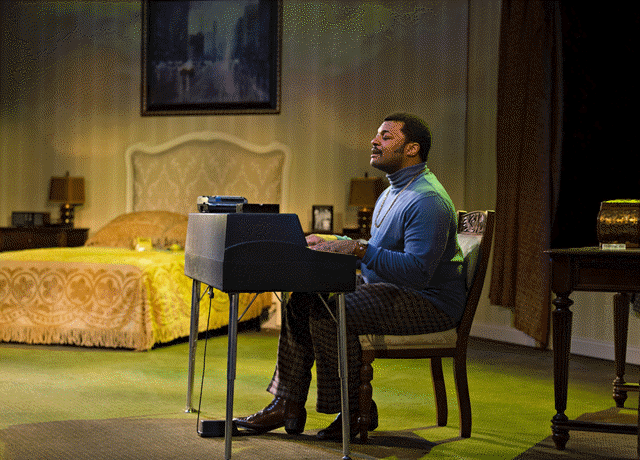
Twisted Melodies, a dramatic interpretation of the last day of Donny Hathaway’s life, touches us on so many levels. As a consummate songwriter and performing artist, Hathaway was one of the most enduring talents during the height of the 1970’s R&B scene. An accomplished pianist, soul, blues and jazz singer, and collaborator with Roberta Flack (The Closer I Get To You), he borrowed from his gospel roots reinterpreting his melodic memories into one of the most recognizably appealing sounds of the decade. For area audiences it’s a special treat to experience this powerful production and revisit some of his music, as Hathaway was well known in DC circles where he attended Howard University during the Civil Rights era.
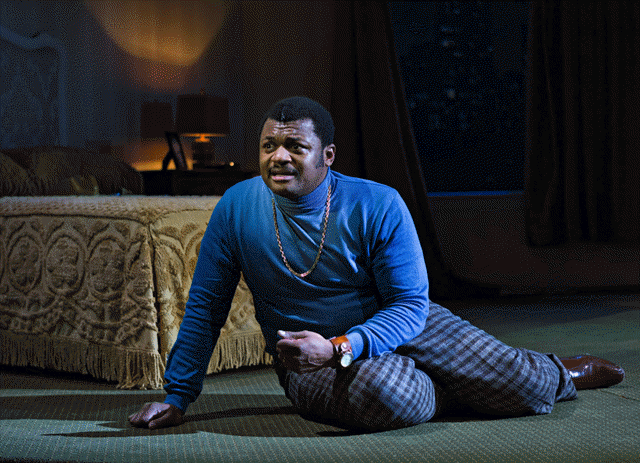
Making its DC premiere at Mosaic Theatre in association with New York’s famed The Apollo Theater, its writer, star, and musical director, Kelvin Roston, Jr., presents an indelible foray into Hathaway’s psychological turmoil. Roston’s skill at becoming Hathaway’s doppëlganger captures the artist in his most fragile period after he had been hospitalized several times with a diagnosis of paranoid schizophrenia and was living on a dangerous cocktail of medications that served only to increase his fears and insecurities.
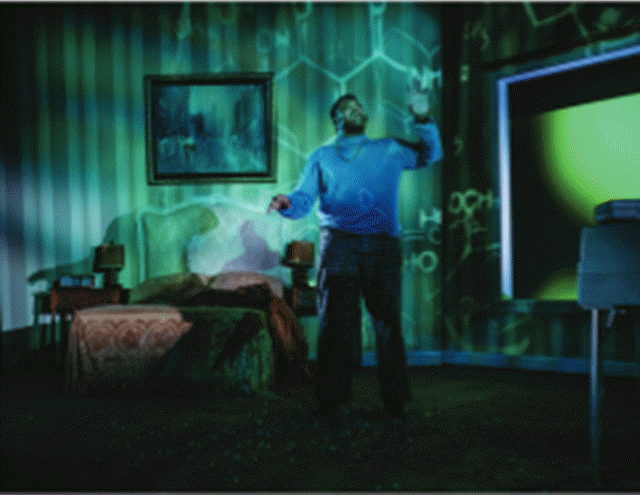
Set in a New York hotel room where Hathaway is surrounded by his demons – a ghost named Duke, disembodied voices and fears of his room being bugged – the terrified singer fights to keep it together on the eve of his comeback. “I gotta focus! Twist it into melodies. Everybody is depending on me.” Interspersed with songs by Hathaway and other artists – Leon Russell, George Clinton, Stevie Wonder – played on an electric piano, Roston dramatizes Hathaway’s decline as both an artist and father.
Roston’s tour de force portrayal of a tormented soul in full-blown crisis mode is skillful beyond imagining. Not only is his beautifully written script filled with passion and raw emotion, but more incredibly, he takes on Hathaway’s entire persona in what would be a physically and emotionally draining role for any actor. Along the way, he reaches out to the audience, as though we are a part of his rehabilitation. As his “angels” and “muses”, he calls out to us for support, acknowledging our presence as he strives to transform his anger and weakness into beauty.
Highly recommended.
Directed by the award-winning Derrick Sanders, Set Design by Courtney O’Neill, Costumes by Dede Ayite, Lights by Alan C. Edwards, Sound by Christopher M. LaPorte, and Projections by Mike Tutaj. Presented in co-production with Baltimore Center Stage and The Apollo Theater.
Through July 21st at the Atlas Center for the Performing Arts in the Theresa and Jane Lang Theatre – 1333 H Street, NE, Washington, DC 20002. For tickets and info on post show discussions, special rates and discounts visit www.MosaicTheater.org or call the box office at 202.399.7993 ext. 2. Valet parking at 1360 H Street, NE.
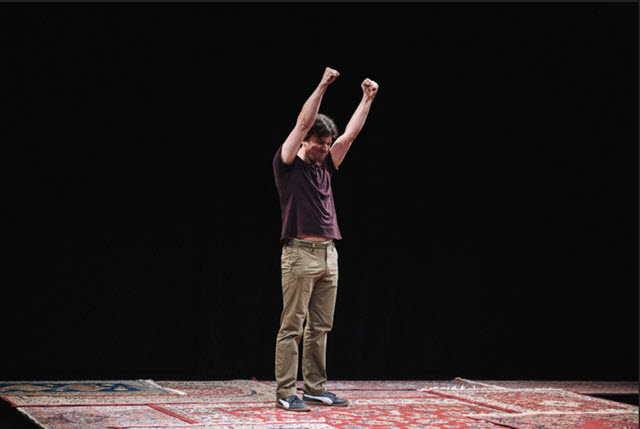
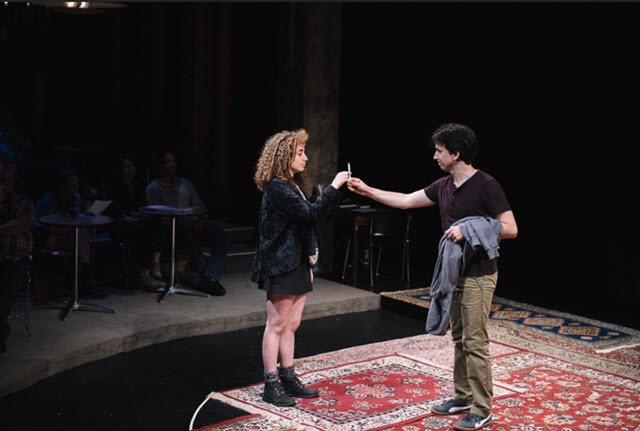
Studio Theater’s new Milton Theatre is looking to attract a summer crowd and last night it did. Called SHOWROOM it is a casual space offering specialty cocktails and snacks at the bar. Olney Theatre Center’s production of Every Brilliant Thing, by playwrights Duncan MacMillan and Jonny Donahoe, is a one-man, one-act play about suicide and was the first of the off-beat performances of the season. Pleasantly ensconced at café tables lit with candles, the youngish crowd had bought their drinks and looked ready for a Friday date night that promised audience participation. Touted as a comedy, it seemed as though fun was just around the corner.
Alexander Strain and an audience member in Every Brilliant Thing. Photo: Teddy Wolff.
So, maybe I should have had what they were drinking, or snagged one of the cards that was handed out in advance to a smattering of guests so they could call out some of the “brilliant things” Alexander was grateful for while his mother lay in hospital after another suicide attempt. But for me, no amount of jokes or self-deprecating comedic schtick could subtract from the fact that a family was being torn asunder by a mother’s crushing depression and nothing could stop that fateful train from jumping the tracks.
Alexander Strain and an audience member in Every Brilliant Thing. Photo: Teddy Wolff.
Thinking about my feelings for the play, I drifted off to sleep that night and had a dream about it – a dream as quirky as the play itself. I dreamed that Amy Schumer was in a play she had written and was eager to get a group of us into the theater to see it. She described it as a story about her mother’s suicide. We didn’t want to see her act out her personal tragedy, but she begged us to participate. We entered the theater (in Greece, no less) and the more we listened, the more we wanted her to stop. Because though it seemed to be alleviating her sorrow, we couldn’t bear to hear the whole dismal story.
The audience and Alexander Strain in Every Brilliant Thing. Photo: Teddy Wolff.
That’s what this play is about more or less, except that the audience is conscripted to shout out these brilliant things like “ice cream”, “staying up past bedtime”, “things with stripes”, etc. Much of the time these non-actors couldn’t be heard across the room. My seatmate turned to me on several occasions with a quizzical look, as if hoping I would tell him. That left us wondering what the brilliant thing was that Alexander as the child, who later presents as a teenager, and ultimately a college student with his own crushing depression, might have said.
I’ll grant you it might seem like a healthy psychological exercise to look for the sunny side of life while everything around you is crumbling, but nonetheless, it doesn’t work out in the end for Alexander, even though a woman from the audience has been asked to play his dying dog’s vet, another has been asked to play his guidance counselor, and a man is challenged to play Alexander’s father, a man so removed from his child’s life, he closets himself away when the going gets tough.
Audience members and Alexander Strain in Every Brilliant Thing. Photo: Teddy Wolff.
Once in college Alexander learns of Goethe’s notions about suicide and subs an audience member to play the part of his college professor. He references ‘social contagions’ and agrees with the notion that we are unconsciously affected by the behavior of our peers – as in copycat suicides. It’s called the ‘Werther Effect’ after Goethe’s notable character. As Alexander tells us, “Children of depressed mothers have a heightened sense of stress.” It would be good to keep this warning in mind when writing a play about suicide.
The evening’s oddest moment came when a pretty girl who was asked to pretend she was Alexander’s girlfriend didn’t understand how the game was played. Everyone else in the audience had understood they were to parrot the words he voiced aloud to them but even after he repeatedly fed her the lines, she opted to concoct her own responses until she finally had that aha moment and played along. LOL… or not.
Alexander Strain and an audience member in Every Brilliant Thing. Photo: Teddy Wolff.
So, see it if you’ve never known anyone who has committed suicide. That’s my warning. Just be sure to order a cocktail first. Who knows? You might find it amusing.
Directed by Jason Loewith and starring Alexander Strain.
Through July 7th at Studio Theatre – 1501 14th Street, NW, Washington, DC 20005. For tickets and information about the remaining shows in the run, visit www.StudioTheatre.org or call 202 232.7267
Written at the height of the AIDS epidemic, Falsettos has been an anthem to the love and emotional support gays and their families experienced as they watched their love ones die off in droves. It had its Broadway debut in 1992, but before that the musical had appeared Off-Broadway as March of the Falsettos in 1981 and Falsettoland in 1990. Thanks to Composer and Lyricist James Lapine’s efforts, you’d be hard pressed to find a musical with a more difficult score to sing.
Trina, Jason and Marv in Eden Espinosa, Thatcher Jacobs and Max von Essen. Photo by Joan Marcus.
It is a story of Marvin, his wife, Trina, and their boy, Jason. When Marvin leaves his family for Whizzer, a cocky, handsome gay man, the couple turns to Mendel, the psychiatrist to sort it all out. Mendel falls for Trina and, oh well, it’s complicated.
Mendel and Marvin – Nick Blaemire and Max von Essen. Photo by Joan Marcus.
If you look at it as a story only about gays and AIDS, it seems incontrovertibly dated. A broader perspective might be to think of it in terms of devotion or, perhaps, altruism – the devotion of caregivers and the empathy required to sacrifice one’s own needs for another’s touches everyone. At least that’s how I came to view it, because, in that deeper way, it can be far more relatable.
But it’s not for everyone. It’s overly long, nearly three hours, and demands our sympathies in uncomfortable ways. Do we like how Marvin destroys his marriage to Trina and cavalierly ignores his own son? Certainly not. Is he not vain, egotistical, obsessive, hurtful and destructive? All of the above. Do we notice that their shrink Mendel cuckolds Marvin, his original patient? Indeed, we do. What about the tempestuous and superficial relationship between Whizzer and Marvin? “We like fighting most,” he admits. Should we care? And, though they are Jewish, their only nod to religion is their insistence that Jason have a Bar Mitzvah, even though the boy is dead set against one. The pessimism, obsessions and neuroses can be soul-killing to witness.
Marvin and Whizzer ~ Max von Essen and Nick Adams. Photo by Joan Marcus.
In “Trina’s Song” she laments that men are so immature yet rule the world. Here, Lapine and Finn offer a brief nod to women’s liberation and her hopes for a more fulfilling life, but then do a 180 making Trina a stay-at-home wife and mother. It is only when Whizzer is dying and Marvin returns to care for him with their lesbian neighbors, Cordelia and Dr. Charlotte, that we witness the human connection.
Cordelia and Dr. Charlotte ~ Audrey Cardwell and Bryonha Marie Parham. Photo by Joan Marcus.
As a sing-through that includes 37 titled numbers and scenes, the musical stretches the vocal talents of any singer and in this production it takes a host of Broadway veterans.
The Company ~ Photo by Joan Marcus
Directed by James Lapine, Set by David Rockwell, Costumes by Jennifer Caprio, Lighting by Jeff Croiter, Choreography by Spencer Liff, and Sound by Dan Moses Schreier.
With Max Von Essen as Marvin, Thatcher Jacobs or Jonah Mussolino as Jason, Nick Adams as Whizzer, Nick Blaemire as Mendel, Eden Espinosa as Trina, Bryonha Marie Parham as Dr. Charlotte, and Audrey Cardwell as Cordelia.
Through June 23rd in the Eisenhower Theater at The John F. Kennedy Center for the Performing Arts, 2700 F St., NW, Washington, DC. For tickets and information call 202 467-4600 or visit www.Kennedy-Center.org.
Evan Linder’s play has all the elements of a hackneyed soap opera starring a young, broke, white couple with adultery issues and a bible-thumping mother in bitterly acrimonious conflict with her daughter and son-in-law, Jim. If not for Linder’s uncompromising storytelling, an admirable and passionate cast, and superb directing, it would seem like a story we have heard all too many times with the exception that this one comes with sharp incisors and a propensity for equal doses of poignancy and hilarity.
(L-R) Caroline Neff, Jack Falahee, and Cecelia Wingate ~ Photo by Jeremy Daniel.jpg
Overdue and big as a watermelon, Laurel cuddles up with Jim who is excited about the prospect of a son, “Are you my stupid baby?” he asks sweetly, ear to Lauren’s swollen tummy. Even Laurel’s mother, Celeste, whose late husband was a serial philanderer and doesn’t cotton to her out-of-work son-in-law, can’t wait to be a grandma. “The only thing I care about is this baby.”
(L-R) Blake Morris and Jack Falahee ~ Photo by Jeremy Daniel.jpg
A few years before, Jim had a brief fling. Laurel reluctantly forgave him, and, still very much in love, they recommitted themselves to their marriage. But when the baby is born and is black, Jim loses his mind, blaming his best friend, Karl, who happens to be African American. Celeste’s reaction is mortification about what the townspeople will think of her and her daughter, insisting Laurel “get rid of it”.
(L-R) Blake Morris and Aime Donna Kelly ~ Photo by Jeremy Daniel.jpg
There are so many spoilers that I won’t reveal any more of the plot as the story takes twists and turns so serpentine that it proves totally unpredictable as to where the characters’ paths take them. Do we like them? Not always, but we are kept in jocular hysterics by both their Southern-ness and their messy lives. Celeste’s drawl and quirky backwoods metaphors alone are priceless. To put a frame around it, Linder, who is white, references the ghost of civil rights activist, Skip Robinson, leader of a 1974 boycott of businesses in Byhalia after the shooting death by a local policeman of a young, unarmed black man named Butler Young, Jr. Young’s memory was ignored by Byhalia, and still is. Linder is determined to correct the town’s selective memory and provoke a conversation about race relations. You will see that there is racism on both sides here, and emotional disconnects that are a mile wide.
(L-R) Jack Falahee, Blake Morris, and Aime Donna Kelly ~ Photo by Jeremy Daniel.jpg
Byhalia, Mississippi is a story about truth, forgiveness, commitment and racism – real or imagined. It is also a sweet, crazy tale of hope and redemption set in a blip of a provincial town caught up in a changing world. As Laurel, who commits to raising her baby, tells her mother, “Nothing ever changes unless people like you watch it happen.”
Highly recommended. A perfect cast beautifully directed by Kimberly Senior. You will be glued to your seat, if you don’t keel over from laughter.
With Caroline Neff as Laurel, Cecelia Wingate as Celeste, Jim Falahee as Jim, Blake Morris as Karl, and Aimé Donna Kelly as the surprise character, Ayesha.
(L-R) Jack Falahee and Caroline Neff 2 ~ Photo by Jeremy Daniel.jpg
Scenic Design by Cameron Anderson, Costume Design by Jen Caprio, Lighting Design by Jennifer Reiser, and Sound Design by Mikhail Fiksel.
Through July 7th in the Terrace Theater at The John F. Kennedy Center for the Performing Arts, 2700 F St., NW, Washington, DC. For tickets and information call 202 467-4600 or visit www.Kennedy-Center.org.
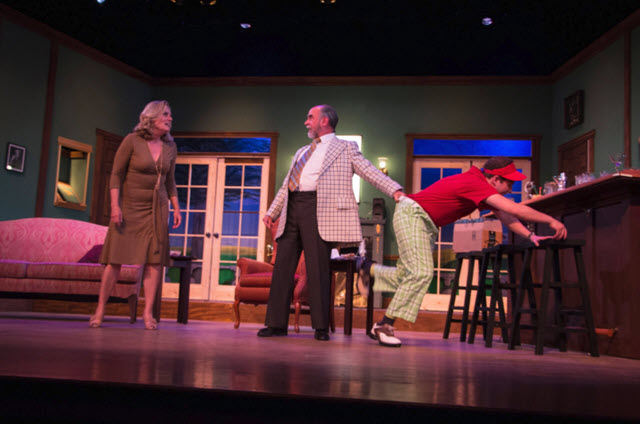
“Golf and sex are the only things you can enjoy without being good at them,” announces Pamela, a sophisticated member and perennial sexpot of the Quail Valley Country Club.
: (L -R) Patricia Nicklin as Pamela Peabody, Ken Kemp as Henry Bingham and Cameron McBride as Justin Hicks ~ Photographer: Matt Liptak
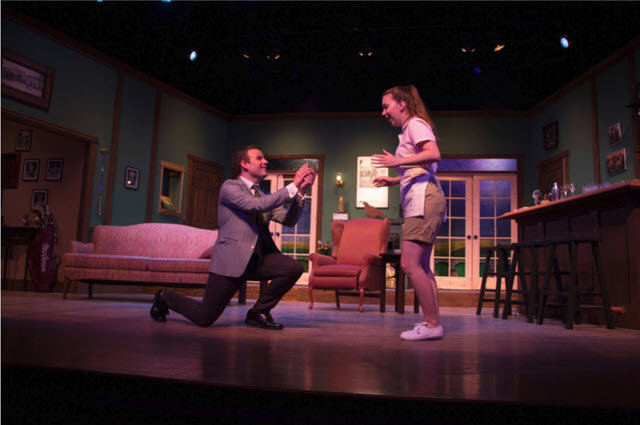
When we meet Richard Bingham, the urbane manager of Quail Valley, it’s tournament weekend and the mood is dire. Quail Valley has never won the annual golf tournament against their rival Crouching Squirrel. And to make matters worse, their ace player has defected. But the debonair club director, Bingham, has plans for a reversal of fortune with the entry of its newest member with a pro’s handicap. Unfortunately, Bingham’s counterpart and nemesis from Crouching Squirrel, Dickie, has a surprise of his own and the old archenemies bet a king’s ransom, including Bingham’s wife Muriel’s antique shop, on the outcome.
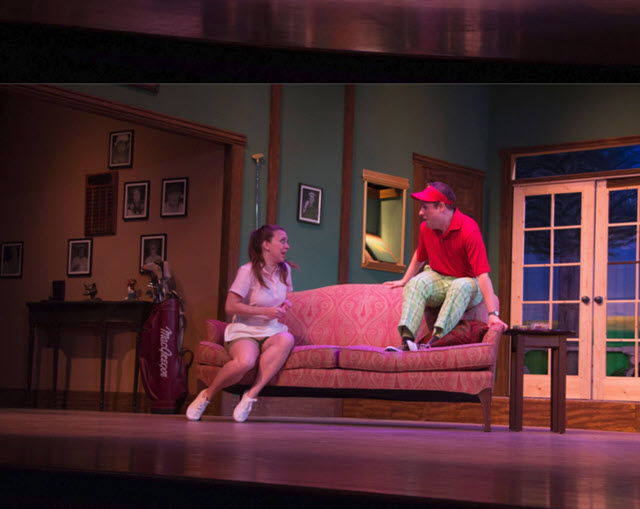
(L-R) Cameron McBride as Justin Hicks and Raeanna Larson as Louise Heindbedder ~ Photographer: Matt Liptak
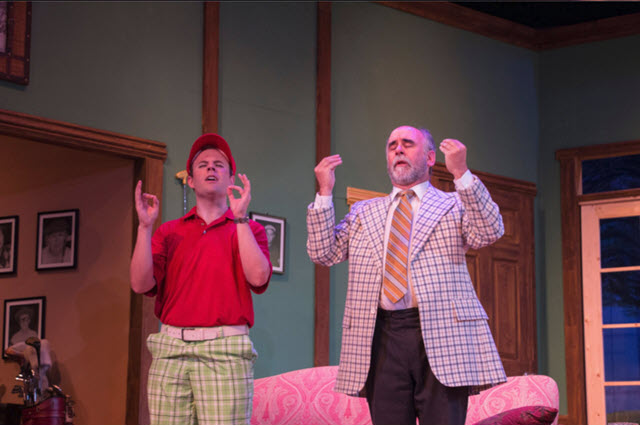
Dickie is a veritable Mr. Malaprop sporting garish golf attire and mixing his metaphors with clueless aplomb. The champagne-swilling Pamela of the multiple spouses, claims, “I would drink water but there’s so much fish in it.” She is sharp, witty and fiercely snide. In a swipe at her ex-husband, Dickie, she snarks, “Never use box tops to buy wearing apparel.”
(L-R) Raeanna Larson as Louise Heindbedder and Cameron McBride as Justin Hicks ~ Photographer: Matt Liptak
Our young romantics are the club’s emotionally fragile waitress Louise and her hapless beau Justin, the club’s latest hire and Bingham’s ringer. Their on-again off-again engagement keeps them in a dither as their breakups mount and the club’s chances for the cup dwindle.
(L-R) Cameron McBride as Justin Hicks and Ken Kemp as Henry Bingham ~ Photographer: Matt Liptak
Enter Bingham’s wife Muriel, full of frustration at her husband’s extra-marital flirtations with Pamela, plus the potential loss of her shop. Written by internationally-acclaimed playwright Ken Ludwig, this production is in line with his long-running Broadway play, “Lend Me a Tenor”, as a sophisticated farce full of high anxiety.
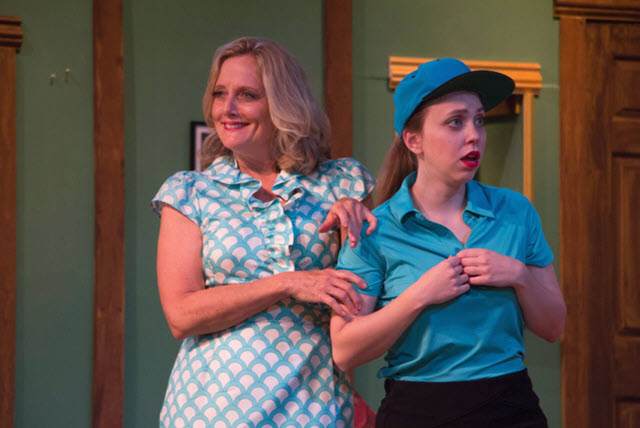
(L-R) Patricia Nicklin as Pamela Peabody and Raeanna Larson as Louise Heindbedder ~ Photographer: Matt Liptak ~ Photographer: Matt Liptak
Unfortunately, the pace and the funny bits are thwarted by uneven casting, proving even a terrific comedy can miss the mark when it’s not done right.
Still, kudos to Cameron McBride, a newcomer to acting, whose timing and physical comedy is expert and Ken Kemp, who is a pearl among the pebbles.
Directed by Scott J. Strasbaugh, Set Design by Marian Holmes, Lighting Design by Jeffrey Auerbach and Kimberly Crago, Costume Design by Ceci Albert and Lisa Brownsword.
With Raeanna Nicole Larson as Louise, Patricia Nicklin as Pamela, Brendan Chaney as Dickie and Lorraine Bouchard as Muriel.
Through June 29th at The Little Theatre of Alexandria, 600 Wolfe Street. For tickets and information call the box office at 703 683-0496 or visit www.thelittletheatre.com