Charlotte Maltby as Maria Rainer, and the von Trapp children in The Sound of Music. Photo by Jeremy Daniel.
Watching Richard Rodgers and Oscar Hammerstein’s classic, The Sound of Music, is like reuniting with a dear friend from your childhood. Though many of the songs are familiar and beloved, “The Sound of Music”, “Do-Re-Mi”, “Climb Every Mountain”, “My Favorite Things” and “Edelweiss” (the latter two reprised during Christmas season), there are others just as meaningful that we don’t hear as often – like “Sixteen Going on Seventeen” and “No Way to Stop It” – that seem to have fallen into obscurity yet deserve to be reheard.
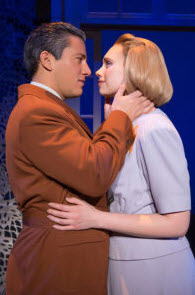
Nicholas Rodriguez and Charlotte Maltby in The Sound of Music. Photo by Jeremy Daniel.
In this national touring company Maria, played puckishly by the very youthful Charlotte Maltby is more Scarlet Johanssen than Julie Andrews. And that’s a good thing because the current generation of children that fall in love with this musical will need a modern-day heroine who is energetic and adorable with a side of feisty and flippant. A woman who can stand toe to toe with Captain von Trapp, played by the Helen Hayes awarded actor, Nicholas Rodriguez whom you may remember in the role of Billy Bigelow in Arena Stage’s last year’s production of Carousel at Arena Stage.
Melody Betts as ‘The Mother Abbess’ and Charlotte Maltby as ‘Maria Rainer’ – Photo: Matthew Murphy
Smooth as silk and pitch-perfect is Teri Hansen as Elsa Shraeder, the would-be fiancée to the widowed Captain, who brings a shot of Old World elegance to the part and Merwin Foard as Max Detweiler, Elsa’s political ally, whose luscious baritone and comic timing bring a dose of levity to the role of turncoat. All seven children are adorable including little Birgitta played by Dakota Riley Quakenbush and Gretl played by cute-as-a-button Anika Lore Hatch. But the ne plus ultra is Melody Betts as The Mother Abbess with a mellifluous voice and a dignified gravitas.
Paige Silvester as ‘Lies!’ and Austin Colby as ‘Rolf Gruber’ – Photo: Matthew Murphy
Director Jack O’Brien breathes fresh air, passion and energy into the characters making the entire production more modern and clearly wowing the audience who literally leapt to their feet at curtain call in full appreciation.
Sound designer Ken Travis delivers a terrifying thunder storm to counter Lighting Designer Natasha Katz’s stunning depiction of the abbey with its glowing rosette window and late day shafts of sunlight onto the tender wedding scene. And Douglas W. Schmidt’s sets that include a massive statue of an angel and massive Romanesque arches bordered by panels of Austrian lace, offer an evocative sense of place and time.
Despite the period in which it’s set, 1932, and perhaps because it speaks to the bravery of Maria and the entire von Trapp family in their struggles against the Nazis and Hitler’s takeover of their homeland of Austria, it is entirely relevant in today’s worldwide political climate. It serves as a cautionary tale to those afraid to speak truth to power and an inspiration to families who find strength in their combined ability to overcome obstacles.
Highly recommended for all ages.
Through July 16th at The Kennedy Center, 2700 F St., NW, Washington, DC. For tickets and information call 202 467-4600 or visit www.Kennedy-Center.org.
Nature-inspired mosaic by Nina Tisara – Photo credit Jordan Wright
When interviewed for her 2015 Living Legends of Alexandria profile, Artist-Photographer Nina Tisara quipped, “I had a life before Living Legends and I expect to have a life after.” As founder of the organization that selects and celebrates annually the inspiring accomplishments and contributions of our finest citizens, Tisara will retire from her ten-year commitment leading the organization to pursue her art.
Her photography journey began in the 70’s at Air Force official photo library job when she took first photography class writing picture captions. While attending NOVA night classes in photography to reward herself for earning George Mason BA degree in economics in the mid-80’s and working full-time for a national association, she got hooked, and started part-time freelance photojournalist journey. More study followed and her work began to get noticed. Eventually the single mother of four went pro with portrait and wedding commissions, moving her business from Fairlington in 1990 to the townhouse on King Street where Tisara Photography continues to thrive under her son, Steven Halperson.
Currently Tisara has two very different shows in our area. Both are worthy of study. Her powerful black and white photographs of worshippers of all faiths allow us a window to the faithful in intimate and revealing moments of worship. In her nature-related mosaics show she interprets her own photographs in a more classic form – revealing the intricate details of nature through tiny pieces of tile.
The show at Convergence, Witnessing Worship – Connecting Through the Lens of Faith, brings together for the first time two of Tisara’s photo documentary studies of worship in Alexandria – Converging Paths (1984-85) and United in the Spirit (1995). The exhibition invites Alexandrians to share photographs of current worship online.
Convergence believes Tisara’s work fits their universal philosophy. “The ambitious spiritual/cultural objective of this undertaking was the creation of a space where viewers were comfortable in considering the idea that agreement is not a requirement for relationship but an invitation to each of us to expand our capacity for generous listening and observation,” said Reverend Lisa Smith of Covergence.
The closing reception for Witnessing Worship is Friday, June 16, 7-9pm at Convergence, 1801 N. Quaker Lane. For details about the online project contact DabABH@ourconvergence.org. The reception is free and open to the public.
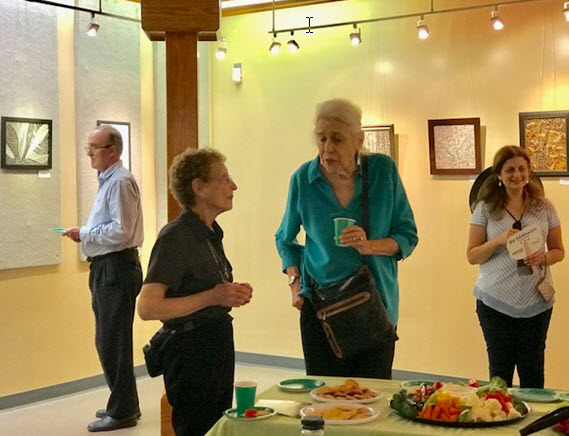
Nina Tisara talks with fellow artist Marian Van Landingham at the opening reception at Huntley Meadows Visitors Center – Photo credit Jordan Wright
In 2005 when photography went predominantly digital, Tisara laid her camera aside and started creating mosaic designs studying under Gene Sterud, a retired archeologist. “The medium provides the opportunity to combine my early training in painting and sculpture and my later work in photography. I often use the double-reverse process taught by Gene which, like sculpting in clay, allows the image the freedom to evolve,” she explains. Each piece is signed with a tiny silver gecko. “Geckos represent transition and transformation, death and rebirth, and letting go of old things for new,” she adds.
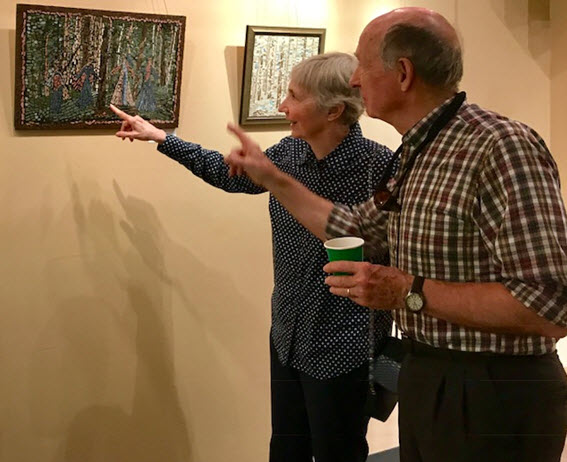
Alexandria residents Judy and Carl Lohmann admire details of Tisara’s mosaics – Photo credit Jordan Wright
Currently on exhibit at Huntley Meadow Park Visitors Center through August 31st, we see her work inspired by her photographs of a particular stand of trees at the park where she had envisioned “dancers” in the twisted grapevines that gird these trees. Some of the mosaics are hung alongside the photographs that inspired them. Tisara has been visiting the park and observing and photographing nature there since 2000 and first exhibit in 2003.
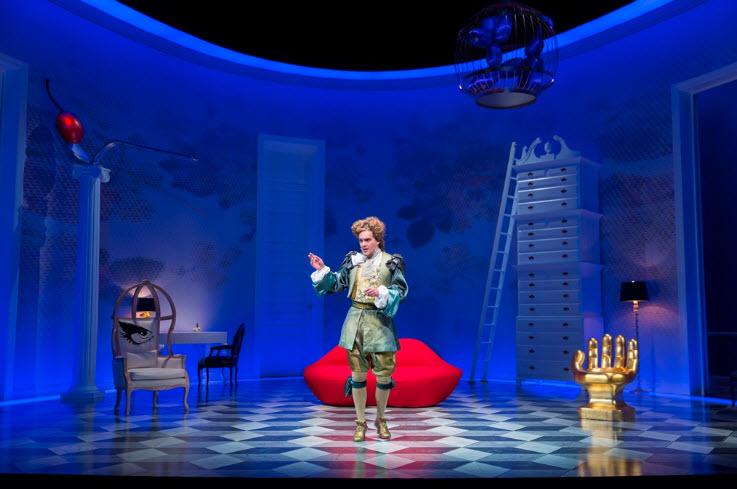
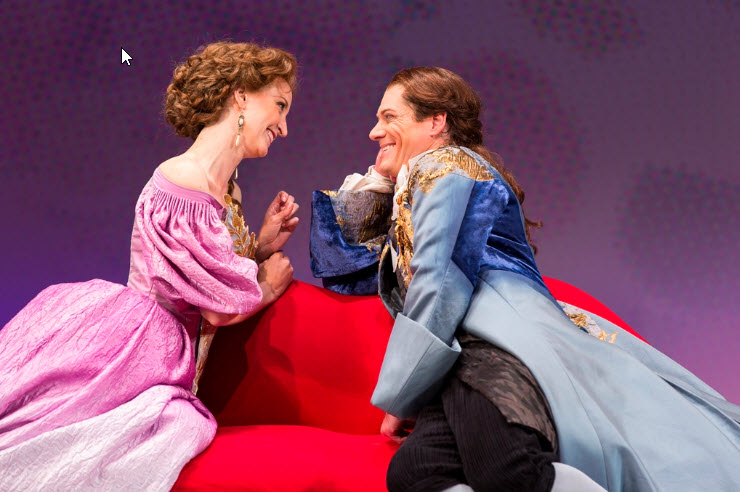
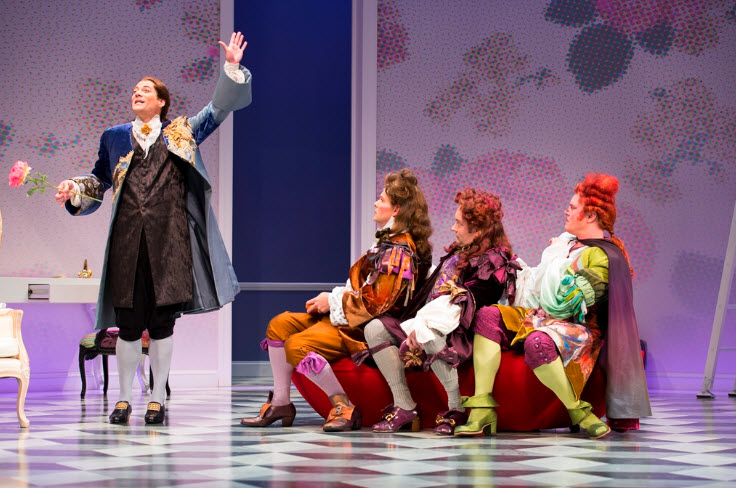
Cody Nickell as Philinte in The School for Lies by Scott Suchman
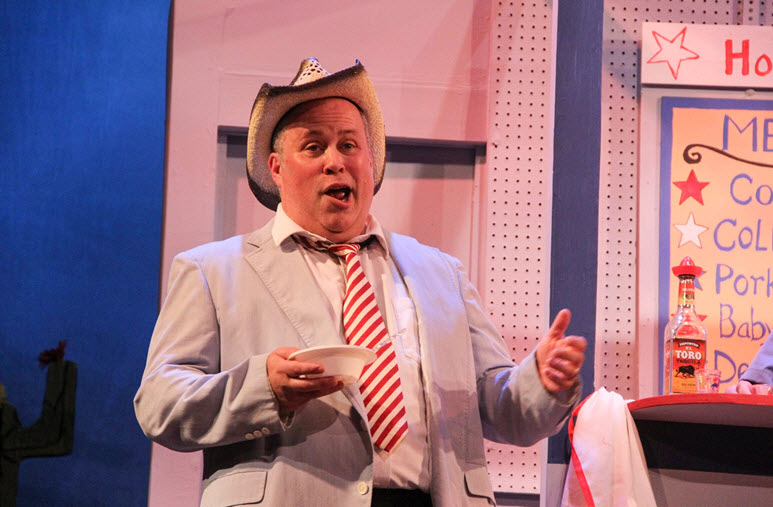
Shakespeare Theatre Company’s production of David Ives’ genius adaption of The School for Lies opens with an announcement by Philinte (Cody Nickell), a secret transvestite with a fondness for blue satin gowns. It advises us to prepare for a comedy that parallels events currently swirling around our nation’s capital. The invitation to revel in schadenfreude reminds us that the world of gossip, slander and innuendo is as vigorous, and as double-dealing, as it was in the 17th century when Moliére first penned quite different lines to his classic The Misanthrope. Knowing titters and outright guffaws were appreciably audible from an audience chockful of Beltway insiders.
Victoria Frings as Celimene and Gregory Wooddell as Frank in The School for Lies by Scott Suchman
Ives, who won a Drama Desk Award this week, creates his misanthrope in Frank (Gregory Woodell), a sharp-witted realist who mocks social proprieties with great aplomb. “Society is nothing but a school for lies,” he rails – until he falls head over heels for the feisty and scurrilous widow, Celimene (Victoria Frings) who herself is up for charges of slander.
Gregory Wooddell as Frank, Dorea Schmidt as Eliante and Veanne Cox as Arsinoé in The School for Lies by Scott Suchman
But the lovely-in-lavender Celimene has a bevy of suitors, Acaste (Liam Craig), a vain, moneyed marquis with the brains of a hamster, Clitander (Cameron Folmar) an influential courtier and Oronte (Tom Story) a boulevardier and master rhymster of prosodic gaffes (i.e. “fetus” with “coitus”). Look for scene-stealer Michael Glenn in dual roles, both Dubois and Basque, to add a dash of slapstick to the snidely sophisticated repartee. Canapés will fly!
Gregory Wooddell as Frank, Cameron Folmar as Clitander, Liam Craig as Acaste and Tom Story as Oronte in The School for Lies by Scott Suchman.
Frings lean-forward, hilarious performance, delivering rhymes with accents ranging from Valley Girl to black gym-rat hipster, is delicious.
Written entirely in rhyme and laced throughout with bawdy colloquialisms and ruthless insults, Ives gives us a contemporary comedy – reworked from his 2011 original to reflect present day events. Be prepared for a hornet’s nest of confusion around who said what and who’s lusting for whom, notable by the misdirected amours of the pretty-in-pink Eliante (Dorea Schmidt), who is what we’d refer to in modern jargon as a dizzy broad, and the misunderstood emotions of Frank and Celemine.
cast of The School for Lies by Scott Suchman
Leave it to the jealous-in-green silks, delightfully snarky Arsinoé (Veanna Cox), the pillar of morality (we might call her an uptight prude) to hatch a destructive plot of her own to snag Frank away from Celimene.
Coupled with Murell Horton’s lavishly elegant period costumes, Alexander Dodge’s quirky chic set, Director Michael Kahn (who collaborated with Ives on the brilliantly devised The Metromaniacs) has yet another megahit on his hands to round out his thirty years with Shakespeare Theatre Company.
This is great theatre! Highly recommended.
Though July 9th at the Lansburgh Theatre, 450 7th Street NW, Washington, DC 20003. For tickets and information contact the Box Office at 202 547-1122 or visit www.shakespearetheatre.org.
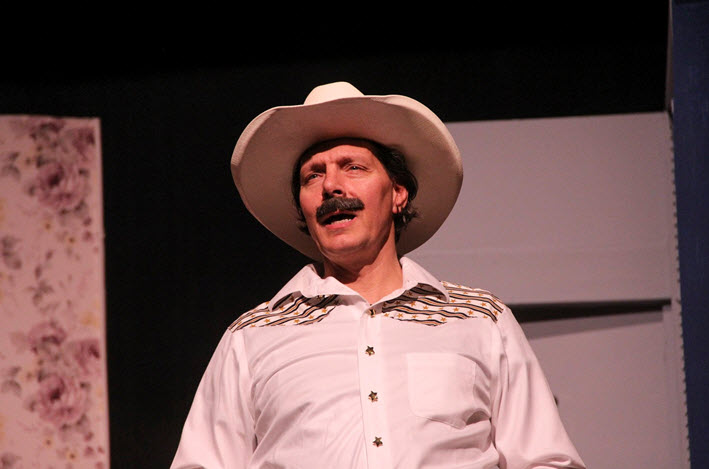
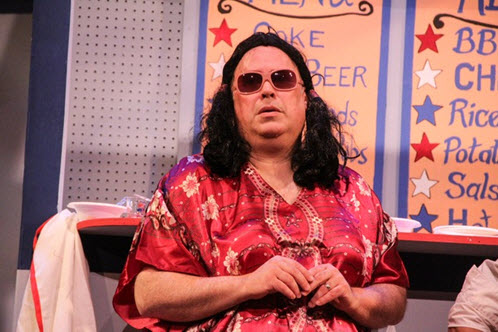
(l to r) Stephen McDonnell as Amber Windchime and David Wright as Star Birdfeather – Photos by : Matt Liptak
In a series of pastiches that harken to Hee Haw days, actors David Wright and Stephen McDonnell take on ten roles apiece beginning as two aging female flower children returning for their high school reunion. From there it’s a dizzying escapade filled with twenty crazy characters who enter and exit with lightning speed. Along the way you’ll meet Didi Snavely of Didi’s Used Weapons Shop, “If you can’t get yourself killed in a small town in Texas, yer not really tryin’,” a pair of radio announcers, Thurston and Arles, who invite townsfolk to upcoming events like the Pest Fest and the Rattlesnake Roundup, Stanley a former juvenile delinquent now artiste, and Helen and Inita owners of Hot to Trot Catering whose country cooking nearly poisons the whole town.
Stephen McDonnell as Arles Struvie ~ Photos by : Matt Liptak
And that’s just a smattering. There are enough characters in this Ed Howard, Joe Sears, Jaston Williams comedy to fill a jailhouse, or perhaps a Baptist meetinghouse. Racism comes easy in this tiny hick town where people’s opinions are driven by “Christian values” and the shadow of the KKK is ever-present.
David Wright as Star Birdfeather ~ Photos by : Matt Liptak
Director Michael J. Baker, Jr. revives this 1998 classic like a fine tuned ’55 Chevy truck with tons of belly-laugh lines aimed squarely, and satirically, at the provincial denizens of the Texas town of Tuna – from whence the title.
Among others, McDonnell plays the cat-eye glasses wearing Vera Carp, the high priestess of Tuna society who is a dead ringer for Dana Carvey’s morally superior character the “Church Lady”. McDonnell’s version of Vera, the fearless leader of the ever-vigilant Smut Snatchers Society who are always on the lookout for racy songs and lewd activity, is hilarious.
David Wright as R.R. Snavely ~ Photos by : Matt Liptak
One of Wright’s characters is Aunt Pearl Burras, an aging chicken farmer who brings to mind a cross between Jonathan Winters’ Maude Frickert, Vicki Lawrence’s Thelma Harper (Mama) on The Carol Burnett Show and Tyler Perry’s Madea. “I was not born in a Blue State,” she declares unapologetically. It’s a brilliant mash-up – classic vaudevillian schtick with one-liners and country colloquialisms that flow like moonshine whisky on a hot, Southern night.
There are critters in spaceships, of course, a side-splitting scene in the Starlight Motel with a sex manual and a lot of misunderstandings, and Vera’s line to the fresh-from-prison Baptist preacher, Reverend Sturgis Spikes, calling him “a born again has-been”.
David Wright as Leonard Childers ~ Photos by : Matt Liptak
Costume Designers Ceci Albert and Lisa Brownsword deserve praise along with their six wardrobe assistants for getting the actors in and out of their umpteen costume changes. And kudos to Wig and Makeup Designer Howard Kurtz for the instant transformations.
Get ready to praise the Lord and pass the ammunition!
Through June 24th at The Little Theatre of Alexandria, 600 Wolfe Street. For tickets and information call the box office at 703 683-0496 or visit www.thelittletheatre.com
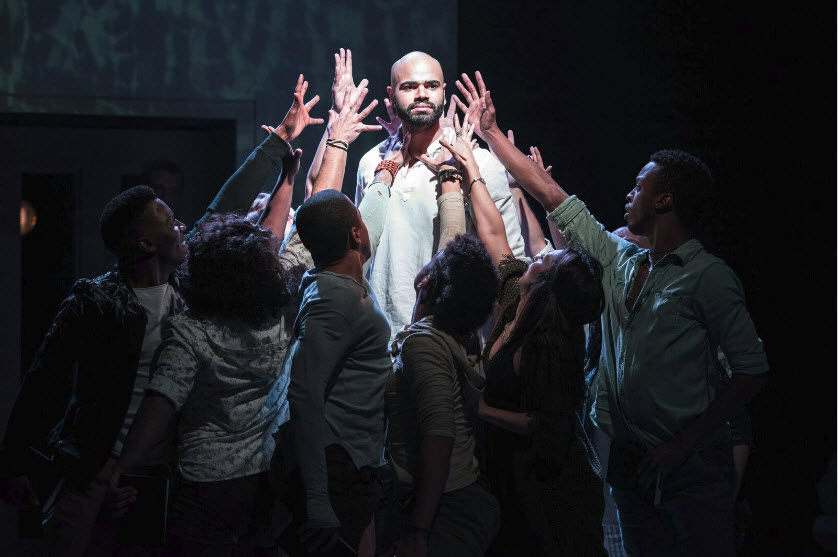
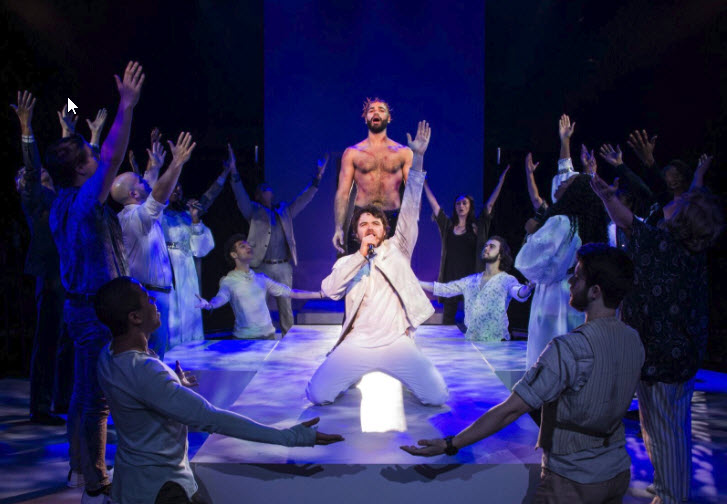
Nicholas Edwards (Jesus) with the cast of Jesus Christ Superstar. Photo by Margot Schulman
Signature Theatre’s Artistic Director, Eric Schaeffer, has been upping the ante with big, bold Broadway shows. His latest mega production is Tim Rice and Andrew Lloyd Webber’s hyper hit Jesus Christ Superstar. Casting some madly impressive voices in this blockbuster rock musical signals Schaeffer’s emphasis on the compelling music and lyrics, and drawing the theatre-goer’s attention to the story’s similarities to current culture.
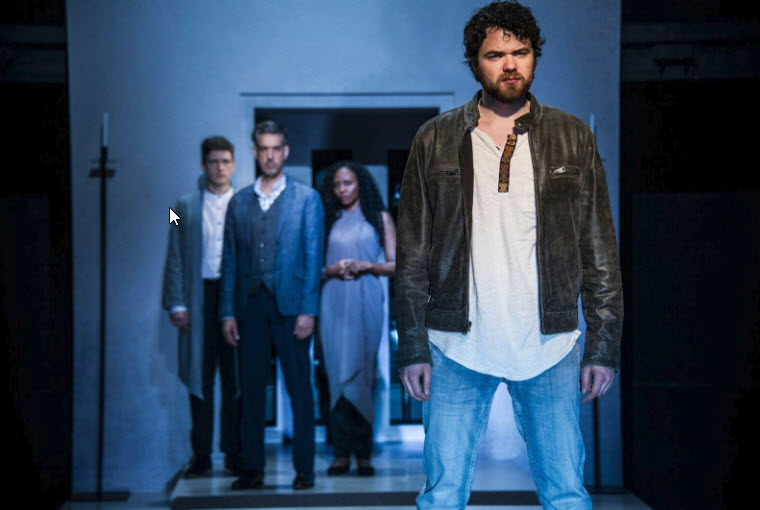
Ari McKay Wilford (Judas) with Sam Ludwig (Annas), Thomas Adrian Simpson (Caiaphas) and Kara-Tameika Watkins (Priest) in Jesus Christ Superstar. Photo by C. Stanley Photography.
And that’s a good thing, because Director Joe Calarco strips away all semblance of a period piece. Early versions, you may recall, stage it in biblical times. But you’ll see none of that sentimentality here with Luciana Stecconi’s stripped-bare set of nine movable white platforms reconfigured throughout to represent the table at The Last Supper, or put to use as a soapbox for Jesus or Pontius Pilate to utter proclamations to their indecisive followers. Again attention is focused on the music directed by Conductor William Yanesh, and not predominantly on costumes by Frank Labovitz who gives us monochromatic teen streetwear for Jesus’ apostles, sharkskin suits for Pontius Pilate, and sequined satin gospel dresses for the Soul Sisters. No flowing robes here. And an odd choice of using bibles as props, neglects the tiny detail that they hadn’t been written yet. I’ll take it as a reference to “bible-toting” fanatics and give it a pass.
Look instead to Nicholas Edwards (as Jesus of Nazareth) who reprises the role made famous by actor Ted Neely. Edwards is spellbinding, delivering a viscerally transformative performance that is a game changer for this role. With his remarkable voice and ripped body, he exudes both passion and raw sexuality. Another powerhouse performance comes from the very versatile Bobby Smith who plays Jesus’ evil nemesis Pontius Pilate as effortlessly as I’ve seen him play comedy. Lean into his delivery of “Trial Before Pilate” to witness his nuanced performance.
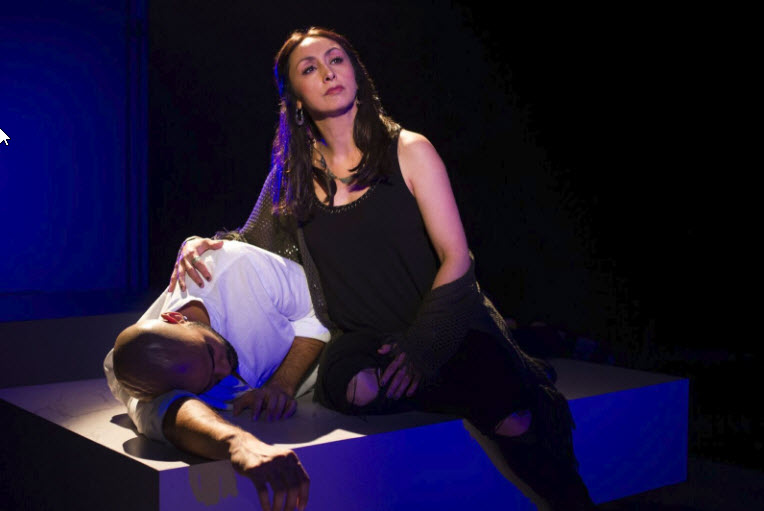
Nicholas Edwards (Jesus) and Natascia Diaz (Mary) in Jesus Christ Superstar. Photo by C. Stanley Photography
Natascia Diaz as Mary Magdalene also offers a different interpretation of her role – one very different from the fiery female roles we’re accustomed to seeing her play. Her strong voice seems tamer and often aimless with a surfeit of trills and superfluous flourishes in the ballads. Though her believability in her affection for and defense of Jesus is where she shines.
Nicholas Edwards (Jesus) and Ari McKay Wilford (Judas) with the cast of Jesus Christ Superstar. Photo by C. Stanley Photography
Karma Camp’s choreography, seamlessly weaving 18 performers through complicated dance and fight scenes, is impressive and Zachary G. Borovay’s video projections of Hitler and the Nazis, 9-11, Syria and an assortment of social extremists to background the number “The Crucifixion”, reveal an eerie resemblance to racial violence and religious terrorism in modern society.
As a side note, I couldn’t help but wonder if my seat which was close to the stage was the reason the singers seemed to frequently be drowned out by the seven-piece orchestra. I hope it was merely the sound levels which may be straightened out by now. In any case I’d choose the upper level for this show since watching the actors at waist level is not the best perspective.
Through July 2nd at Signature Theatre (Shirlington Village), 4200 Campbell Avenue, Arlington, VA 22206. For tickets and information call 703 820-9771 or visit www.sigtheatre.org.
Jordan Wright May 22, 2017
Photo credit – Jordan Wright
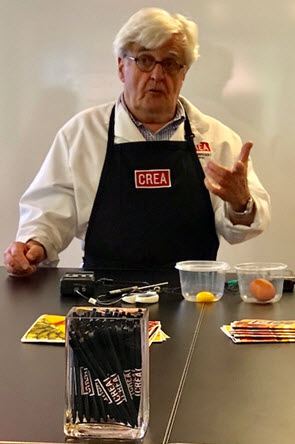
In a non-descript two-story building in Sterling, VA, in a suburb better known for defense contractors and software developers, is a company that has trained more three-star Michelin chefs than any cooking school in the world. Here at Cuisine Solutions Inc. through their learning division CREA (Culinary Research and Education Academy), I recently participated in a workshop on sous-vide given by Dr. Bruno Goussault, the very scientist who developed the revolutionary technology.
In the classroom with Dr. Bruno Goussault, the creator of sous-vide
There are two divisions under one large corporate umbrella. Cuisine Solutions sells prepared sous-vide foods to Costco, as well as airlines, cruise ships, the military and major hotel chains worldwide. And CREA, with locations in France and Sterling, trains chefs in the sous-vide technique with seminars, on-site training and online video courses. The company opened its $30 million dollar, 163,000 square-foot, state-of-the-art plant in Sterling in 2013.
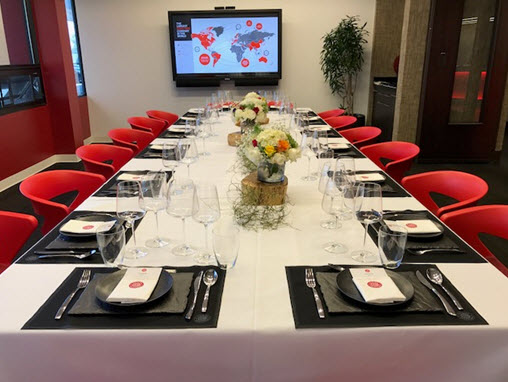
Table set for luncheon in the Executive Dining Room
Along with Goussault’s many years of experience as a scientist and founder of Centre de Recherche et d’Edudes pour Alimentation in Paris as well as recipient of the “Ordre National du Merite” from the President of France, officers in the company have equally extensive pedigrees. Stanislas Vilgrain, Chairman and CEO, rose to the top of his career earning the medal of Chevalier of the Legion of Honor of the French Republic in 2015 after years as a top officer at Vie de France Corporation; Chief Strategy Officer Gerard Bertholon is a Maître Cuisinier de France, one of the world’s highest honors, and trained as a chef under the great Alain Chapel; Felipe Hasselmann, Cuisine Solutions president, brought his powerful international business development experience from L’Oreal Paris, Coca Cola and Frito Lay; and Bruno Bertin, VP of Culinary Innovation who himself has worked with the legendary Pierre Troisgros, Louis Outhier and Daniel Boulud, as Sous Chef at Restaurant Daniel in New York.
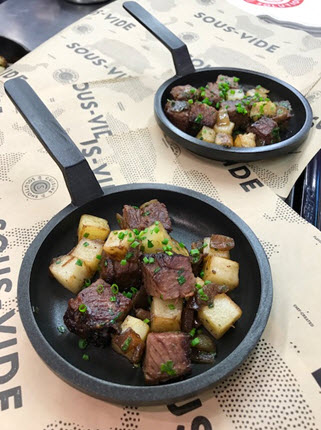
72-Hour Short Rib & Potato Hash
Not only did I watch, learn and participate, but I also spent most of the day tasting the results, beginning with a breakfast prepared by a cadre of chefs schooled in the art of sous-vide. Exquisitely decorated plates were served starting with an egg white and red pepper sous-vide egg bite (these were specially created for Starbucks); bacon and Gruyere egg bite; coconut and chia seed oatmeal parfait; compressed fruit and dragon fruit granite; egg and rosti with sous-vide hollandaise and 72-hour short rib and potato hash served in a miniature cast iron pan.
Egg White & Red Pepper Sous-Vide Egg Bite and Bacon & Gruyere Sous-Vide Egg Bite
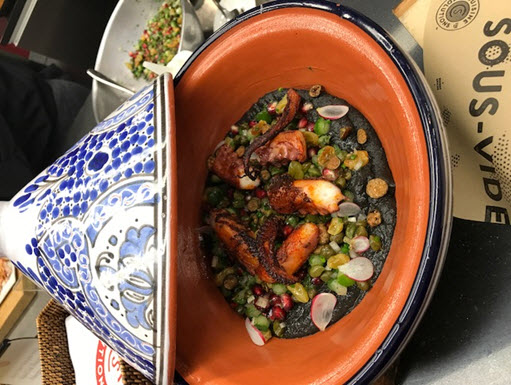
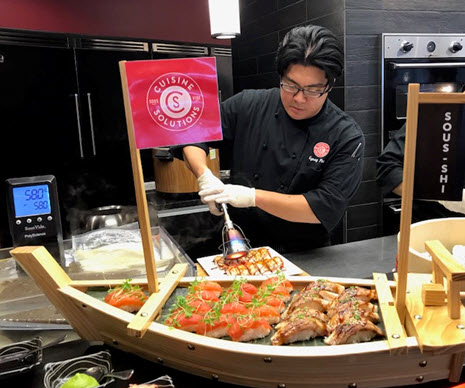
After breakfast our class moved onto nibbles of “sous-shi” – a trompe l’oeil preparation that looked and even tasted like sushi but was entirely vegetarian; a Moroccan dish of octopus, raisins, capers, compressed melon, pomegranate seeds and radishes; Arctic char brandade with ramp aioli; and a sous-vide pig face which offered up meltingly tender cheek meat. Well fortified, we left the dining area for a large classroom, which is really a laboratory.
Moroccan-influenced Sous-Vide Octopus
Under the avuncular tutelage of the 75-year old Goussault, “father of sous-vide” and the company’s Founder and Chief Scientist, I slowly shed the neophyte’s notion that sous-vide is a cheater’s technique or a culinary sleight of hand. There is just as much time and effort put into sous-vide preparation as there is with conventional methods. In many cases, a lot more goes into achieving the perfection that it guarantees to the chef. Moreover, I learned that many of the world’s greatest chefs were taught by Goussault – chefs such as Thomas Keller, Heston Blumenthal, Daniel Boulud, Dan Barber, Charlie Trotter, Anne-Sophie Pic and the late Michel Richard, who have embraced it wholeheartedly.
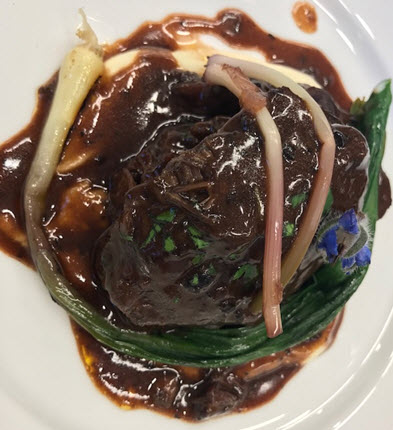
Braised Beef Cheeks over Celery Root Purée with Truffle Triple Sauce & Pickled Ramps garnished with borage flower
During this one-day workshop I became a rabid convert, sometimes tasting conventionally prepared product beside sous-vide prepared foods. I learned how preparing literally tens of thousands of dishes for major events using this method (Cuisine Solutions has catered huge events, like The Ryder Cup and the Super Bowl, for tens of thousands of guests.), offers high quality, consistency, precision and food safety while preventing product loss and spoilage. Meats are cooked uniformly and fruits and vegetables retain the intense signature of the ingredient. This was heady stuff for someone not particularly science-minded.
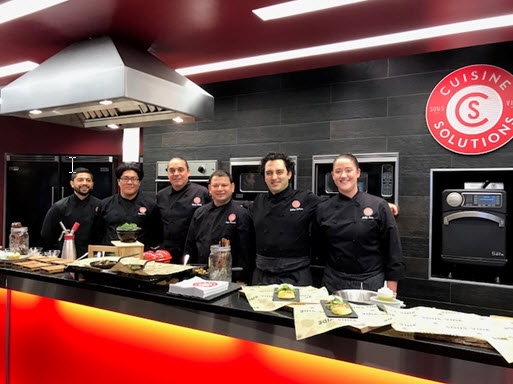
A cadre of chefs create our meals
Dr. Goussault, who invented the two-minute rice while working in food science for the United Nations in Africa, invented sous-vide in the early 1970’s and continued to tweak and promote it with Joël Robuchon in Paris with the establishment of CREA. Armed with probes and monitors Dr. Goussault travels the globe throughout the year training chefs in his methods. He has been compared to Escoffier as a pioneer in the world of gastronomy, and you can take that to the bank! Some of our local chefs who have trained with him at this facility are from Le Diplomate, Mintwood Place, Green Pig Bistro, The Red Hen, Central Michel Richard, Convivial, Fiola and The Dabney, to name but a few.
Glazing the vegetarian “Sous-shi”
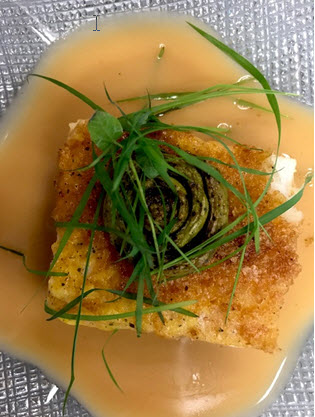
After discussions on vacuum sealing, water circulators, the precise temperatures for the scale of doneness, and becoming familiar with the various types of machinery involved in this technique, it was time for lunch – Beef sirloin “jar salad’ with ponzu and baby greens; Amazon cod with soy beurre blanc and fiddlehead ferns; braised pork belly over Beluga lentils with shitake broth and wild foraged mushrooms; braised beef cheeks over celery root puree with truffle, triple sauce and pickled ramps. As each dish was sampled it became clearer to me that food prepared sous-vide results in the superior dishes found in the world’s finest restaurants. Each ingredient retains its singular identity, and that is a mind-blowing experience.
Amazon Cod with Soy Beurre Blanc & Fiddlehead Ferns
Even after such a lavish lunch we continued to sample sous-vide filet of beef, fried chicken, carrots and other delights comparing them alongside traditionally prepared product. The meats were seared and finished on a flat top grill, the chicken crisped up in a fryer. The results were remarkable. In the matter of the chicken, you could just die right there. It was ultra-crispy while still juicy. Carrots tasted as though they were picked fresh from the garden and apples like they had just been plucked off a tree.
Platter of citrus madeleines
Cramming ten meals into one day wasn’t for the faint of heart, or I should say, stomach. At this point I am wishing I had a cow’s four stomachs and a week to digest everything. But I persist, because this is what I do. And were we done?
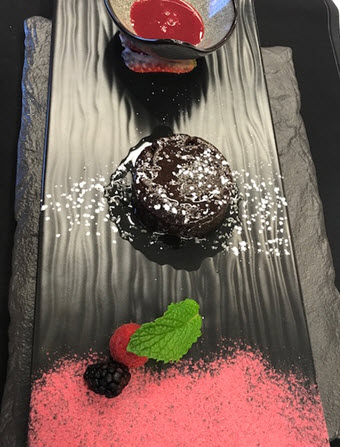
Chocolate Moelleux with Raspberry Coulis
No siree! Desserts were served – chocolate moelleux brightened with raspberry coulis and baskets of citrus madeleines and macarons.
Compressed Fruit & Dragon Fruit Granita
After all this, I’m fairly sure I will never attempt to replicate these dishes at home – equipment costs can be out of sight for home cooks and small restaurants, though many do experiment with the concept of sealing and immersion.
A Multivac seals the food before immersion
I certainly came away with a greater appreciation and keener understanding of what sous-vide means and how lucky I am to have been born when it was invented.
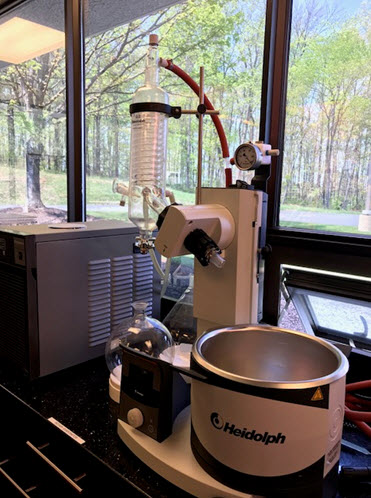
High Tech Rotary Evaporator
Here are some pearls of wisdom from Goussault.
* Water is the best fluid to transfer the heat. When you cook in water you’ll have a beautiful jus.
* Take lemon to the market when you buy fish and squeeze it over the raw fish to determine if it’s fresh. If it turns opaque, it’s NOT fresh.
* The Maillard reaction has to do with the perception of the color of the meat. What do you say in a London fog? All the cats are grey!
* Red meat has a thin layer of albumen. White meat has a thicker layer.
* Vegetables cooked separately retain the integrity of the dish. Cooking vegetables to 85 degrees to respect the pectin will give you the top taste in the world.
* Brine your fish for 10 minutes before cooking. Fifty grams of salt per one quart of water.