|
|
Jordan Wright
February 2010
 Bernadine Mitchell - The Queen of Gospel Photo by Chris Mueller On the North End of Old Town Alexandria MetroStage is a small but prestigious theatre of such import that it has been recognized for its performers and innovative new musicals by the Helen Hayes Awards on numerous occasions. Last week I was privileged to witness a spectacular reprise of Mahalia – A Gospel Musical by Tom Stolz at this intimate venue where it runs through March 14th.
Its star, Bernadine Mitchell, who comes to us from Atlanta, channels “The Queen of Gospel” in a cakewalk. She has already won a Helen Hayes award for Outstanding Actress in a Resident Musical for her role in an earlier MetroStage production. Her co-star, William Hubbard, nailed a nomination for his multiple roles playing Cousin Fred; Pastor Lawrence; songwriter, Thomas A. Dorsey; Blind Francis, Ms. Jackson’s piano accompanist; and Martin Luther King, Jr.
For those who remember and those who may not, Mahalia Jackson was the premiere gospel singer of her day, transcending her genre to perform at Carnegie Hall, tour Europe’s finest concert halls and appear on television shows, such as the iconic Ed Sullivan Show in the late 1950’s. She sang at John F. Kennedy’s inauguration and at the historic March on Washington in 1963 at Martin Luther King, Jr.’s request.
In addition she won six Grammys, was commemorated with her own postage stamp, and inducted into the Rock and Roll Hall of Fame…and that’s just the half of it.
Actress, as well as the production’s musical director, S. Renee Clark melds herself into the dual roles of the stern, take-no-prisoners Aunt Duke, and the tentative musicologist and companion to Mahalia, Mildred Falls. It’s no great leap for Clark whose background as a composer and musical director for countless productions has occupied her both here and abroad.
 William Hubbard, Bernadine Mitchell, S. Renee Clark - Photo by Chris Mueller I grew up listening to Mahalia Jackson. It was introduced into our home by African-American folks up from the deep South, who held her revival music and inspirational message in high esteem. To me it is like a lullaby. I’ve heard it since I was a baby. Even if you’ve never heard it before you can sense its roots of soul and blues and picture robed church choirs swaying to the swelling harmonies of Christian hymns and Negro spirituals.
Mitchell, Hubbard and Clark are the perfect complements to each other’s voices…their harmonies so pure and powerful they travel right up the aisles, into the marrow of your bones, and bounce off the back wall of the theatre.
Hallelujah, Mahalia! Your spirit lives on.
For ticket information contact MetroStage at 703 548-9044 or visit www.MetroStage.org. MetroStage is located at 1201 North Royal Street, Alexandria, VA 22314.
For comments or questions about this article contact Jordan@WhiskandQuill.com.
Jordan Wright
Whisk and Quill
January 2010
 Director and Screenwriter Michael Hoffman - photo by Jordan Wright Michael Hoffman’s remarkable twice Oscar-nominated film, “The Last Station” is a sweeping love story-within-a-love story of the life of legendary Russian writer Leo Tolstoy. Coming off his recent documentary, “Out of the Blue – A Film about Life and Football” it is a sea change from this historical work, which Hoffman directed and also wrote the screenplay from Jay Parini’s novel.
With her first Oscar under her belt in 2008 for “The Queen”, Dame Helen Mirren, has again been recognized by the Academy for her role as Tolstoy’s tormented wife and muse, Sofya. This could well be her greatest screen performance ever.
Christopher Plummer, nailing his first ever Oscar nod after a career spanning over 100 films, morphs into the brilliant and conflicted Tolstoy as no other actor could.
I recently met with the very articulate and profound Hoffman, a former Rhodes scholar, in Washington, DC to pose some questions about his research and understanding of Tolstoy’s life, and his experience directing two of film’s most accomplished actors. As for all the acclaim, he has been taken aback, “I honestly thought this film was not going to be distributed in America.”
Jordan Wright – Did you have a target audience when you made “The Last Station”?
Michael Hoffman – The reason that I wanted to avoid making a biopic about Tolstoy is that I thought the target audience was just wrong.
When I first read the novel I couldn’t figure it out. But fourteen years later, and after I had been married for awhile, I saw the difficulty of living with love and the impossibility of living without it. I saw a tragicomedy I could make about marriage, with all the hopes and dreams and all the pain and frustration and atrocities in a relationship, and it fascinated me…and I believed strongly that it would appeal to a lot of people.
JW – The details in the film were remarkable. In the picnic scene I noted one of the guests stirring a spoonful of jam into her tea. Such a Russian idiosyncrasy! How important were these details to you?
MH – We had some great Russian advisers, one of whom was a great-great-grandson of Tolstoy. He told us an interesting story about how the servants would place a boot on top of a samovar and pump air into it to breathe life back into the fire and reheat the tea.
JW – Tolstoy, it seems, had a public face and a private face. Not so very different from some of today’s more notable figures. When you discovered he had three separate diaries, including the super-secret one he kept hidden in his boot, did you have a chance to read them? Also how did his public persona compare to his private one?
MH – Tolstoy was the first real media celebrity. When I went to the Tolstoy family estate and archives they handed me an hour’s worth of footage that was shot on the estate during the last two years of Tolstoy’s life. There were sometimes four film crews shooting them at once. It was like paparazzi gone wild. Everything they did was observed. I think it was one of things he tried to run away from in the end.
JW – Before they were married Tolstoy asked his wife to read her diary. It is known that this mutual reading of their diaries brought about jealousies that perhaps set up the difficult dynamics in their future relationship. How did you portray this in your film?
MH – What’s so great about this is there is so much primary source material because every one of these characters kept a diary of events. It’s all well documented so you can read about the same incidents from six different points of view.
JW – Tolstoy preached sexual abstinence yet he didn’t live up to his own philosophies. Did you find other instances of dichotomy in Tolstoy’s life?
MH – When he was preaching sexual abstinence he wasn’t being profligate. The truth is Chertkov [played by Paul Giamatti]was more impressed with abstinence than Tolstoy, who used it as a sort of spiritual distraction, and then Chertkov would take these principles that Tolstoy talked about and create a dogma box to try to keep Tolstoy inside.
Chertkov and Sofya were engaged in a war for Tolstoy’s affection that was an absolute zero sum game. They both defined their worth in terms of whether or not he was paying attention to them. They weren’t interested in property or ideas they were interested in being loved by this man. And that’s what the movie is about. It all reduces down to ‘love’.
It was as if Tolstoy was a beacon or a mirror standing at the center of a circle, and all these people lived off of whatever was reflected back from him. It’s really a fantastic story.
In the beginning of their relationship Tolstoy gave Sofya a catalogue of all his sexual relationships because he thought, “She really needs to know me.” She in turn gave him hers. Their jealousies of each other stemmed from that exchange.
I discovered he had had an affair with a peasant woman who lived on the estate and had his son, who was semi-retarded, and who later became their coachman. Tolstoy started up that affair again and that’s why Sofya saw him as a hypocrite. She saw the gaps between the press and the man.
JW – How do you get the most from your actors?
MH – Casting people that are not only great actors but are great storytellers and have a deep connection to the story. Actors with a strong theatrical background who understand issues of style and tone in acting, which takes a lot of experience moving between genres…also actors that had done Chekov. That was a great point of reference with these sophisticated actors…to be able to refer to Chekov’s plays. They knew exactly how to pitch it, and they recognized it in each other and modulated their performance, so that they were all living in the same world. You can’t do that with every actor. It was a very risky thing to do stylistically.
JW – What was it like working with both Helen Mirren and Christopher Plummer?
MH – It’s interesting. These actors are such good storytellers. The ideal of the method is all about emotional truth…about becoming the character. Not necessarily about what goes wrong. It’s not just, “What is my narrative function? What is my responsibility to the story as an actor?” These actors are all hyper-aware of why the scene is in the story…the kind of narrative building block that relates to the whole picture…and, “When do I step forward and when do I step back?” Those are the central issues of directing.
Every argument that I had with Helen was when I wanted to change something in the script. And she would say, “No, no, no. You had it right the first time.”
Because I’ve talked to directors who aren’t crazy about actors and they are basically afraid, because they’ve got this vision in their heads about what it should be. I think it’s largely because the director has been living with the film for a long time and imagining it very specifically, and then you have this actor with a point of view that doesn’t match up with what you have in your head.
It’s actually the same problem that goes on in this movie when you’re talking about love and ideal love and love in the world. They don’t necessarily match up. But sometimes you have to go with it because they are part of the world.
JW – What were the some of the challenges you faced filming in Russia and Germany?
MH – It wasn’t easy. Russia is a chaotic improvisation and Germany is the most organized place in the world. For example, we wanted to make the house unkempt and messy and we sent out memos saying we need dirt on things, because it’s a farm you know. And the Germans, before you could turnover, would sweep up the dirt. So we had to hurry up and shoot before they could get to it.
There were a lot of lessons in this movie because we really had no money. Monica Jacobs, the costume designer, thought we could take advantage of that and got many of the costumes from the Berlin Ensemble where she had worked, and that had been used for years and years, and we found worn clothes that people had lived in.
JW – Will your next project be an historically set film as well?
MH – What it should be is something that doesn’t take me five years to do. I think that’s probably key.
This interview was conducted, condensed and edited by Jordan Wright. For comments or questions contact Jordan@WhiskandQuill.com
Jordan Wright
Whisk and Quill
February 2010
Wine Techno-Speak Cranks up the Message
If your wine talks to you have you had a bit too much to drink? Not if you’ve purchased a bottle with the new wine decoder technology embedded in the bottle itself. Holy vintage, Batman!
Producer Allegrini of Verona, Italy, known for their Valpolicellas using only their estate-grown fruit since 1557, has just launched a combination hand-held scanner and speaker, brand-named “Ecocoder” into its wine bottles. The wine-speak is activated by touching the surface of a wine label, instantly playing a prerecorded audio file stored in its memory card, allowing you to hear first-hand from the producer about the wine’s history, origin, production, flavors and ideal food pairings.
This cutting-edge wine communication system, patented by the Italian label designer and printer Modulgraf, was launched exclusively by Allegrini earlier this year at VinItaly, Italy’s largest annual wine trade show. As of this writing it’s only available in New York.
“The international wine market is thirsty for information about wine and Italian wines can be difficult for many consumers to understand,” notes winery owner Marilisa Allegrini.
Now if only it could make the pasta too!
Francophiles Rejoice!
I took in the opening of the stellar Chester Dale Collection at the National Gallery of Art last week and felt like a star-struck groupie. The Gallery owns these works but has never before mounted them in one glorious show. It was completely and blessedly overwhelming and I quite nearly threw my neck out of whack deciding which masterpiece to zero in on. There were works by Picasso, Monet, Manet, and Morisot, Degas, Cezanne, van Gogh, Matisse and Modigliani, Renoir et al…the finest representative art from Impressionism up to Modernism. A riveting oil, “Blue Morning’ by George Bellows, one of Dale’s final purchases, begged me to linger. This is a triumph of a show on exhibit through July.
 Chef Michel Richard signs his book Happy in the Kitchen at the opening of the National Gallery's Chester Dale Collection exhibit - photo by Jordan Wright Wait for it… Wait for it…. You expected to read about food in this story and here it is. The Gallery, in its infinite epicurean wisdom, has chosen Michel Richard to design the food for their Garden Café Francais. The award-winning world-renowned chef of DC’s Citronelle and Central Michel Richard fame, who studied under the distinguished chef Gaston Lenotre, has created a charming bistro menu that will have you believing you are dining on the Left Bank with Toulouse Lautrec sketching by your side. In-house Executive Chef David Rogers worked with Richard to translate the dishes for the newly expanded café.
See the paintings and dine on charcuterie, cassoulet, gougeres, coq au vin, ratatouille and so much more. French fromages such as Camembert, Comte and Livarot precede dessert in the French way. Fruit tarte, crème brulee, chocolate mousse or crepes Suzettes follow. Quelle joie!
Virginia Wines Wow at Wildfire Dinner
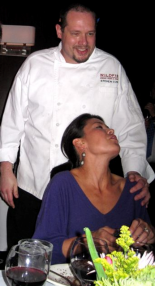 Wildfire's Executive Chef Steven Lukis checks on WUSA's Angie Goff's dinner - photo by Jordan Wright Food and wine events continue to draw a crowd and it was a rollicking group that attended last month’s wine dinner at Wildfire Restaurant in Tyson’s Corner. James Roth, wine consultant and owner of Red, Hot and Bleu Wine Shop in Falls Church, conducted the dinner whose five courses were paired with Virginia wines. How can you go wrong starting out the evening’s festivities with Kluge’s 2004 sparkling Blanc de Blanc and an hors d’oeuvre of lump crab on an herb-roasted cottage fry with lemon mustard aioli and ending with a 2006 Barboursville Vineyards’ Cabernet Franc Reserve served with a molten chocolate cake?
Renee Catacalos, of the recently folded magazine, Edible Chesapeake, was there to speak of the importance of eating locally-produced foods, while WUSA’s 9News Now Morning Show’s savvy and stunning, Angie Goff, just wanted the scoop on the local artisanal cheeses served with a 2007 Prince Michel Cabernet Franc.
On hand local PR maven, Bunny Polmer, who started her successful career prepping mis en place for the likes of Wolfgang Puck and Craig Claiborne when she worked for retailer Kitchen Bazaar, setting up demos back in the day. Bunny knows finely minced parsley.
Putting It All Together – Saturday Morning Along Del Ray’s Mount Vernon Avenue
Good news for locavores. The popular producer-only Del Ray’s Farmers Market on Mount Vernon Avenue is now open year-round. Here you’ll find organic produce, meats, cheeses, yogurt, homemade pastas and sauces to accompany them, baked goods, jams, honey and herbs locally raised and/or grown. We love this small neighborhood market where you can get to know your local farmers up close and personal.
Augment your food shopping with a stop along the way at Cheesetique where you can select from over 330 local and international cheeses. Pick up some salami, prosciutto, patés and duck rillettes too. Which leads me down the block to Planet Wine, where a nice Cabernet franc from Virginia’s Horton Vineyards or the slightly drier Pigeoulet en Provence, a Grenache blend from Vaucluse, France, suggested by wine consultant Alyssa Blevins, complements the rillettes quite nicely.
Princesses Rule at Old Town’s Lavender Moon Cupcakery
 Devil's Food Peanut Butter Mousse Cupcakes beckon at Lavender Moon Cupcakery - photo by Jordan Wright Back in Old Town Alexandria at 116 South Royal Street, Lavender Moon Cupcakery is a must visit serving up delectable cupcakes using only the finest ingredients….sweet European butter, dark Belgian chocolate, whole vanilla beans and organic eggs from Joel Salatin’s Polyface Farm in Swoope, VA.
Owners Peter and Tammy Durkin are emphatic about using organic ingredients and no food dyes for their luscious cupcakes. To color their red velvet cupcakes, they use blood orange or pomegranate juice. The quality is evident in all their cupcakes baked up with seasonal flavors.
 Sisters Sophia (left) and Rachel Margarella with their to die for cupcakes at Lavender Moon Cupcakery in Old Town - photo by Jordan Wright In summer fruit-filled cupcakes contain fresh local berries, peaches and apples. Last week I sampled a few of their winter specialties: Flourless Chocolate with Sea Salt and Almonds (gluten-free), Vanilla Bean with Lemon Curd filling, Red Velvet, Buttermilk with Mexican Chocolate Pudding, Devil’s Food with Peanut Butter Mousse filling, Triple Belgian Chocolate, Blood Orange Dreamsicle, Mocha and Vanilla Vanilla.
All were exceptional, with a dense buttery crumb and ethereal icing. Yes, you really could taste the difference with the use of premium, all-natural ingredients. Birthday boys and girls tell your moms. They do full-size cakes too.
While there, two tiny princesses, sitting pretty on small café-style chairs, were enjoying their after-school treats. “This is to die for!” exclaimed one. Her companion was polite enough to refrain from speaking with her mouth full of Vanilla Vanilla.
Barton Seaver Takes His Message to France
At Bibiana Enoteca last Thursday, I ran into DC Chef Barton Seaver relaxing at the bar before his flight to France where he’ll speak on sustainable seafood. Barton, formerly of Hook, is a huge advocate for sustainable fishing and in his soon-to-be-open Diamond District Seafood Company restaurant and market he will source fish from a dozen different fishermen. Swordfish need not apply.
The new location will be at 14th and Q Street, back in his old stomping grounds, where he told me his first cooking gig was at the Black Cat, too many years ago to count. “It’s named for the shape of the district itself,” Seaver explains. We are looking forward to seeing him in his upcoming PBS series, “Turning the Tide” scheduled for Spring 2010.
 Misha (center) with Nikki Giovanni and Patowmack Farm Executive Chef Christopher Rogers at a recent taping at the restaurant And while we’re on the subject of a new TV series, “Cooking Up a Better Life with Misha” premieres next Saturday at 11am on ABC. The charming Misha will be featuring celebrities, politicians and local chefs. The show will be produced in a recently designed Virginia studio kitchen in Alexandria, where I visited her last month while she taped one of her first segments with the author of a cookbook that features DC’s embassy chefs and their recipes.
For questions or comments on this story contact Jordan@WhiskandQuill.com
Jordan Wright
January 2010
I was nearly raised in a palace in the rugged highlands of Northern India.  A palace in India When my model/artist/writer/socialite mother found herself smack-dab in the throes of a divorce in the swinging ‘60’s, she threw herself Eva Tanguay-style into New York’s social whirl attending the opera, ballet and nightly galas. Invitations by the handful would appear daily on heavy vanilla card stock from every hostess and charity committee in town. It was at one such soiree that she met a very distinguished man who began to ardently court her.
 Narendra Singh Sarila at the Harry Ransom Center, University of Texas, where he gave a presentation based on his book about the partition of India. Enter the Maharajah Narendra Singh from the Princely State of Sarila, who had still retained his palace with its many lands and servants, though along with many other rulers when independence ended the days of The Raj, he had been stripped of a great deal of the usual privileges and status. I was fifteen, wildly impressionable and safely ensconced in an all-girls boarding school. On holidays I would often see the elegant maharajah when his trusty manservant would fill the kitchen with the alluring aromas of exotic curries in our East Side apartment. This was my first introduction to Indian cuisine aside from the occasional tandoori chicken my mother would whip up in her small clay pot when the cooking spirit moved her.
On my tiny bunk bed in a frigid dormitory in New England I dreamed of life in a palace. I conjured up halcyon days of jewels and robes, elephant hunts and lavish parties. What fodder for a young girl’s fecund imagination! As it happened he had a handsome son about my age. Now I had a vested interest.
In letters home I began my indelicate campaign of pleading and cajoling, hoping to sway my mother to marry him. Eventually the maharajah returned to India pressing my mother through the mails to accept his proposal. One day a massive tiger-skin rug, postmarked Sarila, arrived. I felt certain such an extravagant gift would seal the deaI, but my mother was far less moved, and alas, it was not to be after a prince showed up on our doorstep and trumped the dear maharajah. But that’s another story for another day.
It’s a curious thing how memories will come flooding back after so many years, triggered by a mere morsel, but this is what happened to me, in a most unlikely place, as I sampled the Indian cooking sauces produced by a small company named Stonehouse 27 Spice Company on the cement floor of a convention hall in Washington, DC where I occasioned to meet the owner of a fledgling company out of Germantown, Tennessee.
 Sharon Fernandes creator of Stonehouse 27 Indian cooking sauces - photo by Jordan Wright Sharon Fernandes descends from a family accustomed to bridging cultural divides. A trained engineer, she was born in what is now called Mumbai of a British father and Portuguese mother who worked as a caterer. Later she made her home in Dubai and Australia where she received her degree from the Royal Melbourne Institute of Technology.
A few years ago she had a slap-to-the-forehead moment. “My right brain and left brain finally hooked up,” she says of her epiphany and decision to start the company. “I created the line for my family. I wanted them to have the best.”
Her six beautiful sauces made using stone-ground spices reflect her combined heritage. In a recent phone call she told me that she grew up eating steak and potatoes. “A part of India is all Christian and we love our pork and beef,” she explained. “With that in mind, I made my line of sauces compatible with meats and seafood.”  Gourmet sauces from Stonehouse 27 Spice Co - photo by Jordan Wright Working daily on-site from start to finish in the cooking process she explains, “Everything is done in a very staged approach – one step at a time. At first I tasted over a dozen types of onions before selecting the perfect one for its flavor and consistency. I now get all my onions from Oregon and we sauté them for two hours, allowing them to achieve just the right texture and deepest flavor, before the garlic is added. It all gets just the right amount of cooking as it would in a home or restaurant.”
Her mild Tamarind and Garlic sauce for shrimp and vegetarian dishes and a more delicate Cilantro and Coconut sauce for fish like tilapia, flounder and cod reflect the care she puts into the sauces. A hotter Cashews and Cream sauce, a medium heat Tomato and Chiles sauce and the more spicy Dates and Tamarind sauce are designed to go with meats like beef, lamb and pork. I like that the dishes take only minutes to prepare but taste as though you have been slaving away all day.
Sharon is very proud of the fact that only agave nectar and California dates are used for sweetening and no salt is added keeping sodium levels very low unlike other prepared curry sauces on the market. “People try to compensate for bad-tasting products by adding salt. So I don’t use any salt and there is only the naturally occurring sodium from the lemons, limes and tamarinds in the sauces.”
Stonehouse 27 Spice Company’s Indian Cooking Sauces are not yet available in our immediate area though plans are underway. In the meantime Sharon has kindly offered Whisk and Quill readers free shipping on three jars or more if purchased online. Use the code WhiskandQuill10 to get a dollar off too.
 Chef Willis Underwood of McNulty's 7 Fruit Chutney - photo by Jordan Wright To complement your curry, do try McNulty’s 7 Fruit Chutney, another recent discovery of mine. Fifty years ago North Carolina native Margot Walser started making this condiment during the holidays in her home kitchen from an 80-year-old family receipt. Chockfull of fresh-picked peaches, plums, golden raisins, honeydew, apples, grapes, pineapples and spiced with ginger it is hand-made in small batches as it has always been. Distinctive, flavorful and toothsome it has no preservatives or additives. Toss out the syrupy and gelatinous jelly-like chutneys. This is the gold standard. Find it in Dean & De Luca and some Whole Foods or online.
So here’s my plan…a Bollywood-inspired party. Just ring up your friends, slip in a DVD and whip up some curry in the comfort of your own home. Pretty soon you’ll be having dreams of India too.
For cooking ideas and to order the all-natural Indian sauces, go to:
www.stonehouse27.com
For the heavenly chutney:
www.mcnultyschutney.com
For questions or comments on this article email Jordan@WhiskandQuill.com or visit www.WhiskandQuill.com
Jordan Wright
January 25, 2010
Whisk and Quill
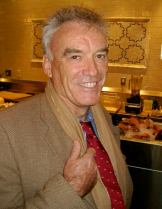 Chef Jean-Pierre Moulle of Chez Panisse in Berkeley, CA - photo by Jordan Wright An early morning trip to the White House with a tour by White House Chefs Sam Kass and Cristeta Comerford were just desserts for some of the country’s top toques who flew into Washington, DC this weekend for a noble cause. 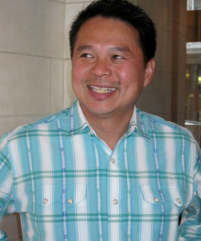 Visiting Chef Charles Phan of San Franciscos The Slanted Door - photo by Jordan Wright Their goal: To raise money for local charities, Martha’s Table and DC Central Kitchen.
The visit proved auspicious. After torrential rains last night, the dark skies parted and all were greeted with a warm, sunny morning to tour the White House private kitchens and vegetable garden. Alice Waters, who had no small hand in influencing the First Lady to plant the organic garden as a teaching tool for local schoolchildren, was part of the group of stellar chefs. Along the way she noted the small size of the wine closet in comparison to an enormous refrigerator holding a vast supply of soda. She tsk-tsked and a suggestion was made that sodas be done away with in the presidential manse. Do I detect a new initiative?
The previous evening they were paired up with local chefs like Jose Andres, a longtime supporter of DC Central Kitchen; Kaz Okochi of Kaz Sushi Bistro; Bryan Moscatello of Zola and Potenza; Michel Richard of Citronelle; Cathal Armstrong of Restaurant Eve; Nora Poullion of Restaurant Nora’s; Nick Stefanelli of Bibiana; Fabio Trabocchi of DC’s Four Seasons; and DC resident, Joan Nathan, who used her not unsubstantial sway to organize the event she is calling “Sunday Suppers”, pairing up chefs to create their signature dishes at private homes throughout town. 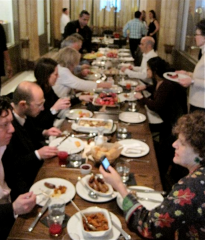 Top toques chow down at the celebration brunch at Potenza - photo by Jordan Wright Wine selections were arranged by Italian wine journalist Filippo Bartolotta of Le Baccanti, whose suppliers donated dozens of wines (although I heard that some gracious hosts opened up their personal wine cellars to amp up the festivities). Grass-fed Dorset-cross lamb was provided by John and Sukey Jamison from their farm in Latrobe, PA.  Rustic egg bake at Potenza's Brunch Celebration - photo by Jordan Wright From Berkeley, California, came Alice Waters of Chez Panisse and Co-Chef Jean-Pierre Moulle, who has been cooking beside her for 35 years; from Martha’s Vineyard Chef/Caterer/Culinary Instructor Jan Buhrman of The Kitchen Porch; from The Modern in New York City, Executive Chef Gabriel Kreuther and his Pastry Chef Patrick Clark; and from San Francisco, Charles Phan of The Slanted Door. Chef Elisabeth Bourgeois of Le Mas Tourteron brought her Provencal style from her iconic restaurant in Vaucluse, France. In all there were 23 participating celebrity chefs.
It all culminated in a lavish Italian-style brunch at Potenza where owner/host Dan Mesches and Chef Bryan Moscatello, marshaled their forces to put on a fabulous spread and thank the chefs for their donation of time and talent. It was all very collegial. You just had to be there.
For questions on this story contact Jordan@whiskandquill.com or visit www.WhiskandQuill.com
Jordan Wright
March 2010
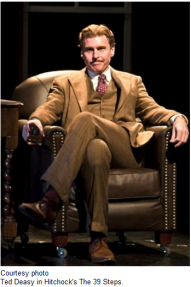 Ted Deasy, who currently stars in the Alfred Hitchcock-inspired THE 39 STEPS at the Warner Theatre, graciously granted me an interview to share his views on theatre, food and the arts. The two-time Tony and Drama Desk award-winning play will run till March 28th. The following are some earlier reviews. It is scheduled to open Off-Broadway later this month. Ted Deasy, who currently stars in the Alfred Hitchcock-inspired THE 39 STEPS at the Warner Theatre, graciously granted me an interview to share his views on theatre, food and the arts. The two-time Tony and Drama Desk award-winning play will run till March 28th. The following are some earlier reviews. It is scheduled to open Off-Broadway later this month.
Ben Brantley of the New York Times, called the production, “Absurdly enjoyable! This gleefully theatrical riff on Hitchcock’s film is fast and frothy, performed by a cast of four that seems like a cast of thousands. The actors themselves seem to be having a helluva good time. As does the audience.”
 Claire Brownell and Ted Deasy in ALFRED HITCHCOCKS THE 39 STEPS Clive Barnes, of the New York Post, pronounced THE 39 STEPS “Inventively astonishing, riotous & marvelous.”
Joe Dziemianowicz, of the New York Daily News, exclaimed, “Hitchcock probably never imagined his thriller had the makings of a hilarious comedy, but this show is a dizzy delight and an ingenious spoof, inventively directed by Maria Aitken. A fast-paced fun ride!”
It continues to play to sold-out houses in London’s West End.
Jordan Wright – I apologize that I haven’t seen the show as of yet. I’ll be seeing it next week.
Ted Deasy – It’s fairly common to hear that unless you’ve seen it in New York. It’s a gem of a show that most people haven’t yet heard of. It just didn’t get that much attention. But it’s like the little engine that could.
Its success is mostly word-of-mouth. People say, “Ya hafta see it!” It’s an irreverent and fun send-up of Hitchcock. It’s music hall and vaudeville…pure theatricality.
For me it’s a joy to be in a show like this because it’s enjoyable for all generations. It’s an evening full of actors playing multiple roles with a script directly from the 1935 film. It has a great sense of decorum and tongue-in-cheek for the adults as well as kids and teens.
JW – I understand there is a great deal of slapstick and physical comedy?
TD – Our director pulled from everything you can imagine – from vaudeville, from comedia, from slapstick. Also any of the old theatrical styles, like Shakespearean asides. The physical part is done super-fast. In order to create that sense of excitement it moves incredibly quickly and with great style. It captures that sort of breathlessness.
JW – I understand that there are only four actors but dozens of roles. How does that work?
TD – The roles are divided up. I play one role and I’m on stage throughout, but Claire, the classic Hitchcock blonde, plays four different roles. The other two actors play between 130 – 150 different roles, some “roles” are actually inanimate objects. Some of the actors are instantaneously changing characters over and over, often playing three characters simultaneously.
JW – Had you done physical comedy before?
TD – Sure. One of the great treats doing this show was that the casting agents were looking for actors that had had careers doing classical work. I’ve done Moliere and outdoor Shakespeare, as have Eric and Claire, but this was nothing like I’ve done before.
It looked effortless when I first saw the show. But it took a lot of rehearsal to make it look that way. It was a great challenge to make this crazy, mayhem, funny, show look fast and effortless.
JW – I discovered you had a coffee shop and bakery in Jackson Heights, very near Astoria, where actors, Christopher and Glenn Walken grew up and where I met them when they were in their twenties. Their parents owned Walken’s Bakery, where Lydia Bastianich once worked. I wondered if you knew that Queens was an incubator for Hollywood actors and gourmands!
TD – That’s extraordinary! I didn’t know that. My partner, Gina and I started baking for casts and they loved it and we loved doing it. People kept asking us to do more. When we moved to NY we worked for a farm cooperative. We were just doing this on the side.
Three years ago we opened the bakery and coffee shop and we’re still trying to figure out how to make it work – to find the right balance. The store is on hiatus right now since we are both under contract in different parts of the country.
JW – Recently one of the country’s top chefs, Jose Andres, was given an award in the arts by The Vilcek Foundation who included the culinary arts in their definition of the arts. As an actor who is involved in the food arts how do you see the relationship between the two?
TD – That’s great to hear that! I listen to so many people and their issues with food and I think about why we eat and how we eat. And I hope for people to experience, especially if they’re in the arts, sitting down to a meal and thinking of it as if it were an art event. It incorporates all of your senses.
 Alfred Hitchcock’s THE 39 STEPS You need to look at what’s in front of you and see the preparation visually and then experience it orally. Then you feel afterwards, like with a play, or an art opening, a dance piece or the opera, that you might have the same satisfaction. You can ask, “How did this happen, why did this happen, where did this come from and where are we going with this?”
I think the best dietary experience that people can have is to not talk about restricting or denying [themselves], but to actually think about, “What this is, how is it made, what is the preparation and why do I want it?”
People just don’t take the time to examine these things. I do think that the theatre and the culinary arts are intrinsically tied together.
JW – Will you reopen your bakery again?
TD – We plan to be back in New York in July and, although we’re not sure what we will do with the bakery, Gina, who is now out West, was experimenting with a new cupcake recipe yesterday. It was a chocolate Guinness cupcake with a milk chocolate malted buttercream icing.
So although we don’t yet know if we’ll continue with baking it’s like Tom Stoppard said [in Rosenkrantz and Guildenstern], “You can’t unstir the jam!”
This interview was conducted, edited and condensed by Jordan Wright. For questions or comments on this interview contact Jordan@WhiskandQuill.com or visit www.WhiskandQuill.com.
www.warnertheatre.com
www.39stepsonbroadway.com
|
