|
|
Jordan Wright
March 2010
 At the award presentation - from left Jose Andres, Spains Ambassador, Varin Keokitvon, Jan and Marica Vilcek - photo by Jordan Wright A humble Jose Andrés, accepted the Vilcek Prize for the Arts at the residence of His Excellency the Spanish Ambassador, Jorge Dezcallar De Mazarredo and his lovely wife, Marica this Tuesday. Eyes fixed firmly at the soaring ceilings of the elegant Foxhall Road residence throughout his introduction, so moved did he seem by this august award, one could sense that the great chef was not only thanking the culinary gods that have shone powerfully on his brilliant career, but also his family and devoted friends as well.
“It’s been almost 19 years since I came to this country,” he recalled. “I’ve been an immigrant all my life and when I came here I was received with open arms.”
This is the first time The Vilcek Foundation has recognized the culinary arts as pertaining to “the Arts” in general and it was a cultural shift for future art awards from other foundations.
Andrés was credited with bringing Spanish culture to the forefront of American cuisine while pushing the boundaries of food both as a sensory experience and vital component of well-being.
Along with Andres, Laos-born Pastry Chef, Varin Keokitvon, was honored with a Vilcek Prize for Creative Promise for his work as a chef/instructor with the Seattle-based FareStart, where he trains homeless and struggling individuals for careers in the culinary arts.
 Friends at the awards reception at the residence of the Spanish Ambassador - photo by Jordan Wright The Vilcek Foundation Prizes, founded by Dr. Jan T. and wife, Marica Vilcek, themselves immigrants from the former Czechoslovakia, were established to honor the contributions of immigrants to the American arts and sciences, and consist of a $50,000 cash prize and an award sculpture. “Our prizewinners are excellent example of how immigrants continue to fuel innovation and enrich our society,” said Dr. Vilcek.
The 2010 Vilcek Prize for the Arts is awarded in the field of Culinary Arts. The prestigious jurors include Chef Dan Barber, former Editor-in-Chief of Gourmet Magazine; Ruth Reichl, Dana Cowin, Editor-in-Chief of Food & Wine magazine; Susan Ungaro, James Beard Foundation President; and Maria Guarnaschelli, Vice President and Senior Editor at W. W. Norton & Company.
The evening’s fare was highlighted with tasty tidbits from José Andrés Catering with Ridgewells, his latest venture.
Chef Andrés will be honored at an awards presentation dinner on April 7th, 2010, in New York City, where The Vilcek Foundation is based.
For questions or comments on this story contact Jordan@WhiskandQuill.com.
Jordan Wright
Is DC Becoming the New New York?
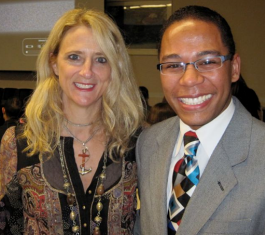 Greater Washington Fashion Council screening of Schmatta on the Hill with fashion designer, Nanette Lepore and Ohio Cong. Tim Ryan Legislative Assistant, Robert Bacon - photo by Jordan Might as well start practicing your spaghetti twirling and channeling your inner Guido, with NY’s Casa Nonna scheduled to arrive in April to California Pizza Kitchen’s former Connecticut Avenue location and Carmine’s, another NY transplant, planning on a two-story 20,000 square foot location in Penn Quarter in mid-June.
The much-anticipated, over-the-top fabulous, Buddha Bar, with locations in New York, Paris, Tokyo, Beirut, Dubai and Kiev, is due to open this Spring in the Mount Vernon Triangle along with Philadelphia-based Cuba Libre, which promises over 75 different rums and a pre-Castro Cuban décor, slated to open in late May to early June. And now we have our own outpost of New York’s Greek restaurant Kellari (see my review). NY’s BBQ wunderkind, Mark Glosserman, is bringing us Texas style down-home flavors and live music with Hill Country with an opening scheduled for this summer.
Traditionally NYC-based industries like fashion, food and film now have a firm toe hold here. There’s the socially and politically active Greater Washington Fashion Chamber of Commerce, and entrepreneur Philip Dufour’s Politics on Film Festival in early May and the Environmental Film Festival that now calls DC home, earning DC its well-deserved moniker as “Capitol of The Documentary Film”. Is New York fading as a destination for these industries?
Hollywood Cupcake Confidential
Beverly Hills cupcake titan, Sprinkles, is coming to town this spring. Adored by Oprah, Tyra and Barbra this “cupcake boutique” will sweeten the pot by sharing M Street with our beloved Georgetown Cupcake. Oh the lines! Oh the hookups while waiting for those tiny sugary aphrodisiacs!
New York City’s Bond 45 Sails Into National Harbor
 Bond 45 - photo by Jordan Wright Blend NYC’s once-great Luchow’s, the century-old Peter Luger steakhouse, the historic Mama Leone’s, and the recently shuttered Gage and Tollner’s seafood emporium into one perfect authentic Italian steakhouse and seafood restaurant and what do you get? Bond 45, an instant classic, recently opening their second location at National Harbor. Their first venture is in the old Bond Building in New York City…thus the name.
While Executive Chef, Daniele Turchetti, hails from Fruili, Italy, the snappy-confident Italian waiters in a retro look of black ties and crisp white vests, serving guests with a flourish and a quick wit, are direct from NYC. A turn-of-the-century dark-paneled bar unfolds into smaller dining rooms with a mix of Old World Euro and 1940’s style décor. There are mosaic-tiled floors, nailhead-studded tobacco-hued leather banquettes, stamped tin cove ceilings and original oils selected by owner/creator, Shelly Fireman, on his tours of Italy.
I am still swooning for Bond 45’s crescendi of glorious vegetable antipasti and salumi, dry-aged or grass-fed beef, clams oreganata, luscious seafood risotto, house made burrata, pasta with slow-cooked beef ragu, and the traditional white linen napkins with stitched-in buttonholes…very old school. Don’t miss the chocolate mousse that transcends all previous renditions.
This unpretentious restaurant is homey and sophisticated all at once. For NY transplants and their foodie friends, this is the place for your next in-country Roman holiday. Look for their Nat Harbor summer opening of Fiorella, a casual pizzeria by the water.
Kitchen Quotes
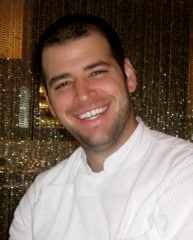 Bibiana Chef Nicholas Stefanelli -in love - photo by Jordan Wright Maryland native Nick Stefanelli, executive chef at Ashok Bajaj’s latest downtown restaurant creation, Bibiana Osteria and Enoteca, tells me his dishes reflect his amorous emotional state. “I am in love,” he declares. That’s amore in every bite!
Velvet Rope-a-Dope at the W Hotel
During a recent visit to the uber-modern W Hotel, to attend a reception I found a lobby with all three elevators roped off and seriously intentioned sleek-suited men with clipboards checking off names. Quite unlike any hotel I had ever experienced, the entire lobby was cordoned off with a series of velvet rope rows, airline terminal-style. It seems as though there were several other events that evening and they were screening incoming guests like high-class bouncers. We all dutifully stood in lines while the tiny elevators came and went. Not my cuppa. When I asked a staff member if it was always like this he barked, “Well, Madame, it is a hotel!” Oooohhhh, slap on the wrist! Guess I should have known better than to question an authority on hotel protocol.
Jordan Wright
March 2010
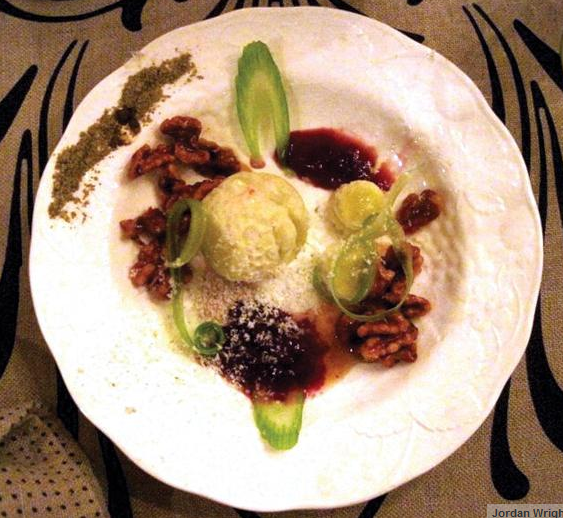 Photo credit Jordan Wright After two and a half months of anticipation, several blizzards and a flurry of back and forth emails, I was armed with the event’s protocol. It consisted of guest photo op restrictions and apparel parameters from the hosts of a local super-secret dining club. Five couples had agreed to let me cover one of their monthly themed dinners.
The Hosts: Anonymous members of a private supper club.
The Location: Somewhere in metropolitan Washington DC on a hilltop.
The Plan: A Japanese Harajuku evening with six courses and countless complex accompaniments.
The Inspiration: Recipes sourced from New York’s Momofuku and Chicago’s Alinea restaurants.
The Guest List: Serious foodies, gourmands, amateur chefs and wine connoisseurs.
The Required Dress: Creative outfits from the Harajuku movement.
On the appointed day I rushed to google it up. Isn’t that how we inform ourselves these days? I learned that Harajuku, which loosely translated means Halloween, originated with Japanese teens meeting up on Sunday afternoons in their neighborhood parks and sporting clothing and makeup inspired by specific themes. There’s the over-the-top Lolita, look replete with baby doll dresses and large bows or barrettes clipped into brightly-dyed pink, blue or purple pigtails, Japanese Anime character look-alikes, period Victorian garb and colorful punk gear with Goth-inspired hair and makeup. Matchy-matchy is very uncool, and plaids are routinely mixed with stripes and floral patterns.
“Hello Kitty” and “Pokemon” purses and lunch boxes are favored accessories, as are carrying or wearing small “Totoro” stuffed animals or creatures from Japanese animator Takashi Murakami’s line of plush toys. Some styles are straight from high-end designer ateliers, but for the most part it is cobbled together from mismatched thrift shop or boutique finds. It sounds totally anti-fashion but is actually spectacularly artistic in a bizarre and inventive way. Many current high-fashion runway looks have evolved from this genre.
I hastily pulled together a shocking pink Japanese brocade frock coat over a cream-colored Victorian lace blouse with jabot and paired it all with plaid knee socks over black leggings and a black schoolgirl’s kilt. I left the stuffed dinosaur at home, skipped the Kabuki makeup for a smear of lip gloss, and topped it all off with an assortment of rhinestone hair clips. I felt completely off-kilter but ready to channel my inner Japanese teen.
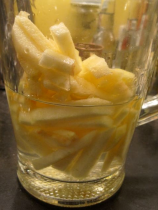 Welcoming cocktail with Japanese sho-chu vodka and Asian pears - photo by Jordan Wright I arrived at a large restored colonial with a hawk’s eye view of the city where my hosts, their children, and an on-duty Papillon greeted me enthusiastically. I planned to come early to take some food photos and offer assistance to my hosts, but the preparations were well underway. My host, and chef for the evening, handed me a welcoming cocktail, an infusion of Asian pears with sho-chu vodka, and invited me on a tour.
The 19th Century high-ceilinged home had two kitchens and a butler’s pantry with ten-foot high shelves filled with all manner of exotic spices, condiments and a working kitchen’s necessaries. The upstairs kitchen, large and rustic, had a wall of well-used copper pots, another featured a large contemporary oil painting. On the lower level another workspace housed state-of-the-art equipment befitting the molecular gastronomy necessary to achieve our much-anticipated dinner.
There was a Pacojet Puree Machine, an Excalibur Food Dehydrator, a Minipack Torre Vacuum Chamber Sealer for shrink-wrapping, and a Poly Science Sous Vide Circulating Bath for cooking or chilling. Freezer drawers held silicone molds filled with spherical frozen mousse. It immediately became clear that this was more than just a passing interest for my host…and the Iron Chef-style excitement ratcheted up a few more notches.
As guests filtered in and out of the bustling kitchen and drawing room and the conversation turned lively, the children, clad in their own versions of the “look”, wandered off to wherever it is that children go when they are bored with adult conversation. After a few rounds of champagne, we gathered at the long dining table where food and wine began to consume the conversation and we, in turn, them.
The first course presented was a frozen sphere of Maytag Blue cheese ice cream surrounded by walnuts in grape syrup, a port wine gelee, grape foam, walnut milk, celery and celery salt made from stalks dried in the dehydrator…a sort of mad scientist’s Waldorf salad and our host’s nod to Chef Grant Achatz of Alinea Restaurant. It was an inspired, playful and delicious adventure and I ate my way in circles around the plate repeating the yin-yang flavors by turns.
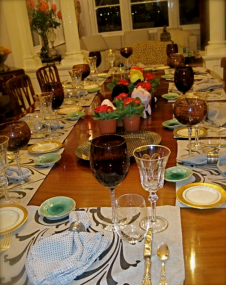 Before the guests arrive for the Harajuku evening - photo by Jordan Wright A subsequent course proved to be a sensuous dish of Riesling gelee over lychee nuts with pine nut brittle and shaved frozen fois gras – a tribute to Momofuku and the genius of Chef David Chang. The mouth feel of this combination was luxurious…the tiny wriggly cubes of late harvest Riesling jelly; tender globular floral-fragrant lychees; crunchy pine nuts with their sap-like aroma encased in hardened caramel; and buttery-smooth Hudson Valley duck foie gras raining down over the whole. I was pleased this evening was a secret for I had no impetus to reveal its mysteries to outsiders just yet.
Irresistible slabs of crispy pork belly glistened, and in yet another triumph borrowed from Chang, Bo Saam, a ten-pound braised pork shoulder, its skin rendered bronze and lacquered with saam. Platters of just-shucked oysters appeared alongside of sauces and condiments like kimchi, chiles, fermented bean curd, pickled mustard seed sauce, scallion and ginger compote, pickled vegetables and fish sauce dotted the table.
The wines for the evening were carefully selected and exquisite. A Carlisle Zinfandel from the Russian River Valley, a double magnum of Poizin Reserve in the skull and crossbones etched bottle from Armida Winery in Sonoma’s Dry Creek Valley, a fine 2007 Sea Smoke Pinot Noir from Santa Barbara County and an extraordinary 2007 Saxum from James Berry Vineyard Proprietary Blend…100 points from Robert Parker! A wine of such splendor and amplitude begged silent contemplation of its marvels, every sip bespeaking its provenance and development. As my imagination concocted its journey, I envisioned its beautiful grapes slowly ripening on the vine and the experienced decisions of its vintner shepherding its path from birth passage to aging process.
With deep regret I had to take my leave for a prior engagement before dessert was served, so I will never know the ending to this evening’s meal. But in a way, like all great meals and all great wines, we stand at the precipice, lured by the siren’s song and the promise to our most fragile selves to relive that evanescent moment when all the gastronomic stars align.
To start your own private supper club:
There are widely varying degrees of group size and culinary skill levels in each supper club. To start your own, you just need to round up friends of like mind for a once-a-month evening, decide on a theme (My hosts’ club did a multi-course fennel dinner the previous month (Yes, fennel cake and fennel ice cream for dessert!) then decide if it’s “pot luck” or if the host couple will prepare the entire meal. Guests can bring wines but need to consult the host as to the proper pairing.
Themes:
The fun is in the planning and using your imagination. Single ingredients, ethnic cuisine or holidays can drive the theme of your gathering. I recall once coming upon a group of 20 or so Ukrainians picnicking in Fort Hunt Park last summer. Their party was more of a “pot luck” in that the guests each brought a dish, but it was marvelous in its variety of homemade pickled cucumbers and mushrooms, potted meats, borscht, a grill laden with skewered lamb shashlyks, salads, homemade breads and cakes and, of course, large bowls of fresh cherries. The clear liquid of choice to wash it all down was most decidedly not branch water.
For questions or comments on this story contact Jordan@WhiskandQuill.com. And if you decide to host your own supper club let me know how it turned out. Better yet I’d be delighted to help!
Jordan Wright
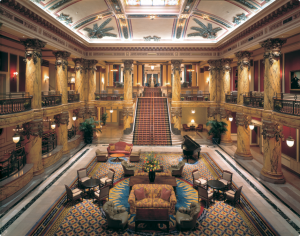 The Jefferson Hotel Rotunda Brunch at The Jefferson Hotel in its magnificent columned Rotunda, where ceilings soar to seventy feet, is an over-the-top event. Guests come from miles around to enjoy the finest gourmet Southern cuisine and this spring I wrote glowingly about my experience.
Recently I returned to The Jefferson eager to revisit this splendid property, replete with Tiffany glass ceilings and sweeping Scarlett O’Hara staircases, and to stay where luminaries like Elvis and F. Scott Fitzgerald; actors Morgan Freeman, Sarah Bernhardt and Charlie Chaplin and no less than the great explorer, Sir Edmund Hillary, had wined, dined and reveled…presumably after his Everest climb. After all, if nine American presidents and Sheryl Crow thought it had a cool vibe, I knew I would too.
After a short drive from Washington, we crossed the cobblestone drive to the elegant portico. Valets whisked off our bags and seamlessly ushered us in. Along the way we were warmly welcomed by every staff member we passed. In fact, throughout our stay we wondered if they hadn’t confused us with the hotel’s owners or long lost cousins returning to the fold, so very genteel was the staff’s daily attention.
As one of one of the last remaining bastions of Southern hospitality, everything about this hotel spells graciousness and grandeur. Built in 1895 by Major Lewis Ginter, a visionary in the extreme, to compete with Europe’s grand hotels, it featured more luxuries than the QE2 and Titanic put together. The Beaux Arts architecture is breathtaking, the life-size marble statue of Thomas Jefferson, awe-inspiring and the alligators intimidating. Well, actually the alligators aren’t there any longer, but not so long ago they roamed the lobby. Memorialized on the dining room staff’s cute blue and green silk ties they have been revered and adopted as the hotel’s iconic mascots.
Richmond has been enjoying a stunning renaissance of late. Big tobacco no longer dominates and the story on everyone’s lips is the success of Virginia Commonwealth University. To accommodate its 32,000 students VCU has bought up and restored many of the old warehouses and historic Victorian homes that had fallen into disrepair and the city now boasts the largest contiguous Victorian neighborhood in the US.
The revitalization appears all over town in areas like Shockoe Slip and Tobacco Row along the waterfront, where old tobacco warehouses have been turned into shops and offices and in Carytown, the Museum District and the Fan District where you’ll find hip nightspots, coffee houses, quirky boutiques and charming restaurants. I loved the too too fabulous Can Can Brasserie, housed in a former bridal salon, which will have you believing you’re dining at Paris’ La Coupole, and Zeus Gallery Café, a tiny bistro, next to Chadwick and Son Orchids, in the fashionable museum district serving brilliant food.
But foremost on my mind for this quick visit was the redesign of both menu and décor of The Jefferson’s famous restaurant Lemaire. Nine months shuttered, its reopening was greatly anticipated.
Executive Chef Walter Bundy had his early culinary training on a family farm along the Chesapeake Bay where he learned to tend a garden, hunt, fish and prepare meals from what was available. Later he was to learn Southern coastal cuisine on North Carolina’s Outer Banks and train at Mark Miller’s Coyote Café in Santa Fe and Thomas Keller’s French Laundry in Napa Valley. He has a keen and dedicated sense for local ingredients in his dishes and he keeps a small herb and vegetable garden behind the hotel where he gleans ingredients for his dishes.
In recent years Lemaire had become stodgy and out-of-date, attracting an older crowd known to preserve their traditions under glass. So when the menu was changed to attract a hipper crowd they feared they might lose their loyal though waning clientele. Instead Richmond’s scions and well-heeled doyennes have embraced the smaller portions and innovative cuisine and the place is filled with a mix of old and young establishment Richmonders flocking to the lively bar before dinner.
It was there we sampled hand-crafted cocktails like ‘Two Grapes”, a sublime concoction of Tomio Junmai Ginyo sake, St. Germain elderflower liqueur and red grapes…quite irresistible…and enjoyed along with Jamerson Farms braised rabbit egg rolls and Kite’s Country Ham with a sweet tangy dipping sauce of spicy orange marmalade and rabbit liver mousse on a caramelized brioche.
With great anticipation we left our nibbles and sips and went to table where we entered into a profound understanding with some Rappahanock River oysters, a locally farmed oyster which I adore and sourced earlier this year for my Inaugural menu. We enjoyed the “Sting Rays” 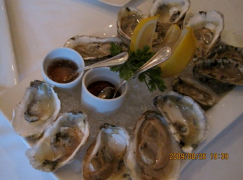 Sting Rays and Old Salt oysters at Lemaire - photo credit Jordan Wright and “Old Salts”, briny and beautiful, and the ginger-crusted Virginia soft shell crab atop a cous cous tower stacked with watermelon and avocado mousse and highlighted with chili oil. A peppy 1999 J Brut sparkler from the Russian River paved the way and we were off. Wine Director, Ben Eubanks, took savvy charge of the pairings for us during our dinner.
Beef tartare, with local lettuces and horseradish cream charmed us with a 2008 Mas le Dame rose Les Baux-de-Provence., while a 2008 Lawson’s Dry Hill Pinot Gris Marlborough complemented the fried green tomatoes, Silver Queen corn, Surry sausage (a Virginia favorite) and Gulf shrimp succotash with sunflower shoots and buttermilk blue cheese cream.
Three things to note: Tender and velvety-leaved sunflower sprouts are becoming a favorite of mine; rose is coming into its own again and I intend to write more about it in another column and finally, I would eat this delicious dinner all over again and right this minute, for this cuisine, canonized by the great hostesses of Virginia, is as beloved as a favorite child.
A petit cadeau from the chef arrives: A Hanover tomato gazpacho shooter with Chesapeake Bay blue crab, watermelon and a drizzle of basil oil spelling s-u-m-m-e-r to the max.
It is no secret that I am a fan of real stone-milled corn grits…not the soupy, breakfasty, diner-style puddle…but the toothsome kind, a close neighbor to polenta. And Lemaire, paean to the cherished cooking of the South, serves their antebellum Carolina grits with seared ocean scallops, sautéed spinach and fire-roasted tomato sauce. As a pleasing counterbalance a 2005 Enotria Barbera from Mendocino shone over all. My partner chose the curry-scented lamb loin that strode alongside of cauliflower mousse, garlic rapini and fresh local huckleberry jus that harmonized with a 2002 Romero and Miller Rentas de Fincas Rioja Reserve. You just knew the riojas were coming, now, didn’t you?
At last we chose a dark chocolate terrine with scattered wild berries and sabayon sauce and a huckleberry semifreddo to crown this exquisite repast. 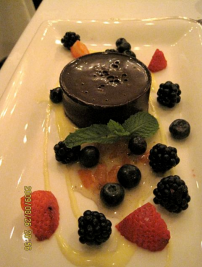 Chocolate terrine with wild berries and sabayon sauce at Lemaire - photo credit Jordan Wright Dining at Lemaire that evening I detected a warm camaraderie. Shared smiles and nods from other diners created the sense that everyone in the room held the same secret…that we were all there for a very special reason. It was a remarkable and unique experience.
In the morning we scampered out to Independence Golf Club, a Tom Fazio designed course just twenty minutes out of town in Midlothian. Its Jeffersonian-styled clubhouse, known as the Charles House, is home to the Museum of Virginia Golf History and is chock-a-block with trophies and memorabilia from tournaments passed. We opted for the nine-hole course. Since, even with a breeze and shaded paths, the heat was stifling. This club has both an eighteen and a nine-hole course. Notwithstanding, we were the only wilted wimps on the nine.
Later in the day we opted for a tour of the famous Hollywood Cemetery, known as one of the more intriguing historic venues in Richmond. US Presidents James Monroe and James Tyler; Confederate President, Jefferson Davis; six former governors and a heap of noted southerners are interred here in a cemetery of over 200 hilly acres. Recently they instituted guided Segway tours of the grounds and, after a few minutes of required instruction, we were ready to “roll” with Mr. Butterworth as our guide. E. L. is a certified guide trained by the Historic Richmond Foundation, and he was a veritable encyclopedia of Virginia arcana. He regaled us with both on and off-the-record tales of this cemetery perched above the beautiful James River. We took in the cool breeze off the mighty river and saw Belle Isle where picnickers were splashing, swimming and wading from rock to rock.
The following day we toured Agecroft, a remarkable 17th century Tudor house brought by sea and train from Lancashire, England and painstakingly reassembled here. Housing one of the nation’s finest collection of 16th and 17th century furnishings, this estate and its elegant Elizabethan gardens are a must see. In summer they present a Shakespearean festival under the stars.
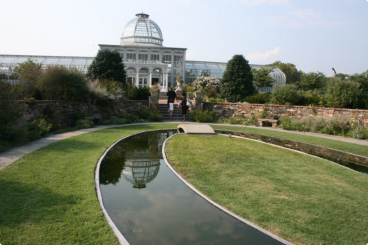 Lewis Ginter Botanical Garden - photo credit Jordan Wright On our way home we stopped at the Lewis Ginter Botanical Garden which has blossomed into a world-class 82 acre garden featuring an enormous conservatory with tropical orchid wing; Bloemendaal House, the antique-filled ancestral home of the Ginter family; a children’s garden; the Lace House Garden with its hand carved gazebo; the Sunken Garden inspired by ancient Rome; the Healing Garden with medicinal plants; and many other separate gardens to explore. A community kitchen garden project, staffed by local volunteers, donates more than 500 pounds of fresh produce each summer to the Central Virginia Foodbank.
Our two-day two-night stay showed us a small snapshot of Richmond and we plan to return soon and often to explore more of the city. Before you plan your trip visit the sites below for more information on these and other attractions.
www.visitrichmondva.com
www.jeffersonhotel.com
www.cancanbrasserie.com
www.lewisginter.org
www.segwayofrichmond.com
www.agecrofthall.com
For comments or questions write Jordan@whiskandquill.com.
Jordan Wright
Local Kicks and Whisk and Quill
February 2010
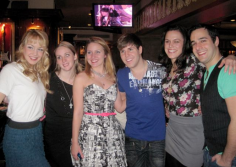 Cast of Grease at the Hard Rock Cafe after party - photo by Jordan Wright Grease is one of those throwback shows that will always delight baby boomers who define their teen years by hot rods, high school and high hair. Apparently the allure has recently transcended the genre because I was quite surprised to see so many 20- and 30-somethings in the audience singing along with the 50’s tunes.
The production opens up with the high-energy Dominic Fortuna as Vince, warming up the mostly local crowd and “greasing” the wheels for the evening. He exudes song bits and shtick, instructing the audience in a seated version of the Monkey, the Swim and the Funky Chicken. But all this comes to nought in a production that never coheres. There’s plenty of talent in the dancing and singing, especially the a capella moments, though Lauren Ashley Zakrin, playing goody-goody turned hipster, Sandy, was pitchy in places in her solos.
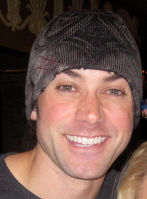 Ace Young after the show - photo by Jordan Wright As for former American Idol contender, Ace Young, he nails his role with brio…his voice clear, strong and sexy…his dancing dead on.
“I was a football player and all-round athlete in high school,” he told me at the cast party. When I asked him how long it took to learn the complex routines he said, “I had two weeks of rehearsal, but I’ve always been a good dancer.”
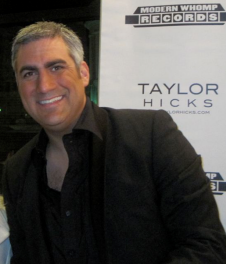 Taylor Hicks of Grease at the National Theatre - photo by Jordan Wright The night turned starry when former Idol winner, Taylor Hicks, playing Teen Angel, sprung from a giant ice cream cone in a blue sequined suit, his riveting personality electrifying the audience who shrieked and applauded his raspy country singing and bluesy harmonica playing. Note to his agent: Hicks soulfulness could use a more appropriate vehicle than a be-bop forum.
When Hicks sings “Beauty School Dropout” to Frenchy, played by Kate Morgan Chadwick, he goes all googly-eyed as she twists his chest hair telling him, “I voted for you.” – a reference to the Idol competition.
This Grease could have shown more oomph but see it for the nostalgia and see it for the talented Ace and Taylor.
For comments or questions on this article contact me at Jordan@WhiskandQuill.com.
Moon Bay Coastal Cuisine and Old Hickory Steakhouse
Jordan Wright
February 2010
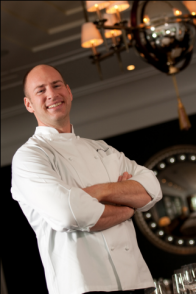 Chef Michael Harr - photo courtesy of the Gaylord National Resort and Convention Center Chef Michael Harr’s return to the DC area has landed him at the Gaylord National’s Resort and Convention Center to helm both the Old Hickory Steakhouse and Moon Bay Coastal Cuisine. Thrilled to have a chef with such star quality, the hotel takes a decidedly different turn in offering diners a more innovative and chef-driven dining opportunity.
Locals know the Gaithersburg-raised Harr from turns at the Watergate’s Jean-Louis, where the cooking bug bit him, Butterfield 9, the greatly adored and sadly missed DC restaurant, where he made his mark with his beautifully created and unique offerings, and at the former five-diamond Maestro Restaurant, where he worked alongside famed chef, Fabio Trabocchi.
Harr has held stages in France at a number of prestigious restaurants working with other noted chefs, Alain Ducasse and Guy Savoy. In Las Vegas he was Sous Chef to Jacques Vanstaden at the famed London Club, later worked in Montreal, New York and Miami as Executive Chef at Zodiac.
Old Hickory, which I reviewed last year, is a sophisticated steakhouse. It has an après dinner cigar deck, their very own artisanal cheese cave and one of the most beautiful dining rooms ever designed…a stunning Charleston-inspired setting with gorgeous views of the Potomac River.
Moon Bay, also reviewed here last year, feels like a coastal retreat, with a babbling brook flowing beside its deck, it, too, overlooks the Potomac. Surrounded by a lush tropical forest, it features creative seafood dishes. Harr’s French-trained background is an impressive new direction for these two top-drawer destinations.
In an exclusive first time interview with Whisk and Quill, Harr shares his vision for his latest adventure.
Jordan Wright – As an iconoclastic chef with classical traditions how will your style translate to accommodate two distinctly different restaurants…Old Hickory Steakhouse and Moon Bay Coastal Cuisine?
Michael Harr – As a culinary professional, it is important to appreciate many aspects of cuisine and the use of products available to us with every season. In this case, we have seafood and meats as the main focus. This amazing opportunity will allow me to focus on foods that I am passionate about. Such as local East Coast seafood as well as sourcing seafood items that wouldn’t normally be found on a general seafood restaurant menu.
For Moonbay, I envision it as being an adventurous outlet with the freshest of seafood as it’s main focus. My objective with the food is sustainably sourced, seasonality and driving personality…and keeping it simple and approachable.
For Old Hickory, I plan to incorporate classic approaches as well as “new-age” items with a modern twist. We hope to share our concepts to a clientele that can be adventurous and enjoy creativity within a steakhouse setting. Old Hickory is a gorgeous restaurant with an outstanding service. I’ve dined in many steak houses and Old Hickory stands out as an attractive destination that sets itself apart from the rest.
I would like to introduce seasonally inspired food items with creative choices for our composed plates. We are a steakhouse so our focus will be to offer great quality steak dishes, but I’m looking forward to incorporating some very interesting twists like “Chocolate Elk” (a dish that became my signature and gained notoriety at one of my previous restaurants) among others. My vision for Old Hickory is to make it one of the Capital region’s newly appointed destination restaurants that everyone must experience.
JW – How will you interpret your training in haute cuisine for the both restaurants?
MH – I have a very ambitious approach to our cuisine at the Gaylord National, with important goals to accomplish along with our executive leadership. My initial focus will be to bring the best local ingredients to our clients while enhancing overall food quality.
We currently have corporate contracts and, once they are approved for local sourcing, I will be able to develop a seasonal program that allows me to design creative and fun menus with local products. I believe “haute” is about quality, passion and foundation… in this way I am able to be successful in my mission to create the best for the clientele.
JW – What menu changes and local sourcing do you have in mind? When will the menu reflect these changes?
MH – I believe that all menus should be seasonal. Local sourcing can be significant with the amount of business that we produce. If we support the local farmers, we demonstrate our support for agriculture, renewable resources and local community.
In regards to menu changes, that’s a good question. We have to consider that we are in a corporate environment so there are many processes that must be followed. We will gradually implement the changes as we provide comprehensive training to our staff.
JW – Will you be using only sustainable seafood and from what sources?
MH – Yes, I would like to obtain sustainable resources as much as possible. As a local DC chef, I have many sources that I have used throughout the years. I will continue to use my vendors to source amazing seafood products.
JW – Who have you brought with you to execute your vision?
MH – We are currently evaluating our organizational structure, and we will strategically allocate our talent to improve operations.
This interview was conducted, condensed and edited by Jordan Wright.
DC and Alexandria residents can get to National Harbor by taking the Metro to King Street where a Gaylord Hotel bus shuttle at the entrance to the station runs every 30 minutes from 10AM till 10PM direct to National Harbor for $5.00 each way.
Ferry service from the Georgetown and Old Town Alexandria docks to National Harbor resumes in March. For more information visit:
www.PotomacRiverboatCo.com
www.GaylordHotels.com/gaylord-national/ and click on transportation.
For questions or comments about this article contact Jordan@WhiskandQuill.com.
|
