|
|
Jordan Wright
March 7th, 2011
Special to The Alexandria Times
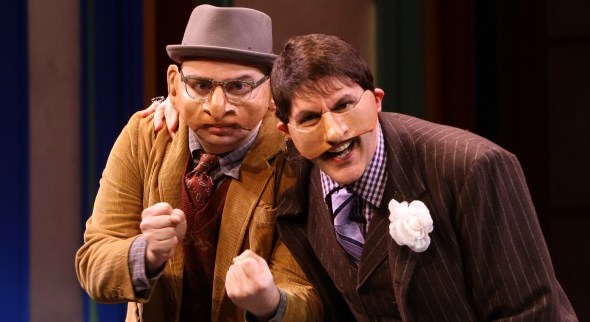
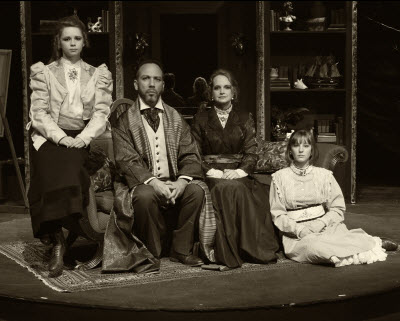 Emily Woods (Constance), Lars Klores (Mr. English), Elizabeth A. Keith (Mrs. English), and Elise Kolle (Felicity) Photo by Shane Canfield
When a Welsh family of four vanishes into thin air from their cozy country manse, leaving no other clue save a slip of paper handwritten with the word “widdershins”, we find two detectives hot on the trail to solve the mystery. In a complex and fascinatingly convoluted Victorian plot replete with Druids, faerie legends, French Impressionists and the occult, “Widdershins”, currently at The Little Theatre of Alexandria, connects these seemingly disparate elements with cohesive aplomb.
Underneath the quaint façade of this turn of the century upper crust family there are darker sides to each member that Inspector Ruffing, and his tippling cohort, McGonigle, aim to uncover. Between pours of the family’s finest scotch, McGonigle attempts to wrest the truth from a series of interviews with the family’s only remaining daughter, Annie, their lame servant girl, Jenny, and Betty, the village sorceress.
Mr. English, as the patriarch of the family, is a man in full who fancies himself a painter, writer and intellectual. Yet he is a dilettante holding his family firmly in his thrall. In a self-absorbed metaphysical quest – “To find the truth one must travel deeper and deeper into the abyss,” he declares – he dabbles dangerously in superstitions and Pagan legends. With the aid of a daft local seer and herbalist with a penchant for young boys, he is lured into the places where the “lost ones” dwell, as she goads him on to visit the spirits that have haunted him in his hallucinations.
“The sacred and the damned are the same,” English declares in a delusional dualist attempt to define God. With such a cavalier philosophy it should come as no surprise that he absolves himself of any responsibility towards his family, and we soon discover that everyone including his wife and children, Constance, Felicity, and their adopted daughter, Ann, has dark secrets and their own private demons. When English describes the world as a turf labyrinth or “mizmaze”, with the boundaries of a chessboard as its metaphor, we see his children, Constance and Felicity, toying with the pieces, in a symbolic reference to God toying with our destinies.
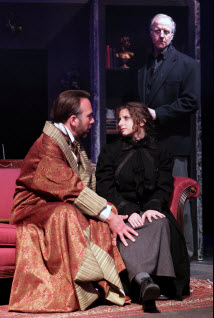 Lars Klores (Mr. English), Rebecca Fischler (Jenny) Photo by Shane Canfield If you’re sensing a dash of Alice in Wonderland and The Wizard of Oz meets the Addams Family, in a story written by Immanuel Kant and Edgar Allen Poe and directed by Fellini, then you’re on to something. Just remember to stage the fantasy in a comfortable Victorian drawing room with a fireplace.
In this carefully crafted whodunit, playwright Don Nigro reaches beyond a simple missing persons crime scene to explore intricate themes of religion, morality and sexuality in a mystery with cosmic mysteries. “God swims in a mysterious soup,” English divines.
To express that the characters’ reappearances are but visits from another realm as they waft in and out of the misty scenes in a time continuum, their visages are cleverly illuminated, by lighting and special effects designers, Ken and Patti Crowley.
The acting is smooth as a bolt of silk with Mike Baker, Jr. playing the bereaved McGonigle, J. Andrew Simmons as Ruffing the lead detective, Elizabeth A. Keith as the aggrieved Mrs. English, Kat Sanchez as the adopted daughter Ann, and Lars Klores as Mr. English. Gayle Nichols-Grimes plays the combo seer/witch in hoary and hilarious fashion (did I neglect to mention there was comedy here too?), while Elise Kolle and Emily Woods as the younger children exceed our expectations as the playful and mischievous foils whose innocence creates chaos.
Flawlessly directed by C. Evans Kirk, this production is highly recommended.
Through March 29th at The Little Theatre of Alexandria, 600 Wolfe Street, Alexandria, VA 22314. For tickets and information call 703 683-0496 or visit www.thelittletheatre.com.
WATCH Awards Reach Out and Touch
Alexandria’s Little Theatre
Jordan Wright
March 6, 2011
Sunday night and the crowd at the Birchmere was explosive. The WATCH Awards, which are to Washington area community theatres what the Tonys are to Broadway, were being presented and it was a pretty amped up crowd. Covering as far East as Annapolis, and south as Prince William County it included Alexandria’s own Little Theatre of Alexandria, which raked in four awards for Outstanding Achievement in Choreography for Amy Carson for her work on “Chicago”; Outstanding Achievement in Hair Design for Paul Morton for “Lady Windermere’s Fan”; Outstanding Achievement in Music Direction for Paul Nash for “Chicago; and Outstanding Achievement in Direction of a Musical for Susan Devine for “Chicago”.
By Jordan Wright
Posted on 21 February 2011
Special to Washington Life Magazine
 From "The Weir" - Kevin Adams (foreground) with Mike Tinder and Susan Marie Rhea - photo credit to Jim Coates The Weir, One Flea Spare and On The Razzle are on our radar for top theatre picks this week. Click HERE.
Jordan Wright
February 2011
Special to The Alexandria Times
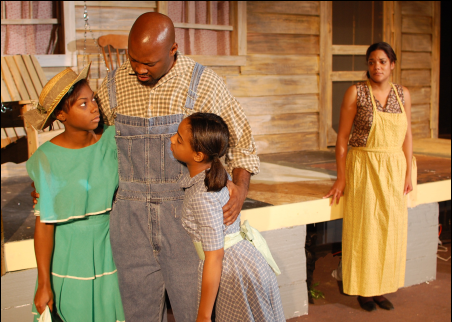 Marissa Moody as Joyce Cheeks, DeJeannette Horne as Rawl Cheeks, Aeshia Brown as Matoka Cheeks, Lolita-Marie as Mattie Cheeks Cal - photo credit Ari McSherry Before you “get all up in my family’s business,” as matriarch Mattie Cheeks is fond of telling Jewish traveling scholar and Holocaust survivor, Yaveni Aaronsohn, there is a perfectly plausible reason why this play uses the “N” word and why its usage, in any other context except historical, is so derogatory.
Brooklyn-born John Henry Redwood, an African-American actor and playwright, aimed to shock his audiences, shock them clear out of their complacency, in order to remind them of the invidiousness of the segregated South, not only for Blacks but for Jews as well.
In his play, “No Niggers, No Jews, No Dogs” presented by Alexandria’s Port City Playhouse, Redwood urges us not to forget the signs of racism, “Coloreds only”, “No niggers”, “Whites only”, and other hate-filled descriptors posted on restaurants, drinking fountains, rest rooms, hotels, gas stations and storefronts in the pre-civil rights South when fear-mongering, lynching, systematic rape and humiliation were promulgated and carried out by the Ku Klux Klan and their sympathetic followers.
The time was summer and the year was 1949 when Aaronsohn shows up in Halifax, North Carolina to study “the negative psychological effects of prejudice” on an African-American family. He finds the Cheeks’ home where husband, Rawl, played with a masterful subtleness by DeJeanette Horne, is a sharecropper and wife Mattie takes in laundry while raising their two girls, Joyce and Matoka during the days of Jim Crow law, and offers to pay them for their participation. Although initially suspicious the family comes to share their story with him and the complexities of their lives are revealed.
Beautifully paced and soulfully delivered this provocative yet tender and funny memory piece presents a cautionary tale…one that should never be forgotten.
In an unforgettably moving performance the beautiful and dulcet-voiced Lolita-Marie as the indomitable Mattie delivers an exquisite portrayal of a woman of grace and strong convictions whose canniness saves her family from certain doom. “You think life started when your life started?” she asks her children.
Also outstanding is ten-year old Aeshia Brown, playing the sweetly precocious daughter, Matoka, with the timing and delivery of a pro. “I’m studying you,” she informs Aaronsohn, as he records her explanation of the world. Her pivotal role, handled with sass and aplomb, providing the necessary comic relief.
The action takes place on or around the front porch – an iconic setting for Southern family life – where doors are slammed, peas are shelled, secrets are revealed and baskets of food are left for the mysterious Aunt Cora. Set Designer Erin Cumbo cleverly employs a clothesline hung with sheets as a projection screen for the opening photographs of racist signage from the South’s painful history.
“My father was an historian who taught me history could be sad,” recalls the playwright’s daughter, Rhonda Redwood-Ray, a federal prosecutor in Washington, DC. “Because he grew up around a lot of strong women, he was innately sensitive to women. Many of his characters were drawn from his own life.”
“Aunt Cora was a younger sister to my grandfather, and Mattie, my father’s mother is still alive at 90 and lives in Halifax, North Carolina,” she explains, acknowledging that her own father was probably the model for Rawl Cheeks.
Redwood-Ray remembers a childhood that included going to the homes of her father’s Jewish friends for supper where she was taught to be respectful of the customs of others and where she witnessed her father’s great sense of humor. “He had a laugh that would shake this whole set,” she told the audience recently in a talk after the show at the company’s newest location.
Weekends through March 6th at The Lab at Convergence, 1819 North Quaker Lane, Alexandria, VA 22302. For tickets and information call 703 838-2880 or visit www.PortCityPlayhouse.com.
Jordan Wright
February 2011
Special to The Washington Examiner
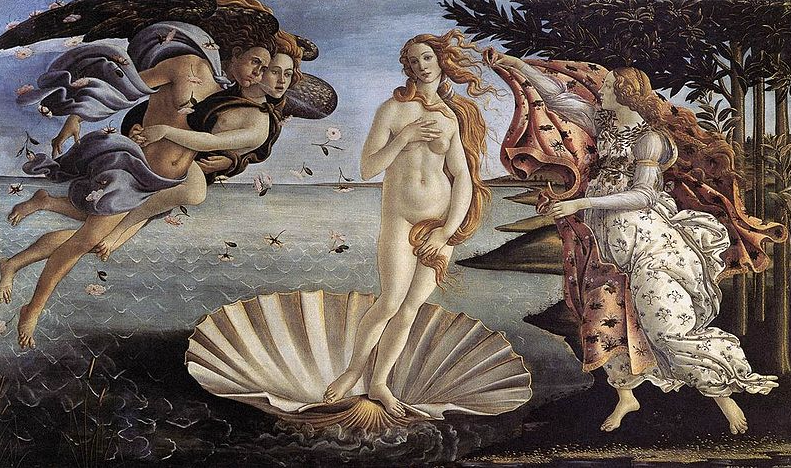 La Naissance de VénusUffizi – Gallery in Florence,Italy Rosemary, figs, pine nuts, honey. Oysters, grapes, avocado, chiles. Strawberries, coffee, lavender, ginger. Of all the foods reputed to inspire romance, it is chocolate that is most closely associated with gift giving on Valentine’s Day.
Whether its powers for sexual desire are provable or not, has researchers in a conundrum. Since years of testing can’t confirm it as fact, current science holds that the two major chemicals found in chocolate, phenylethylamine (related to amphetamine) and seratonin, contain mood-lifting endorphins.
And what about all the other ingredients purported to enhance romance? Ancient cultures have their favorites, and if lavender works for the French and pine nuts for the Italians, well, who are we to say. As far as the term, “aphrodisiac” goes, credit goes to the Greek goddess of Love, Aphrodite, known around Rome as Venus, unquestionably one of the hottest babes in history, whose son was Cupid. You make the call.
If you could ingest a few sensual foods in one fell swoop delectably enrobed in chocolate, would your sweetheart be doubly or triply affectionate? Food for thought indeed.
Here are some exceptional local sources to explore.
At ACKC Chocolates Cocoa Bar Café in Downtown DC artisan chocolatier, Rob Kingsbury has been creating inspired sweets for a discriminating clientele since 2002, when he opened his first shop on King Street in Old Town Alexandria. Kingsbury comes from four generations of candy-makers who sold maple-flavored popcorn balls from their maple syrup farm in Vermont.
His highly original handmade chocolate confections boast dozens of unusual infusions and one of the most sought after is his “Strawberry Pink”, a dark chocolate bar with strawberries and pink peppercorns. Other striking flavor harmonics are a dark chocolate bar with pine nuts, Herbes de Provence, sunflower and pumpkin seeds and sea salt or the exotic “Chipotle 5-Spice Bar” infused with smoky jalapenos and a blend of cinnamon, anise, fennel, cloves and white pepper. Or get three aphrodisiacal ingredients in one ganache-filled bite with his Honey Ginger Truffles. ww.thecocoagallery.com
Another source is the kitchens of chocolatier Wilhelm Wanders of Chocolaterie Wanderings whose European-influenced stylings are reflected in his hand-crafted confections, well-known to crazed chocophiles. “I use honey for nearly all my confections,” he reveals. Biagio’s in DC, The Sugar Cube in Alexandria, VA and The Inn at Little Washington will all feature his heart-shaped truffles with hand-piped jasmine tea ganache, as well as a very pretty dark chocolate bergamot-scented Earl Grey tea truffle garnished with a lavender flower. www.chocolateriewanderings.com
By Jordan Wright
Feb. 14, 2011
Special to Washington Life Magazine
 (L-R) Domio of Ephesus (Darius Pierce) with his master, Antipholus of Ephesus (Bruce Nelson), in The Comedy of Errors, on stage at Folger Theatre through March 6, 2011. (Credit: Carol Pratt) Bring on the drama! Our top Washington-area theatre picks for the upcoming week. Click HERE.
Jordan Wright
February 2011
Special to The Washington Examiner
 Fabio Trabocchi with National Gallery of Art Chef David Rogers at the recently opened exhibit - image courtesy of the National Gallery of Art As I sit in the gutted remains of what was once chef Yannick Cam’s glamorous Le Paradou, I am listening to Fabio Trabocchi, the formidable chef from Le Marche, Italy and his stunningly beautiful Spanish wife, Maria, describe their new restaurant-to-be, Fiola.
“The floors will be mosaic tiled and there will be a 56-foot marble bar,” he urges me to conjure up. “The ceilings will be golden domes with dark glossed wood for the tables and super-comfortable caramel leather chairs.” But it is January, the place is frigid and stage one of the renovations is a far cry from the expected transformation. I struggle to imagine the sunny space as a sumptuous retreat for his haute clientele. A whole section of the restaurant will be raised up three feet, “We don’t want anyone to feel as though they are sitting in Siberia,” he tells me, referring to the back of the restaurant which was down three steps and felt like Siberia.
Workmen are stationed in every corner of this immense space – a hive of activity – they invade not just in the front of the house, but behind the scenes in the vast state-of-the-art kitchen with its warren of rooms for cooking, prepping and baking. A glimpse of the wine storage, reveals room after room and row and row of endless racks reaching clear to the top of 10-foot ceilings, their hundreds of carved wooden niches ready to cradle precious bottles of barolo, brunello and vin santo.
The couple had met here in the mid-90s when it was Bice. “He was only 20, fresh off the boat from Italy and a skinny little thing,” Maria tells me. “Not my idea of what a chef would look like. But it was our love story.”
 Prosciutto San Daniele (Prosciutto, marinated eggplant, Parmigiano-Reggiano, aged balsamic vinegar)  Mozzarella caprese (buffalo mozzarella, tomato, basil, and extra virgin olive oil) Though still attending university in Spain, she had arrived in Washington at the same time as Fabio on what was to be a short internship at Bice. “I had to ring up my father to find out how to make a wine list,” she confesses. As fate would have it the chef and the manager fell in love soon after they met, and the restaurant’s management sent the two off to her homeland in Marbella to run a luxury five-star hotel and high-end restaurant along the Iberian coast, where it was not uncommon to see celeb neighbors, Antonio Banderas and Sean Connery, drop by when they were in town. Their next stop was a posh hotel in London’s Knightsbridge area for a few years before they returned to DC. Not exactly hardship posts.
When at last Trabocchi found a restaurant that would give him total control of his cuisine, he blossomed and during his six-year reign at Maestro in the Ritz-Carlton Tysons Corner, he consistently garnered effusive reviews.
But he needed a bigger stage and stunned his loyal clientele when he went to New York City where he briefly helmed the now-shuttered Fiamma Osteria. Although Frank Bruni, food critic of The New York Times, went head over heels for Trabocchi’s cooking, bestowing a three-star rating, the economic downturn could not stave the restaurant’s demise.
Maria and Fabio, who even in jeans look like they just sprung from the pages of Italian Vogue, have moved back to DC, “to the city we have always loved” and his impatience to reclaim the top rung with Fiola is palpable.
 Tiramisù classico e cioccolato (classic tiramisu with chocolate sauce)  Parmigiano-Reggiano cheese, served with house-made preserves, honey, grissini, and pane carasau He describes it as “super-elegant and seasonal with straightforward and approachable regional cuisine inspired by my cookbook”. Of course he will still prepare his signature dishes…the lobster ravioli and lasagna from the Le Marche region. “My clientele wouldn’t let me back in town without having these on the menu!” he teases.
Until Fiola opens this April his followers will have to be content with sampling some of his specialties at the Garden Café Italia launched this week at the National Gallery of Art. It dovetails with the just-opened and spectacular exhibit, “Venice: Canaletto and His Rivals”.
“Now we are on two sides of Pennsylvania Avenue. I’m getting closer to the White House!” he jokes, reflecting on the coincidental convergence of the two locations.
See him this Sunday at the museum at noon and at 1pm for “The Italian Pantry”: Part I Demonstration with Chef Fabio Trabocchi at the Cascade Café, Concourse where he is joined by Chef David Rogers of Restaurant Associates and senior lecturer Eric Denker to discuss staple items for Italian cuisine. This first of three demonstrations to be held during 2011 will focus on Italian breads, olives, olive oils, and cheese—from Canaletto’s day to the present. Chef Trabocchi will also sign copies of his book Cucina of Le Marche: A Chef’s Treasury of Recipes from Italy’s Last Culinary Frontier, available in the Gallery Shops.
To view Garden Café Italia’s menu visit – www.nga.gov/dining
To keep track of Fiola’s April opening visit – www.fioladc.com
|


