|
|
Jordan Wright
January 11, 2013
Special to The Alexandria Times
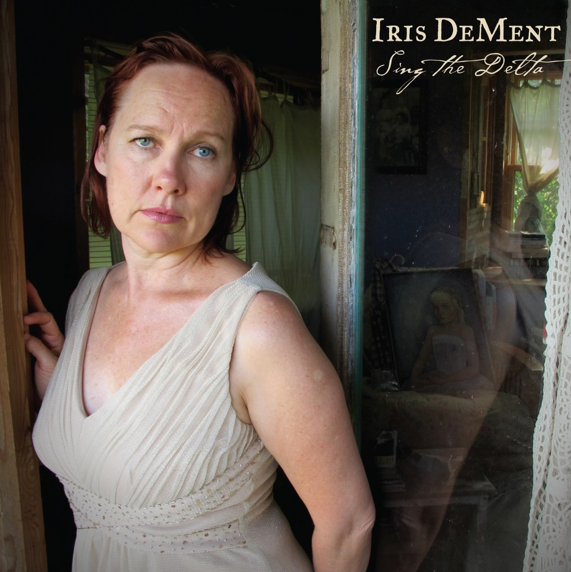 SinS SinS
Iris Dement’s singing voice can best be described as the mournful sound of a dove, the backwoods twang of Appalachia, and having what is known in the industry as a “cry” in her voice reminiscent of Patsy Cline. The woman’s got soul – White soul – though she was once classified with a Grammy nomination for the Best Contemporary Folk Album category.
So I was somewhat taken aback when I reached her by phone last week in her Iowa home, where she has lived for the past five years with her singer/songwriter husband, Greg Brown and she spoke with an accent as pure and American as a television anchorwoman. I asked her where her accent comes from when she sings and she explained, “You know I grew up listening to a lot of country music and that’s the music that rubbed off on me. That’s where I actually go and always have. I don’t think it’s like anything in particular. I don’t know what it is. It’s my accent. It’s just me. I grew up in a house full of Southerners in California and I listened to all kinds of music but I’ve always leaned towards country.”
It’s been 16 years since DeMent last put out an album, if you don’t include Lifeline, released in 2004 in which she covered well-known gospel tunes with the exception of He Reached Down, an original composition. During a career spanning over a quarter of a century, she has sung with some of the greats like Ralph Stanley, John Prine and Emmy Lou Harris, and made frequent appearances on Garrison Keillor’s radio show, A Prairie Home Companion. A role in the 2000 film Songcatcher, in which she played the character Rose Gentry, featured her singing on the movie’s soundtrack and in 2010 one of her songs was used in the closing credits of the Coen Brothers film, True Grit.
Released in October 2012, Sing the Delta is DeMent’s long-awaited, self-composed and much anticipated album. On January 21st she will perform at the Birchmere along with a band consisting of guitar, mandolin, bass, drums and pedal steel guitar.
You grew up in a fairly strict Pentecostal household. How much has religion affected your music?
I don’t reject religion. I think I’ve just decided to take religion and tune it up to suit myself. I grew up in the church and that environment had a great impact on me musically and every other way, so I couldn’t separate what I do from that world that I was submerged in. It’s all kind of one and the same. I’ve allowed my self to grow with it. I didn’t long ago. I didn’t buy into the stories and all the answers that were written. It was my job to just go along. I took what I learned from church and I kept moving through life with it and adapting it to where I was at any particular time. I’m willing to move as far away from it as I have to. The heart of the thing is still in there intensely for me.
Would you say that creating a context for social change within your music is part of your inspiration?
I don’t think of things as issues. I’m just talking about what’s going on in my world – what I care about. I am trying to unravel things for myself and put them back together in a way that makes sense, whether that’s music or sitting down having coffee with friends. I think that’s just human nature to try to make sense of your world. And I do that to a great extent through music. I don’t have an agenda. I just want to see what my heart says about the thing.
What was it like growing up in such a large family in a house with over a dozen siblings? Was it hard to get heard?
It was hard to get heard. But looking back I think there was a huge advantage to that. It meant listening a lot especially when you’re the youngest. I learned to be quiet a lot. I’m really grateful that I was in that position. I think it’s a lot of the reason I did end up writing.
Is any one else in your family in music?
Oh yes! They all play or sing in the churches. I’m the only one that went out in the world with my music.
You have your own label – Flariella. Is it more difficult to get airtime with your own label?
For me it’s always been difficult to get airtime. The music business has changed so much that now everybody is on their own label. I enjoy the independence of it. I’m inclined to be by myself. Thankfully there have been enough journalists like yourself that will write about me.
What was happening in your life when you wrote “Before the Colors Fade”?
I had just lost my mother. She had been gone only a few weeks. When you lose somebody they’re gone, but their presence, and my sense of them, is intensified. No matter how close you are, there’s a fading.
Have you played the Birchmere before?
I love the Birchmere. I’ve been playing there just about every year since 1992. It’s a great environment. It’s a world made for music. The sound is wonderful. The audience is always really warm. It’s a good place to play.
How would you define your audience?
I wouldn’t do that.
Iris DeMent will perform with Jason Wilbur for one night only at The Birchmere on January 21st at 7:30pm. For tickets visit www.ticketmaster.com. For venue information visit www.birchmere.com. The Birchmere is located at 3701 Mount Vernon Avenue, Alexandria VA 22305
The “First Lady of Napa Valley” talks love, travel and California wines.
By Jordan Wright
Special to Washington Life Magazine
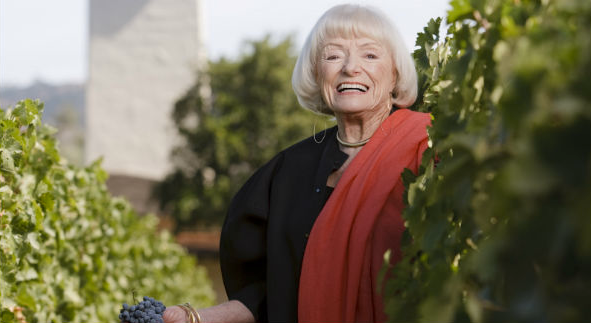 Margrit Mondavi, the “First Lady of Napa Valley,” is most at home in the vineyards. (Photo courtesy of Robert Mondavi Winery) Margrit Biever Mondavi’s book tour to Washington, DC dovetailed seamlessly with the opening of “FOOD: Transforming the American Table, 1950 – 2000”, an enticing new exhibition at the National Museum of American History chronicling a half century of American food and wine from farm to table. As Vice President of Cultural Affairs for the Robert Mondavi Winery, she was there to witness the opening.
Wearing a fire engine red shawl and snappy silver sequined boots, she diligently signed copies of her book, “Margrit Mondavi’s Sketchbook – A Reflection on Wine, Food, Art, Family, Romance and Life.” If that seems like a rather lengthy title, the sprightly octogenarian has unquestionably earned it. Her far-flung adventures and indelible legacy are the proof of the pudding.
It is a refreshingly candid pentimento written by a woman and accomplished artist who has found both pleasure and passion in her work and life. It reads like a private conversation with a close friend and is beautifully composed with personal photographs, recipes, tributes by friends and family, along with her whimsical watercolors that capture the couple’s private dinner menus, tablescapes and plein air landscapes.
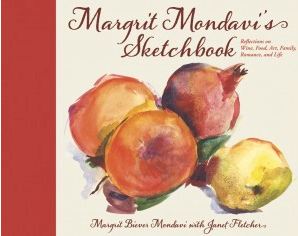 Mondavi’s new book has reflections on everything from family to wine. (Photo courtesy of Robert Mondavi Winery) From a childhood on the shores of Italy’s Lago Maggiore, to meeting the love of her life, Robert Mondavi, in 1967, she writes of the Napa Valley winery. Together, she and Robert made it into a cultural destination for the performing arts as well as a world renowned culinary school, where three-Michelin-starred French chefs Joel Robuchon, Alain Chapel and Paul Bocuse, and American icons like Julia Child, the institute’s first guest chef, took turns teaching classes.
Over a leisurely lunch at a downtown District watering hole, I interviewed the legendary Margrit, as she prefers to be called. As she twirled lengths of truffle-topped pasta around her fork, we spoke of many things from wine to the price of olive oil, which she knows off the top of her head. She met most of my questions with questions of her own; her curiosity is insatiable. Below are just a few of the memorable anecdotes she told me over lunch on life, love, cooking and everything in between:
On life and family:
“I love life. I think everyday is a present, and as my husband would say, I have no secrets. I cannot tell a lie, because my memory is too short. In general, I like to be on the joyous side and be remembered for that. I have wonderful friends and family, but I realize that you have to accept life and I try not to ponder it too much. It’s important to participate and enjoy life as long as you can and I do with three children, six grandchildren and three great-grandchildren whom I adore.”
On cooking:
“Once, we were in Salzburg to do a television show. They had found a wild turkey, but it weighed only about two pounds. After the tiny bird was cooked – they actually had prepared one in advance to speed up the show – we shared it with the manager and his staff. It was the most delicious turkey I’ve ever had in my life!”
On wine:
“There was a time when the French turned up their noses at California wines. Not anymore! The tasting of 1976 with un-aged wines proved that we could do what Bob said we could do. Twelve years later they did another tasting at COPIA and proved that California wines age well if they are properly made and properly stored.”
On love:
“Love is excitement and Robert was always exciting. Our life was enjoyable, but challenging,too. I was the person who brought art into Robert’s life, because he never had time. We started the music festival and the cooking schools and he was always very supportive. And we loved to travel. When Bob was eighty-two we bought a pair of worldwide American Airlines tickets for unlimited first class travel, so we went everywhere for free. He would say, ‘Let’s go to Berlin. Let’s go to Beijing.’ And we did!”
On letting go:
“I have to learn about tossing things aside. I want to and don’t know how to begin. I have to simplify my life. I go to work every day and I feel very betwixt and between because with my husband it was always people, people, people. It was a wonderful time.”
In a ceremony at the winery in January 2013, Margrit Mondavi will be honored as the thirtieth recipient of the Monteith Wine Bowl Trophy, given to the stalwarts and icons of the wine industry.
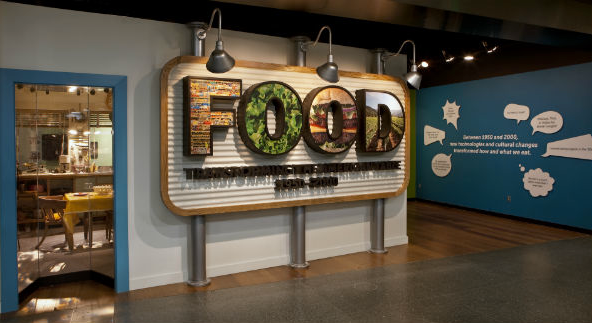 Margrit was recently in Washington to attend the opening of this exhibition at the Smithsonian’s National Museum of American History, on which the Robert Mondavi Winery was a consultant. (Photo courtesy of the Smithsonian) 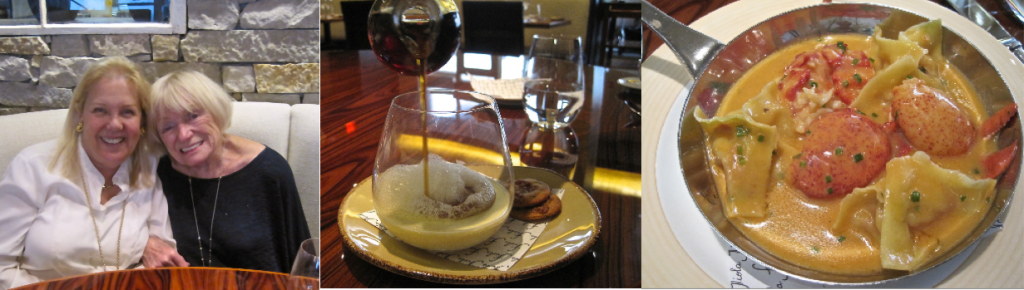 Jordan and Margrit The Perfect Finish Lobster ravioli
photo credit Jordan Wright
Jordan Wright
December 13, 2012
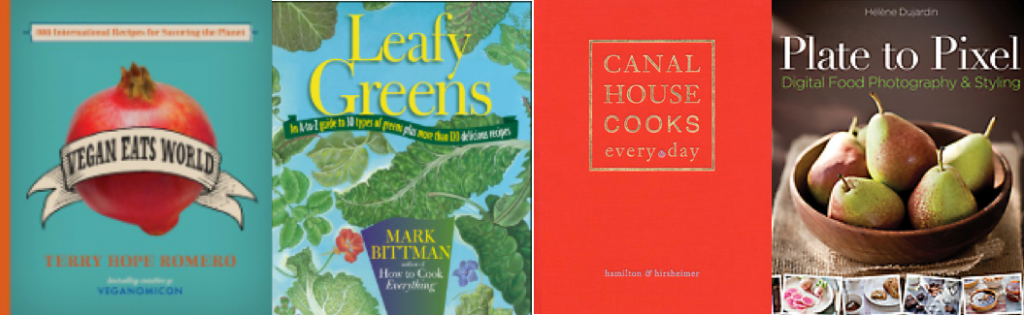
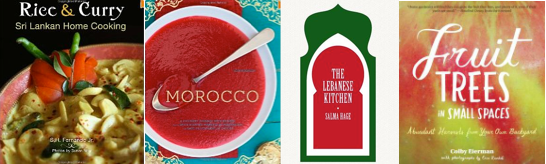
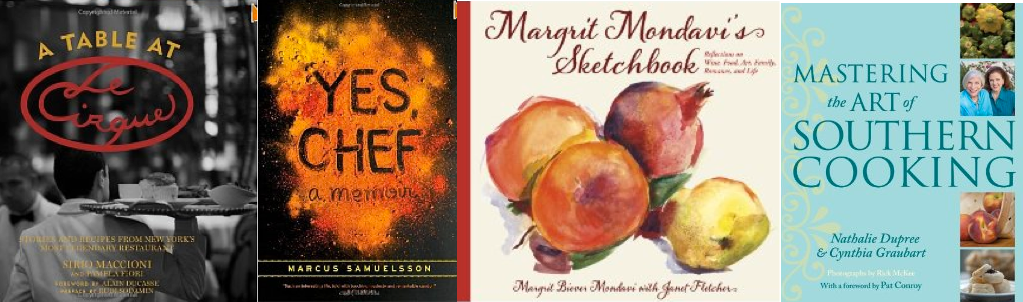
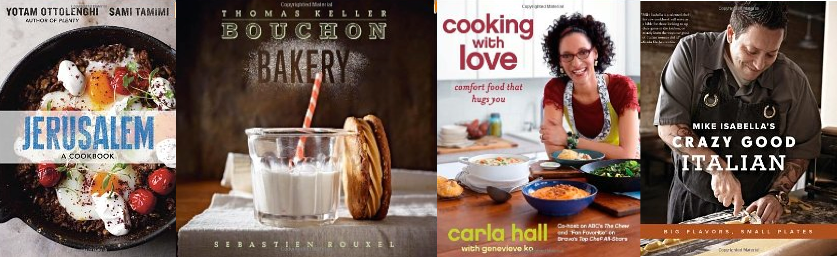
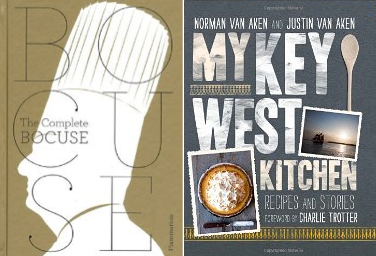
This year’s cookbooks brought us a wealth of ways to be engaged in food in one way or another – grow it, cook it, eat it, share it, broadcast it. While some cover the cuisines of far-off cultures, others focus on a specific region of America or share memories of meaningful meals. Books on preparing a garden’s harvest and instructive manuals on chronicling your food adventures with blogs, photos or Pinterest. Proust would be pleased. Have a madeleine and read on.
Lifestyle Cooking
Each afternoon I am treated to lunch by the writers of the Canal House cooking series – virtually that is. From their bespoke blog they email a beautiful photograph of their luncheon with a short description of how they prepared it and what they served with it. It might come from their Lambertville, New Jersey garden; be foraged on a hike in a nearby woods; or left on their doorstep by a friend. Sometimes a few simple ingredients combined with leftovers from their Sunday suppers or backyard cookouts become a gourmand’s delight. Written by Christopher Hirsheimer, former executive editor and co-founder of Saveur magazine and food and design editor of Metropolitan Home; and Melissa Hamilton, food stylist and former Saveur food editor, Canal House Cooks Every Day (Andrews McMeel Publishing) is a gorgeous collection of over 250 recipes for the home cook.
Entertaining
Cynthia Nims’s Salty Snacks (Ten Speed Press) is a fun book with simple, but original recipes for making your own chips, crisps, crackers, pretzels and other savory bites and had me bookmarking a goodly number of pages. I loved the Cumin Lentil Crackers, Salami Chips with Grainy Mustard, Blue Cheese Straws, Five-Spice Duck Skin, and other tasty treats. Whether you make food for gifting, cater parties or host them, you will refer to this delightful book whenever you’re entertaining. Heads up, family and friends, the Coconut Crisps with Basil and Chiles could be in your Christmas stocking.
How To Books
Helene Dujardin’s Plate to Pixel – Digital Food Photography & Styling (Wiley) shares secrets from her career as a professional food photographer teaching photo-by-photo how to achieve the fabulous results professional food stylists use in creating those mouth-watering photos used in ads, magazines, blogs and books.
Three food-centric books from the “For Dummies” series, give tips for DIYs on how to get your message out with Pinterest For Dummies by Kelby Carr, Food Blogging For Dummies by Kelly Senyei, and Food Styling & Photography by Alison Parks-Whitfield – all from Wiley. Now you can write your own cookbook, blog about your Aunt June’s recipes, or photo broadcast the last scrumptious thing you ate.
Healthful Cooking and Gardening
Health nuts delight! Mark Bittman has you in his culinary sights with Leafy Greens – An A-to-Z Guide to 30 Types of Greens (Wiley). From the New York Times food writer and author of How to Cook Everything, Bittman puts together over 120 recipes to green up your diet. And who isn’t going green these days? Ramp up your anti-oxidant intake with dishes like Bitter Greens with Bacon, Grilled Radicchio and Risotto with Arugula and Shrimp. Whether its mizuna, kale, watercress, broccoli rabe, mustard greens, dandelion or collards, this nifty book will tell you how to identify and prepare over 30 kinds of greens whether found at local farmers markets or an Asian grocery.
I had a lot of fun with Vegan Eats World (Da Capo) by Terry Hope Romero – named “Favorite Cookbook Author” by VegNews. Though I am most assuredly not a candidate for a strict vegan diet, there are many wonderfully creative recipes from a wide variety of cultures that would suit an omnivore. Romero doesn’t just share her recipes and experiences that she describes as “savoring the planet”, she dreams of a vegan revolution. So imagine a tofu banh mi sandwich, a seitan Greek gyro, Jackfruit Tacos, and Korean bulgogi made with extra-firm tofu.
I’m all for growing your own berries and veggies. So over the past ten years or so our family has tended a small plot at the Chinquapin Organic Gardens in Alexandria, Virginia. Community gardening is a great way for urban gardeners to keep their hands in the soil, swap crop tips or recipes, and share summer’s bounty. So I was particularly interested in Fruit Trees in Small Spaces – Abundant Harvests from Your Own Backyard by Colby Eierman (Timber Press) an inspiring and informative book filled with concrete advice on selecting, pruning, espalier training, and preparing the fruits of your labor. Did you know you could make wine from fresh oranges or peach leaves?
Photos by Erin Kunkel who once served as Director of Sustainable Agriculture for the Benziger Family Winery and Director of Gardens at the recently shuttered COPIA: The American Center for Wine, Food and the Arts in Napa Valley, make it look easy and fun. Expect to see his produce on your plate if you are dining at Chez Panisse in Berkeley or Girl and the Fig in Sonoma. As an advocate for children’s gardening programs, he was the co-founder of the School Garden Project in Eugene, Oregon.
Ethnic Cuisine
Phaidon Press, who last year charmed us with the Noma cookbook whose recipes used Scandinavian foraged ingredients, now brings us The Lebanese Kitchen by Salma Hage. Hage has compiled over 500 recipes from every region of her native Lebanon to bring us an astonishing collection of dishes for every course from mezzes to fattoush and aromatic desserts. Within its pinked-edged pages is also a special section devoted to recipes from noted chefs who have already come under the spell of the Lebanese cuisine. Roasted Sea Bass in Tahini Sauce, a Middle Eastern favorite of mine, is here demystified.
Morocco (Chronicle Books) by Jeff Koehler has a subtitle – A Culinary Journey with Recipes from the Spice-Scented Markets of Marrakech to the Date-Filled Oasis of Zagora which pretty much tells you what you can expect from its matte finish pages. If I could eat this book I would. You can almost smell the rosewater and spices. This is why everyone dreams of visiting the ancient North African nation and why those that have come away with stars in their eyes. The food is lavish, sensual and colorful. From tagines to cous cous with a section on the Moroccan pantry that defines the country’s exotic ingredients. It is easy to follow and sublime to eat. You can follow Jeff’s culinary adventures on his website www.jeff-koehler.com.
Also worth noting is Rice & Curry – Sri Lankan Home Cooking (Hippocrene), a re-issue written by former Rolling Stone contributor S. H. (Skiz) Fernando Jr. The photo-laden cookbook slash travelogue, has book jacket blurbs from Andrew Zimmern, host of Bizarre Foods and Anthony Bourdain who used Skiz as a guide through Sri Lanka on Travel Channel’s No Reservations. Visit this link to read about Skiz’s DC pop up dinner this summer and more 2012 cookbook reviews.
American Regional
Get the jump on your Charleston friends this year with Mastering the Art of Southern Cooking (Gibbs Smith). Veteran cookbook authors Nathalie Dupree and Cynthia Graubart explore the history of Southern regional cuisine with recipes that reflect the Old South along with some modern day twists. This summer I watched Ms. Dupree making an unholy mess at a biscuit demonstration at Maryland’s National Harbor. She was as funny on that hot steamy day as she is in this book. And she gave practical tips in the same generous way she shares them on these pages.
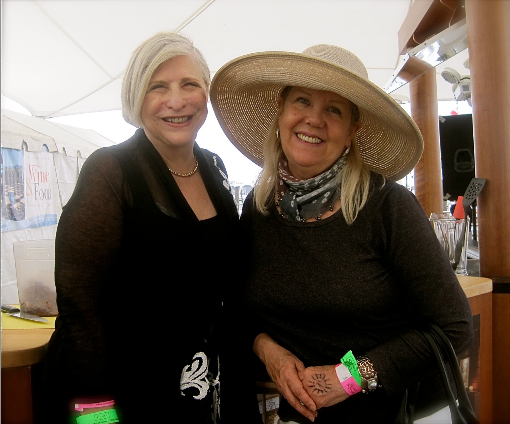 Jordan with Nathalie Dupree “I always use flexible plastic cutting boards. They make life easy when you transfer dry ingredients to the bowl and cut out your biscuits,” she trilled. She went on to show how the biscuits must touch, and how she uses a 9” cake pan to nestle eight biscuits together. “That’s enough for four for the first serving. You can put in another pan after that to keep bringing out hot biscuits.” She is very clear in her instructions and it certainly emboldened me to learn to make the perfect biscuit. In this terrific compendium of all things edibly Southern you’ll find classics like Fried Chicken, Pimento Cheese and Sweet Potato Biscuits along with Peaches and Figs Wrapped in Country Ham. It’s a keeper – all 600 recipes!
Memoirs
Margrit Mondavi’s Sketchbook – Reflections on Wine, Food, Art, Family, Romance, and Life is a personal favorite. Margrit, widow of Napa wine pioneer Robert Mondavi and worldly octogenarian, has written this book with her heart and soul. It is a refreshingly candid pentimento by a lively spirit who has found both pleasure and passion in both work and life. Enjoy a memoir that reads like a private conversation with a close friend, and is beautifully composed with personal photographs, recipes and tributes from friends and family, and illustrated with her whimsical watercolor studies chronicling the couple’s private dinner menus, tablescapes and plein air landscapes. Visit this link to read my recent interview with Margrit Mondavi. .
Marcus Samuelsson’s latest book, “Yes, Chef”, is an emotion-filled autobiographical journey beginning with his adoption as a child from his native Ethiopia to his new family in Sweden. The James Beard Foundation Award winner and winner of Top Chef Masters has written a thoroughly fascinating and poignant memoir that takes the reader from his culinary education in Europe to his success at New York’s Aquavit restaurant, later culminating in the 2010 opening of his smash hit Red Rooster restaurant in Harlem. Visit this link to read my August interview with Samuelsson at the Howard Theatre.
A Table at Le Cirque: Stories and Recipes from New York’s Most Legendary Restaurant (Rizzoli, NYC) written by its creator the Tuscan-born Sirio Maccioni and Pamela Fiori, a former editor at Town & Country and Travel & Leisure, puts you squarely at the best table in Manhattan. For close to four decades, this exclusive institution has been a glamorous watering hole for celebrities and the country’s social and business elite. Many of the world’s leading chefs have made their mark in its kitchens and the book contains recipes of some of their legendary dishes including Daniel Boulud’s Black Bass with Barolo Sauce, Alain Sailhac’s Fettuccine with White Truffles, Pierre Schaedelin’s deconstructed Caesar Salad, and noted chocolatier Jacques Torres’s Bombolini.
Local and Notable
Jersey born and bred Mike Isabella has a passion for food – earthy, soul-stretching, heart-stirring Italian food – and he’s decided to share it with the home cook. In Crazy Good Italian (Da Capo Press Lifelong Books) he takes you into the kitchen with his nonna to teach you the family’s favorite dishes. Included in the over 150 recipes that speak to his Italian roots is his famous Pepperoni Sauce, the one that wowed the judges on Bravo’s “Top Chef”. Isabella has gotten to be a familiar fixture not only on television, where he made a cameo appearance on “Life After Top Chef”, but also around the DC area with his casual resto Graffiato and Georgetown venture Bandelero. His almond and jam flavored Rainbow cookies are perfect for Christmas with their red, gold and green layers topped with chocolate. Visit this link to read my piece on Isabella’s opening of Bandelero earlier this year.
My first assignment as a DC-based food writer was to interview Carla Hall at DC’s CulinAerie, a catering company where she once taught cooking classes. I found her presiding over a TV watch party with her friends and co-workers, held the night the Top Chef finalists were announced. Though she came in second that night, the show forever changed the life of the former French fashion model in ways she could not have imagined.
Currently the co-host of ABC’s The Chew, Hall has written her first book Cooking With Love – Comfort Food That Hugs You (Simon and Schuster Digital Sales). In it she offers up her versions of simple, home-style dishes like Chicken Pot Pie and Deviled Eggs with Smoky Bacon. The amorous title best describes Hall’s easygoing approach to cooking. She continues her presence in DC as executive chef of Alchemy, an artisanal cookie company. Visit this link to read my interview with Hall on that auspicious night.
A Few More Treasures from This Year
Bouchon Bakery (Artisan) by Thomas Keller; Jerusalem: A Cookbook (Ten Speed Press) by Yottam Ottolenghi and Sami Tamimi; My Key West Kitchen: Recipes and Stories (Kyle Books, London) by Norman Van Aken and Justin Van Aken; The Complete Recipes (Flammarion, Paris) by Paul Bocuse.
Jordan Wright
December 10, 2012
Special to The Alexandria Times
Here’s the grabber up front. Synetic Theater’s A Trip to the Moon is one of the most exciting, imaginative, flawless pieces of theatre I’ve seen in light years. If I were to use a rating system, I would give it five glowing stars.
 Pasquale Guiducci, Ben Arden, and Victoria Bertocci in “A Trip to the Moon.” Projection Design by Jared Mezzocchi. Photo by Johnny Shryock. In this wonder-filled production Japanese director/writer/illustrator and Georgetown professor, Natsu Onoda Powers brings us a lively triptych of vignettes. In the first she sources her inspiration from George Melies 1902 silent sci-fi film, Le Voyage Dans La Lune referenced in Martin Scorsese’s recent Oscar-winning film Hugo. A stage-wide interactive paper scrim delivers illustrations, schematics and film projections dovetailing with the action on stage. Performers seamlessly slide in and out of invisible openings in the paper and there is a heightened experience achieved by integrating an alternate stage above the main stage. By incorporating that usually empty third into the design, there is full use of the space for performers to deliver their performances both from above and below. In one hyperkinetic scene the astronauts, working with a collection of cutout shapes cleverly reconfigure the pieces to depict boats, airplanes and a hot air balloon to create a design for their spacecraft.
The action becomes more and more frenetic including prancing chorus girls and mad scientists whirling about. It’s an hilarious moment when the man in the moon walks on stage, wrapped in shiny black plastic with a white circle of paper surrounding his face, and is slathered with ‘moon whip’. With Synetic there is always that connection to the Theatre of the Absurd.
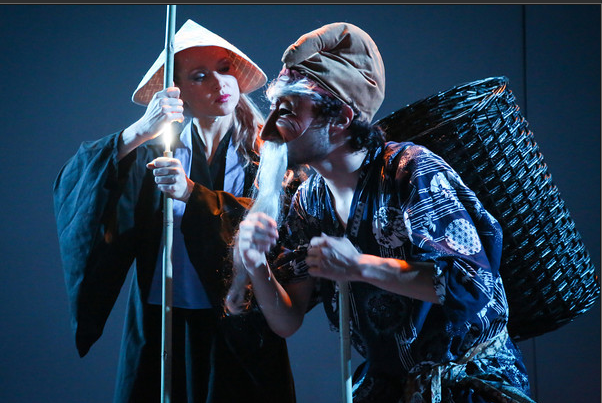 Francesca Jandasek and Colin Analco in “A Tale of the Bamboo Cutter.” Photo by Johnny Shryock. The second in this series of space travels is The Bamboo Cutter, an ancient Japanese tale of a woodsman (played by Colin Analco) who finds a child in a glowing length of bamboo. He takes her home to his wife and she becomes a beautiful princess with magical powers. Katrina Clark deftly plays the gossamer moon maiden. To please her father she must marry but first she orders suitors to pass a rigorous test – to find a silver branch with gold pearls from a treacherous island, a necklace from a dragon and a golden egg. The young men attempt to woo her with Kendo fighting, song, juggling, pantomime and modern day sign spinning. There is even a Chippendales-style dancer and a hip-shaking hula hooper bent on winning her affections.
In this piece the costumes by designer Kendra Rai are both fabulous and phantasmagoric with heavily beaded and trimmed robes, gowns and fanciful headpieces. Sets designed by Giorgos Tsappas, seem lifted from classical 17th Century Japanese paintings.
 Karen O’Connell as Laika in “Laika the Space Dog.” Photo by Johnny Shryock The final story is set in Moscow in the 1950’s. It is the story of Laika, the first dog to travel to the moon, and is told from the dog’s perspective. Endearingly and unforgettably performed by Karen O’Connell, who is costumed as the other canines in furry muscular leggings, it is a tale of a little stray who finds her dog family in the mean streets, is then captured and taken to a dismal pound only to be saved by rocketeers for a space mission. It is told through woofing, yipping, baying and whimpering and through the eyes of the adorable Laika. If you’re a dog owner, or have ever known a dog, you will howl with pleasure, especially in the indelibly romantic dream sequence of a pas de deux between Laika’s adoptive mother (Francesca Jandasek) and the Moon King (Ben Arden).
Highly recommended.
Through January 6th at Synetic Theater, 1800 South Bell Street, Arlington in Crystal City. For tickets and information call 1 800 494-8497 or visit www.synetictheater.org.
 Derrick Suwaima Davis (Ken Ross Photography)
As a child growing up in his native Arizona Derrick Suwaima Davis, Hopi/Choctaw, was fairly certain how he fit into life on the reservation. “I got my first dance clothes when I was three. I was always around native songs and dances, but that’s when I considered my life as a dancer official.” For Davis, who was the Head Man Dancer at the grand opening of the National Museum of the American Indian in Washington, D.C. in 2004, dancing was both his destiny and means of escape – a place of imagination where he could use its intricate forms as a means of self-expression. His first hoop dancing championship was in 1992, his most recent in 2010, and he has earned the title of World Champion Hoop Dancer five times. As a member of the pop/rock group Clan/destine he has worked with the Heard Museum, the Phoenix Symphony, the American Dance Theater, Canyon Records and Willie Nelson continuing to share his Hopi culture with thousands of admirers around the world. Davis has been featured on the covers of leading publications like Smithsonian and Native Peoples and was once named Cosmopolitan’s “Man of the Year”.
As one of Arizona’s cultural treasures Davis has been Artistic Director of Native Trails, an intertribal collaborative presented by the Fort McDowell Yavapai Nation and produced by the Scottsdale Center for the Performing Arts in Scottsdale, Arizona. Nine performers including Davis represent the best of the Southwest region, in a twice-weekly free show at the amphitheater at the Scottsdale Civic Center Park where the hour-long performances showcase song and dance using traditional instruments, regalia and stories. Unique indigenous cuisine, like cactus chili, blue corn mush and mesquite muffins, are sold there alongside the more familiar fry bread. Look for the 2013 season to start up again on January 17 and run through April 6 on Thursdays and Saturdays at noon. Visit www.scottsdalenativetrails.com for more information. You can also see Davis perform daily at the Hyatt Regency Scottsdale where for over twenty years he has been part of a three-person 5 p.m. show.
In a recent interview he told ICTMN of his early life with its traditional influences and why he feels the need to share his culture with the world.
What was your childhood like?
My father worked for the Bureau of Indian Affairs and took us a lot of places. I spent part of my life on the Navajo reservation and summers with my grandparents on the Hopi reservation that is surrounded by the Navajo reservation.
When did you first become interested in dancing?
I never thought I would end up in my adulthood being a performer. I just grew up singing and dancing as part of our culture capturing history and expressing gratitude and encouraging good life. It wasn’t until I moved down to the Phoenix Valley and was asked to be part of a Native American dance troupe where we performed at resorts and cultural festivals. I saw how it would be a way to educate people about Native culture.
Who was your greatest influence?
My grandfather as far as information and experiences and putting it all into song and dance. He was well known in Hopi.
How did you develop your own style?
I first saw the dance when I was around the intertribal gatherings in New Mexico. I was already a champion fancy dancer. As a young boy my father made us hoops. I didn’t really understand the significance but it was something I was drawn to. We began to imitate the dance. I continued fancy dancing but later got involved with the Hopi cultural dances. There are a lot of parallels with those two art forms. When I moved to Phoenix I joined the Eagle Spirit Dance Group. I was asked if I would also do intertribal eagle dancing along with hoop dancing and the horsetail dance. I got into it at the Heard Museum where they had the World Championship Hoop Dancing contests. That’s where all us hoop dancers inspired one another.
As I was coming along I really began to understand the story. The origin of the dance goes back to the Healing Dance where the shaman or the patient would pass through the hoop and whatever ailment was disturbing the patient would be dismissed. And although this dance is done in a public and competitive format, it still conveys that message of healing and restoring balance and the Hopi culture and how we talk about First, Second, Third and how we are now in a Fourth World.
At the end of the dance I set down a four-hoop globe. Each time I pick up one of those hoops it acknowledges times of adversity and prosperity, and how through time it’s the plants, the animals and the insects that have taught human beings how to utilize the resources around us. And so, as we are stewards and guardians, it’s through our songs and our dances we ask and encourage everything to be healthy. Because if the environment is healthy, then we are going to be healthy. Through our art forms and with our good intentions we encourage wellbeing. The hoop dance encompasses a large amount of teaching.
Did you learn a specific pattern of dance steps and later interpret it for yourself?
The dance steps and the rhythm are based more on the intertribal pow wow style of music. I used that style of song and dance for most of my hoop dance career. That goes back to the fancy dance style of footwork. The showmanship and athleticism I learned from fancy dance I brought into hoop dancing. There is some crossover. The reason for dancing with five hoops is because in the Southwest we don’t get much rain. In many ways we must do the best we can with the least amount possible so you’re not overharvesting or being selfish with the natural resources. Instead we let the plant community and the animal and insect community be strong and grow in numbers. That’s where a lot of the story in my dancing comes from.
At a young age I was introduced to ‘dry farming’ that we still do at Hopi. In the Southwest we have been in a drought. When I remember the days when I was young and rainfall was plentiful, it’s easy to understand the importance of nature and to encourage everything to be healthy. In the dance, although there may be mechanics involved, there is also the inspiration of what the dance continues to represent. It is filled with its own type of prayer and desire and expressing gratitude. So when I make the various patterns I know how important it is for the insects, like when I make the butterfly, or similarly if I make a hummingbird, or eagle or buffalo. I have learned not only from Hopi, but also from schooling, how important these creatures are and how everything fits into the circle of life, the web of life, which is what the hoop represents.
Do you integrate different forms in your performances? Are there strict guidelines for a contest?
Each one of us hoop dancers has our own story that we like to share. I am one of maybe two dancers who use only five hoops. Everyone else dances with from ten to maybe sixty hoops. It’s not how many hoops you use. Any art evokes some kind of emotion whether it’s a painting, a sculpture, or singing and dancing. They all evoke some kind of emotion. The music and the movement combined make people feel really wonderful. Any talented or gifted artist realizes that we really are just an intermediary between something higher than we are, and as performers we are just a vehicle to share our blessings with those in the audience.
Do you have different feelings when you dance?
Yes. I think that the objective of sharing the dance is always the same, but certainly what we have most recently experienced in our lives shapes how the dance is shared. I always feel that I’ve done the same dance, but people who see it will say that I’ve done something different in it. And of course after a six-minute dance there’s no way I can remember everything I did! I may notice simply that the floor was smoother or uneven or the song was faster or slower. So each performance is unique and influenced by the audience.
Have have you performed outside of the U.S. and what has it meant to you?
Yes, and that’s what I’ve really enjoyed. I’ve been to half of Africa, Singapore, Malaysia, Japan, Denmark, Germany and Spain and up to Alaska and Hawaii, and Canada. I’ve brought our Native Southwestern culture around the world and they have shared their songs and stories with me. It has helped me understand how much alike we are as human beings and the geography and history that have shaped our cultures. There are both similarities and also a uniqueness to the different cultures.
What else are you passionate about?
I was honored to record a PSA for the Arizona Department of Health Services on Diabetes Prevention. It’s an issue that means a lot to me.
Do you have a favorite drum and singer to perform with?
Through the years I’ve worked with various singers. I work with three different singers for the two-man performances. Most are based on the intertribal rhythm and they incorporate the Hopi language as well as our rhythms. It makes it very unique from other hoop dancers.
How would you advise a young person just getting started?
It’s important for young people to really listen to who they are. What I mean by that is we all have a gift, a purpose here in life. As a young boy I experienced contradiction and ideas of wanting to live a healthy life. I want all children to hang on to their innocence, their dignity, and make healthy decisions. Hopefully their songs and dances will be an art that encourages wellbeing. Don’t worry about being unique. Just be yourself. As a father I don’t expect my boys to grow up to be like me. They have a gift and a purpose. So if I live my life with good intentions and I stay true to who I am, then I think that’s a good role model for my boys to stay true to who they are.
Even though I can’t put everything into words our cultural singing and dancing was a way to express myself in this art form. It allowed me to be who I am. I’m fortunate to speak politely and honestly and when I do share my culture I never say that I’m right, but that the power of choice is up to everybody. Hopefully what I do share is an inspiration to people to be who they are and accomplish their goals.
Derrick can be reach through www.TheCharlesAgency.com
Jordan Wright
December 3, 2012
Special to The Alexandria Times
Riddle me this. Do goose bumps get goose bumps? And can you hear a pin drop in the theater? Well, yes, to both – especially if Nova Peyton is singing her pipes out!
 A proud moment for Effie White (Nova Y. Payton) in the musical “Dreamgirls” Photo: Christopher Mueller Peyton plays Effie White in Signature Theatre’s current production of Dreamgirls – a career-establishing role made famous by Jennifer Hudson in both the Broadway and film version. So there’s a lot on the line. Peyton not only nails it but carves out her own definition of the role in songs like the poignant “I Am Changing” and the earthshaking “I’m Not Going”. I promise you won’t be disappointed by the powerful vocals, the muscular hep cat and cool kitty dancing, or the lavish costumes. In fact there is so much to like that it’s hard to pinpoint why some moments seem flat. Here’s a show with a theatrical pedigree evidenced by six Tony Awards, a cast brimming with talent and a tear-drenching plot to melt the hardest heart. So what’s wrong with it? Not much but we’ll get to that.
The story centers on an African-American girl group from Chicago and their meteoric rise to fame and fortune. You’ll immediately recognize them as The Supremes and, though the story is legally defined as “loosely based on” them, there are innumerable parallels.
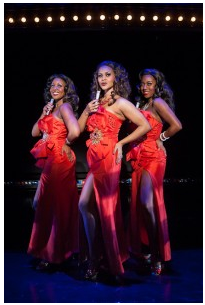 Deena Jones (Shayla Simmons) leads the new incarnation of The Dreams, with Michelle Morris (Kara-Tameika Watkins, back left) and Lorrell Robinson (Crystal Joy, back right) in the musical “Dreamgirls” Photo credit: Christopher Mueller. The trio known as the ‘Dreamettes’ starts out as runners up in a rigged talent show at the Apollo Theatre, but are soon urged to tour as backup singers for the velvet-voiced, slick dancing, ego-centric singer Jimmy Early, brilliantly played by Cedric Neal. “I don’t do oohs and aahs,” Effie complains, though she’s quickly overruled by partners Deena Jones (Shayla Simmons) and Lorrell Robinson (Crystal Joy), and they hit the road. As the women rocket to superstardom they go through a series of business challenges, jealousies, diva meltdowns and heartbreaks. Costume designer Frank Labovitz chronicles the trio’s ascent with gorgeous electric-hued gowns that increase in fabulousness with miles of chiffon and lurex stitched up with tons of ostrich feathers, spangles and sequins. As for the menswear, shiny sharkskin suits neatly define the times.
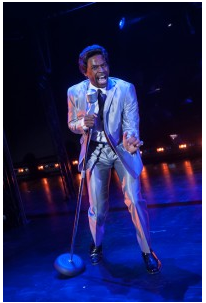 Jimmy “James Thunder” Early (Cedric Neal) makes a grand entrance in “Dreamgirls.” Photo: Christopher Mueller. The show is set in the early ‘60’s when the pop music biz was controlled by big record labels and disc jockeys were known to take payola to play and promote certain records and artists. Soul and black R&B was a hard sell, and radio stations played “white” music, aka black music done by white performers. Has anything changed? It was a hard road for all black musicians until the Motown sound began to dominate the airwaves. Dreamgirls captures the essence of that Berry Gordy/Phil Spector period thanks to Krieger’s music whose twenty-five glorious numbers are dead center of that unforgettable sound.
Set Designer Adam Koch created the painted black set and mechanical stage that is so cavernous that at times it seems to swallow the cast. It is only when the women sashay onto center stage with increasingly spectacular wigs, jewels and gowns that it becomes a frame for their glamour.
Thankfully it’s all about the music and dancing since actor Sydney James Harcourt’s portrayal of the Dreamettes’ impresario,Curtis, is not convincing either as a Svengali or a Lothario. The role calls for Taylor, their agent and Deena’s boyfriend, to be a self-centered, slimy, backroom double-dealing manipulator and Harcourt lacks the smarminess to pull it off.
Matthew Gardiner does double duty as both director and choreographer, and you can’t find fault there. The dancing is stellar particularly for Neal’s character Jimmy who shakes, rattles and rolls till the cows come home in the number “Baby-Baby”.
See it, love it and spend some time backstage with the Dreamettes back when Motown was the pinnacle of the music world.
Through January 13th 2013 at Signature Theatre (Shirlington Village), 4200 Campbell Avenue, Arlington, VA 22206. For tickets and information call 703 820-9771 or visit www.signature-theatre.org.
|