|
|
APRIL 10, 2013 BY JORDAN WRIGHT
Special to The Credits – MPAA
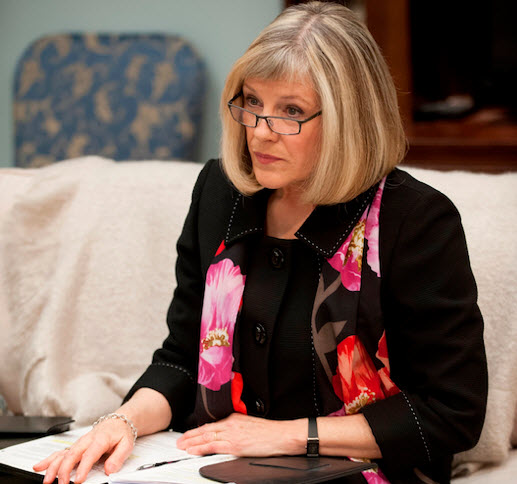 Featured image of Mimi Kennedy on HBO’s Veep. Photo by Lacey Terrell, courtesy HBO
Mimi Kennedy pops up on the screen in the most unexpected places, but as an actor, writer and political activist that should be no surprise. She recently played the formidable madam in a house of ill repute in ABC’s Scandal, Jason Segel’s tough talking mother on the big screen in The Five-Year Engagement and the soigneé mother-in-law-to-be in Woody Allen’s all-star cast of Midnight in Paris. Known early on for her TV role as Dharma’s hippie mother in Dharma & Greg, last year Kennedy appeared on Anger Management, Up All Night and In Plain Sight. And now, she has recently wrapped shooting in Baltimore with director Armando Ianucci and Julia Louis-Dreyfus for HBO’s second season of Veep. Set to air this Sunday, April 14, this hilarious political satire is based on Ianucci’s BBC series The Thick of It, which was a take on the Tony Blair style of modern British government. It later hatched the American film In The Loop. Veep stars Louis-Dreyfus as Selina Meyer, a one-time presidential hopeful now mired in her role as Vice President.
Kennedy joins a cast of comedy juggernauts, including Anna Chlumsky, Tony Hale and Timothy Simons. The Credits caught up with Kennedy at her LA home to talk about her new role on HBO’s most reliable comedy.
The Credits: What is your role on Veep?
Kennedy: I play the House Majority Leader.
What was the most exciting part about being cast in Veep?
At first I was just so thrilled that Armando had written me into the script. But when I was on the plane to DC on my way to the shooting, I see this tall drink of water and it’s Zach Woods. He told me Ianucci was reuniting the American cast members who had been in In The Loop. David Rasche and Chris Addison, also in Baltimore directing an episode that would be in rehearsal while we were there, would be in the episode too, and we’d see writers Simon Blackwell, Jesse Armstrong and Tony Roche again, who wrote and worked on In The Loop. Unfortunately James Gandolfini was the only one of the American cast members that wouldn’t be back since he was shooting elsewhere. I felt as if Armando had planned a surprise birthday party for us.
What was the atmosphere on the set?
Armando gathers the cast and we read the script at the table. Then we get scenes on our feet. He lets us loosely just riff on what we think is going on between our characters. So when he introduces a new character he can see the flavor of the relationship developing, which gives the writers more ideas about how to point a scene or what else to introduce. That’s what we did for two days. Then they write a new script, generally the same arc as the original script, though adding some of what they might have picked up in rehearsal. We shoot all of that. After that, they come up with new pages and say, “The scene is this now.” You will see very different details and different jokes and that’s the fun of it. They’ll say, “What if you guys do this?” It’s shot in a warehouse in Baltimore with hand-held cameras and the actors are given a lot of freedom to move around and improvise.
What’s it like working with Julia Louis-Dreyfus?
She’s fantastic to work with—deadpan funny, my favorite style. Julia and I were in a scene together and the set up was we had to negotiate some budget compromises before midnight. We had to do it at her daughter’s birthday party. So she’s torn as a mother between having to do it at her daughter’s noisy 20-somethings party with a DJ playing and her ex there, and I’m yelling over the music, “We have to do this now.” We go into the ladies room to talk it out and there’s a fight in there. So we go into her office and I have this huge allergy attack from some flowers. I lost my voice for two days from all the sneezing, choking and coughing I faked. At one point I laughed so hard at something Julia was doing that I broke up and she said, “Close your eyes!” I’m sure she gets that all the time, because she’s so hilarious. In fact the whole cast is brilliant to work with.
Frank Rich, one of my favorite culture/political writers [former theatre critic for the New York Times (then an Op Ed columnist), contributor to New York Magazine] is one of the executive producers so talking to him was a “rich” experience for me! He and I knew each other tangentially. He informs the writers about American policy issues, although they have all kinds of consultants. At one point Julia was saying, “Let’s leave. Turn right, turn right.” And I said, “I always turn right. You follow me right.” And they said, “We can’t use that. We can’t refer to the left or right or liberal or conservative.” They try to stay to the center so it’s not predictable. They walk that line. The whole thing moves very fast, even when they’re improvising. And they pack a lot in. Armando said the first cut of In The Loop was four and a half hours that they had to get down to 92 minutes.
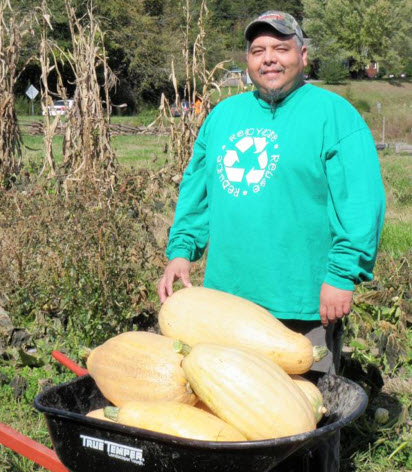 Kevin Welch is helping Eastern Band of Cherokee growers save heirloom vegetables from extinction. (Courtesy Eastern Band of Cherokee Indians Cooperative Extension)
Ask Kevin Welch what he does, and he’ll tell you he’s a “professional farmer.” But he’s no ordinary farmer.
In his unique role with the Eastern Band of Cherokee Indians’ Cooperative Extension, Welch has become a nationally renowned speaker on health, nutrition and the benefits of traditional agriculture. He has served as a lecturer-in-residence at Purdue University and spoken at the University of Georgia as well as to the Association of American Indian Physicians in San Diego, California and Anchorage, Alaska, preaching the importance of traditional plants and their roles in combating diabetes, high blood pressure, heart disease and depression.
But in his day-to-day life, his passion is preserving the heirloom seeds of his heritage. And that’s what makes him a farmer.
In 2007, Welch established the Center for Cherokee Plants, headquartered in the Great Smoky Mountains of Western North Carolina on the Qualla Boundary. The project is funded by the Federally Recognized Tribes Extension Program, the National Institute of Food and Agriculture, and the Cherokee Choices Healthy Roots Project through the Centers for Disease Control and Prevention.
Welch’s interest in preserving traditional Cherokee methods of farming, creating a heritage seed bank, and sharing with the community is known far and wide. And he regularly receives donated seeds from growers who have passed them down from generation to generation. Though some of these seeds were cultivated for centuries by Cherokees, the tradition of growing these ancient crops had been all but lost. Welch’s mission is to preserve and propagate plants that are considered culturally relevant to the Eastern Band of Cherokee Indians and to maintain a seed exchange program for enrolled members who agree to grow the seeds in isolation, thus keeping them pure, and to share 10 percent of their first harvest with the Center.
During growing season, Welch’s office is an ordinary single-level white outbuilding off U.S. 19 beside a large open field where he tends to his crops on a two-acre parcel of land alongside the Tuckaseegee River in a fertile valley. On the same stretch of ground lies the sacred Kituhwa Mound—the site of the first Cherokee Village.
The long concrete structure, once a former dairy, is used mainly for farm equipment, but it is here in a small room where Welch first carefully records the history and provenance of the rare cultivars.
Harold Long, an Eastern Band member, and his wife Nancy are locals who have benefited from Welch’s seed exchange. Their three-generations farm is a mile higher in elevation from the valley below, and they seek out plants with a shorter growing season—plants like Harold’s mother and father grew.
“We grow seventeen types of heirloom tomatoes like Cherokee purple, Aunt Ruby’s German Green, Mortgage Lister and Violet Jasper, which is small and very beautiful,” says Nancy. “Our pole beans are all string-less—October bean, Lazy Housewife, greasy bean and Cherokee butter bean. We collect our seeds or get them from the extension. We also have the older varieties of apples on our farm, like Moonglow and Liberty. We keep patches of sochan [a relative of the green-headed coneflower] and ramps too.”
Along with hundreds of other gardeners, the Longs have become part of the ever-expanding circle of heirloom plant growers, and their farm a testing ground for these ancient seeds.
In a recent interview, Welch spoke to Indian Country Today Media Network about the program’s promising future.
What are you doing now?
We have a project calledDa gwa le l(i) A wi sv nvusing an enclosed trailer we call the garden wagon. We converted it into a space for holding educational courses. We can set it up at any venue and be ready to teach in about 15 minutes. In remote places where it’s hard to get people to a community center, we can bring it right to them.
We also have a garden kit giveaway program coordinated by Sarah McClellan, project director and educator of the Eastern Band of Cherokee Indians’ Cooperative Extension, and funded for the past 10 years by Chief Michell Hicks’ discretionary fund. In addition to organizing the volunteers and selecting locations, McClellan determines all the plants and seeds we give away.
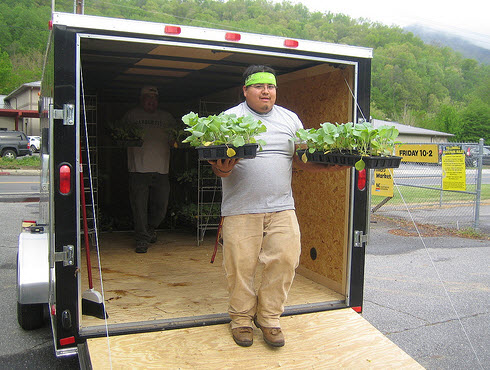 Volunteer Kevin Welch unloads Garden Wagon plants. (National Institute of Food and Agriculture) How are the seeds kept?
We collect them and dry them and put them in the freezer to kill off any pests. Then we sort and clean them and store them in bulk. It’s actually very low-tech. We hold seed saving workshops to teach the basics. Sharing them and planting them is the best way to keep a viable seed bank.
How are they shared?
We provide the seeds to enrolled members only. We don’t sell seeds. Sometimes I bring seeds along with me when I give talks, but then I’m mostly talking about the practical applications, local foods and agricultural education.
All tribes have some aspect of agriculture—from aquaculture to agriculture to ranching. A lot of tribes, when they try to modernize, tend to get away from their traditional agricultural heritage.
Who are some of the people outside the immediate community you have you given seeds to?
We gave seeds to the Smithsonian’s National Museum of the American Indian in Washington, D.C. for their garden and also on the Earth Day event to the [U.S. Department of Agriculture’s] “People’s Garden” when I came and spoke about gardening. Several years ago, we donated seeds for a rare Cherokee flour corn; Cherokee Speckled butter beans; “Candy Roaster”, a variety of winter squash; and a mix of October beans, to Michelle Obama’s White House garden.
And to start their seed program in the Western Cherokee Nation, we have given 24 varieties to Pat Gwin [director] and Mark Dunham [natural resources specialist] with the Cherokee Nation Natural Resources.
How many different varieties do you have now?
We have many varieties but we only grow out a few each year. We rotate them to build up a stock. My job is to plant, care for them and harvest them. We have quite a few folks that support our program and bring in heirloom seed that has been grown in their family for a long time. We grow varieties of tomatoes, the Cherokee Tan pumpkin, corn, beans, peppers, Jerusalem artichokes and gourds, as well as non-traditional varieties like vetch and wild potatoes from the Americas.
How do you process the seeds you receive?
When we get them, they are catalogued with a story about their heritage. Then they are dated and labeled. Afterwards, we grow them out to see if they are a stable variety, and we’ll take as many seeds as we can. We give away the seeds for free, because the idea is to get as many people growing it as possible, so the variety doesn’t die out.
What about the stories the families tell about their seeds?
That’s an integral part of its being an heirloom and being around so long. If no one liked it, then they would have not grown it anymore. I tell people that without the story of why it’s important to anyone—a seed is just a seed. This is called “memory banking”—the process of gaining the story behind the plant or behind any social construct. The same application is done for the seeds and the plants, like who grew them, why they grew them and why they liked them.
Are they more disease resistant?
Most open-pollinated varieties evolved because they have traits for a certain area. It really goes to soil conditions, environment, pH levels, climate—even the topography of where they come from. Basically they are grown because theyarepest and disease resistant. Sometimes people do what they call “high grading,” selecting the ones they like until they become the dominant trait.
Have you found traditional and natural ways to combat pests and disease?
Most of it is really basic. You can plant companion plants like beans that are a good nitrogen fixer for corn [and] squash, because its broad leaves shade out other plants for a natural weeding effect, and certain types of flowers that attract desirable insects. In winter, we collect praying mantis chrysalises that we place in the garden in springtime, where they’ll hatch out and eat the aphids. Also important is to select the right slope and drainage to prevent mildew from overly damp soils.
What are the challenges to growing these seeds?
The only challenge is crossbreeding and the application of pesticides and fertilizers, which we do not use here; also the elk that roam free here, or even the neighbors’ critters!
Do you have fruit seeds too?
Yes, we have Junaluska apples and Nickajacks—both documented as over 100 years old; Buff apples that are a variety documented to have been grown for at least 150 years; and the heritage White Indian peach, very small and sweet, that the elders really enjoy; also ground cherries and persimmons.
Do you teach people how to prepare the fruits and vegetables?
Most families still know how to cook these foods. It’s generally passed down from mother to daughter, though there are several cookbooks out by enrolled members. The Big Cove Community Club recently held a workshop about traditional cooking. And if you ask at the elementary school, the kids all know whatsochanand ramps are and how they like to eat bear and deer meat.
What are your plans for the future?
Hopefully we will continue to enhance and develop our programming to reach a broader audience. We want to focus on growing more varieties and developing a program customized to different groups. One of the things we’re trying to do is to re-educate the youth so that they’ll have a set of life skills. In this way they will be able to grow their own foods and pass that knowledge along. Our emphasis will be on education and youth gardening because the children are the ones that will carry on the traditions to future generations.
Jordan Wright
for the Alexandria Times
April 8, 2013
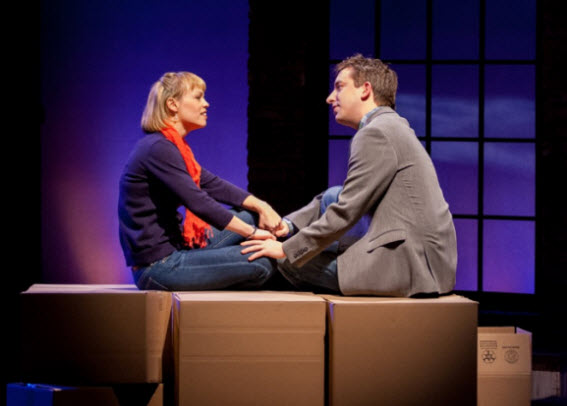 Jamie (James Gardiner) and Cathy (Erin Weaver) share a tender moment. Photo: Teresa Wood Being a theater critic is not always the best way to enjoy a show. I’m not a typical audience member out for a spot of entertainment. Scribbling furiously in the dark I analyze each scene, each song, each performer. Sometimes it’s hard to pinpoint why I am not moved, not amused, not inspired. In Signature Theatre’s The Last Five Years the acting and singing are exemplary. The set design and lighting inspired – the dialogue lively or suitably dramatic, depending on the scene. There is nothing “wrong” with this show. So why does it feel flat?
Well, it’s complicated, in this case as complicated as the plot which jumps from early courtship to their breakup for our hero Jamie, and takes the opposite route for our heroine Cathy, occasionally meeting in the middle for a duet. Known as a “song cycle”, the music by Jason Robert Brown, tells the story of an aspiring actress and a recently published writer who attempt to keep their love alive while pursuing their individual careers in different cities. That is to say when they aren’t living in the same city where he is enjoying success and temptations of the female variety, while she spends her days going on cattle calls in hopes of landing a part.
It is certainly not because actors Erin Weaver, whom we recently adored in Signature’s production of Xanadu, and James Gardiner, a local favorite we are soon to see in Signature’s upcoming productions of Company and Miss Saigon aren’t right for their roles. They both have wonderful voices and a keen sense of comic timing. Gardiner’s sense of physical comedy is especially noteworthy in the number “The Schmuel Song” about a Jewish tailor who sews 41 dreams into his wife’s velvet dress. And Weaver shines in “A Summer in Ohio” a Cole Porteresque tune that lists all the things that are worse than waiting for his return. “I could get a root canal in hell!” she croons, though she follows that with the line, “The torture is just exquisite while I’m waiting for you.” You see the dichotomy of her emotions.
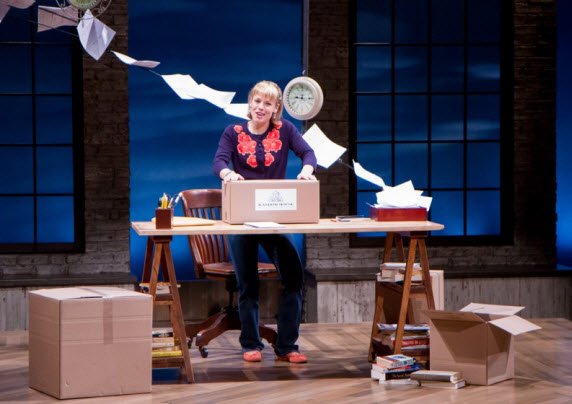 Cathy (Erin Weaver) settles into her relationship with Jamie . Photo: Teresa Wood It cannot be that Director Aaron Posner, the recipient of three Helen Hayes Awards and two Barrymore Awards, all of a sudden knows nothing of direction or that playwright Brown who has composed four major musicals and won countless awards doesn’t write his tail off with songs that are complete, emotionally solid and melodic. No, no it’s not the music, that’s the issue here, but a human connection that goes missing. The je ne sais quoi moment that reaches deep into your soul and tears out a piece you’d be glad to offer up, if only it were needed. It’s the part that’s not in the script, not in the songs, not in the staging. Because you really did come for that emotional ride – to believe – to buy into the moment – but sometimes the magic isn’t there.
The story is written to showcase Brown’s songs and the script is the device to string it together rather than the other way round – a construct originating with Beethoven and popular today in the TV shows “Smash” and “Nashville” which center around the music rather than the story. If you are ready to let it come at you as an evening of music, rather than a backwards forwards plot chronicling the perils of young love played out in two cities, you’ll be better prepared to enjoy its pleasures.
Through April 28th 2013 at Signature Theatre (Shirlington Village), 4200 Campbell Avenue, Arlington, VA 22206. For tickets and information call 703 820-9771 or visit www.signature-theatre.org.
Jordan Wright
March 31, 2013
Special to The Alexandria Times
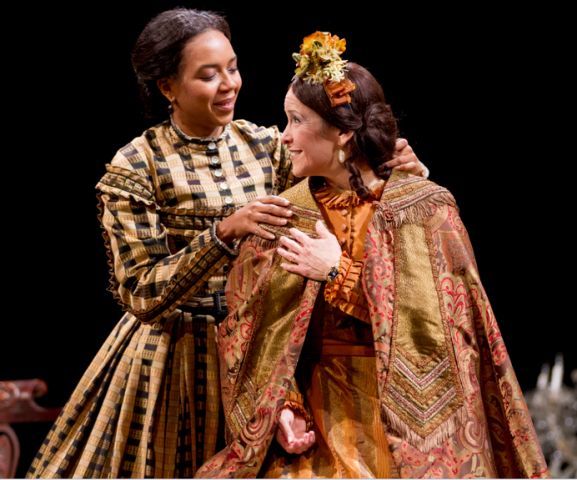 (L-R) Sameerah Luqmaan-Harris as Elizabeth Keckly and Naomi Jacobson as Mary Todd Lincoln – Photo by Scott Suchman. Four indisputably exceptional actors command the stage at Arena Stage’s world premiere of Mary T. and Lizzy K. Of that there should be no argument. They are a master class in acting – – powerful and fierce in their portrayals of their roles. But what’s troubling here is not the fine acting by Naomi Jacobson as Mary Todd Lincoln, Sameerah Luqmaan-Harris as Mary’s dressmaker, Elizabeth Keckly, Thomas Adrian Simpson as Abraham Lincoln, and Joy Jones as Lizzy’s assistant, Ivy, it is the disjointed script and tedious dialogue by Tazewell Thompson, who also serves as the play’s director. Adapted from the book Mrs. Lincoln and Mrs. Keckly by Jennifer Fleischner, Thompson’s attempt to portray the women as friends is a flimsy frame on which to hang the plot.
Tazewell’s own notes describe the two women’s relationship as a “partnership and sisterhood…a formidable alliance”. But is it really? Mary holds Lizzy in her thrall by not paying her for the last twenty-seven ensembles. A condition that would be more aptly referenced as indentured servitude. The play slogs on as Mary degrades and belittles Lizzy, begging then ordering her to make another frock to wear to her countless parties, to which Lizzy capitulates, “Tell me who I am and what I must do for you.” Though Lizzy has already bought her freedom, Mary clearly has taken ownership of Lizzy’s life. Far from an equal relationship, it seems more akin to the Stockholm syndrome.
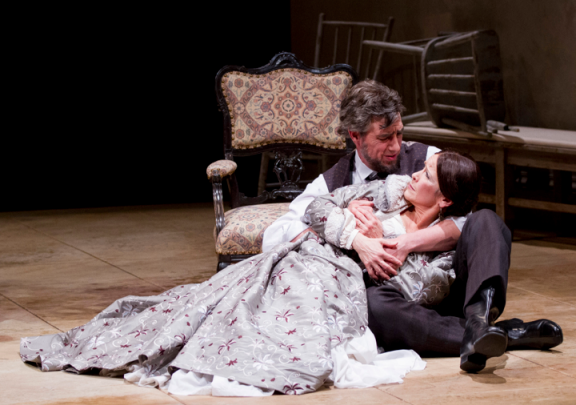 Naomi Jacobson as Mary Todd Lincoln and Thomas Adrian Simpson as Abraham Lincoln – Photo by Scott Suchman. Mary’s lavish spending and melancholia have been well documented in many historical writings, yet Tazewell’s interpretation puts the focus exclusively on these two points. These are Mary’s opening lines, “An Indian spirit is removing the bones from my cheeks. I am inundated by strangers that invade my thoughts.” Is this a woman who might be considered a reliable friend? The director defines their “friendship”, as “marked by its warmth, trust, intimacy and loyalty.” You may recall that slave owners also referred to their house servants as loyal and trustworthy.
Thompson imagines Mary as bipolar – by turns ferociously jealous, vengeful, bullying and delusional, then flipping like a light switch into girlish charm and political shrewdness. She would give Martha from Who’s Afraid of Virginia Woolf a run for her money. Certainly there were moments I thought I had stepped into the wrong theatre.
Tazewell’s odd device to hold this disjointed piece together is Mary’s preoccupation with her clothes. Mind numbing nattering about the fashions of the day fill the script and stunt the play’s momentum.
Mary spends a great deal of time center stage on a trunk, while Lizzy and her indentured assistant Ivy, conduct fittings. Mary carps about the perils of her unwieldy dresses – – bones and stays, crinolines and hoops, and a device worn under the dress called a “pagoda” that she loathes yet cannot do without – – and yet she wants more clothes, more shoes, more hats and more shopping sprees. See what comes of being a clotheshorse, the play seems to say.
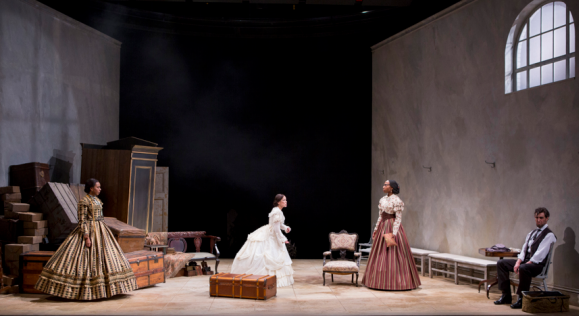 (L-R) Sameerah Luqmaan-Harris as Elizabeth Keckly, Naomi Jacobson as Mary Todd Lincoln, Joy Jones as Ivy and Thomas Adrian Simpson as Abraham Lincoln – Photo by Scott Suchman. As for the costumes by designer Merrily Murray-Walsh, they accurately reflect the popular 19th C fashions of the day from Godey’s Lady’s Book, but designer Donald Eastman’s set, described in the playbill as “a room”, is little more than a smattering of piled up trunks, an unhung chandelier and an armoire, looking more like the contents of an attic than a proper Victorian parlor.
Through April 28th at Arena Stage, 1101 Sixth St., SW, Washington, DC 20024. For tickets and information call 202 484-0247 or visit www.ArenaStage.org.
Jordan Wright
March 29, 2013
Special to DC Metro Theater Arts, Broadway Stars, and localKicks
Greek Orthodox Easter Festival at Zaytinya
 Head Chef at Zaytinya – Michael Costa – photo credit Jordan Wright Jose Andres’ popular spot, Zaytinya, is planning a five-week festival beginning March 31st and ending on Greek Orthodox Easter, May 3rd. Head Chef, Michael Costa, who continues his mission to create dependably delicious flavor-forward food, has devised some truly savory bites for the Lenten season. Last week we had a chance to sample some of the upcoming dishes including mixologist, Juan Coronado’s dazzling cocktail, Apokreas. Named appropriately after a Greek carnival celebrating Dionysus, it’s a combination of Metaxa, verjus, and maple syrup garnished with a red pickled quail egg and baby carrots. Cue the bunnies!
 Apokreas cocktail with pickled quail egg and baby carrot garnish – photo credit Jordan Wright A few of the traditional dishes we sampled were lachanosalata, shredded cabbage and carrot salad served in Brussels sprout leaves and dressed with olive oil, lemon and smoked walnut skordalia; sopa me lahanika aladoti, a smooth Lenten vegetable soup with cauliflower, rice, mushrooms, tahini and herbs topped with crispy cauliflower and black tahini; and clam stew from Lefkada, sea sweet clam soup with basmati rice.
 Greek Easter offerings Yogurt, olives and lava beans – Seasonal morsels from Zaytinya – photo credit Jordan Wright During the festival there will be an agorá outdoor market on Sunday, April 21st and Monday, April 22nd featuring artisanal foods, crafts and Greek music. Look for Andres’ Pepe Food Truck to be out front selling spit-roasted lamb sandwiches served with tzatziki and pickled red onions. Prizes of signed cookbooks, Zaytinya gift certificates, wines and other delights are being offered to benefit World Central Kitchen.
During the first week of the festival, the restaurant will host Greek cookbook author, photographer and journalist, Aglaia Kremezi for a collaborative wine dinner on April 3rd and a cooking class on April 4th. Check the website for more deets. www.Zaytinya.com.
Todd and Ellen Gray Host Seder Dinner With Recipes From Their Latest Cookbook
 The NEW JEWISH TABLE by Ellen and Todd Gray The New Jewish Table (St. Martin’s Press) by Todd Gray and Ellen Kassoff Gray arrived at my door in galley form a few months ago. Written with Washington Post food writer, David Hagedorn and sporting a foreword by Jewish cookery queen and DC local, Joan Nathan, the book is Gray’s modern spin on traditional Jewish cooking. What really charms me as a cookbook collector is the backstories told by the writer, and in this collection the duo fills the space between the easy-to-make recipes with cooking tips and personal tales of their very different childhoods. Ellen, a city-bred Jewish girl and husband, Todd, a country-bred Episcopalian, are the successful owners of Equinox Restaurant here in DC. Between them they have written a book that speaks to their food memories yet reinvents familiar Jewish recipes in Todd’s fresh and elegant style.
 The ceremonial Seder plate – Photo credit Jordan Wright This week the Grays hosted Passover Seder dinner for family and friends at Equinox and this scribe was lucky enough to snag an invitation. Though I had attended a one Seder dinner long ago at the Palm Beach Country Club when I was a girl, I enjoyed revisiting the time-honored traditions, including the reading of the prayers by the guests and the unique ceremonial plate of baytzah (roasted egg), maror (bitter herbs), z’roa (roasted bone), karpas (green vegetable) and haroset (chopped apples, nuts and wine) to represent their exodus from Egypt to the Holy Land.
 Guests read the Seder prayers The Gray’s, who are known for their warmth and conviviality served dishes from the cookbook starting with a salad of roasted heirloom beets with golden raisins and Sicilian pistachios; Todd’s Black Angus beef brisket in red wine sauce with potato mousseline and wilted spinach and sesame seeds; quinoa with poached figs and mint; and finishing wondrously with a decadent flourless chocolate cake with caramel ice cream and bourbon vanilla sauce. Now have I got your attention? Mazel tov Mr. and Mrs. Gray!
 Chocolate Hazelnut Rugelach 

Click Link to Download Receipt in PDF
Chocolate Hazelnut Rugelach
A Persian Excursion in the Heart of Georgetown
Word is out that one of Georgetown’s “in” spots for the past twenty-two years is serving Persian cuisine on Wednesday and Thursday nights. Now that’s hard news, readers, especially when you consider this place has flown under the radar for over two decades. So, yes, we had to see for ourselves what all the fuss and flutter was about.
When Iranian chef and Peacock Café’s co-owner Maziar Farivar, was tapped by the James Beard Foundation to cook a dinner for the Persian New Year’s celebration, Nowruz, he had to research his own country’s cuisine. Inspired by the dishes of his childhood that were still close to his heart, he set out on a mission to learn how to prepare the dishes that the women in his family had brought with them to America. From that jumping off point he and brother Shahab Farivar, decided to proudly offer his country’s cuisine in his own restaurant.
Regulars are familiar with Farivar’s everyday menu of American meatloaf, organic chicken, sustainable seafood and an array of pastas. It’s the jumbo lump crab cake, grass-fed rib eye steak and lobster salad that up the ante. But lately the clientele have been clamoring for his exotic Persian dishes and that is what we came for on a frigid winter’s night.
 Fresh herbs with feta and beets and Pistachio soup at Peacock Cafe – Photo credit Jordan Wright We pored long and hard over the menu and the specialty cocktail list from which we chose mango martinis made with homemade sour mix, fresh fruit and organic blue agave. It was a good place to start. Stymied by so many alluring menu choices, we vacillated wildly over our decisions before settling on the following – – borani-e laboo, red beet and yogurt dip with hummus, olives and seasoned flat bread; naaz, roasted eggplant with pomegranate; and panir va sabzi gthat with whole fresh herbs, feta radishes and dates.
An exquisite pistachio citrus soup, soup-e pesteh, arrived followed by khoresht qaymeh, which turned out to be a stew consisting of lamb and yellow split peas with sundried lime over basmati rice. We also tried a dish called albaloo polo ba morgh, a pomegranate-glazed chicken dish with sour cherries in the rice. We found the dishes to be quite small so there was ample room for dessert when we capped off the evening with the restaurant’s signature chocolate volcano.
P. S. We tried to take some photos but, alas, the sexy, red-lit resto, bracketed by neighbors Neyla and Café Milano, is so charmingly intime that the photos aren’t quite up to snuff. www.PeacockCafe.com.
A New Brunch Spot Shines in Shirlington
On the far end of what I’ll call the Shirlington Strip, that two-block boulevard lined with boutiques, bakeries, heaps of restaurants, one artsy movie theatre and, of course Signature Theatre, is The Curious Grape. You may recall I swooned over young chef, Erik McKamey’s food last June, shortly after they expanded from a wine and cheese shop into a full size restaurant. Now happily they have also expanded their hours to include a sit-down lunch on Saturdays and, more importantly, a scrumptious Sunday Brunch.
 Flight of wine-based Bloody Marys – photo credit Jordan Wright You would expect nothing less from a place that features wine at every turn, than their creative use of wine as a base for the ubiquitous Sunday morning drink, the Bloody Mary, which they just call “Mary” cocktails here. There are three versions, but order the flight in order to try them all, thus finding a favorite, if you can, which is well-nigh impossible. These cute cocktails served in half-size martini glasses snub their noses at vodka while providing an assuredly more preferable and less earth-shattering way to start your day of rest.
For the flight you’ll have the Ciao Bella, flavored with balsamic vinegar, roasted red pepper and basil and decorated with a morsel of cheese and sundried tomato on a bamboo spear. The Bloody Maria, spices it up with smoked paprika, piquillo peppers and cumin seed and comes garnished with chorizo. And lastly the Beijing Mary incorporates soy sauce, wasabi and sesame oil with a sprig of Thai basil. Each one delivers a sort of sprightly perfection. There are other brunchy drinks made with sparkling rose, sake, tawny port and sparkling hard cider as a base, but those will be for another day.
The menu is cleverly laid out in food and wine columns to aid the diner in pairings, and since the list quite extensive, you might want to stick to the script. Most selections can be ordered by the half glass, so as you work your way through their well-culled offerings, you can convince yourself you are getting an education in wines from around the world. Blissfully all wines are $13.00 and under for a full glass, so drink up, it’s study hour.
Baked goods are made in house, so try a coconut lavender muffin or cinnamon bun to break the fast. We dove in hard selecting a few starters to share. Doughnuts with wild boar, hoisin sauce and pickled onion were a tasty balance of flavors we couldn’t get enough of was an earthy foil for a dish of airy ricotta blintzes sweetened with cranberry compote, caramelized honey and thyme. And a gooey wine-kissed Abondance cheese fondue, served only as a small plate, proved a tease I’d like to see offered as an entree.
 Wild boar doughnuts at the Curious Grape – photo credit Jordan Wright Driving me mad with craving as I write this, was the house made flat iron corned beef accompanied by sweet potato hash, poached egg and salsa verde. Why, you may ponder, is this corned beef so different from all others? Why is it so irresistible, so craveable? It is because to achieve this wonder you must first appreciate the marvel of well-brined, slow-cooked meat, a process that renders the beef mouth-meltingly tender. But here’s why this one supersedes the others. In a twist of brilliance, the chef puts a thick slice of the boiled meat onto the flat top grill, searing the flesh and giving it a crusty ‘bark’. Gourmands, it does not get any better than this, except when the yolk of a perfectly poached egg oozes over the meat and onto the crispy potato hash below.
 Flat iron corned beef on sweet potato hash – photo credit Jordan Wright Next I was eager to try what is referred to as the Spanish breakfast, a potato and leek “tortilla” with Serrano ham and Zamorano cheese. I am a sucker for any dish that lists leeks as an ingredient. But this one was a disappointment, as the eggs were dry, the whole concoction flat as a board, the leeks, well, I’m not sure where they went to, and the delicate imported ham was seared to smithereens. Even the sweet note of quince on the side could not redeem it. I hope they get a better handle on this, since apart from an apple pancake soufflé, it was the only other egg dish.
 Ricotta blintzes – photo credit Jordan Wright As a footnote we decided to wait until we had finished with our bloodies before ordering coffee and tea. The restaurant has an extensive coffee bar menu and additions like house made vanilla bean, hazelnut and toasted almond syrups to flavor the java. My cappuccino with hazelnut syrup was lovely but my cohort chose a Chai latte that sent us into orbit. It seems the barista makes pouches of well-chosen spices for this drink and it’s terrific. All in all we concluded that the Curious Grape is a most welcome addition to the brunch scene and we’ll be back very soon. www.CuriousGrape.com.
Last Chance for The Garden Café’s British Menu at the National Gallery
 The Garden Cafe at the National Gallery of Art – photo credit Jordan Wright By last count I have already made three trips to the Garden Café Britannia to dine on Cathal Armstrong’s British-inspired menu at the museum and I am still smitten. With the opening of the large and gorgeously curated Pre-Raphaelite exhibition, I have returned with both local and out-of-town friends luring them in with the fabulous buffet, the elegant fountain setting and the best lunch deal in town (at $20.75 for all you can eat, it’s a steal). They have all been giddy with delight over the food, which is consistently wonderful and overseen by the National Gallery of Art’s Executive Chef, David Rogers.
 Carrots and turnips – Cornish pasties at the Garden Cafe The menu will stay in place until the end of April, but hurry! In early May, to complement the Gallery’s upcoming Diaghilev and the Ballets Russes exhibit, famed chef Michel Richard will transform the café into the Garden Café Ballets Russes. Expect dishes with both a French and Russian influence as the master creates a menu featuring Russian black bread, lentil salad, chilled borscht, blini with caviar, grilled eggplant, beef stroganoff, salmon coulbiac, and strawberries Romanoff for dessert. Na zdorov’ye!
 Digging in at the Garden Cafe Britannia – photo credit Jordan Wright
Jordan Wright
February 20, 2013
Special to DC Metro Theater Arts, Broadway Stars, and localKicks
 The Barefoot Spirit How to Succeed in the Wine Business Without Really Knowing a Damn Thing About It
Last month I spoke with Barefoot Wines founder Michael Houlihan about his upcoming book The Barefoot Spirit (Evolve Publishing – May 2013). Michael, who has been in the wine industry for nearly 30 years along with his life and business partner Bonnie Harvey, created the affordable and ubiquitous wines we know from the cute footprint icon. As soon as I spoke with him, I knew I liked him. He’s engaging, modest, enthusiastic and plain speaking, and considered a wine industry visionary. Though there are better known trailblazers throughout the history of California wines – perhaps none have started out more hapless, or dare I say clueless. He’d be the first to admit it.
When Michael and Bonnie hatched their idea to produce wine out of their farmhouse laundry room in 1985, they were so unaware of the vagaries and complexities of the business that they didn’t even know that wine came in different sized bottles. And though Bonnie had a nose for business and Michael had a knack for sales, they couldn’t possibly foresee what it took to make and sell wine on a grand scale. But both kept an open mind and both were quick studies.
 Bonnie Harvey and Michael Houlihan Co-Founders of Barefoot Spirit As he describes it in his light-hearted and informative book, Michael started his sales adventures by lugging samples of Barefoot wines through a blinding thunder storm to the Piggly Wiggly in South Carolina – hardly an auspicious beginning. Neither one of them was knowledgeable about such crucial details as marketing, distribution and shelf placement, and they were sticker-shocked when they discovered the high cost of glass to bottle their wines. The term ‘spiffs’, which are legal bonuses given to distributor reps to push a wine, was not in their vocabulary yet. They just had a product they believed in and a commitment to see it through. Michael remembered what one wine purveyor told him, “You’ve got to be better and cheaper than Bob.” Mondavi, that is. So they put their heart and soul into the venture and learned along the way. Turns out they learned a lot.
A cornerstone of their success in marketing their brand is something all winemakers use today in one way or another – getting their wines to the public through tasting events in order to establish solid relationships and engender goodwill along the way. To that end Michael and Bonnie created Barefoot’s “Worthy Cause Marketing”, donating their wine to charitable events and following up with their new friends. It proved to be an ideal model, both personally and professionally. Many budding entrepreneurs now turn for advice to the pair who in 2005 sold Barefoot Wines to the family-owned E. J. Gallo, which according to Wine Folly is, “the largest wine brand on the face of the earth.”
“The Barefoot Spirit” is the polar opposite of a dry business-oriented tale of success. It’s about a pair of entrepreneurs who dropped everything, except their commitment to fun, to make and sell an affordable wine. I mean who wouldn’t love a pair of nature-loving, beach-combing winemakers who think there’s nothing better in life than hiking the Sierras with their cats and treating their business like an adventure. Now that’s a tale you wouldn’t want to miss.
 The action at Toki Underground – photo credit Jordan Wright Tales From The Underground – Toki’s Simple Pleasures
“We have to arrive at an unfashionable time,” I insisted. “The minute they open the doors!” Like everyone else I’ve been put off by Toki Underground’s rumored lines-around-the-block and their no-reservations policy but my accomplice and I were determined to check out all the noise. Certainly the restaurant’s 2012 DC “Restaurant of the Year” award has the trendoids beating a path to their door, but we weren’t going to let that stand in our way. So around five on a weeknight, I picked up my epicurean compatriot and we headed off to H Street where we discover to our delight that we are seated right away.
Toki Underground has been on the radar screen of foodies and chefs from Alice Waters to Joan Nathan whose famous Sips & Suppers event featured the noodle shop’s Executive Chef Eric Bruner-Yang in one of their private dinners this year. The tiny noodle house, all 650 square feet of it, has a mere twenty-five stools and most face the wall. Don’t expect a romantic hideaway or group ramen night. This hot spot could be more fondly described as a hole in the wall.
 Counter dining at Toki – photo credit Jordan Wright The tiny outpost sits above The Pug, a small dive bar on the first level. A steep stairway leads to the second level and the unmistakable aroma of miso, soy and freshly made ramen. (Why “Underground” if it’s on the second floor?) A tattooed host leads us past clouds of billowing steam from the open kitchen where we hop onto two empty stools, propping our feet up on the footrests, actually repurposed skateboards, and dive into the menu like starving cheetahs.
The décor is Asian animé hipster – the limited menu Japanese/Taiwanese fusion ramen and dumplings complimented by Asian-themed cocktails, sake and Korean beers. But it’s the ramen, lovely silken noodles made off premises in Springfield, VA to Bruner-Yang’s specifications and floating in a 24-hour simmered pork shoulder bone stock, that steals the show. Though there are a purported twenty-six different styles of ramen, the young chef draws on his life in Taiwan watching his mother and grandmother form the flour and water into pliable strands to interpret his own style.
The proper way to eat ramen is to slurp. (Miss Manners, cover your ears!) The reasoning behind this custom, uncouth to Western proprieties, is to aerate the noodles in order to eat them quickly before they break down in the hot broth. Lots of communal slurping was heard. Dainty diners need not apply.
 Sesame Crusted Salmon with horseradish sauce and eggplant jam – photo credit Jordan Wright Our dumplings come first, steamed instead of pan-fried and the soft pillows, stuffed with ginger, scallions, Napa cabbage and a house-made spice mix, and served alongside tare, a sweet soy dipping sauce. A classic hakata follows – the bowl filled to the brim with ramen, pork loin, pickled ginger and nori seaweed. My partner likes the nitamago with the sous vide cooked egg that when broken spills into the broth turning it into a creamy slurry. If you’re of a mind, Chashu pork cheek or other additions can be added to most dishes with a nominal $4 surcharge. All the ramen bowls are layered with complex seasoning and spice and cradled by the deep undertones of the slow cooked pork bone stock.
Dessert is an afterthought here with house made chocolate chip cookies and a carafe of milk. Take it or leave it. If you want something more substantial you may want to drift over to Dangerously Delicious Pies for a slice of heaven on a plate.
Currently in the works is Bruner-Yang’s experiment to channel the Asian night market experience. Look for Maketto to bring the same energy and intriguing cuisine to his revered H Street neighborhood.
1,001 Serbian Dreams
 Cherry pomace and Honey Drop rakija – photo credit Jordan Wright It was last November and a small group of us were brunching at Masa 14, when I first heard about Ambar. Ivan Iricanin and his partner, chef and restauranteur Richard Sandoval (Masa 14 and El Centro D. F.) had already begun building out the Eighth Street restaurant that would soon transport the soul-satisfying regional dishes of Serbia’s Balkan republic to DC. In particular they were excited to debut dozens of varieties of the country’s national treasure, rakija, which are fruit brandies of a wide-ranging potency. My antennae were vibrating like a summertime cicada.
In January the two-story brownstone opened with three authentic Serbian chefs and bar shelves filled with glistening bottles of rakija sharing space with wines from Slovenia, Bulgaria, Croatia and Serbia. It’s a cozy country rustic space yet with a modern polish. Mason jars of pickled eggs and vegetables take up shelf space with books and candles flicker against the pickled wood walls.
 Forest Gnocchi at Ambar – photo credit Jordan Wright The cuisine here is a heavenly mixture of Mediterranean, Balkan, Turkish and hearty Slavic fare – a bit spicy, earthy and deeply flavored, especially the meats. Scanning the menu I saw a multitude of intriguing dishes – Wild Mushroom Salad salata sa pecurkama, White Veal Soup teleca krem corba, Venison Carpaccio karpaco od smetine. But it was the way they were described that made us lean in further. A dish called simply ‘Grilled Asparagus’ is done up in a velouté sauce with crispy prosciutto, pumpkin, purple potato and quail egg. Beet and Goat Cheese Salad, slojevi cvekle arrives garnished with pork cracklings, walnuts and chives. Sesame Crusted Salmon, losos, is flavorfully enhanced by horseradish sauce and spicy eggplant jam. It seemed impossible to decide but after giving our preferences to our capable and quite adorable server, she made a few suggestions and additions to complement our initial choices.
 The Balkan bread basket with three spreads at Ambar – photo credit Jordan Wright The homey Bread Basket ustipci ili proja is a good place to start. Filled with the Balkan version of cornbread, fried sourdough, (be still my heart) and three savory spreads, the one most of us are familiar with is ajvar – a spicy red pepper puree. We also swooned over the Cheese Pie gibanica – a delicately layered phyllo napoleon with spinach and goat cheese, far better than most I’ve tried. Though they have the traditional beef and pork kebabs cevapi, which adds cheese to the skewer and the National Dish pljeskavica, a Balkan hamburger – it was the Stuffed Sour Cabbage known as sarma that transported us on that cold, rainy evening.
Ambar does not treat dessert as an afterthought. They have a pastry chef who trained in kitchens throughout Europe. The most unusual dessert is the Forest Gnocchi. Dazzlingly presented in an earthenware bowl that weighs as much as a bocce ball, its separate components consist of chocolate mousse, bitter orange cake, ground chocolate, orange gelee, tarragon gnocchi and passion fruit espuma. The unusual dessert, pretty as a medieval garden, is then stirred up with black tea sauce.
Be sure to finish with one of the rakijas. We opted for the subtle Honey Drop and the high octane Cherry Pomace. Just the beginning of our love affair with Ambar.
|