Jordan Wright
July 09, 2013
Special to The Credits – Motion Picture Association of America
David works with elephant
If you’ve ever seen a rhino in a television commercial, his name is Tank and he’s the only working rhino in show business. Maybe you’ve noticed zebras, bears, leopards, African lions, panthers or Siberian tigers in TV ads or on the big screen and wondered how they’re train to stand still, lie down, run around or roar on command for the camera?
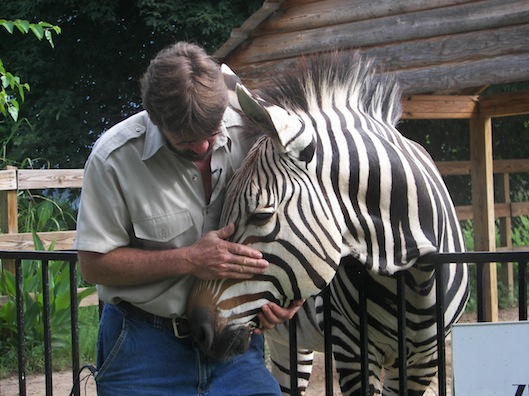
Meeks with his Zebra Zeke
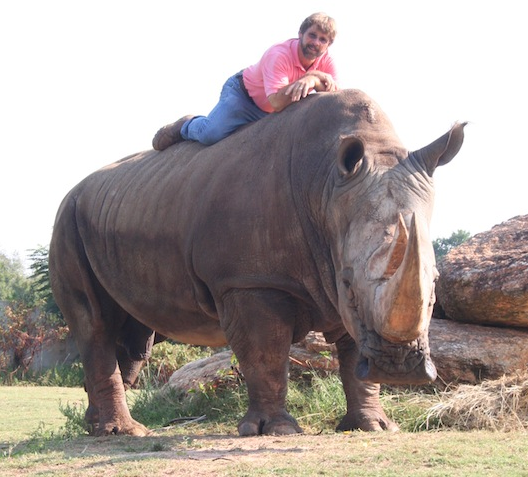
Many of the animals you see on the big and small screen belong to David Meeks, director of Hollywild Animal Park in South Carolina. Meeks is the East Coast animal wrangler filmmakers call when they need, say, a panther in their in movie. The business side of the 100-acre park is called Cinema Animal Talent, and it’s been going strong for over 30 years. Tank, the white rhino, is one of Meeks’ biggest stars.
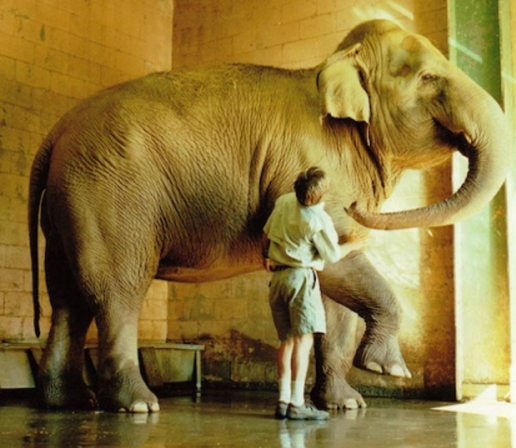
With over 700 exotic animals living in the park, Meeks has tapped on his zoological collection for over 60 major motion pictures and countless print ads and television commercials since the early 1980’s. For nearly a decade his cougars shilled for Lincoln-Mercury and pounced in The Last of the Mohicans and Reversal of Fortune. Pongo the orangutan did commercials for Mazda, and Donna the Asian elephant appeared in Ryder Trucks and Land Rover ads. Tank the rhino can’t stop getting work, offering his majestic prehistoric-looking bulk for Blue Cross/Blue Shield and Land Rover ads. Meeks’ lynxes have worked for Minolta, while Alfonso the Leopard Appaloosa horse was in The New Adventures of Pippi Longstocking, along with some of Meeks’ crafty Capuchin monkeys.
Meeks’ film credits include, A Breed Apart, Order of the Black Eagle, Date with an Angel, Never Say Goodbye, Prince of Tides, Reuben, Reuben, Rottweilers, The Real McCoy, The Stand, Betsey’s Wedding Days, Days of Thunder, Monkey Shines, Prancer, Blood Savage and many, many others.
Recently the park had a joyous occasion when a long-horned African Watusi (a breed of cattle native to Africa) accidentally bred with an American Bison. They tagged the resulting offspring a Waffalo and cheerfully named them Pop Tart and Eggo.
The Credits had a chance to talk with Meeks about his unique career.
David Meeks with his rhino star Tank
The Credits: How do you even begin training animals to camera ready?
I don’t call it training because you can’t really train a wild animal. I call it “conditioning” and you have to keep it up even when they’re not in a film. You have to have a rapport with an animal—be firm but be fair. They’re not circus animals. And they don’t understand our humor.
But you’ve got these animals doing tricks…
An exotic animal will only do tricks if he thinks you won’t hurt him. He can react badly if you don’t know how to read his body language and make him relax. When I see that they’re uncomfortable I’ll tell the director, “We have to take a break.” I know what the animals are saying. They’ll scream it at you. You can’t second-guess an animal’s behavior. It’s instinctive for them to act from experience. Even a mixed martial arts master is nothing going up against a lion, a primate or a bear. If the animal doesn’t respect you, you’re gone.
What was one of the most unusual things you were asked to have an animal do?
One film company wanted to do a complete body scan of our rhino— film every inch of the animal’s body so that they could make him do everything a rhino can’t do, like cartwheels or a split. They wanted to make his horns perfect, too, but I realized that if they did that they would never need to use a real rhino again. I didn’t do it. The real thing looks much better.
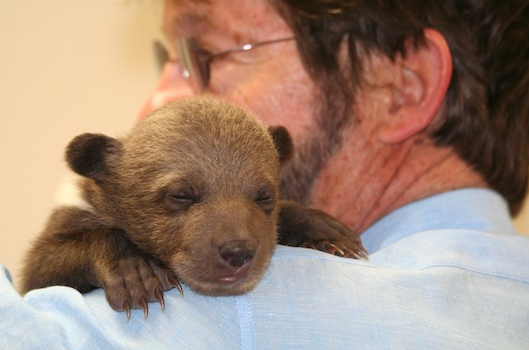
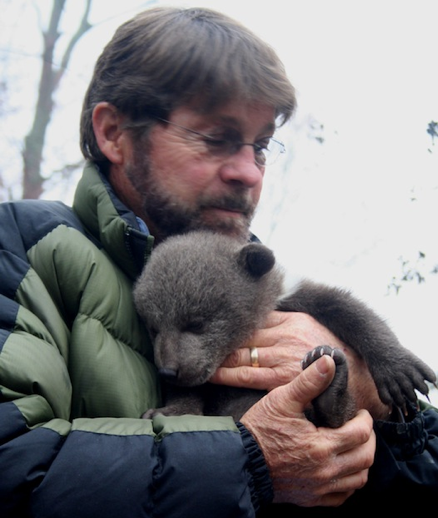
Meeks with a potential new star
What are a few of the features your animals or you have appeared in?
There are so many. In Stephen King’s miniseries The Stand, where it was good versus evil, we used cockroaches, deer, a dog, a butterfly, hundreds of bats, a crow and a cow. I had to go all the way to Utah to find this giant Holstein. We used bats in The Big Chill, too. In Betsey’s Wedding I stunt doubled for Alan Alda when he had to fight a Bengal tiger we had provided. In another movie I doubled for Gary Sinise. For A Breed Apart, we provided the eagle, which at the time was considered an endangered species. Recently we shipped monkeys to Florida for an upcoming episode of Shipping Wars. And even though we didn’t have a lion in it, my lions were used for study purposes in The Lion King.
Have you ever had to modify an animal’s appearance for the purposes of a film?
Yeah, for this film Prancer [a Christmas movie about a girl who comes across a reindeer with an injured leg]. When director John Hancock came to me to do a Christmas movie I figured they would want a reindeer. I’d never even seen a reindeer up close and never worked with one. But he told me they preferred to use a fallow deer because it’s prettier. I told them any deer that has antlers is a male, and this time of the year they are in rut [their mating season], and there’s no way I’ll work with a deer in rut next to an 8 year-old girl. Even a deer that’s tame and workable will kill you when it’s in rut.
Who knew deers in mating season were so deadly.
Yeah. So I don’t hear from them for a while, and then one day I get a call back and they said I said I could use a reindeer, but now the problem is the timing. I tell them the females lose their antlers before the males and you could have a reindeer that loses its antlers in the middle of the shoot. So I flew up to see them and said we have to have several reindeer on the set because they are herd oriented and they need to stay together. So we used a female and had fake antlers made for her. A puppeteer made a fake reindeer head for close ups but they only had to use it once.
Did any of your animals do something you couldn’t have predicted?
We were in Nashville to do an ad. Every time I’d go there I had to do four or five commercials at a time. The last time I was up there I had a female chimp called Rosie. Chimps are really smart. They work on credit [meaning, incredibly, that they’re so smart they know they’ll be rewarded at a later time.] I said, “Rosie, could you please do some cartwheels over here?” But you can’t rush her. I can see the stool she’s sitting on is too close to the cabinets and there’s a paint bucket nearby. The director says they’ll have the stool secured, and I left the set and went to the trailer with Rosie. When I got back they said it was all fixed. So I dressed her up, put her diaper on, and the stool was still not locked down. Then I saw her go for the paint bucket. She snatched it up and when I grabbed it out of her hand she bit me. Every time animals do something there’s a good reason. They think you make it rain or make the sun shine. They look at you negatively or positively and they think and ask questions. They will instinctively blame you for your mistakes.
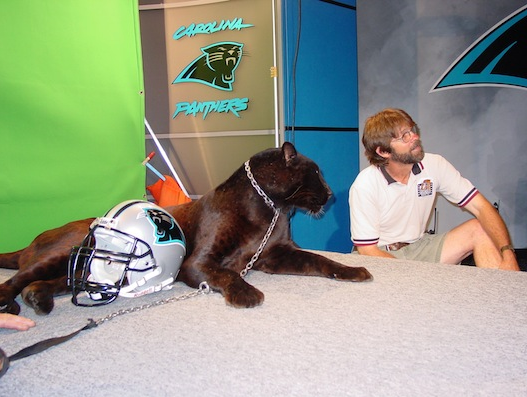
Meeks provided the Carolina Panthers with the real version of their namesake
What was the most dangerous thing that happened on set?
Once when we were filming in Chimney Rock, North Carolina late at night, I had my black panther walk between a cave and a rock. There was a fire nearby and she was on a piece of transparent monofilament we use for a leash [a thin plastic wire like a fishing line that can’t be seen, so it’s used as a leash during filming].When she crossed the fire the filament burned up and I didn’t know where she was. In this case I should have used a steel cable even though it doesn’t stretch. If something goes wrong on a shoot, you have to let the big cat run until you can get them back.
Whoa, you have to let a panther just run? Is that the craziest thing that’s happened to you on a set?
No. I was doing a Ryder Trucks commercial with the actor Steve Landesberg. I had worked with him before in Leader of the Band. We head off to Atlanta with this Asian elephant provided by this trainer I know, Rex.
When we got to the set I saw that the elephant was reaching out her trunk. I could tell she was fixing to hit Steve and I was worried. The line in the ad was, “When I’ve got something really big, I choose a Ryder Truck.” I asked Rex, “Has that elephant ever smacked anyone?” He hesitated. So I asked Rex if the elephant maybe needed a break, and he agreed. But then Rex said, “Nah. Shoot the rest of it.”
As soon as the cameras begin to roll, the elephant knocked Steve clear out of the shot.
It is with heavy heart that I divulge to my dear readers one of my secret pleasures – because not to share my latest adventures is anathema to my nature. But first I’ll tell of my history with a place that has been dear to my heart for many years.
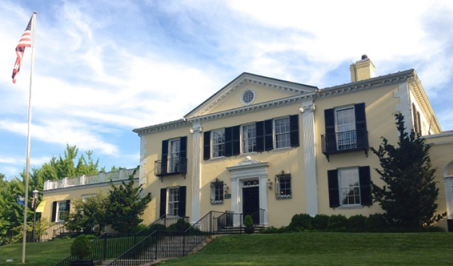
Fifteen years ago I discovered one of the nation’s most under-the-radar destinations. A secluded destination that has more in common with Britain’s “Treasure Houses” than a Virginia gentleman’s farm, although that is what it once was. It began innocently enough on a Saturday morning in the beautiful foothills of the Piedmont region where we had gone to meet friends at the steeplechase races. After driving about an hour from Washington we turned off the highway onto a country lane past a series of stone columns fitted with iron gates. A large rock waterfall beside the road appeared as if out of nowhere. Meadows resplendent with wildflowers and a small airstrip came into view. The winding road led us high up to a racetrack that coursed over hill and dale and around several ponds. We spent a glorious day wondering where indeed we were.
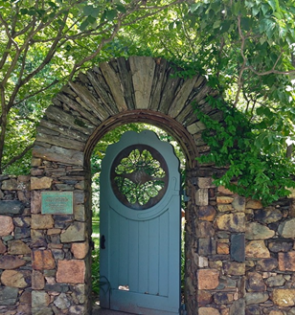
The moon gate at Airlie – photo credit Jordan Wright
Fast forward to the following year and we are watching sheep trials on the same wondrous property. We take luncheon in the manor, tour the formal gardens, watch collies work the sheep, and stroll the grounds circling around quiet ponds bordered with more houses, cottages, swimming pools and a small pub. Herons and geese abound, frogs and crickets whir in concert and fish leap out of the water breaking the silence. We are at Airlie House.
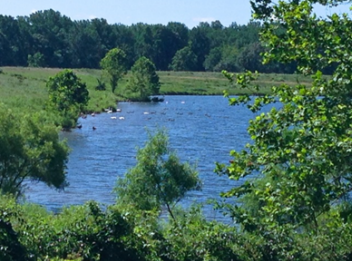
Trumpeter Swans swim alongside Canada Geese on one of Airlie’s nine ponds – photo credit Jordan Wright
On our next visit we were guests at a lawn party at one of the homes on the property where the landowner’s son, a young doctor and musician, lived in bohemian splendor amidst mansions and stables and wild raspberries.
The Roger Tory Peterson Butterfly Garden dedicated to Airlie by his wife Virginia Peterson – photo credit Jordan Wright
Soon after we learned of the Airlie Environmental Studies Center and its Director Dr. Bill Sladen whose swan migration program trained Trumpeter Swans, bred on the property, to follow an ultralight plane. And so, we returned for a swan conference, an international ornithological event that occurs somewhere in the world every ten years. For the first time we spent a night in one of the lovely cottages before taking off to a secret location near the Chesapeake Bay where we banded swans while cradling them in our arms. The bus then took us further south to the Great Dismal Swamp on a 32-hour expedition shared with thirty-five ornithologists speaking seventeen languages.
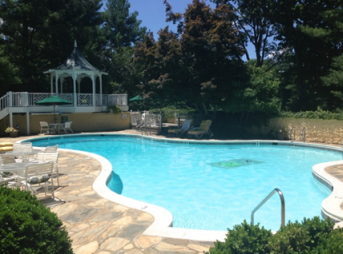
Poolside at Airlie – photo credit Jordan Wright
Last weekend I returned for a stay at Airlie House for the full-on guest experience. The 1200-acre conference center, once known only to high-level government officials, corporate CEOs and those whose business is conducted free from prying eyes, has now flung open the doors and grounds of this historic property to overnight guests, offering weekend packages, winemaker’s dinners in the field and a new partnership with the Castleton Festival. No longer is it the exclusive purview of conference attendees. At last anyone can experience its once-hidden glories.
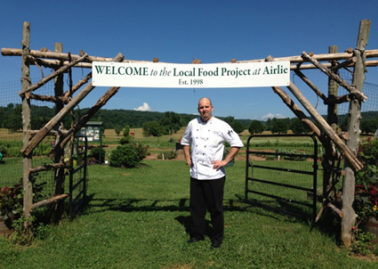
Airlie House Executive Chef Jeff Witte at the entrance to the kitchen gardens – photo credit Jordan Wright
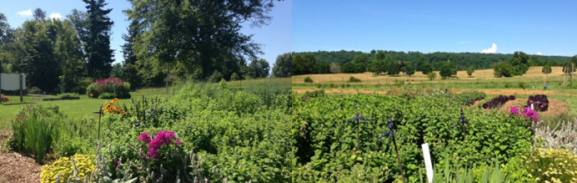
As the summer sun climbed high overhead I met with Airlie’s Executive Chef Jeff Witte, a Los Angeles native and graduate of Le Cordon Bleu, who guided me through the sustainable gardens, a passive solar hoop house and raised beds bursting at the seams with herbs, vegetables and flowers. Bee hives, the wellspring of Airlie’s honey, dot one side of the fenced-in plots, while climbing hops twine around poles in the biergarten.
The Center’s kitchen benefits from 4,500 pounds of organic produce each year, some of which is shared with community food banks. “We source from over 30 local farms for our meats, cheeses and fruits, buying everything as locally as we can. We’re totally committed to our relationships with the community’s farmers,” explains Witte whose upscale regional cuisine strikes an elegant chord with diners.
A trio of palate cleansers – Alaskan halibut with Airlie garden vegetables – Garden figs with goat cheese ice cream, shortbread cookies and caramel sauce – photo credit Jordan Wright
Kae Yowell, Head Gardener for the Local Food Project at Airlie, who grew up on a dairy farm where her grandparents grew and canned their own vegetables, enjoys teaching others about the pleasures of the garden. “Throughout the year we have a series of lectures on gardening, seed saving and beekeeping. We just had one on making fruit jams and jellies from our strawberry patch.
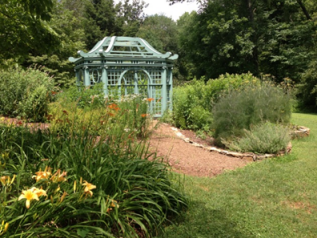
The summer garden at Airlie – Flowers grow side by side with herbs and vegetables at the Local Food Project – photo credit Jordan Wright
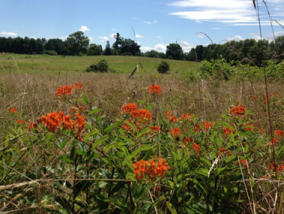
This weekend guests can join in the annual Butterfly Count and by the looks of it there will be plenty of monarchs and swallowtails flitting about the gardens and the surrounding wildflower meadows. For more information on Airlie Center and its weekend packages with tickets to Castleton visit www.Airlie.com.
Butterfly weed in the meadows of Airlie – photo credit Jordan Wright
Castleton
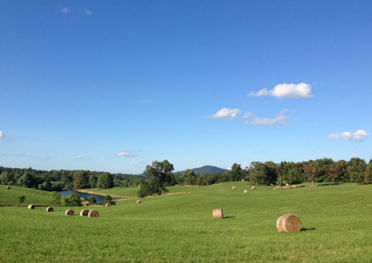
The fields of Castleton – photo credit Jordan Wright
Entering its fifth anniversary season with Maestro Lorin Maazel, Castleton’s founder and world-renowned former conductor of the New York Philharmonic and guest conductor of many of Europe’s finest orchestras, the festival plays host to international opera and musician superstars, as well as up and coming orchestral virtuoso artists. Situated on a 550-acre farm the Theatre House and its concert venue feature weekend programs of classical music concerts played by a full orchestra, chamber music performances, cabarets, and operas by composers from Puccini to Verdi to Andrew Lloyd Webber.
Maazel’s wife, Dietlinde Turban Maazel, is the festival’s co-founder and Associate Artistic Director. As a stage and screen actress she is singularly qualified to train the young artists that come from around the world to Castleton’s doors for the summer Artists Training Seminars and workshops in the performing arts. Another famous faculty member is American mezzo-soprano, Denyce Graves, veteran of the Metropolitan Opera and native Washingtonian.
Westward ho for Castleton Festival’s “The Girl of the Golden West”
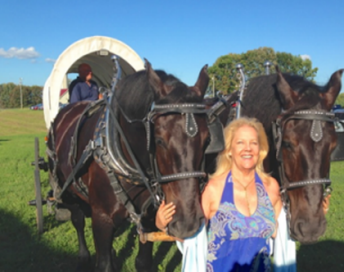
Last Saturday the Castleton Festival staged a spectacular performance of Puccini’s “The Girl of the Golden West” and organizers had put an exclamation point on the theme with a cowboy galloping around the hills on a black and white Paint and a Conestoga wagon pulled by two perfectly matched draft horses at the entrance to the concert hall. It was a glamorous night for attendees and benefactors who basked in the glow of a glittering opening night. For tickets and information on the Festival’s upcoming performances through July 28th visit www.castletonfestival.org
Debuts and re-dos seem to be the thread of late. Restaurants in the DC Metro Area are opening and remixing at a astonishing rate no one could have imagined a few years ago. Forks up!
La Tasca Gets A Culinary Facelift
At La Tasca the privately owned chain of Spanish-themed restaurants, there’s huge buzz with the hiring of Josu Zubikarai, former executive chef at DC’s posh Taberna del Alabardero. The Basque native, whose knowledge of Spain’s authentic regional cuisine has earned him a beloved following, has come back to DC to ratchet up La Tasca’s menus with tapas and paellas both traditional and modern. He’ll work on pairings with his former Alabardero colleague, Aurelio Cabestrero, whose last stint was sommelier at Marcel’s.
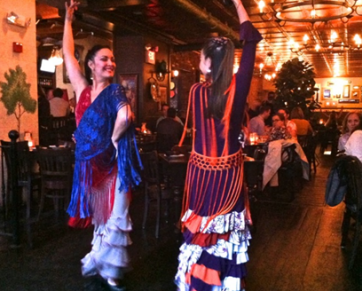
Flamenco dancers at La Tasca – photo credit Jordan Wright
In my experience Spanish wines are some of the unsung stalwarts of the vineyard. At a recent gathering of sophisticated Spaniards I asked an elegant socialite why she thinks Americans aren’t more enlightened about Spanish wines. “Because we want to keep them all to ourselves!” she cheerfully explained. I’m hoping Cabestrero will be more inclined to share his knowledge from the fantastic wine list he’s assembled.
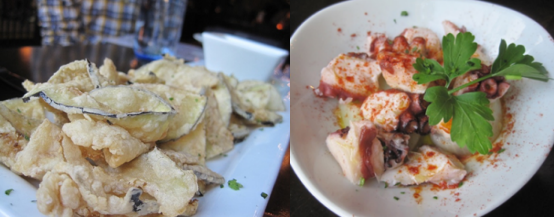
Berenjenas served with a warm Cabrales cheese dip – Pulpo a la Gallega – Steamed octopus with potato – photo credit Jordan Wright
Of the five La Tasca outposts around the DMV, I chose to visit the Old Town Alexandria location. As I approached the sound of flamenco music was pouring out onto the street. A party! Even though the sun was barely setting, the bar was lively, with patrons sipping sherry or drinking pitchers of sangria, some with filled with summer berries or fresh peaches, and nibbling on tapas.
There are over fifty tapas to choose from – – traditional nibbles like Manchego Frito, (fried manchego cheese) served with honey orange marmalade and Croquetas de Pollo y Jamon (croquettes with ham and chicken). The list goes on and on. More contemporary tapas like Mejillones Tigres (spicy mussels breaded and deep-fried with a béchamel sauce) are fabulous and you can’t go wrong with a cured meat platter of salchichon, cana de lomo, jamon de Serrano and chorizo served with picos and Marcona almonds or a cheese board of Tetilla, Montenebro, Valdeon and Manchego that arrives with a delicious fig jam.
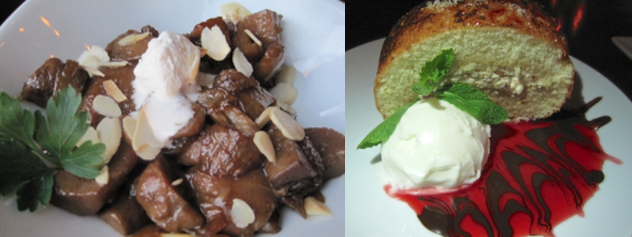
Eggplant with almonds and goat cheese – Brazo de Gitano – A rolled sponge cake layered with quince jam and served with Manchego cheese ice cream at La Tasca – photo credit Jordan Wright
Some diners never get around to the paellas, but you should venture forth. Most of the rice-based dishes incorporate shellfish along with the traditional peas and peppers. One variety uses chicken and duck. Finish with café cortado or a glass of Gran Torres Orange, a Spanish liqueur, and hot and crispy house made churros or a creamy flan, and you’ll find yourself clicking your heels and shouting olé! www.LaTascaUSA.com.
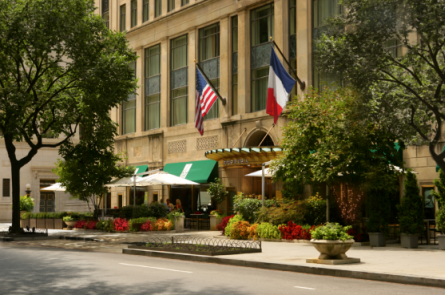
Sofitel Lightens Up
No matter how critics whine and moan about small plates, they are here to stay. Whether it’s to please grazers whose palates operate like Twitter, or dieters who eschew heaping portions of protein, diners are choosing smaller, lighter and healthier portions.
Sofitel Washington DC – photo courtesy of Sofitel
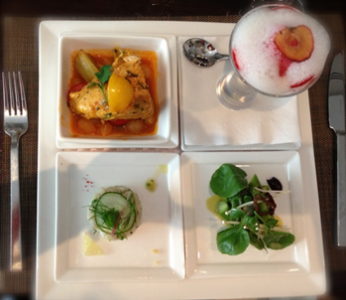
To that end Sofitel DC has reintroduced its popular, De-Light by Sofitel, with a lightened up summer lunch menu guaranteed to have business diners served and out in thirty minutes if they so choose, which I do not. Because who wouldn’t want to linger at an outdoor table with a glass of rosé, savoring the cuisine of Executive Chef Franck Loquet and the heavenly macarons from Pastry Chef Vincent Bitauld?
The 30-minute De-Light luncheon menu from Sofitel – photo credit Jordan Wright
Or why not dine languorously under the smashing black & white celebrity photo portraits by Gilles Bensimon covering the dining room walls?
But this is news about a quick, well-balanced, low-calorie lunch whose courses are served at the same time. That’s an appetizer or salad, entrée and dessert with a calorie count of under 200 without sacrificing taste or satiety. There are a few choices to make first – Grilled Asparagus Salad with orange basil dressing or Branzino Tartare scented with lemon, ginger and vanilla, a delicate Chicken Tagine with fennel and pearl onions or Mixed Grill, an assortment of fish, tomato, lemongrass and glazed baby vegetables. Dessert is a strawberry and milk foam treat called ‘Milky Way’ for its etherealness.
Bearnaise – Adventures in Retro French Bistro
On the opposite end of the spectrum of Gallic cuisine are the cholesterol-heavy dishes of Bearnaise – Spike and Micheline Mendelsohn’s latest endeavor whose steak frites concept beckons like a croupier at a baccarat table. To say this type of cooking is as out of fashion as Carla Bruni, is an understatement. I had thought we were fast-tracking towards healthier fare, not the cardiac unit. Don’t expect to celeb-spot vegan goddess Gwyneth Paltrow slicing into a filet mignon here.
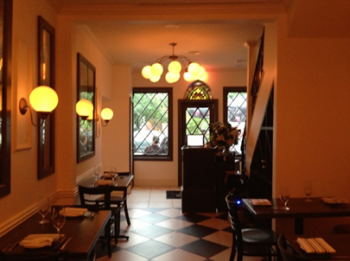
Downstairs dining area at Bearnaise -photo credit Jordan Wright
I enjoy revisiting the past as much as the next memoirist. Traveling back to a more innocent time, before Bocuse, Guerard and Vergé gave butter and cream the heave-ho and snubbed their consensual noses at the great Escoffier. Before the culinary renaissance of the 60’s trumpeted nouvelle cuisine and French restaurants reigned supreme, sauciers held sway, crepes suzette were made tableside, and bistros redolent of Gauloises and café filtre could be found on every street corner in France. We are enamored of that sexy epoque and so is the restaurant. Framed posters of Serge Gainsbourg, Brigitte Bardot and Coco Chanel dominating the cream-colored walls, are a dead giveaway.
The most difficult decision of the night – photo credit Jordan Wright
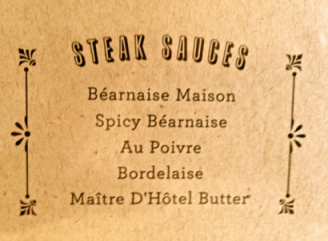
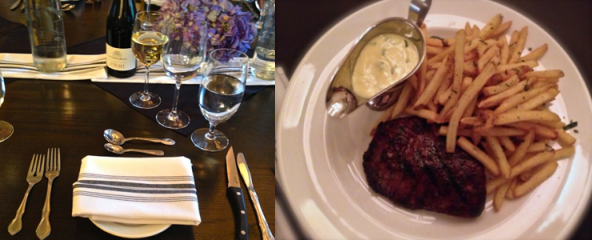
Bearnaise is steak-centric and the tender cuts are cooked to perfection. Serving them with a choice of sauces – béarnaise, spicy béarnaise, au poivre, bordelaise or maître d’hôtel butter – ups the ante. Sides include roasted Portobello mushrooms, Brussel sprouts dripping with bacon and tarragon-infused béarnaise, bone marrow for the Paleos, and potato gratin with lardons in a creamy Reblochon sauce. The night I dined there the soup of the day was vichyssoise that would have benefited from more leeks. But the crispy frites made from Yukon Gold potatoes. Sacre bleu! I dare you not to dip them in one of the exquisitely made sauces!
The bespoke French table at Béarnaise -Steak frites with béarnaise – photo credit Jordan Wright
The restaurant prides itself on its affordable French wine list. Over two dozen vintages are offered at $40.00 a bottle or $10.00 per glass. A few, like the 2009 Cardinale Cabernet at $400.00 a pop, are for high rollers only.
So would I eat here again? Mais bien sûr, mes amis! Though I’ll have to eat like a peasant for a month before returning to the French onion soup smothered in melted gruyére, escargots bathed in garlic herb butter and topped with a jaunty pastry beret, flat-iron steaks, unlimited frites and chocolate mousse.
The questions remain. Will the Mendelsohns’ legion of fans that flock to We, The Pizza, and Good Stuff Eatery’s burgers and shakes put their money on steaks frites? Will General Manager Chris Connor bring members from his former gig at the Cosmos Club to the stylish spot? Will Exec Chef Brad Race, formerly of Jose Andres’ Minibar and Michel Richard’s Michel be able to coax diners into dining on bistro cuisine? I’m betting the bank they do.
Malmaison – Not Just for Josephine
While we’re weighing in as Francophiles, I should mention Omar Popal’s new Malmaison is now serving dinner. Mussel soup, vichysoisse, short ribs Bordelaise, vegetarian bouillabaisse and house made duck confit are a few of the offerings in this hidden Georgetown spot best known for hosting dance parties. Malmaison has jiggered its cavernous space, once an ice factory, to provide diners with a view of the Potomac while dining on dishes from Michelin-starred chef Gerard Pangaud, formerly of Gerard’s Place and sweet treats from pastry chef, Serge Torres, an alumnus of New York’s Le Cirque.
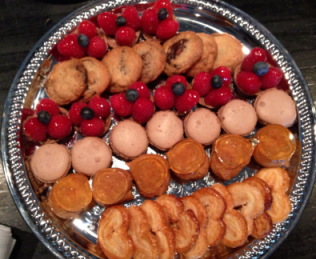
Pastries at Malmaison – photo credit Jordan Wright
Popal’s other hot spot, Napoleon Bistro & Lounge, will be celebrating Bastille Day on Saturday, the 13th with a “Vive la France” party at their Columbia Road address. They’ll be spinning French beats and offering champagne cocktails. The French-themed costume party invites you to sport your best beret, black and white stripes and a moustache – ladies are exempt from the latter.
Whisk and Quill is delighted to welcome guest contributor Cary Pollak a Washington-based attorney, veteran reporter, feature writer and culinary educator. Cary’s articles have appeared in DC Style, Capitol File and www.DCDigest.com. In addition he is a writer for the National Press Club’s members’ newsletter, The Wire.
[/color-box]
After a two-year change of venue to Washington, DC the Fancy Food Show has returned to its West Side digs in the recently renovated Jacob Javits Convention Center in New York City. For Communications Director, Louise Kramer, who was delighted with their stay in the nation’s capital, the show’s return to the Javits Center, “was like coming home.”
The show has grown immensely since its inception in 1955 and features over 260,000 innovative specialty food products. Even with a three-day window it’s almost impossible to cover 354,000 square feet of exhibit space filled with 2400 exhibitors and their exciting products. Attending the numerous food seminars and cooking demos can present even more of a challenge.
For a retailer on the hunt for new products, a visit to that section of the show is all they’d need. But for the casual visitor, strolling aimlessly, there’s no sense in racing down the aisles, especially with all the tempting displays of candies and cookies, olives and oils, vegetables, fruits, meats and seafood products set out for sampling.
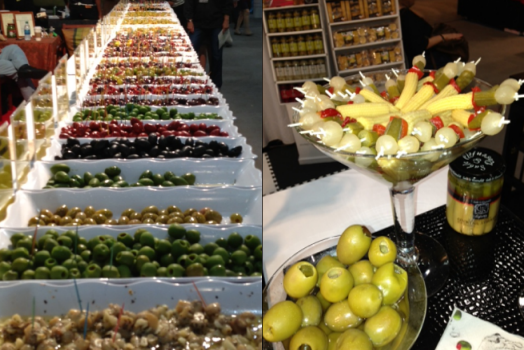
Bins of Olives and Mushrooms – Photo Credit Cary Pollak
When you discover a new product at Whole Foods or Trader Joe’s or any other supermarket, there’s a good chance it debuted at this show. The ubiquitously known Perrier, Ben & Jerry’s and Terra Chips are just a few of the thousands of products that have debuted at the Fancy Food Show over the years, so it is especially interesting to search out new offerings there. Many of the exhibitors highlighted below either introduced new foods or are perennial favorites.
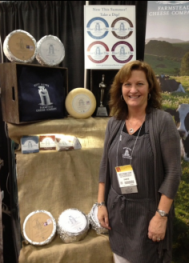
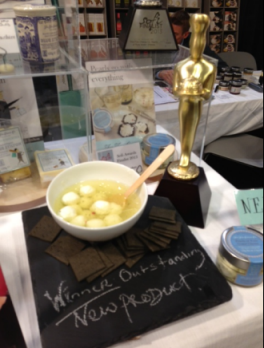
Twice a year the Specialty Food Association announces the winners of the sofi Awards for specialty outstanding food innovation in 32 categories. One of the most coveted awards is “Outstanding New Product”, and this year two cheeses, Point Reyes Bay Blue produced by the Point Reyes Farmstead Cheese Company in Marin County, CA, and The Fine Cheese Co. Pearls of Pure Goats’ Cheese distributed by Artisan Biscuits Ltd. of Britain and Ireland, tied for first place. The former stood out for its “fudgy texture and sweet caramel finish,” and was hosted by Farmstead’s Donna Hagan.
Farmstead’s Donna Hagan – Photo Credit Cary Pollak
The latter was not much to look at swimming in a bowl of sunflower oil, but a marinade of garlic, herbs and crushed pink peppercorns gave it a distinctive flavor. For a list of the winners visit http://www.specialtyfood.com/sofi/finalists/2013/.
sofi Award winner from Artisan Biscuits Ltd. – Photo Credit Cary Pollak
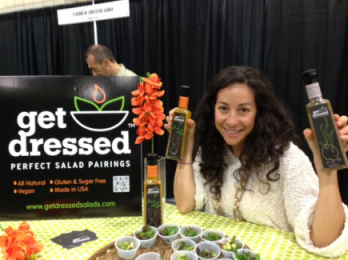
Stories of the sacrifice and determination that go into creating a successful food product abound. Vanessa Miller of New York City was a primary school teacher when she decided to bottle her delectable salad dressings. She created a company name, Get Dressed Salads, and though she knew how to obtain the bottles, design a label, and find a production factory, she was short on cash. Miller got help from the fund raising website www.Indiegogo.com but still had to put up all the money she had as well as sell some of her own jewelry before she had enough to get her project off the ground. Her dressings are now available at about six local gourmet shops and online at www.abesmarket.com. This was Miller’s first Fancy Food Show and the www.express.com website identified her dressings as one of “eight brands worth a bite” at the show.
Vanessa Miller of Get Dressed Salads – Photo Credit Cary Pollak
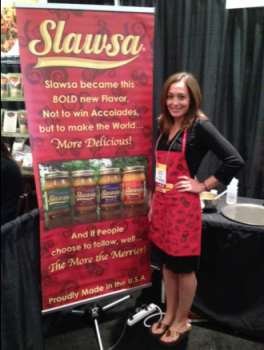
Another newcomer to this year’s show was former marketing specialist, Julie Busha, whose Slawsa is a new kind of relish that works well on grilled meats or as a dip. Busha has foregone starting a family and buying a bigger home, pouring all her profits back into the company for marketing efforts. Each retail account she landed was as the result of a pitch personally made by Julie, who explained how she would market her brand to move it off the shelf. Within 18 months her product was selling at 4200 retail outlets.
Julie Busha of Slawsa – Photo Credit Cary Pollak
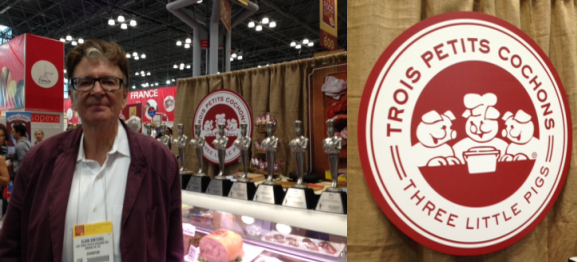
Owner/chef Alain Sinturel’s popular Trois Petits Cochons produces a line of all-natural paté and charcuterie. This charming if somewhat stoic gentleman lets the long row of sofi awards atop his display case speak for itself. The little porkers on the company logo, however, are all smiles. And why not? Business has been booming since the company started modestly in Greenwich Village in 1975. Last year they introduced a new line of pork-free products. Could that be another reason why the little fellows are smiling?
Alain Sinturel of Trois Petits Cochons – Photo Credit Cary Pollak
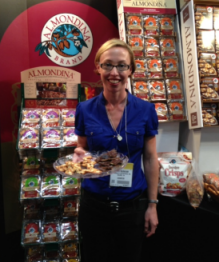
My favorite packaged cookie of all time, Almondina, is a former winner of the sofi for Outstanding Classic. These crunchy wafers studded with nuggets of almonds and raisins are uniquely delicious. Other products look somewhat like it, but none can deliver as amazing a taste as Almondina’s. Grandma Dina had baked these treats in her kitchen in Haifa, Israel. Grandson Yuval Zaliouk, a world famous former conductor of the London Royal Ballet, orchestrated a business plan and today its Ohio plant produces 200,000 cookies daily. Dina’s great-granddaughter, Tamar Markham, was proud to display her family’s product.
Tamar Markham of Almondina – Photo Credit Cary Pollak
Although the Fancy Food Shows are open only to the trade, if you have ever thought of starting a business that is any way related to gourmet foods, gaining access to this extravaganza is reason enough give it a try. It’s the greatest collection of sights and bites you’ll ever come across.
JULY 02, 2013 BY JORDAN WRIGHT Special to The Credits – MPAA
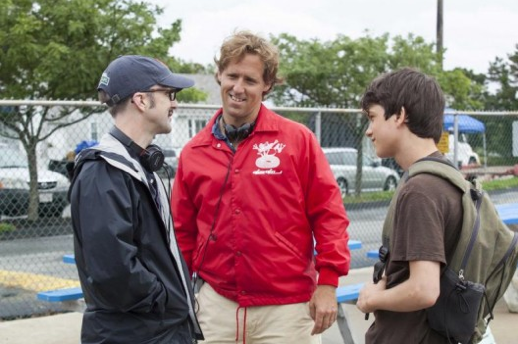
Filmmakers Jim Rash and Nat Faxon with Liam James on the set of THE WAY, WAY BACK – Courtesy Fox Searchlight
After winning an Oscar for their screenplay for The Descendants, the screenwriting duo of Nat Faxon and Jim Rash appeared to have burst onto the scene as a couple of unknowns. In reality the writing and directing team have been on Hollywood filmmakers’ short list since 2007, when their script for The Way, Way Back was being read and praised by insiders. The Credits sat down with the old friends and collaborators in advance of their already well reviewed coming-of-age comedy to find out about their process, their history, and what’s on tap next.
The Credits: Can you talk about how you two break down a script that you’re working on? What is your process?
Rash: It evolves. We break the stories down and do the treatments together, and then we get started based only on my wonderful neuroses. That’s to say there are times when Nat needs to send me to a coffee shop while he tends to his family so this single guy can sit and talk to himself. After that we get back together.
You both went to prep school. Was that experience helpful in writing a coming of age film?
Faxon: It was more about our memories of summertime and the people that influenced us when we spent our summers in Nantucket. I remember when I was first included in doing cool stuff with the older kids and being part of the gang. It was more about recollections.
Rash: I wasn’t popular like Nat probably was. I pulled more from pain—specifically in the first scene, which we used verbatim from an incident when my stepfather called me a three on a scale from one to ten. We just have a fondness for rites of passage, the moment when something shifted for us. We bond with that protagonist.
What was the lifecycle of this script? It’s been kicking around getting good buzz for a while.
Faxon: This script was sitting around for a while. It was written back in 2005 before The Descendants. And it had gotten on The Black List. It did open a lot of doors for us, and we got some great meetings, one of which was with Alexander Payne’s production company that has the rights to The Descendants. Even still, making a movie in Hollywood is always a challenge no matter what level you’re at, and this was no exception. We had to find financing and casting to put all the pieces together. It was a struggle all the way through.
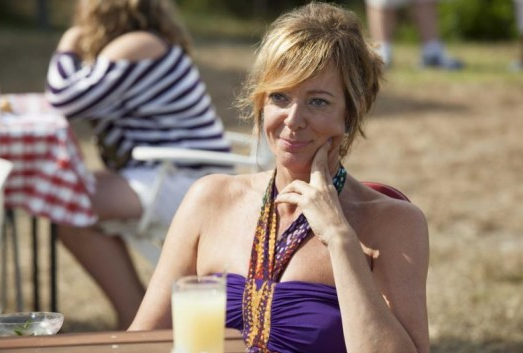
Allison Janney as “Betty” in ‘The Way, Way Back.’ Courtesy Fox Searchlight
Who was the first talent you got on board?
Rash:Allison Janney. We knew her through different circles and had written the part pretty much with her in mind. So we started with her and it really was a building pattern from there. The last piece was Steve Carrell.
How did your journey into becoming filmmakers begin?
Rash: We met at The Groundlings Theatre in late 1998 when we became part of The Sunday Company, which is the farm team that feeds the main company. Eventually we both got to The Groundlings and we were there for about 11 or 12 years. That’s where we became friends and started writing television together. We’re both actors and we’re still acting.
Faxon: For me I had a lot of characters in my family that I used to imitate and make fun of at the dinner table and get some good laughs. Later I did school plays. I knew early on that I wanted to get into the entertainment industry. After college I moved to LA and got involved in The Groundlings and in acting and sketch comedy, and did commercials. Slowly I got TV jobs. I didn’t know anybody out there. It’s hard. Nobody tells you how to play the game.
Rash: I was consuming some dysfunction and pain and then utilizing it later. It started clicking then. I took screenwriting classes and worked for the student TV channel. I did some theatre and then went to LA.
As writers, what are your favorite books? Do you gravitate to any particular author?
Faxon: I am rereading “A Prayer for Owen Meany” and “The Curious Incident of the Dog in the Night-time.” Also Jonathan Tropper’s “This is Where I Leave You.”
Rash: “A Separate Peace” and, of course, “The Catcher in the Rye.” At Lawrenceville I liked Southern literature, although I really struggled through Faulkner’s “Absalom, Absalom.”
Faxon: I loved Russian literature early on. I found the stories and the writing to be fascinating. Coming from the East Coast I like Nathaniel Philbrick stories and survival tales. Right now I’m reading [Jennifer Egan’s] “A Visit From the Goon Squad,” which is a collection of stories in which the characters are interwoven. For comic writers I like David Sedaris and Bill Bryson and the twisted characters of Carl Hiaasen.
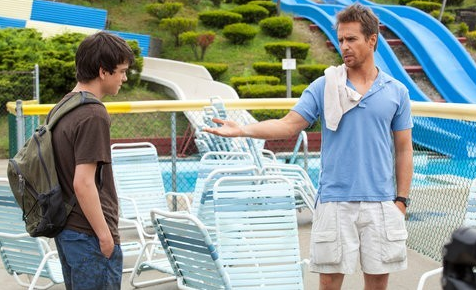
Liam James as “Duncan” and Sam Rockwell as “Owen” on the set of ‘The Way, Way Back’ Photo by Claire Folger, courtesy of Fox Searchlight Pictures
How was the filming process on The Way, Way Back?
Rash: We pretty much got hit with a lot of rain when we started. The house stuff was shot outside of Marshfield, MA in Green Harbor, and the water park was in East Wareham, MA. The town was very supportive and very helpful during the whole shoot. One night, during a very climactic scene we were shooting in someone’s backyard, most of the town came out to watch from their mini cocktail parties. There was this sort of theatre-in-the-round thing going on and the actors really enjoyed it.
Faxon: Certainly we had challenges at the water park since we shot in the evening. There were a lot of hot days and all we wanted to do was go down the slide. One night the folks at Water Wizz, a family owned place, opened the park for us and it was so much fun.
What’s next?
Rash: We’re writing another movie with Fox Searchlight, a sort of dysfunctional tap-into-some-pain type story, and then we’re writing an action comedy for Kristin Wiig, who is a friend of ours from The Groundlings. It’s a little grittier and little darker.
Featured image: Filmmakers Jim Rash and Nat Faxon with Liam James on the set of The Way, Way Back
It’s 2013 at Arena Stage or is it? The house is exploding and a tripped out light show has begun. Eight slim-hipped long-haired musicians – a three-man horn section, a crack drummer, bluesy keyboardist and three flaming hot guitarists – are cranking out the wailing sounds of blues and heart-stopping, mind-altering rock n’ roll. The audience, lit up by white-hot strobes and pulsing psychedelia, is in their seats – but barely. They are nodding in sync to the earth-shaking beat in their button-down shirts and summer dresses, remembering their lives before kids and jobs, paychecks and mortgages. It’s the ‘60’s all over again. A time of peace signs, free love and magic mushrooms. A time when you might have been lucky enough to catch Janis Joplin performing in 1968 at the city’s former roller rink known as the Alexandria Arena.
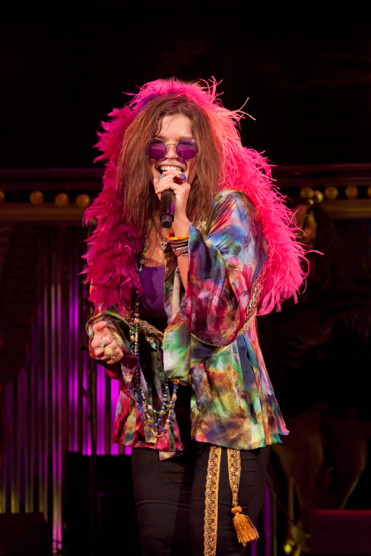
And then it happens. Janis Joplin, the tiny Texas ball of fire, streaks down the catwalk and onto the stage. It’s her! It’s just like her! No, it’s Mary Bridget Davies, and she’s totally channeling Janis. The scratchy voice, the stuttering syllables, the “yeah, man” and “far out” and hoarse cackle she punctuated her lyrics with. Davies has Janis down pat – down to her round rose-colored shades and salty language, down to her bending forward in search of a single note and delivering a primal sound, a cry, and twisting it in a new way, rearing backwards to let it out with a howl. So like Janis with arms outstretched in supplication, then punching the air fighting for her place in a straight world – drawing us in while telling us we’ve failed her. We know the desolation of her soul, her lost loves, her emotional release. And Davies does too.
Mary Bridget Davies as Janis Joplin Photo by Jim Cox.
It was all about the blues for Janis, “It’s the want of something that gives you the blues,” she once said. She latched onto it as a kid in middle-class Port Arthur singing folk songs at Threadgill’s, a local honky-tonk near Austin, where she met a two-bit manager and ran off to San Francisco to front for the acid-rock band Big Brother and the Holding Company just before the “Summer of Love”.
But it was her love affair with the music of Bessie Smith, “She showed me the air and she taught me how to fill it,” that lingered. Later it was Odetta, who inspired Janis’ rendition of “Down on Me” and Nina Simone whose haunting version of “Summertime” was covered by Janis. Even Aretha Franklin and Motown’s The Chantels were her muses paving the way for her to invent her own sound.
Sabrina Elayne Carten sings these early blues and gospel influences with an astonishing vocal range that is heart-stoppingly soulful with a spectacular and nuanced portrayal of Bessie, Aretha and Odetta. Carten’s voice on “Spirit in the Dark” an early Aretha-written song, Nina’s “Summertime”, and Bessie’s “Nobody Knows You When You’re Down and Out” is as expressive as it is powerful, harkening back to the singers’ early renditions.
In One Night With Janis playwright and director Randy Johnson lets Janis share her musical story from art school dropout to the feathered spangled rock star we came to know as ‘Pearl’. And ultimately it’s Davies ripping up the stage with Janis’ greatest hits, putting another little piece of her heart out there in “Me and Bobby McGee”, “Try (Just a Little Bit Harder)”, “Cry Baby” and “Down On Me”, that grabs you by the throat – those and twenty other jammin’ Janis numbers performed by a killer rock band and three-girl backup that translate into the grooviest night of music and memories from the “Queen of Rock and Roll”. It’s like so far out, man.
Through August 11th at Arena Stage, 1101 Sixth St., SW, Washington, DC 20024. For tickets and information call 202 484-0247 or visit www.ArenaStage.org.