It is with heavy heart that I divulge to my dear readers one of my secret pleasures – because not to share my latest adventures is anathema to my nature. But first I’ll tell of my history with a place that has been dear to my heart for many years.
Fifteen years ago I discovered one of the nation’s most under-the-radar destinations. A secluded destination that has more in common with Britain’s “Treasure Houses” than a Virginia gentleman’s farm, although that is what it once was. It began innocently enough on a Saturday morning in the beautiful foothills of the Piedmont region where we had gone to meet friends at the steeplechase races. After driving about an hour from Washington we turned off the highway onto a country lane past a series of stone columns fitted with iron gates. A large rock waterfall beside the road appeared as if out of nowhere. Meadows resplendent with wildflowers and a small airstrip came into view. The winding road led us high up to a racetrack that coursed over hill and dale and around several ponds. We spent a glorious day wondering where indeed we were.
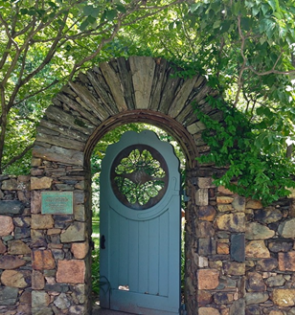
The moon gate at Airlie – photo credit Jordan Wright
Fast forward to the following year and we are watching sheep trials on the same wondrous property. We take luncheon in the manor, tour the formal gardens, watch collies work the sheep, and stroll the grounds circling around quiet ponds bordered with more houses, cottages, swimming pools and a small pub. Herons and geese abound, frogs and crickets whir in concert and fish leap out of the water breaking the silence. We are at Airlie House.
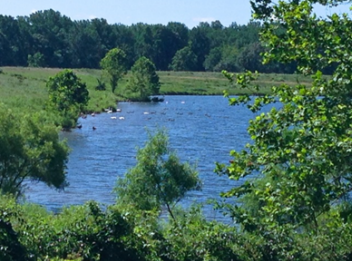
Trumpeter Swans swim alongside Canada Geese on one of Airlie’s nine ponds – photo credit Jordan Wright
On our next visit we were guests at a lawn party at one of the homes on the property where the landowner’s son, a young doctor and musician, lived in bohemian splendor amidst mansions and stables and wild raspberries.
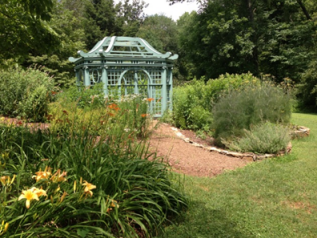
The Roger Tory Peterson Butterfly Garden dedicated to Airlie by his wife Virginia Peterson – photo credit Jordan Wright
Soon after we learned of the Airlie Environmental Studies Center and its Director Dr. Bill Sladen whose swan migration program trained Trumpeter Swans, bred on the property, to follow an ultralight plane. And so, we returned for a swan conference, an international ornithological event that occurs somewhere in the world every ten years. For the first time we spent a night in one of the lovely cottages before taking off to a secret location near the Chesapeake Bay where we banded swans while cradling them in our arms. The bus then took us further south to the Great Dismal Swamp on a 32-hour expedition shared with thirty-five ornithologists speaking seventeen languages.
Poolside at Airlie – photo credit Jordan Wright
Last weekend I returned for a stay at Airlie House for the full-on guest experience. The 1200-acre conference center, once known only to high-level government officials, corporate CEOs and those whose business is conducted free from prying eyes, has now flung open the doors and grounds of this historic property to overnight guests, offering weekend packages, winemaker’s dinners in the field and a new partnership with the Castleton Festival. No longer is it the exclusive purview of conference attendees. At last anyone can experience its once-hidden glories.
Airlie House Executive Chef Jeff Witte at the entrance to the kitchen gardens – photo credit Jordan Wright
As the summer sun climbed high overhead I met with Airlie’s Executive Chef Jeff Witte, a Los Angeles native and graduate of Le Cordon Bleu, who guided me through the sustainable gardens, a passive solar hoop house and raised beds bursting at the seams with herbs, vegetables and flowers. Bee hives, the wellspring of Airlie’s honey, dot one side of the fenced-in plots, while climbing hops twine around poles in the biergarten.
The Center’s kitchen benefits from 4,500 pounds of organic produce each year, some of which is shared with community food banks. “We source from over 30 local farms for our meats, cheeses and fruits, buying everything as locally as we can. We’re totally committed to our relationships with the community’s farmers,” explains Witte whose upscale regional cuisine strikes an elegant chord with diners.
A trio of palate cleansers – Alaskan halibut with Airlie garden vegetables – Garden figs with goat cheese ice cream, shortbread cookies and caramel sauce – photo credit Jordan Wright
Kae Yowell, Head Gardener for the Local Food Project at Airlie, who grew up on a dairy farm where her grandparents grew and canned their own vegetables, enjoys teaching others about the pleasures of the garden. “Throughout the year we have a series of lectures on gardening, seed saving and beekeeping. We just had one on making fruit jams and jellies from our strawberry patch.
The summer garden at Airlie – Flowers grow side by side with herbs and vegetables at the Local Food Project – photo credit Jordan Wright
This weekend guests can join in the annual Butterfly Count and by the looks of it there will be plenty of monarchs and swallowtails flitting about the gardens and the surrounding wildflower meadows. For more information on Airlie Center and its weekend packages with tickets to Castleton visit www.Airlie.com.
Butterfly weed in the meadows of Airlie – photo credit Jordan Wright
Castleton
The fields of Castleton – photo credit Jordan Wright
Entering its fifth anniversary season with Maestro Lorin Maazel, Castleton’s founder and world-renowned former conductor of the New York Philharmonic and guest conductor of many of Europe’s finest orchestras, the festival plays host to international opera and musician superstars, as well as up and coming orchestral virtuoso artists. Situated on a 550-acre farm the Theatre House and its concert venue feature weekend programs of classical music concerts played by a full orchestra, chamber music performances, cabarets, and operas by composers from Puccini to Verdi to Andrew Lloyd Webber.
Maazel’s wife, Dietlinde Turban Maazel, is the festival’s co-founder and Associate Artistic Director. As a stage and screen actress she is singularly qualified to train the young artists that come from around the world to Castleton’s doors for the summer Artists Training Seminars and workshops in the performing arts. Another famous faculty member is American mezzo-soprano, Denyce Graves, veteran of the Metropolitan Opera and native Washingtonian.
Westward ho for Castleton Festival’s “The Girl of the Golden West”
Last Saturday the Castleton Festival staged a spectacular performance of Puccini’s “The Girl of the Golden West” and organizers had put an exclamation point on the theme with a cowboy galloping around the hills on a black and white Paint and a Conestoga wagon pulled by two perfectly matched draft horses at the entrance to the concert hall. It was a glamorous night for attendees and benefactors who basked in the glow of a glittering opening night. For tickets and information on the Festival’s upcoming performances through July 28th visit www.castletonfestival.org
JULY 02, 2013 BY JORDAN WRIGHT Special to The Credits – MPAA
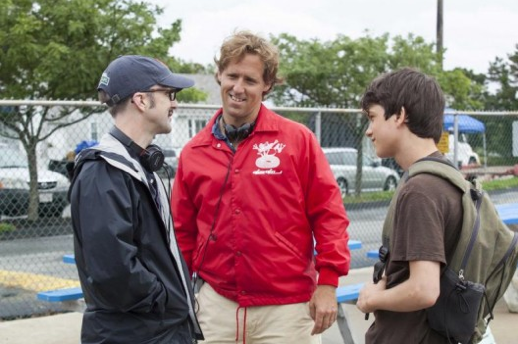
Filmmakers Jim Rash and Nat Faxon with Liam James on the set of THE WAY, WAY BACK – Courtesy Fox Searchlight
After winning an Oscar for their screenplay for The Descendants, the screenwriting duo of Nat Faxon and Jim Rash appeared to have burst onto the scene as a couple of unknowns. In reality the writing and directing team have been on Hollywood filmmakers’ short list since 2007, when their script for The Way, Way Back was being read and praised by insiders. The Credits sat down with the old friends and collaborators in advance of their already well reviewed coming-of-age comedy to find out about their process, their history, and what’s on tap next.
The Credits: Can you talk about how you two break down a script that you’re working on? What is your process?
Rash: It evolves. We break the stories down and do the treatments together, and then we get started based only on my wonderful neuroses. That’s to say there are times when Nat needs to send me to a coffee shop while he tends to his family so this single guy can sit and talk to himself. After that we get back together.
You both went to prep school. Was that experience helpful in writing a coming of age film?
Faxon: It was more about our memories of summertime and the people that influenced us when we spent our summers in Nantucket. I remember when I was first included in doing cool stuff with the older kids and being part of the gang. It was more about recollections.
Rash: I wasn’t popular like Nat probably was. I pulled more from pain—specifically in the first scene, which we used verbatim from an incident when my stepfather called me a three on a scale from one to ten. We just have a fondness for rites of passage, the moment when something shifted for us. We bond with that protagonist.
What was the lifecycle of this script? It’s been kicking around getting good buzz for a while.
Faxon: This script was sitting around for a while. It was written back in 2005 before The Descendants. And it had gotten on The Black List. It did open a lot of doors for us, and we got some great meetings, one of which was with Alexander Payne’s production company that has the rights to The Descendants. Even still, making a movie in Hollywood is always a challenge no matter what level you’re at, and this was no exception. We had to find financing and casting to put all the pieces together. It was a struggle all the way through.
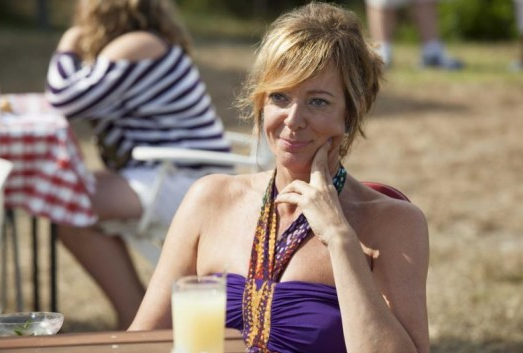
Allison Janney as “Betty” in ‘The Way, Way Back.’ Courtesy Fox Searchlight
Who was the first talent you got on board?
Rash:Allison Janney. We knew her through different circles and had written the part pretty much with her in mind. So we started with her and it really was a building pattern from there. The last piece was Steve Carrell.
How did your journey into becoming filmmakers begin?
Rash: We met at The Groundlings Theatre in late 1998 when we became part of The Sunday Company, which is the farm team that feeds the main company. Eventually we both got to The Groundlings and we were there for about 11 or 12 years. That’s where we became friends and started writing television together. We’re both actors and we’re still acting.
Faxon: For me I had a lot of characters in my family that I used to imitate and make fun of at the dinner table and get some good laughs. Later I did school plays. I knew early on that I wanted to get into the entertainment industry. After college I moved to LA and got involved in The Groundlings and in acting and sketch comedy, and did commercials. Slowly I got TV jobs. I didn’t know anybody out there. It’s hard. Nobody tells you how to play the game.
Rash: I was consuming some dysfunction and pain and then utilizing it later. It started clicking then. I took screenwriting classes and worked for the student TV channel. I did some theatre and then went to LA.
As writers, what are your favorite books? Do you gravitate to any particular author?
Faxon: I am rereading “A Prayer for Owen Meany” and “The Curious Incident of the Dog in the Night-time.” Also Jonathan Tropper’s “This is Where I Leave You.”
Rash: “A Separate Peace” and, of course, “The Catcher in the Rye.” At Lawrenceville I liked Southern literature, although I really struggled through Faulkner’s “Absalom, Absalom.”
Faxon: I loved Russian literature early on. I found the stories and the writing to be fascinating. Coming from the East Coast I like Nathaniel Philbrick stories and survival tales. Right now I’m reading [Jennifer Egan’s] “A Visit From the Goon Squad,” which is a collection of stories in which the characters are interwoven. For comic writers I like David Sedaris and Bill Bryson and the twisted characters of Carl Hiaasen.
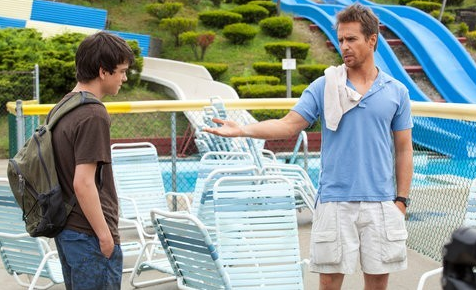
Liam James as “Duncan” and Sam Rockwell as “Owen” on the set of ‘The Way, Way Back’ Photo by Claire Folger, courtesy of Fox Searchlight Pictures
How was the filming process on The Way, Way Back?
Rash: We pretty much got hit with a lot of rain when we started. The house stuff was shot outside of Marshfield, MA in Green Harbor, and the water park was in East Wareham, MA. The town was very supportive and very helpful during the whole shoot. One night, during a very climactic scene we were shooting in someone’s backyard, most of the town came out to watch from their mini cocktail parties. There was this sort of theatre-in-the-round thing going on and the actors really enjoyed it.
Faxon: Certainly we had challenges at the water park since we shot in the evening. There were a lot of hot days and all we wanted to do was go down the slide. One night the folks at Water Wizz, a family owned place, opened the park for us and it was so much fun.
What’s next?
Rash: We’re writing another movie with Fox Searchlight, a sort of dysfunctional tap-into-some-pain type story, and then we’re writing an action comedy for Kristin Wiig, who is a friend of ours from The Groundlings. It’s a little grittier and little darker.
Featured image: Filmmakers Jim Rash and Nat Faxon with Liam James on the set of The Way, Way Back
It’s 2013 at Arena Stage or is it? The house is exploding and a tripped out light show has begun. Eight slim-hipped long-haired musicians – a three-man horn section, a crack drummer, bluesy keyboardist and three flaming hot guitarists – are cranking out the wailing sounds of blues and heart-stopping, mind-altering rock n’ roll. The audience, lit up by white-hot strobes and pulsing psychedelia, is in their seats – but barely. They are nodding in sync to the earth-shaking beat in their button-down shirts and summer dresses, remembering their lives before kids and jobs, paychecks and mortgages. It’s the ‘60’s all over again. A time of peace signs, free love and magic mushrooms. A time when you might have been lucky enough to catch Janis Joplin performing in 1968 at the city’s former roller rink known as the Alexandria Arena.
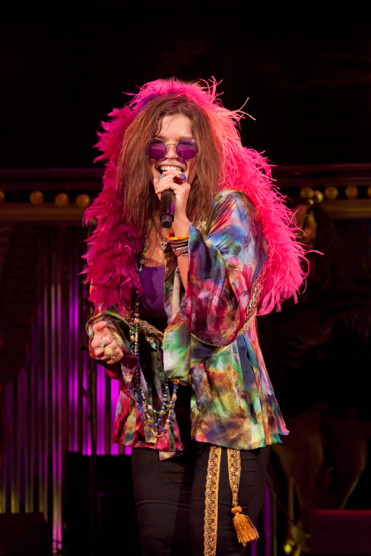
And then it happens. Janis Joplin, the tiny Texas ball of fire, streaks down the catwalk and onto the stage. It’s her! It’s just like her! No, it’s Mary Bridget Davies, and she’s totally channeling Janis. The scratchy voice, the stuttering syllables, the “yeah, man” and “far out” and hoarse cackle she punctuated her lyrics with. Davies has Janis down pat – down to her round rose-colored shades and salty language, down to her bending forward in search of a single note and delivering a primal sound, a cry, and twisting it in a new way, rearing backwards to let it out with a howl. So like Janis with arms outstretched in supplication, then punching the air fighting for her place in a straight world – drawing us in while telling us we’ve failed her. We know the desolation of her soul, her lost loves, her emotional release. And Davies does too.
Mary Bridget Davies as Janis Joplin Photo by Jim Cox.
It was all about the blues for Janis, “It’s the want of something that gives you the blues,” she once said. She latched onto it as a kid in middle-class Port Arthur singing folk songs at Threadgill’s, a local honky-tonk near Austin, where she met a two-bit manager and ran off to San Francisco to front for the acid-rock band Big Brother and the Holding Company just before the “Summer of Love”.
But it was her love affair with the music of Bessie Smith, “She showed me the air and she taught me how to fill it,” that lingered. Later it was Odetta, who inspired Janis’ rendition of “Down on Me” and Nina Simone whose haunting version of “Summertime” was covered by Janis. Even Aretha Franklin and Motown’s The Chantels were her muses paving the way for her to invent her own sound.
Sabrina Elayne Carten sings these early blues and gospel influences with an astonishing vocal range that is heart-stoppingly soulful with a spectacular and nuanced portrayal of Bessie, Aretha and Odetta. Carten’s voice on “Spirit in the Dark” an early Aretha-written song, Nina’s “Summertime”, and Bessie’s “Nobody Knows You When You’re Down and Out” is as expressive as it is powerful, harkening back to the singers’ early renditions.
In One Night With Janis playwright and director Randy Johnson lets Janis share her musical story from art school dropout to the feathered spangled rock star we came to know as ‘Pearl’. And ultimately it’s Davies ripping up the stage with Janis’ greatest hits, putting another little piece of her heart out there in “Me and Bobby McGee”, “Try (Just a Little Bit Harder)”, “Cry Baby” and “Down On Me”, that grabs you by the throat – those and twenty other jammin’ Janis numbers performed by a killer rock band and three-girl backup that translate into the grooviest night of music and memories from the “Queen of Rock and Roll”. It’s like so far out, man.
Through August 11th at Arena Stage, 1101 Sixth St., SW, Washington, DC 20024. For tickets and information call 202 484-0247 or visit www.ArenaStage.org.
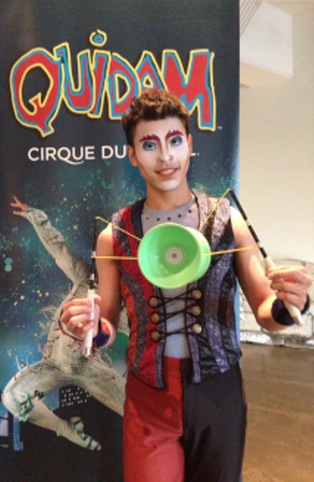
Quidam diabolo performer William Wei-Liang Lin – photo credit Jordan Wright
The critically acclaimed Cirque du Soleilis bringing Quidam to our area next month. The captivating extravaganza which has toured five continents and been seen by millions over its 17-year history, will be at the Patriot Center at George Mason University.
Last week at Georgetown’s newest restaurant and event venue Malmaison, I had a chance to chat with Jessica LeBoeuf and Cirque’s newest performer, William Wei-Liang Lin, the company’s 24 year-old diabolo act who hails from Taiwan.
LeBoeuf, Quidam’s publicist, described the complex logistics of moving the production from city to city via fifteen trucks loaded with the set, costumes and equipment to stage a show consisting of fifty-two world-class performers including singers, acrobats, musicians and characters from twenty different countries and staging it in an arena. “The show has been redesigned for an arena from the usual Big Top. But it’s the same show, just under a different roof. It’s theatre-style seating, which gives us five hundred to a thousand more seats, still with the sound of a live concert. We take about a third of the stage area, think of a hockey rink, for the backstage where there’s a gym, all the props, costumes and a place for the performers to warm up, plus the band pit and the garage. The stage comes out nearly to the front rows,” she explained.
“There are a lot of aerial acts in the show, though we don’t use a safety net or safety line. We use the téléférique, the French word for cable car. It’s an arch that comes halfway across the arena and stops above the audience and then there’s a cable car system on each of the five rails where we fly the performers in and out on their apparatus. It’s all sheer human power.”
For William Lin the journey to Cirque stardom has been as circuitous as it has been auspicious. As a schoolboy his aim was to study tae kwon do, but when the hoped-for class was filled he wound up studying ‘diabolo’, a technique evolved from the Chinese yo-yo that incorporates string and one or more axles that are spun and tossed.
Quidam by Cirque du Soliel
Eventually Lin developed tremendous expertise, winning first prize over all the acts at the Festival Mondial du Cirque de Demain in France, an international competition akin to the Oscars for the Circus Arts. Soon after he was discovered in England by Cirque’s scouts. Although he curtailed his university studies, he still needed to complete mandatory military service. Even so he had to wait a year until a spot opened up in the company this January. “Cirque du Soleil is my dream,” he beams. “My work is my diabolo. I love learning new tricks. Many of my ideas come from videos and movies. For me the possibilities are limitless.” Lin has become wildly popular back home in Taiwan where he is flooded with request for TV interviews.
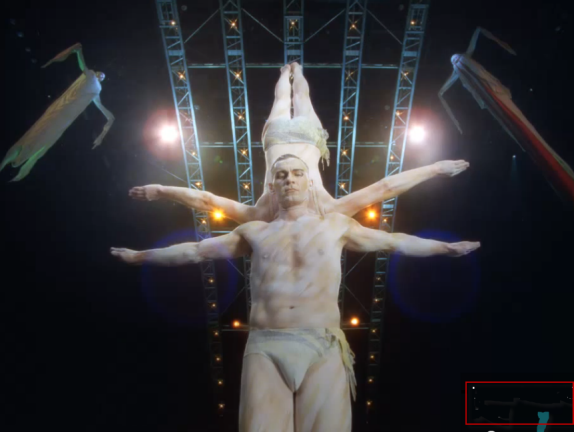
In a story of a young girl bored by the world and her apathetic parents, young Zoé seeks to fill the void of her existence with the imaginary world of Quidam, which offers characters that encourage her to free her soul. The show is notable for its poetic transitions and beautiful acrobatics that create an exhilarating sensory experience.
As LeBoeuf puts it, “The performers need to keep their bodies in good shape for eight shows a week while performing at the same level. They do Pilates, stretching, yoga, dance classes, conditioning and cross training. To keep them interested and involved local dance teachers are often invited in to do demonstrations. In Detroit we had a famous dancer come in that did hip hop. It was very cool for the foreign performers to learn hip hop. The contortionists said, “I don’t understand how you move!” It was pretty funny coming from them.”
Quidam will hold seven performances from July 17th through July 21st at the Patriot Center at George Mason University 4400 University Drive, Fairfax, VA 22030. For tickets and information visit www.CirqueduSoleil.com or call 703 993-3000.
JUNE 14, 2013 BY JORDAN WRIGHT Special to The Credits – MPAA
According to a 2007 British survey Hans Zimmer is considered “one of the world’s 100 living geniuses.” He shares space on the list with the likes of Stephen Hawking, Prince and Philip Glass. Zimmer’s own list of achievements includes an Academy Award, several Golden Globes, Grammys, Lifetime Achievement Awards, a star on the Hollywood Walk of Fame, and dozens of film credits that attest to his significant contribution to many of the industry’s finest films.
Zimmer’s scored a slew of classics. Driving Miss Daisy, Rain Man and The Lion King are a few of his famous past films, as well as more recent blockbusters like Pirates of the Caribbean, Madagascar, The Da Vinci Code, Sherlock Holmes, The Thin Red Line and Dark Knight. Today’s release of Man of Steelcontinues this living legend’s legacy of creating the mood and musical identity of some of our biggest films.
There may not be a single filmgoer who has not been touched by his music. The Credits spoke to him about his craft, his passions, and his hopes for Man of Steel.
Hans Zimmer – photo credit to his wife, Zoe Zimmer
The Credits: Can you talk about your approach to composing for Man of Steel? How did your sense of the script guide you?
Zimmer: Not one bit. I never read it. I told David Goyer [Man of Steel scriptwriter] forgive me for not reading it. For me there are two types of directors. There’s the writer/director and the director that works from somebody else’s script—and what’s important for me is figuring out what the director has in his head. So I said to Zack [Snyder, Man of Steel director] let’s sit down. Tell me the story. And while the telling is going on I find out what’s really in his heart—what the emphasis is for him. The weird part of the process is that as someone tells you the story you start to come up with sounds and music. So in my head I’m scoring Zack telling me a story. That helps with starting. But also I was somewhat overwhelmed by the enormity of the task. Because I was working on Dark Knight Rises at the same time and I didn’t think I was quite up for it. The master, John Williams, had done rather well by it, and it was part of my growing up and DNA loving John Williams’ score. The inevitable comparisons are out there, but I couldn’t care less about what anybody says. Find me a composer who isn’t driven by paranoia and neurosis.
I don’t ever remember seeing a film that had a musical score throughout most every scene. It must have been quite a task to create such an enormous score. What was the reasoning behind that decision?
It’s because the score is fairly new. It goes from me playing a little upright piano to these rather grand gestures that you’d expect. In an odd way, though it’s a Superman movie, there’s an absolute inherent reality in this film, because America really is America, and America is real. So it felt like it would be nice to create this “through line” from the word go to the end. When we get to the second half it gets pretty intense, but we tried to use music to create beautiful silences as well. For example, when Krypton blows up, and I don’t think I’m giving anything away here, the tendency would be to go hugely bombastic and throw everything at it–but it’s just one single solo violin.
Can you talk about the musical transitions in the film when you segue from battles to farm scenes? Do you look at the film and it comes to you or is it a separate process?
Transitions are tricky because we change tones so dramatically, and you just hope that you’re replacing very kinetic energy with emotional energy, because I did try to make the farm scenes tiny and emotionally poignant. Part of the disadvantage I have in this interview is I haven’t seen the movie with an audience. All I know is that I spent many months loving the process and that’s truly the whole thing. I love writing music and sitting with my friends and colleagues and the musicians and the director and we’re building something and hoping people will love it as much as we love the process. But by the end of it you have no idea if you’ve succeeded or not. You just try your best.
How hard was it to make this music different when everyone already knows the music from the Christopher Reeves’ movies and John Williams’ score?
It really comes from the filmmakers having a very different take on how we can tell the story. I remember when we were doing Gladiator with Ridley Scott and he was speaking about when he first saw Spartacus and how it resonated with him and how those movies should sound. And I kept saying to him but that’s my job, that the next bunch of fourteen-year olds should have their own music.
And that’s what Chris [Producer, Christopher Nolan] wanted me to do…to find my own language. If Zack had sat down with John Williams and told him the story the way he told it to me, John would have written a very different score from the one he wrote [for the earlier film], because it’s a very different movie. Ultimately I write from a very personal perspective. I have to find my own personal bits. Being a stranger in a strange land, being a foreigner in a culture that is not necessarily your own culture, and forever being torn between the two cultures, I think is interesting. And so for me as a foreigner I think there’s a chance to hold up a mirror to America and to let it see the things it’s become a little bored with. The things it takes for granted.
What do you mean by ‘the things America takes for granted’?
I remember when we were in the Grand Canyon shooting Thelma and Louise and we were saying, “Wow! It’s the Grand Canyon!” and there were these kids standing there saying, “Dad, Can we go home? It’s just the Grand Canyon.” So as a foreigner that used to look at America with wonderment, I just want to give that back to America. To say, “Look at your towns. Look at your people. See what’s good and decent and noble.” I have no idea if I’ve succeeded. At the end of the day it comes down to two questions; were you entertained or did it make you feel something? That’s all you can hope for. That somewhere in one little corner of this vast movie you got to feel something and you were in this world.
It’s one of the reasons I didn’t want to use the old Superman theme. Because suddenly you would have recognized it and thought, this is the old Superman, and then you would have been aware you were watching a movie. I was terrified of parody in any sense, even unwitting parody. Part of my very simple plan was to exorcise anything out of my orchestra, like the main instruments that I remember John Williams using, like the trumpet fanfare. I didn’t use any of that. By narrowing my palate I felt I was doing something different.
Do you compose electronically, on a piano or on another conventional instrument?
Nothing conventional! I had two weeks of piano lessons. That’s my formal education. I write the stuff in my head and then I use a computer with a music word processor. After all, I am a child of the twentieth century and whatever works is how I get there.
Have you ever had your music pirated?
Yes, of course my music gets pirated all the time! The thing that worries me the most, from a film composer’s point of view, is that the more things get pirated, the less value they have. And the flip side of this is there are all kinds of horrible and nasty things you can say about Hollywood. But you should always remember that Hollywood is the last place on earth that commissions orchestral music on a daily, if not hourly, basis. It gives children a reason to have a passion to learn an instrument and actually make a living at it. So every time one of those very expensive film scores gets pirated what you are doing is directly affecting if we’re going to have, or not have, orchestras left in this world. If we lose orchestras, it’s going to rob us of more than just a bit of culture. There’s a lot of heart that’s going to go missing.
In Mozart’s time he had to make sure he could get his score published the following day because during the premiere there would be people in the audience scribbling along and pirating it the next day. Pirating has been going on forever.
Featured image: Henry Cavill and Amy Adams in Man of Steel. Courtesy Warner Bros. Pictures
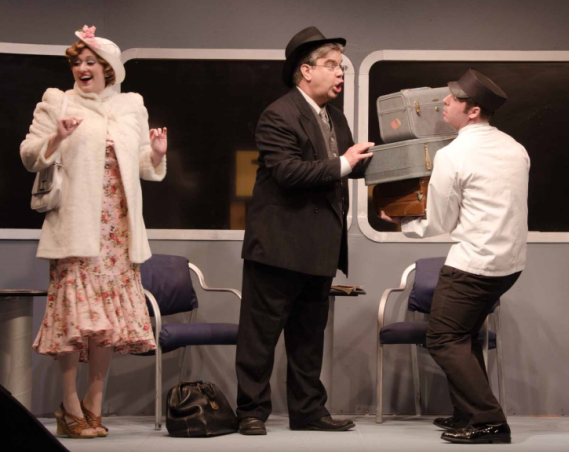
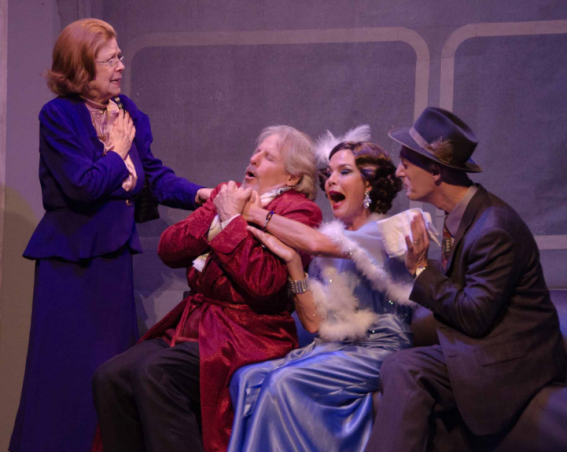
Heather Norcross (Anita Highland), Michael Gerwin (Dr. Grover Lockwood), and Ben Norcross (Porter) – Photo Doug Olmsted
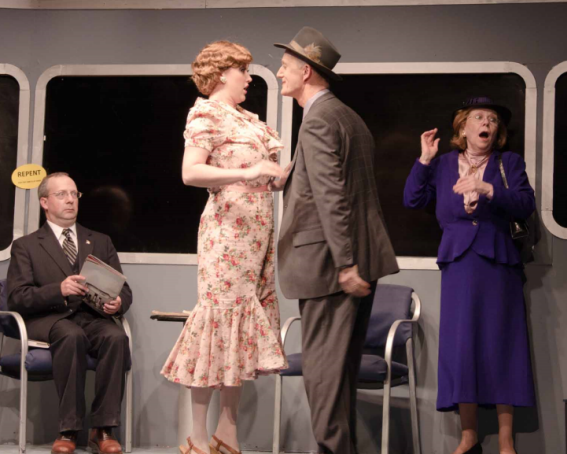
There’s nothing like the sound of a collective gasp from the audience as when the curtain draws back to reveal a dazzling stage set. Co-Set Designers, John Downing and Bill Glikbarg, achieved this stunner after months of pouring over historic photographs of the 20th Century Limited, dubbed the “Most Famous Train in the World”. Their construction consists of three railroad cars decorated with Art Deco period furnishings in cool pearl gray tones that move on hidden pulleys as the action shifts wildly from private berths to a sitting car. Scrims inserted into the back windows of the cars allow the audience to catch sight of the passengers as they race back and forth in pursuit of each other – be it out of greed, lust or retribution.
For Roland Branford Gomez directing Ken Ludwig’s adaptation of 20th Century was a trip down memory lane. Not only had he ridden on the iconic train as a former child actor, but he had met and befriended a fellow dance studio student he had come to care for. Mary was the daughter of one of the play’s authors, Charles MacArthur and his lovely wife Helen Hayes, the “First Lady of the American Theatre”. Both parents frequently took the children to matinees in New York and so for Gomez it was a dream come full circle to direct this play for his adored playmate who died at the age of nineteen.
Kathy Fannon (Ida Webb), David James (Oscar Jaffe), Margaret Bush (Lily Garland), and James McDaniel (Owen O’Malley) – Photo Doug Olmsted
Meet Oscar Jaffe, a producer with three recent flops, buckets of bombast and a burning desire to get back in the game. Lily Garland is his muse – a glamorous actress flush off an Academy Award and eager to return to the stage. Along with their respective press agents, a cheating husband and his paramour, and an escaped mental patient they are all on the train to New York City. In between stations they serve up plenty of comedy, farce and whodunit in this delightful comic stew. And for that we should all be grateful.
David James plays failed producer, Oscar Jaffe, the self-described “Wizard of Broadway”, to the hilt in a flamboyance of zany, physical comedy that often out-emotes the rest of the cast. Margaret Bush as Jaffe’s former lover Lily, delivers in fine fashion, but as with the other terrific cast members she is often overshadowed by James.
Gary Cramer (Matthew Clark), Heather Norcross (Anita Highland), James McDaniel (Owen O’Malley), and Kathy Fannon (Ida Webb) – Photo Doug Olmsted
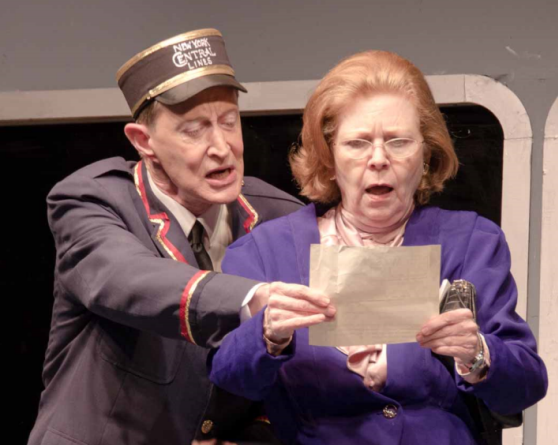
Heather Norcross as the coy sex kitten Anita Highland and Michael Gerwin as the adulterous doctor Dr. Grover Lockwood, make the most of their small roles, as does Kathy Fannon as Ida Webb, Jaffe’s assistant. And Gary Cramer does high anxiety to a T as the bible-thumping neurotic pill saleman Matthew Clark who convinces Jaffe he will underwrite his new play. I couldn’t get enough of their quirky well-crafted characters.
The second act picks up nicely when Max Jacobs, Jaffe’s rival for Lily, shows up on the train to thwart Jaffe and offer her a contract. That’s when Bob Cohen strides onstage and nearly steals the show with his portrait of the big time New York producer with a heart of steel.
Cal Whitehurst (Conductor) and Kathy Fannon (Ida Webb) – Photo Doug Olmsted
Sound Designer David Correia does a bang up job of recreating the glorious rumble and screech of a train streaking down the tracks. But, like a train that slows when it pulls into the station and speeds up to its next destination, this production has its fits and starts, moments of brilliance, and periods of static, still with plenty of high jinks and snappy repartee to go around.
Through June 29th at The Little Theatre of Alexandria, 600 Wolfe Street. For tickets and information call the box office at 703 683-0496 or visit www.thelittletheatre.com