Jordan Wright
June 3, 2013
Special to The Alexandria Times
 The cast of “Company” turns Manhattan into a dance floor as they sing “Side By Side By Side.”
Photo: Scott Suchman. When the cast of Signature Theatre’s Company struts onstage in the musical’s first number, the thing to keep in mind is that three of the four onstage couples, Sherri L. Edelen as Joanne and Thomas Adrian Simpson as Larry; Tracy Lynn Olivera as Sarah and Evan Casey as Harry; Erin Driscoll as Jenny and James Gardiner as David are in fact real-life married couples. Only Erin Weaver as Amy and Paul Scanlan as Paul are not. Got that? Knowing that underlying dynamic makes it all the more compelling to watch their interactions with each other. Set in 1970’s Manhattan to the dawning of the sexual revolution, the reimagining of the meaning of marriage, and the requisite neuroses of the typical New Yorker, the musical is reminiscent of a Woody Allen movie set to music – fabulous, iconic, Stephen Sondheim music.
Perennial bachelor, Bobby, is a cad and a charmer, the type of guy who won’t commit to any girl. But his married friends adore him. He remembers their birthdays and brings them flowers when they are sick. They reveal their innermost selves to him and he stays as neutral as Switzerland. Light and breezy Bobby, the perennial observer, who stands on the sidelines and watches as the couples bicker or praise, need one another, yet feel trapped. Marriage. It’s complicated. And for middle-aged Bobby, bed hopping is far less messy.
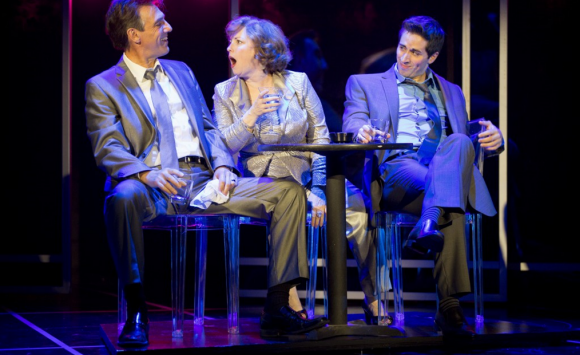 Joanne (Sherri L. Edelen; center) gets fired up to sing “The Ladies Who Lunch” while out on the town with Larry (Thomas Adrian Simpson; left)
and Bobby (Matthew Scott; right). Photo: Scott Suchman. When he queries the husbands about their marital satisfaction they explain the dichotomy of their lives with ” Sorry-Grateful”, a song that attempts to clarify both the loneliness and the comfort of marriage. Given such conflicting advice Bobby hunkers down in his bachelor foxhole examining the paradoxes of modern relationships. The wives sing about Bobby’s loneliness and trash his choice of women in “Poor Baby”, synching up with their husbands in the tune, “Have I Got a Girl For You”.
For more than four decades the music from Company has been sung in every city and cabaret from here to Timbuktu. Memorable showstoppers like “The Ladies Who Lunch”, “Another Hundred People”, “Barcelona”, “Side By Side”, “Marry Me a Little” (a later addition) and “Getting Married Today” have become beloved classics.
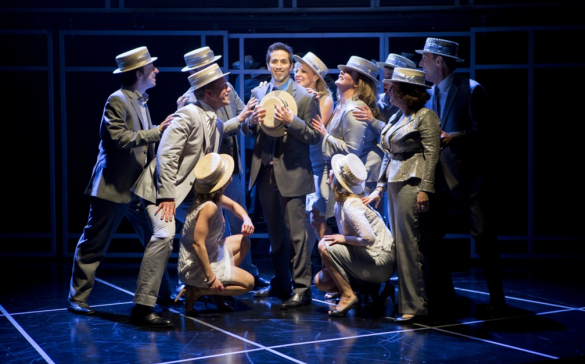 The cast of “Company” serenades Bobby (Matthew Scott; center) as they sing “Side By Side By Side.”
Photo: Scott Suchman. Matthew Scott as Bobby is outstanding throughout, especially if you like Seth Meyers of Saturday Night Live whom he could double for in adorableness. Notable too is the effervescent Erin Weaver recently off her starring roles in The Last Five Years and Xanadu, who tears off the roof with her rendition of “Getting Married Today”.
Choreographer Matt Gardiner keeps the cast on their toes with snappy slick dance routines and a karate scene between Sarah and Harry that is outright hilarious. (Oh, yes, there’s plenty of comedy amongst all that angst.) Scenic Designer Daniel Conway employs a sleek three-tier stage bracketed by a grand staircase, sliding doors, a lofty apartment terrace and hydraulically controlled mid-century modern furnishings.
Producer Eric Shaeffer has put together a strong cast of powerful singers to showcase Sondheim’s musical and in turn give us a terrific show.
Through June 30th 2013 at Signature Theatre (Shirlington Village), 4200 Campbell Avenue, Arlington, VA 22206. For tickets and information call 703 820-9771 or visit www.signature-theatre.org.
Jordan Wright
May 11, 2013
Special to The Alexandria Times
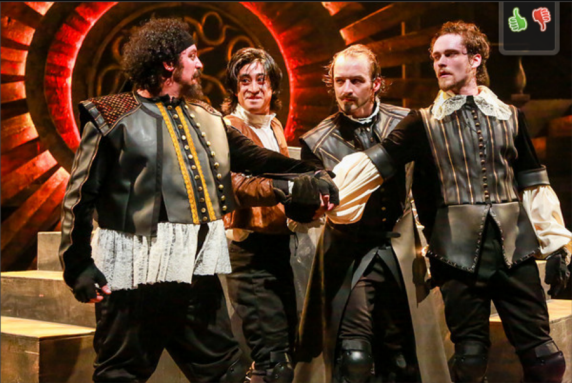 The Musketeers and D’Artagnan: Hector Reynoso as Porthos, Dallas Tolentino as D’Artagnan, Ben Cunis as Athos and Matthew Ward as Aramis. Photo credit Johnny Shryock “It is supposed to be the most difficult task for a dancer to leap into a definite posture in such a way that there is not a second when he is grasping after the posture, but by the leap itself he stands fixed in that posture. Perhaps no dancer can do it — that is what this knight does. The knights of infinity are dancers and possess elevation. They make the movements upward, and fall down again; and this too is no mean pastime, nor ungraceful to behold.” – Soren Kierkegaard
Synetic’s dancers excel in perceived weightlessness and aerialistic suspension and in this production of The Three Musketeers their talent is well utilized. Thankfully most of the play is good old-fashioned swashbuckling, fight-till-the-death duels and leaping tour-de-force dances performed with a viscerally physical athleticism for which the ensemble is best known. It’s the script that gets in the way of the action.
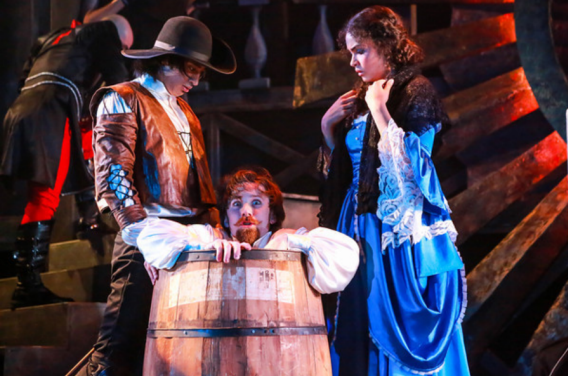 Dallas Tolentino as D’Artagnan, Mitchell Grant as the Duke of Buckingham and Brittany O’Grady as Constance. Photo credit – Johnny Shryock Playwright brothers Ben and Peter Cunis, seem to have conceived the play to serve as backdrop to the fight scenes using the speaking parts as a vehicle to hang the piece together until the next dramatic swordplay. And that’s a good thing since the dialogue is not nearly as riveting and the scene transitions are sometimes awkward.
In Alexandre Dumas’s classic you may recall D’Artagnan, the eager rube from Gascony, who endeavors to join the illustrious Musketeers, the King’s personal guard. The “barn boy” as the men refer to him, is determined to prove his mettle and his love for Constance, the Queen’s handmaiden. Within France’s Bastille, Athos, Porthos and Aramis serve a cuckolded child king, a beautiful queen and a Machiavellian cardinal. Their unforgettable motto, “All for one and one for all!” becomes a battle cry for “I’ll meet you at dawn!” “I’ll take you out!” and “How dare you insult me or my King!”
 A ball at the palace. Robert Bowen Smith as Louis XIII, Dan Istrate as Cardinal Richelieu, Brynn Tucker as Queen Anne and Ensemble. Photo credit – Johnny Shryock Dallas Torentino stands out as the eminently likeable D’Artagnan, whose love for Constance, played enchantingly by Brittany O’Grady, is placed in peril when she defends her queen’s cheating heart. Dance diva Irina Tsikurishvili as the treacherous Milady thrills in Act One in a pas de deux with Athos. Later, amidst an ongoing duel, she performs a macabre tango with the evil Cardinal Richelieu. Notable too are all three Musketeers – Hector Reynoso portraying Porthos as a short-tempered, speech-slurring buffoon; Ben Cunis rendering Aramis, the priest wannabe, as a handkerchief hoarding heartbreaker; and Matthew Ward as Athos the Musketeer with a dark past. But it’s Robert Bowen Smith as the petulant, mincing King Louis XIII who sends it over the top.
Set to an olio of bal-musette, a dash of Mendelssohn’s Wedding March, and a soupçon of exhilarating orchestral pieces, the play is a departure from Synetic’s Silent Shakespeare Series but keeps to the troupe’s same riveting dance-centric tradition.
Through June 9th at Synetic Theater, 1800 South Bell Street, Arlington in Crystal City. For tickets and information call 1 800 494-8497 or visit www.synetictheater.org.
Jordan Wright
April 29, 2013
Special to The Alexandria Times
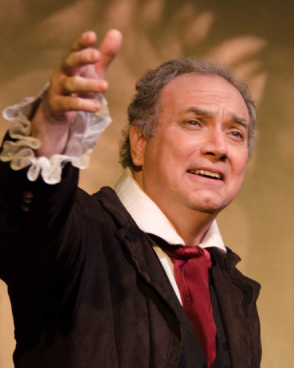 Elliott Bales (Beethoven) – Photo credit Doug Olmsted In 33 Variations, now playing at The Little Theatre of Alexandria, we embark on an intellectual exercise into Beethoven’s intent when he composed thirty-three variations on his music publisher’s mediocre waltz. Researcher Dr. Katherine Brandt (Sarah Holt) explores the cerebral territory of Beethoven’s sketches and gives us a window into the soul of the maestro. Playwright Moisés Kaufman’s storyline jumps back and forth from 1819 though 1823 in Vienna as Beethoven descends into deafness and ill health, to present day New York and later Bonn, Germany where Brandt’s research centers around the composer. This early period in Vienna where Beethoven (Elliott Bales) lived with his assistant Anton Schindler (Ken Gaul) is counterbalanced by a story set in the present of Brandt and her relationship with her daughter, Clara (Rebecca Phillips) and Clara’s boyfriend, Mike Clark (Matt Baughman).
Paralleling that Brandt too is dying having been diagnosed with Lou Gehrig’s disease. Against the wishes of her doctor, she departs New York for Bonn to study Beethoven’s musical scripts under the tutelage of Dr. Gertrude Ladenburger (Melanie Bates). “Here be dragons,” she exclaims defining the risky proposition. She is soon joined by Clara and Mike who care for her as she weakens.
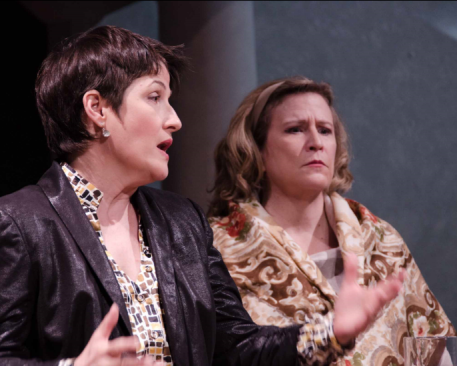 Melanie Bales (Dr. Gertrude Ladenburger) and Sarah Holt (Dr. Katherine Brandt) – Photo credit Doug Olmsted For a man that seeks” freedom and progress” and considers himself “an instrument of God”, it is a tumultuous time in Vienna where the composer resides in a police state. His contemporaries, Mozart, Hayden, Liszt and Schubert, are the reigning classical music luminaries of their time and competition among the musicians is fierce. It is under this shadow and with failing health and little money that Beethoven is pressured to compose the variations for profit. Soon he becomes obsessed with the waltz and its first four notes compel him to write ever more complicated and spectacular versions. Anton Diabelli (David Rampy) is the impatient publisher, urging then threatening Beethoven to complete his opus.
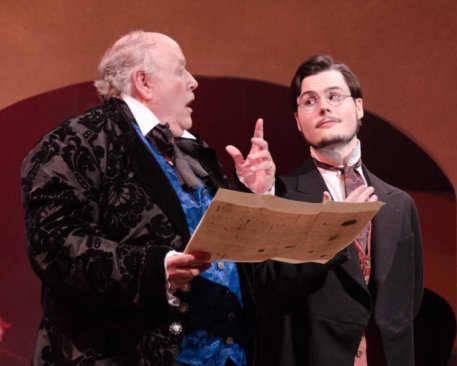 David Rampy (Anton Diabelli) and Ken Gaul (Anton Schindler) – Photo credit Paul Olmsted As Brandt endeavors to intuit Beethoven’s reason for creating these works, she reveals much about herself, self-important and callously indifferent, and her relationship with her capricious yet devoted daughter, Clara is rocky.
It is an exciting moment in the theatre when the audience exits in a daze from the impact of such an emotionally charged tale and raves are coming from all sides. But that is what I heard on opening night after a standing ovation and thunderous applause for a play that is both moving and breathtakingly performed.
How do you credit everyone in a review? Let’s begin with the actors. Sarah Holt carves a sharp and affecting portrait of the dying woman, a pedant with little care for anyone or anything beyond her work. Her character is sharply contrasted by the charm and adorableness of Rebecca Phillips and Matt Baughman whose affectionate and hilarious interplay as the young lovers is so palpable that the audience roots for their love to succeed. Counter that with the mad genius of Beethoven played by Elliott Bales in a tour de force performance. It is the second time I have been awestruck by Bales in the past few months (most recently in The Drawer Boy at Port City Playhouse this February).
Beautifully directed by Joanna Henry with lighting from the team of Ken and Patti Crowley who have created an atmosphere that is both modern and mood setting. Special credit goes to Matt Jeffrey as the onstage pianist, who gives a stellar rendition of excerpts from all thirty-three of the variations.
Highly recommended.
Through May 18th at The Little Theatre of Alexandria, 600 Wolfe Street. For tickets and information call the box office at 703 683-0496 or visit www.thelittletheatre.com
Jordan Wright
April 29, 2013
Special to The Alexandria Times
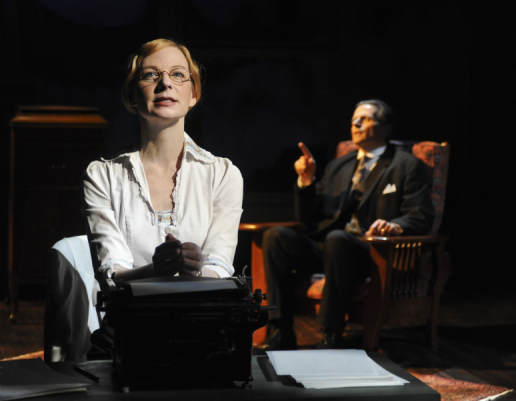 Susan Lynskey and Paul Morella – Photo credit Christopher Banks As MetroStage celebrates receiving three Helen Hayes Awards for Jacques Brel is Alive and Well and Living in Paris, we are treated to another brilliant show by Producing Artistic Director, Carolyn Griffin, who has spent the last seven years searching for the perfect vehicle for actress, Susan Lynsky. At last she appears to have found it in Ghost-Writer. She chose well. As the last production for the current season and a Washington, DC premiere of the play, it’s a spellbinding piece for the three-actor cast – most especially for its leading lady.
Franklin Woolsey (Paul Morella) is a renown novelist married to a proper Victorian lady (Helen Hedman). Moving in the rarified circles of aristocratic Old New York, he draws from its foibles like a hawk preying on a field mouse. Playwright, Michael Hollinger was inspired by Henry James’ relationship to his real-life secretary, Theodora Bosanquet, and used it as a vehicle to inform the background for a play that examines the art and act of writing.
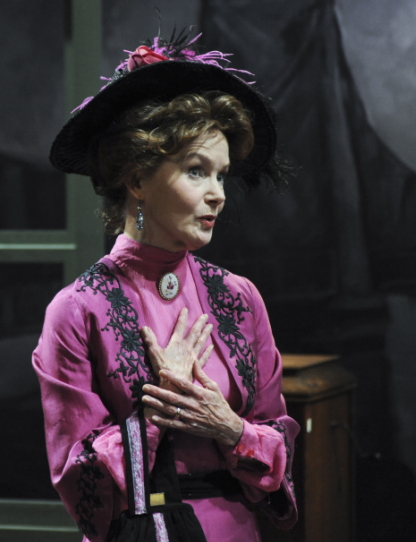 Helen Hedman -Photo credit : Christopher Banks Woolsey’s newly schooled, but oh-so-clever typist, Myra Babbage, is a hunter of sorts too – one who dallies with her target while keeping him enthralled. The play is set in 1919, the age of women’s advancement in the workplace and the beginning of their post-war freedoms. The 19th Amendment giving women the right to vote was then reaching the House floor for approval and women were experiencing a newly achieved independence. It is no coincidence that Hollinger sets the play in this power-shifting moment.
Miss Myra Babbage is a woman with ideas about writing and editing and she isn’t afraid of appearing presumptuous in order to express herself. She jousts with the author and his obsession with commas and dashes, periods and semicolons until he begins to trust her judgment and with it her way of turning a phrase when she sometimes finishes his sentences. (A curious clue in the punctuation of the play’s title is revealed at the outset and explains his typist’s successful insinuation into his writerly sphere.)
We meet the duo in Woolsey’s study. The décor is the austere Mission style befitting a serious writer of the late Victorian period. A Royal typewriter is front and center with the primly dressed Miss Babbage at its helm. She has been recently hired as Woolsey’s amanuensis, a taker of dictation, her fingers poised to record his every word. He soon grows addicted to her presence and the staccato sound of her typing and cannot think clearly when she pauses awaiting his next dictation. She devises a phrase she types over and over again until he is able to retrace his thoughts. “Don’t tell me what it is,” he insists. And her secret becomes her power.
“The waiting is part of the work,” she explains, “We waited together.” Thus begins their long and very close collaboration as Myra, addressing the audience as if we were her inquisitors, explains how, after Woolsey’s death mid-novel, she is able to complete his work by divining his words. “No one else has an intimate relationship with his style,” she insists, emboldened by their relationship and not wanting to abandon the book to Vivian nor his publishers’ inquiries.
From time to time, Myra and Franklin are visited in his study by his jealous wife, Vivian. Can you blame her? When the socialite tries to replace Myra by learning to type, a hilarious scene ensues and Hedman is at her best as the dithering pupil of the Myra the Taskmistress.
The piece is wonderfully tongue-in-cheek comical and its trio of actors superbly in synch. But it is Susan Lynskey as the stalwart heroine who captivates. Lynskey is magnetic, giving an enthralling portrait of a young woman gaining her footing in that brave new era, confident and well educated, polite yet outspoken, secure in her expertise, and unafraid to stand up to anyone. She is utterly captivating in the role and worth Ms. Griffin’s wait.
Highly recommended.
At MetroStage through June 2nd – 1201 North Royal Street, Alexandria, 22314. For tickets and information visit www.metrostage.org.
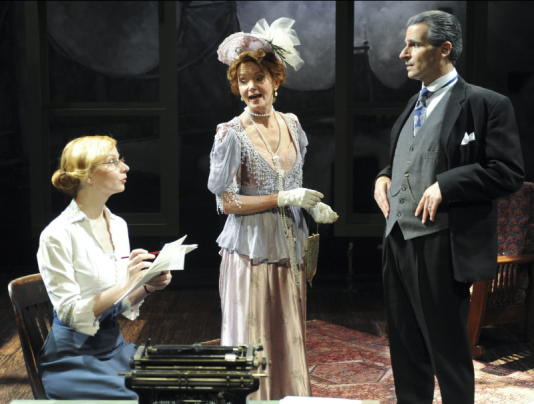 Susan Lynskey, Helen Hedman and Paul Morella – Photo credit Christopher Banks
May 1, 2013 Jordan Wright
Special to The Credits – MPAA
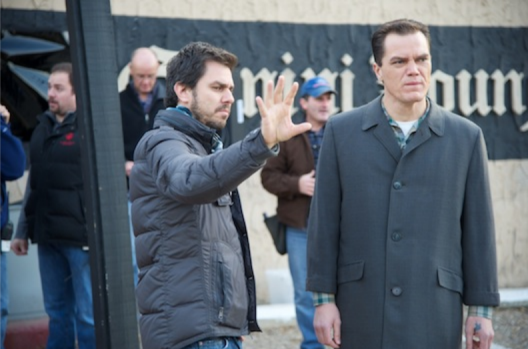 Iceman Director Ariel Vromen How does an ‘extreme’ special unit Israeli Air Force soldier, law student and world-traveling DJ become a successful director working with some of the country’s biggest stars? Here’s the circuitous route Ariel Vromen took on his path from performing military maneuvers in Israel and reading dense law texts in England to getting behind the camera. Vromen faced an endless string of challenges to get his latest project, TheIceman, onto the big screen. Inspired by real events, the film follows Richard Kuklinski (Michael Shannon), a notorious contract killer who, when not doing his grim work for the mob, was a devoted family man. When he was finally arrested in 1986, Kuklinki’s wife and daughters were stunned by the revelation of what he did for a living.
Vromen played the film in a slew of prestigious film festivals all over the world, tirelessly campaigning to lock down distribution for this passion project. He pulled it off. The film hits theaters on May 3.
We spoke with Vromen about The Iceman, his plight from law school to movie set, and his love for filmmaking.
 Ariel Vromen on the set of ‘The Iceman.’ Courtesy Millenium Entertainment How did you go from law school in England to filmmaking in LA?
I was a child of thirteen when I got my first camera at my Bar Mitzvah. I used to do a lot of short films. I was very attracted to film. But then when I went into the army, an extreme special unit in the Israeli Air Force, it shut down the creativity within me. Going to law school afterwards felt more serious for me. In law school, I started to be exposed to music. I started to work on electronic music and became a DJ, traveling around the world. I partnered with a lot of people and worked on soundtracks. That’s what brought creativity back into my life. After law school, when it was time to practice law, I said, “There’s no way!’ I had to try to do something I always wanted to do in my life. I was almost thirty then, I really started pretty late. That was the journey, from being creative to not being creative to returning to that world. When I came back to film, my interest was not in directing or writing…I was passionate about sound design. I did a short film in 2002 (Jewel of the Sahara), but it wasn’t until the mid-2000s that I became more attracted to directing.
How did you get your foot in the door in such a short time?
You know, it’s about perseverance and hard work and luck. As you get older you adjust yourself faster and, if you’re smart enough, you learn from your mistakes. You understand what you did wrong and what you need to do better, and if you’re focused enough, then you just go for it. There are no set rules or one specific journey. At the end of the day, you have to decide what kind of filmmaker you want to be. That happened to me after trying to direct a couple of features. To make your own film, it’s almost a miracle. The hardest part for many people in show business is to control your ego, especially if the film’s good.
Was law school helpful to you once you entered the film world?
Yes. It puts you into that mode of determination, of researching and understanding the material. It takes a lot of discipline to get up in the morning and work every day until 6 a.m. If you have a deadline, you can’t give up and you can’t be lazy. I wouldn’t say it’s fair, but if you really focus and believe in what you want to get out of it, and you’re putting all your energy into it, then anyone can achieve it. Sometimes it’s just a matter of being in the right place at the right time.
How did you develop relationships with fellow filmmakers, as well as distributors like Millennium Entertainment?
It’s funny, because I am much more connected to people that work with me like my editor, Danny Rafic. As for the DP department, I’m still on the search for the same person that will come on again and again for the style that I’m looking for. It would be nice to know that I have one DP that is there for life.
As for distribution, The Iceman was produced and financed by Millenium. It’s complicated. You’ve finished the film and done your screenings at festivals and you think it’s the end. Absolutely not! It’s just the beginning. Being on top of the distributor, doing release planning and strategic marketing, is probably as important as planning your shots and testing your film. Even though not everybody is happy to get your emails in the morning, you’ve got to ask a lot of questions. It’s the only way. You’ve got to be passionate about it. The job is not over when you pick a distributor.
We’ve been touring with Iceman since last September. It was in so many festivals, in Venice, Telluride, Toronto, San Francisco, Los Angeles, Texas, Florida, New York, New Orleans, Haifa. Despite the fact that it is such a controversial, dark film, with a dark subject matter, people really connected to it. They want to see the character redeem himself. It was a big challenge to make people relate. In the end I’m very pleased with the movie.
Ariel Vromen talks with his crew on the set of ‘The Iceman’
Can you talk about the challenges you had on The Iceman?
Hmmm…casting, financing, insisting on Michael Shannon to be the lead, nobody wants to give me money, competitive projects, dealing with threatening letters from a legal department on a weekly basis, trying to make Shreveport look like New York and New Jersey. Go figure that out. Shooting it in thirty days and having so much to cover in terms of three time periods. Sixty-eight locations, the post-production time restraints to get it into festivals, marketing, making sure it’s the best timing, and just keeping the momentum going. I think there were a lot of challenges! Ask me if there was anything that went smoothly.
Okay. Did anything go smoothly?
I would say the only thing that went really, really great was the work with my actors and the time I loved the most was editing in post-production. Ultimately it was all about creating, not about fighting.
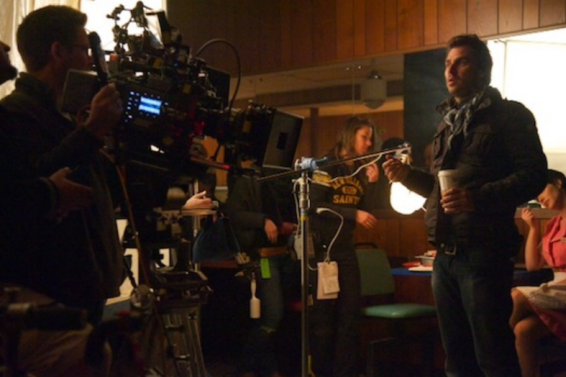 About to film a scene on the set of ‘The Iceman.’ Courtesy Millenium Entertainment As an independent filmmaker who works project to project without much of a financial safety net, what are your thoughts on protecting the content you create?
Piracy is absolutely a disease. Unfortunately there is a period of time, as it gets closer to the movie’s release, when the DVDs have been shipped, and you can only do so much for the content protection. However, the whole new way of distribution via the DCPs [Digital Cinema Package] really makes it helpful. But the moment that someone wants to put your work out there to the public, even knowing that essential element that you gave your life for something, it’s like somebody who has a virus they’re carrying and they want to spread it around. They just don’t care. You cannot control it.
What can we do?
I think it’s a matter of education. Like if someone goes to the supermarket and they want a yogurt and a bottle of wine and they take it and decide to just walk out. You can’t just say it’s wrong. You have to educate people and enforce it. Already the industry is suffering so much. Even though the numbers seem high, they can be deceiving. Someday we won’t be able to make these films.
There are so many countries where piracy has become commonplace, because people don’t get those movies, like in Turkey, Russia, China, Thailand and also Israel, where I’m from. They will even put them [pirated copies] on TV. When I was in Russia in 2007, I saw my film Danika playing on National Russian Television and it was a piracy copy. I hope people will understand that at the end of the day, we are just stealing from ourselves.
Featured Image: Director Ariel Vromen works with actor Michael Shannon on the set of ‘The Iceman.’ Courtesy Millenium Entertainment
Jordan Wright
April 22, 2013
Special to The Alexandria Times
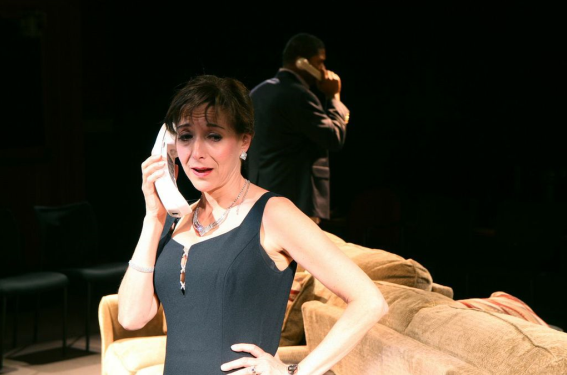 Chaz Pando as Paul and Dana Gattuso as Ouisa Kittredge – photo credit J. Andrew Simmons When John Guare’s now iconic play was first produced at the Lincoln Center in New York in 1993, it was a timely concept. Society had been reconfigured over the 60’s, 70’s and 80’s by integration, intermarriage and the acceptance of celebrities mixing with high society – most especially in New York where music, theatre, fashion and the arts have always defined social constructs. They called it “The Jet Set” for its mix of international luminaries and well-heeled travelers. Recreational drugs had a way of bringing unlikely social enclaves together and gallery openings sent the uptown crowd downtown to Soho, the East Village and Tribecca to dip their naïve toes into the newly fashionable unknown. In Six Degrees of Separation Guare visits the evolving complexities of Society vis-à-vis Modern Art at the turn of the decade.
Ouisa and Flan Kittredge are a well-heeled WASP couple who fancy themselves liberal-minded. Flan, a self-styled art dealer, is on the hunt for two million dollars to buy a French masterpiece he intends to flip for a profit to the Japanese. When his wealthy friend, Geoffrey, comes by for a drink they pitch him their idea. Interested, Paul explains his political position as an owner of gold mines in South Africa. “We have to educate the black workers. We’ll know we’re successful when they kill us,” he haughtily states. To which Ouisa replies, “It doesn’t seem right living on the East Side talking about revolution.” Her husband, attempting to soften her stance, clarifies. “Ouisa is a Dada manifesto.”
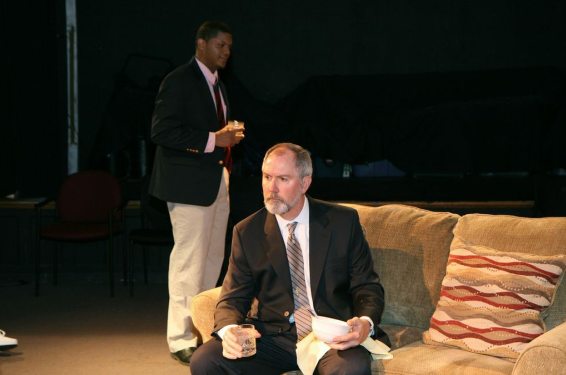 Chuck Leonard as Flan Kittredge (R) and Chaz Pando as Paul (L) – photo credit J. Andrew Simmons Thus the stage is set for an existential exercise in compassion, morals and old money when a well-dressed young African-American male knocks on their door, weak from a stabbing, and throws himself on their mercy. He introduces himself as a schoolmate of their Harvard-attending children and just like that, Paul is in the door and in their thrall as they quiz him on literature, art and the “Black Experience”. Paul readily expounds on his intellectual theories and tells them he is the son of famed actor, Sidney Poitier. They agree to back a film festival in New York City if they can act in Poitier’s next film. And as raconteur extraordinaire Paul boondoggles his victims, their involvement becomes compounded by their sympathies. “We turned him into an anecdote to dine out on,” Ouisa admits.
Guare has managed to perfectly capture the mood of the period – White guilt, radicalism of art, sex and politics and the confusion, curiosity and fear that comes from such a dramatic social shift. So successful is this play, based on a true story, that its title has become part of our shared lexicon, a euphemism for how closely we are socially connected. It has even spawned a parlor game called the “Six Degrees of Kevin Bacon” in which two actors can be connected through their films or their love life.
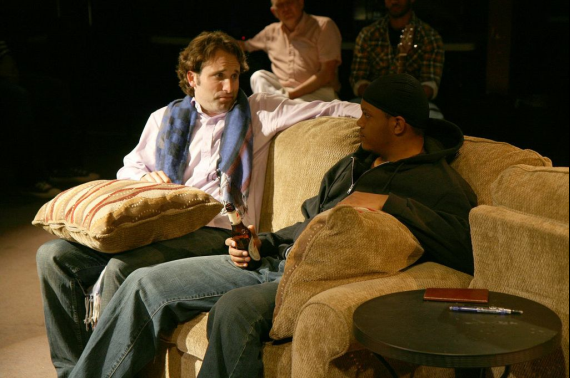 Kyle McGruther as Trent Conway (L) and Chaz Pando as Paul – photo credit J. Andrew Simmons As Port City Playhouse celebrates its 100th show since its founding, they have chosen the perfect vehicle to launch them into what will be their 36th season. Director Mary Ayala-Bush triumphs in the subtle staging of this production. On a small stage in the round she has managed to choreograph the actors so as to draw in the audience and deliver a feeling of shared experience and believability. Dana Gattuso (as Ouisa), Chuck Leonard (as Flan), Chaz Pando (as Paul), Marcus Anderson (as Rick) and Kyle McGruther (as Trent Conway, Paul’s Henry Higgins) are especially riveting, as is a cameo by Daniel McKay (as the gay hustler).
Highly recommended.
Port City Playhouse at The Lab at Convergence, 1819 North Quaker Lane, Alexandria, VA 22302. Performances are on the following dates – Apr. 19th, 20th, 26th, 30th and May 3rd and 4th at 8pm. Matinees on Apr. 27 and May 4th at 2pm. For tickets and information visit www.portcityplayhouse.org.
|