History, or shall we say “herstory”, will remember Ann Richards as one of the most colorful lawmakers in Texas politics… and that’s truly saying something about a state that has had its share of unusually quirky politicians. As a mother of four who never planned to dive into the political arena, she had one of the most notable careers in politics – one made especially memorable by her powerful keynote address at the 1988 Democratic National Convention. As a housewife and member of the Waco Women’s Club, she thought she’d always be a stay-at-home mom. But when her civil rights attorney husband turned down a run for the position of County Commissioner, and friends suggested she run, Richards threw her hat into the proverbial ring and trounced a Republican incumbent. Later this savvy lady parlayed her way into becoming the Texas State Treasurer, and later the governorship by being part cajoler, part charmer, and all business. It didn’t hurt that she had the gift of Southern gab, was warm-hearted and tossed out quotable one-liners to rival any standup comedian.
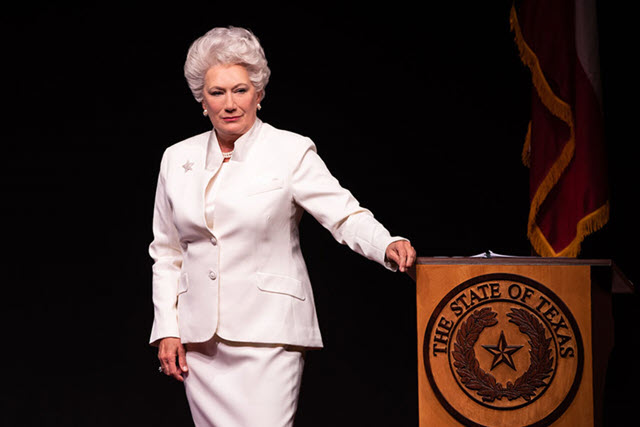
Jayne Atkinson as Ann Richards in “Ann” running July 11 through August 11, 2019 at Arena Stage at the Mead Center for American Theater. Photo by Margot Schulman.
After a rocky start due to her love affair with the bottle, she experienced a family intervention, went to rehab, and never looked back. It didn’t hurt that as a girl and daughter of a good old boy who weaned her on bawdy jokes, the family moved to San Diego where she attended her first integrated school. There she developed what she refers to as “a passion for simple fairness” that was to define her life’s work as an advocate for racial justice, women’s rights, and the protection and advancement of social security. “Life isn’t fair, but government should be,” she insisted.
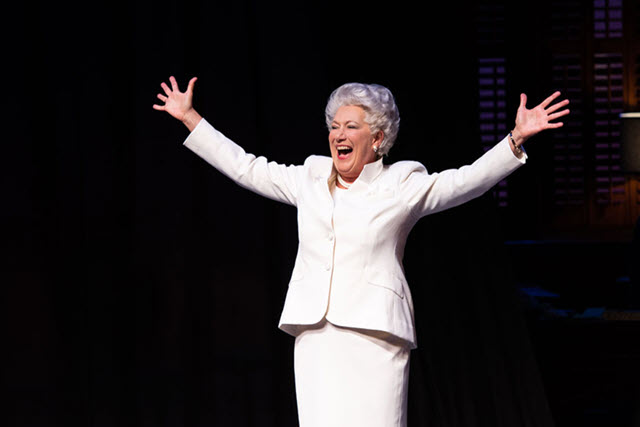
Jayne Atkinson as Ann Richards in “Ann” running July 11 through August 11, 2019 at Arena Stage at the Mead Center for American Theater. Photo by Margot Schulman.
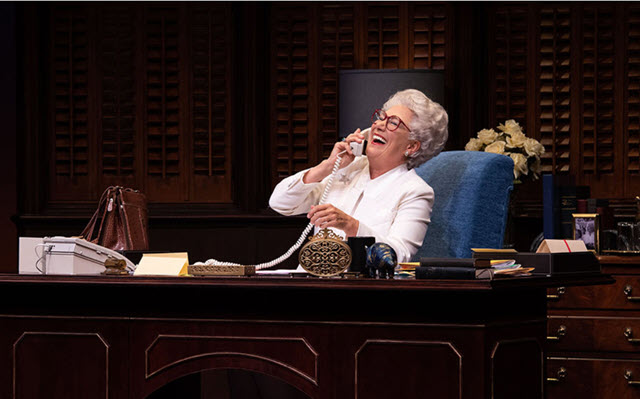
Ann, the one-woman, two-acter starring Broadway and TV actor, Jayne Atkinson, crystallizes the political life and bon mots of this feisty force of nature and home-grown feminist. Holland Taylor, a multi-award- winning Broadway, TV and film star who wrote and starred in the original Broadway production, begins Richard’s story before and after her loss of a second gubernatorial term to George W. Bush. The first act focuses on her address to a graduating high school class peppered with recollections of her career and hilarious, yet sage, advice. But it’s in Act Two, set in the governor’s private office, where the play really takes off and her humor ratchets up to warp speed as she fields incoming calls from her disjointed family as well as from her pal, President Clinton, and other influential politicos, while trying to plan a family holiday, a parade appearance, and other routine duties.
Jayne Atkinson as Ann Richards in “Ann” running July 11 through August 11, 2019 at Arena Stage at the Mead Center for American Theater. Photo by Margot Schulman.
Directed by Kristen Van Ginhoven, Set Design by Juliana Von Haubrich, Costume Design by Jess Goldstein, Lighting Design by Andi Lyons, Sound Design by M. L. Dogg.
Highly recommended.
Through August 11th in the Kreeger Theatre at Arena Stage, 1101 Sixth St., SE, Washington, DC 20024. For tickets and information call 202 488-3300 or visit www.ArenaStage.org.
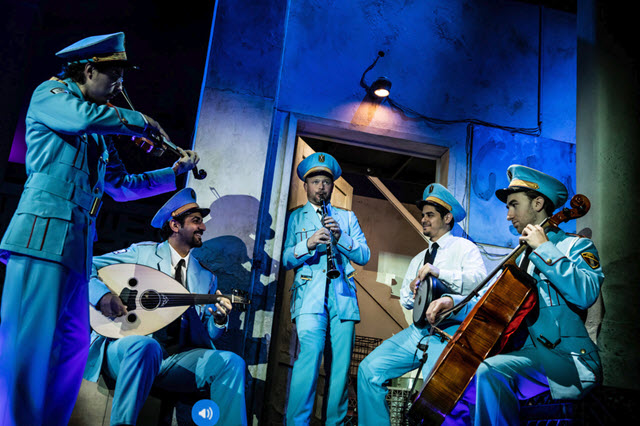
The Band’s Visit is a timeless musical, a romantic intrigue, and a wryly funny tale based on a true story. You may have seen the movie, but the musical allows the story to be fully fleshed out bringing to life the story of a 7-piece classical Arab band known as the Alexandria Ceremonial Police Orchestra and its conductor, Colonel Tewfiq, and how they all wind up in a dusty desert town in Israel where no one is expecting them. Winner of ten Tony Awards including “Best Musical” and “Best Original Score”, the sultry number “Omar Sharif” was performed on the night of the 2018 awards. Countless other prestigious theater awards have showered down upon this tenderhearted tale with original screenplay written by Eran Kolirin, book by Itamar Moses with composer/lyricist David Yazbek, and beautifully directed by David Cromer. It stars Sasson Gabay, who played the lead in the film version, as well as Chilina Kennedy (Carole King in Beautiful on Broadway), Pomme Koch and Joe Joseph, both of whom were in the Broadway cast.
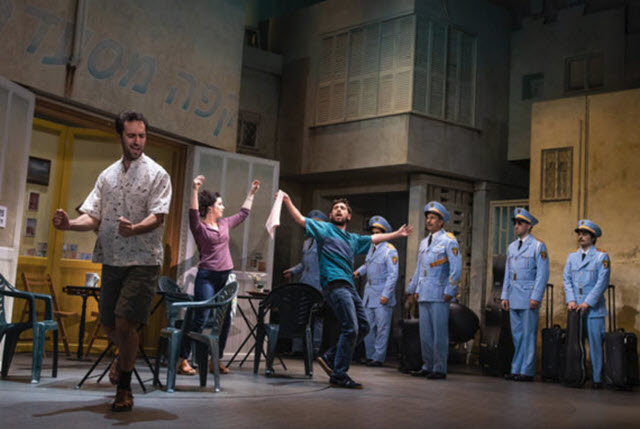
‘The Band’s Visit,’ now playing at The Kennedy Center. Photo by Matthew Murphy.
Imagine Tel Aviv in 1996. Egyptian music and movies have been banned even though generations of Israelis have thrilled to the haunting voice of the internationally famous singer, Umm Kulthum, and films starring the divinely suave and handsome Egyptian box-office idol, Omar Sharif (Lawrence of Arabia andDr. Zhivago). It is a fraught time, not so different from today, when cultures are separated by politics or war, and borders, real or imagined, are redrawn or redefined. And it is how Tewfiq and Dina find their music connection.
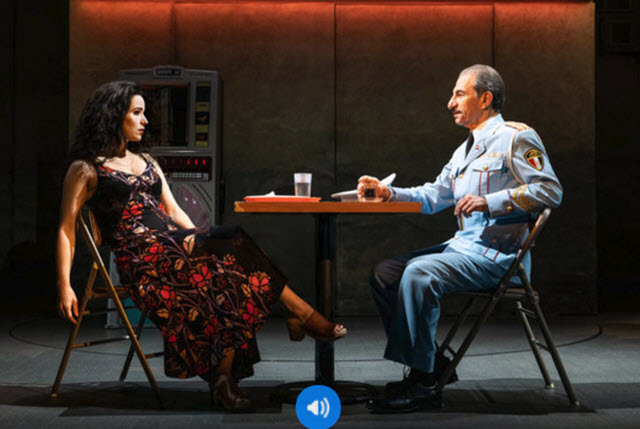
When the youthful Haled purchases the band’s tickets and mistakenly gives the wrong name for their destination, his miscommunication sends the men to Bet Hatikva, a tiny town where nothing ever happens and where the song “Waiting”, sung by the residents of the town, describes their ennui. At the café the musicians meet the lovely and fiery Dina, owner of the town’s sole café, who finds them homes to stay for a single night till the next day’s bus can take them to their correct destination.
Chilina Kennedy as Dina and Sasson Gabay as Tewfiq in ‘The Band’s Visit.’ Photo by Matthew Murphy.
Nine musicians – including players of the traditional Arab instruments oud, darbouka and riq – perform all the numbers onstage in a sort of musical ballet assisted by a rotating center stage. This beautifully expressed musical accompaniment weaves together the characters’ personal stories enhancing their shared communion with their temporary hosts. The story centers around the initial awkwardness of the two separate cultures attempting to understand each other’s cultural differences, ultimately discovering that they are more similar than not, and that love and family and the universality of music are at the heart of the human connection.
‘The Band’s Visit,’ now playing at The Kennedy Center. Photo by Matthew Murphy.
Highly recommended. Take everyone you know!
With Chilina Kennedy (Carole King in Beautiful on Broadway) as Dina; Sasson Gabay as Tewfiq; Pomme Koch as Itzik; Joe Joseph as Haled; Mike Cefalo as Telephone Guy; Adam Gabay as Papi; Ronnie Malley as Camal; David Studwell as Avrum; Jennifer Apple as Anna; Marc Ginsburg as Sammy; Kendal Hartse as Iris; Sara Kapner as Julia; James Rana as Simon; and Or Schraiber as Zelger. The Band is conducted by Rick Bertone, Music Director – with Tony Bird, George Crotty, Evan Francis, Roger Kashou, and Ronnie Malley.
Choreography by Patrick McCollum; Scenic Design by Scott Pask; Sound Design by Kai Harada; Costume Design by Sarah Laux; Lighting Design by Tyler Micoleau.
Through August 4th at The John F. Kennedy Center for the Performing Arts in the Eisenhower Theater – 2700 F St., NW, Washington, DC. For tickets and information call 202 467-4600 or visit www.Kennedy-Center.org
Is soul music making a comeback? With the recent success of Ain’t Too Proud – The Life and Times of the Temptations garnering 12 Tony Award nominations this season and Pride & Joy – The Marvin Gaye Musical that played the National Theatre two months ago, I’d say there’s an audience hungry to recapture those funky rhythms, groovy backbeat, slick harmonies and smooth vocals. In Soul Redeemer by composer and lyricist Neal Learner (LIFE: A Comic Opera in Three Short Acts) in collaboration with Paul Handy (a veteran of four Capital Fringe Festival productions), the early 70’s vibe is on point both musically and visually.
The new musical stars Bryce Monroe, as Buddy King, a soul singer who flamed out on drugs in the high-flying 70’s and is looking to get back onto the charts. Unfortunately, Buddy burned a lot of people, including his wife, Jeanine (Isabelle Pickering/Christina McCann), his producer, Jake (Evan Thanicatt), and his two backup singers, Quincy (Anthony Williams) and the sexy Melody (Melanie Lawrence), whom he has the hots for, much to the dismay of his pop singer wife. It’s a tragedy, a romance and a comedy set to soul music with a disco scene thrown in for good measure.
(l-r) Isabelle Pickering and Bryce Monroe.
Handy conceived the show and Learner wrote all eight of the period songs giving the cast free rein to interpret his music and context resulting in a vibrant collaboration and a convincing freshness to his material. Both Monroe and Williams have strong, soulful voices and hot chops that put this one on your must-see Fringe list.
Nicely directed by Anya Randall Nebel, the talented cast of locals moves to the groove with terrific voices and fierce emotion.
Produced by Don Michael Mendoza of LA TI DO Productionswww.latidoproductions.com with Assistant Director Larry O. Grey, Jr., and LeVar Betts and Josh Cleveland Co-Directing. A five-piece kickass band backs up the singers.
Last dates July 20th , 21st , 25th and July 27th at Westminster Presbyterian Church “Pickle”, 400 I Street, SW, Washington, DC 20024.
(l-r) Doug Bowles “Warbler” and Alex Hassan “Pianoodler”
Doug Bowles and Alex Hassan are back on Maple Avenue’s Creative Cauldron with more laughter, merriment, touching songs and stories, and where they’ll perform the beloved songs you know and some you haven’t yet heard from their research into the lost and forgotten songs of the ‘Great American Song Book’. The show is part of Creative Cauldron’s ‘Cabaret Series’ which features a cabaret or concert every summer weekend.
Alex Hassan ~ Pianoodler
A few notes on the amazing Alex Hassan: As current president of the Northern Virginia Ragtime Society, Alex Hassan has been thoroughly immersed in the musical styles and arrangements of the 20’s and 30’s for over four decades. As a renowned collector of over 50,000 pieces of popular sheet music wedged between the World War I and II, Hassan recreates the spirited and glorious melodies of the Golden Age of popular music.
Amongst the highlights of his musical career, Alex counts performances at the Smithsonian, the Scott Joplin Festival in Sedalia, MO, where he will return this year, New York’s tony Player’s Club, Toronto’s McMichael Art Gallery, Kennedy Center’s Millennium Stage, England’s Aldeburgh Festival, and the Husum, Germany “Piano Rarities” festival.
In the 1990’s and 2000’s, Alex recorded regularly for the UK company, Shellwood. Currently, Hassan has three solo piano CDs that are available on the Operetta Archives label, along with one recorded for the Pittsburgh-based Rivermont Records. Alex has also written program notes for CD reissues of notable 78 rpm performances by syncopating pianists of the past. Alex’s flying fingers will do their usual magic with recent arrangements of his own piano solos.
Doug Bowles
Doug Bowles is a tenor extraordinaire and much sought-after Musical Director with an extensive background in voice and theater who serves on the faculty of both Howard University and the Catholic University and who has directed nearly 200 musical productions. His collaboration with Hassan has taken the performers around the country and across the pond performing songs by 1930s composers from Harold Arlen to Fats Waller to George Gershwin. Bowles’ entertainment company SingCo Music represents Bowles’s hot jazz and swing band “Doug Bowles and his SingCo Rhythm Orchestra”, a multiple Wammy-nominated orchestra that has performed at many venues including the Glen Echo Spanish Ballroom, on The Voice of America, and at The National Archives. Bowles has also appeared with noted, Grammy Award winning band leader, Vince Giordano and his Nighthawks, (Boardwalk Empire, The Aviator, Prairie Home Companion, Bessie). www.dougbowles.com
The guys will be joined by the dulcet voiced actor/singer, Jennifer Timberlake who has performed around the DC area including at The Kennedy Center, Olney Theatre Center, Round House Theatre, The Washington Stage Guild and Adventure Theatre. Timberlake counts both Patsy in Always…Patsy Cline and Carrie in Carousel as her favorite roles.
As usual, the warblers and ‘pianoodler’ will introduce you to amazing “new” songs of the 20’s and 30’s. This performance will also be the world premiere of two new transcriptions/arrangements of songs by beloved 1920’s songstress, recording artist and famed Broadway performer, Esther Walker, as interpreted by the lovely Miss Jenn. Thrill to a rarely heard, but exquisite tune by Jerome Kern, and a fabulous selection of tunes you will no doubt want to sing along with.
You Can’t Go Wrong with Two For a Song!
Two shows only. Friday July 12th at 8pm and Saturday, July 13th at 8pm at Creative Cauldron, 410 South Maple Avenue, Retail 116, Falls Church, VA 22046. For information on this show and upcoming summer cabarets and concerts call 703 436.9948 or visit Creative Cauldron web booking,
Celebrate Wimbledon at the Fairmont and Bastille Day at the Sofitel Both Events on July 14th
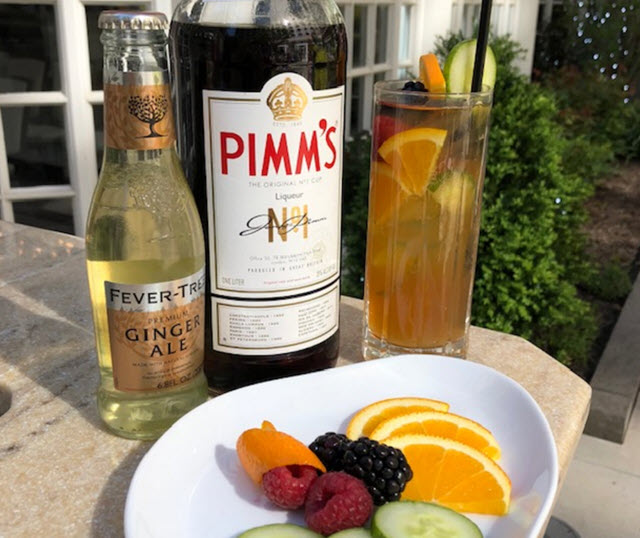
On Sunday, July 14th Georgetown’s tony Fairmont Hotel is planning a British invasion to honor the 2019 Wimbledon Championships. From 11am till 2pm guests will view the men’s finals on the big-screen in the hotel’s stunning garden courtyard while feasting on traditional British fare including flutes of champagne, Pimm’s cup and G&Ts.
Spectators will view the men’s finals on huge screens while trying out their backhand and forehand on a miniature tennis court. Wearing green, purple or white will make you eligible for prizes for the best garden party or tennis attire. Overnight stays, dinners and brunches are some of the prizes to be ‘lobbed’ at the winners. Tickets are $25 per person.
Executive Chef Jordi Gallardo and his team will feature an all you can eat $25pp array of passed delicacies without any ‘foot faults’!
Traditional, Finger Sandwiches
Salad Buffet with Salmon, Smoked Trout and Sirloin Steak
Scottish Eggs
Lamb Chops and Sausages from the Grill
Fish and Chips
Mini Pork Pies
Pastry Chef Charles Froke plans an extensive dessert buffet. Here’s the scrumptious menu.
Strawberries and Cream Station
Scones with Clotted Cream
White Chocolate & Cherry Tennis Balls
Summer Berry Trifle
Sticky Toffee Pudding Cake
English shortbreads
Strawberry rhubarb crème
Bottomless Pimm’s cups and mimosas are $15 pp or sip on the Juniper G&T or Thiénot Brut Champagne at $10 each. Live entertainment provided by the Dom Petrellese Quartet playing British favorites.
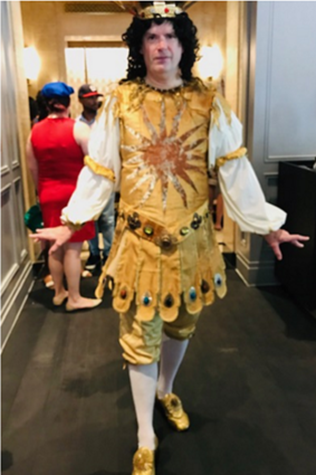
Some go all out with fabulous costumes! Here’s Louis XIV the “Sun King” at last year’s Bastille Day Party at the Sofitel
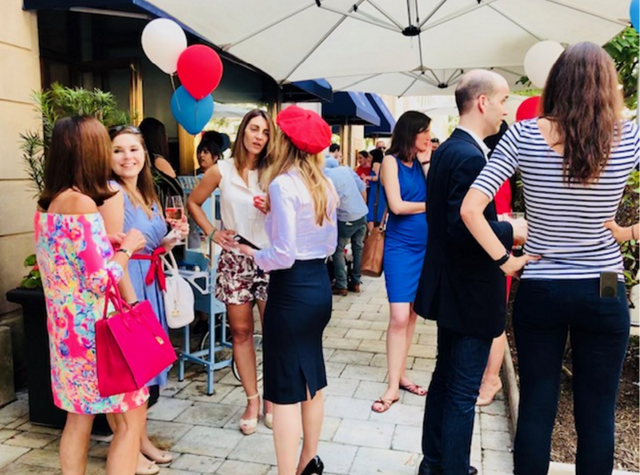
Want to leave London for Paris? At the Sofitel Washington DC on Lafayette Square the Bastille Day celebration kicks off with their 2nd Annual Bastille Day Picnic in the Opaline Bar & Brasserie from 2 till 4pm on July 14th . The deluxe hotel will pull out all the stops with French music, French picnic fare, champagne, rosé, fun photo ops, a caricaturist and more. Prizes will be awarded for best parasols and best French attire.
Full disclosure: I am a descendant of Edward Teach aka Edward Thatch aka Blackbeard.
Okay, now that my admission of partiality is out of the way, I can talk about why the world premiere of Blackbeard is a rousing success. First and foremost, Lyricist John Dempsey (Brother Russia, The Witches of Eastwick, The Fix) and Composer Dana P. Rowe (Dempsey’s collaborator on the same award-winning shows) have chosen the consummate swashbuckling blackguard to lead us into a hilariously unconventional fantasyland of pirates and their amours. Directed by Signature’s Artistic Director Eric Schaeffer, this turbo-charged adventure is based on the legendary exploits of the infamous 18th century privateer.
Awa Sal Secka (Shanti), Kevin McCallister (Caesar), Chris Hoch (Blackbeard), Christopher Mueller (Jake), and Lawrence Redmond (Samuel) in Blackbeard at Signature Theatre. Photo by Christopher Mueller.
Punctuated with dazzling pyrotechnics, the snicker-snack of gleaming swords, and booming cannons so thunderous that the floor actually quakes beneath your feet, this lusty new musical introduces us to the life of the dastardly pirate, Blackbeard.
Maria Egler (Morgan), Lawrence Redmond (Samuel), Christopher Mueller (Jake), Ben Gunderson (Garrick), Awa Sal Secka (Shanti), and Kevin McAllister (Caesar) in Blockbeord at Signature Theatre. Photo by Margot Schulman.
Conceiving a plan to conquer the British navy and achieve notoriety, Blackbeard seeks out his former lover, Dominique, a dazzlingly alluring temptress who rules the high seas. His aim: To gain access to her sorcery and recruit an army of the undead. Her aim: To secure her freedom from the island where he abandoned her and conscript him to bring her three precious jewels. To achieve this perilous feat, Blackbeard must travel to the kingdoms of Japan and India and confront the Norse gods of Scandinavia.
Nova Y. Payton (Dominique) in Blockbeord at Signature Theatre. Photo by Christopher Mueller.
Accompanied by Roger, a clever young stowaway, his trusty African Captain Caesar, Karl, a curiously reticent sailor, and a scurrilous band of ne’er-do-wells, Blackbeard travels across stormy seas on his perilous mission.
Veteran Broadway actor Chris Hoch (War Paint, Amazing Grace, Matilda, Shrek: The Musical, Beauty and the Beast, Dracula), with his marvelously commanding voice and stage presence, gives us an imposing Blackbeard, while leading lady Nova Y. Payton blows us square out of our seats with her powerhouse singing and fierce portrayal of the payback-seeking Dominique who enchants Blackbeard in the sultry number “Spellbound’. Equally engaging is Lawrence Redmond’s finely tuned portrayal of the Old Man and Bobby Smith as Ódinn, the Viking ruler, who engages Blackbeard in an uproariously comical drinking contest in the number “Valhalla” – “Val-ha-ha-ha-la”!
As bold and colorful as these pirates is Paul Tate Depoo III’s set design. Rigged with ship’s lines for clambering and a massive ship’s prow, the two-level set is wonderfully atmospheric.
It’s all tongue-in-cheek as this band of buccaneers takes us on a wild ride to exotic ports of call.
Ben Gunderson (Lt. Maynard) and Chris Hoch (Blackbeard) in Blockbeord at Signature Theatre. Photo by Christopher Mueller.
Highly recommended. A rousing adventure with a memorable score.
Ten actors play over 60 roles. With Chris Hoch as Blackbeard; Nova Y. Payton as Sally/Dominique; Rory Boyd as Roger; Lawrence Redmond as Samuel/Old Man; Kevin McAllister as Caesar; Bobby Smith as Karl/Ódinn; Maria Egler as Morgan/La Mer; Ben Gunderson as Garrick/Lt. Maynard; Christopher Mueller as Jake/Kamikase; and Awa Sal Secka as Shanti/Kali Maa.
Conducted by Jon Kalbfleisch; Choreography by Matthew Gardiner; exceptionally costumed by Erik Teague; Lighting Design by Chris Lee; Sound Design by Ryan Hickey; Orchestrations by David Holcenberg & Scott Wasserman; Fight Choreography by Casey Kaleba.
Through July 14th at Signature Theatre (Shirlington Village), 4200 Campbell Avenue, Arlington, VA 22206. For tickets and information call 703 820-9771 or visit www.signature-theatre.org.