|
|
Jordan Wright
March 4, 2020
There’s something rather quaint about Tennessee Williams now. His sultry Southern romances no longer seem shocking, though the stories are like listening to a fine storyteller spinning a yarn on the veranda of an old house on a steamy summer night. They’re always captivating and, though we know it will not turn out well for the characters, we wait breathlessly to hear how they navigated turgid waters.
 Erik Harrison as George Holly and Megan Morgan as Mrs. Holly in Avant Bard’s ‘Suddenly Last Summer.’ Photo by DJ Corey. Set in New Orleans in 1935, Suddenly Last Summer reflects a time when electroshock therapy and lobotomies were still in style, when women got the vapors and took laudanum or cocaine and could be committed to an asylum by their husbands for postpartum depression. Were they crazy or just “handled” in order to be disposed of?
In this story the beautiful and captivating Catherine Holly is holding up the dispersal of a large family inheritance with the telling of a shocking tale about how Mrs. Violet Venable’s son died in a rural Mexican beach town. The problem is no one wants to hear it. They hold a high position in society and, if the family doesn’t squelch her story, their reputations will be forever tarnished. Nowadays there’s not so much attention paid to a few black sheep in a family. But in that time, and in that place, one’s entire social standing in a community rested on their good name.
 Sara Barker as Catherine Holly. Photo by DJ Corey. Violet fancies her son, Sebastian, an aesthete – a poet and gardening enthusiast with little time for carnal pleasures. They travel the world together and she becomes accustomed to the attention he garners for his looks and charm. When Catherine replaces the sickly woman on his stylish adventures, Violet becomes enraged. Catherine reveals to the others, the Sebastian’s dark side that Violet knew about, and even indulged, but was not willing to acknowledge. Tragically, Catherine’s future as a free woman is at stake if she reveals the truth of the horrific way he died. Jealousy and greed drive William’s extraordinary characters and remind us of how brilliant a playwright he was.
Under the fine direction of Christopher Henley, the play crackles with a terrific cast, most especially Cam Magee and Sara Barker who we loved in Avant Bard’s production of Emilie: La Marquise du Chatelet Defends Her Life Tonight.
The play is preceded by a little-known, twenty-minute, two-person production also written by Tennessee Williams and called Talk to Me Like the Rain and Let Me Listen.
With Cam Magee as Mrs. Violet Venable; Matt Sparacino as Doctor Cukrowicz; Miss Kitty as Miss Foxhill; Erik Harrison as George Holly; Megan Morgan as Mrs. Holly; Sara Barker as Catherine Holly; and Christine Hirrel as Sister Felicity.
Scenic Design by David Ghatan; Lighting Design by Ian Claar; Costume Design by Anna Marquardt; and Sound Design by Clay Tuenis.
Through April 5th at Avant Bard Theatre, Gunston Hall Arts Center, Theatre Two, 2700 South Lang Street, Arlington, VA 22206. For tickets and information visit www.AvantBard.org/tickets or call the box office at 703.418.4808.
Jordan Wright
March 1, 2020
SOLD OUT!, read the sign outside the theatre on press night. That I’m writing this with no chance of you securing tickets might seem fruitless, but just in case someone, anyone, cares to read this review, which is entirely needless, I will forge on. After all, it is Signature’s 30th anniversary season and that’s something that bears notice.
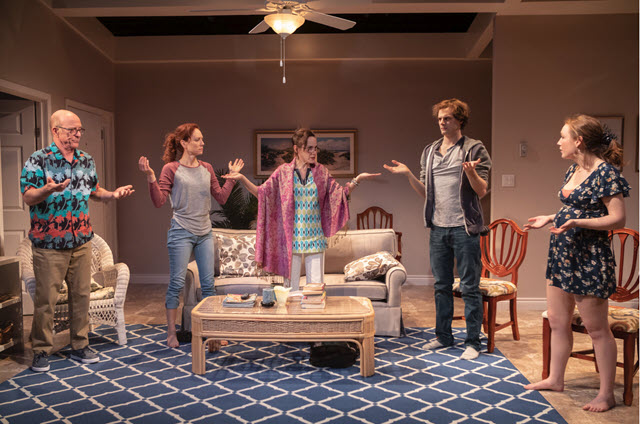 John Leslie Wolfe (Richard), Shanara Gabrielle (Lee), Susan Rome (Marian), John Austin (Bobby), and Jordan Slattery (Kitty). Photo by Christopher Mueller As a widely recognized actor on the DC theatre scene, Dani Stoller has been around the theatre long enough to know how it’s done. However, checking the playbill’s bios, it appears this is her first produced play. Thankfully, she’s chosen a top-notch local director in Stevie Zimmerman who brings to life a quirky comedy that comes off like a racy TV sit-com. It’s a little bit new agey, a little bit throwback, with Lee, a young married woman who’s a sex addict; her father Richard and mother Marian (who practices sacred female wisdom) both determined to support her no matter how reckless her behavior; niece Kitty finding her way while unmarried and pregnant; and Bobby a family friend who becomes involved with two of the women.
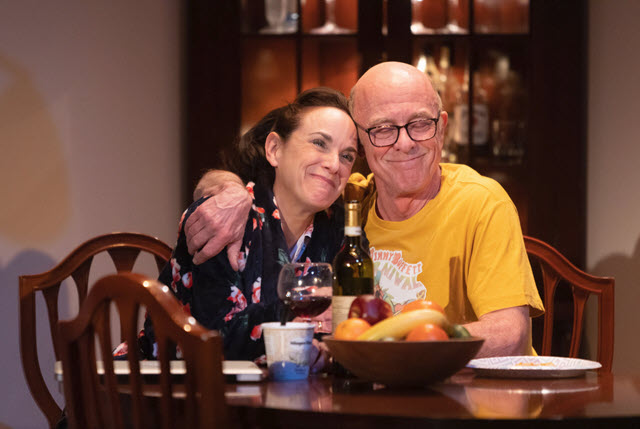 Susan Rome (Marian) and John Leslie Wolfe (Richard). Photo by Christopher Mueller. The title alone is suggestive enough to lure theatregoers titillated by the idea of loose women cavorting around onstage, but they won’t find that. The play is alluring in other ways as it deals with a family teetering on the edge of a total breakdown. But it’s the determination to heal each other and the terrific comic lines that are the glue holding this piece together. As Lee’s mother tells her, “Having a child is like your heart walking around outside your body.”
 John Austin (Bobby) and Jordan Slattery (Kitty). Photo by Christopher Mueller A fine ensemble, led impressively by Susan Rome, brings it all home.
With Susan Rome as Marian; John Austin as Bobby; Shanara Gabrielle as Lee; John Leslie Wolfe as Richard; and Jordan Slattery as Kitty.
Directed by Stevie Zimmerman; Scenic Design by Meghan Raham; Lighting Design by Andrew Cissna; Costume Design by Debra Kim Sivigny; Intimacy Coordinator Casey Kaleba.
Through March 29th at Signature Theatre, (Shirlington Village), 4200 Campbell Avenue, Arlington, VA 22206. For tickets and information call 703 820-9771 or visit www.signature-theatre.org.
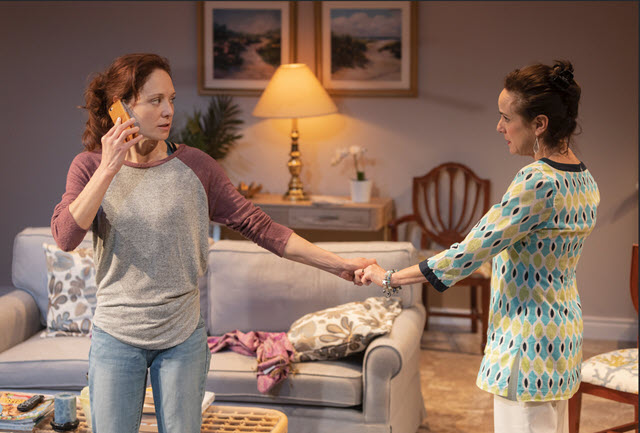 Shanara Gabrielle (Lee) and Susan Rome (Marian). Photo by Christopher Mueller
Jordan Wright
March 2, 2020
The Tony Award-winning Bandstand opens with the sounds of war and of soldiers in the heat of battle. It isn’t the first of many flashbacks for Donny Novitski, a down-on-his-luck vet whose best friend, Michael, was killed by a grenade when they came under attack. Donny promises to find Michael’s widow Julia and share stories of the men’s friendship.
 Bandstand First National Tour – Photo by Jeremy Daniel As a teen, Donny had been a singer and pianist. Upon returning from battle, he goes looking for a gig but is turned down for being too old or too out of touch with the current music scene. The story really begins to blossom when Donny learns of a nationwide Big Band contest, decides to start his own band, and convinces Julia to front the group. Their struggles and Donny and Julia’s romance form the basis of this poignant story of the aftermath of World War II.
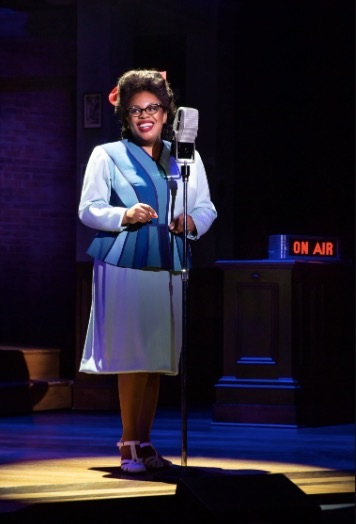 Shaunice Alexander in the Bandstand First National Tour – Photo by Jeremy Daniel Donny’s band members experience PTSD, problems with drugs and alcohol, grief, and anger management issues. How they conquer their disabilities and the ghosts of war to triumph against all odds, provides us with a story that is heartwarming, honest and hopeful.
This musical has all the song and dance elements of a big Broadway show. Andy Blankenbuehler who choreographed Hamilton, keeps eleven dancers jitterbugging and swing dancing throughout. And Donny’s band of sax, horn, drums, piano, bass, plus a five-piece orchestra create the Big Band sound of the 1940’s and bobby-soxer tunes of the early 50’s. Tender ballads accompany some of the best-known songs from the show – “You Know Who Tells Me”, “Donny Novitski”, Julia’s mother June’s song, “Everything Happens”, “Welcome Home” and Julia and Donny’s snappy love song, “This Is Life”. Twenty numbers keep the joint jumpin’ and the band cookin’.
 Bandstand First National Tour – Photo by Jeremy Daniel As the first stop in the show’s first National Tour, the cast of Bandstand has been focusing on presenting its story to all members of the armed forces and their families, which is quite nearly all of us. To that end, the audience contained many invited vets including TAPS and Gold Star families.
 Bandstand First National Tour – Photo by Jeremy Daniel A song and dance bonanza!
Starring Zack Zaromatidis as Donny Novitski; Jennifer Elizabeth Smith as Julia Trojan; Roxy York as Mrs. June Adams; Rob Clove as Jimmy Campbell; Benjamin Powell as Davy Zlatic; Scott Bell as Nick Radel; Louis Jannuzzi III as Wayne Wright; Jonmichael Tarleton as Johnny Simpson; Shaunice Alexander as Jean Ann Ryan; Matthew Mucha as Andre; Taylor Okey as Oliver.
Music by Richard Oberacker; Book and Lyrics by Rob Taylor and Richard Oberacker; Original Direction by Andy Blankenbuehler; Tour Director Gina Rattan; Conducted by Miles Plant; Scenic Design by David Korins; Costume Design by Paloma Young; Lighting Design by Jeff Croiter; Original Broadway Sound Design by Nevin Steinberg.
Through Sunday, March 8th at The National Theatre 1321 Pennsylvania Avenue, NW, Washington, DC. For tickets and information visit www.TheNational.com or call 1-800-514-3849.
 Bandstand First National Tour – Photo by Jeremy Daniel
Jordan Wright
February 26, 2020
You’d think by now Shakespeare’s plays would have taught society a few basic life lessons. Be nice, don’t let your ego get the better of you, love madly, and don’t trust a drunk. Take Timon of Athens – a wealthy aristocrat whose “friends” (and I use that word loosely) trade shallow compliments for lavish gifts and sumptuous dinners. He who has the gold, rules and all that rot. Amirite? In this rarely produced play written with Thomas Middleton we can see that present-day sycophants have a lot in common with Jacobean sycophants. What sets them apart is Timon’s plan to exact revenge on her coterie of parasitic predators.
 Kathryn Hunter as Timon of Athens. Photo by Henry Grossman. In Artistic Director Simon Godwin’s directorial debut at STC, we can see just how exciting and radical his approach will be. His unusual choice of a female actor for the role of Timon and his mind-bending choices for the 2020-2021 season, bode well for STC audiences. Kathryn Hunter (Timon) has made her reputation predominantly in England and so has Godwin as Associate Director of the National Theatre of London, the Royal Court Theatre and Bristol Old Vic. It was at the Royal Court Theatre that he directed Hunter in Timon, and it seems they have come full circle for this American production.
 Shirine Babb as Lucia and John Rothman as Flavius. Photo by Henry Grossman. Hunter’s physically demanding performance is nothing less than extraordinary. A tiny, wiry slip of a woman, she nonetheless displays all the power and ferocity of Dwayne ‘The Rock” Johnson when she takes to the woods to live hermit-like eschewing all social contacts and earthly comforts. Discovering a treasure chest filled with gold, she devises a plan to outwit her greedy group of false friends. You can’t help but be utterly gobsmacked by Hunter’s dramatic transformation from glamorous benefactor swathed in gold and jewels to monastic recluse clad in rags.
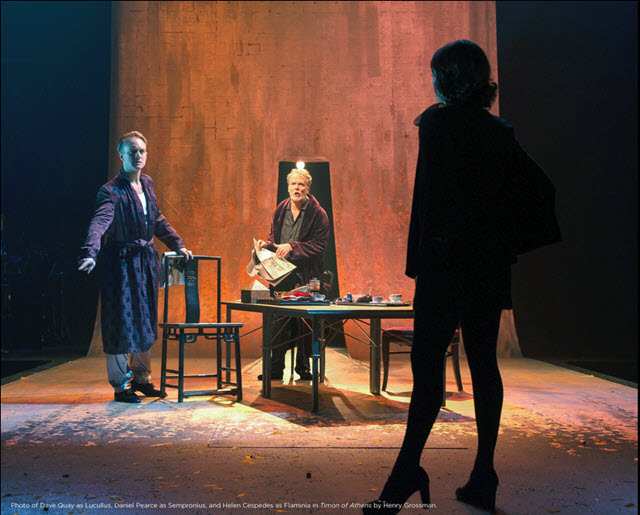 Dave Quay as Lucullus. Daniel Pearce as Sempronius, and Helen Cespedes as Flaminia. Photo by Henry Grossman. Treating the play as a modern-day social construct, Godwin reinvents Timon’s steward, Alcibiades, imbuing him with empathy for Timon’s plight and using his sway to unmask and shame Timon’s friends for the phonies they are. Another clever devise is using Apemantus as Timon’s reality check and positioning him around the theatre as a disembodied voice of wisdom and truth. It’s a delicious stew of glamour and glitz, grit and gore, with indelible characters you will love to both hate and adore. Congratulations to Godwin on his American directorial debut!
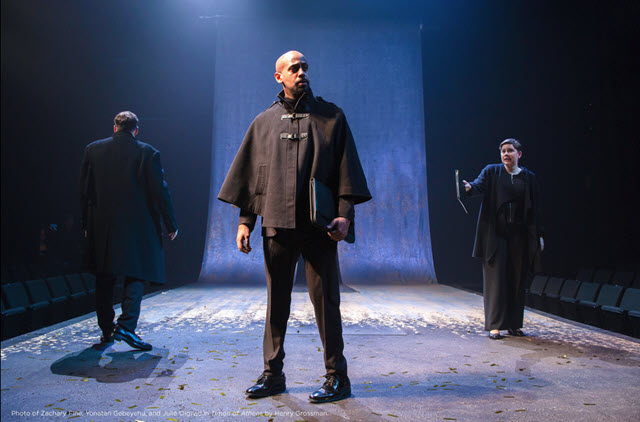 Zachary Fine, Yonatan Gebeyehu, and Julie Olgivies. Photo by Henry Grossman. And high praise for Soutra Gilmour who designed both the costumes and the sets and Kristen Misthopoulos whose haunting voice on ancient Greek ballads lends a sense of place to the drama.
 The Cast of Timon of Athens. Photo by Henry Grossman. Highly recommended.
Lighting Design by Donald Holder; Sound Design by Christopher Shutt; Composer Michael Bruce; Choreographer Jonathan Goddard; Fight Director Lisa Kopitsky; Dramaturgy Jonathan Kalb and Drew Lichtenberg; Associate Director Allison Benko.
With Arnie Burton as Apemantus; Shirine Babb as Lucia; Helen Cespedes as Flaminia; Liam Craig as Demetrius; Zachary Fine as The Painter; Yonatan Gebeyehu as Poet; Adam Langdon as Lucilius; Elia Monte-Brown as Alcibiades; Julia Ogilvie as Jeweller; Daniel Pearce as Sempronius; Dave Quay as Lucullus; and John Rothman as Flavius.
Through March 22nd at the Michael R. Klein Theatre (formerly known as the Lansburgh Theatre) at 450 7th Street, NW, Washington, DC 20007. For tickets and information visit www.ShakespeareTheatre.org/events or call the box office at 202.547.1122.
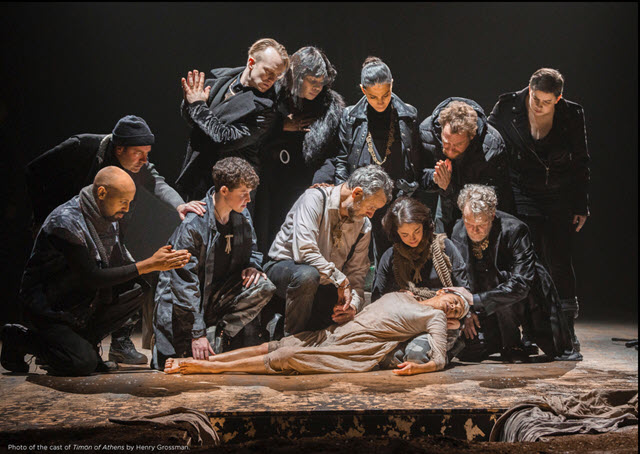 The Cast of Timon of Athens. Photo by Henry Grossman.
Jordan Wright
February 19, 2020
Sometimes I feel like I could jump right out of my skin when I see a production as thrilling as The Amen Corner. Straight out of the gate, we find ourselves as guests in the electrifying spirit of an African American church service. Amens and hallelujahs fill the air in synchronized rhythm to a soulful choir while worshippers fall into singing, shouting, clapping, stomping and praising the Lord. Oh, the voices – rich, earthy tones, clear as a bell, filled with sanctifying praise and mellifluous harmonies. I can’t sit still. It’s a toe-tapping, arms-outstretched-to-heaven sensation.
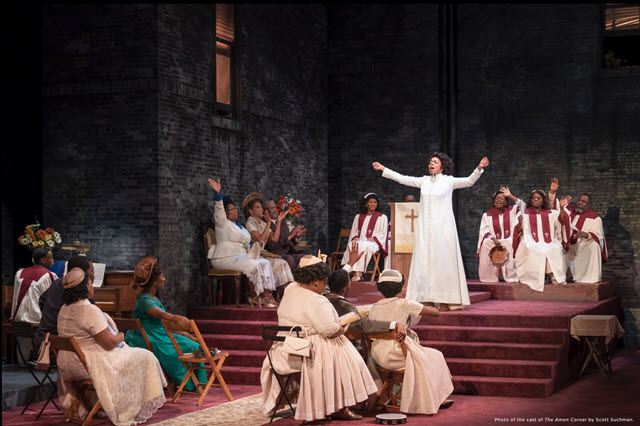 Deidre LaWan Starnes as Sister Boxer and Mia Ellis as Margaret Alexander – Photo by Scott Suchman Onstage a few of the gathered sit in chairs beside the pulpit in what is called “the amen corner”, but all are moved by the soaring rhetoric of Sister Margaret. “This here is a Holy Ghost station,” she calls out to the faithful as they sway and fan themselves, bonding through rituals rooted in ancient community.
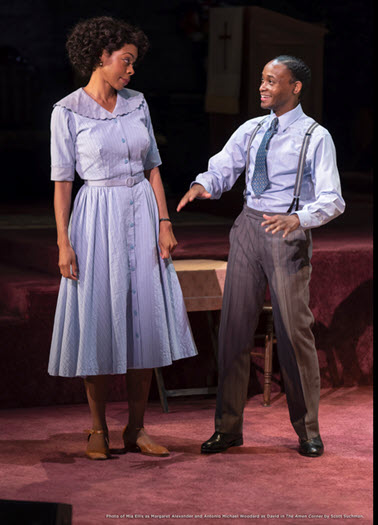 Mia Ellis as Margaret Alexander and Antonio Michael Woodard as David – Photo by Scott Suchman. Brilliantly directed by Whitney White, James Baldwin’s play focuses on Sister Margaret, a Black female pastor who falls from grace when her own fallibility is revealed. Forces within the church begin to undermine her. They challenge her decisions, gossip behind her back, and conspire to fight back against her rigid edicts. “You ain’t better than the rest of us,” one of the elders tells her while Sister Moore pits the congregation against her through rumor and innuendo.
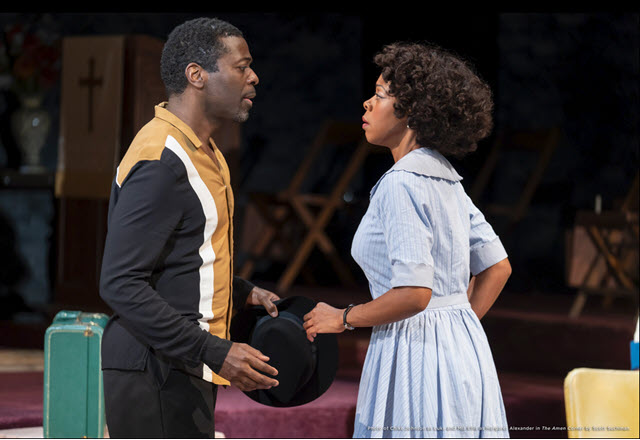 Chiké Johnson as Luke and Mia Ellis as Margaret Alexander – Photo by Scott Suchman. The play/musical draws directly from Baldwin’s own life as the son of a preacher. In the same way Baldwin’s art called to him in a louder voice than the word of God, young David rebels against the constrictive life his mother has laid out for him. “Mom, if a person don’t feel it, he don’t feel it,” he tells her. When Luke, his absent father, returns home to live out his last few months, David finds the strength to break the chains that bind him to home and church. Baldwin’s own experience as a child pastor lends power and insight to the hierarchy of the Black church universe.
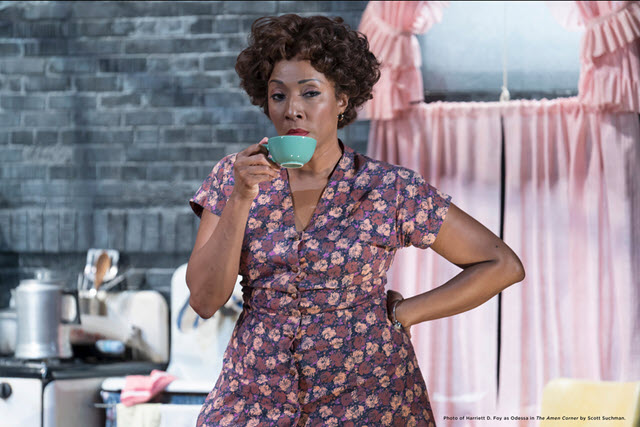 Harriett D. Foy as Odessa – photo by Scott Suchman. Each character is exquisitely defined by Baldwin, and it is easy to feel the depth of his frustration with the hypocrisy he experienced, all in the name of a higher power. Simon Godwin, STC’s new Artistic Director, sees the tragedies and hypocrisies as keenly as if Shakespeare had written them himself. “I was struck by the similarities to Shakespeare’s work – the domestic and spiritual tragedies and the play’s classical structure,” he writes.
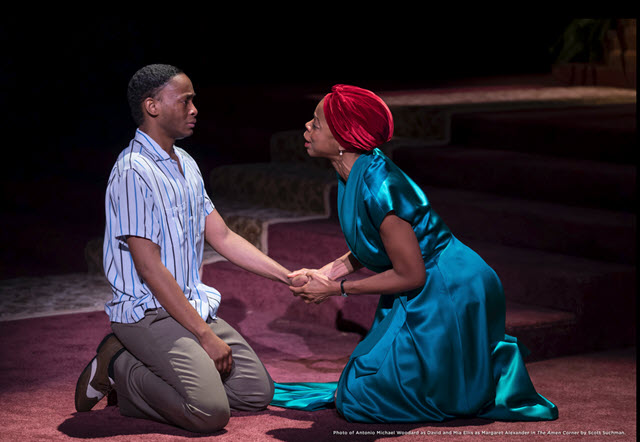 Antonio Michael Woodard as David and Mia Ellis as Margaret Alexander – Photo by Scott Suchman. Expect an outstanding cast with some of the best, and most soulful, choir-trained voices from DC’s musical theatre scene, and a large stage set that segues from intimate – Luke’s death bed and Margaret’s kitchen – to the power-and-glory atmosphere of a veritable come-to-Jesus house of praise.
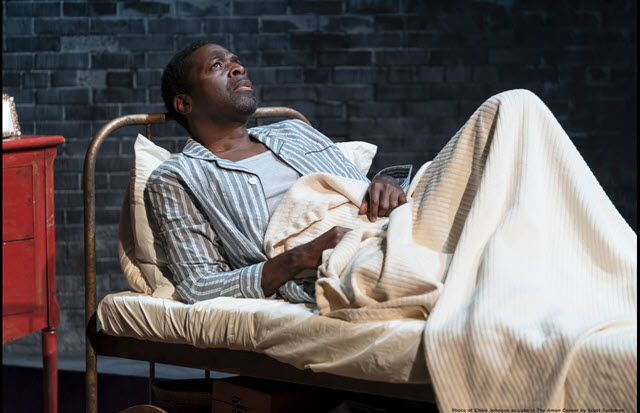 Chiké Johnson as Luke – Photo by Scott Suchman. People get ready. This is highly recommended!
With Mia Ellis as Sister Margaret Alexander; Harriett D. Foy as Odessa (Margaret’s older sister; Jasmine M. Rush as Ida Jackson; Antonio Michael Woodward as David; Chiké Johnson as Luke. Church Elders: E. Faye Butler as Sister Moore; Deidra LaWan Starnes as Sister Boxer; Phil McGlaston as Brother Boxer. Member of the Congregation: Lauryn Simone as Sister Sally; Nova Y. Payton as Sister Douglass; Jade Jones as Sister Rice; Marty Austin Lamar as Brother Davis and Choir Director; Tristan André Parks as Brother Washington.
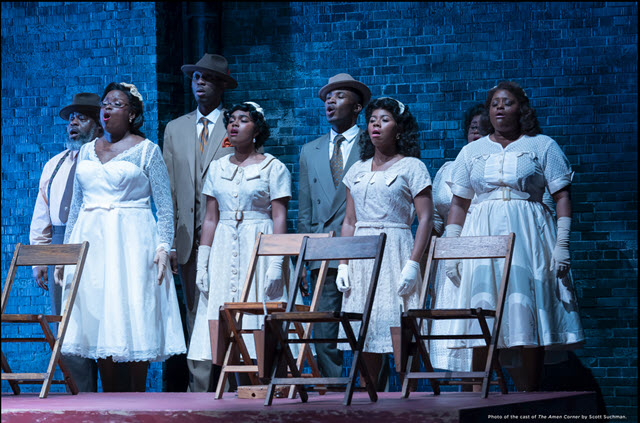 The cast of The Amen Corner – Photo by Scott Suchman. Directed by Whitney White; Assistant Director, Manna-Symone Middlebrooks; Victor Simonson, Music Director; Scenic Design by Daniel Soule; Costume Design by Andy Jean; Lighting Design by Adam Honoré; Sound Design by Broken Chord.
Through March 22nd the Shakespeare Theatre Company at the Sidney Harmon Hall at 610 F Street, NW, Washington, DC 20004. For tickets and information visit www.ShakespeareTheatre.org or call the box office at 202.547.1122.
Jordan Wright
February 15, 2020
Mother Road transports us into the world of John Steinbeck’s 1939 novel The Grapes of Wrath and the terrible tragedy of the Joad family. Playwright Octavio Solis picks up where the novel left off, leap-frogging the generations to provide us a glimpse into what life would be like for the modern-day Joads.
 Cast of Mother Road. Photo by Margot Schulman. In this telling, the eldest Joad, Will, who witnessed his sharecropper family perish during the Oklahoma Dust Bowl, is determined to pass the farm onto his next of kin to keep the farm in the Joad name. When he discovers his last remaining relative is his cousin Martin, a Chicano migrant worker, Will is forced to face his intolerance towards minorities. It’s a beautifully told story of personal challenges, dreams, redemption and respect.
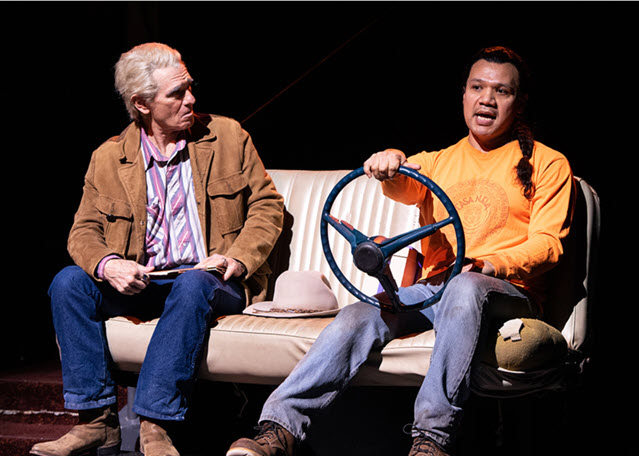 (L to R) Mark Murphey (William Joad) and Tony Sancho (Martín Jodes). Photo by Margot Schulman. Will and Martin meet in Arvin, California, Martin having been tracked down by Will’s attorney, Roger. Will tells Martin he will give him the Joad farm. No strings attached. On their road trip to the farm in Sallislaw, Oklahoma we learn of Amelia, Martin’s love, whom he leaves behind when he is arrested for defending a fellow migrant worker. As the men drive past rest stops, roadhouses and mile markers, Martin stops to pick up Mo, a salty-mouthed lesbian and fellow day laborer he envisions as forewoman on his soon-to-be inherited farm. Later they meet Ivy, a pretty waitress who knew the Joads before they left for California, and James, Martin’s African American friend, who has found God in the beauty of nature. In Martin’s old jalopy the disparate gang swap memories and jokes along the road. For Will it’s a life-changing epiphany as he comes to understand what it’s like to be black, Chicano or gay in today’s America.
 Cast of Mother Road. Photo by Margot Schulman. The day laborers face all manner of indignities and hardships – disease from chemicals, an uncertain future, the threat of not getting paid for their work, and the fear of arrest and ultimately deportation. To this day America’s meat, produce and farming industries would not survive without these migrant workers. More than half of all farm workers in the U. S. are undocumented. Mother Road shines an unblinking light into their struggles to survive in a harsh and intolerant world.
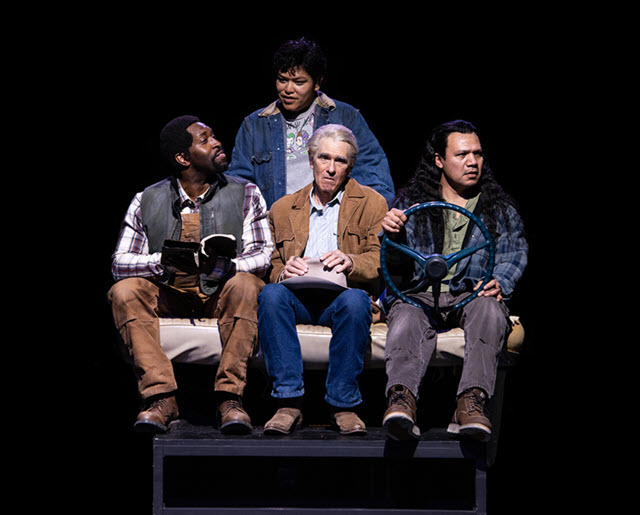 (L to R) Cedric Lamar (James/Cook), Amy Lizardo (Mo/Chorus), Mark Murphey (William Joad) and Tony Sancho (Martín Jodes). Photo by Margot Schulman. Terrific performances by the entire cast and special kudos to Amy Lizardo as the outlandish Mo in a razor-sharp performance that brings light and levity to an otherwise serious subject.
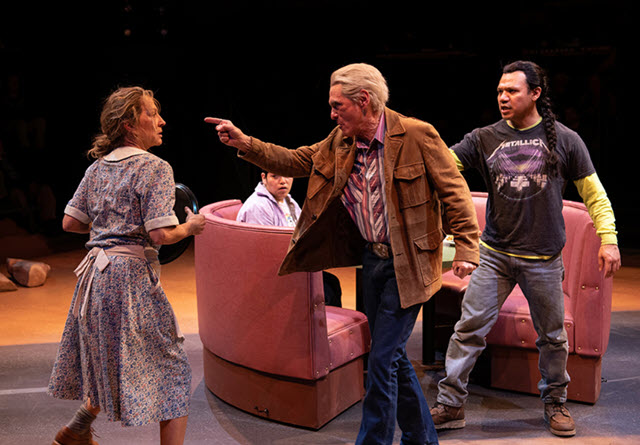 (L to R) Kate Mulligan (Ivy/William’s Mother/Police Officer), Amy Lizardo (Mo/Chorus), Mark Murphey (William Joad) and Tony Sancho (Martín Jodes). Photo by Margot Schulman. Directed by Bill Rauch; Set Design by Christopher Acebo; Costume Design by Carolyn Mazuca; Original Sound and Music by Paul James Prendergast; Dramaturgs Jocelyn Clarke and Tiffany Ana Lopez.
 (L to R) Tony Sancho (Martín Jodes) and Natalie Camunas (Amelia/Chorus Leader). Photo by Margot Schulman. With Tony Sancho as Martin Jodes; Mark Murphey as William Joad; David Anzuelo as Abelardo/Ranch Hand; Natalie Camunas as Amelia; Amy Lizardo as Mo; Ted Deasy as Roger/State Trooper/Ranch Hand/Will’s Father; Derek Garza as Curtis/Abelardo’s Father; Cedric Lamar as James/Cook/Fight Captain; Kate Mulligan as Ivy/Police Officer/William’s Mother.
Through March 8th at Arena Stage, 1101 Sixth St., SE, Washington, DC 20024. For tickets and information call 202 488-3300 or visit www.ArenaStage.org.
|