Categories

Find Us

Bistrot Lepic and Wine Bar – The Petite Retreat Rediscovered

Jordan Wright
April 2010

It was just after the first big snow, and everyone was struggling to navigate around the snow dunes created by the plows. I was slipping and sliding around the icy streets in Georgetown with plans to meet a friend at Bistrot Lepic for hearty French fare.

Bistrot Lepic - Georgetown's cozy French retreat - photo by Jordan Wright

Bistrot Lepic - Georgetown's cozy French retreat - photo by Jordan Wright

The restaurant has been offering a three-course prix fixe lunch for $20 to celebrate their 15th anniversary and the menu items were inviting. But as I scanned the menu I spied “Rognons de Veau”, veal kidneys with roasted potatoes and a Dijon mustard sauce, and I was on my way to French comfort food heaven.

My longing for this childhood dish, made by our beloved French cook we named “Nana”, has been as forceful and evocative as Proust’s reflections on madeleines, and in this cheery yellow-hued retreat I would recapture my memories. This restaurant has been a fixture in Georgetown for many years and I recall lunches with my mother, who wished to revisit its charms whenever she was in town.

Head Chef Simon Ndjiki-nya has kept all the bistro classics to warm the cockles of your Francophile heart. The Camaroon-born chef, who grew up in Paris from the age of five, has worked at Bistrot Lepic for eight years with a brief stint mid-way to cook with Gerard Pangaud, no stranger to Michelin stars.

Executive Chef at Bistrot Lepic, Simon Ndjiki-nya - photo by Jordan Wright

Executive Chef at Bistrot Lepic, Simon Ndjiki-nya - photo by Jordan Wright

An endearingly charming, but unfussy place with a Parisian sensibility, you will find all your favorites like roast lamb and ratatouille, calves’ liver Provencale-style and coquilles Saint-Jacques, tweaked ever so modernly by its ginger broccoli mousse accompaniment.

Desserts are everything you would expect when you’re dreaming up favorites like pear tarte, chocolate mousse and the ambrosial ile flottante, a feathery-light sweet egg dish floating on crème Anglaise.

Drift up the townhouse stairs to the wine bar where cheese is paired with wines…Roquefort from Aveyron with sauterne or port, a Tomme de Savoie with a light Burgundy, or perhaps, Montbriac with a glass of Cotes de Rhone. Small dishes are served here and the country pate is made in house with Armagnac. The upper level has comfortable sofas and chairs and is decorated like a private salon, intimate with an air of decadence. A floor to ceiling Toulouse-Lautrecesque mural places you in the turn-of the-century Moulin Rouge cabaret.

This precious bistrot is the sort of rare jewel that one finds less and less in France and almost never in the States. Keep it close to your heart.

www.bistrotlepic.com

For questions or comments on this story contact [email protected].

Connecticut Avenue for the Connoisseur – The Bombay Club and The Oval Room

Jordan Wright
Whisk and Quill
April 2010

James Beard Nominees, Restaurateur Ashok Bajoj and Chef Tony Conte at The Oval Room - photo by Jordan Wright

James Beard Nominees, Restaurateur Ashok Bajoj and Chef Tony Conte at The Oval Room - photo by Jordan Wright

Ashok Bajaj, Washington DC restaurant dynamo, is a 2010 recipient of a prestigious James Beard Foundation nomination for “Outstanding Restaurateur”. That no other owner has as many successful outposts in Washington, DC with seven diverse and prestigious restaurants in his empire, it is no surprise that he has achieved a status that others might easily envy.

On Connecticut Avenue, a stone’s throw from the White House, reside two of his especially patrician establishments, The Bombay Club and The Oval Room, both a draw for DC’s fine dining-driven elite.

I trotted off last week to visit two of Bajoj’s Executive Chefs, Tony Conte, at The Oval Room, noted for his clean-lined “Modern American” food, and Nilesh Singhvi who reigns over the kitchen at The Bombay Club and is known for his authentic regional Indian cuisine.

The Oval Room – Modern American Cuisine

“Modern American Cuisine” – the terminology gives pause for thought. It evokes everything from corn dogs to apple pie to Aunt Molly’s pickled beans. Even a lowly rib joint considers their food American cuisine, so it seems a convoluted coinage to slap the word “modern” on the front end for clarification. I remember when Betty Crocker was considered “modern”.

A far cannier descriptive to my mind is “Modern French” or “French Fusion”. It translates more accurately into an individual chef’s interpretation of the new French cuisine, that uses French techniques and incorporates American, Asian and Italian ingredients. Well, it’s too late for that now. The terminology is ubiquitous. I can’t change it and I won’t try, but I do feel it comes up short to express the beauty and innovation of what American chefs with French culinary training and global influences are creating in the better restaurants today.

Across Connecticut Avenue to another of Bajaj’s outposts, The Oval Room is a culinary paradigm shift with the cuisine of Chef Tony Conte and his stellar interpretation of the French dynamic. Conte has gotten the nod from the James Beard Foundation as well and is a semi-finalist for “Best Chef: Mid-Atlantic” 2010. Though the restaurant bills itself as “Modern American”, Conte has a light-hearted, eclectic, predominantly Euro sensibility in which I intuited a delicious blend of Thomas Keller and Jean-George Vongerichten, Conte’s former boss and muse, with a soupcon of Alain Ducasse. Conte however, has his own distinct interpretations.

Roasted Baby Beets with Passion Fruit, Shaved Horseradish and Icewine Dressing from The Oval Room - photo by Jordan Wright

Roasted Baby Beets with Passion Fruit, Shaved Horseradish and Icewine Dressing from The Oval Room - photo by Jordan Wright

His roasted baby beet salad uses a tangy-sweet passion fruit gelee with delicately earthy red, golden and purple beets, zingy fresh horseradish shavings, micro-greens and a sweet drizzle of ice wine mignonette.

In salads today most chefs incorporate elements of sweetness…fresh or dried fruits perhaps…and earthiness…as with multi-colored beets, radishes and artichokes, or legumes such as French lentils, lending a certain piquant rusticity and serving to balance out the bitterness in field greens. Conte’s design goes one better with its clean preparation and clever addition of fresh horseradish.

The food at The Oval Room is stylish and understated, echoing its décor. It is a pretty room but unfortunately I experienced one of my restaurant pet peeves…banquette seats so much lower than table height my chin was nearly grazing the plate.

I focused on the food instead…its flavors, textures and techniques. Whether preparing a Berkshire pork rack and belly with briny little neck clams, sweet peppers and lime; or a dish of Pennsylvania duck with red cabbage traced by an alluring persimmon and mustard sabayon sauce, Conte is able to tweak his ingredients to achieve something new yet quite un-twee. In these and some of the other dishes the combinations take their cues from the Asian kitchen and reflect a decidedly unorthodox direction.

Although the menu reads like a gourmand’s shopping list of intriguing, multi-ethnic ingredients (What, pray tell, is shrimp chorizo?), you can put your trust in the outcome when Conte is at his creative best.

Crudo of hamachi, a raw tuna appetizer oft-experienced elsewhere, is gotten right when dressed with a green apple mustard and yuzu vinaigrette to create a vivid flavor and color interplay.

Chef Tony Conte Crispy Rockfish - photo by Jordan Wright

Chef Tony Contes Crispy Rockfish - photo by Jordan Wright

Rockfish, as served here, crisped up and perched over slices of fingerling potatoes, nestled in a sheer peekytoe crab “chowder” and balanced by pancetta and licorice root, was perfection. The fish itself was lauded by Conte’s skillful balancing of his components, and never losing sight of his prevailing ingredient. Nothing is flashy, over-wrought or contrived here. In fact, although he incorporates a multitude of global ingredients in his cuisine, the result is quite harmonious, delightful and unexpected.

Pastry Chef Adrienne Czechowski helped draw the veil for us with a dessert of caramelized peanuts and hazelnuts, puddled beside a chocolate glazed hazelnut dacquoise, layered with peanut butter mousse, and served with salted caramel ice cream bringing the salty-sweet thing to a heavenly convergence. Another reinvention of a classic is her Asian pear tart served with homemade honey ginger ice cream.

If this is Conte’s “Modern American” call-it-what-you-will experiment, then I offer myself up as the thoroughly “Modern American” guinea pig!

Highly recommended.

www.ovalroom.com

The Bombay Club – An Ayurvedic Tradition

Bombay Club Executive Chef Nilesh Singhvi - photo by Jordan Wright

Bombay Club Executive Chef Nilesh Singhvi - photo by Jordan Wright

At Bombay I discovered that Chef Singvi pulls
Malabari Shrimp, Chicken Tikka and Tandoori Salmon at Bombay Club - photo by Jordan Wright

Malabari Shrimp, Chicken Tikka and Tandoori Salmon at Bombay Club - photo by Jordan Wright

no punches in his use of lively spices, chilies and herbs; a kitchen that has neither chamber vacuum packers nor a thermal immersion circulator, but does have an ancient Indian coconut meat grinder and deep charcoal-fired tandoori clay ovens for baking off the delicious naan, paratha and kulcha breads. You could live on the goat cheese and tomato kulcha with its scattered bright green mint. Warm, grill-smoky, sassy and alluring.

Exploring the kitchen I saw boxes of cashew nutmeats waiting to be pureed into creamy curry sauces. Mace and fenugreek seeds in clear containers stacked beside whole black cumin seeds and nutmeg pods. More boxes stretching up to the ceiling were filled with cloves, bay leaves, cinnamon, ginger, mustard seeds and green cardamom pods, while dates and tamarind stood ready to transform into fruity chutneys. All chutneys and curries are concocted in-house, ground from these raw ingredients, and familiar Indian dishes are ratcheted up stratospherically with Singvi’s experienced hand.

Ancient Coconut Meat Grinder - photo by Jordan Wright

Ancient Coconut Meat Grinder - photo by Jordan Wrightwww.bombayclubdc.com

Main Event Caterers: Going Green on the Catering Scene – Changing the World – One Party at a Time

The Georgetowner/Downtowner
From Wright on Food
Jordan Wright
April 2010

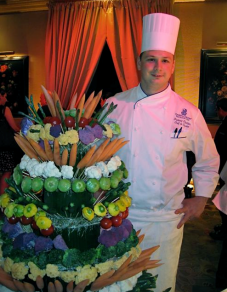
Chef/Owner Joel Thevoz of Main Event Caterers - photo by Jordan Wright

Chef/Owner Joel Thevoz of Main Event Caterers - photo by Jordan Wright

Swiss-born and raised, Joel Thevoz, hit Washington in the mid-80’s with a business degree and a briefcase full of fresh ideas. Coming off la vida loca in Costa Rica and Mexico, where his on-the-fly dinners were highly praised by friends and neighbors, he had decided to settle down to a serious culinary career.

With his wife and partner, Nancy Goodman, they launched Main Event Caterers in 1995 on K Street in Georgetown. Ten years later they were to bring their ever-expanding operations into Arlington, VA, where their stunning cuisine and lavish events garner rave reviews and an ever-increasing upscale clientele.

Main Event Caterers  - 2010 Caterer of the Year" award winner by Catering Magazine - photo by Jordan Wright

Main Event Caterers - 2010 Caterer of the Year award winner by Catering Magazine - photo by Jordan Wright

They ran their company like every other top-tier caterer until three years ago, motivated by Al Gore’s groundbreaking film, “An Inconvenient Truth”, they had a epiphany and took their successful company to higher level…one with a conscience…where green is the new black. It would hail a new dynamic for Main Event Catering and reflect their growing ecologic awareness.

Now in the vanguard of a new aesthetic, where style meets substance, this sophisticated caterer is a leader in the green revolution, as they continue to be recognized with a growing list of local and national green business awards that reflect their commitment and the calibre of their cuisine. To add to their accomplishments, this year they won the coveted “Caterer of the Year” award from industry giant, “Catering Magazine”.

I spoke with the passionately eco-knowledgeable, Joel Thevoz, and toured the 20,000 sq. ft. facility with its gleaming stainless steel demonstration kitchen-in-the-round, 25-foot floor-to-ceiling wine wall and extensive culinary library featuring a precious archive of leather-bound Gourmet Magazines dating from 1946.

Jordan Wright – How long have you been on the green bandwagon?

JT – We started out being aware of our impact in this world about 3 years ago. The Green Movement was just getting started here and, for us, that set the pitchfork in the ground in terms of thinking about what we do and how we do it.

There was one very impactful moment for us. It was a day when we were winding up after an event that used disposables. And at the time I was very proud of using the best quality plastics. I took a look at our truckload worth of waste and plastic garbage from this one event and I was literally sick to my stomach. I thought this stuff is going to last forever. What can we do better?

JW – What did you do to change your company’s way of doing business?

JT – That moment set the tone for a period of discovery. We wondered, “Can we find products that are biodegradable?” It was right about the time when cups made from cornstarch by-product became available. I had seen them used in an airport in England and brought some back with me.

For events using "disposables" - Balsa wood cutlery, palm frond plate and recyclable box from Main Event Caterers - photo by Jordan Wright

For events using disposables - Balsa wood cutlery, palm frond plate and recyclable box from Main Event Caterers - photo by Jordan Wright

But it was a real challenge to find these things in the US. We started digging around and discovered they were making plates from dead palm fronds in India. They are sandwich-pressed using steam into these flat shapes with a bit of curvature to make a plate. Then they are hand-scissored to size.

Finally we could eliminate all plastics from our catered service, and now we only use biodegradable palm plates, balsa wood cutlery, washable glassware and other biodegradable products for our events using disposables. Also we use purified water in jugs in place of mini plastic bottles.

JW – How do you recycle?

JT – We bring large recycling cans onsite, and all our staff is trained to separate out recyclables like paper, cardboard, tin, glass and plastic. Then it gets brought back here where we take it to the recycling center. It does add to the workload of an event, but we still do it effectively.

We also decided to add solar concentrators to the roof over the individual offices to bring in light and we are now replacing all our metal halide lights with T5 lights that use a minimal amount of electricity and are motion-sensitive. This way they shut off when someone leaves the room. The floors here are bamboo, the ice machines use filtered water and we clean and press all our linens to lessen our carbon footprint.

To be carbon-neutral we buy carbon credits to offset all the energy that is used, as with our trucks going to and from events. Also we calculated the approximate employee commute for the whole team and buy carbon credits to offset all those greenhouse gases, so that now we are 100% carbon-neutral. We’ve been doing that for three years.

JW – What other ways have you found to save energy?

JT – For one thing we compost our food matter to make high-quality soil that we distribute to our community, and we collect and store all of our used cooking oil, that we donate to a local biodiesel cooperative.

Also we wanted to subsidize wind power. So we purchase an equivalent amount of electricity from a wind farm. And though it is off-site, it gives us the advantage of being technically wind-powered. It tells the energy company that we are serious and we want to spend our money on clean energy…because unless you prove with dollars that there is a desire to purchase alternative energy, they won’t listen. We’ve seen how it creates momentum when a lot of companies get involved.

JW – Have you figured out how much more it costs to do business in this way?

JT – We have a general idea, and of course the start-up costs were quite high, but it is far outweighed by the amount of business we receive from clients that are like-minded. Companies and individuals who like what we are doing eventually gravitate to us and we feel rewarded.

We live happy and it has paved the way to the next stages in our development. It’s given us the knowledge and the confidence and introduced us to organizations that have things to offer us that are above and beyond anything else that we’ve done so far.

JW – What are some of the newest technologies that you’ll be using?

JT – Lately we find we are becoming a sort of incubator for green solutions.

Not long ago we had a visit from a gentleman based in Florida and began to talk about using geothermal. I mentioned how our dishwasher pushes out gallons of 180 degree water and it just goes down the drain. He told us we could divert it and harness it. Ultimately his company designed a product for us using heat exchange and we’ll be testing it here. The plan is to have it up and running in a few weeks.

In a nutshell we will be running “grey” water alongside the city water pipes to super-heat municipal water. The fresh and “grey” water don’t mix together. There are membranes between the two of them. But in this way we can take the 65 degree water from the county and introduce it through our ”grey” water cisterns before it goes into the pipes. Eventually it will raise the temperature of our instant hot water for our washing machines two-fold to 130-160 degrees. It will save us a lot on gas usage.

JW – Is that a cost to the city?

JT – No, we handle it all from here. We’ll build a tank and the city water will go right through it.

We’re also looking at placing these huge cisterns beside our buildings to gather and harness the rainwater from our roofs. Imagine! They can collect up to 40,000 gallons per month of water. What we want to do is use those tanks for latent energy.

We subscribe to a train of thought that the future of this world is based upon communities building vertical farming. We have these flat roofs here and we are in the process of designing a rooftop garden with greenhouses to grow all our own vegetables and herbs. We have at least 6,000 square feet of roof space. We want to prove that it can be done and share the plots with the community.

The greenhouse will be hydroponic and aeroponic which is a system NASA developed that uses an oscillator that is introduced into a water tank. You create a certain vibration and it renders the water into a mist. You can then push that vapor, with pressure, into a system of canals or closed chambers in which the roots of your vegetables thrive without soil. Every intermittent three minutes the pipes are filled and then flushed. It works like a rainforest. The plants grow at 2-3 times the speed.

JW- What about the “terroir” – the taste imparted to the vegetables from the soil and its minerals? Won’t that be missed?

JT – We can introduce that into the water by making a slurry from our compost and extracting the minerals out in liquid form to fortify the water, or we can buy organic feed to add to it.

Our last initiative will be to crush our glass and smelt it in kilns and create recycled glass slabs to use for platters and bowls. We are interested in inviting others, even our competitors, to see how we are doing this. We look to inspire others.

JW – What do you see for the future of catering?

JT – I foresee in the next few decades that we’ll move towards a more vegan and a more raw diet and a more healthful nutritious diet. So we’re making a small push to increase our vegetarian options and training ourselves to be better at cooking those options for our clients that want them, and for the future of our planet too.

This interview was conducted, condensed and edited by Jordan Wright.

Local Brothers Kick It with Maurice Hines in “Sophisticated Ladies”

Jordan Wright
April 2010

The Arena Stage Production of Duke Ellington's Sophisticated Ladies and choreographed by Maurice HinesThe Manzari brothers are a couple of cool dudes. So low key and under-the-radar that during a master class at the Duke Ellington School the great dancer and choreographer, Maurice Hines himself, didn’t intuit they were from the same family. It wasn’t until he singled them out from dozens of dancers that he discovered that the teens were in fact brothers. The following day Hines invited them both to an open audition at the Lincoln Theatre. It was during the third day’s callback that they were cast alongside leading man, choreographer and virtuoso performer, Hines, in the newest production of “Duke Ellington’s Sophisticated Ladies”.

In the world of dance improvisational tap scenes are called “trading”…a friendly challenge in which the dancers trade tap licks and push the percussive envelope ever higher. In a recent YouTube video Hines narrates his encounter with the amazing and adorable prodigies, John Manzari, 17, and his brother, Leo, 15, and the three do a tap-off together. You can see it here: http://www.youtube.com/user/arenastage1

(l-r) Leo Manzari, Maurice Hines and John Manzari in the Arena Stage production of Duke Ellington’s Sophisticated Ladies

(l-r) Leo Manzari, Maurice Hines and John Manzari in the Arena Stage production of Duke Ellington’s Sophisticated Ladies

Growing up in DC they danced around the living room watching PBS’s “Sesame Street” and “Zoom”, shows that presented rhythm tapper Savion Glover, doing his “free-form hard core” tap, and veteran pioneers like Maurice and Gregory Hines. Their mother, Mary Manzari, told me they started dancing when they were just tots, though none of their relatives had ever been performers.

Last fall they heard about the master class at the Duke Ellington School from Leo’s best friend’s mother who rang up Mary. They both decided to go.

While they have performed the Nutcracker with the Washington Ballet and the American Ballet Theatre at the Kennedy Center and, later worked with Debbie Allen in her Kennedy Center production of “Brothers of the Knight” and the world premiere of “Walking the Winds: An Arabian Tale”, this show will be a professional regional theatre debut for the boys, who take classes five days a week from 5 till nearly midnight. Yes, folks, that’s what it takes.

Their style is both similar and different. John describes it as, “Leo, takes the role as creator and I manipulate it so it fits with what I’m doing till we find common ground. It’s a complicated process but it makes sense.”

“We still want to stay as a brother act. My main goal is to bring tap into the R&B world of music. I want to combine the two,” says the younger Leo. “Everyone talks about how revival tap is coming up, but I want it to be a new thing that we’ll do as a brother act. When we’re dancing to music we like Michael Jackson and Stevie Wonder.”

John graduates in June from The Field School on Foxhall Road, which both boys attend, and will enter college this fall.

Wright – Tell me what it was like to work with as highly respected and accomplished a star as Maurice Hines.

John – Mr. Hines has taught me versatility. He taught me to dance to the crowd, make your movements bigger.

You never know what to expect from him. His character stays the same but it’s what he does with it that’s fun and when we have fun the crowd has fun. When it comes to step-wise with all the technical stuff, he “gives” it to us, but even more so the performing stuff…cause that’s his main thing.

Leo – Mr. Hines is a great mentor. I’ve learned a lot and I can’t wait to start performing. Just working with a legend and being part of the whole experience just makes me happy, I guess.

John – I’m really excited about the show. I was intimidated at first but then everyone was very, very kind…the whole cast, the director, the stage manager, everyone. We’re just a family…we blend together. It’s very heart-warming.

Wright – How has your ballet training helped your style and endurance?

John – Mr. Hines told me that age doesn’t matter and watching him it’s true. I forget that he’s not 17. Also I do feel that if you have ballet training you can dance a lot longer because you know how to control your body and take care of it and what muscles to build. Tap is very, very, very demanding of strength and stamina because you’re constantly pounding into the floor. You have vibrations going through your legs and even though you need to build muscle, you have to relax those muscles at the same time. So I can’t really say that one style of dance is more strenuous than the other.

Catch the break-out Manzari brothers captivating audiences in “Sophisticated Ladies”, the hot and sassy musical featuring the life and music of local legend Duke Ellington.

From April 9th till May 30th at Arena Stage at the Lincoln Theatre. For tickets and information visit www.arenastage.com

This interview was conducted, edited and condensed by Jordan Wright. For questions or comments contact [email protected]

NICFA Goes To Bat For the Small Farm and Top Local Chefs Get into the Act

Jordan Wright
March 2010

Local advocate and Weston A. Price Foundation publicist Kimberly Hartke of hartkeisonline.com - photo by Jordan Wright

Hartkeisonline published my story on the NICFA small farm lobby day on Capitol Hill.

Take a host of committed small farm advocates and add one part farmer to one part grower. Recruit a panoply of top chefs from Washington, Virginia and Baltimore, who graciously volunteered their time. Using all-natural ingredients donated by the participating local farms, passionately blend to create a delicious dish. The result: An inspiring and delightful event.

We begin with the language of organic, GMO and sustainable farming and the laws, like the very unsexy-sounding “S-510”, that govern food products and the farms they’re grown on. It’s enough to leave a layperson scratching their head and it’s easy to feel out of the lettered loop. There’s NICFA (National Independent Consumers and Farmers Association), HAACP (Hazard Analysis & Critical Control Points), LGMA (Leafy Greens Marketing Agreement), and UNCED (United Nations Conference on Environment and Development)…a puzzling jumble of acronyms to sort out…but this is a story of ourselves, the consumers, our farmer friends, and the restaurants that use the food they grow.

Last week farmers and believers organized by NICFA headed up to Capitol Hill to do some lobbying against a proposed bill entitled “S-510” that would impose draconian measures on the small farms that we, as consumers, overwhelmingly support.  The bill, known innocuously as the  “Food Safety Modernization Act”, favors large industrial farms and threatens the ability of the small farmer to do business.  In its broad scope it would afford the FDA and USDA ever greater powers, needing only “reason to believe”, in order to quarantine or shut down a farm, and fine or imprison the farmer.

Don’t we all want our food to be safe?  Well, of course we do…though the proof is in the pudding that less than one half of one percent of all foodborne illnesses originates on small farms.

Spike Gjerde (L) with sous chef of Woodbury Kitchens Restaurant at the NIFCA reception - photo by Jordan Wright

Spike Gjerde (L) with sous chef of Woodbury Kitchens Restaurant at the NIFCA reception - photo by Jordan Wright

Frequent news reports reveal that it is the operations of large industrial farms that cause most food safety issues.  Note: In the month of March alone dozens of food recalls were issued as a result of salmonella in hydrolyzed vegetable protein used pervasively in a multitude of food products such as pretzels and chips (several varieties of Pringles and Herr’s were on the list); seasoning mixes and dips (some from the ubiquitous T. Marzetti); and boullion cubes from grandma’s old stand-by Herb-Ox.

In addition thousands of pounds of such disparate products as pecans, pet foods, black pepper, and over 95,000 pounds of beef from North Carolina’s, Randall Packing, contaminated with E. coli, were recalled or voluntarily removed from grocery shelves.  Just last month over 5 million pounds of veal and beef were recalled from one California meat packer.  The list seems endless, the challenges insurmountable.  I wonder if restaurants using these products will either care enough or be aware enough to remove them from their pantries.

A recently introduced new standard known as LGMA, Leafy Green Marketing Order, and written by industrial distributors, sounds docile and concerned about the safety of our veggies.  Yet it is another burden on our small farms that has resulted in zero increase in food safety and has doubled costs to farmers within one year’s time.  Its implementation has caused the closure of small slaughterhouses, causing farmers to ship their meat hundreds of miles back and forth to distant abatoirs for processing.   As demand grows from consumers concerned about humane slaughter, we hope to see an increase in processing plants.

Beef Roasts from JuJo Acres farm prepared by Restaurant Nora's - photo by Jordan Wright

Beef Roasts from JuJo Acres farm prepared by Restaurant Nora's - photo by Jordan Wright

Translation to consumers like you and I:  Higher costs for food produced by farmers, driving some out of business and limiting our options to purchase local foods at our farmers markets.  This encourages “factory food” from farms run by huge agri-business conglomerates featuring genetically-modified and trademarked grain and industrially-raised and slaughtered cows, pigs and chicken.

On to HAACP, Hazard Analysis and Critical Control Points.  It sounds as creepy as it is.  As Joan Veon suggests, “This legislation will stymie small farms.  It is a huge onus.”

If passed, HACCP would demand that all food producers, to include small jam and jelly preservers, picklers, local bread bakers and artisanal cheese makers, put together highly detailed production plans.  These plans are often prohibitively expensive to a small independent farmer.

After a day of heavy lobbying on the Hill, guests, including Senator Mark Warner of Virginia and Senator Testor of Montana, were treated to a host of impassioned speakers.   Iconic Virginia farmer, author and rock star of the sustainable food movement, Joel Salatin; David E. Gumpert, author of “The Raw Milk Revolution”; Chef Spike Gjerde of Baltimore’s highly rated Woodberry Kitchen Restaurant; and Joan Veon, Executive Director of The Women’s International Media Group, spoke about the impact of the restrictive S-510 on small farms.

From Gumpert, who also writes for Business Week Magazine, we heard about the economic impact S-510 could bring to bear on small businesses in general.

Jamie Stachowski and son, Josef with some of their charcuterie - photo by Jordan Wright

Jamie Stachowski and son, Josef with some of their charcuterie - photo by Jordan Wright

“Jobs in this economy come from the smallest businesses.  Ninety percent of all jobs are from businesses with 20 or less employees,” he said, and raised the alarm that “since 1970 we’ve lost 80% of our dairy farms.”

But he also spoke encouraging of the resurgence of the small farm. “Smaller farms have been creating new jobs and we have added 18,000 new farms in recent years.”

In a stirring speech, Joan Veon addressed listeners on a broader scale about the multi-dimensional nature of these harsh plans on the international community of nations.   She talked of the World Food Summit Plan of Action, and about “being serfs on a global plantation.”  She warned, “It is all about control [of our resources] so that we will have no freedom and no rights.”

I left this ominous thought to ponder the bounty of the evening’s offerings.

Here’s what the chefs created from the farm products that were donated:

* A delicious deboned roast pig, from Salatin’s Polyface Farm in Swoope, VA.  Filled with an aromatic apple stuffing, roasted on a spit till its skin crackled, and served with apple bourbon broth, it was courtesy of Chef Joel Thevoz of Main Event Caterers in Arlington, VA.  Apples and potatoes used in the stuffing were from Rabbit Hill Farm, kale from Two Acre Farm and prosciutto biscuits from Meat Crafters.

Artisanal breads from Maureen Diaz with spelt flour from Small Valley Mill - photo by Jordan Wright

Artisanal breads from Maureen Diaz with spelt flour from Small Valley Mill - photo by Jordan Wright

* Sous Chef Jenn Flynn of Poste Brasserie prepared goat from Pecan Meadow Farm.

* Eric Johnson of Krishon Chocolates made chocolate truffles from donated Amish cream and butter.

* Executive Chef/Owner Tom Przystawik of Food Matters prepared Amish Chicken sandwiches on mini biscuits.

* Sonoma Restaurant did a veal stew with veal from Smith Meadow Farm.

* Charcutier Jamie Stachowski served up some of his pates, sausages, cured meats and terrines with his son, Josef. Jamie sources his meats from local farms.

* Chef Nick Sharpe of Sonoma Restaurant and Wine Bar prepared veal from Smith Meadows Farmer’s Markets.

* Lavender Moon Cupcakery’s heavenly all-organic cupcakes made, as always, with eggs and butter from Polyface Farm.

* Coppi’s Organic Restaurant prepared leg of lamb donated by Baer Farm.

* Restaurant Nora served JuJo Acres’ beef filet on mini toasts.

* Anna Saint John Catering prepared quiche using eggs and cheese from local Amish farms and bacon from Cedar Run Cattle.

* Executive Chef Spike Gjerde of Woodberry Kitchen Restaurant prepared cranberry skillet cornbread and bison chili from Gunpowder Bison Farm and oyster stew from Circle C Oysters.

* Alchemy Caterers cooked a turkey from Springfield Farms.

There were artisanal cheeses from Keswick Creamery, Cherry Glen Goat Cheese and Chapel’s Country Creamery; coffee from Zeke’s Coffee, Amish-made vanilla and chocolate ice cream and artisanal bread by Maureen Diaz with spelt flour from Small Valley Mill.

It was a fitting ending for a very enlightened gathering assembled with love and passion for a very worthy cause.

For more information visit the sites listed below.  For questions or comments email me at [email protected] or visit www.WhiskandQuill.com.

www.usrecallnews.com

www.womensgroup.org

www.thecompletepatient.com

www.slowfoodusa.com

www.certifiedhumane.org

Vilcek Foundation Awards

Jordan Wright
March 2010

At the award presentation - from left Jose Andres, Spains Ambassador, Varin Keokitvon, Jan and Marica Vilcek - photo by Jordan Wright

A humble Jose Andrés, accepted the Vilcek Prize for the Arts at the residence of His Excellency the Spanish Ambassador, Jorge Dezcallar De Mazarredo and his lovely wife, Marica this Tuesday. Eyes fixed firmly at the soaring ceilings of the elegant Foxhall Road residence throughout his introduction, so moved did he seem by this august award, one could sense that the great chef was not only thanking the culinary gods that have shone powerfully on his brilliant career, but also his family and devoted friends as well.

“It’s been almost 19 years since I came to this country,” he recalled. “I’ve been an immigrant all my life and when I came here I was received with open arms.”

This is the first time The Vilcek Foundation has recognized the culinary arts as pertaining to “the Arts” in general and it was a cultural shift for future art awards from other foundations.

Andrés was credited with bringing Spanish culture to the forefront of American cuisine while pushing the boundaries of food both as a sensory experience and vital component of well-being.

Along with Andres, Laos-born Pastry Chef, Varin Keokitvon, was honored with a Vilcek Prize for Creative Promise for his work as a chef/instructor with the Seattle-based FareStart, where he trains homeless and struggling individuals for careers in the culinary arts.

Friends at the awards reception at the residence of the Spanish Ambassador - photo by Jordan Wright

The Vilcek Foundation Prizes, founded by Dr. Jan T. and wife, Marica Vilcek, themselves immigrants from the former Czechoslovakia, were established to honor the contributions of immigrants to the American arts and sciences, and consist of a $50,000 cash prize and an award sculpture. “Our prizewinners are excellent example of how immigrants continue to fuel innovation and enrich our society,” said Dr. Vilcek.

The 2010 Vilcek Prize for the Arts is awarded in the field of Culinary Arts. The prestigious jurors include Chef Dan Barber, former Editor-in-Chief of Gourmet Magazine; Ruth Reichl, Dana Cowin, Editor-in-Chief of Food & Wine magazine; Susan Ungaro, James Beard Foundation President; and Maria Guarnaschelli, Vice President and Senior Editor at W. W. Norton & Company.

The evening’s fare was highlighted with tasty tidbits from José Andrés Catering with Ridgewells, his latest venture.

Chef Andrés will be honored at an awards presentation dinner on April 7th, 2010, in New York City, where The Vilcek Foundation is based.

For questions or comments on this story contact [email protected].