|
|
Jordan Wright
May 2010
Leading Spanish Chef María José San Román Brings Her Paellas to Jaleo’s Paella Festival
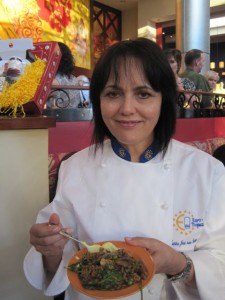 Chef Maria Jose San Ramon at Jaleo's Paella Festival - photo by Jordan Wright José Andrés and his culinary team at Jaleo will celebrate this year’s Paella Festival from June 7th through the 20th. The paellas will be based on the recipes of guest chef María José San Román of Alicante, Spain.
One of the leading female chefs in Spain, she is self-taught and expert in traditional Catalan and Valencian cooking, choosing a career in restaurants after studying law and languages. Today she and her family preside over a number of highly rated restaurants in the Alicante area including La Taberna del Gourmet and the critically acclaimed Restaurante Monastrell.
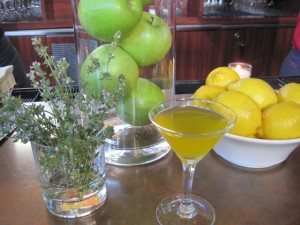 A bit of refreshment with saffron, green apple and rosemary flowers -photo by Jordan Wright San Román has presented at a number of culinary conferences around the world including the Culinary Institute of America’s “Worlds of Flavor” conference in Saint Helena, California and the prestigious Madrid Fusion conference. An internationally recognized expert in “crocus sativus”, she works closely with the Universidad de Castilla La Mancha and the Spanish saffron industry and travels the world lecturing on saffron. Her book on the subject “El libro del azafran” will be published by Montagud in October of this year in Spanish and in English.
Chef San Román’s paellas combine interesting ingredients with various types of rice, resulting in exceptional taste and texture. Featured dishes will include Arroz con pluma ibérica y verduras de Alicante, Iberico pork paella with green
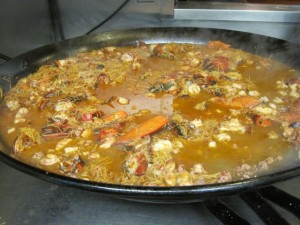 Seafood paella -photo by Jordan Wright garlic and seasonal vegetables; Arroz caldoso con cigalas, soupy rice with Norway lobster, Fideos finos tostados con bogavante, vermicelli paella with lobster; Arroz con verduras y setas de temporada, paella of seasonal vegetables and mushrooms and Caldero de pescados con arroz finito a banda, fish stew with rice. The specials will be rotated throughout the two weeks and will be available for lunch and dinner.
Jaleo has locations in DC, Bethesda and Crystal City.
www.Jaleo.com
Jordan Wright
May 2010
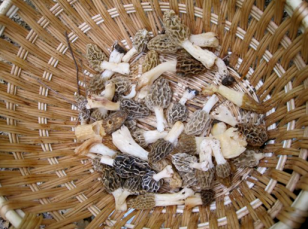 A cache of the elusive morel - photo by Jordan Wright The season for morels is upon us, and the only way in God’s creation I was going to collect and eat a wild mushroom was to go into the woods accompanied by an expert mycologist. Anything else was a deal-breaker. I put the thought of the odd copperhead out of mind and prepared for my orientation with the President of the Mycological Society of Washington (MAWDC), Ray LaSala; Forays Chair, Mitch Fournet; and a couple of the club’s “shroom” experts. It was no small feat to tamp down my excitement at the possibility of discovering morels less than thirty miles from my front door, but there is nothing like mystery and adventure to fire up the spirit, and morels have a certain earthy allure to a chef.
With samples of chanterelles and morels spread out on a picnic table for viewing and instructions on how to cut the mushroom…pick first then cut off at the base…we signed waivers releasing MAWDC from our possible imminent demise due to picking and eating dangerous fungi.
A soft rain was beginning to fall when our group of fifteen neophytes tromped off with our group leaders. We had come armed with field compasses, net bags or woven reed baskets, magnifying loupes, and pocketknives for collecting the precious specimens. I chose Culinary Chair, John Harper, hoping to gain some insight as to how to prepare my much-anticipated cache.
There are certain distinctive characteristics regarding terrain, weather conditions and flora, that entice the spores of the morel to spring up out of the leaf litter, fully formed and reveal themselves to the novice forager.
The most auspicious time of year for collecting morels is when local cherry trees drop their blossoms, the black locust is flowering, and the purple pink flowers of the Eastern redbud dot the landscape. One should look for tulip poplars and the soft carpet of leaf litter beneath the trees. Old apple orchards in flower, and decaying elms, both Slippery and American, especially when the tree is rotting out, can provide an excellent habitat for morels.
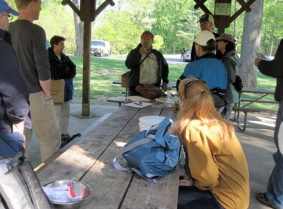 Orientation by MAWDC President Ray LaSala - photo by Jordan Wright Another clue can be the ash tree (fraxinus species) with its white-splotched diagonal bark carved with deep furrows. When identifying the ash, Dr. David L. Roberts of the Michigan State University Extension writes, “Very few trees in our landscapes and forests have opposite branching. The predominant types are maple, ash, dogwood and horsechestnut. A simple phrase to remember when identifying trees with opposite branching is to use the acronym ‘MAD Horse’ which represents Maple, Ash, Dogwood & Horsechestnut.” That sounds like a helpful tip to me.
As for optimum climactic conditions, temperatures should be in the high 50’s and there should be rain or overnight dew. Precisely the conditions we had last week.
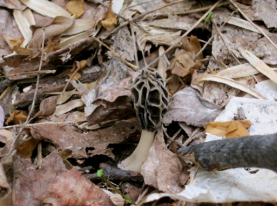 The elusive morel - photo by Jordan Wright LaSala told us, “Morels grow in a sight line like telephone wires.” So if you spy one, chances are you can find more in a row stretching out on either side. He describes its appearance as “a hollow swayed stem, “felty” in feel and with no overhang.” He warned us that it is poisonous if eaten raw. Dried they can last for years (LaSala has a stash of morels he regularly taps into) and they are easily rehydrated.
Within minutes of our setting off, cries of, “I found one!” and “Is this a morel?” echoed throughout the woods and groups converged to investigate the sight line for more treasures nearby. LaSala said that before picking, “Australian Aborigines do a tap-tap-tap with their feet to spread the spores for future hunters.” And he advised, “Not to spread the leaves or rake as it disturbs the natural environment.”
As we foraged through likely habitats, heads bent and eyes trained laser-like to the ground, it became abundantly clear that there were some novices in the group that were far better at spotting morels than others. And after two hours of searching and finding only one tiny morel, I must confess I resorted to botanizing.
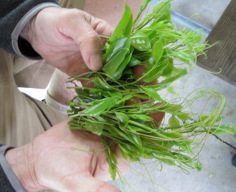 Edible greenbrier vine tendrils - photo by Jordan Wright Pleasantly distracted by spring ephemerals, I spied delicate Virginia claytonia, mayapples, numerous fern species, Solomon’s seal, and Jack-in-the-Pulpits peppering our path. Along with chomping on the early garlic mustard leaves, we cut off the tender shoots, leaves and tendrils of the greenbrier vine for salads. They taste like asparagus, only better, if you can imagine that!
In the end I decided that my astigmatism didn’t allow for more precise deciphering of the beiges and tans of the leaf litter and consoled myself with the successes of my fellow foragers who were over the moon dreaming of their trophies in their dinner plans.
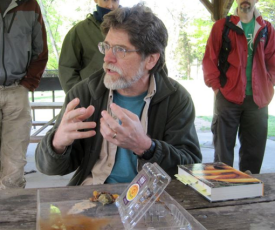 MAWDC Culinary Chair, John Harper instructs the novice foragers - photo by Jordan Wright If you decide to purchase morels you can get them dehydrated – one ounce for $16.99 at Balducci’s and at Whole Foods for $19.99. If you’re luckier than I was, ½ pound of fresh morels is approximately the equivalent of one ounce.
Here is a delicious recipe to try that uses one ounce of dried morels. It’s from Sous Chef Matt Finarelli of Open Kitchen in Falls Church.
Red Wine Morel Cream Sauce
Yield: 1½ cups
Ingredients:
• 1 oz dried morels
• 1½ cups heavy cream
• 1 ea shallot – small dice
• 2 cloves garlic – minced
• ¾ cup red wine – Zinfandel or Syrah work nicely
• 1 Tbsp Cognac
Method:
– If you have fresh morels, dry them in a paper bag on your counter top for a few days. It’s important to start with dried morels so they can absorb the cream.
– Rehydrate the dried morels in the cream for about 2-4 hours
– In a saucepan over medium heat, sweat shallots in a small amount of oil until translucent, then add the garlic and cook until fragrant.
– Add the red wine, and reduce gently until it has almost all evaporated.
– Add the morels and the cream they soaked in and gently reduce the mixture to about 1 cup in total volume.
– Remove some morels from the sauce to save for garnish if desired, puree rest of sauce to a smooth consistency in a blender or with an immersion blender.
– Return sauce to pan, place back on heat, add the Cognac and reduce slightly.
Serve this sauce with game bird (like pheasant, guinea fowl, quail or partridge) or on top of rabbit. Also, be sure to add any accumulated roasting juices (fat removed) from the meat to the sauce – it only helps the final flavor that much more!
www.openkitchen-dcmetro.com
This article in no way suggests or promotes consuming wild mushrooms of any kind without an expert guide. Contact the Mycological Society of Washington for guided forays, pot luck mushroom dinners and membership information. www.MAWDC.org
For questions or comments on this article contact Jordan@WhiskandQuill.com.
Everything You Always Wanted to Know About Healthy Baking, But Were Afraid to Try
Book Review
Jordan Wright
May 2010
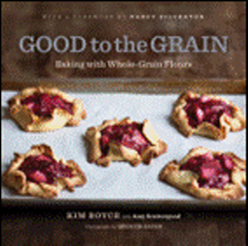 Good to the Grain: Baking with Whole Grain Flours by Kim Boyce It should come as no surprise, when the topic is about healthful foods, green lifestyles and fine wines…California will lead the way. So when I read author Kim Boyce’s bio, and noticed her background was carved from a career as a pastry chef at LA’s famous Spago and Campanile restaurants, I knew that “Good to the Grain: Baking with Whole-Grain Flours” was going to be a groundbreaking cookbook by a hands-on expert in baking.
In her book, Boyce tackles a subject where most bakers fear to tread…that of baking with whole grains. For anyone who has ever tried substituting whole wheat flour into a recipe that calls for white flour, the experience is deflating at best. The final product, whether loaf or crust, will no doubt emerge so tough and dense as to be edible by only the most virtuous among us.
But Boyce shows us not only how to incorporate more nutritious grains and flours like whole wheat, but also a wide spectrum of other flavorful grains like kamut, spelt, amaranth, oat, corn, buckwheat, rye, quinoa, barley and the malty Ethiopian grain “teff”, usually employed in a recipe for that nation’s spongy “injera” flatbread.
Using a novel approach she bakes the unique “teff” into Date Nut Bread, that once ubiquitous throwback that hasn’t been seen in stores in decades. I still harbor fond memories of the sweet, dense bread made into sandwiches filled with cream cheese and homemade preserves. Because she includes a handful of tempting recipes for jams and compotes in the back of the book…perhaps I’ll make her Rhubarb Hibiscus Compote to slather on my bread while the jewel-hued stalks are still in season.
Though the history of each grain is explored in these pages, there is no mention of the increased nutritive value the various grains contribute to our diet. Yet Boyce’s knowledge of the quirks and foibles of home baking and her friendly storytelling before each recipe, gently guide and inspire the reader with an invitation to share in her whole grain epiphany.
Plumbing the intimate relationship with baker and recipe are photographer Quentin Bacon’s evocative pictures that take us into an old-fashioned kitchen. His reverence for simple glass jars filled with Poppy Seed Wafers made with buckwheat flour; well-worn muffin tins filled to the brim with Ginger Peach Muffins made with oat flour; and wooden cutting boards that form a platform for Olive Oil Cake. A lush picture of Boyce’s Quinoa and Beet pancake batter bubbling off in a glistening cast-iron skillet, convinces the reader that here are simple recipes that anyone can master.
You’ll also find instructional pictures of kneading, rolling out and forming biscuits and pie dough, helpful to the neophyte baker, and the book abounds with informative tips from an experienced chef that has made all the mistakes for us and is willing to acknowledge the ofttimes humbling process.
You may want to try Fig and Nut Muesli made with quinoa, flax seeds and Black Mission figs, or rustic Apple Boysenberry Tarts made with rye flour and seasonal fruits. I’ll think I’ll serve the Corn and Blueberry Cookies in July when the berries are at their peak.
Here’s a delicious recipe to try as a Mother’s Day breakfast-in-bed treat.
Honey Amaranth Waffles
2 ounces (1/2 stick) unsalted butter, melted, for the waffle iron
Dry mix:
1/4 cup amaranth flour
1/4 cup flaxseed meal
1 cup whole-wheat flour
1 cup all-purpose flour
2 tablespoons sugar
2 teaspoons baking powder
1 teaspoon baking soda
1 teaspoon kosher salt
Wet mix:
2 cups buttermilk
1/4 cup plus 2 tablespoons honey
2 eggs
2 tablespoons unsalted butter, melted and cooled slightly
Finish:
Greek yogurt, optional
1. Turn the waffle iron to its highest setting. Even if you don’t usually heat it this high, these waffles come out best when cooked at high heat. Sift the dry ingredients into a large bowl, pouring back into the bowl any bits of grain or other ingredients that may remain in the sifter.
2. In a medium bowl, whisk together the wet ingredients until thoroughly combined. Using a spatula, add the wet ingredients to the dry ingredients and gently combine. The batter will begin to bubble and swell as the baking soda begins to react with the buttermilk.
3. Brush the waffle iron generously with butter; this is the key to a crisp crust. Use a ladle or measuring cup to scoop 1/2 cup batter onto the spaces of the iron. Promptly close, and listen for the iron to sigh as the batter begins to cook. The smell wafting from the iron starts out like a freshly kneaded loaf of bread, then becomes toasty. Remove the waffle when the indicator light shows that it is done, or when a quick peek shows that it’s turned a dark golden-brown, 4 to 6 minutes. Remove the hot waffle with a fork, and repeat with the remaining batter.
4. The waffles are best eaten right off the griddle, with a bit of butter, a drizzle of honey, or a hearty spoonful of Greek yogurt, as desired.
For questions or comments on this article contact Jordan@WhiskandQuill.com
Jordan Wright
April 2010
 Chock-a-block with the best kitchen equipment and supplies - photo by Jordan Wright For those professional cooks or weekend iron chefs who prefer to whip up a soufflé using a French copper bowl or create artisanal  La Cuisine - The Cook's Resource - photo by Jordan Wright chocolates with edible gold leaf or a color riot of pretty dye-free sugar sprinkles, the tiny Provencal green and pink townhouse, La Cuisine in Old Town Alexandria, where they have been selling some of the finest quality cookware and gourmet food products for 40 years, is an unparalleled culinary resource.
Sourcing the Most Sought-after Kitchenware
Here you’ll find everything from earthenware tagines to make authentic Morroccan stews, cookbooks, olive wood scoops and spoons, the most extensive collection of baking gear, dozens of wooden butter molds, cookie cutters in a myriad of shapes and sizes, enough copper pots and molds to re-plate the dome of St. Peter’s Basilica, and pots, pans and knives from the likes of Mauviel, Messermeister, Pillivuyt, Combrichon, Sabatier, Lodge Cast Iron and Shun. And that’s just a soupcon!
You’ll also find culinarily-knowledgeable assistance from owner, Nancy Pollard, and her staff, Stephanie Gorenflo and Larissa Avendano, who between them have dozens of years of cooking experience.
Classes for the Cook – Young and Old
They also offer classes in knife skills from Joe Raffa of Oyamel; marzipan, chocolate molding and fondant classes from Phyllis Farzam; cookies and pie making from Betsey Cukla of Hammersong, of the adorable cookie cutters; and cooking lessons for kids by Alicia Cherry, which sell out fast.
 Wooden cooking utensils at La Cuisine - photo by Jordan Wright If you’re serious about cooking, or aspire to be, you’ll find everything from Marcella Hazan’s beloved 00  The Perfect Italian 00 Flour is here - photo by Jordan Wright Italian flour to trendy top-notch carbon-steel crepe pans. You did know that crepes are back!
Visit the adorable shop or find them at www.lacuisineus.com.
For questions or comments about this article contact Jordan@WhiskandQuill.com.
 Copper pots and molds at La Cuisine - photo by Jordan Wright  Burl wood utensils - Photo by Roy Wright
Jordan Wright
April 2010
When I heard they had revamped The Jockey Club, Washington’s bastion of the Old Guard and sanctuary for the well-heeled, my heart sank. The power dining spot in its heyday, it was a place where gentlemen’s chauffeurs awaited; purposeful young men, hoping to impress, brought their dates; and fashionable ladies lunched in suits and jewels. It stood alone in cataloguing the to-ings and fro-ings of elite Washington society. And though the menu rarely changed, there was comfort in the veal paillard avec foie gras and the delicate Dover sole meuniere. No culinary acrobatics here.
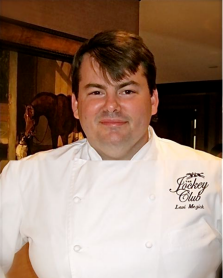 Jockey Club Executive Chef Levi Mezick - photo by Jordan Wright On a perfect spring afternoon we drove up to the porte-cochere at The Fairfax at Embassy Row. The original Jockey Club lantern stood beside the black-booted jockey, still sporting his red and white racing silks, and the etched brass plaque were in situ as we strode into the newly decorated dining room. Gone were the red-and-white checked tablecloths and the dark-stained wooden booths (how they had held such charm is now inexplicable), in their place an elegant, understated room flooded with sunlight, soft colors, suede banquettes and equine portraiture.
But the food, my dears, after all, that is why I have come.
Levi Mezick is a young chef whose Modern French cuisine has thrown down the gauntlet to every French chef in this city as he 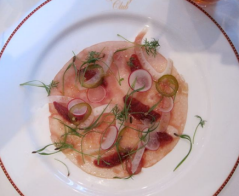 Snapper Carpaccio at The Jockey Club - photo by Jordan Wright displays a new dynamic for gastrophiles in this city. Mezick trained under Edouard Loubet, the Provencal chef whose Domaine de Capelongue restaurant in Luberon sports two Michelin stars. He cut his teeth in the New York kitchens of Daniel Boulud at Daniel and Café Boulud, and later at Thomas Keller’s Per Se. All revel in three Michelin-starred restaurants and all are in the forefront of progressive French cuisine.
We started with a simple butternut squash soup with cinnamon croutons and cranberry coulis, nicely executed though a bit behind the season. But it was the next dish, a snapper carpaccio, exquisitely articulated and looking for all the world like the circles of Fibanacci with rings of blood orange segments and red radishes swirling around the thinly-sliced raw fish, that foretold the glories that lay ahead.
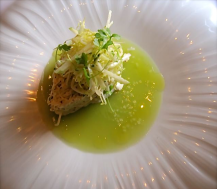 Maryland Crab Salad with green apple gelee on sunflower china - photo by Jordan Wright We swooned and chirped over a glorious crab salad, a destination dish, mounted atop green apple gelee and celery root remoulade, an old French classic reinvented with a lively balance of creamy and tart. A delicious bread-crusted sea bass on Basmati rice, showed Indian-Asian influences with trails of coriander, tamarind and Kaffir-lime oil highlighted by tender baby bok choy aswirl in an airy coconut foam.
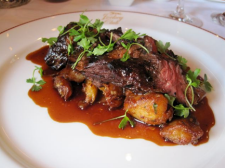 Duo of beef with Bordelaise sauce - photo by Jordan Wright A duo of Pineland Farms local beef…red wine-braised short rib and seared strip loin…struck a lovely chord among sunchokes and pommes Dauphine that were accented by a rich sauce Bordelaise fragrant with marrow bone, wine and herbs.
Sadly, desserts don’t measure up to Meznick’s triumphs. Pastry Chef, Lisa Hood, who was at the Inn at Little Washington and Westend Bistro by Eric Ripert will hopefully have more to offer on my next visit. For the present, a serviceable but plebian chocolate-crusted Key lime cheesecake with raspberry coulis, and a Valrhona chocolate crème brulee with fresh berries will have to suffice.
It was too early in the day to tipple, but rest assured the wine list is breathtaking. Cellaring over 450 labels and vintages, it is certainly one to explore over many occasions. Mostly weighted on the French side it ranges from Nuits-St. Georges, Pommards and Chambertins to Meursaults and Puligny-Montrachets. Yet there are also stunning Brunellos and Barolos and nine Chateaux d’Yquem to quibble over.
This “new” Jockey Club is as alluring as a first kiss. Just as impressive as ever, it has returned with a fresh cachet, a winning new chef and a dining room to match the restrained elegance of its cuisine.
For questions or comments contact Jordan@WhiskandQuill.com.
Celebrating Cinco de Mayo at Home
Jordan Wright
April 2010
Deborah Schneider was smitten the first time she ever sunk her teeth into a taco. “Wow! I thought it was the best thing I ever had in my life.“ For a Canadian growing up on “ham steaks with pineapple  Amor y Tacos by Deb Schneider—Executive Chef of SOL Cocina in Newport Beach rings”, it was a revelation and a call to arms.
In “Amor y Tacos”, her third and latest book on Mexican cuisine (her 2009 “Cooking with the Seasons at Rancho de la Puerta” was nominated for a James Beard award), Schneider brings her love of fresh, street-style Mexican food infused with a modern twist. “I love the immediacy of this food,“ she told me in a recent interview.
“What really got me interested was working alongside Mexican cooks from Puebla or Michoacan in a restaurant where we were made classical French and Italian dishes. They told me fascinating stories about their mothers and grandmothers and the villages they came from. I got interested in the history and evolution of Mexican cuisine, looking at it as an anthropologist would.”
As the Executive Chef and partner of Sol Cocina, a Baja-influenced restaurant in Newport Beach, CA, Schneider developed the authentic easy-to-make recipes while Manny Hinojosa, a friend and local rep for Corzo and Cazadores tequilas who set up the bar program at her restaurant, shared some of his personal drink recipes for the book.
In a section designed to help you plan everything from a Cinco de Mayo celebration to summer barbeques, she shows you how to pair her authentic recipes for tacos and antonitos (“little bites”) with her outrageous margaritas (Pineapple Serrano and Tangerine Ginger got my attention), sangritas and mojitos.
Tips Schneider gave me for products and resources she prefers are: pickled jalapenos from La Victoria; a crumbly goat cheese in log form, like Laura Chenel, and Mexican chorizo. “It’s like a paste. You have to cook it for a long time till it’s brown and crumbly, to release the garlic and pepper flavors,” she advises.
For lard she recommends the pork lard found in Latin grocery stores that stays in liquid form even when cold. “It tastes like smoked pork.”
Make sure to check out the section on decorating your cocktails to really make them stand out. I love her idea of spearing shrimp or scallops on a skewer with a cherry tomato and lime or chile on the tip. Dinner and a drink in one!
Here are Schneider’s suggestions for your Cinco de Mayo celebration.
Shrimp Tacos Dorado
Carne Asado Tacos Vampiro (her favorite)
A few different salsas (the Mango Habanero sounds great!)
Guacamole
Black Beans and Rice
Margaritas, Sangria, Mexican Beer
Shrimp Taco Dorado
from “Amor Y Tacos”
Makes 12 substantial tacos, enough for 6 hungry people. The dorado taco is a supertaco—a new trend in which the basic taco is elaborated upon by adding more salsas, cheese, and garnishes; adding layers; toasting and frying; and generally pushing the taco to its limit. (See also the Taco Vampiro, page 107.) A good dorado is gooey, substantial, and filling—a corn tortilla fried on the griddle with a little butter or oil until golden and half crisped, then stuffed with cheese and any number of fillings and sauces.
This taco, a favorite of mine, tops melted cheese with garlicky shrimp, guacamole, and chipotle salsa, then finishes with a spoonful of sweet-hot mango habanero salsa and fresh cilantro sprigs. It all comes together quickly, so make sure everything is ready to serve before you start cooking the shrimp.
Ingredients
1 tablespoon plus 2 teaspoons butter or olive oil
1 teaspoon chopped garlic
1 pound medium shrimp, peeled, tails removed, and cut in half if large
1 teaspoon finely chopped chipotles in adobo
1⁄4 teaspoon salt
Large corn tortillas
11⁄2 cups grated Jack cheese
Chipotle salsa (page 138)
Guacamole (page 77)
Mango habanero salsa (page 136)
Cilantro sprigs
1. In an 8-inch sauté pan, melt 1 tablespoon of the butter or oil over medium heat.
When it is heated, but not brown, add the garlic and shrimp, and cook, stirring, until the shrimp are pink. Stir in the chipotles and salt and remove from the heat.
2. Preheat a heavy pan or griddle over medium heat and brush it lightly with some of the remaining butter or olive oil. Set a corn tortilla on the griddle and scatter 2 tablespoons of shredded Jack cheese evenly over the tortilla. Set 3 or 4 shrimp on one side of the tortilla. When the cheese starts to melt, fold the tortilla in half over the shrimp, and continue to cook on both sides until the cheese is melted and the tortilla is lightly crisped and golden brown.
3. Open the taco. Dollop 1 teaspoon of chipotle salsa on top of the shrimp and follow with a tablespoon each of guacamole and mango habanero salsa. Tuck a couple of cilantro sprigs into the opening and serve right away.
If you decide to visit her restaurant on the Balboa Marina in Newport Beach go to www.SolCucina.com for menus and reservations.
|