|
|
Jordan Wright
March 2012
Special to Indian Country Today Media Network
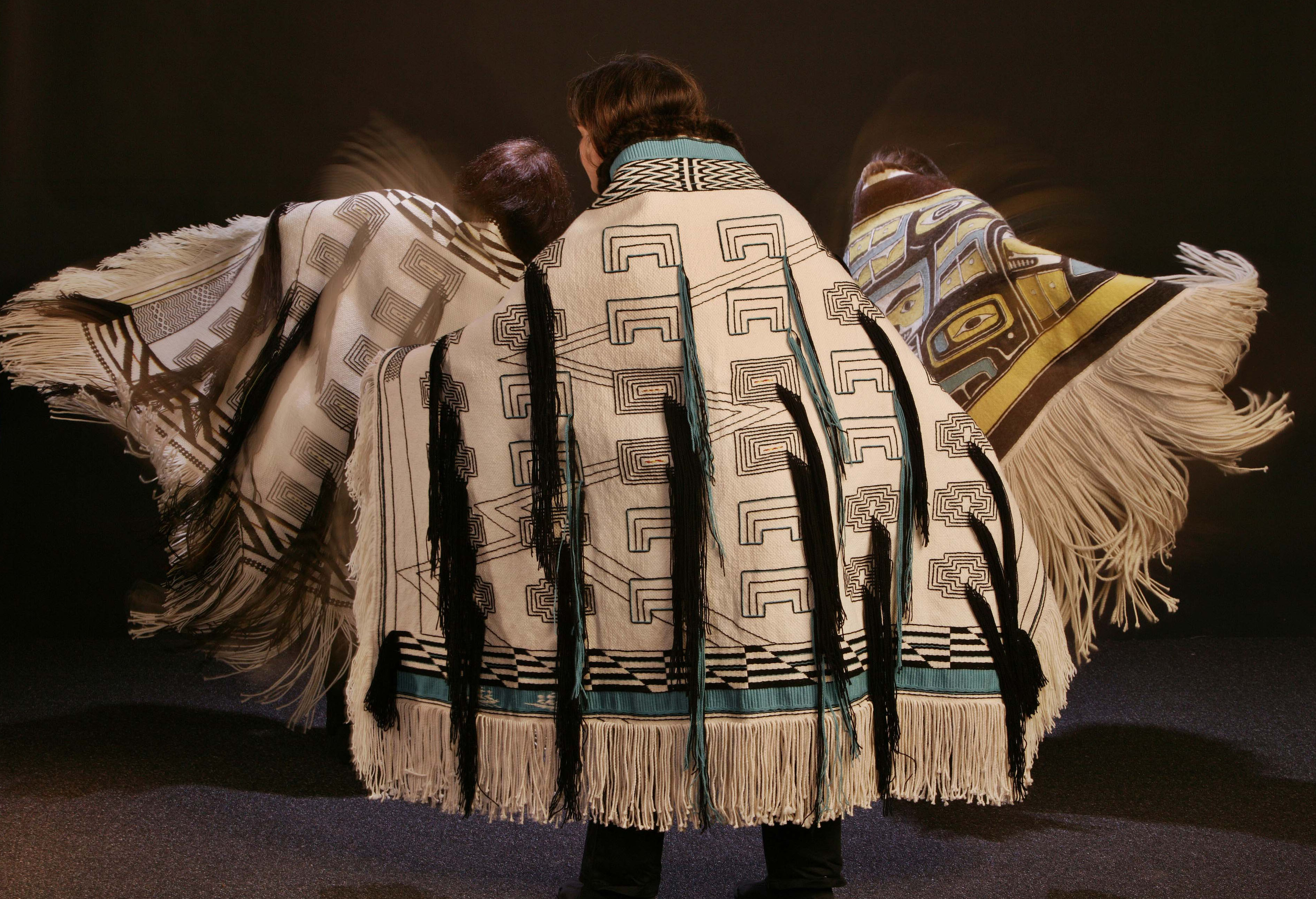
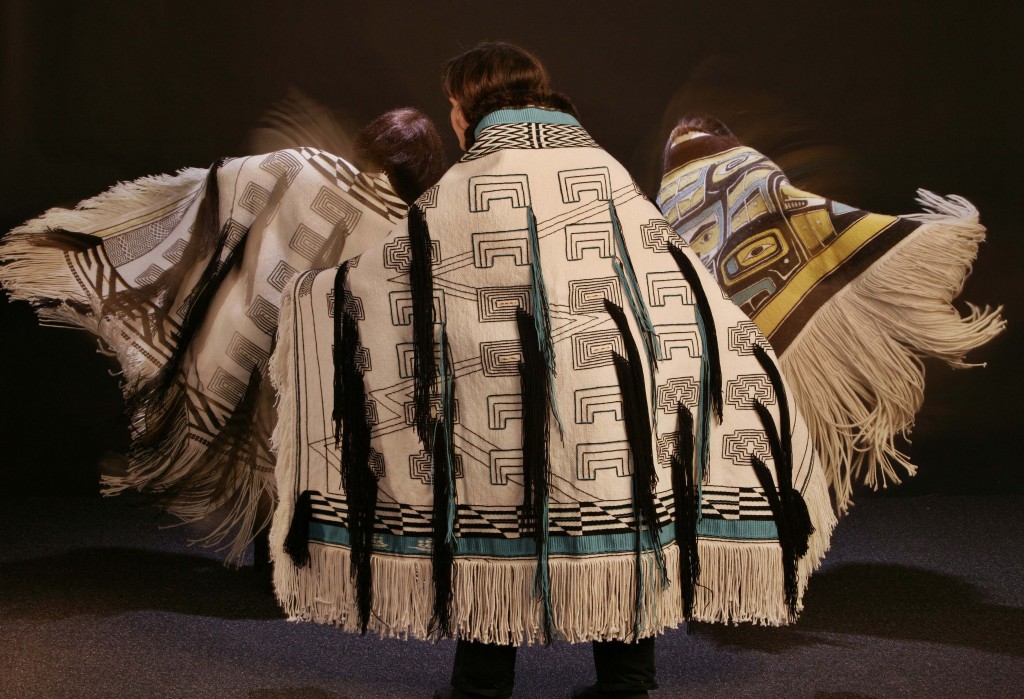 Terri Rofkar's Lituay Bay Robe Teri Rofkar (Tlingit of the Raven Clan from the Snail House) of the Sitka Tribe of Alaska sees patterns and shapes emerge from wool and roots. Using cedar, spruce tree roots, ferns, and mountain goat wool she collects in the woods, and along the shoreline of her Northwest coast home, the internationally renowned artist has been weaving exquisite baskets and textiles for over 25 years. Her robes are made with traditional Sitka freehand weaving techniques that date back over 6,000 years. Descending from a family of weavers she is inspired by “a deep connection to my ancestors.”
In creating ceremonial regalia she weaves in the once lost art of the Tlingit Raven’s Tail style of twining that uses ‘formline’ figures to represent the creature or spirit. Rofkar’s expertise also extends to the more highly stylized and representational Chilkat style of curvilinear and circular forms, one of the most complex weaving techniques in the world and the only one that can create perfect circles. Chilkat robes feature long wool fringe and are used for both ceremonial as well as dancing robes.
But though these loom-free techniques derive from an ancient culture, Rofkar is not wedded entirely to the past. “I listen to heavy metal when I work,” she cheerfully explains debunking the notion that she is a strict traditionalist unwilling to experiment with new concepts as an artist. “Change is the one thing that is constant. Traditional arts continue because they adapt and change with society. I’m not changing the methodology. It is the same as it was thousands of years ago. My technique and my intent are still there.”
Her latest project the “Tlingat Superman Series” will comprise three ceremonial robes, two of which will use modern technology. She credits a seminal meeting with the noted anthropologist and textile expert, Alice Kehoe, who spoke to her of “extending yourself beyond what you might be capable of” that drove her to explore new ways of applying her technique.
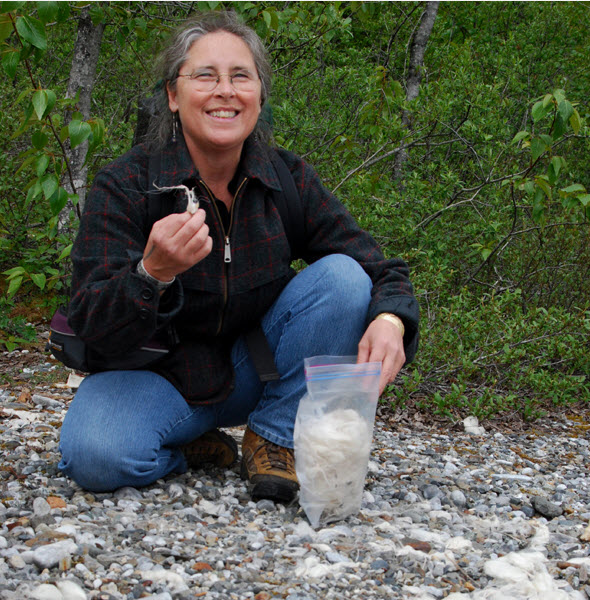 Teri on the beach with mountain goat wool The first and most traditional robe, which Rofkar estimates will take over 2,300 hours, will be in the earlier Raven’s Tail technique and will be woven from mountain goat wool that she spins herself. “These robes are created all by hand. It’s the same kind of textile you see with Kennewick man, found 9,000 years ago in Oregon, or the mummies of South America, discovered around 30,000 years ago,” she elaborates. “The patterning on the robe will be accurate. Design work and art was our written language. Our village goes back 11,000 years with its stories of flood times and when the ice advanced.”
The complexity of the Tlingit style of finger weaving is well known. “We used math and science, but we didn’t use Western terminology for it. So in the Western mind it didn’t exist. Weaving is all math and not many numbers,” she says.
Drawing from symbols of animals and clan crests spoken of in Native oral history, traditional robes can often include headpieces with frontlets that might include sea lion whiskers or shells. “In Alaska our top predators have been bears and killer whales and I plan to weave grizzly bear tracks and killer whale teeth patterns into the robe.”
As an eco-conscious artist and 2004 Buffett finalist for Indigenous Leadership, Rofkar is concerned with sustainability and stewardship of natural resources and her passion is palpable. Some of the trees she sources from are hundreds of years old and known to her family for generations. “Tlingit culture recognizes that animals, plants, people and places all have spirits and American Indian relationships to the earth are great examples of this. Native people left the land sustainable and preserving the environment is a part of the Indian community since we’re so in tune with it,” she asserts. “In fact when the invaders came it was like, ‘Hey! There’s nobody here!’ ”
Following this philosophy she will use locally found copper and hemlock bark for the coloring and mountain goat for the wool. “I just found an ancient population of mountain goat for my wool fiber source,” she reports. In addition she will use her beadwork skills to describe the building blocks of life, “I will incorporate the double helix [into the robe], because it represents the proteins of amino acids. “
In 2010 Rofkar visited the Kunstkamara Museum in St. Petersburg where she viewed the largest collection of the oldest Raven’s Tail robes. “They had six robes. All acquired in Lituya Bay in 1788. They realize how important they are. I had no idea they came from that area. Ten years earlier I had woven my Lituya robe that was all about my clan group and the fault lines and plate techtonics and megatsunamis of the area. It sure gave me the context of why I’m so obsessed with them.”
Another robe will be created from Kevlar, a bulletproof fabric. It’s what she defines as her “tongue-in-cheek” reference to the Sitka park rangers who wear bulletproof vests. “In our Native communities there isn’t even any car theft. We only have 14 miles of road here. When we’re in our cars we call it joy riding!”
Of the recent use of Native images for ‘homeland security’, she explains, “There have been a plethora of images for the term, so this is my political statement. They [the park rangers] are the people that are the caretakers of our sacred ground. It’s not for protection from the bears that they wear it.”
“When I do my patterning on the Kevlar robe I will use those top predator patterns and do it accurately. It will be where science and art meet to tell the stories of legends and dance – to stretch our creativity. When I first came up with the concept I didn’t tell anyone for a while. I knew it was risky,” she admits. “But I knew if I didn’t get it out there it would haunt my dreams.”
The final piece in the series is called, “The Robe of Enlightenment”. It is inspired by the Maoris of New Zealand whose ancestral war chants sung during their rhythmic Haka dance is also used by Hawaiian football teams before a game or after a win. Rofkar recognized elements of Maori symbols that are similar to Native Alaskan weaving.
Haka is the theme song for this robe. It has the embodiment of the “Okay, we’re ready. Bring it!” she emphasizes. She also acknowledges being inspired by Del Beazley’s popular Hawaiian Maui “Superman” song. “I think it embodies leadership. And I’m looking for a hero. Before there was a Clark Kent there was a Superman.”
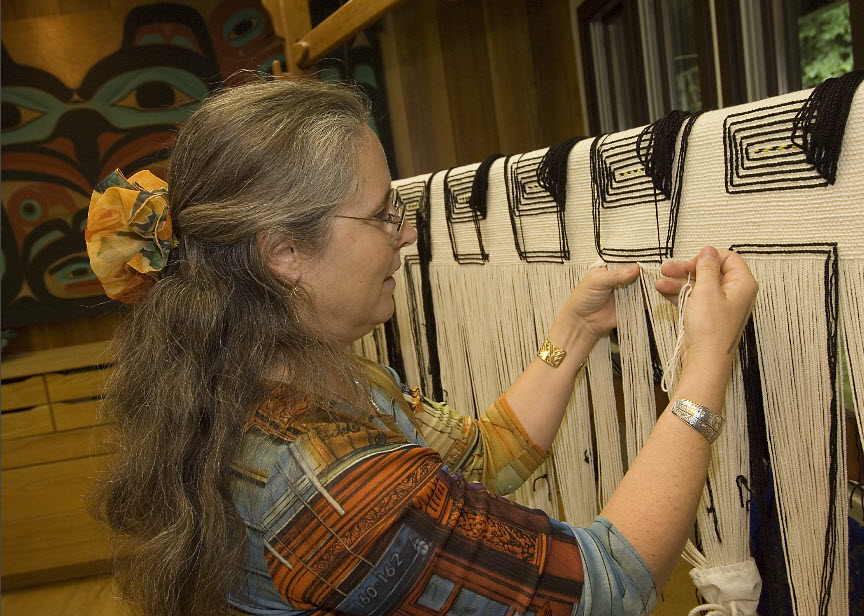 Rofkar weaving a continuum robe In this garment her strategy is to fuse luminescence and nanotechnology into the fabric. “I visualize it as the warps are fiber optic and could be in an audio frequency that gets louder, and the wefts are embedded with nanofibers that are aluminum and programmable. Tassels and lights could be embedded too and change color, “ she describes, “much like the story of the raven changing color.
As a lecturer and educator Rofkar has taken her woven arts to the Peabody Essex Museum in Massachusetts, the Field Museum in Chicago, and the American Museum of Natural History in New York. In 2006 she was the Native Arts “Smithsonian Visiting Scholar” at the National Museum of the American Indian (NMAI) and in 2004 she won the Governor’s Award for Alaska Native Arts.
She received a USA Fellowship in 2006 and performed at the inaugural USA Fellows Celebration at Jazz at Lincoln Center dressed in one of her spectacular robes. In 2009 she was awarded the National Cultural Heritage from the National Endowment for the Arts, the highest honor in the folk and traditional arts.
She is aware of her responsibility to the craft. “I am really challenged to incorporate today’s fabrics and technology into the traditional textiles because those are the textiles of this generation. I thought how awesome it would be to take the regalia to the next level where it would be programmable, where I could integrate the knowledge that young people have today with music and sound and hip-hop into the Robe of Enlightenment.”
Reflecting on the future of art and its relationship to technology she muses, “If we don’t use our creativity and stretch it in ways that it hasn’t gone before, how do we know what the applications are. When we go into space we learn a whole lot about what our technology is and can apply it to other things. I think that this kind of thinking is something that has been missing.”
Acknowledged to be one of the few living practitioners of the Tlingit woven arts, she ventures, “I thought, I’m the one carrying the culture forward by doing the weaving and creating the pieces, and all of them have extensive stories about plate tectonics and earthquakes, mega tsunamis and migration. I feel I am just the conduit. It’s the twining that is moving through me.”
Rofkar’s work can be seen at the National Museum of the American Indian (NMAI) in Washington, DC, the University of Pennsylvania in Philadelphia and the Museum of the North in Fairbanks, Alaska.
 The Cliffs of Moher - photo credit Jordan Wright Jordan Wright
Go Green!
After a grand sweep through Ireland last May, I have become a huge fan of their hospitality… and especially of their food and drink. I visited the Jameson Distillery (a bit of a jolt to sip whiskey at 11am) and had a private tour of the spectacular Guinness Storehouse with lunch in the Executive Dining Room where the Queen of England, clearly following my lead, enjoyed lunch the following month. The country has achieved extraordinary culinary successes over the past ten years. So let’s cheer them on from our shores by toasting to the Emerald Isle.
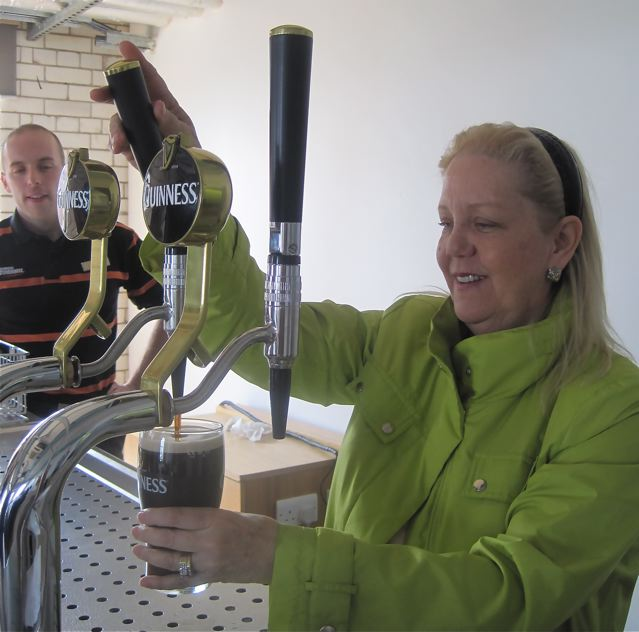
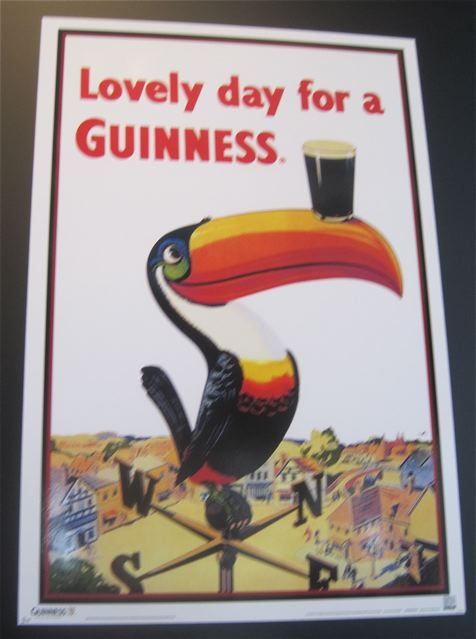 Early poster art from the Guinness Storehouse in Dublin - photo credit Jordan Wright 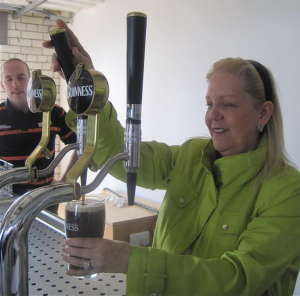 Jordan learning to pull the perfect Guinness Drop in for a dram at the Irish-owned and brand new The Dupont Circle Hotel where they’ll celebrate their Irish lineage by literally going green – from LED lighting to the staff sporting leprechaun-green shirts. Specialty cocktails and dishes that recollect the Emerald Isle will delight St. Patrick’s Day revelers at the hotel’s Bar Dupont staying open till 2:30am.
Get jiggy with these inspired cocktails: The Peppermint Patrick – made with Jim Beam Bourbon, Caramel Baileys, Crème de Menthe, Cream; Sweet Shamrock – Bushmills Irish Whiskey, Drambuie, Lemon Juice, Honey; The Irish 350 – Bacardi Limon, Southern Comfort, Smirnoff, Grand Marnier, Cream de Cacao, Orange Juice, Sprite [a 350 proof combination cocktail to honor the first St. Patrick’s Day Parade in the U.S. 350 years ago] and the Baby Guinness Shot: Kahlua, Baileys.
For two days only, March 17th and 18th, Café Dupont will offer two special brunches featuring these yummy Irish comfort dishes. Bangers & mash: pork sausage served atop mashed potatoes with onion gravy; traditional Irish stew served with Irish soda bread; authentic shepherd’s pie; a full Irish breakfast with pork sausage, a rasher of Irish bacon, sautéed mushrooms, breakfast potatoes, baked beans and herb tomato. That’s precisely how I remember it. Sweeten it up with Bailey’s cheesecake or bread & butter pudding with vanilla custard. www.thedoylecollection.com/dupont
Close by Signature Theatre in Shirlington is Samuel Beckett’s Irish Gastro Pub. For rugby fans who don’t want to miss the 2012 Six Nations Championship games, the pub will be running them all day on St. Paddy’s Day. For a bit of good “craick” (it means fun in Irish slang) the 19th Street Band and Oren Polak are on hand and Guinness, as always, is on tap. The pub’s traditional hearty brown bread served with Kerrygold butter go great with their meltingly tender lamb stew. www.samuelbecketts.com
Party at the House of Sweden
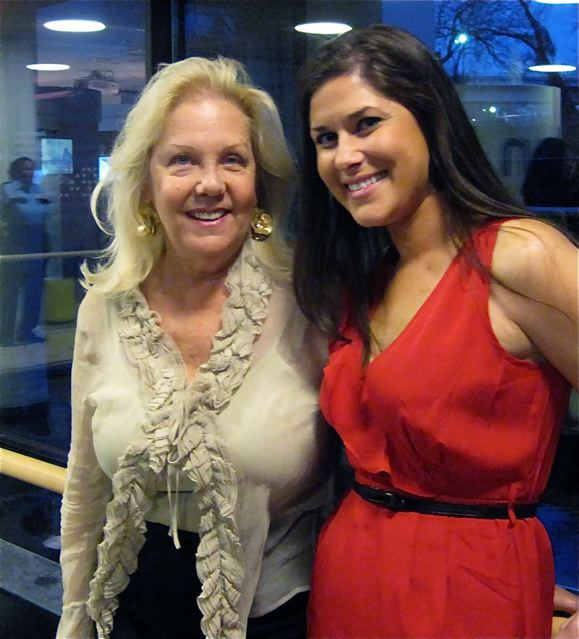 Jordan and Lauren DeSantis at the launch party at the House of Sweden  Watching DeSantis's new TV series at the House of Sweden - photo credit Jordan Wright Lauren DeSantis launched her new travel and food series show in style at the House of Sweden Wednesday night. Sweden plays host to the first three episodes of the series that will air Fridays at 7pm and again on Saturdays at 1pm and 4pm on WETA. Attorney by day chef by night, DeSantis is the lovely host of Capital Cooking where she showcases her talent and that of chefs in our area on her site www.capitalcookingshow.blogspot.com.
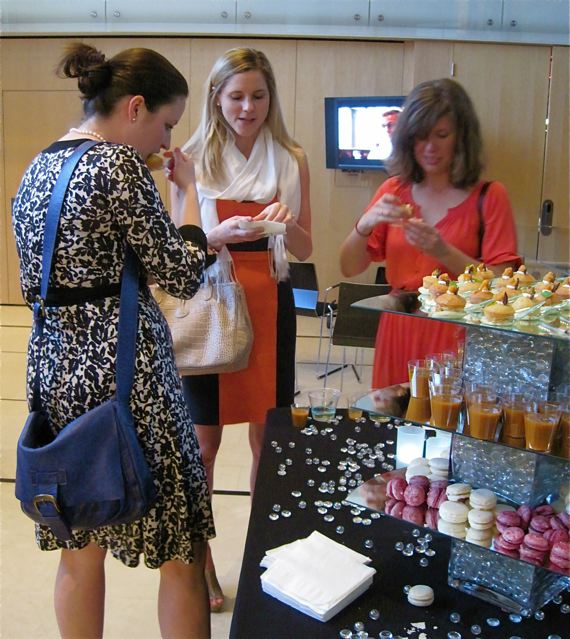
Ambassador and Mrs. Jonas Hafström lent their private chef, Frida Johansson, who created a delicious smorgasbord for the party showcasing Sweden’s delicacies including elk kabobs, crayfish skewers, shrimp and dill hors d’oeuvres and, for the sweet tooth, a sea buckthorn cooler, cloudberry cupcakes, and two kinds of macarons – lingonberry and licorice. Skal!
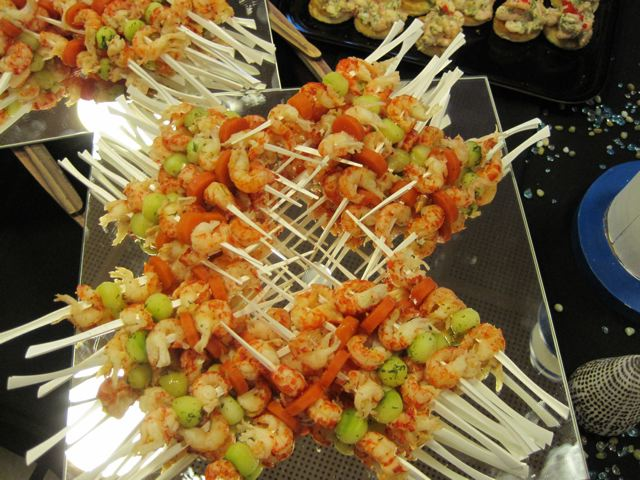 Crayfish skewers at the House of Sweden - photo credit Jordan Wright  Swedish sweets display is irresistible - photo credit Jordan Wright
Very Cherry Celebrations Continued…
 National Mall Cherry Blossoms It’s the centennial anniversary of Japan’s gift of 3,000 cherry trees to our nation’s capitol and the gorgeous blossoms have opened early this year. Personally I prefer to see them at the end of their bloom time when they are cascading to the ground like pink snow, but there’s no reason not to start the celebrations now. Here’s what’s going on around town.
The National Gallery of Art and the Smithsonian’s Freer and Sackler Galleries will present Japan Spring on the National Mall. These concurrent exhibitions—Colorful Realm: Japanese Bird-and-Flower Paintings by Itō Jakuchū (1716–1800), at the National Gallery of Art (March 30–April 29, 2012), and Masters of Mercy: Buddha’s Amazing Disciples (March 10–July 8, 2012) and Hokusai: 36 Views of Mount Fuji (March 24–June 17, 2012) at the Smithsonian’s Arthur M. Sackler Gallery arrive in the nation’s capital this spring. www.nga.gov
Legal Sea Foods tempts with dishes available exclusively at their Chinatown spot. Highlights include the red salad with radicchio, crumbled Gorgonzola, candied pecans, dried cherries and balsamic vinaigrette; cherry glazed Atlantic salmon with watercress salad and potato gaufrettes; and a surf-and-turf with grilled hanger steak with a cherry demi glaze and crab stuffed potato and haricot verte. A decadent cherries jubilee with vanilla ice cream completes the theme. Cocktail enthusiasts will appreciate the Cherry Blossom made with Cherry Heering, lemon juice, Fee Brothers Cherry Bitters and topped with Cava. www.legalseafoods.com/restaurants/washington-dc-7th-street
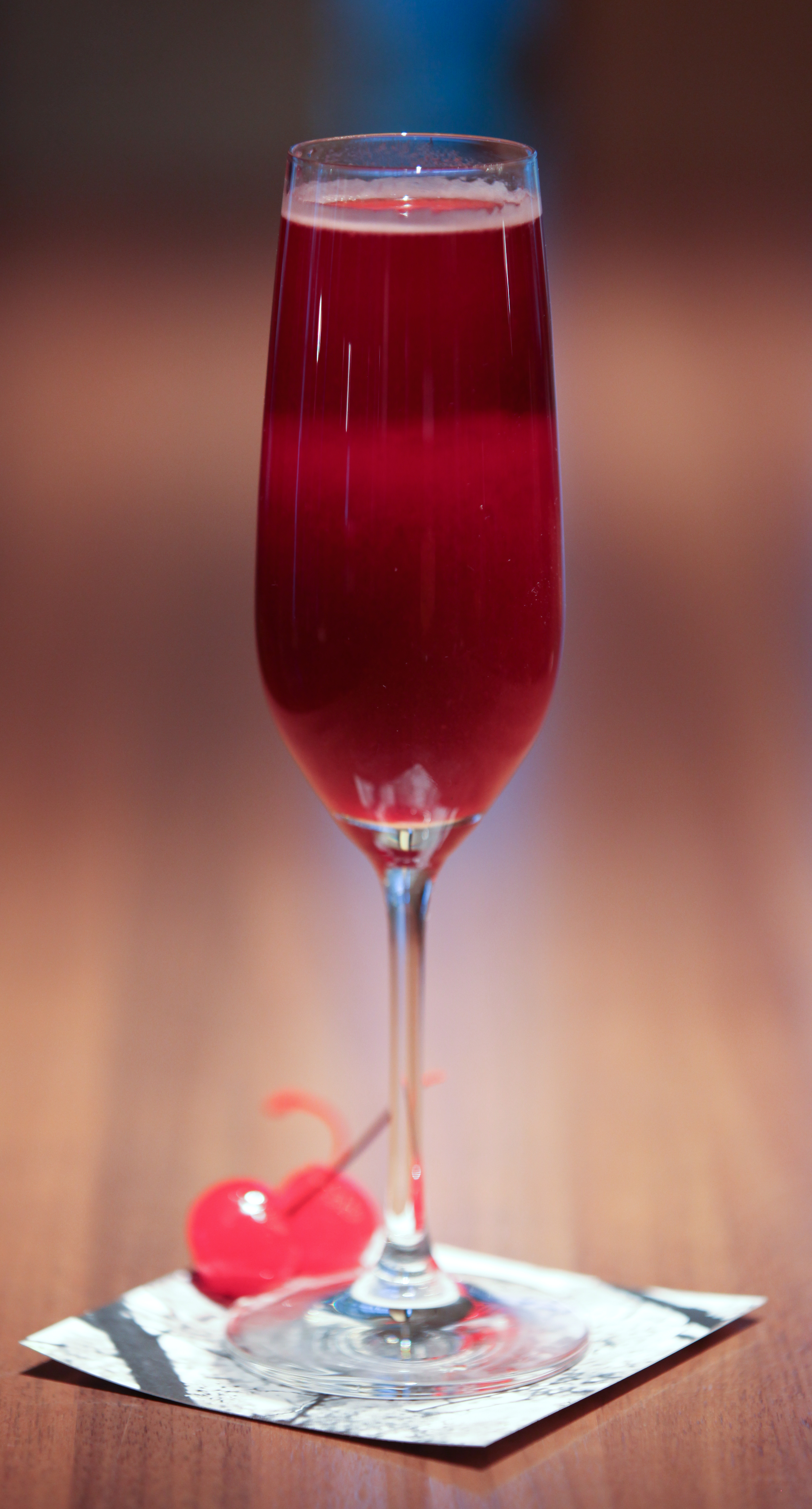
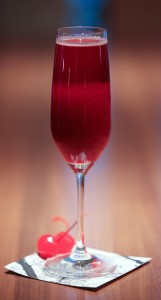 Sakura cherry blossom cocktail Cuba Libre Restaurant & Rum Bar hops on the bandwagon with several entrees to cherry-charm you Latin style. Try Salmón con Salsa de Guindas, Cherry BBQ Glazed Grilled Salmon Fillet with Roasted Sweet Potato Mash and Fennel-Cherry Blossom Salad. In the dessert department get your fix with the Pastel Rustico de Cerezas, Warm Cherry Clafouti with White Chocolate Ice Cream. Instead of sipping one of the restaurant’s signature mojitos welcome the spring with vanilla-cherry Coke, a drink made from aged rum infused with cherry brandy and topped with Classic Coke. www.cubalibrerestaurant.com
At Urbana Restaurant and Wine Bar lead bartender, Obinna Emenyonu, will serve the Tuscan Flor made with cherry and apple purée, vodka, yuzu and prosecco and served with a brandied cherry garnish. www.urbanadc.com
At the 1789 Restaurant in Georgetown Executive Chef Anthony Lombardo is planning a dish of pan roasted duck breast with cherry quinoa, crispy duck confit and duck consommé and for dessert Pastry Chef Mallory Staley will create fried cherry pie. Love that they have free valet parking! www.1789Restaurant.com.
The Park Hyatt Washington wants you to try a special Sakura cocktail that will be available in the Park Hyatt Lounge and Blue Duck Tavern during the festival. The Sakura is made from a combination of Prairie Organic Vodka, Cherry Puree, Cherry Syrup, Cherry Bitters, Va de Vi Sparking Wine and garnished with a Cherry. www.blueducktavern.com.
Jordan Wright
March 12th, 2012
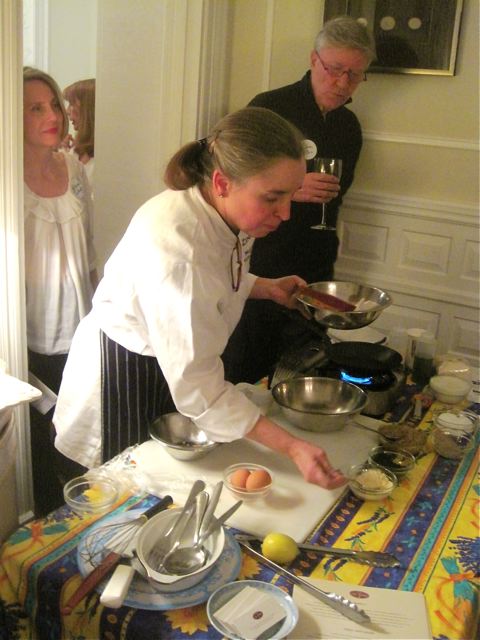 Robin Ellis and Katherine Tallmadge watch as Janis McLean demos a recipe from the book - photo credit Jordan Wright 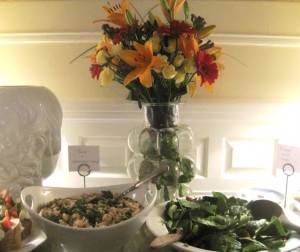 Diabetes safe dishes - photo credit Jordan Wright Last Wednesday the swashbuckling Captain Ross Poldark swept into town. Well actually it was Robin Ellis, star of the BBC series Poldark who held court to a swarm of adoring aficionados of the Masterpiece Theatre classic. It seems the elegant British actor still has the same draw with the ladies. “Downton Abbey can’t hold a candle to Poldark,” quipped one starry-eyed fan.
But we were there for a book signing, weren’t we? A polite query on the coveted invitation asked guests to consider preparing a dish from Ellis’s new Mediterranean style cookbook, Delicious Dishes for Diabetics – Eating Well with Type 2 Diabetes. Recipe cards would be forwarded. That was all the prompting needed to get an astonishing array of delectable low-carb, no sugar dishes for the gourmet potluck.
Ellis told the assembled foodistas that he had discovered he had Type 2 diabetes, prompting him to compile and share his collection of favorite go-to recipes, including treasured ones from his notable friends. A cold cucumber soup from Donald Douglas, his former nemesis Captain McNeil from the series and now a neighbor, is included in the bespoke book.
Fellow Brit actor, Catherine Flye, glowing from her recent nomination for a Helen Hayes Outstanding Supporting Actress award, was there to cheer on her compatriot. “It was lovely to see him this side of the pond. I loved his book. It’s simple, direct and easy to follow. It’s like cookery from the heart.”
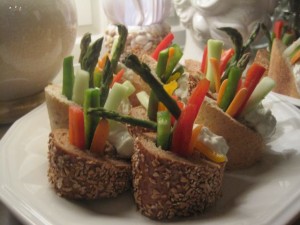 Nibbles from the table - photo credit Jordan Wright 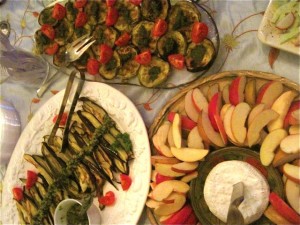 Dishes from Ellis's new cookbook - photo credit Jordan Wright The posh get-together, organized by noted local dietician and nutritionist, Katherine Tallmadge, also featured a cooking demo by Janis McLean, Executive Chef of Cleveland Park’s Bistrot Le Zinc. Many of the recipes have been adapted from (and graciously credited to) notable cookbook authors like Marcella Hazan or Jaime Oliver, two of Ellis’s favorite chefs. Charming illustrations by Hope James of the Ellis’s laidback life in Southwest France, a place where we’d all like to cook, fill the pages of this evocative cookbook.
And now please excuse me while I watch the new Poldark double DVD set while “Charlotte’s Chicken Tagine” simmers happily in the pot.
Charlotte’s Chicken Tagine
Serves 4
1 large chicken – jointed in 8-10 pieces
3 onions – peeled and quartered
2 medium fennel bulbs – outer leaves cut off, cored and quartered
6 cloves of garlic chopped
1 tsp. each turmeric, cumin, paprika, cayenne, and ground ginger
1 tsp. saffron threads
Salt and pepper
1 cup vegetable stock
Olive oil
Handful of green olives
1 preserved lemon – rind only, cut in strips
2 tsp. chopped cilantro or parsley
– Put the chicken pieces in a casserole, or tagine, if you have one.
– Pack in the onions and fennel pieces.
– Sprinkle over the garlic and spices. Season with salt and pepper. – Pour over the stock and drizzle over some olive oil.
– Bring to a very gentle simmer. Carefully turn over the contents in the liquid. Cover and cook for one hour, basting occasionally. The chicken pieces should be sumptuously meltingly collapsed when ready.
– Add the olives and lemon rind and continue cooking for 10-15 minutes more.
– Add the cilantro or parsley just before serving with a steaming plate of basmati rice.
From Delicious Dishes for Diabetics by Robin Ellis (Skyhorse Publishing)
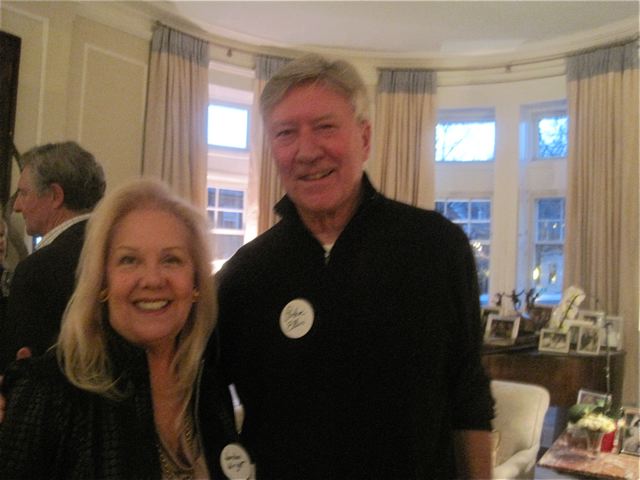 Author/Actor Robin Ellis aka Poldark with Jordan Wright
Jordan Wright
March 10, 2012
Special to Indian Country Today Magazine
 The Thirteenth Step by Robert Hayward - photo credit Mark Chambers By the time author Robert Hayward (Winnebago) decided to write about his journey to redemption in The Thirteenth Step – One Man’s Odyssey of Recovery, he had been through hell and back. His resume read like a psych report – drug dealer, addict and full-blown alcoholic. After 26 years of self-destruction his physical health had suffered, his mind had deteriorated, and his relationships with his parents, wife and three kids were on a fast track to nowhere.
What makes this revelatory book so compelling is Hayward’s honesty and heartfelt sincerity coupled with his admission of failure and his decision to turn to tribal wisdom to heal. It is an intriguing insight into the Native American Church’s peyote cleansing rituals yet a cautionary tale to all substance abusers. Though the Church’s practice of using peyote as a sacred sacrament in its ceremonies is perfectly legal for tribal members [under the American Indian Religious Freedom Act Amendments of 1994], it is still controversial and fraught with negative connotations since the 1960’s when it was used experimentally by the counter culture.
To this day there are very few members permitted to conduct this sacred religious ritual and they are referred to as ‘Roadmen’. During the lengthy, ritualistic event, Hayward experienced powerful revelations. Eventually with the trust and guidance of the church’s leaders he was granted permission to reveal the ceremony to the outside world and give his profoundly personal account.
Interview with Robert Hayward
Jordan Wright – You seem to have emerged from a nightmare of alcoholism and drug addiction like a phoenix rising from the ashes. What have been the rewards?
Robert Hayward – I started out using at age 14, so for 26 years I was in a daze. Yet immediately after walking out of that tipi my life has been clear. From then on I have been alive.
I knew I was reaching rock bottom. I remember fishing with my sons and I was in a fog. I was looking at them and had an out of body experience like, ‘I’m not participating. I’m just a drunken mess.’ But now I have clarity, plus I developed a compassion for people that have the same problem. I wanted to reach out and help and that’s why I went back to school to study to become a counselor. It really reinforced my need to prevent other people from falling into the same trap.
JW – Why didn’t you succumb to any of the dangers associated with drug and alcohol use?
RH – I was never arrested because I was selling to the cops and I knew when busts were going down. But there was always danger. And the fact that I’m alive is amazing since I’ve been to over 200 funerals over the years and most were related to alcohol or drugs. Most of the people I grew up with are either dead or in jail or still on drugs or alcohol.
JW – It seems almost like a cult of tragedy.
RH – Yes, in a way we loved the drama. We lived for it. It was like – who could be the most distraught.
JW – Do you think there is another way to reach young people or addicts without the use of peyote in a healing ceremony? And as you go forward as a counselor how you think your ways will be most effective?
RH – My primary focus will be the treatment of Native Americans. But on the other hand I still counsel as a volunteer at A Better Tomorrow, a treatment center here, and of course I don’t use peyote there. Basically alcohol addiction is universally a spiritual problem and it only has a spiritual solution. If you look at the twelve-step program, the third step is the key. And I tell people if you can’t take the first two steps of the program, don’t waste your time with the rest of the steps. You have to turn your will and your life over to God as you understand him – you have to have a higher power. And that really is the key and how you go about that is a personal thing.
No matter what race people are, they have indigenous roots and people respond well to simple things like a campfire at night. I’ll take a group of young people and we’ll talk in a circle and it’s a type of spirituality. It has a calming effect. I’ll put the cedar in the fire and bless them with the feathers and we talk using the same rules as the tipi. They open up and talk, as opposed to sitting in a treatment room where they tell you, “You have 45 minutes to spill your guts.” Even a group of strangers will bond. I think the key is to create a bond. We also pass around water to get the four elements going. Once you have shared a night together in a ceremony, you become a relative to everyone there – no longer separated by blood, but bonded by the spirit.
The trend is to turn towards a chemical short-term solution to get the addict through the early stages of abstinence so that they have a better chance at avoiding relapse. The problem is that there’s a 96% or 97% failure rate in the recovery field and which creates a revolving door in some of these treatment centers that charge up to $30,000 per month, so they’re not super anxious to fix it because people keep coming back and the insurance companies keep paying for it. If they can get three cycles out of each person they’re not real motivated for success.
JW – Can you talk about your interest in starting national programs to help addicts?
RH – I’ll work with John Halpern, MD [Associate Professor of Psychiatry, Harvard Medical School and Director of the Laboratory for Integrative Psychiatry, Alcohol and Drug Abuse Research Center] for who is looking for grants for programs for Native Americans.
The model would be to have an area on a reservation with four tipis and separate the sexes. We’d take the hardcore repeaters for the first night and run them through the ceremony – though it’s critical they go through chemical detox first. Then we would have a ceremony for everyone with members of the Native American Church in order to make a complete circle. What you do in a month in a treatment center, you can do in one night in a tipi. This will speed up their recovery and open up their heart. They would live without cell phones or TVs and we’d have drumming and songs and eating outside. Ideally we would have horses too. What I really want to see from this program is real success. I want to see people not identifying themselves as an addict, which I see as incredibly negative affirmation.
What we have in the Native American Church is a support system for Indian people because it becomes a lifestyle. The social aspects are incredible after we go through the ceremonial night – the bonding is incredible. And then the next morning we become as relatives. It has a lasting bond that becomes our identities. The spiritual aspect is important as well. They have to get a sustainable program going whatever group or church they’re in. I want to start a system that is positive for people – to talk about things that are better. There is a huge demand for that.
JW – Can you talk about the importance of spiritual education from our elders?
RH – That was one of the things that really struck me in that ceremony because the way it works is that ‘The Roadman’ runs it and also speaks throughout the night and different people will talk as the medicine leads you. He will give elder wisdom during the night. There is a huge value to it.
When I counsel kids I ask them what is your real tribal name and clan and then I send them to their elders to talk to them. A lot of these guys think the idea of being Indian is hanging a feather on the rearview mirror of their truck. They don’t even know anything about their family or their tribe, so they lost that identity which then becomes games and alcohol and drugs. Once they sit down and talk to their elders, who are dying to talk to these kids, they come back all excited with stories. It totally changes the way they look at themselves.
The elders would teach us and raise us the way we are supposed to be raised. It’s a huge problem that what we do in all of society is put our elders in housing and separate them – let them rot and grow old. But what you can learn from the elders is stuff you can’t get from books or anywhere else. Unfortunately what you see now is that kids have no respect for elders anymore. And it’s sad. You miss the generational connection without that.
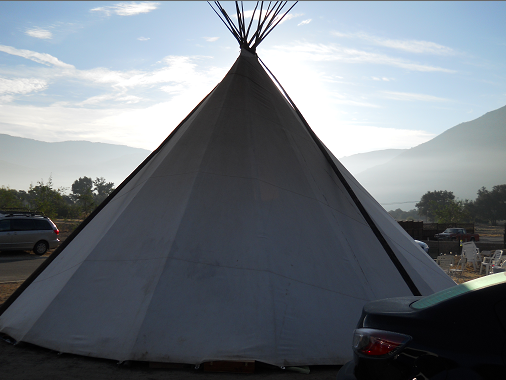 TiPi in Daylight - photo credit Robert Hayward. In tribal groups I talk about the concept of ‘seven generations’. Seven generations ago my ancestors were praying that I would be alive today and that’s the only reason that I am alive. Our duty is to pray for the next seven generations so that there is still clean air and still clean water and still a place to hide in the trees.
We need to keep that continuous cycle so that we don’t just pray for today or tomorrow and live our life that way. The reason that Indian people are having this problem right now is because we are living in the seventh generation since the conquest. So many Indian people were chased off or diseased that they didn’t have the opportunity to pray for this generation, so the circle was broken at that point. We miss those prayers and a lot of the reason we have these problems now is that our ancestors were unable to pray for us.
So there’s this revival about the seventh generation and it’s in all kinds of prophesies that amongst this current generation young kids will rise up and they will they will have dreams and visions and start to bring back the old ways and start reviving the traditions and I’m seeing that, kids that are learning the songs and how to drum at nine years old and you can see the power coming out of them. The best thing that I see happening is the young kids at the pow wows are starting to dress up again and dance and that’s where you see the connection with their elders who are trying to pass this on to the kids. The kids look up to them and that’s where I see the hope.
JW – What has the response been to your talks?
RH – They are really well received, especially when I start off with the video on my website [www.youtube.com/watch?v=IVP-Z6WcYlo] and the crowd will grow, they really get into the story. Nowadays there is a technological separation because of texting, etc. It’s become a novelty to talk to each other. But for me I feed on the energy of the group. I let them know that it’s time we stood up and became accountable. We owe it to our ancestors to get this right. We have to stop this cycle of drinking. Indian people did not drink. There was no such thing as fermented drink. We lack the enzymes to process alcohol or sugar. It ruins our lives – the abuse and everything. People need to hear that there is hope. We need to start giving them something.
I am realizing that the true niche for this book is all Native Americans, because we haven’t had a book written by one of us with our perspective and way of life fully explained in a long time, if ever. It is fast becoming a book that we as Indians can call our own.
We have the opportunity as spiritual caretakers of this land to hear the words of our ancestors because they [the words] are floating in the wind. Their blood is in these rivers and we are part of this earth. Our ancestors are waiting for us to call on them to heal and we have that opportunity. I hear that drumbeat sitting inside the tipi and I get this incredible feeling. We have to reconnect with that ground because it’s ours – it’s all sacred ground. We all have to put more respect back into the earth.
March 9, 2012
Jordan Wright
 GrooveLily band members (l to r) Brendan Milburn,Valerie Vigoda, and Gene Lewin - photo courtesy of The Wolf Trap Foundation for the Performing Arts GrooveLily band member and powerhouse electric violinist, Valerie Vigoda, talks with Jordan Wright about the group’s meteoric career and what fans will hear at their March 16th concert date.
Jordan Wright – How do you feel about performing for the first time at Wolf Trap?
Valerie Vigoda – Well, I grew up going to Wolf Trap so I’m very excited.
JW – What does it mean to you as a local?
VV – It’s something I’ve dreamed of doing in my younger days. I grew up going to Wolf Trap. My family and I came to many shows here as well as every Fourth of July. I remember one of my favorite concerts was seeing Jonatha Brooke playing solo at The Barns. I even ushered there one summer. It’s a place that’s been dear to my heart my whole life.
JW – Can you talk about your group’s autobiographical show, Wheelhouse?
VV – It has been on the back burner for many years. The show concerns the events of our lives over ten years ago. It is about the period when we gave up everything to tour in a used RV. It was a bad decision and everything went wrong almost immediately. It turned into a physical and symbolic millstone around our necks. Because after three months it sat at a repair shop and needed a ton of money to fix it. It was like a Catch 22 because we needed it to get to our gigs, which was our main source of income, which could ten pay for repairs. So we just spiraled down to the lowest point we have ever been. It was really tough. Part of what makes the Wheelhouse interesting and funny is that after all these years we now have the distance to look back at the situation and find the humor.
It took us a while to be very honest with ourselves and write about it. And Gene, our drummer whose character arc has always been of someone who had been very cautious with his life has been able to take a leap. Now Wheelhouse is about to be produced and will be directed by Lisa Peterson. We open in Palo Alto on June 6th.
When we come to Wolf Trap to do Sleeping Beauty Wakes we’re hoping to do some numbers from the show. We’ll do a concert version of some of our numbers but not in costume. We’ll also be able to give people a glimpse into the writing process.
JW – Can you talk about your work with Disney?
VV – We have been doing a lot with Disney since we moved to Los Angeles. The first thing was a one-hour musical adaption of the Toy Story film. It’s a story that has always been one of our favorite Disney productions, because it was one of the first dates that Brendan and I went on. That project led us to meet some people that work at DisneyToons and they are the people who are putting out the new Tinkerbell movies. They are coming out with new movies about once a year.
The first one we got involved with was the second movie Tinkerbell and the Lost Treasure. We wrote the opening and closing songs for that as well as Tinkerbell and the Great Fairy Rescue. From there we have written for Tinkerbell and the Secret of the Wings and we wrote two songs for that one as well as Tinkerbell and the Pixie Hollow Games that was a TV special that came out around Thanksgiving 2011. Up until that film the sound they wanted was very Celtic, like Enya, with pennywhistles and Irish bodhran drums. It was very lush. But the songs were not going up on the charts.
Lately they are using more pop songs and we wrote “Dig Down Deeper” for them. It was performed by the very charismatic performer, Zendaya, who sung it on the Build-a-Bear float at the Macy’s Day parade last year. It was very exciting and the song was nominated for our first 2011 Annie Award (industry awards for animated films). We are getting to explore a wider breadth of song styles under the Disney umbrella and we’ve loved working with them over the past six years.
JW – Lately your musical Striking Twelve has been staged by other groups who often perform it by expanding the roles to the size of the cast. Do you think that will continue?
VV – After 2007 we adapted it for larger casts like high schools who could have 25 people in one cast. It depends on the size of their cast and musicians how they put it on. It seems to really work well whether they have a cast of three like we do or many more. This past year there were productions in Helsinki in Finnish as well as Korea and Zimbabwe. We look forward to the opportunity to see other people performing it.
JW – What is the future of your solo performing?
VV – I’m thrilled about it. On a personal level, and in our household, the desire to perform is different between Brendan and myself. He doesn’t miss it but I really need it. In order to make us each be our happiest we put together something that I could perform on my own and we are currently producing a musical we wrote called Ernest Shackleton Loves Me.
JW – Can you tell me about your use of live ‘looping’?
VV – We realized we could take music from Ernest Shackleton Loves Me. We got a copy of Ableton Live which is an incredibly powerful program that people use for looping and deejaying and we put that together with my electric violin and the vocals and out of that what is possible is for me to create from scratch for the audience in real time. I can create soundscapes and full background rhythms and harmonic backgrounds to the vocal as well. It’s as if I have a band behind me that created it. It’s a really interesting way to build a song.
What we realized is that we could take music from Ernest Shackleton… along with mashups and stand alones of cover songs done in a new way I put together a whole solo concert. We plan to add some songs from this show to our March 16th concert.
Using this technology I have done two full-length solo concerts around the country that are on my website, www.ValerieVigoda.com. It’s one of the projects that we are currently juggling.
The group performs together less frequently than we used to since we live on opposite coasts, so when we do get together it’s extra special and extra fun. Now that we’re all parents the central story is even more resonant to us and performing together is one of the most beloved things we do. And in a wonderful venue like Wolf Trap, I can’t think of anything better.
Interview conducted, condensed and edited by Jordan Wright.
March 3, 2012
Jordan Wright, Publisher of Whisk and Quill
Very Cherry Celebrations
 National Mall Cherry Blossoms Ahh the cherry…luscious fruit and symbol of spring in our Nation’s Capitol. But why? The cherry trees whose airy pink blossoms grace the Tidal Basin at this time of year will never bear cherries – but no matter – local chefs and mixologists have been falling all over each other to create cherry-inspired concoctions to celebrate the 100th anniversary of the National Cherry Blossom Festival. Here are some enticing examples of what you can expect around town during the five-week festival. I’ll be posting more in the upcoming weeks.
At Station 4 they’ve added a fixed price cherry-laden three-course meal. Chef Orlando Amaro proffers a seared foie gras with Marcona almond powder, dried cherry jelly and rosemary crusted lamb loin and sous vide cherries, finishing the dinner with cherry essence chocolate lava cake with cherry cabernet sorbet. www.station4dc.com
Hank’s Oyster Bar has a cherry salad is made with bibb lettuce, Gorgonzola cheese, cherries and cherry vinegar. Beverage Director Dana Mosbarger’s dazzles with her festival concoction called Cherry Stone Blossom made with a combination of vodka, sake, lemon juice and a splash of tart cherry juice. www.hanksrestaurants.com.
Top Chef Spike Mendelsohn’s Good Stuff Eatery in Crystal City, Georgetown and Capitol Hill is where the Obamas drop in for burgers and shakes and you should too. During the festival they’ll feature a cherry blossom shake made with the restaurant’s homemade custard and fresh cherry puree topped with a bing cherry. www.goodstuffeatery.com
In Dupont Circle, Agora, the Mediterranean-centric eatery, is pouring a special cocktail, the Kiraz Cicegi, which translates to cherry blossom in Turkish. This delicious elixir is made from a combination of Southern Comfort, Yeni Raki, cherry juice, fresh mint and agave nectar. www.agoradc.net.
Poste Moderne Brasserie takes a more Asian approach with a sake-based cocktail called For Heaven’s Sake made with house-made pomegranate soda, Tozai sake, vodka, Maraschino liqueur and fresh lemon juice. www.postebrasserie.com
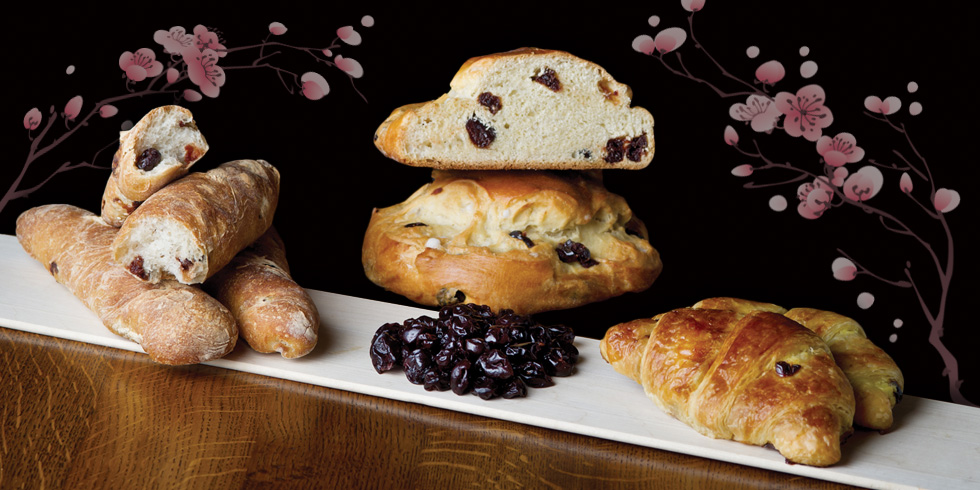 Torsade cerises, twisted artisan Bread studded with cherries - Photo credit Paul Bakery in Penn Quarter Stop by Paul Bakery in the Penn Quarter or the newly opened Georgetown location where they’ll start baking up cherry treats from March 20th – April 29th.
Any of these should satisfy. Torsade cerises, twisted artisan Bread studded with cherries, Croissant aux cerises, a crusty and buttery croissant filled with hand-made pastry cream and cherries; Cramique aux cerises a mouthwatering brioche with sweet pearls of sugar and sour cherries; Flan aux cerises, flan in a sugary shell filled with handmade pastry cream and cherries; Millefeuille aux cerises, a Napoleon of crispy puff pastry encasing a delicious mix of cherries and fresh pastry cream; or the Éclair aux cerises, a crispy choux pastry éclair filled with a delicate balance of cherries and pastry cream.
In Alexandria The Grille at Morrison House look for both sour and smoky cherry cocktails to celebrate the season. The Sour Cherry Fizz is made with sour cherry juice, Tanqueray gin, lemon juice, simple syrup, egg white and a splash of club soda. But try a Smoked Cherry Old Fashioned made with Maker’s Mark, bitters, house-smoked cherry syrup and garnished with a smoked cherry and a slice of orange for a new twist on an old classic. www.thegrillealexandria.com
Also in Alexandria Jackson 20 celebrates with the Cherry Picnic made with ginger liqueur, spiced rum, fresh sour mix and Campari wash. www.jackson20.com
Firefly’s Sakura Sling is cherry and vanilla bean infused Ketel One with Leopold Brothers Michigan tart cherry liqueur, simple syrup and a splash of soda. www.firefly-dc.com or www.facebook.com/FireflyDC
These concoctions should keep you in the pink!
Deals and Steals
Station 4 has a cool option for theatregoers. You gotta love this one with valet parking for $10 per car and only steps from Arena Theater. Enjoy a three-course menu for only $29 per person (excluding tax and gratuity) and walk to the performance leaving your car in the care of the restaurant’s valet. You could also opt for the first two courses of the pre-theatre dinner then return for dessert after the show.
From March 8th – March 25th Synetic Theater is offering the Light in the Darkness Dinner Package that includes tickets to the show and the New Movements-inspired pre-theatre menu at Jaleo in Crystal City. Patrons can save $10 total if they purchase the Dinner and Theater Packages online at synetictheater.org. Visit this website for a deal off the restaurant’s prix fixe menu. www.jaleo.com
A Washington institution 701 Restaurant offers Modern American cuisine by Executive Chef Ed Witt. Enjoy a three-course pre-theatre menu for $30 per person from 5:30 p.m. to 6:45 p.m. Monday – Saturday and 5 p.m. to 9:30 p.m. on Sunday. Valet parking Monday – Saturday for $8. ww.701restaurant.com
The award-winning Rasika restaurant offers Chef Vikram Sunderman’s pre-theatre menu for $35 per person (excluding tax and gratuity). The menu is available Monday – Friday from 5:30 p.m. to 6:30 p.m. and Saturdays from 5 p.m. to 6:30 p.m. Validated valet parking for $8. www.rasikarestaurant.com
Happenings
If you miss this one, you’d better hop a plane to Mexico, because you won’t find this anywhere else! Oyamel Cocina Mexicana hosts their Fifth Annual Tequila & Mezcal Festival from March 5 – 18 the two-week festival will have informational cocktail sessions, open to the public, and intimate dinners complete with tequila and mezcal tastings.
In honor of the festival, Oyamel will offer special bar antojitos. These small plates are served only at the bar and include garbanzos fritos – crispy roasted spiced garbanzo beans and alas de pollo con salsa naranja – chicken wings in a sauce of orange, spices and chile pequin.
Chef Omar Rodriguez is also crafting a special menu highlighting the flavors of Oaxaca and Jalisco in Mexico. Dishes from the Jalisco region include Sopes de ostiones, traditional corn flour cake topped with an oyster, tomato salsa, lettuce and queso fresco; Pozole de camarón, shrimp and hominy soup with Hawaiian blue prawns, guajillo and ancho chilies, served with garnishes of onion cabbage and slice radishes, and Lomo de cerdo relleno con chorizo en mole manchamanteles, chorizo stuffed pork loin with a mole of almonds, chilies, tomatoes, plantains and pineapple. Authentic Oaxaca flavors can be found in Tortitas de patas de puerco, crispy pork trotters served with a salsa of tomatillos, avocado, Serrano peppers, and cilantro, and Chuletas de cordero en chileajo con frijoles borachos, grilled lamb T-bones marinated in Guajillo chiles and garlic with drunken navy beans with pork belly and Negra Modelo.
Drinks are the highlight of every Tequila & Mezcal Festival at Oyamel and the beverage team at Oyamel has created unique cocktails just for the occasion. Libations featuring mescal include the Oaxacan Swizzle, Del Maguey Mezcal “Vida”, ruby port, fresh pressed apples, lime, ginger and house-made orange bitters; El Bahio, Sombra mezcal, roasted pineapple juice, lemon and cardamom; Joven avocado, avocado-infused mezcal, Cocchi Americano, grapefruit syrup, grapefruit juice, Hellfire bitters, and avocado leaf; and the High Tea, Los Nahuales Reposado Mezcal, chamomile tea, honey, and house-made tobacco bitters. Drinks featuring tequila are the Mexican Tailor, house-infused “Gin-quila” fresh pressed apples, lemon and basil; El Pescador, Herradura Tequila three ways, grapefruit juice, Curacao, maraschino liqueur, Honey and Velvet Falernum, and the Champs–Elysees; Don Julio 70th Anniversary Añejo, Remy VSOP, Green Chartreuse, Lemon, and Peychaud’s bitters. A complete calendar is online at www.oyamel.com/index.php/about/press_and_calendar
New and Notable
Cahal Armstrong’s latest Alexandria food adventure, Society Fair, has just opened on Washington Street a few blocks from The Little Theatre of Alexandria. The pretty gourmet shop featuring fresh baked breads, a butchery, upscale food market and wine bar has some smallish eat-in tables for enjoying delicious sandwiches and cheeses with a wide range of wines by the glass offered on tap. As the weather complies there’s an outdoor patio. www.societyfair.net
In Columbia Heights the hot buzz is all about Mintwood Place where Executive Chef Cedric Maupillier, formerly of Puro Café in Georgetown, has at last found his niche serving French food with an American twist. Nibble on escargot hush puppies or maple pork cracklin’ to start. Spring has arrived with the shad. Try the delicate fish served with it’s own roe accompanied by black trumpet mushrooms and lardo. You get the idea. www.mintwoodplace.com
Stay tuned for lots more news and updates from Nibbles And Sips Around Town. To read more go to www.WhiskandQuill.com
|