|
|
Jordan Wright
April 22, 2013
Special to The Alexandria Times
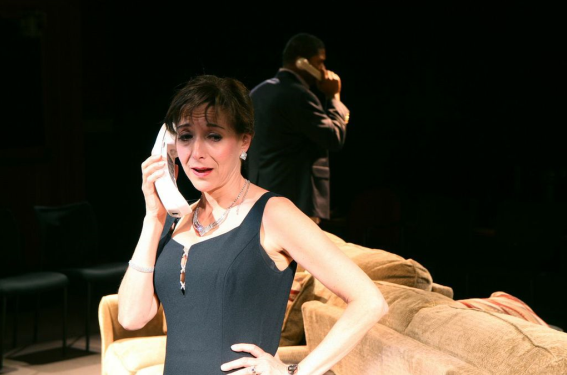 Chaz Pando as Paul and Dana Gattuso as Ouisa Kittredge – photo credit J. Andrew Simmons When John Guare’s now iconic play was first produced at the Lincoln Center in New York in 1993, it was a timely concept. Society had been reconfigured over the 60’s, 70’s and 80’s by integration, intermarriage and the acceptance of celebrities mixing with high society – most especially in New York where music, theatre, fashion and the arts have always defined social constructs. They called it “The Jet Set” for its mix of international luminaries and well-heeled travelers. Recreational drugs had a way of bringing unlikely social enclaves together and gallery openings sent the uptown crowd downtown to Soho, the East Village and Tribecca to dip their naïve toes into the newly fashionable unknown. In Six Degrees of Separation Guare visits the evolving complexities of Society vis-à-vis Modern Art at the turn of the decade.
Ouisa and Flan Kittredge are a well-heeled WASP couple who fancy themselves liberal-minded. Flan, a self-styled art dealer, is on the hunt for two million dollars to buy a French masterpiece he intends to flip for a profit to the Japanese. When his wealthy friend, Geoffrey, comes by for a drink they pitch him their idea. Interested, Paul explains his political position as an owner of gold mines in South Africa. “We have to educate the black workers. We’ll know we’re successful when they kill us,” he haughtily states. To which Ouisa replies, “It doesn’t seem right living on the East Side talking about revolution.” Her husband, attempting to soften her stance, clarifies. “Ouisa is a Dada manifesto.”
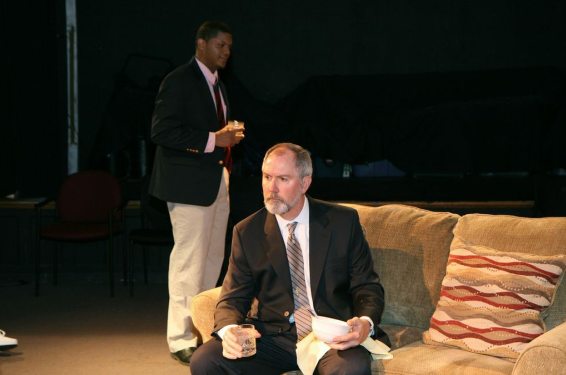 Chuck Leonard as Flan Kittredge (R) and Chaz Pando as Paul (L) – photo credit J. Andrew Simmons Thus the stage is set for an existential exercise in compassion, morals and old money when a well-dressed young African-American male knocks on their door, weak from a stabbing, and throws himself on their mercy. He introduces himself as a schoolmate of their Harvard-attending children and just like that, Paul is in the door and in their thrall as they quiz him on literature, art and the “Black Experience”. Paul readily expounds on his intellectual theories and tells them he is the son of famed actor, Sidney Poitier. They agree to back a film festival in New York City if they can act in Poitier’s next film. And as raconteur extraordinaire Paul boondoggles his victims, their involvement becomes compounded by their sympathies. “We turned him into an anecdote to dine out on,” Ouisa admits.
Guare has managed to perfectly capture the mood of the period – White guilt, radicalism of art, sex and politics and the confusion, curiosity and fear that comes from such a dramatic social shift. So successful is this play, based on a true story, that its title has become part of our shared lexicon, a euphemism for how closely we are socially connected. It has even spawned a parlor game called the “Six Degrees of Kevin Bacon” in which two actors can be connected through their films or their love life.
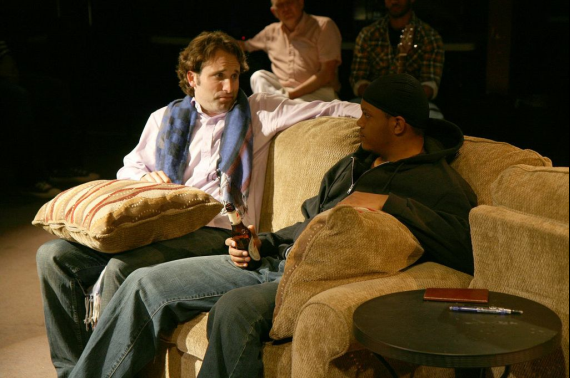 Kyle McGruther as Trent Conway (L) and Chaz Pando as Paul – photo credit J. Andrew Simmons As Port City Playhouse celebrates its 100th show since its founding, they have chosen the perfect vehicle to launch them into what will be their 36th season. Director Mary Ayala-Bush triumphs in the subtle staging of this production. On a small stage in the round she has managed to choreograph the actors so as to draw in the audience and deliver a feeling of shared experience and believability. Dana Gattuso (as Ouisa), Chuck Leonard (as Flan), Chaz Pando (as Paul), Marcus Anderson (as Rick) and Kyle McGruther (as Trent Conway, Paul’s Henry Higgins) are especially riveting, as is a cameo by Daniel McKay (as the gay hustler).
Highly recommended.
Port City Playhouse at The Lab at Convergence, 1819 North Quaker Lane, Alexandria, VA 22302. Performances are on the following dates – Apr. 19th, 20th, 26th, 30th and May 3rd and 4th at 8pm. Matinees on Apr. 27 and May 4th at 2pm. For tickets and information visit www.portcityplayhouse.org.
Jordan Wright
April 11, 2013
Special to Washington Life
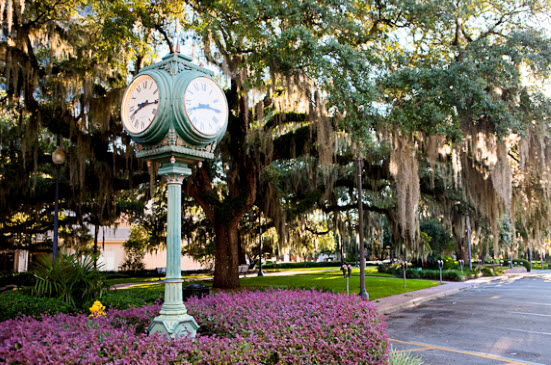 Tally’s Historic District – Park Avenue As Florida celebrates its 500th anniversary of Ponce de Leon’s arrival, visitors to the state should put Tallahassee high on the list of sites to visit. Better known for lobbyists and legislators, Gators and Seminoles, the state capitol is a fascinating historical and recreational locale with as many diversions as a visitor has time to enjoy. “Tally”, as the residents fondly call it, is a surprisingly hip city with restaurants and cafés highlighting both Old and New Southern cuisine.
Along the Native American Heritage Trail archaeology seekers can explore the Lake Jackson Mounds Archaeological State Park with its six earthen temple mounds and imagine the ancient Native culture of the Apalachee Indians, or take in 12,000 year-old paleolithic artifacts in the city’s spectacular history museum. History buffs can trace Hernando de Soto’s Trail of 1539 and his winter encampment in Tallahassee and follow the paths of the early Spanish explorers that traded with the coastal city of St. Augustine.
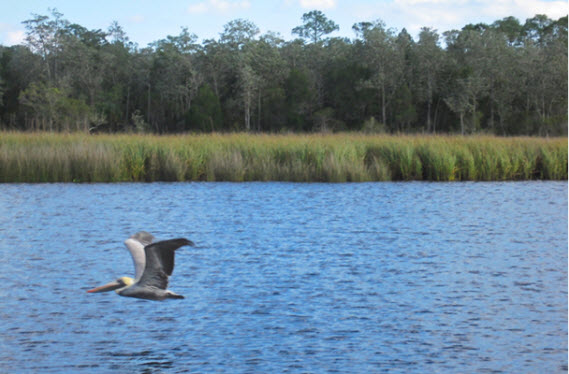 A pelican skims the surface of the St. Marks River – photo credit Jordan Wright Birders can delight in over 372 species of birds that reside in or migrate through this region on one of the country’s major flyways, while eco-tourists can tour thousands of acres of protected wetlands and forests to wonder at the fascinating flora and fauna of the area’s waterways.
First impressions have a way of coloring the traveler’s experience, and Tallahassee gets off on the right foot. To get a sense of how old Florida’s state capitol is, begin in the city’s Park Avenue Historic District with a stroll beneath live oak trees dripping with Spanish moss past Tallahassee’s 19th C architectural gems. If you’re there on a Saturday the “Downtown Marketplace” vibrates with live entertainment, a farmers market, music, arts and crafts, and storytelling for kids. You’ll be on the expansive boulevard known as “Chain of Parks”. From there, go two blocks south to East Park Avenue and tour the William V. Knott House. Built in 1843 and since restored to its 1930’s splendor, this elegant home is where Union troops read the Emancipation Proclamation and where Mrs. Knott wrote quirky poetry that she attached to her furniture.
On South Monroe Street you’ll come up on the Florida Historic Capitol Museum with its magnificent stained-glass dome. A beautifully preserved structure built in 1902 it tells the story of the state’s fascinating political history. Of particular interest is the current “Navigating New Worlds” exhibit featuring the Michael W. and Dr. Linda M. Fisher collection of Old World maps of Florida dating from 1493, one year after Columbus’ arrival on American shores.
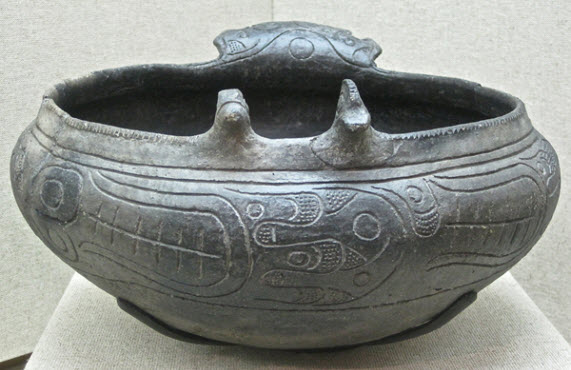 Effigy vessel A.D. 1350-1500 found on Fort Walton Beach on display at the Museum of Florida History – photo credit Jordan Wright On South Bronough Street lies the Museum of Florida History housing exhibits ranging from the prehistoric era to the mid-20th century. With 27,000 square feet of gallery space devoted to over 45,000 artifacts, this remarkable museum is a veritable treasure trove with hands-on exhibits highlighting Spanish exploration and Florida’s indigenous tribes. Be sure to check out the pirates’ booty of diver-discovered jewelry and gold doubloons retrieved form shipwrecks off the coast. Native artifacts and prehistoric skeletal remains are wonderfully displayed and include a full-size mastodon recently discovered in nearby Wakulla Springs. The museum also showcases Floridian curiosities like early antique cars, World War II memorabilia, a collection of early Lily Pulitzer dresses, orange crate labels and unique inventions.
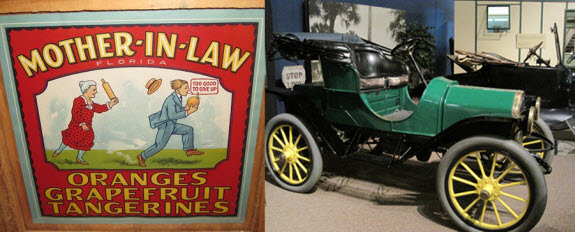 Early orange crate label and 1910 Electric Car at the Museum of Florida History – photo credit Jordan Wright Art lovers can tour the 6,000 square foot permanent exhibit named “Forever Changed: La Florida” highlighting Florida as a colony of both Spain and Great Britain. Current shows include “Reflections: Paintings of Florida from 1865-1965” an impressive 85-piece collection of fine art with Florida subject matter including works by Martin Johnson Heade, N. C. Wyeth and Hudson River School artist, Herman Herzog. The show runs until May 6th.
If you remember the landscape paintings of Old Florida sold by the side of the road between the mid 1950’s to the 1980’s, you’ll appreciate Cici and Hyatt Brown’s collection of the “Florida Highwaymen” paintings that showcases works by 23 of the original 26 artists. Many credit A. E. Backus who taught other young African American students how to paint. For a schedule of lectures, re-enactors and musical performances at the museum go to
Head north and east to South Duval Street and Kleman Plaza, where the Challenger Learning Center boasts a 3-D IMAX theater, a space mission simulator and a 50-foot high Digital Dome Theatre and Planetarium that is out of this world.
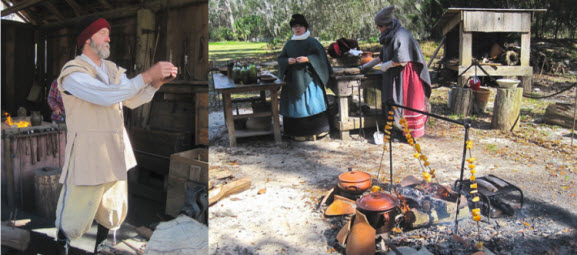 The blacksmith at his forge and pumpkin cooking at the Mission San Luis – photo credit Jordan Wright Three miles from downtown Tallahassee is the Mission San Luis, the westernmost of forty-one missions built by the Franciscan monks in the 17th century. The sprawling 65-acre property consists of the only reconstructed mission of its kind in Florida. There are many buildings to explore and costumed docents to guide you through the living quarters and demonstrate cooking, sewing, blacksmithing and archery typical of early life in the mission. The massive church with its huge oil paintings, a 60-foot high Apalachee council house woven of over 100,000 Sabal palm fronds and numerous outbuildings reveal daily life for its inhabitants. At the blockhouse and stockade, cannons dot the palisade as militia masters demonstrate the art of loading and firing a musket.
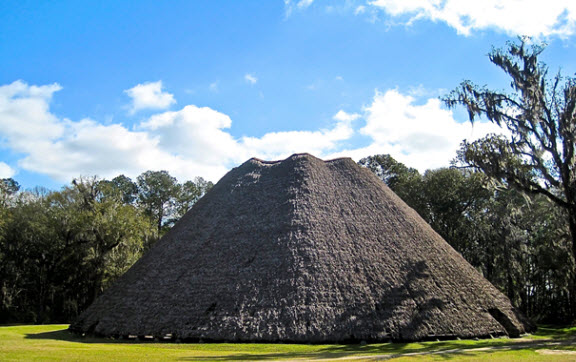 The reconstructed Apalachee Council House at Mission San Luis – photo credit Jordan Wright In 2009 a large Spanish Colonial style visitor center was completed housing an archaeological research center, art gallery, theater, classrooms, gift shop and banquet hall. Groups can call in advance for a catered lunch of authentic paella, from Valencian chef Juan Ten.
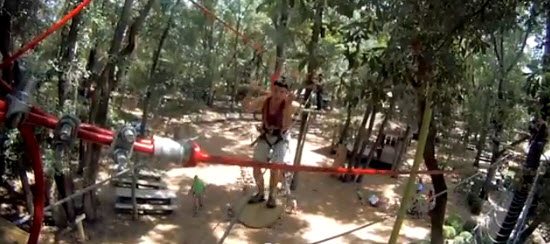 Tree to Tree Adventures Zipline at Tallahassee Museum Minutes from downtown is the Tallahassee Museum – a living museum nestled between Lake Bradford and Lake Hiawatha. From elevated boardwalks it’s easy to spot panthers, bobcats, alligators, black bear and other indigenous Florida wildlife in their natural habitats. Or soar over bald Cyprus swamps on the super cool “Tree to Tree Adventures”. With over 19 zip lines and 70 obstacles, you can view the museum’s 52 acres from the treetops. Back on terra firma join a fossil dig or nature program, or just walk the shaded grounds to see a 1930’s African American church, Jim Gary’s brightly painted metal dinosaur art, Bellevue, the plantation home of George Washington’s great grandniece, a 19th century farm, an 1890’s schoolhouse and the old Shephard’s Mill. You’ll think you stepped into the Florida of days gone by.
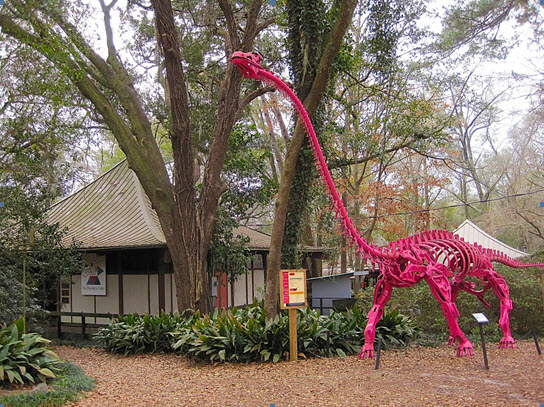 Jim Gary’s metal dinosaurs roam the Tallahassee Museum and Gardens – photo credit Jordan Wright Along the Miccosukee Road is the Goodwood Museum and Gardens. A splendid antebellum house reminiscent of Old Florida, it’s filled to the brim with a vast collection of antiques. The property, which once consisted of 2,400 acres, was a former cotton and corn plantation and the home was built in the 1830’s. Its current twenty acres have eleven historic outbuildings and a reconstructed carriage house that is a favorite spot for weddings, conferences and banquets. The beautifully restored gardens feature vibrant camellias, fragrant magnolias, highly scented freesias and row upon row of roses that peak in April. If you are a rose fancier you’ll be wowed at the 150 varieties on the grounds.
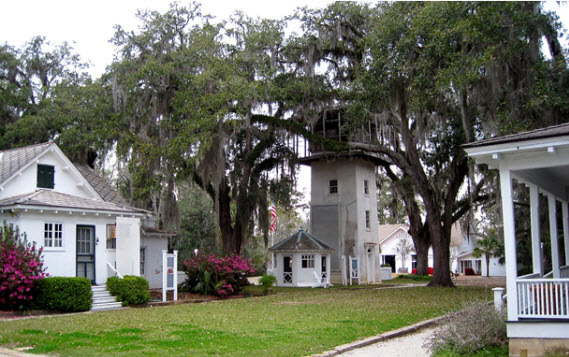 The grounds at Goodwood Museum & Gardens in Tallahassee – photo credit Jordan Wright A handful of historic homes and smaller museums are just as intriguing. Tallahassee Antique Car Museum, Mildred and Claude Pepper Library & Museum, Beadel House at Tall Timbers, John G. Riley Museum of African American History & Culture, Maclay Gardens and State Park, and The Kirk Collection.
STAY
The Sheraton Four Points Downtown is conveniently located in the heart of Tally.
The Hotel Duval is an upscale boutique hotel with a modern, hip dynamic. Visit the rooftop restaurant and Level 8 Lounge for a fabulous sunset view of the city and craftmade cocktails.
DINE
There are a myriad of options for dining in this hip, vibrant city where chefs have caught on to the locavore movement in a big way.
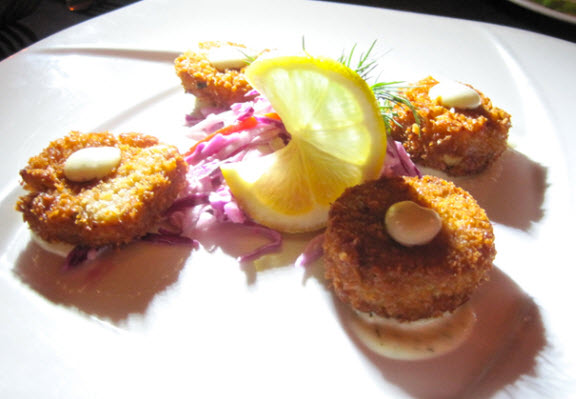 Mini crab cakes at Avenue Eat & Drink – photo credit Jordan Wright Avenue Eat & Drink
Upscale wining and dining in a casual setting. Check the blackboard for specials and let the sommelier pair your meal from their extensive wine cellar. Expect organic meats and local produce from Executive Chef Greg Brown.
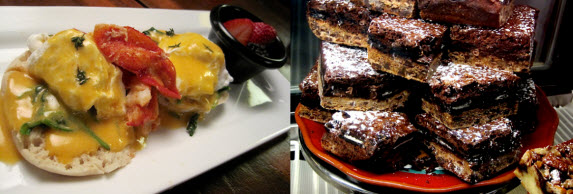 Lobster Benedict and a plate of the “Slutty Brownies” at the Paisley Cafe – photo credit Jordan Wright Paisley Café
This adorable spot in a clapboard house has the best sandwiches and baked goods in Tally. Try their chef-driven brunches on Saturdays and Sundays with Aunt Ruby’s hoe cakes, real Southern biscuits, lobster benedict and housemade berry tea. Take home a bottle of Tupelo honey and a “Slutty Brownie” from the bakery case.
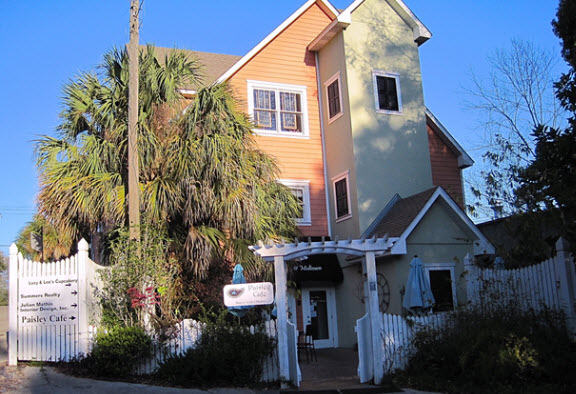 The Paisley Cafe in Tallahassee – photo credit Jordan Wright Cypress
Sophisticated Southern dining with exquisite gourmet dishes and cocktails alongside works from local artists. Order a platter of artisan-made cheeses including Sweet Grass Dairy’s “Green Hill” made in nearby Thomasville, GA. Try a “Gallagher” cocktail made with cane rum, pineapple, ginger and a combination of cherry and apple liqueurs.
Shula’s 347 Grill
Aged Black Angus steaks and double-cut chops get top billing at the Hotel Duval.
Sweet Pea Café
Delicious vegan and vegetarian lunch and dinner till 8pm in a cute tin-roofed barn-red restaurant.
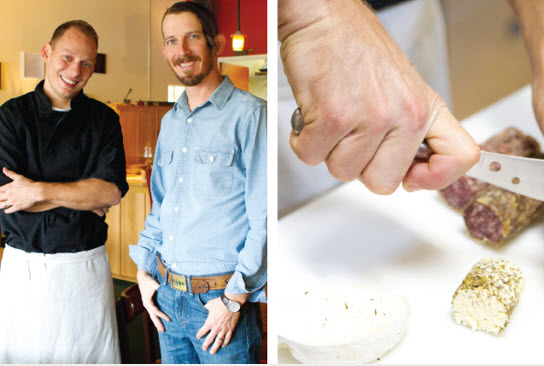 Chef Matt Hagel and Owner Ruben Fields Miccosukee Root Cellar Focuses on Local Flavors –
Photo by Scott Holstein Miccosukee Root Cellar
Farm-to-table dishes from Executive Chef Matt Hagel who sources organic products from over a dozen local farms. Housemade breads, ice creams and desserts plus a collection of craft beers including Big Nose IPA from Swamp Head Brewery of Gainesville, FL. Live music on the weekends.
ST. MARKS AND WAKULLA COUNTY
A side trip to Wakulla County, a 30-minute drive from central Tallahassee to the Gulf, should be on everyone’s itinerary. For nature lovers this area of beaches, marshes and pristine estuaries at the east end of the “Forgotten Coast” is unparalleled. Guided tours of the waterways by kayak or canoe are easily arranged, as are scuba and snorkeling adventures in the blue green waters to explore Wakulla Springs, the deepest and longest known submerged freshwater cave system in the world. Birders take note: It’s a flyover site for the endangered whooping crane.
Of particular interest to historians is the San Marcos de Apalachee Historic State Park situated at the end of the Tallahassee/St. Marks Historic Railroad Trail, an abandoned former rail line to the coast where walkers, equestrians and cyclists enjoy the 19-mile flat-as-a-board pathway. The park sits strategically along the St. Marks and Wakulla Rivers and contains the ruins of a Spanish fort first built of wood in 1679 and fifty years later reconstructed of stone. Civil War buffs will know the presidio as a military post and cemetery for Andrew Jackson’s troops in 1818.
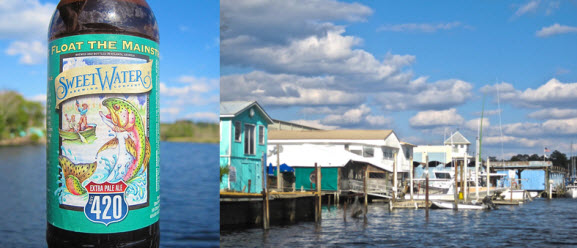 Beer boating along the St. Marks River at the Port – photo credit Jordan Wright At the end of the road is the quaint town of St. Marks, a small port noted for its historic lighthouse and crab processing plants. It is here that you can catch a ride on a peaceful solar-powered boat along the St. Marks River escorted by a Green Guide Master Naturalist. Herons of all varieties as well as manatees, bear, ibises, turtles, alligators and leaping mullet are easy to spot through the long-leaf pines and tupelo trees.
STAY
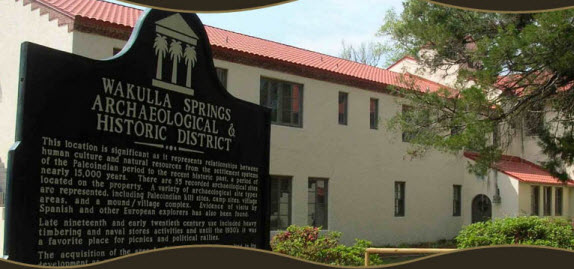 Wakulla Springs Lodge build by Edward Ball 1937 Wakulla Springs Lodge and the Wakulla Springs State Park – Docent and historian, Madeleine Hirsiger Carr has written a fascinating book chronicling the restoration of the magnificent lodge built by Edward Ball in 1937.
The Sweet Magnolia Inn – A charming bed and breakfast constructed of solid rock and coquina shells, that once knew life as a general store, a brothel and even the City Hall. Each room has its own Jacuzzi tub. Bikes are available to rent. On Sundays the inn serves casual food and a jazz band plays till early evening. Call in advance and genial owners Denise and Andy Waters will cater a delicious lunch with wine and beer or a cocktail spread of cheeses and hors d’oeuvres and deliver it to your boat for a sunset cruise. Her shrimp salad is legendary.
Shell Island Fish Camp, the oldest fishing camp in Florida. Anglers can catch speckled trout, red fish, blue fish, tarpon, cobia and more.
DINE
Boat or drive to the Riverside Café for local grouper, Gulf shrimp and mullet. Blue crabs all year and stone crabs from October through mid-May. Wash it down with a frosty 420 IPA from Georgia’s SweetWater Brewing Company.
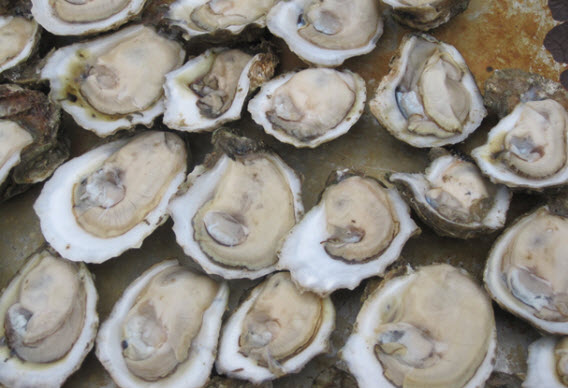 Appalachicola oysters ready for the grill – photo credit Jordan Wright Deal’s Famous Oyster House has its share of seafood too – grouper, flounder, catfish, scallops and plump Apalachicola oysters. After all that’s what we came for. There’s no alcohol served in this family style spot, but the restaurant has a specialty you won’t find anywhere else. Something the old folks call a “pogo stick” which is an old time percussion instrument on a tall stick with a cymbal on top and a drum connected to it. When waitress Zodie Horton bought the place from the Deal family she learned to play it from Mrs. Deal. Expect to hear songs like “Cotton Eyed Joe” and don’t be surprised to see locals joining in on spoons or washboard. On Port Leon Drive next to the post office or access by boat from the St. Marks River.
In nearby Crawfordville try the family-owned Spring Creek Restaurant, another old-line Florida spot where you’ll find oyster stew, crab cakes, fried quail, hushpuppies and tomato pie. Wakulla Adventures now offers a sunset cruise from there.
FESTIVALS
“Wild About Wakulla Week” is a week-long festival bracketed by two popular festivals, The Sopchoppy Worm Gruntin’ Festival held the second Saturday in April and the Wakulla Wildlife Festival. A two-day event held the third weekend in April.
WILDLIFE TOURS
Arrange Wakulla Adventures solar boat tours through Palmetto Expeditions who can also help with certified birding and wildlife guides, fishing and scenic cruises, historical walking tours, scuba and snorkeling gear rentals, and specialized catering.
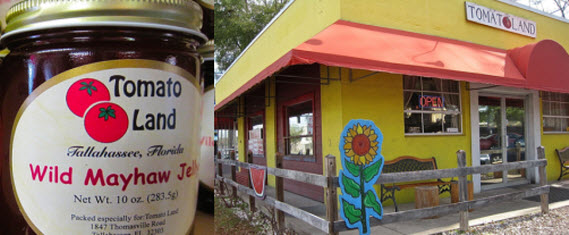 Jars of local mayhaw jelly at Tomato Land – photo credit Jordan Wright On your way back to Tally be sure to stop at Tomato Land for wild mayhaw jelly, pecans, local hot sauces and stone ground grits. The kitchen makes oyster and shrimp po’ boys and fried green tomato sandwiches. Fish Fry Fridays platters come with cheese grits, coleslaw and hushpuppies. A small farmers market with locally grown produce is next to the parking lot.
Jordan Wright
for the Alexandria Times
April 8, 2013
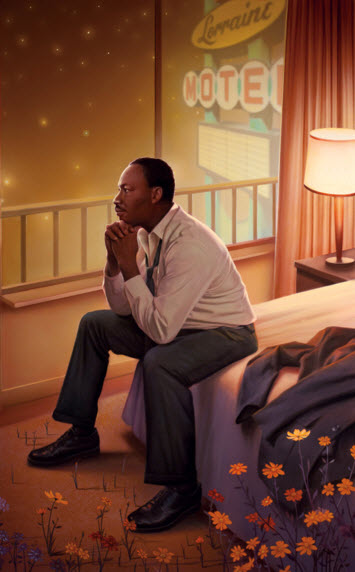 The Mountaintop runs March 29-May 12, 2013 at Arena Stage at the Mead Center for American Theater. Illustration by Tim O’Brien. When playwright and actor Katori Hall’s play The Mountaintop was staged on Broadway in 2011 it starred Angela Bassett and Samuel L. Jackson, two of the finest American actors we know. But with Arena Stage’s latest production, irresistibly directed by Robert O’Hara, it’s hard to imagine anyone else in the roles except the current stars of this production – Bowman Wright as Dr. Martin Luther King, Jr. and Joaquina Kalukango as Camae.
From the moment the lights go up on Clint Ramos’s set design of the iconic Lorraine Motel, all the images of that tragic day come flooding back. The dark-suited men on the second floor balcony pointing to the direction where the bullets had been fired, the foreboding sky, and the subsequent revelations of how we lost one of the country’s most powerful civil rights leaders on the night after he gave his “I’ve Been to the Mountaintop” sermon at the Mason Temple in Memphis, Tennessee.
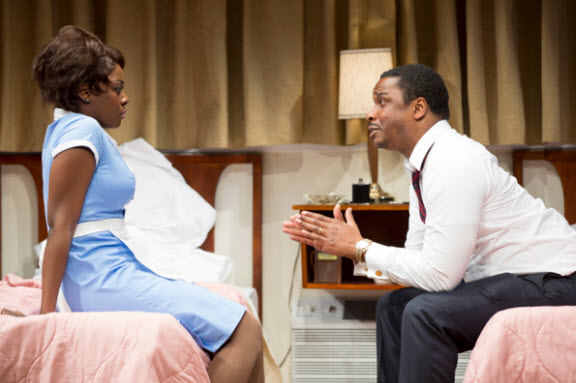 Joaquina Kalukango as Camae and Bowman Wright as Dr. Martin Luther King, Jr. Photo by Scott Suchman. Hall’s play imagines that rainy night and King’s conversations with Camae, a hotel maid, who brings a cup of coffee to his room and stays with him until that fateful hour. Camae is a sassy, sexy, amusingly profane foil for the serious preacher. “I need a needle and thread to sew up my mouth,” she confesses after one too many f-bombs. With her Pall Malls tucked in her bra, “My daddy said Kools’ll kill ya”, and her flask cached in her stocking top, she appeals to King’s well-known weaknesses and they spend the evening flirting and talking of race relations and the War on Poverty. He is working on a speech in Room 306, more familiarly known as the King-Abernathy Suite, and it is clear he is easily distracted by her not inconsiderable charms.
As the night progresses and the rain turns to light snow, King’s visions and suspicions of her uncanny knowledge of his childhood name bring out his paranoia. “Fear has become my companion,” he admits. “I know the touch of fear even more than I know the touch of my own wife.” To recount the subsequent plot twists would be to act the spoiler, so I’ll put it a pin in it from that point on.
Crafting an engrossing script for an audience who knows the outcome of these historical events can be challenging, but Hall delivers with electrifying dialogue and inspiring originality and both Wright and Kalukango are seamlessly convincing.
Well worth noting are Lighting Designer Japhy Weideman and Projection Designer Jeff Sugg whose evocative special effects conjure the mood of the night and in a surprising ending use flashback projections to depict one of the most radically tumultuous eras in American history.
Highly recommended.
Through May 12th at Arena Stage, 1101 Sixth St., SW, Washington, DC 20024. For tickets and information call 202 484-0247 or visit www.ArenaStage.org.
APRIL 10, 2013 BY JORDAN WRIGHT
Special to The Credits – MPAA
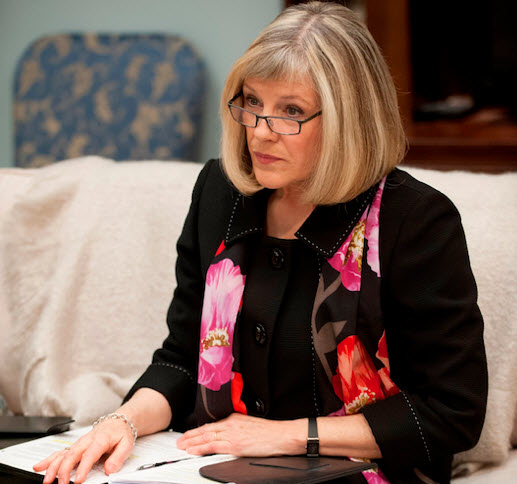 Featured image of Mimi Kennedy on HBO’s Veep. Photo by Lacey Terrell, courtesy HBO
Mimi Kennedy pops up on the screen in the most unexpected places, but as an actor, writer and political activist that should be no surprise. She recently played the formidable madam in a house of ill repute in ABC’s Scandal, Jason Segel’s tough talking mother on the big screen in The Five-Year Engagement and the soigneé mother-in-law-to-be in Woody Allen’s all-star cast of Midnight in Paris. Known early on for her TV role as Dharma’s hippie mother in Dharma & Greg, last year Kennedy appeared on Anger Management, Up All Night and In Plain Sight. And now, she has recently wrapped shooting in Baltimore with director Armando Ianucci and Julia Louis-Dreyfus for HBO’s second season of Veep. Set to air this Sunday, April 14, this hilarious political satire is based on Ianucci’s BBC series The Thick of It, which was a take on the Tony Blair style of modern British government. It later hatched the American film In The Loop. Veep stars Louis-Dreyfus as Selina Meyer, a one-time presidential hopeful now mired in her role as Vice President.
Kennedy joins a cast of comedy juggernauts, including Anna Chlumsky, Tony Hale and Timothy Simons. The Credits caught up with Kennedy at her LA home to talk about her new role on HBO’s most reliable comedy.
The Credits: What is your role on Veep?
Kennedy: I play the House Majority Leader.
What was the most exciting part about being cast in Veep?
At first I was just so thrilled that Armando had written me into the script. But when I was on the plane to DC on my way to the shooting, I see this tall drink of water and it’s Zach Woods. He told me Ianucci was reuniting the American cast members who had been in In The Loop. David Rasche and Chris Addison, also in Baltimore directing an episode that would be in rehearsal while we were there, would be in the episode too, and we’d see writers Simon Blackwell, Jesse Armstrong and Tony Roche again, who wrote and worked on In The Loop. Unfortunately James Gandolfini was the only one of the American cast members that wouldn’t be back since he was shooting elsewhere. I felt as if Armando had planned a surprise birthday party for us.
What was the atmosphere on the set?
Armando gathers the cast and we read the script at the table. Then we get scenes on our feet. He lets us loosely just riff on what we think is going on between our characters. So when he introduces a new character he can see the flavor of the relationship developing, which gives the writers more ideas about how to point a scene or what else to introduce. That’s what we did for two days. Then they write a new script, generally the same arc as the original script, though adding some of what they might have picked up in rehearsal. We shoot all of that. After that, they come up with new pages and say, “The scene is this now.” You will see very different details and different jokes and that’s the fun of it. They’ll say, “What if you guys do this?” It’s shot in a warehouse in Baltimore with hand-held cameras and the actors are given a lot of freedom to move around and improvise.
What’s it like working with Julia Louis-Dreyfus?
She’s fantastic to work with—deadpan funny, my favorite style. Julia and I were in a scene together and the set up was we had to negotiate some budget compromises before midnight. We had to do it at her daughter’s birthday party. So she’s torn as a mother between having to do it at her daughter’s noisy 20-somethings party with a DJ playing and her ex there, and I’m yelling over the music, “We have to do this now.” We go into the ladies room to talk it out and there’s a fight in there. So we go into her office and I have this huge allergy attack from some flowers. I lost my voice for two days from all the sneezing, choking and coughing I faked. At one point I laughed so hard at something Julia was doing that I broke up and she said, “Close your eyes!” I’m sure she gets that all the time, because she’s so hilarious. In fact the whole cast is brilliant to work with.
Frank Rich, one of my favorite culture/political writers [former theatre critic for the New York Times (then an Op Ed columnist), contributor to New York Magazine] is one of the executive producers so talking to him was a “rich” experience for me! He and I knew each other tangentially. He informs the writers about American policy issues, although they have all kinds of consultants. At one point Julia was saying, “Let’s leave. Turn right, turn right.” And I said, “I always turn right. You follow me right.” And they said, “We can’t use that. We can’t refer to the left or right or liberal or conservative.” They try to stay to the center so it’s not predictable. They walk that line. The whole thing moves very fast, even when they’re improvising. And they pack a lot in. Armando said the first cut of In The Loop was four and a half hours that they had to get down to 92 minutes.
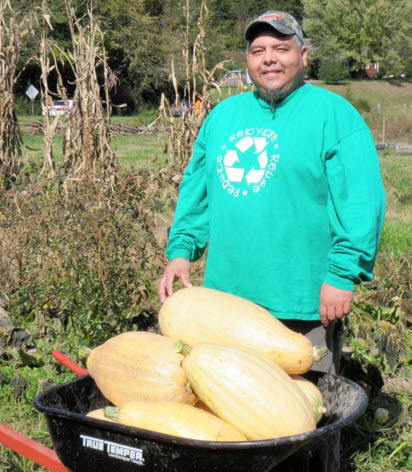 Kevin Welch is helping Eastern Band of Cherokee growers save heirloom vegetables from extinction. (Courtesy Eastern Band of Cherokee Indians Cooperative Extension)
Ask Kevin Welch what he does, and he’ll tell you he’s a “professional farmer.” But he’s no ordinary farmer.
In his unique role with the Eastern Band of Cherokee Indians’ Cooperative Extension, Welch has become a nationally renowned speaker on health, nutrition and the benefits of traditional agriculture. He has served as a lecturer-in-residence at Purdue University and spoken at the University of Georgia as well as to the Association of American Indian Physicians in San Diego, California and Anchorage, Alaska, preaching the importance of traditional plants and their roles in combating diabetes, high blood pressure, heart disease and depression.
But in his day-to-day life, his passion is preserving the heirloom seeds of his heritage. And that’s what makes him a farmer.
In 2007, Welch established the Center for Cherokee Plants, headquartered in the Great Smoky Mountains of Western North Carolina on the Qualla Boundary. The project is funded by the Federally Recognized Tribes Extension Program, the National Institute of Food and Agriculture, and the Cherokee Choices Healthy Roots Project through the Centers for Disease Control and Prevention.
Welch’s interest in preserving traditional Cherokee methods of farming, creating a heritage seed bank, and sharing with the community is known far and wide. And he regularly receives donated seeds from growers who have passed them down from generation to generation. Though some of these seeds were cultivated for centuries by Cherokees, the tradition of growing these ancient crops had been all but lost. Welch’s mission is to preserve and propagate plants that are considered culturally relevant to the Eastern Band of Cherokee Indians and to maintain a seed exchange program for enrolled members who agree to grow the seeds in isolation, thus keeping them pure, and to share 10 percent of their first harvest with the Center.
During growing season, Welch’s office is an ordinary single-level white outbuilding off U.S. 19 beside a large open field where he tends to his crops on a two-acre parcel of land alongside the Tuckaseegee River in a fertile valley. On the same stretch of ground lies the sacred Kituhwa Mound—the site of the first Cherokee Village.
The long concrete structure, once a former dairy, is used mainly for farm equipment, but it is here in a small room where Welch first carefully records the history and provenance of the rare cultivars.
Harold Long, an Eastern Band member, and his wife Nancy are locals who have benefited from Welch’s seed exchange. Their three-generations farm is a mile higher in elevation from the valley below, and they seek out plants with a shorter growing season—plants like Harold’s mother and father grew.
“We grow seventeen types of heirloom tomatoes like Cherokee purple, Aunt Ruby’s German Green, Mortgage Lister and Violet Jasper, which is small and very beautiful,” says Nancy. “Our pole beans are all string-less—October bean, Lazy Housewife, greasy bean and Cherokee butter bean. We collect our seeds or get them from the extension. We also have the older varieties of apples on our farm, like Moonglow and Liberty. We keep patches of sochan [a relative of the green-headed coneflower] and ramps too.”
Along with hundreds of other gardeners, the Longs have become part of the ever-expanding circle of heirloom plant growers, and their farm a testing ground for these ancient seeds.
In a recent interview, Welch spoke to Indian Country Today Media Network about the program’s promising future.
What are you doing now?
We have a project calledDa gwa le l(i) A wi sv nvusing an enclosed trailer we call the garden wagon. We converted it into a space for holding educational courses. We can set it up at any venue and be ready to teach in about 15 minutes. In remote places where it’s hard to get people to a community center, we can bring it right to them.
We also have a garden kit giveaway program coordinated by Sarah McClellan, project director and educator of the Eastern Band of Cherokee Indians’ Cooperative Extension, and funded for the past 10 years by Chief Michell Hicks’ discretionary fund. In addition to organizing the volunteers and selecting locations, McClellan determines all the plants and seeds we give away.
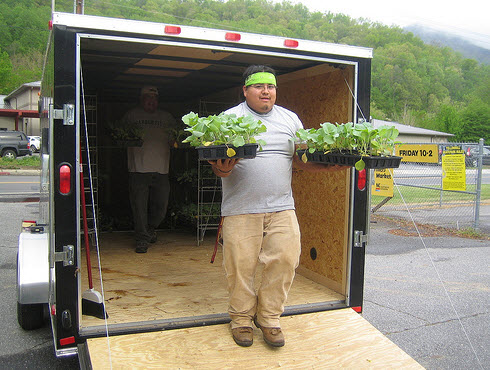 Volunteer Kevin Welch unloads Garden Wagon plants. (National Institute of Food and Agriculture) How are the seeds kept?
We collect them and dry them and put them in the freezer to kill off any pests. Then we sort and clean them and store them in bulk. It’s actually very low-tech. We hold seed saving workshops to teach the basics. Sharing them and planting them is the best way to keep a viable seed bank.
How are they shared?
We provide the seeds to enrolled members only. We don’t sell seeds. Sometimes I bring seeds along with me when I give talks, but then I’m mostly talking about the practical applications, local foods and agricultural education.
All tribes have some aspect of agriculture—from aquaculture to agriculture to ranching. A lot of tribes, when they try to modernize, tend to get away from their traditional agricultural heritage.
Who are some of the people outside the immediate community you have you given seeds to?
We gave seeds to the Smithsonian’s National Museum of the American Indian in Washington, D.C. for their garden and also on the Earth Day event to the [U.S. Department of Agriculture’s] “People’s Garden” when I came and spoke about gardening. Several years ago, we donated seeds for a rare Cherokee flour corn; Cherokee Speckled butter beans; “Candy Roaster”, a variety of winter squash; and a mix of October beans, to Michelle Obama’s White House garden.
And to start their seed program in the Western Cherokee Nation, we have given 24 varieties to Pat Gwin [director] and Mark Dunham [natural resources specialist] with the Cherokee Nation Natural Resources.
How many different varieties do you have now?
We have many varieties but we only grow out a few each year. We rotate them to build up a stock. My job is to plant, care for them and harvest them. We have quite a few folks that support our program and bring in heirloom seed that has been grown in their family for a long time. We grow varieties of tomatoes, the Cherokee Tan pumpkin, corn, beans, peppers, Jerusalem artichokes and gourds, as well as non-traditional varieties like vetch and wild potatoes from the Americas.
How do you process the seeds you receive?
When we get them, they are catalogued with a story about their heritage. Then they are dated and labeled. Afterwards, we grow them out to see if they are a stable variety, and we’ll take as many seeds as we can. We give away the seeds for free, because the idea is to get as many people growing it as possible, so the variety doesn’t die out.
What about the stories the families tell about their seeds?
That’s an integral part of its being an heirloom and being around so long. If no one liked it, then they would have not grown it anymore. I tell people that without the story of why it’s important to anyone—a seed is just a seed. This is called “memory banking”—the process of gaining the story behind the plant or behind any social construct. The same application is done for the seeds and the plants, like who grew them, why they grew them and why they liked them.
Are they more disease resistant?
Most open-pollinated varieties evolved because they have traits for a certain area. It really goes to soil conditions, environment, pH levels, climate—even the topography of where they come from. Basically they are grown because theyarepest and disease resistant. Sometimes people do what they call “high grading,” selecting the ones they like until they become the dominant trait.
Have you found traditional and natural ways to combat pests and disease?
Most of it is really basic. You can plant companion plants like beans that are a good nitrogen fixer for corn [and] squash, because its broad leaves shade out other plants for a natural weeding effect, and certain types of flowers that attract desirable insects. In winter, we collect praying mantis chrysalises that we place in the garden in springtime, where they’ll hatch out and eat the aphids. Also important is to select the right slope and drainage to prevent mildew from overly damp soils.
What are the challenges to growing these seeds?
The only challenge is crossbreeding and the application of pesticides and fertilizers, which we do not use here; also the elk that roam free here, or even the neighbors’ critters!
Do you have fruit seeds too?
Yes, we have Junaluska apples and Nickajacks—both documented as over 100 years old; Buff apples that are a variety documented to have been grown for at least 150 years; and the heritage White Indian peach, very small and sweet, that the elders really enjoy; also ground cherries and persimmons.
Do you teach people how to prepare the fruits and vegetables?
Most families still know how to cook these foods. It’s generally passed down from mother to daughter, though there are several cookbooks out by enrolled members. The Big Cove Community Club recently held a workshop about traditional cooking. And if you ask at the elementary school, the kids all know whatsochanand ramps are and how they like to eat bear and deer meat.
What are your plans for the future?
Hopefully we will continue to enhance and develop our programming to reach a broader audience. We want to focus on growing more varieties and developing a program customized to different groups. One of the things we’re trying to do is to re-educate the youth so that they’ll have a set of life skills. In this way they will be able to grow their own foods and pass that knowledge along. Our emphasis will be on education and youth gardening because the children are the ones that will carry on the traditions to future generations.
Jordan Wright
for the Alexandria Times
April 8, 2013
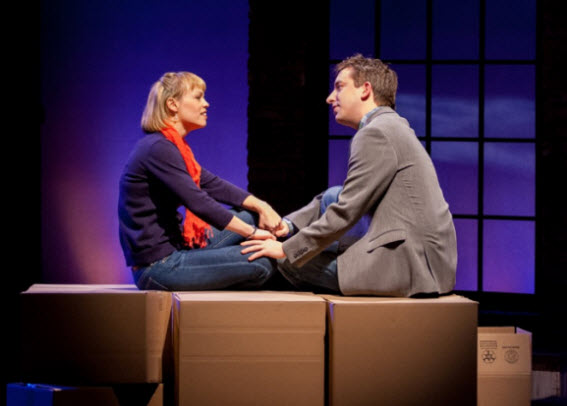 Jamie (James Gardiner) and Cathy (Erin Weaver) share a tender moment. Photo: Teresa Wood Being a theater critic is not always the best way to enjoy a show. I’m not a typical audience member out for a spot of entertainment. Scribbling furiously in the dark I analyze each scene, each song, each performer. Sometimes it’s hard to pinpoint why I am not moved, not amused, not inspired. In Signature Theatre’s The Last Five Years the acting and singing are exemplary. The set design and lighting inspired – the dialogue lively or suitably dramatic, depending on the scene. There is nothing “wrong” with this show. So why does it feel flat?
Well, it’s complicated, in this case as complicated as the plot which jumps from early courtship to their breakup for our hero Jamie, and takes the opposite route for our heroine Cathy, occasionally meeting in the middle for a duet. Known as a “song cycle”, the music by Jason Robert Brown, tells the story of an aspiring actress and a recently published writer who attempt to keep their love alive while pursuing their individual careers in different cities. That is to say when they aren’t living in the same city where he is enjoying success and temptations of the female variety, while she spends her days going on cattle calls in hopes of landing a part.
It is certainly not because actors Erin Weaver, whom we recently adored in Signature’s production of Xanadu, and James Gardiner, a local favorite we are soon to see in Signature’s upcoming productions of Company and Miss Saigon aren’t right for their roles. They both have wonderful voices and a keen sense of comic timing. Gardiner’s sense of physical comedy is especially noteworthy in the number “The Schmuel Song” about a Jewish tailor who sews 41 dreams into his wife’s velvet dress. And Weaver shines in “A Summer in Ohio” a Cole Porteresque tune that lists all the things that are worse than waiting for his return. “I could get a root canal in hell!” she croons, though she follows that with the line, “The torture is just exquisite while I’m waiting for you.” You see the dichotomy of her emotions.
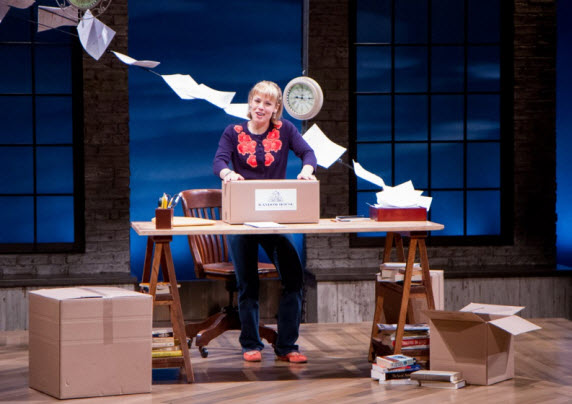 Cathy (Erin Weaver) settles into her relationship with Jamie . Photo: Teresa Wood It cannot be that Director Aaron Posner, the recipient of three Helen Hayes Awards and two Barrymore Awards, all of a sudden knows nothing of direction or that playwright Brown who has composed four major musicals and won countless awards doesn’t write his tail off with songs that are complete, emotionally solid and melodic. No, no it’s not the music, that’s the issue here, but a human connection that goes missing. The je ne sais quoi moment that reaches deep into your soul and tears out a piece you’d be glad to offer up, if only it were needed. It’s the part that’s not in the script, not in the songs, not in the staging. Because you really did come for that emotional ride – to believe – to buy into the moment – but sometimes the magic isn’t there.
The story is written to showcase Brown’s songs and the script is the device to string it together rather than the other way round – a construct originating with Beethoven and popular today in the TV shows “Smash” and “Nashville” which center around the music rather than the story. If you are ready to let it come at you as an evening of music, rather than a backwards forwards plot chronicling the perils of young love played out in two cities, you’ll be better prepared to enjoy its pleasures.
Through April 28th 2013 at Signature Theatre (Shirlington Village), 4200 Campbell Avenue, Arlington, VA 22206. For tickets and information call 703 820-9771 or visit www.signature-theatre.org.
|