|
|
Jordan Wright
August 16, 2013
Special to DC Metro Theater Arts, Broadway Stars, and LocalKicks
The Sushi Bar in Del Ray
There’s been a fine kettle of fish brewing in Del Ray. Raw fish, that is. Jilted by the adults-only restrictions at a new sushi bar, horrified moms lit up Twitter and the Del Ray Patch’s Facebook page with blistering comments, accusing the restaurant of discriminating against their little paragons of politeness. Others claimed they were just fishing for publicity. One writer challenged the unique name of someone’s child on the comment board. While another retorted, “One day some family is going to pull a Rosa Parks on this place!” Good heavens! What was going on in hipster Del Ray, the sweet little burb where Gen-Y parents queue up with their little angels at The Dairy Godmother for soft-serve on steamy summer nights?
Here’s the skinny, if you haven’t already heard. Six weeks ago restaurateur Mike Anderson of Mango Mike’s and Pork Barrel BBQ, opened a sushi and sake bar for adults. That’s all. If you saw the miniscule size of the place you’d realize that even one stroller could get in the way of service. There are sixteen seats at the sake bar, six stools at the sushi counter and a few banquettes along the back wall, accommodating a grand total of 45 guests who will enjoy its pleasures on weekends between 5pm and 1:30am and during the week from 5 till midnight. Get the picture?
 From left – tuna tartare, yellowtail & jalapeño, salmon carpaccio and sea scallops with mango salsa and tobiko — Three Kings – toro, salmon roe and uni — Tuna, yellow tail and salmon with a quail egg shooter in iced shot glass The Sushi Bar’s jewel box size is its charm. It’s an intimate and relaxing spot with exceptional sushi and a well-chosen sake menu. Momokawa, from Denver, Colorado, is one such sake in the nigori style. It’s the first sake ever to be produced in the US. I enjoyed its Moonstone Asian Pear, a delicate fruit-infused sake with the unmistakable floral sweetness of the fruit that dovetailed nicely with the raw fish and smoky seaweed flavors. My partner opted for the Momokawa Pearl, an unfiltered sake that was both sharp and sweet. Other sakes are in the ginjo & daijinjo, junmai and nama styles.
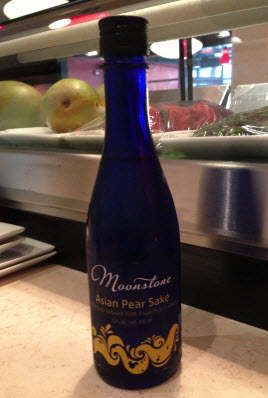 Moonstone Asian Pear Sake We sat at the sushi counter with sushi master, Peter Kannasute, an abundantly cheerful fellow who delights in describing his craft. Omakase, meaning “chef’s choice”, is an option that allows the chef to dazzle the diner with a seven-course dinner that showcases his creativity. For Kannasute, that’s the highest compliment.
Fourteen years ago Kannasute came to the US from Thailand, where his family owned a restaurant in Bangkok. While attending college on Florida’s East Coast he made the decision that becoming a sushi chef was his true calling. “I asked myself what I really wanted to do,” he remembers. “I knew of one master sushi chef with his own Japanese restaurant. He hired me on and began to teach me the art of sushi. Ten years later I was the head chef.”
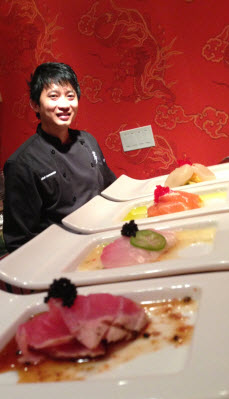 Master Sushi Chef Peter Kannasute with some of his creations At age twenty-three Kannasute entered an Iron Chef-style competition at the Morikami Museum and Japanese Gardens in Delray Beach, where he went head-to-head with local leading chefs, including Jeb Bush’s private chef. “I was the only entrant who hadn’t gone to culinary school!” he recalls. “Ginger was the main ingredient. I prepared lobster rolls and won!”
Later on in his career Kannasute opened the Atlanta branch of Sushi Ra, a well-known chain of sushi restaurants, where he established himself as head sushi chef. At The Sushi Bar the young master has achieved his dream of teaching others about sushi. He expresses his philosophy in the restaurant’s logo – the Japanese symbol for ‘dream’. “I want our all our guests’ dreams to come true too.”
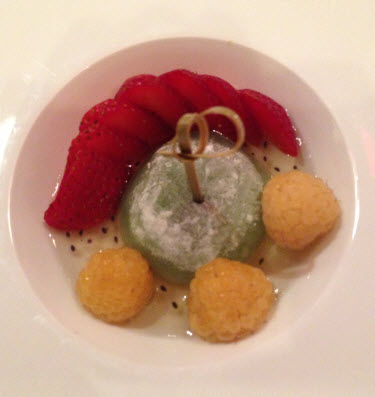 Red bean & green tea mochi with strawberries and yellow raspberries Gin Takes Center Stage in Summer Cocktails
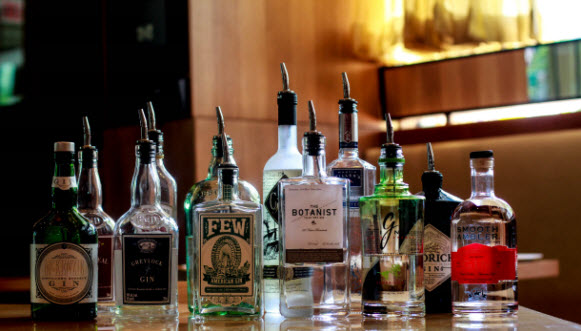 Central’s Gin Program Summer says G&T to a lot of us, but who knew we could keep it local? In DC New Colombia Distillers is making it the juniper-based elixir the old-fashioned way in a copper pot still, launching Green Hat gin – the city’s first gin since Prohibition. The distillers even craft seasonal gins like their Spring/Summer offering with floral notes of cherry blossoms. We’ll want to serve this during next year’s Cherry Blossom Festival.
At Central Michel Richard they’ve jumped on the gin bandwagon with both feet offering US made gins and those from as far away as France, England and Scotland and using over twenty varieties in surprising concoctions to highlight its glories.
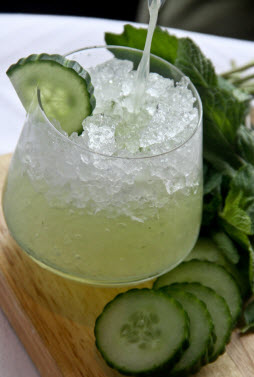 Cucumber Mint Gimlet at Central Michel Richard There’s California’s Distillery No. 209 Napa Valley Gin, a citrusy gin made from an original recipe from the 1860’s and distilled five times. Or try Greenhook Ginsmiths gin out of Brooklyn, NY whose product is made from organic wheat using Tuscan juniper, elderflowers and chamomile in the blend. Berkshire Mountain Distillers, the first distillery in the Berkshires since 1911, is in the town of Great Barrington where my family had a country retreat nearby. This summer Central presents a cocktail made from the company’s “Greylock” gin. It’s called ‘Gin Blush’ and uses Campari, Chinotto, orange and lemon to enhance its charms.
The bar at Central has a rotating menu of four cocktails that are indelibly creative. Try a ‘Lavender Gin Rickey’ made with FEW American Gin and lavender turmeric syrup, or this one that sounds particularly appealing, ‘Summertinez’, made with the UK-based Hayman’s Old Tom Gin, Vya Sweet Vermouth, Triple Sec and house made strawberry rhubarb bitters. General Manager David Hale partners with the staff to come up with new concoctions every week. Cheers to that!
Clyde’s Turns 50
Clyde’s CEO and partner, John Laytham, is reveling in half a century of success. “I don’t know of too many restaurants that have been around for fifty years or too many restaurant companies who haven’t closed a restaurant,” he remarks in his book How We Do Business, Clyde’s Primer For Beating The Odds In The Restaurant Business (Brick Tower Press). 
Scheduled for August release, the book chronicles the history of the company’s fourteen restaurants and is broken down into vignette conversations with the company’s founding partners who reflect on the restaurants’ proud history and their modus operandi. The late Stuart C. Davidson quoting the 4th Earl of Chesterfield, espoused the business’s core philosophy by once remarking, “Anything worth doing is worth doing well.” The company has proven that adage beyond a shadow of a doubt with an enterprise that has continued to grow and prosper.
Pages are filled with photographs of Clyde’s formative years in Georgetown. I checked to see if I was in one of them, but didn’t see myself, though I lived around the corner on Cecil Place and misspent a good bit of my reckless youth downing Bloody Marys and ripping into steak tartare amidst its red-and-white checkered tablecloths. Oh, the memories…
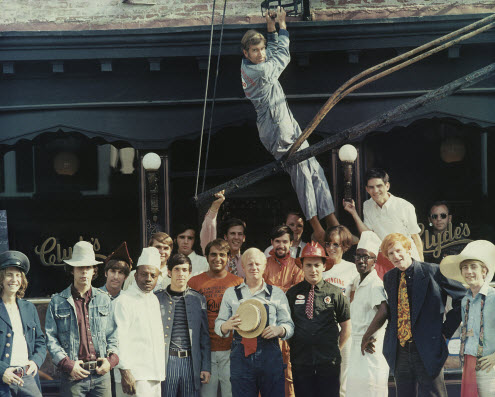 Clyde’s in Georgetown – Stuart Davidson hanging from fire escape; John Laytham in the bib overalls holding straw boater There are beautiful images of Old Ebbitt’s Grill and the group’s newest outpost, The Hamilton in downtown DC, a spectacular 37,000 square foot entertainment venue, restaurant and bar that had its first incarnation as Garfinkel’s luxury department store. And even Clyde’s famous chili recipe has here been revealed. Unfortunately no photos of The Tombs tare provided, though my initials might still be carved in one of the tables.
Local writer, Food Network producer and documentarian, J. Garrett Glover, does a fine job of capturing the owners’ personalities with an ear for humor and a keen perspective on the history of Clyde’s and its many outposts.
Photo credit – Jordan Wright
Jordan Wright
August 2013
Special to DC Metro Theater Arts, Broadway Stars, and LocalKicks
Maketto at Hanoi House Serves Its Street Food Indoors
When Erik Bruner-Yang decided to do a pop-up test kitchen in advance of Maketto, his open air market and retail store slated for Lord knows when, it was a chance to revel in his Southeast Asian street food at the bargain price of $30.00. For that very affordable price of admission, we embarked on an eight-course Asian odyssey during which we became quite eager guinea pigs for the sweet heat of Thai/Viet/Cambodian regional cuisine. Until its official opening on H Street, Hanoi House, a Franco-Viet hip slip of a place on Fourteenth Street will serve as Maketto’s temporary quarters.
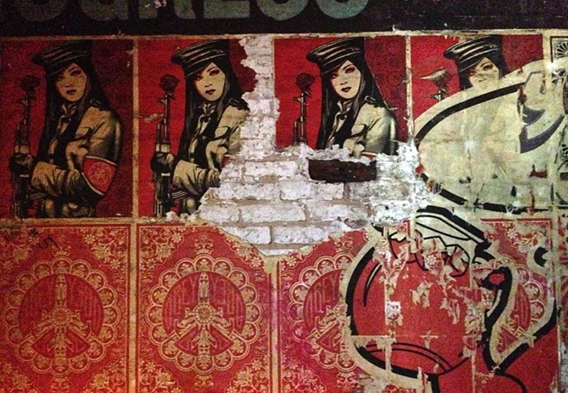 The Franco-Viet decor at Hanoi House Bruner-Yang is a hands-on guy. One minute he’s in the kitchen making your dinner the next he’s serving and describing his dishes and the a la carte items on the dim sum cart. There’s also a full bar menu. Specialty cocktails called “Strongdrink” are a good way to start. I opted for “Silk Road”, a refreshing concoction of rum, coconut milk, ginger and vanilla – – perfect for a steamy summer night.
On the night we dined the menu started with Lok Lak a DIY Cambodian dish in which you pack with egg, tomatoes, rice noodles and Wagyu beef into a lettuce wrap, then dip the leafy cylinder into an irresistible pepper, garlic and lime sauce; then Bok Lahong, a spicy salad of green papaya, dried fish and shrimp, chilies and cabbage. As the meal progresses the courses get spicier – in a good way. Fried prawn heads, the spot where the crustacean guards its fat and flavor, are a gastronome’s nirvana. Pick up the head, suck out the meat and rake out the good bits with your teeth. Lick your fingers and repeat.
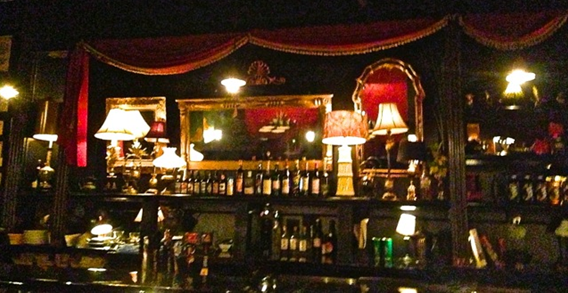 The bespoke bar at Hanoi House As the kitchen brought out more courses we watched Chef de Cuisine James Wozniuk standing behind the bar pounding spices with a mortar and pestle, tattoos flexing with each smash while tantalizing aromas waft about the room. Next up was ground pork chili pepper ragout – – spicy, addictive and enrobed in a tangy tamarind sauce with green beans and water morning glory stems, a plant I’d never encountered before. The insistence on its name from our server was so mystifying I thought I hadn’t heard her correctly. I later discover Bruner-Yang grows it at home from seed. The next day I look up its Latin name, ipomoea aquatica, to better understand its origin. It’s the same genus as our morning glory, however “water morning glory” is a separate species, not well known here but commonly used in Southeast Asian and Eastern cuisines. Mystery solved.
 Ground pork chili pepper ragout in a tangy tamarind sauce with green beans and water morning glory stems As quickly as one dish disappears another arrives. Everything moves at top speed with the fixed price, two-seatings-a-night plan. There were times we had to plead with servers to let us keep some of our courses, so eager were they to remove dishes we were still savoring. A Cambodian concoction of black sea bass, dill and coconut milk was followed by Somlah Machoua chicken and pork broth based dish of tamarind, taro, lime juice, mint and crispy fried garlic – all mouth-wateringly delicious. In the end I could have skipped the final dish of handmade fermented sausage that ended the savories with a whimper – – the only disappointment.
 Shaved ice with sweetened condensed milk, fresh peaches and mochi served in a Mason jar After all that we wondered if we could eat dessert too. But we had signed up for the total immersion experience and we couldn’t pass up shaved ice with sweetened condensed milk, fresh peaches and mochi served in a Mason jar. Could you?
Reservations required at www.HanoiHouse.com
Doukénie Winery Full of Surprises
 Doukenie Winery Doukénie Winery came to my attention when I first heard of their Heritage Club, in which members have an advantage of pre-ordering their personal selections. In mid-July we took a leisurely drive to the winery’s 520-acre property in Purcellville in the region known as the Loudoun Heights Cluster where we could sit overlooking the mountains drinking their award-winning wines and partaking of a once-a-month evening of live music and Greek food. By the time we arrived “Bistro Night” was in full swing. Guests were grazing on humus, Greek salads, gyros and baklava and watching ducks and geese splash around in a nearby pond while the sun descended over the blue hills on a clear night. The barns and silo became silhouettes against the fading light and the water took on the sunset’s pinks and corals. Most couples had purchased bottles to share and along with the band the lively atmosphere gave the evening the feel of a private party.
Sébastien Marquet, Doukénie’s winemaker, is a cheery and sophisticated fellow who began oenological school in Burgundy when he was a mere sprout of thirteen. Naturally he gravitated towards the Côtes de Rhone and Bordeaux of the Burgundy region, the same wines he coaxes from Virginia grapes. The winery produces an astonishing collection featuring Sauvignon Blanc, Chardonnay, Mandolin, Cabernet Franc, Sangiovese, Syrah, Petit Verdot, Merlot, Vintner’s Reserve and Hope’s Raspberry Legacy, a dessert wine created by blending blackberries and raspberries with oak-aged red wine. But the most popular among club members is the Mandolin and new offering, the 2009 Dionysus, made from 100% Merlot. All of Doukénie wines are made from the estate’s own grapes.
 Doukenie winemaker Sebastien Marquet We trotted off close on Marquet’s heels into the cool temperatures of the Barrel Room for a tour. As he spoke of his life story and what brought him to America, he extracted samples with a glass pipette from oaken barrels coded by their variety and vineyard block. They were intriguing and complex, a good sign, certainly holding promise, but clearly needing time to develop – – though it was fun imagining what they might become.
He explained the name of the winery, which is how I first learned that, notwithstanding the Doukénie surname, these are most emphatically not Greek-style wines. So no retsina of course. Though with the focus on Greek rather than French food, it was a bit puzzling.
As the story goes doukénie means “duchess” in Greek and reflects the name of the woman who was the first generation of Bazacos to come to America. She was fourteen, a slip of a girl when she came alone by boat in 1919 from Greece. Her father was a winemaker and she grew up in the vineyards around their home. Traveling with scant possessions, she nevertheless chose to bring her mandolin, the symbol of which later has become the winery’s logo.
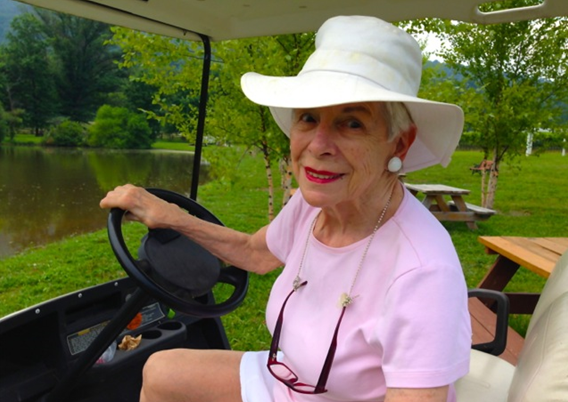 Hope Bazaco, the matriarch at Doukenie Winery It was Hope Bazaco, Doukénie’s daughter and the winery’s matriarch, who shared her story with me as she fed the ducks from her golf cart. Hope is originally from Brooklyn, New York where her mother settled among other Greek ex-patriots. And it was Hope’s son, George, a local pulmonologist, who with his wife, Nikki, purchased their first tract of land in 1981. Together they planted their first vines in 1986 as Virginia’s wine industry was finding its identity. They called it Doukénie Winery after Hope’s mother who lived on the Loudoun farm for many years.
 Sunset at Doukenie Bistro Nights are held on Fridays through the end of September. On September 26th they celebrate the harvest with one of their biggest events of the year – the Italian Festival, featuring Italian food, wine tasting, grape stomping, live music and activities for the kids. Resident geologist, Leanne Weiber, will take visitors on a guided tour of the vineyard by hayride to explain the area’s terroir. For more info visit www.DoukenieWinery.com.
Osteria Marzano – Hidden in Plain Sight
On the first floor of a glamorous high-rise, far more apropos of South Beach or Vegas, is the brand new Osteria Marzano. Located in a cluster of office buildings near Alexandria’s Kingstowne shopping area, it is an unexpected beacon of light in an area better known for chain restaurants and strip malls.
Carmine Marzano has been cooking his country’s cuisine for over 30 years – first training at the prestigious Istituto Alberghiero Statale di Pienerol and later launching his career as the Executive Chef at the exclusive Ristorante Giudice in Turin, Italy where he remained for three years before coming stateside to assist acclaimed chef, Roberto Donna, with the opening of Galileo. Marzano served as Donna’s sous chef for four years before opening Luigino’s in 1993. Sadly Luigino’s shuttered its doors in 2003 after a great run.
 Partners Carmine Marzano and daughter, Elena Pouchelon, at their new restaurant Osteria Marzano Fast forward to three months ago when Carmine finally put his name on the door at Osteria Marzano. Along with his partner and daughter, the beautiful Elena Pouchelon, they have superseded all expectations in the creation of a stunning modern restaurant that covers both the Northern and Southern regions of Italy with dishes from the sophisticated to the casual.
Since opening three months ago it has garnered a loyal fan base from locals who pop in for lunch, drinks and apps after work or dinner at the end of the day. Families, too, have discovered the wood-fired brick oven for pizzas and small plates called assaggini – – perfect for kids. We dropped in last month for dinner and came away thrilled, sated and loaded down with doggie bags or more candidly, lunch for the next few days. Last week tables and chairs were added outdoors across from a burbling fountain, providing a romantic spot for dining under the stars.
Chef Marzano has a light touch that works in dishes like thinly sliced salmon crudo with truffle oil and a toss of lemony greens, and Ahi tuna carpaccio with pink peppercorns. Try the little polpette. They are heavenly. Made with veal, beef and pork and served with a scoop of ricotta, they nearly float off the plate.
 Crudo di Salmone – Atlantic salmon with truffle oil and citronette – Polpette – meatballs with a spicy pomodoro sauce and a scoop of ricotta All the meats on the salumi board are first rate. Ditto for the cheese board that includes marvelous cheeses from five different regions of Italy and comes with ciabatta bread and house made fig jam. Vegetables are prepared gently as are salads, a touch of olive oil, a squeeze of lemon and a hint of garlic. A veal osso buco could have been heartier, its accompanying risotto, brighter and more al dente. The sauce lacked the depth and richness the veal deserved. It’s a dish best made a day or two in advance allowing it to bring the flavors together.
 Tagliere di Salami with house made gardiniera Osteria Marzano’s menu is short story-length. There are fourteen pasta dishes alone. Imagine! One for every other day of the month! Each made in house. You can’t go wrong with a dish that incorporates the restaurant’s basic marinara, a sauce made here that is perfectly balanced – – fresh and tangy, not sugary, with the distinct flavor of good quality tomatoes and herbs.
 Veal Osso Buco with Saffron Risotto But let’s talk pizza – – the offerings are dizzying. Feta, fontina, gorgonzola, buffalo mozzarella, provolone and ricotta are the cheese choices. Dozens more toppings attract. Expect the usual sausage and pepperoni, although the sausage is made here. But it was the grilled eggplant, Italian bacon, shitake mushrooms, and even fresh clams and mussels that caught my eye.
Heads Up: Be sure to let the server know you want your pizza charred. Apparently diners in the hinterlands haven’t gotten the word that 50’s style pizza has gone the way of bobby socks and poodle skirts. Customers keep sending it back thinking it’s burned and the restaurant has had to dumb it down. So be sure to tell the pizzaiolo to prepare it the way he knows best – – the traditional way, the correct way. Because that is how they do authentic Italian pizza here. Of course, my readers already knew that!
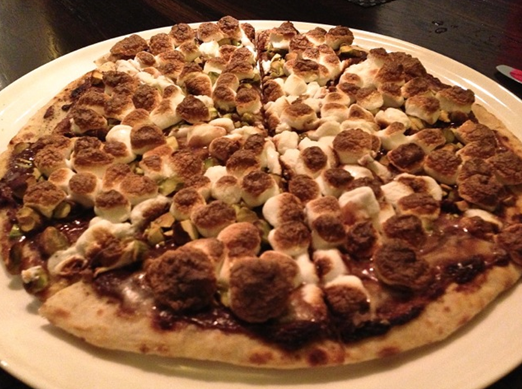 The fabulous Nutella pizza And speaking of pizza, have it for dessert. Yes, you read it right. The Nutella dessert pizza is bad to the bone – – as in good bad – – as in crazy mad fabulous! Think Italian s’mores. First the creamy hazelnut chocolate spread is smeared over cooked pizza dough. Mascarpone goes on top with handfuls of toasted pistachio nuts and tiny marshmallows. Finally it’s slid into the wood-fired oven, which is sort of like a campfire, if you get my drift. The marshmallows melt over the nuts and into the Nutella creating an insanely craveable sweet that turns grownups into kids. Do not miss it.
So close your eyes and pretend you’re in Roma or Napoli or Firenze. Because this is as close as it gets to the real deal without Alitalia.
All photo credit to Jordan Wright
Cary Pollak for Whisk and Quill
July 31, 2013
A recent business trip to Austin, Texas provided an opportunity to do a quick Texas Two Step to a couple of the Lone Star state’s most intriguing cities. I had heard nothing but good things about the Austin scene over the years, and I could take a short drive to nearby San Antonio’s famed Alamo and River Walk.
If you want to check out San Antonio from the airport in Austin, you can hightail it by car and arrive in San Antonio in just over an hour. And despite the basketball playoffs in San Antonio that night, we made good time. Legend has it Spurs fans on their way to a playoffs game are more fearsome than Santa Anna’s troops when they stormed The Alamo, but we managed to sneak through their lines safely.
It was a picture perfect day to visit to The Alamo. Though the 18th century Spanish mission is a relatively small and simple edifice, once you get up close you notice it is dwarfed by the thriving modern city that grew up around it.
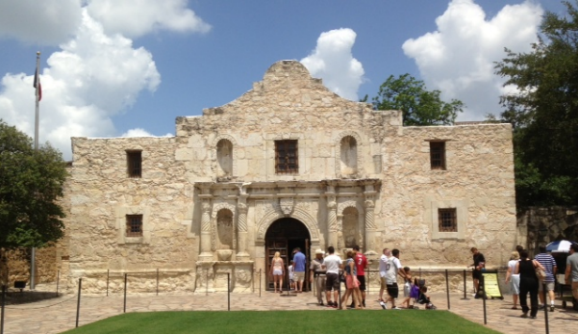 The Alamo The sight of the Alamo can conjure up feelings of reverence for the men who fought and died in a battle critical to the shaping of the United States. It was Sam Houston’s Texas Army that drew on the incident for inspiration during a successful campaign to gain independence from Mexico. Now a lovely and peaceful garden graces the iconic structure, and a small museum portrays daily life in March of 1836 when the Alamo fell. A beautifully elaborate vest worn by Tennessee frontiersman Davey Crockett and a Bowie knife from the 1830’s are among the displays. Both Crockett and Jim Bowie were killed in the legendary battle.
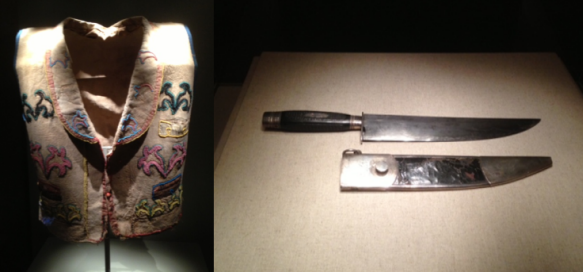 Davey Crockett’s vest – Bowie knife Across the street from the Alamo is the entryway to the San Antonio River Walk. Billed as “The Number One Tourist Attraction in Texas”, it is a long, winding path along the San Antonio River lined with charming restaurants, shops and hotels on both sides. We chose an outdoor table at Rita’s on the River, and enjoyed fabulous Tex-Mex cuisine in a lovely setting. The fajitas arrived sizzling on a cast iron skillet hot as a branding iron. Rita’s menu prepares you for “Texas-sized portions,” and accordingly, fajita platters feature an astonishing three quarters of a pound of meat along with onions, peppers, rice, refried beans, pico de gallo, guacamole, sour cream, and cheese. You might want to take an extra-long stroll down the River Walk to work off one of Rita’s generous meals.
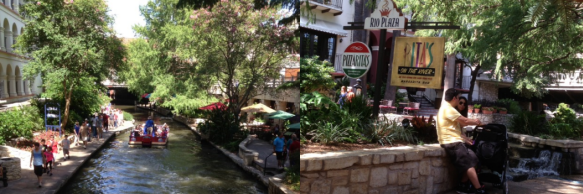 San Antonio River Walk – Rita’s on the River First time visitors to Austin might be surprised to learn that the town’s informal slogan is “Keep Austin Weird,” which can be seen on t-shirts and in store windows around town. The more traditional moniker for the capital city, chosen by community leaders in 1991, is “Live Music Capital of the World.” A good argument can be made for both descriptions.
Reliable sources such as the Travel Channel reckon that the town is home to over 200 live music venues and more than 1900 musicians. As you stroll down popular 6th Street, where bars and restaurants often keep doors open and live bands in view, don’t be surprised if the cadence of your walk shifts to the musical strains of blues, jazz and country. On Briscoe Street, step into The Driskill Hotel to view an elegant showplace reminiscent of early Texas. The Driskill is a beautifully restored Romanesque-style hotel built in 1886 by a rich cattleman who seemed to want to best his neighbors to the north.
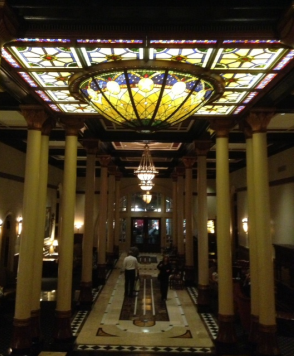 Lobby of The Driskill Hotel The 1869 Café and Bakery occupies a light and airy room with high ceilings and a display of house made pastries that will have you craving dessert at any time of day. Try the glistening cherry Danish. The elegant and highly rated Driskill Grill features local Texas beef and game in a clubby 1920’s décor.
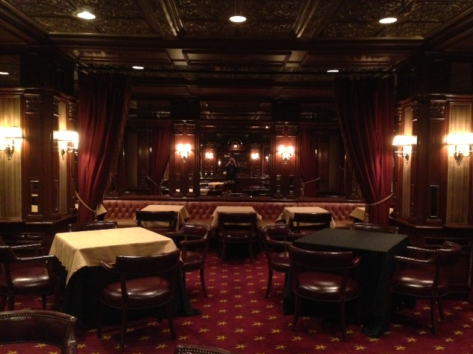 Interior of the Driskill Grill Stubb’s Bar-B-Q at 801 Red River bills itself as “the heart of an explosive music scene,” with good reason. It offers about four or five live performances a week, usually ticketed, on both indoor and outdoor stages. Barbequed meats get a coating of house made dry rub before being slow smoked over Texas Post Oak. Side dishes are made from scratch. The place is so busy that some of the meats can be left on the slow smoker a bit too long. On one visit the turkey breast was tasty but too dry. But the sweet potato fries were timed just right, crispy on the outside, hot and tender on the inside.
Banger’s Sausage House and Beer Garden on Rainey Street boasts the largest selection of sausages in Austin and has 100 beers on tap to wash it all down. The restaurant claims to be named for fictional character Olaf Banger, whose legend can be enhanced by anyone who goes on to the www.BangersAustin.com website and makes up a new story. The menu draws on sausage making traditions from all over the world. The signature bangers and mash is house made Irish style pork sausage with onion gravy and skin-on mashed potatoes. The Cajun Boudin Plate features the famous Louisiana sausage with saltine Crackers, Tabasco Sauce, red beans & rice. Bratwurst is mild and flavorful, just like in the old country. It is made of pork, but the menu correctly explains that any combination of veal, beef or pork is authentic. The most creative menu item is the “Veggie BLT,” actually a sausage made of crushed sun dried tomatoes and cheese curds and topped with shiitake mushroom “bacon”, field greens, and onion aioli. Fabulous! Diners are frequently treated to live music in the beer garden .
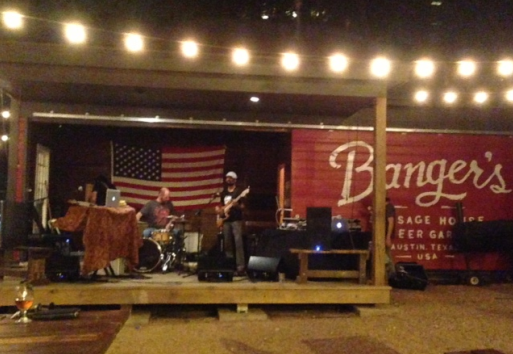 Live band next to the Banger’s sign If you think that Banger’s provides an unusual dining experience, you should pay a visit to Threadgill’s, a food and music establishment that holds itself out as the reason why “Keep Austin Weird” became a popular expression. Threadgill’s now has two charming and homey locations, on North Lamar Street and on West Riverside Drive. They feature a southern style menu that appears not to have been changed for decades. One minor concession to modern tastes might be that the menu offers their “world famous” chicken-fried steak with cream gravy on top or on the side. Those in favor of lighter fare have some options too. Grilled or broiled chicken is well prepared and the Rio Grande veggie burger packs a lot of flavor. The West Riverside Drive location has on display a piano that was played by rock star Jerry Lee Lewis and that accompanied a young Janis Joplin when she developed her early folk singing style.
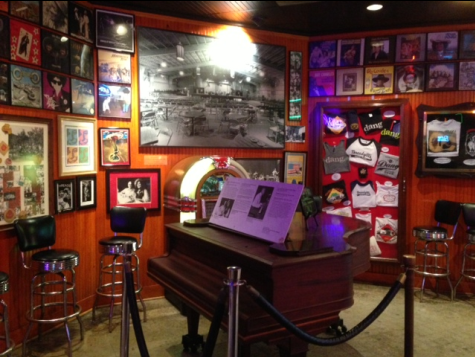 Piano at Thrreadgill’s There are a number of reasons why many Austinites think their hometown is unique. Austin is known for being socially and politically progressive in predominantly conservative Texas, and residents usually vote Democratic. And one of the most unusual attractions in the country is a nightly celebration. Here people of every political stripe gather under the Congress Avenue Bridge throughout the summer to watch the nightly outpouring of the world’s largest urban colony of bats. To top it off, The Museum of The Weird on 6th Street houses a collection of creepy attractions, some in the form of display items from horror movie sets, and some live bugs and reptiles. There’s an entertaining live show by sword swallower Juan Martinez. After the sword is fully inserted down his gullet, he takes a deep bow. He explains that this is a rare and dangerous move, even among the 100 or so sword swallowers currently practicing in the U.S. This performer clearly is a cut above.
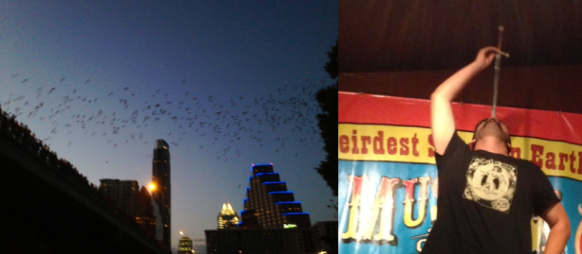 Bats flying from Congress Avenue Bridge – Sword swallower at Museum of the Weird Austin and San Antonio deliver some of the most interesting experiences Texas has to offer. Austin is alive with the sounds of music and is full of surprises, some weird and some just wonderful. San Antonio’s River Walk is a joy to explore. Long after you leave that historic city, you will always “Remember the Alamo.”
All photo credit to Cary Pollak
Jordan Wright
July 28, 2013
Special to The Alexandria Times
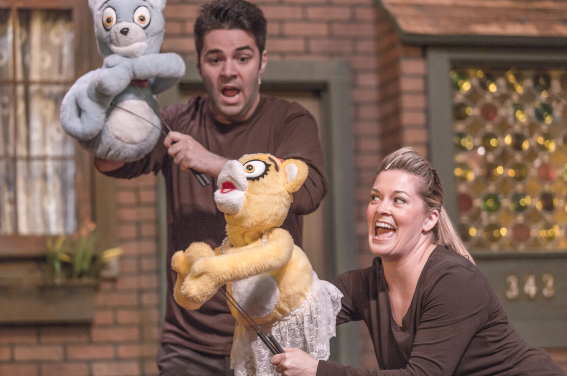 Bad Idea Bears (puppets), Matt Liptak and Charlene Sloan – Photos by Keith Waters With the presentation of Avenue Q The Little Theatre of Alexandria continues its successful leap into the 21st century, with productions that a few years ago would have seemed, well, unseemly to their faithful supporters. My, how times have changed. No longer content with a steady diet of British farce, show tunes and murder mysteries, the theater has branched out this year to include complex religious themes in the sensitive and brilliantly crafted Cantorial, racy topics with a splash of nudity in the hilarious The Full Monty, and now X-rated humor with the uproarious musical Avenue Q. It’s taken some adjusting from the Old Guard benefactors. Overheard – “If they say a bad word, I told him I’d cover his ears.”. Even the director’s notes encourage playgoers to loosen up with this comment, “Let political correctness and sexual and social propriety take a back seat…” But all theaters know they must attract newer, younger audiences and in this day and age swear words and sex talk is everyday TV fare.
Avenue Q picks up where Sesame Street left off. It centers on the generations of kids who grew up with the furry puppets and kooky TV characters that cheered them on, mollified their fears, and taught them the alphabet and, who now as young adults entering the work force, struggle to realize their dreams. The actors, who are quite visible to the audience and mimic the puppets’ emotions, manipulate the twelve furry creatures in a set-to-music guide to the galaxy filled with lessons on love, sex and the Internet.
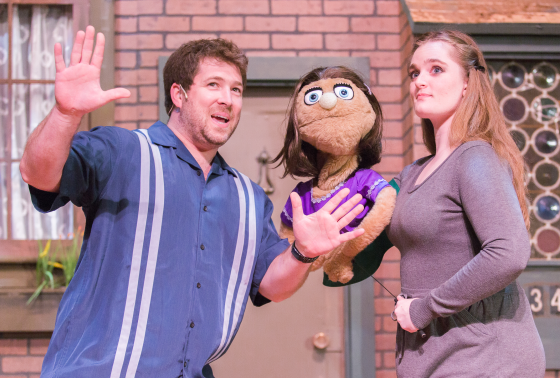 James Hotsko Jr., Kate Monster (puppet), and Kristina Hopkins – Photos by Keith Waters Everything takes place on Avenue Q. Princeton (Sean Garcia) is new to the neighborhood. He’s just graduated college but his life has no purpose, “What Do You Do With a B. A. in English”, he posits. Kate Monster (Kristina Hopkins) is the girl-next-door, an aspiring teacher that Princeton falls madly in love with. Unfortunately he thinks love is not fulfilling enough in his self-absorbed world of job searches and grown-up responsibilities. Christmas Eve (Stephanie Gaia Chu) is the neighborhood’s crazy Japanese lady and psychotherapist, who doesn’t care if she is perceived as Chinese or Korean, but won’t abide by the term Oriental, her significant other is Brian, an out of work Caucasian who wants to be a stand-up comedian.
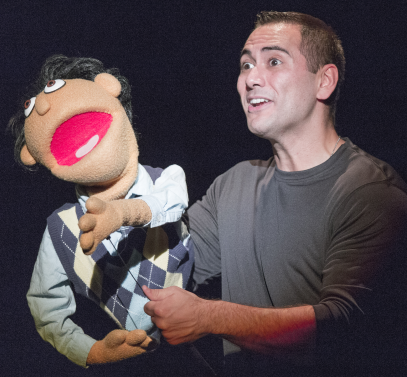 Princeton (puppet) and Sean Garcia – Photos by Keith Waters Nicky (Matt Liptak) and Rod (Sean Garcia) are roommates. Rod, who is still in the closet, hopes to convince everyone otherwise with the song, “My Girlfriend Who Lives In Canada”. And then there are the cuddly cute Bad Idea Bears (Charlene Sloan and Matt Liptak), who try to undermine everyone’s better judgment by sobbing uncontrollably when their devilish advice is not taken.
Gary Coleman (Aerika Saxe) is the street-smart African-American superintendent who balances out the yuppies’ dilemmas with real life issues in the number “Everyone’s A Little Bit Racist”. But they all agree on one thing, including Trekkie (Matt Liptak), the kindhearted but scary monster, in “The Internet Is for Porn”. “He a pervert,” Christmas Eve suggests, but he’s no match for Lucy the Slut (Claire O’Brien), whose Mae West allure has Princeton in her thrall.
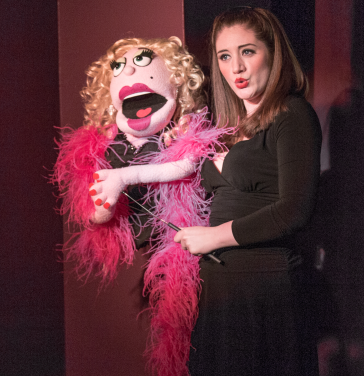 Lucy the Slut (puppet) and Claire O’Brien – Photos by Keith Waters In a show where puppets rule, the actor’s expressions, as they mirror the speaking parts of their hairy avatars, are crucial. Each actor must take on their puppet’s personality and dialogue, both physically and verbally. To say that this troupe excels in their character’s puppet persona, is an understatement and a tribute to Director Frank D. Shutts II’s superb casting as well as Puppet Master Kristopher Kauff and Puppet Wrangler Katherine Dilaber, who taught eight neophytes the art of puppeteering.
Highly recommended. For adults only.
Through August 17th at The Little Theatre of Alexandria, 600 Wolfe Street. For tickets and information call the box office at 703 683-0496 or visit www.thelittletheatre.com
Jordan Wright
July 18, 2013
Special to Alexandria Times
Oxford may be a scant eighty-four miles from Washington, DC, but it is a long and fascinating journey back in time to a postcard-pretty village that has vouchsafed its history as one of the oldest towns in Maryland.
 Parked along the strand in Oxford For our adventure to the Eastern Shore we drove a 2013 Ford Escape Eco-Boost Titanium and it proved to be beyond our expectations in fun, style and technology. Some very cool features stood out – nighttime sidelights that illuminate the area you are turning towards, a remote starter (How did we ever live without this?), blind spot detection and GPS, and the foot-activated rear door, especially handy when arms are loaded down with baggage and souvenirs. Ours was a lovely shade of celery green they call “ginger ale” that drew compliments wherever we went.
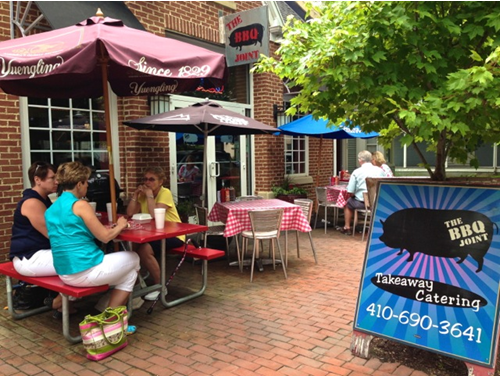 The BBQ Joint in Easton We crossed the Bay Bridge to Rte. 301 and headed due south past acres of flat farmland and roadside stands. Wooden crates stacked high with fresh corn, sun-ripened tomatoes and juicy cantaloupes had to wait for our return as we made our way to the county seat of Easton and a pit stop for lunch at The BBQ Joint. This super cute restaurant with its shady sidewalk tables is recognized as having some of the South’s best barbecue and definitely merits a detour. It’s where Chef/Owner Andrew Evans left the world of fine dining to serve up his award winning smoked meats and unique sauces.
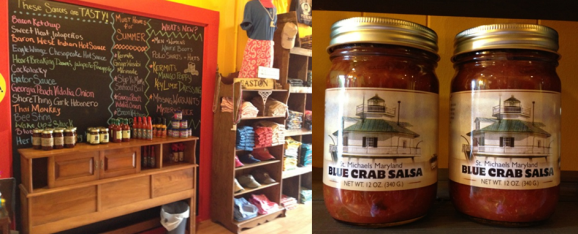 The list of hot sauces – Local blue crab salsa at Crabi Gras in Easton Easton boasts tons of antique emporiums, galleries and upscale gift shops along with the Academy Art Museum A whose exhibits feature local as well as world-renowned artists. On Harrison Street is Crabi Gras for hot sauces, spices and pickles from around the country. We rehydrated at Hill’s Soda Fountain and Café with a glass of JMX, a vitamin-packed elixir of fruits and vegetables, juiced on site, that locals buy by the quart.
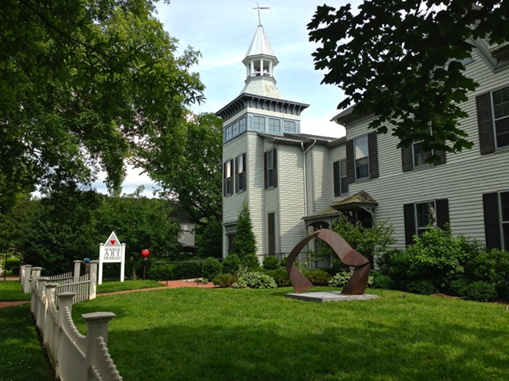 The Academy Art Museum of Easton After a ten-mile drive we come upon Oxford and the Oxford Inn. The yellow clapboard structure with green shutters and a large porch was built circa 1880 and sports an antique British taxi parked out front. The seven-bedroom B&B owned by Lisa McDougal and husband Dan Zimbelman was bustling as preparations were in high gear for dinner and the bar already had its first guests of the afternoon. McDougal is a world-class chef who thrills diners with her inventive European bistro cuisine in the inn’s Pope’s Tavern, a country chic dining room where she showcases her imaginative seasonal dishes. Have a cocktail in the bar and meet the locals or sit on the front porch for a view of the canal. We discover the taxi is to give locals a ride home after an evening of over-tippling. You need only climb the stairs to your cozy room to call it a day.
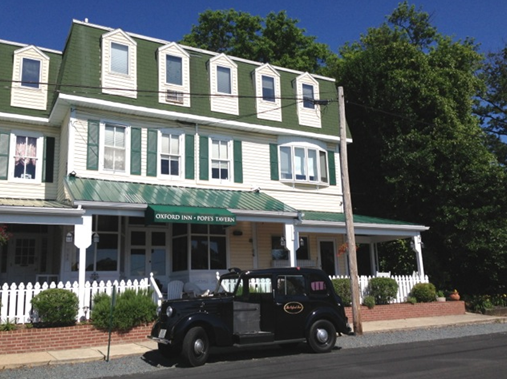 The Oxford Inn with its iconic antique British taxi If you came to the Eastern Shore to do some crab picking, there’s no better spot than the Masthead at Pier Street Marina whose waterside view of the sunset is breathtaking. Get a bucket of Ipswich steamers and spiced crabs and dig in.
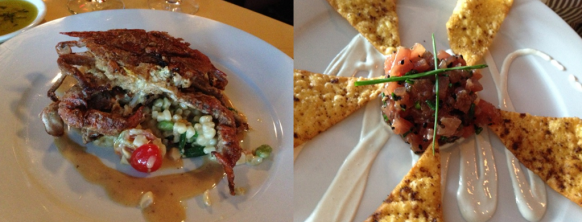 Chef Lisa McDougal’s soft shell crabs with succotash – Salmon seviche with house made crisps at the Oxford Inn The combination of savory aromas wafting upstairs and the morning’s sunlight pouring into our bedroom window pushed out any thoughts of lolling about in bed. There’s nothing like the sound of halyards pinging against a ship’s mast and pennants flapping in the breeze to get the spirit moving – that and sizzling bacon. Weekends are when McDougal goes all out with a lavish breakfast of omelets, bacon, sausage, pancakes, frittatas, fresh fruits and house made breads and scones. Did I mention she does the baking too? All with an engaging energy that makes you feel you’ve known her all your life.
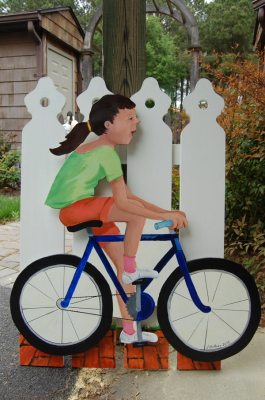 “Come Bike With Me” – Oxford Picket Fence Project Exploring the village by foot is the best way to experience its tree-lined streets and historic homes. For the past five summers the town has organized a picket fence project. Twenty-two fence sections are given to local artists to decorate and display around town before being auctioned off at the end of September with proceeds going to the artist’s favorite charity. Grab a map from the inn and see how many of these highly original fences you can spy. If you see one you like you can bid online before the big night. This weekend a free historical walking tour of Oxford leaves from the ferry dock at 1pm Saturday, July 20th.
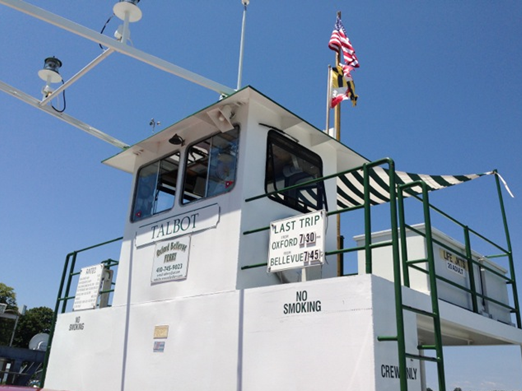 The Oxford-Bellevue Ferry By the river’s edge is the Oxford-Bellevue Ferry, in operation since 1683. Purported to be the oldest ferry service in the nation, it is currently owned by Captain Tom and Judy Bixler. The ten-minute ride is a short cut to Tilghman Island, a fishing village punctuated by an old drawbridge.
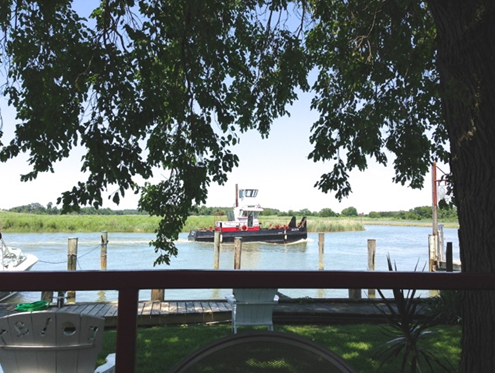 Watching the watermen return to port from the Tilghman Island Inn We took a leisurely lunch under a willow tree on the deck of the Tilghman Island Inn. The peaceful spot comes with sweeping views of Knapps Narrows and the redwing blackbirds and great blue herons that soar across the marshes and perch on wildflowers. Over rockfish chowder and fried local oyster sandwiches we watched sailboats heading out to the bay as watermen returned with their daily catch. With a bit of prodding proprietor and Southern gentleman extraordinaire David McCallum will regale you with stories of his notable guests like Led Zeppelin’s Robert Plant who brought his family for a week earlier this summer.
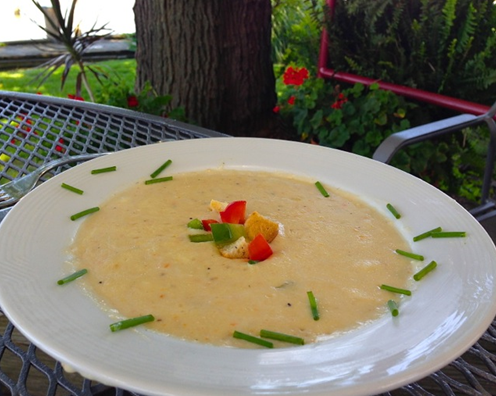 Rockfish chowder at the Tilghman Island Inn After lunch hop a ride on the Rebecca T. Ruark, built in 1886. The antique skipjack leaves from nearby Dogwood Harbor for a two-hour tour of the water. Or check with the inn to book fishing charters, kayaking and bicycle rentals.
Take the Royal Oak Road back to Oxford and you’ll pass Oak Creek Sales. The store cum barn holds an eclectic olio of vintage patio furniture, junk from Grandma’s parlor and attic and terrific finds. I snagged a small cast bronze dog and a brass jockey-themed wall hanging for keys and caps.
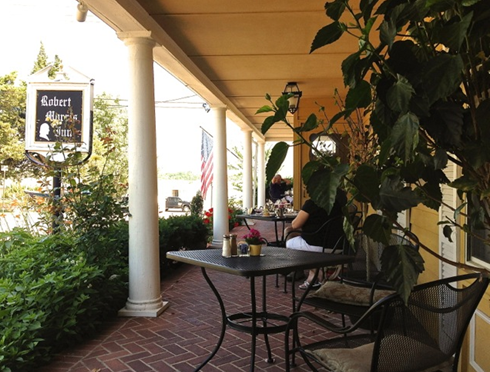 The veranda at the Robert Morris Inn On warm summer nights dining is alfresco at the Robert Morris Inn, a bespoke colonial inn built in 1710 and owned by British Master Chef Mark Salter and Ian Fleming. Salter’s elegant cuisine delivers a modern approach to classically styled dishes like summer gazpacho with lump crab, or the inn’s original recipe crab cakes served with corn succotash, grilled watermelon and white corn sauce. Save room for a slice of pecan pie or Salter’s version of the iconic multi-layered Smith Island Cake topped with whipped cream.
After dinner we strolled along the strand gazing at the stars and hearing the osprey’s call. Then back to Pope’s Tavern for a nightcap with plans for the next day’s stop at a farm market to bring home some of those glorious peaches.
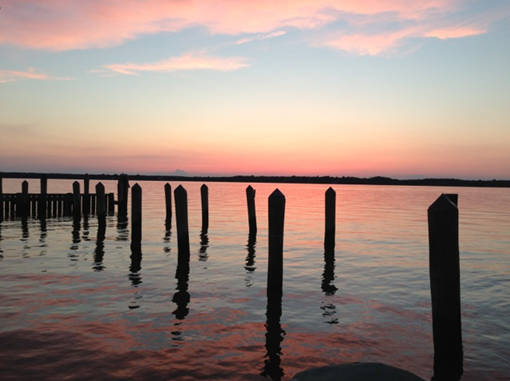 Sunset from the Masthead at Pier Street Marina restaurant All photos by Jordan Wright
Jordan Wright
July 09, 2013
Special to The Credits – Motion Picture Association of America
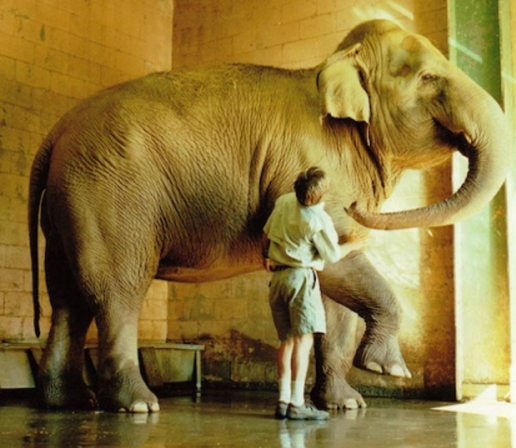 David works with elephant
If you’ve ever seen a rhino in a television commercial, his name is Tank and he’s the only working rhino in show business. Maybe you’ve noticed zebras, bears, leopards, African lions, panthers or Siberian tigers in TV ads or on the big screen and wondered how they’re train to stand still, lie down, run around or roar on command for the camera?
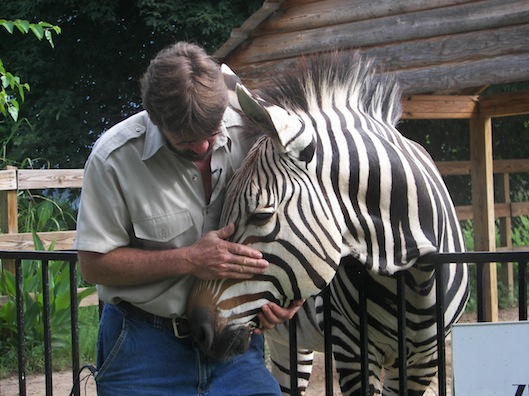 Meeks with his Zebra Zeke
Many of the animals you see on the big and small screen belong to David Meeks, director of Hollywild Animal Park in South Carolina. Meeks is the East Coast animal wrangler filmmakers call when they need, say, a panther in their in movie. The business side of the 100-acre park is called Cinema Animal Talent, and it’s been going strong for over 30 years. Tank, the white rhino, is one of Meeks’ biggest stars. With over 700 exotic animals living in the park, Meeks has tapped on his zoological collection for over 60 major motion pictures and countless print ads and television commercials since the early 1980’s. For nearly a decade his cougars shilled for Lincoln-Mercury and pounced in The Last of the Mohicans and Reversal of Fortune. Pongo the orangutan did commercials for Mazda, and Donna the Asian elephant appeared in Ryder Trucks and Land Rover ads. Tank the rhino can’t stop getting work, offering his majestic prehistoric-looking bulk for Blue Cross/Blue Shield and Land Rover ads. Meeks’ lynxes have worked for Minolta, while Alfonso the Leopard Appaloosa horse was in The New Adventures of Pippi Longstocking, along with some of Meeks’ crafty Capuchin monkeys.
Meeks’ film credits include, A Breed Apart, Order of the Black Eagle, Date with an Angel, Never Say Goodbye, Prince of Tides, Reuben, Reuben, Rottweilers, The Real McCoy, The Stand, Betsey’s Wedding Days, Days of Thunder, Monkey Shines, Prancer, Blood Savage and many, many others.
Recently the park had a joyous occasion when a long-horned African Watusi (a breed of cattle native to Africa) accidentally bred with an American Bison. They tagged the resulting offspring a Waffalo and cheerfully named them Pop Tart and Eggo.
The Credits had a chance to talk with Meeks about his unique career.
 David Meeks with his rhino star Tank The Credits: How do you even begin training animals to camera ready?
I don’t call it training because you can’t really train a wild animal. I call it “conditioning” and you have to keep it up even when they’re not in a film. You have to have a rapport with an animal—be firm but be fair. They’re not circus animals. And they don’t understand our humor.
But you’ve got these animals doing tricks…
An exotic animal will only do tricks if he thinks you won’t hurt him. He can react badly if you don’t know how to read his body language and make him relax. When I see that they’re uncomfortable I’ll tell the director, “We have to take a break.” I know what the animals are saying. They’ll scream it at you. You can’t second-guess an animal’s behavior. It’s instinctive for them to act from experience. Even a mixed martial arts master is nothing going up against a lion, a primate or a bear. If the animal doesn’t respect you, you’re gone.
What was one of the most unusual things you were asked to have an animal do?
One film company wanted to do a complete body scan of our rhino— film every inch of the animal’s body so that they could make him do everything a rhino can’t do, like cartwheels or a split. They wanted to make his horns perfect, too, but I realized that if they did that they would never need to use a real rhino again. I didn’t do it. The real thing looks much better.
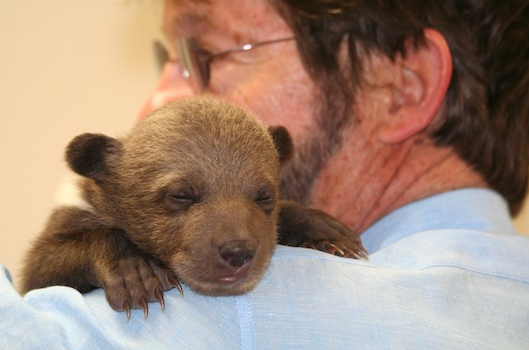 Meeks with a potential new star What are a few of the features your animals or you have appeared in?
There are so many. In Stephen King’s miniseries The Stand, where it was good versus evil, we used cockroaches, deer, a dog, a butterfly, hundreds of bats, a crow and a cow. I had to go all the way to Utah to find this giant Holstein. We used bats in The Big Chill, too. In Betsey’s Wedding I stunt doubled for Alan Alda when he had to fight a Bengal tiger we had provided. In another movie I doubled for Gary Sinise. For A Breed Apart, we provided the eagle, which at the time was considered an endangered species. Recently we shipped monkeys to Florida for an upcoming episode of Shipping Wars. And even though we didn’t have a lion in it, my lions were used for study purposes in The Lion King.
Have you ever had to modify an animal’s appearance for the purposes of a film?
Yeah, for this film Prancer [a Christmas movie about a girl who comes across a reindeer with an injured leg]. When director John Hancock came to me to do a Christmas movie I figured they would want a reindeer. I’d never even seen a reindeer up close and never worked with one. But he told me they preferred to use a fallow deer because it’s prettier. I told them any deer that has antlers is a male, and this time of the year they are in rut [their mating season], and there’s no way I’ll work with a deer in rut next to an 8 year-old girl. Even a deer that’s tame and workable will kill you when it’s in rut.
Who knew deers in mating season were so deadly.
Yeah. So I don’t hear from them for a while, and then one day I get a call back and they said I said I could use a reindeer, but now the problem is the timing. I tell them the females lose their antlers before the males and you could have a reindeer that loses its antlers in the middle of the shoot. So I flew up to see them and said we have to have several reindeer on the set because they are herd oriented and they need to stay together. So we used a female and had fake antlers made for her. A puppeteer made a fake reindeer head for close ups but they only had to use it once.
Did any of your animals do something you couldn’t have predicted?
We were in Nashville to do an ad. Every time I’d go there I had to do four or five commercials at a time. The last time I was up there I had a female chimp called Rosie. Chimps are really smart. They work on credit [meaning, incredibly, that they’re so smart they know they’ll be rewarded at a later time.] I said, “Rosie, could you please do some cartwheels over here?” But you can’t rush her. I can see the stool she’s sitting on is too close to the cabinets and there’s a paint bucket nearby. The director says they’ll have the stool secured, and I left the set and went to the trailer with Rosie. When I got back they said it was all fixed. So I dressed her up, put her diaper on, and the stool was still not locked down. Then I saw her go for the paint bucket. She snatched it up and when I grabbed it out of her hand she bit me. Every time animals do something there’s a good reason. They think you make it rain or make the sun shine. They look at you negatively or positively and they think and ask questions. They will instinctively blame you for your mistakes.
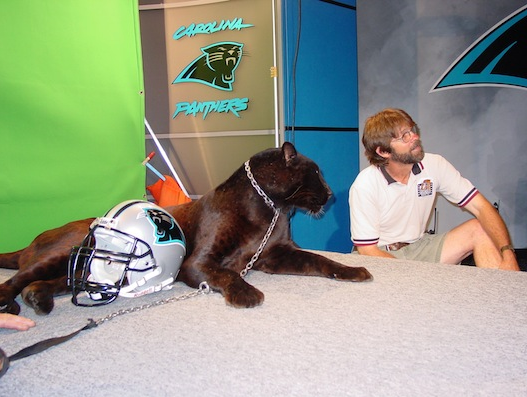 Meeks provided the Carolina Panthers with the real version of their namesake What was the most dangerous thing that happened on set?
Once when we were filming in Chimney Rock, North Carolina late at night, I had my black panther walk between a cave and a rock. There was a fire nearby and she was on a piece of transparent monofilament we use for a leash [a thin plastic wire like a fishing line that can’t be seen, so it’s used as a leash during filming]. When she crossed the fire the filament burned up and I didn’t know where she was. In this case I should have used a steel cable even though it doesn’t stretch. If something goes wrong on a shoot, you have to let the big cat run until you can get them back.
Whoa, you have to let a panther just run? Is that the craziest thing that’s happened to you on a set?
No. I was doing a Ryder Trucks commercial with the actor Steve Landesberg. I had worked with him before in Leader of the Band. We head off to Atlanta with this Asian elephant provided by this trainer I know, Rex.
When we got to the set I saw that the elephant was reaching out her trunk. I could tell she was fixing to hit Steve and I was worried. The line in the ad was, “When I’ve got something really big, I choose a Ryder Truck.” I asked Rex, “Has that elephant ever smacked anyone?” He hesitated. So I asked Rex if the elephant maybe needed a break, and he agreed. But then Rex said, “Nah. Shoot the rest of it.”
As soon as the cameras begin to roll, the elephant knocked Steve clear out of the shot.

|