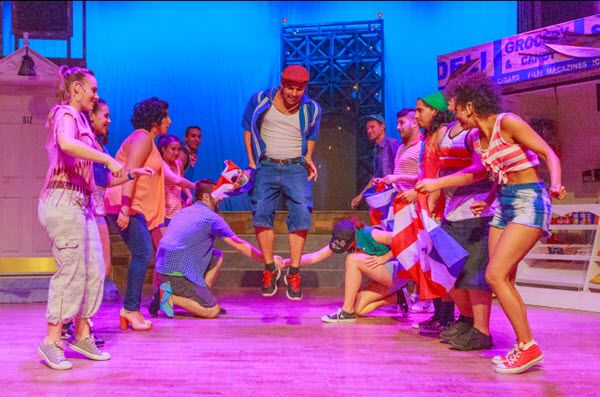
“Carnival Del Barrio” (Cast) – Photos by Keith Waters / Kx Photography
Do you speak Spanish? No problemo. I’ll bet you can translate most of the words and phrases that have found their way into our everyday lexicon. Gracias, te amo, buenos dias, piragua (a shaved ice treat. Okay, that one was new to me.) and dozens more that you didn’t know you knew. Be prepared to test your skills at In the Heights, now at The Little Theatre of Alexandria. It’s Latino immersion served up in high energy by a fantastic cast. Quiara Alegria Hudes, who wrote the book for Conceptualist/Composer/Lyricist Lin-Manuel Miranda, allows us a heart-warming glimpse into the lives of Latino immigrants and their assimilation into American culture – New York style. It’s a tale familiar to every immigrant who has faced the frustrations and hardships that beckoned them to American shores and a show that achieved four Tony Awards and one Grammy for Best Musical Show Album.
Set in the barrio of Washington Heights on the northern tip of Manhattan, a community settled over the past half century by immigrants from the Dominican Republic, Puerto Rico, Cuba and assorted Hispanic Caribbean islands, the musical is written in hip-hop, rap and rhyme – en Español, pero con Inglés, tambien. Spanning the three-day Fourth of July weekend, it tells the story of a determined, close-knit culture and the love stories of Benny (Carl Williams) and Nina (Christy Fischer) and Usnavi (Andres Alejandro Ponce) and Vanessa (Chelsea Crane). Think West Side Story without the gangs.
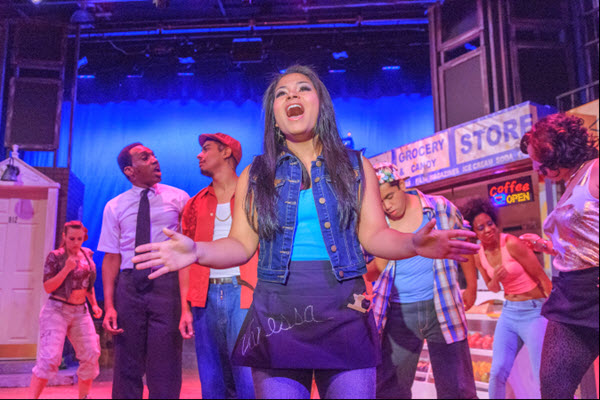
Left to Right: Carl Williams (Benny), Andres Alejandro Ponce (Usnavi De Le Vega), Chelsea Crane (Vanessa), Joey Ledonio (Sonny), Patricia Targete (Female Community), Jacqueline Salvador (Carla) – Photos by Keith Waters / Kx Photography
Living under the shadow of the George Washington Bridge, Usnavi, the owner of a small bodega that serves the neighborhood, works alongside his cousin, Sonny (Joey Ledonio). Together they dream of a better life for themselves and their adored Abuela Claudia (Mary Ayala-Bush), matriarch of their family. Down the street Daniela (Tahara Robinson), Carla (Jacqueline Salvador) and Vanessa ply their hairstyling skills in the Unisex Salon while Vanessa dreams of escaping to the West Village. Across the way husband and wife, Camila (Janice Rivera) and Kevin (Sean Garcia), run the struggling Rosario’s Car and Limousine service. Benny, who eloquently raps road conditions to the drivers on the two-way, falls hard for their daughter, Nina, a scholarship student at Stamford and the hope of the neighborhood. It’s a “beans and rice” life for most of them.
Twenty-five musical numbers underpin this high-energy production, punctuating the action with breakdancing, rhumba and catchy Latin rhythms. LTA has done a tremendous job casting all 22 super-talented dancers and singers, more than a few of whom raised the roof – – most especially the riveting and hugely talented, Ponce; the powerhouse voice of the diminutive Crane, Usnavi’s love interest; the sass and comedic timing of Robinson who kills it in “Carnival del Barrio”; the cool hipster vibe and beautiful voice of Williams, who duets with Fischer’s dulcet tones in “Sunrise”; and Garcia, who lends operatic pathos to “Alabanza”.
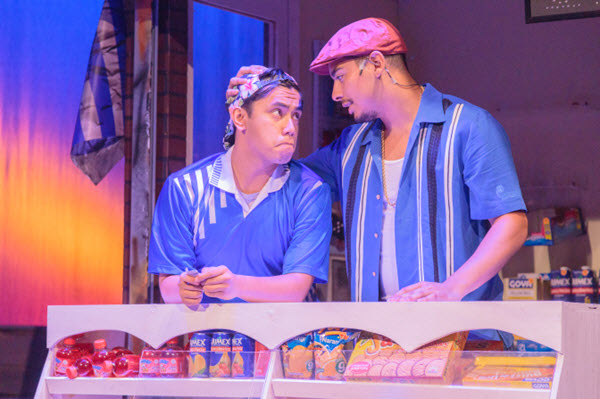
Left to Right: Joey Ledonio (Sonny), Andres Alejandro Ponce (Usnavi De La Vega) – Photos by Keith Waters / Kx Photography
Raves for Choreographer Stefan Sittig, a veteran of over 60 productions and multiple WATCH Award nominee, who drives the cast to nearly pop the floorboards in “The Club” an all-out dance-a-thon brilliantly lit by Ken and Patti Crowley to echo a Diego Rivera painting; and Director, Frank D. Shutts, who bravely takes on a musical that stretches LTA’s typical audience to embrace the edge.
Highly recommended.
Through August 15th at The Little Theatre of Alexandria, 600 Wolfe Street. For tickets and information call the box office at 703 683-0496 or visit www.thelittletheatre.com
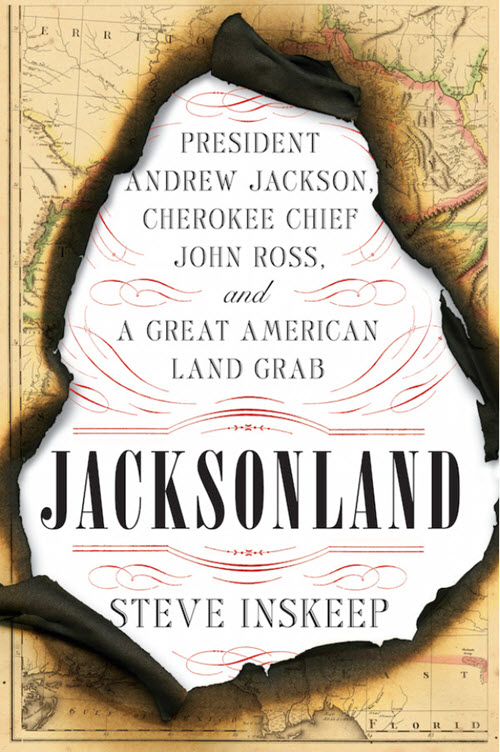
Morning Edition co-host Steve Inskeep’s book Jacksonland: President Andrew Jackson, Cherokee Chief John Ross, and a Great American Land Grab tells the almost-lost-to-history story of Cherokee Chief John Ross and his attempts to save the Cherokee Nation from President Andrew Jackson. Photo credit: Penguin Press
You don’t need to be a history buff to dive headlong into Jacksonland: President Andrew Jackson, Cherokee Chief John Ross, and a Great American Land Grab (Penguin Press, 2015), Steve Inskeep’s riveting masterpiece of two influential men who held radically opposing visions for our country. The well-respected author and co-host of National Public Radio’s Morning Edition recounts in vivid detail the ultimate story of power, ego and greed that was played out in the Deep South (which Inskeep dubs Jacksonland) and which ultimately defined the future settlement of our nascent nation. Coming from relatively humble roots, both men once fought on the same side and later crossed verbal swords in defense of their principles—Jackson, whose desire for personal gain for both himself and his well-heeled cronies translated into immense power and control of the Union, and John Ross, a well-educated and savvy Cherokee Indian chief committed to protecting Indian territories and sovereign rights.
Inskeep toggles between chapters about Jackson and Ross as he methodically lays out their personal journeys, meticulously detailing their early lives, crossed paths, and the events and battles that lead to the ultimate betrayal—the Trail of Tears. But the events do not progress in a straight line. And that’s precisely what makes this a page-turner.
At stake in 1812 were the territories of the Five Civilized Tribes—Cherokee, Seminole, Chickasaw, Choctaw and Creek—whose collective territory extended from the southernmost tip of Florida, around the panhandle to Louisiana and the Gulf of Mexico to the south, westward along the muddy banks of the Mississippi River to the Missouri Territory, and north in a winding border that extended from the Atlantic Coast south of what is known today as Georgia and along the northern reaches of the Tennessee River. This was the so-called Indian Map. On the contrary, the “White Man’s Map” of the same period laid claim to everything east of the Ohio River and the Mississippi, with the exception of Florida, which was still in Spanish hands.
Known to his people by his Cherokee name, Kooweskoowe, Ross was able to access the “whiteside,” as he called it, using his mixed Scottish and Indian ancestry to straddle both Indian and white political and social spheres. Trained as a lawyer, he sported the sartorial style of white politicians, cutting an imposing figure as he strode through the halls of Congress, negotiating with lawmakers to strike deals favorable to his people. There was no more dedicated and effective representative for the Cherokee, and they trusted and relied on his savvy statesmanship.
But the dark side to this era of Indian relationships with the U. S. government is the backstory of Jackson’s unimaginable greed, ruthless double-dealing and consolidation of power. How he granted favors to and colluded with his associates to obtain land for their personal enrichment, while breaking promises to the Indian nations.
Through personal letters written by Ross and Jackson, and a wealth of documents of the period, Inskeep has achieved an exhilarating read. Outlining the real history of Jackson’s rise to the U.S. presidency, and Ross’s hard-fought efforts for the Cherokee, the author makes it clear that given a few different conditions, the removal of the tribes might never have happened. For example it is stunning to learn that the 1835 Treaty of New Echota, in which the Indians ceded territory and agreed to move west, prevailed by a single vote, even though it had never been signed by Chief Ross or the Cherokee National Council. And that Jackson’s biggest battle may have been his health, which was so poor that frequently he was perilously close to death.
As a seasoned reporter, Inskeep has said he was driven by “the disgraceful politics of the past few years” to write this book. That passion has driven him to give us a clear-eyed and fascinating story of two influential men, one whose democratic values followed the principle of majority rule, and another who represented minority rights. But he has also delivered a cautionary tale of the machinations of the rich and powerful that especially resonates today.
Author Steve Inskeep, co-host of NPR’s Morning Edition, discusses ‘Jacksonland: President Andrew Jackson, Cherokee Chief John Ross, and a Great American Land Grab,’ published by Penguin Press. Photo credit: Linda Fittante
Noted author and journalist Steve Inskeep, co-host of Morning Edition on National Public Radio, sat down with Indian Country Today Media Network to dissect his new book, Jacksonland: President Andrew Jackson, Cherokee Chief John Ross, and a Great American Land Grab, published this summer by Penguin Press. The book, a riveting masterpiece about two influential men who held radically opposing visions for Turtle Island, brings to light lesser-known facts about this time period that the publisher calls a “crossroads of American history.”
What prompted you to write this story?
I just wanted to tell the whole story, and it was interesting to me to realize how little of the story I knew. John Ross was almost an entirely undiscovered character, an interesting character, and I wanted to find out what made him tick.
What was your reaction when you began to discover a clear picture of interwoven greed and power?
It wasn’t a complete surprise. How it worked, and why, was new to me. It’s understood that there were national security motives and patriotic motives to clear Indians out of the Southeast. But I don’t think it’s as well understood that there were also economic motives and a desire for land and a desire to expand slavery that was behind it and that really drove it. And that Andrew Jackson himself was personally involved in developing the land that he obtained as general. I came across a lot of detail that had never been put together in quite this way.
There were so many moments when things could have gone in an entirely different direction, as when the Indian Removal Act won passage in Congress by only one vote. It seems the press was hugely influential then, creating stories out of whole cloth while spreading fear and innuendo about the Indians. Do you think newspapers were more influential then than they are today?
Newspapers then were more influential because they were the principal form of media. There would have been around three dozen newspapers during late colonial times. By the early 1800s they were in the low hundreds, then very quickly it goes up to around 800 by 1828. Everybody read each other’s papers, and people would send them around by mail.
Do you think Sequoyah’s creating of the Cherokee syllabary in 1821, and its usage in Ross’s newspaper, helped spread the word?
Yes and no. The Cherokee Phoenix newspaper had articles in both Cherokee and English. And so, although it was a cultural triumph to have their own written language in a newspaper, it also had propaganda value. But the real political punch was that editors of other papers would read the Cherokee perspective of events that were different from the White perspective of the same events.
How important do you think Ross’s ability to walk on the “whiteside,” as it was called then, contributed to his success as a diplomatic envoy?
I think it was very important that he was able to speak English and present himself in a way that white men could understand and relate to, and that sometimes he could also pass as a white man. I’m not saying that was good or bad. It was just the political reality of the time. That could also be used to undermine him, though. And it was also used to challenge him. Cherokees didn’t challenge his status as an Indian, but whites would undermine his racial credentials and say he wasn’t Indian enough. So sometimes it was a double-edged sword.
The most important thing was that he was literate in English, could write his own letters and make his own demands, and was not dependent on an interpreter to get across all the nuances of what was intended in agreements. Others who signed treaties may not have known what they were signing. Ross understood the terms and the wider political context of what the Indians were being offered.
What do you think was Ross’s greatest success?
I think it was when he blocked Jackson from grabbing two million acres of land, even though later Jackson went around him. At the end I don’t think it’s widely understood that before the Trail of Tears, Ross improved the terms under which the Trail was to be undertaken. He managed to keep the Cherokees together and get more than $6 million for the land. Though that was not what it was worth, it was substantially more than what the government was offering. At the same time Ross managed to keep the Cherokee government together. All along he was innovative in the use of democratic tools in a way that adds to our democratic tradition and foreshadows a lot of things that civil rights leaders did a century or more later.
In the end, if the tribes had held together and not sold their lands, do you think there would have been a larger war?
We have an answer to that. More or less, yes! We saw it happen in Florida. There was a war that lasted for years. Thousands died, U.S. soldiers, civilians and Seminoles. We’re talking about a really awful conflict for its time, and that, I suppose, would have been the alternative. In Alabama there were Creeks who did not want to go away, and there was an insurgency there in the 1830s. You could have had more devastating wars. There can’t be any doubt about what the result probably would have been, because even if they were all united, they were so outnumbered by then. Had they united in some effective way, you could have had a different course of history. But they didn’t, and when there was an attempt to unite them under Tecumseh, it didn’t turn out very well for the Indian side in the end.
During your extensive research, what surprised you most?
I had no idea that the Cherokees had done so much in their own defense. I think that has been overlooked, even by accounts that were sympathetic to the Indian side. I think Indian removal has often been portrayed as an argument among white people, though there were people who were for it and people who were against it. I’m not sure that the Cherokee participation in the emerging democratic life in the United States has been recognized in the way that it should be.
What would you say are the parallels to today’s struggle for civil rights?
I think some of the same techniques John Ross used were those used by civil rights leaders in the 20th century. Cherokees decided they needed their own newspapers, as did African Americans. They also both realized they needed white allies, and both groups reached out to the religious communities to get some of those allies.
Both groups fought in Congress, and both fought and won before the Supreme Court. In the end though, the Cherokee efforts and victories did not do them a lot of good. While by no means perfect, by the 20th century, racial attitudes were changing and improving, and it was becoming less and less acceptable to argue that there were entire racial groups of people not entitled to become full citizens of the United States.
In the recent campaign to put a female icon’s image on American paper currency, would you prefer to see Jackson removed, rather than Hamilton?
I wrote an article for The New York Times recently in which I proposed that John Ross should be on the twenty-dollar bill and Andrew Jackson should be on the flip side. I think there should be two characters on every bill. Each pairing should be people who relate, so that they tell a story about our democracy and about imperfect people fighting it out about our democracy. Abraham Lincoln could be paired with Frederick Douglas. Ulysses S. Grant on the $50 bill paired with Harriet Beecher Stowe. It would give a greater sense of this grand democratic story that we are all a part of, and the way that different kinds of people participate in that story and have influenced it over time. Jackson and Ross were not perfect people. They were people who fought within the democratic system.
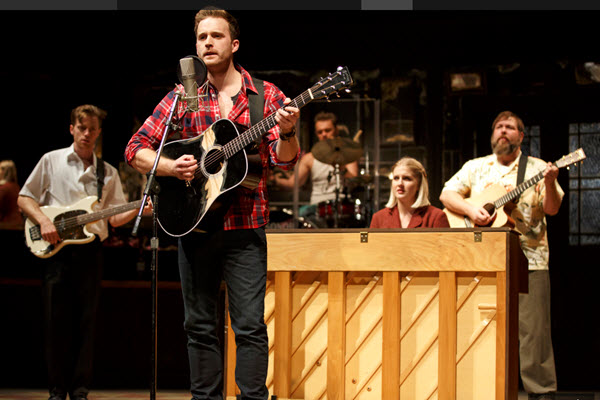
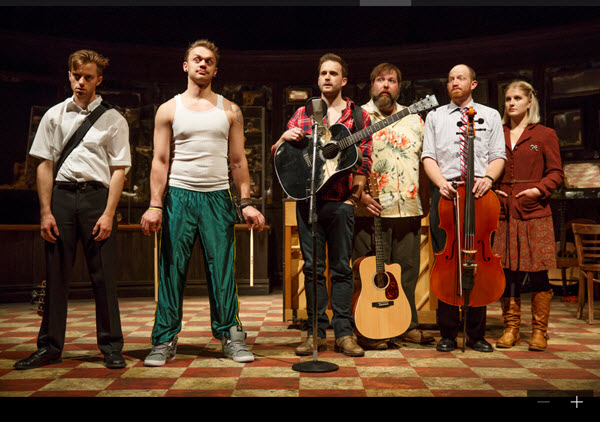
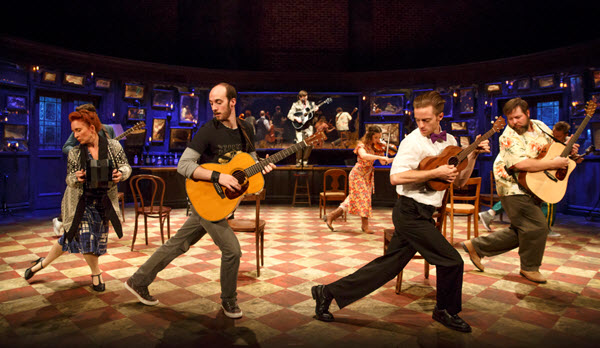
Once, the show that won eight Tony Awards in 2012, is a poignant love story set in Dublin where Girl (Dani de Waal) meets Guy (Stuart Ward) on open mic night in a rundown pub. She’s a piano-playing emigrant from Czechoslovakia. He’s a lovelorn, guitar-playing, vacuum cleaner repairman who’s lost his sweetheart to the lures of New York City. The rest of the cast, brilliantly talented musicians, singers and dancers, are the onstage orchestra who, when not dancing or interacting on center stage, sit in full view of each other in rows on each side of the one-set stage. Shakespeare would love this.
Although this is a musical, it is a quantum leap from the razzle-dazzle shows we have come to expect from Broadway. Irish playwright Enda Walsh gives us a story with pure Celtic heart and soul, and Glen Hansard and Marketa Irglova fill it up with memorable music and meaningful lyrics. Oh well, there is Guy’s goofy number “Broken Hearted Hoover Fixer Sucker Guy”, a paean to Girl and reference to his mundane day job.
There is plenty of dry humor and tongue-in-cheek wit, the sort we expect from Irish theatre, but here often unexpectedly delivered by the Czechs who speak in English with Czech accents while Czech translations are projected above the stage.
This show is for you too, with tremendous performances by Evan Harrington as Billy, the beefy, and romantically inept, pub owner who plays guitar, percussion and ukelele; Dani de Waal on piano as Girl; Stuart Ward on a mean guitar as Guy; Scott Waara on mandolin as Da, Guy’s supportive father; John Steven Gard as Eamon a role that calls for him to play piano, percussion, melodica and harmonica; Benjamin Magnuson as the soft-hearted bank manager on cello and guitar; Alex Nee as Andrej on electric bass, ukulele, guitar and percussion; Matt DeAngelis as Svec, the wild and crazy, former heavy metalhead who rocks out on guitar, mandolin, banjo, drum set and percussion; Tina Stafford on raging accordion and concertina as Baruska; and the fantastic musical talents and duets of Erica Spyres on violin and percussion, and Erica Swindell on violin.
Back to the story, a romance played out in evolving vignettes to the tune of fierce Irish jigs, tenderhearted ballads and soul-stirring folk rock. Though we wonder if they’ll ever get together, fifteen musical numbers keep us guessing and provide tension to the plot. The show won a Grammy Award for Best Musical Theatre Album, and though you may be more familiar with the bittersweet music of “Falling Slowly” and “Leave”, be prepared to take out the tissues for “Gold”, an a cappella showstopper in the second act. Sung by the entire company the goosebump-inducing tune fills the theatre with hope and longing and the sense that no matter where our star-crossed lovers end up, we have seen one of the most exquisitely electrifying musicals of our generation.
Highly recommended.
Through August 16th at the Kennedy Center, 2700 F St., NW, Washington, DC. For tickets and information call 202 467-4600 or visit www.Kennedy-Center.org.
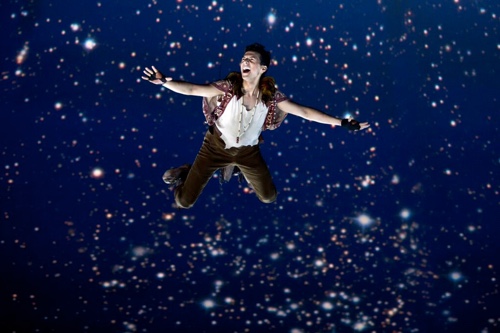
Dan Rosales takes flight as Peter Pan in PETER PAN at the Threesixty Theatre. Photo credit: Jeremy Danie
“Do you believe in fairies?” The audience, primed for a night of wonder and magic, seized on the age-old qualifier with resounding approval. Author J. M. Barrie would have delighted to hear them echo his fantastical query of yesteryear.
Notwithstanding the enthusiasm, there’s nothing old fashioned about this production except the bygone tale of a boy who refuses to grow up. Produced by Norton Herrick of Herrick Entertainment and Charlie Burnell of Threesixty Entertainment, this techno-modern Peter Pan got its start in Kensington Gardens in London, the very same gardens that feature a statue of Peter Pan in the neighborhood where the Darling family, Wendy (played by Annapolis native Sarah Charles), Michael (Scott Weston) and John (John Alati) and their Mother (Hannah Jane McMurray) and Father (Stephen Carlile) resided with their canine governess, Nana.
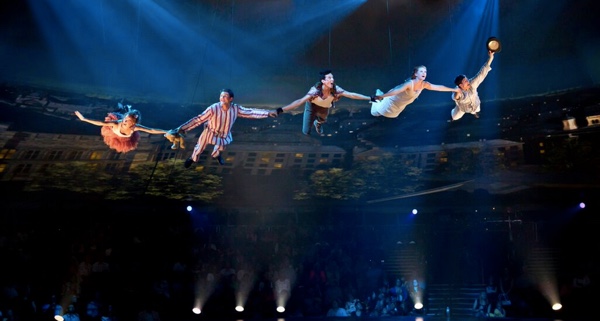
Flight to Neverland Flight (L to R) Tinker Bell (Jessie Sherman), Michael Darling (Scott Weston), Peter Pan (Dan Rosales), Wendy Darling (Sarah Charles), and John Darling (John Alati) in PETER PAN at the Threesixty Theatre. Photo credit: Jeremy Daniel
This spectacular theater experience will wow all comers with its 360-degree CGI (computer-generated imagery) projected backdrop system, the first of its kind in the world. The footage surrounds the audience with breathtaking images – – from Big Ben and Buckingham Palace to the gabled rooftops of Victorian London, and on to the island of Neverland, where the feral and free Lost Boys, Captain Hook (Stephen Carlile) and Tiger Lily (Porsha Putney) live and where jungle scenes and pirate ships complete the total immersion into Peter’s world.
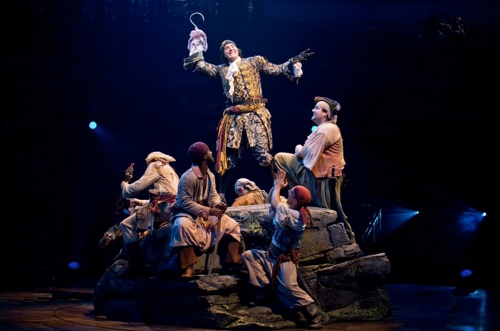
Hook (Stephen Carlile) and his pirates in PETER PAN at the Threesixty Theatre. Photo credit: Jeremy Daniel
This is a unique experience that goes beyond the hype that usually accompanies such major productions. Yes, it is in the round and yes, there are some breathtaking aerialists, most especially two ravishing mermaids that twirl and hang on swaths of silks. And if that doesn’t keep you at the edge of your seat, there are swashbuckling sword fights and dizzying feats of flying by Peter (Dan Posales), Tinker Bell (Jessie Sherman) and the children. No not your children, The Darlings, of course. At times it appears so realistic that one little girl, sitting behind us and witnessing the swaggering menace of Captain Hook, asked her parents, “Is he acting?”
In fact he is, along with 19 other actors and a host of puppets who bring this beloved tale to life in a way never achieved before – – not by Disney, by Broadway or TV.
Porsha Putney (Tiger Lily) and Dan Rosales (Peter Pan) in PETER PAN at the Threesixty Theatre. Photo credit: Jeremy Daniel
Thom Southerland directs the high-energy action and seven-time Olivier Award winner William Dudley continues the magic with clever set designs that achieve the seemingly impossible through the use of rotating trapdoors that swivel 180-degrees to reveal everything from treacherous rocks to home furnishings and the shipboard trappings of the Jolly Roger. Benjamin Wallfisch and Howard Herrick composed the original music with tender ballads, Irish jigs and Tiger Lily’s exotic dance. Gypsy Snider, co-founder of the Montreal-based circus company, Les 7 Doigts de la Main, created the breathtaking choreography.
Highly recommended for all ages.
Performances through August 16th in the Threesixty Theatre at Tysons Corner Center, 8200 Watson Street, Tysons Corner, VA 22102. For tickets and show time information visit www.peterpan360.com or www.Ticketmaster.com.
America Eats Tavern Holds Inaugural Virginia Festival, Bloomsday Celebration, Blue Duck Tavern Rhapsodizes About Ice Cream, Mitsitam Gets a New Chef and We Get His Wild Rice Bars Recipe
As expected tons of events are crammed into the month of June. Why? There seems to be a totally unfounded impression that we are all darting off to faraway lands. We wish! Here’s where we went (Chapter One) and here’s one that’s happening right now.
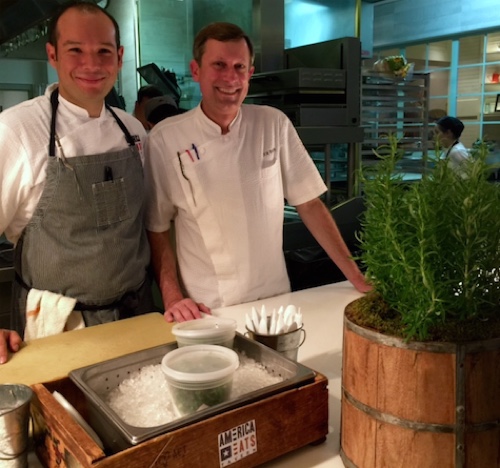
Head Chef Nate Waugaman (left) with Executive Chef Joe Raffa
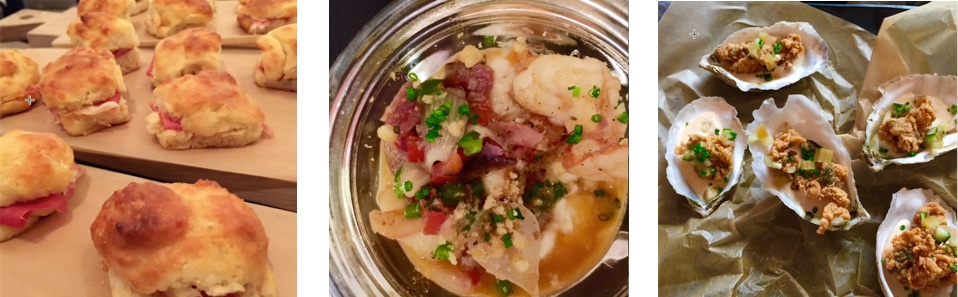
We tasted some of the delicious offerings, many plumbed from Virginia’s historical recipe archives. Here are some of the Virginia specialties from Head Chef Nate Waugaman. Enjoy them from the prix fixe menu or a la carte.
Surreyano ham biscuits with pepper jelly – Byrd Mill grits with cheddar and pearl onion petals – Fried Chesapeake oysters with rhubarb remoulade
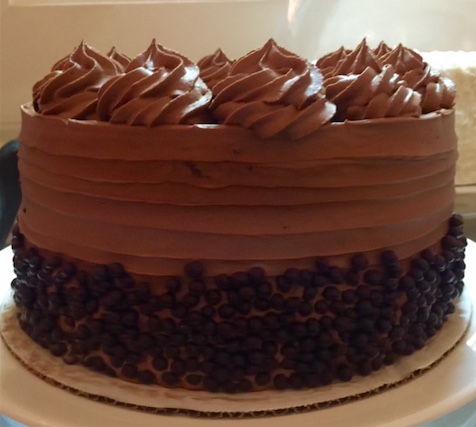
Edwards Surryano ham biscuits with pepper jelly – Cheese Straws – Norfolk Crab and Ham Saute – Broiled blue crab with Virginia ham and lemon butter air – Fried Chesapeake Oysters with rhubarb rémoulade and cucumber and pickled rhubarb salad – Virginia Peanut Soup garnished with celery and blackberries – Shrimp & Grits, Byrd Mill Company grits made with Meadow Creek Dairy Reserve cheddar and served with pearl onion petals and ham hock – Fried Chicken with Cole Slaw – Lemon Chess Pie – Martha Washington’s recipe Chocolate Cake (Do not leave the building without some!)
Martha Washington’s Chocolate Cake
And be sure to try the famous Sally Lunn bread. The recipe is sourced from “Housekeeping in Old Virginia” 1879. Then you can say you had some of George Washington’s favorite breakfast bread.
The festival runs till the end of June.
Bloomsday Celebrated in Washington, DC
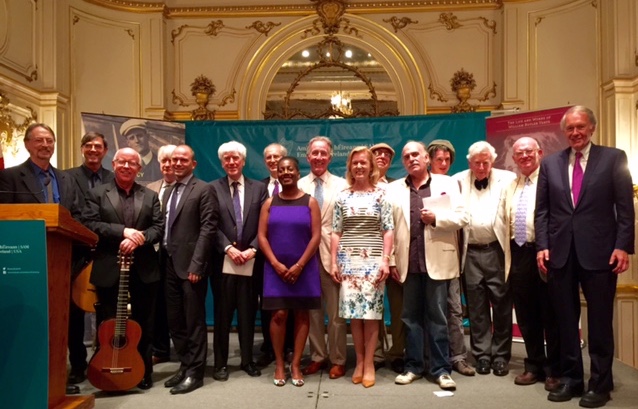
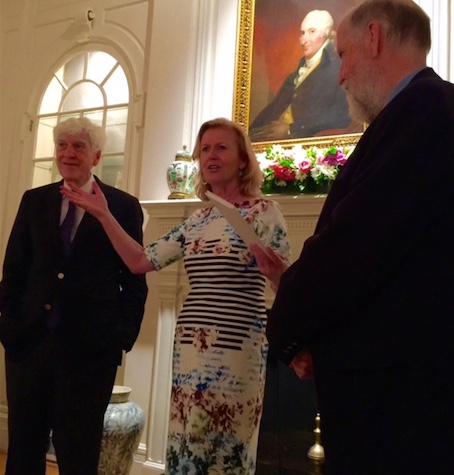
Ambassador Anne Anderson and participants at the Cosmos Club on Bloomsday
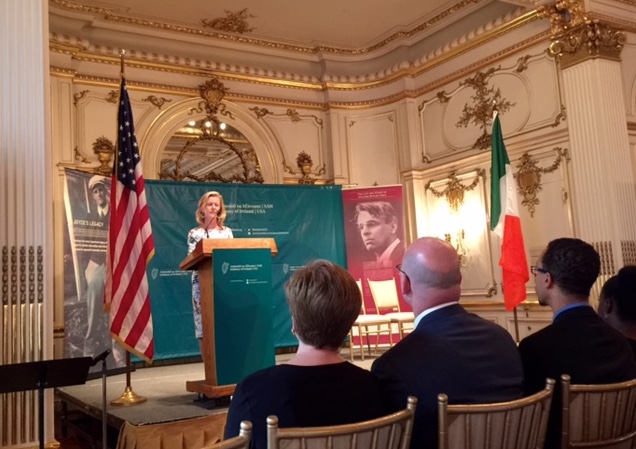
Bloomsday, the annual Irish celebration of all things James Joyce, was ushered in in grand style on June 16th. The posh affair commenced with a musical recital of tunes related to both writers, a new ‘play for voices’, and readings which took place at the tony Cosmos Club. Afterwards guests walked a few short blocks to a garden party at the residence of Ireland’s Ambassador to the United States, Her Excellency, Anne Anderson.
Ambassador Anne Anderson addresses guests at the Cosmos Club
Fortuitously it was also the 150th anniversary of the birth of that “other” great Irish writer, W. B. Yates. The proximity of the two events inspired the Embassy to combine these important events into one magical evening. Noted guests Congressman Richie Neal of Massachusetts, Senator Ed Markey of Massachusetts, Teri Cross Davis from the Folger Shakespeare Library, and Deputy National Security Advisor Ben Rhodes read poetry by Yeats and excerpts from “Ulysses”.
Ambassador Anne Anderson makes a presentation to playwright, Joe Hassett at the Resid
Joe Hassett, attorney and author of Two Stars, saw his mini-play narrated by Scena TheatreCo-founder, Robert McNamara and performed by local actors, and guests thrilled to Irish music of the period performed by John Feeley, Fran O’Rourke, Mitch Fanning, Jesse Winch, Terry Winch and Zan McLeod.
Afterwards Ambassador Anderson graciously invited everyone to the residence for cocktails and traditional Irish fare in the garden.
Blue Duck Tavern Prepares for National Ice Cream Month
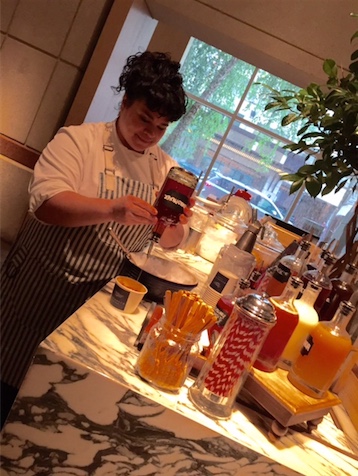
Rain came down sideways in torrents at an ice cream social at the Blue Duck Tavern where we test tasted (Oh please! Somebody has to do it.) snow cones, ice cream sundaes and mini ice cream treats dreamed up by Executive Pastry Chef Naomi Gallego. We had gathered on the terrace in the late afternoon when all hell broke loose – weather-wise that is. Thankfully a small army of chefs and managers marshaled the troops to bring us, and the precious, sweet cargo, indoors where we picked up where we’d left off.
Executive Pastry Chef Naomi Gallego makes snow cones
As you may be aware snow cones are popular with our Hawaiian-born President and the entire Obama family. A popular street treat, the frozen concoctions are made with an untold variety of syrups and shaved ice and often include a dose of sweetened condensed milk.
We won’t guess at what additives are in those day-glo colored flavors typical to sidewalk vendors, but here they are prepared au naturel from an assortment of syrups made in house – Strawberries and Cream, Apple Pie and Cream, Root Beer Float, Ginger Raspberry Rhubarb, Peach Toasted Almond, Piña Colada and more.
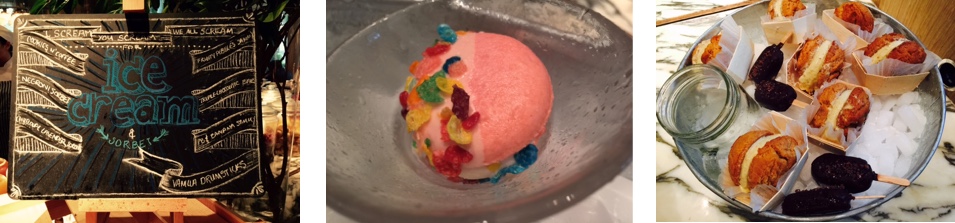
Celebrating National Ice Cream Month – Fruity Pebbles Mac Sammie at the Blue Duck Tavern – Sweet mini treats
The blissfully scrumptious sundae is assembled with a base of cornmeal shortcake, balsamic strawberries, orange ice cream and orange-flavored whipped cream.
Mini offerings were just as seductive – Peanut Butter and Banana Ice Cream Sandwich, Fruity Pebbles Mac Sammie, Triple Chocolate Ice Cream Bars, Cantaloupe Lavender Push Ups (Was this a sign to head off to the gym?) and more. We only wish we could have brought some home in a doggie bag. Sigh…
Mitsitam Gets a New Chef
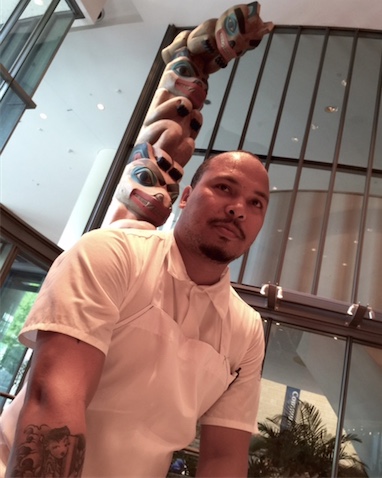
Executive Chef Jerome Grant at Mitsitam Cafe
This year the National Museum of the American Indian hired, Jerome Grant, as Executive Chef of the highly regarded Mitsitam Café where Grant had once worked as Sous Chef under former Executive Chef Richard Hetzler. At a private luncheon at the Museum, Chef Grant showcased some of his latest dishes.
The Oklahoma native won’t change the restaurant’s indigenous cuisine – – there will still be dishes from the Northern Woodlands, South America, the Northwest Coast, Mesoamerica and the Great Plains – – but he has definitely put his own spin on the regional menu.
From the Northern Woodlands we sampled Chilled Golden Beet Soup with Wild Ginger, Puffed Wild Rice and Cherry Granola and a beautiful Cold Broccoli Soup with Citrus Marinated Scallops and Popcorn. Also from the region was Smoked Rhubarb Turkey and Duck Fat Potato Hash with local Mushrooms.
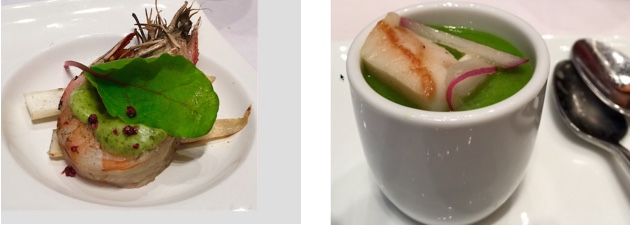
From the Northwest Coast came plates of Wood-Fired Spot Prawns with white asparagus and pink peppercorn sorrel butter.
Wild Spot Prawns from the Northwest Coast – Cold Broccoli Soup with Citrus Marinated Scallops from the Northern Woodlands
And from Mesoamerica we adored a salsa of green tomato, yellow corn and pipicha and his rendition of guacamole. What better companions?
The changes will dovetail nicely with a major new exhibition, “The Great Inka Road”, scheduled to open at NMAI on June 26th, the same time as the Smithsonian Folk Life Festival kicks off.
The bilingual exhibition explores the foundations of the Inka Road in earlier Andean cultures; as well as technologies that made building the road possible; the cosmology and political organization of the Inka world; and the legacy of the Inka Empire during the colonial period and in the present day.
The press release describes the Inka Road as “an intricate network that spans 24,000 miles across six countries and stands as one of the monumental engineering achievements in world history.”
This amazing exhibit features images, maps, models and 140 objects, including a ceramic Chavín stirrup spout bottle (the oldest item in the exhibition, ca. 800–100 B.C.), impressive gold ornaments, necklaces made from shells from the Lambayeque region, stone carvings, silver and gold figurines, and various textiles made from camelid hair and cotton.
For more information on the exhibit as well as upcoming activities, visit www.NMAI.si.edu.
We thank Chef Grant for this terrific recipe you can make at home.
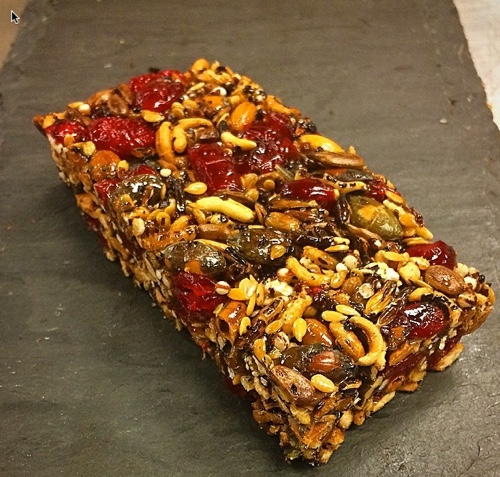
Wild Grain Bars – Courtesy of Chef Jerome Grant
Canola oil
1/2 cup salted, roasted pumpkin seeds
1 cup raw, hulled, unsalted sunflower seeds
1/2 cup golden flaxseed
3 cups raw wild rice (not a blend), separated
1/2 cup dried red quinoa
1/2-cup coconut milk
1/2-cup mild honey
3/4-cup maple syrup
1/4 packed dark brown sugar
2 teaspoons kosher salt
2 cups tart dried cherries
Wild Grain Bars
In sauce pan over medium-high heat add two inches of canola oil. When the oil is at 410 ° Fahrenheit, add one cup of raw wild rice. Cover. The rice will expand and double in size. Skim the popped rice and transfer to a paper-towel-lined sheet pan. Add more rice to the oil and continue popping the rice until all the rice has been popped, then reserve.
Place sauté pan on medium heat with two teaspoons of canola oil. Once oil becomes hot, add quinoa and lightly shake the pan. Quinoa will pop rapidly just like popcorn. Once quinoa has fully popped, remove from heat and transfer to paper-towel-lined sheet pan, and reserve.
Combine the puffed wild rice, quinoa, seeds and dried fruit in a bowl and mix together.
In a saucepan, combine the coconut milk, honey, maple syrup, brown sugar, and salt. Bring the sugar mix to a boil and reduce until soft-ball stage is reached (237° F). Pour the sugar mixture over the seeds and grains and mix thoroughly. Press the bars into a greased pan and let cool for about two hours before cutting.
The recipe makes one 13” x 9” sheet pan, about 15-18 servings.