Jordan Wright
June 27th, 2011
Special to The Alexandria Times
 The cast and set of the Shakespeare Theatre Company’s production of The Merchant of Venice, directed by Ethan McSweeny. Photo by Scott Suchman. From the start the Shakespeare Theatre Company’s version of The Merchant of Venice crackles with electricity amid the hustle-bustle of a large commerce-driven metropolis. On a one-size-fits-all set, trisected by levels and diagonalized by a sweeping three-story staircase, booze-fueled revelers burst through a set of wooden doors in a crazed conga line as they whirl past the train station’s café and into the ether of billowing locomotive steam. The set seems lifted from the Main Concourse at Grand Central Station in New York City, and that’s a good thing because this version of Shakespeare’s familiar tragicomedy has been shapeshifted into The Jazz Age of the 1920’s and launched into the era of hot flappers and cool bathtub gin.
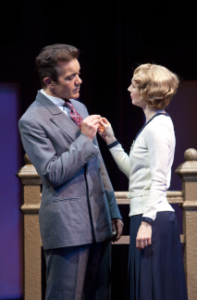 Derek Smith as Antonio and Julia Coffey as Portia in the Shakespeare Theatre Company’s production of The Merchant of Venice, directed by Ethan McSweeny. Photo by Scott Suchman. In a sweeping reinterpretation of the characters by Director Ethan McSweeney, the beguiling Portia is depicted as a horseback riding, golf-playing heiress and The Prince of Arragon as a mincing, Pekinese-toting yachtsman. In this version of the classic tale, Antonio, the cocksure privateer, becomes a self-absorbed commodities trader and The Prince of Morocco, an aviating daredevil playboy. Try envisioning The Little Prince on Viagra.
On a more serious note, Evans’ Shylock shows a grim yet brilliant accuracy…an accuracy that can get you blackballed in the Jewish community. His portrayal of the vengeful moneylender, written as the quintessentially unflattering stereotype of an Orthodox Jew, one whose sense of justice outweighs his sense of mercy, is unflinching. The outcast, as it was written, is a despicable man worthy of inclusion in a Nazi propaganda film short. It’s no wonder Theodore Bikel turned the role down and Evans is thought to be the first Jew ever to accept it. But stop a moment to recognize its worth in the play, it’s no more and no less than a racist characterization and there are countless plays and ethnically-correct actors cast in these thorny roles daily.
Keeping to the new pattern, regional New York and British accents are cleverly tweaked to fit by dialogue coach Deena Burke, with Gratiano, Salerio and Solanio as Bowery Boys; the Duke of Venice as a dese-dem-and-dose mobster; Shylock as a Yiddish-accented Hassidim straight out of Williamsburg, Brooklyn; and Portia as an upper crust Brit on a charm mission. Reattach the untinkered-with script, et voila! a fresh new dynamic. Shakespeare meets F. Scott Fitzgerald on the Lower East Side of Venice.
 Tim Getman as Solanio and Andy Murray as Solario in the Shakespeare Theatre Company’s production of The Merchant of Venice, directed by Ethan McSweeny. Photo by Scott Suchman. Composer Stephen Cahill reinforces the aura with music from the 1920’s, using sultry horns, Charlestonian rhythms and golden standards while Lightning Director Marcus Doshi manages to bring an amber-tinted intimacy to the enormous set, while Jennifer Moeller’s does justice with movie star beaded satin dresses and chic riding attire that share the stage with gangster-style zoot suits, Orthodox Jewish robes and elegant white tie cutaways.
And lest you imagine the production to be tarted up by bold primary colors, knowest all who hearest the proclamation, that the set, designed by Andrew Lieberman, in understated shades of grey, beige and blue, doesn’t distract from the bard’s masterpiece of comedy and still-relevant social drama.
I took as my escort my 13-year old grandson whose knowledge of Shakespeare was A Midsummer’s Night Dream read in dreary black and white (dull compared to the Internet and the technicolor graphics of video games). He was not expecting, nor I, the modernist spin given to the play and sat up with eyes wide open enjoying every action-packed minute of it, most especially the dramatic arrivals of Portia’s suitors.
Bravura performances by Julia Coffey (Portia), Mark Nelson (Shylock), Derek Smith (Antonio), Drew Cortese (Bassanio) and Vaneik Echeverria (The Prince of Arragon). Look for Daniel Pierce to astound in the small role of Launcelot Gabbo.
This is a Merchant with packed with panache and sprinkled with roadsters, radios and champagne toasts.
Five stars.
Through July 24th at the Sidney Harmon Hall, 615 F Street, NW, Washington, DC. For tickets and information call 202 547-1122 or visit www.shakespearetheatre.org.
Jordan Wright
Special to The Alexandria Times
June 9th, 2011
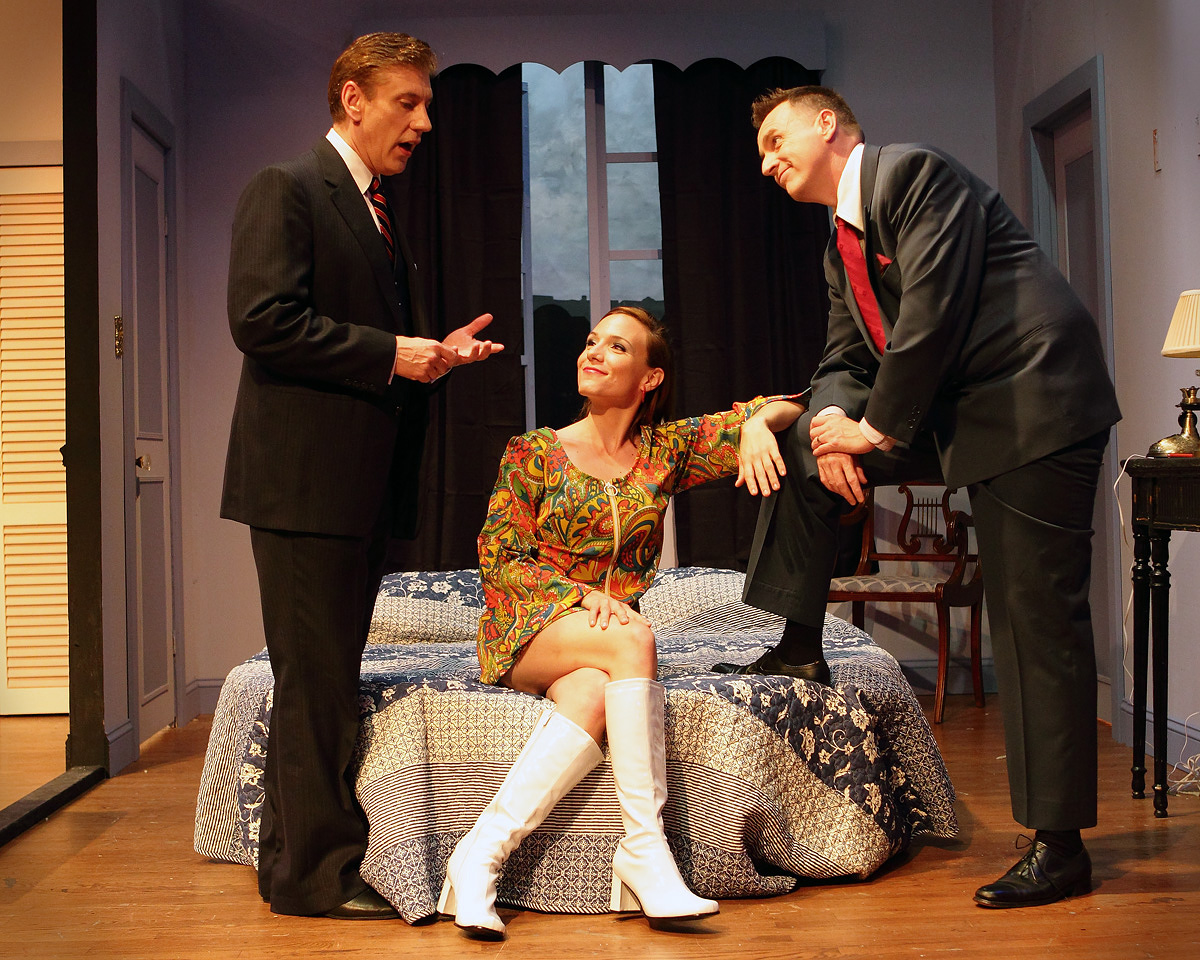
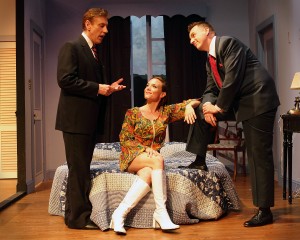 James Raby (Philip Markham), Suzanne Behsudi (Miss Wilkinson), and Charles Boyington (Henry Lodge). Photo Credit Shane Canfield If you want to know how a little white lie can turn into full-blown sex-charged mayhem just ask the well-meaning Mrs. Markham. She’s the full-time referee in this flat-out crazy British farce. You might inquire of her children’s book publisher husband, Philip Markham, who is so squeamishly prim he has to spell out the word S-E-X, or their flashy playboy decorator, Alistair Spenlow, whose sexuality is in question, until cleared up to everyone’s satisfaction up by the remark, “He’s not gay. He plays golf!” Of course the audience has already seen him lusting after Sylvie, the Swedish sexpot housekeeper, who has her own liberated ideas of flirtation. “I do the goose quite well!” she attests imitating his antics.
If you want proof of how a petite prevarication, can morph into a series of whoppers witness the Markham’s friends, Henry and Linda Lodge, and their prospective paramours, Miss Wilkinson, the vixen telephone operator and Walter Pangbourne, the ambitious salesman, as they plan to cheat on each other in the same house on the same night. Oh what a tangled web we weave! In this case it’s a carousel of bed-hopping worthy of Bob & Carol & Ted & Alice.
Move Over, Mrs. Markham derives from the same genre as the screwball Britcoms, Keeping Up Appearances and Are you Being Served? You can count on the characters to be chockfull of malaprops, double entendres and skewed intentions. Thankfully the playbill comes with a glossary of British terms, because the innocent British expression “keep your pecker up” has a decidedly different spin to us than the translation to “keep your spirits up”. Who knew?
In this witty farce there’s a great deal of Marx Brothers’-style tearing around from room to room and peeping through the keyhole to spy on what is quite obvious to the audience by the use of a cutaway view of the Markham’s apartment where all the action takes place. Don’t you just love to be in on the joke while the characters squirm?
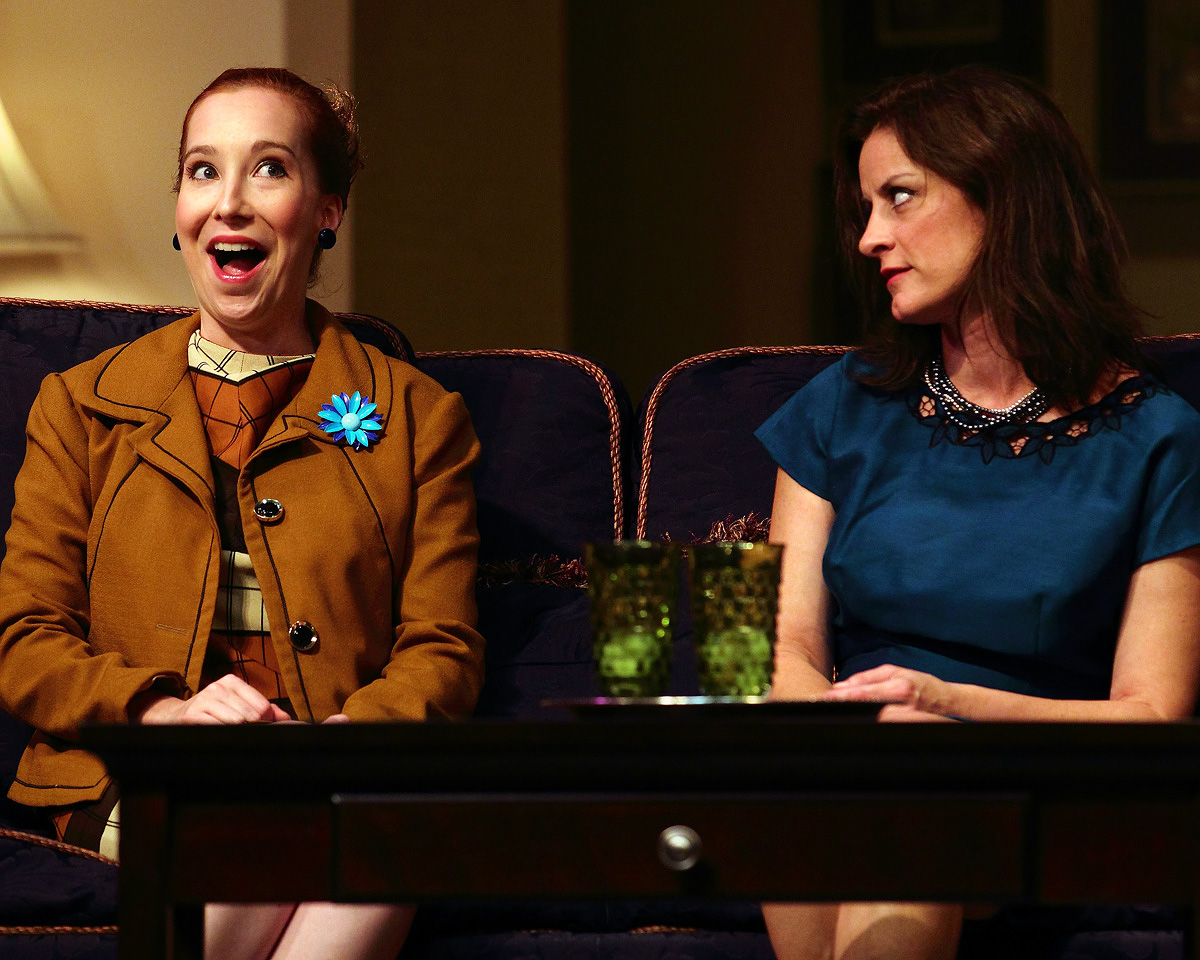
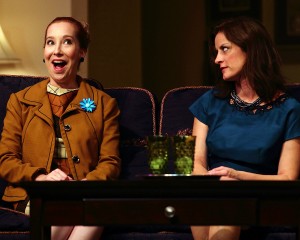 Jennifer Finch (Linda Lodge) and Shelagh Roberts (Joanna Markham). Photo Credit Shane Canfield After assuming his wife has betrayed him by finding a piece of a love letter that he thinks is written to his wife, Philip Markham tries to catch her in the act. An uproarious scene evolves when Alastair, who has already begun to develop ideas of his own about his client’s sexuality, discovers Henry riding Philip horsie-style while they vie for a bedroom view of what they imagine to be Joana’s affair.
But Joana Markham is only hiding the fact that Linda is planning a tryst at her apartment while Philip is doing the same for his business partner, Henry, who plans to meet up with the telephone operator. Oh the lies! Oh the cheating! That the housekeeper and the decorator have secretly chosen to rendezvous in the apartment at the same time as the two other couples makes for a cleverly choreographed and wildly hysterical scenario.
Oddly the production gets off to a tentative start. The set-up of the characters and their complex roles takes a good bit of explaining in order to establish who’s pursuing whom and why. But it soon revs up to full throttle and the audience expectedly falls under the spell of the age-old slapstick.
Look for James Raby who is razor sharp as Philip and even surprises with a dollop of hoofing in his switcheroo role as the snide “May I be so bold?” family butler. Jennifer Finch is scintillating as Linda Lodge, played with a feather-light touch and Katie Zitz turns out a Sylvie reminiscent of Uma Thurman’s Swedish ingénue, Ulla, in the film, The Producers. Seamless performances all around in this summer winner!
At The Little Theatre of Alexandria 600 Wolfe Street through June 25th. For tickets and information call the box office at 703 683-0496.
Jordan Wright
Special to MD Theatre Guide
May 23, 2011
 Judge Omar Noose (Evan Thompson), Carl Lee Hailey (Dion Graham), center, and Jake Brigance (Sebastian Arcelus) in John Grisham’s “A Time to Kill”. Photo Credit Arena Stage In the dog days of summer in a muggy Mississippi courtroom in rural Ford County, the chilling details of Pete Willard’s confession to the recent rape and torture of Tonya Hailey, a 10-year old black girl, are read by the judge. At the pre-trial hearing the father of the child, Carl Lee, stands stoically in attendance, as the twisted brutality of the heinous crime is revealed. Willard and his drug-dealing redneck crony, Billy Ray Cobb, are the accused. Their yellow Ford pickup with the Confederate flag mounted on the back, was spotted at nearby Lake Tutula. With a signed confession in hand and the victim clinging to life, it’s all but a slam dunk for the prosecutor, until Carl Lee guns down the defendants in cold blood and the air is sucked out of the theatre by the sound of gunshots.
It is the first of Grisham’s crime novels to be brought to the stage and Tony Award-winning scriptwriter Rupert Holmes’ adaptation is certain to be considered a classic along with successful courtroom dramas like 12 Angry Men and Inherit the Wind.
Though the powerful story is set in the post-Civil Rights era of the South, nothing much has changed in rural Mississippi. Director Ethan McSweeney does much to evoke the period with haunting visual and musical references. The sound of Bluegrass, suggestive of the film Deliverance, intertwines with echoes of “We Shall Overcome” heard beneath the courtroom windows. Walls dotted with ‘50’s era television sets showing scenes of fiery Klansmen spewing racist hatred are layered with the chilling sounds of a child screaming “Daddy! Daddy!” Interspersed with flickering static-filled TV images, DC news anchor, J. C. Hayward, plays the role of Felicia Albright trial reporter.
As further mood-enhancement, Set Designer James Noone’s clever layout rotates the stage morphing it from a courtroom into the home-under-Klan-siege of the Brigance family, and back again. Lighting Designer York Kennedy boosts the somber mood with the blades of a ceiling fan casting spinning shadows across the courtroom floor. The only thing missing is the aroma of buttermilk fried chicken and a Mississippi mud cake wafting across the stage.
In one particularly effective staging device, Director McSweeney has Judge Noose (an ironical name not lost on Carl Lee), D.A. Buckley and Defense Attorney Brigance face the audience to make their respective cases, giving the audience the eerie sense that they are involved in the deliberations.
But as with real life there’s also levity amidst the tension, enough to allow the audience, who’ve been gripping their seats, a chance to breathe. Southerners can find humor in a funeral and, true to Grisham’s original novel, it’s reflected here.
There are outstanding performances by Sebastian Arcelus (a Matthew McConaughey look-alike) as ambitious Defense Attorney Jake Brigance and his Junior Leaguer wife, Carla Jane, played by Erin Davie; Brennan Brown as the smarmy District Attorney with political aspirations Rufus Buckley; and Rosie Benton as sharp-witted legal assistant and erstwhile flirt, Ellen Roark (“I make the best damn margarita!”), whose slinky sex appeal charms the judge and seeks to undermine Jake’s marriage.
John C. Vennema crafts the charming Hawaiian-shirted, bourbon-swilling down-and-out attorney, Lucien Wilbanks, whose metaphors, “whiter than an albino mouse in a snowstorm”, are pure down home. But it’s Dion Graham in the role of the 46-year old Vietnam vet, Carl Lee Hailey, who will rip your heart out with his graceful, understated portrayal of the grieving father. “God had a son,” he ironically observes, “He didn’t have a daughter!”
Here’s my verdict. A Time to Kill is a raw and riveting drama that sears with redemptive emotion. It is a mega hit for Arena that should send this production straight to Broadway.
At Arena Stage through June 19th. 1101 Sixth Street, SW, Washington, DC. For tickets call 202 488-3300 or visit www.areanastage.org.
Running time: 2 hours
Jordan Wright
Special to The Alexandria Times
May 10, 2011
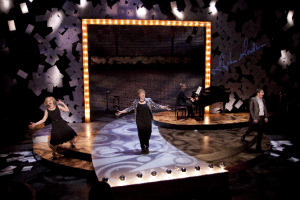 Nancy Anderson, Sherri L. Edelen and Matthew Scott star in Signature Theatre's production of the 1976 musical revue Side by Side by Sondheim. Playing through June 12, 2011. Photo credit Scott Suchman. Where were you when you first heard “Send in the Clowns”? What about “Something’s Coming” or “I Have a Love” from West Side Story? We all have powerful first-time memories of hearing the music of Stephen Sondheim. What are yours?
I was in The National Hotel in Frenchtown, NJ, just across the Delaware from Bucks County, PA, when owner Claiborne Cary, sister of Cloris Leachman and show biz star in her own right, brought her guests to tears with “Send in the Clowns”, one of Sondheim’s classics from A Little Night Music. That was in the early ‘70’s when the show was hot and before every two-bit lounge singer had crucified it.
On Broadway in 1957 I saw Chita Rivera as Anita and Carol Lawrence as Maria tear up the house with “I Have a Love” and “Something’s Coming” in West Side Story. I was sitting with my family on the left side of the house a few rows back. We bought the cast album that night and I remember gazing at its bright red cover with a black and white overlay of Maria leading Tony triumphantly through the streets of New York. I went home with a burning desire to be Puerto Rican as I danced and sang my way around the house to its soaring melodies. Most people attributed the show solely to Leonard Bernstein who wrote the music. But it was Sondheim who penned the lyrics that altered history and brought new awareness to the nation’s Latino immigrants.
On Broadway in 1959 Ethel Merman debuted in Gypsy. I wondered how a singer could get away with singing so brashly. I vowed to project more. In the original production the offer by producer David Merrick to write the lyrics was rejected by Irving Berlin and Cole Porter, when Sondheim got the call. Apparently, as the evening’s narrator tells it, Merman said, “The young man can stick around to write the lyrics.” The rest is history….
Signature Theatre’s current revival of Side by Side by Sondheim, the revue that features the composer/lyricist’s timeless hits in the period between 1957 through 1976 (before Sunday in the Park with George, Into the Woods and Sweeney Todd) affords the theatre-lover the opportunity to luxuriate in some of the greatest show tunes ever written. It is a time capsule of the period some say was one of the most triumphant eras on Broadway.
Three singers and two piano accompanists, Resident Music Director, Jon Kalbfleisch, and Gabriel Mangiante, relate in words and music the early career of Stephen Sondheim. From his clumsy efforts at age 32 when he submitted his first musical to Bucks County neighbor, Oscar Hammerstein – who told him in no uncertain terms that it stunk, but, oh by the way, he did have talent, and then went on to give him a master class in writing musicals – to his ultimate collaborations with Hammerstein, Leonard Bernstein, Richard and Mary Rodgers and Jule Styne, the British-born composer with whom he co-wrote Gypsy.
Imagine A Funny Thing Happened on the Way to the Forum without “A Comedy Tonight” as its opening song. See you can’t! But another tune was written for the show and later tossed out. Who knew? It was called “Love Is In the Air” and here it is woven into the first act.
All in all the brilliantly talented singers, Nancy Anderson, Sherri L. Edelen and Matthew Scott do a bang-up job of hoofing, styling and singing their faces off for a total of 30 Sondheim masterpieces. Look for Edelen’s vampy rendition of “I Never Do Anything Twice”, from The Seven Percent Solution, Anderson’s double-time rendition of “The Boy From…” from The Mad Show, and the trio’s pastiche form of the Andrews Sisters in “You Could Drive a Person Crazy” from Company to fire up the audience.
At Signature Theatre through June 12th. For tickets and information call Ticketmaster at 703 573-SEAT or go to www.signature-theatre.org.
Jordan Wright
Special to The Alexandria Times
May 9, 2011
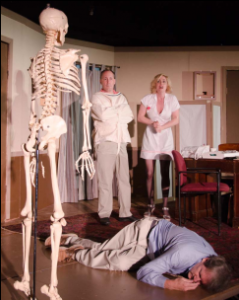 Mark Adams (foreground), Matthew Randall, Shannon Benton. Photo Credit Doug Olmsted Always willing to tread the edge and more than capable to do it, Port City Playhouse tackles the complex and grisly tightrope of Mindgame, by acclaimed English novelist and screenwriter, Anthony Horowitz. Featuring some of the most skillful actors in our area with three-time WATCH Award nominee for lead actor, Mark Lee Adams, as Dr. Farquhar; Matthew Randall, playing journalist Mark Styler; and Shannon Benton, adding the sizzle and terror to Nurse Plimpton.
Set in a doctor’s office in 1990’s England at the country’s most notorious insane asylum, Fairfields, this drama provides the backdrop for examining a gruesome murder mystery. In his quest to explore the relationship between good and evil, Styler hopes to secure an interview with noted serial killer and asylum inmate, Easterman, who has murdered, tortured and cannibalized his 19 victims. Hired by BBC for an upcoming feature, Styler travels solo to this remote outpost in Sussex, to meet with the facility’s director, Dr. Farquhar. His mission: to probe the criminal machinations of serial killers.
But Farquhar, with his experimental role-playing theories created to cure psychotics, regards Styler suspiciously and tags him as a populist writer, unable to delve into the mind of the killer. Coincidences and clues abound, such as the gatekeeper having the same name as a known serial killer, background screams, lulling elevator music, and drawn curtains that arouse Styler’s curiosity and the two begin their danse macabre, with journalist Styler substantiating his theories by quoting Socrates, “No one ever does wrong willingly.” and the doctor refuting him by quoting Hitler, “When Hitler started out all he wanted to do was paint.”
Horowitz sets the chilling tone with references to British slasher Jack the Ripper, Andre Chikatilo known as the Butcher of Rostov, a Russian schoolteacher who murdered 52 women and children, and Milwaukee native son and erstwhile cannibal, Jeffrey Dahmer. While the dialog is tempered with some humor, you’ll be suppressing the laughter with goose bumps.
By the time the voluptuous Nurse Plimpton enters in a state of near undress and high panic, the plot most assuredly thickens. The terrified nurse tries to surreptitiously hand a note to Styler, but the doctor notices and sets it aflame as our chance to uncover her distress fades with each passing moment.
Dr. Farquhar relishes his role, playing cat and mouse with Styler, with Mark Lee Adams convincingly channeling the ever-evolving madman. While Styler, sympathetically portrayed by Matthew Randall, goes from hunter to hunted. Who is Dr. Jekyll and who is Mr. Hyde?
It is a crafty conundrum for even the most practiced mystery junkies.
The plot itself provides some revelations…but are they real clues or red herrings? Have Styler and Farquhar met before? They both lived on Suntower Court in York during the same period. The audience is left holding a patchwork of clues as the plot streaks on at lightening speed to more frantic and gruesome dimensions. Have the inmates taken over the asylum? Will they stage an uprising? An exit becomes a closet door – a window a brick wall. Is there no way out? Wait and see.
On Fridays and Saturdays through May 22nd at 8:00pm. Sundays May 15th and 22nd at 3:00pm. Port City Playhouse at The Lab Studio Theatre at Convergence, 1819 North Quaker Lane, Alexandria, VA 22302. For ticket information call 703 998-6260 or visit www.convergenceccf.net.
Jordan Wright
Special to The Alexandria Times
April 25, 2011
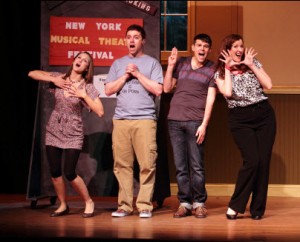 (L to R) Sharon Grant (Heidi), Josh Goldman (Hunter), Scott Harrison (Jeff), and Anne Marie Pinto (Susan)
The popular device of a play-within-a-play is taken to the third power in this cocky musical now debuting at The Little Theatre of Alexandria. [title of the show], no this is not my editor’s idea of a parenthetical joke, has as its theme two aspiring New York hopefuls, the author and the composer/lyricist who enter a writer’s competition at The New York Musical Theatre Festival. It is a play-within-a-play-within-a-play. Or should I say musical? That our heroes are gay is incidental to their theatrical travails, but it provides some humor and background. That they are young and inexperienced defines the complex, behind-the-scenes efforts of the post-modern playwright to bring a production to the stage. It is the consummate guide to backstage politics and insider showbiz jargon.
Our two hipsters Hunter (Josh Goldman) and Jeff (Scott Harrison) have three weeks to pull off the impossible by writing, composing, casting, scoring and mounting a new musical. They engage their aspiring actress/singer pals Susan (Anne Marie Pinto), gainfully but unhappily employed as a part-time receptionist, and Heidi (Sharon Grant), who has a bit part on Broadway in The Little Mermaid, in a madcap challenge to take their musical from writing to final production in three weeks.
In reality (a tricky concept to toss around in this review since there are surface realities and underlying realities) Hunter Bell and Jeff Bowen are really the names of the writers of this show. And Heidi Blickenstaff and Susan Blackwell are really the names of their actress friends. Got it?
The idea was that their four-way conversations were a great deal more inspiring than their attempts at writing. “We could get important points across,” suggests Hunter who literally becomes a costumed blank page. “Writing should be easy, like a monkey driving a speedboat,” he conjures. When he struggles to put words on a page Hunter tells Jeff, “My writing is like a drag queen…fabulous at night…in the daytime…not so much!” In fact Heidi and Hunter play a little game of making up and texting amusing drag queen names to each other…Lady Foot Locker and Dorothy Chandler Pavilion oddly spring to mind.
There are 18 terrific musical numbers in this non-stop one act that the boys hope will “get them on Ellen”, and hosts of celebrity names are bandied about as they imagine Joan Rivers, Bernadette Peters and iconic gay author John Cameron Mitchell will drop backstage to celebrate their triumph. In a local nod they include the WATCH Awards (our local community theatre awards) in “The Tony Award Song”.
While Jeff plays the straight man to Hunter in this comedic one-liner extravaganza, (Henny Youngman where are you?), the girls alternate between insecurities and mutual mistrust in the number “What Kind of Girl is She? ”. Look for Anne Marie Pinto with her powerful voice and wild gesticulations to rip up the stage in the rock number “Die Vampire Die”, Susan’s solution to ridding the show of second-guessing and energy-robbing self-doubt.
While they wait for the financial backing to get their play to Broadway, Hunter considers looking for a day job. “I’m down to tropical plant cleaner or donating eggs,” he mopes. But in a mathematical calculation contrived to insure success, they determine they would rather be “Nine People’s Favorite Thing” than one hundred peoples’ ninth favorite thing.
The winsome cast sings their faces off in a host of great numbers. Sit back and let them charm you. And don’t bother counting the f-bombs, Hunter does it for you, they are integral to the script.
At The Little Theatre of Alexandria 600 Wolfe Street through May 14th. For tickets and information call the box office at 703 683-0496.
|