I’m still trying to puzzle out what the play’s title is supposed to mean. It has nothing to do with autumn or waterfalls and even less to do with the decline of a city called Autrey Mill. And the word “pride” doesn’t begin to sum up the complex neuroses of this dysfunctional family. So with little clue as to what to expect from playwright Paul Downs Colaizzo’s latest comic drama, I entered the theatre as curious as a cat.
Suburban housewife Carly (Christine Lahti, left) makes a discovery about her son Chad (Anthony Bowden) in Pride in the Falls of Autrey Mill – Photo: Margot Schulman.
The play opens onto a set furnished by Better Homes & Gardens or at least one that appears that way. Carly is having a sit-down with her college-age son Chad who has revealed to her that he is gay and has a steady boyfriend. She is surprised and disdainful, though far more interested in exploring the dynamics of his relationship. “Who pays the check?” she demands to know in an attempt to determine which role he plays. “If you pay the check, that makes you the man!” she chides him. “You coulda been president!” she insists in yet another attempt to belittle him. That’s how perfectionist Carly deals with news she doesn’t want to hear. Sweep it under the rug and then put a more palatable spin on it. The approval of their country club cronies is far more important to her than her own family’s feelings.
For a woman who has spent her entire adult life as a stay-at-home mom with an absentee traveling salesman husband, Carly has her own convoluted set of values. A control freak who idealizes her family as she denies them their individualism, she compiles lists of appropriate girls for her sons to date. When asked, “What’s for dinner?” she describes her seven-course meal listing all the gourmet ingredients.
Suburban housewife Carly (Christine Lahti, right) touches base with her husband Louie (Wayne Duvall) in Pride in the Falls of Autrey Mill – Photo: Margot Schulman.
No, this is not a rewrite of Arthur Miller’s “Death of a Salesman” though it has overtones of it and Sam Mendes movie “American Beauty” too. It is a wry, tongue-in-cheek satire on the decline of the American family in all of its modern suburbanite splendor. A popular topic if ever there was. Tolstoy’s Anna Karenina nailed it when she said, “All happy families are alike; every unhappy family is unhappy in its own way.”
Bulimia, homosexuality, incest, overeating, cheating, emotional detachment, parental disapproval, alcohol and drugs. Just your typical middle class family, Colaizzo seems to say. “We’re just letting our dreams die, Mom,” Chad sagely observes.
“Pride in the Falls of Autrey Mill” is without nuance. It’s a straightforward, emotionally charged play loaded with piercing insults and laugh-out-loud satire. But ultimately it’s the humor that Colaizzo puts into this play that makes it palatable – – the nail-in-the-coffin retorts, the relatable characters we can tsk-tsk from a distance. And ultimately we are drawn to the train wreck and the exquisitely satisfying schadenfreude of watching other people’s vulnerabilities tweaked and prodded.
Brothers Chad (Anthony Bowden, left) and Tommy (Christopher McFarland) sneak a moment’s peace in the bathroom of their childhood home in Pride in the Falls of Autrey Mill – Photo: Margot Schulman.
Christine Lahti plays Carly like a tail-swishing cat, ready to pounce. She is riveting in her depiction of the uptight, social doyenne and a perfect contrast to Wayne Duvall’s laid back Southern breadwinner, Louie, who balances out that tension with a restrained yet effective portrayal of her husband who harbors other ideas for his happiness. Terrific performances by both Anthony Bowden as Chad, and Christopher McFarland as Tommy who bears the brunt of couple’s disappointment.
Through December 8th at Signature Theatre (Shirlington Village), 4200 Campbell Avenue, Arlington, VA 22206. For tickets and information call 703 820-9771 or visit www.signature-theatre.org.
What sort of vacuum will be created when U.S. troops withdraw from Afghanistan and leave behind the Afghan men and women who aided the soldiers’ mission? Arena Stage playwright-in-residence, Charles Randolph-Wright, poses that question in “Love in Afghanistan”, a romantic drama with sanguinity. Randolph-Wright, who had never visited the country, got some help from former Secretary of Homeland Security, Janet Napolitano, who vetted the script for authenticity.
(L to R) Khris Davis as Duke and Melis Aker as Roya in Love in Afghanistan – Photo by Teresa Wood.
Set in the war torn city of Kabul, African-American hip-hop superstar Duke and his Afghan translator Roya discover their similarities and interpret their struggles in very different ways. Duke is at the height of his music career and Roya, a women’s rights advocate, has risen through the ranks becoming one of the most sought after translators in the city. When she is assigned to Duke during his concert tour at Bagram Air Force Base, they become enmeshed in each others lives.
The four-character play includes Roya’s father, Sayeed, a translator; and Duke’s mother, Desiree, a senior vice-president with the World Bank assigned to the Arab kingdom. All four become caught in a dangerous and complex trap that has both political and emotional consequences. Lies of convenience and lies of survival weave the multi-layered plot together.
Melis Aker provides us with an intensely riveting performance as Roya, an assertive, modern-day Arab woman, raised as a boy. (Under a little known but widespread practice known as “bacha pash” meaning “dressed as a boy”, it’s how a girl child is raised as a boy when a family has no sons.) Joseph Kamal plays Sayeed in a subtle and moving performance of a protective father who nevertheless admonishes his daughter by reminding her, “A woman must not shame a man.”
As the American mission winds down complications arise for Roya and her father. They need visas or they will be persecuted for aiding the Americans. This is where the play’s present-day setting syncs up with real-world politics. Dramaturg Linda Lombardi provides this salient factoid in the program: The U.S. promised to give visas to those Afghans who, risking their own safety and security, assisted their efforts during the war. A special immigrant visa program was created to provide visas to Afghan locals working with the U.S. military. As a direct result of their work, their lives and their families are now in danger. To date the State Department has granted only 22% of the visas allocated.
Will Roya and Duke escape the suicide bombers and conquer the Taliban’s suppression of women’s rights and education? “We live our lives with fear. Not in fear,” Roya tells him. “In fear means that you have given up.” But while translating for a suspected jihadist, Roya herself becomes a scapegoat for a terrorist incident.
Khris Davis convincingly clones Duke, a middle-class rap artist who talks in jive and has moves to match. Davis lights up the stage in whatever scene he is in. Dawn Ursula, as his mother Desiree, is marvelous as the high-powered career woman who discovers the meaning of romance.
Dawn Ursula as Desiree in Love in Afghanistan – Photo by Teresa Wood.
Adding further authenticity and irony to the production, the stage floor features an enormous scarlet-hued Persian rug once belonging to King Mohammad Zahir Shah, the last king of Afghanistan, who created a new constitution with a parliament, free elections, women’s rights and freedom of speech. It’s hard to believe that was less than 40 years ago.
Through November 17th at Arena Stage, 1101 Sixth St., SW, Washington, DC 20024. For tickets and information call 202 484-0247 or visit www.ArenaStage.org.
(L to R) Joseph Kamal as Sayeed, Melis Aker as Roya, Dawn Ursula as Desiree and Khris Davis as Duke in Love in Afghanistan – Photo by Teresa Wood.
Joseph Carlson as Lord Henry and Dallas Tolentino as Dorian Gray. Photo by Koko Lanham
If I told you Synetic Theaterwas producing one of its much-lauded plays from their Silent Shakespeare series, you might have an inkling as to what to wrap your brain around. You’d also have to wait until early next year when they reprise two of those plays – – their original production of Hamlet…The Rest is Silence and their latest interpretation of Twelfth Night. In the same vein if I were to describe a play as comedic or compellingly poignant, then too, you might have a notion of what sort of an evening to expect. But Director Paata Tsikurishvili wishes to disabuse his audience of either complacency or expectation, which is exactly how he likes it.
As in the book by Oscar Wilde, Dorian is a man obsessed with youth and beauty – – a supreme narcissist who uses a portrait of himself by his artist friend Basil to take on the aging process while he remains young and virile. When Dorian meets the diabolical Lord Henry, whose affection for him seems boundless, his sense of morality eludes him and he descends into a life of debauchery. “There’s only one way to get rid of temptation, and that is to give in to it,” Lord Henry urges, in one of his many instructions to Dorian.
In Synetic’s version the painting itself becomes a living interactive character, first luring and later haunting, the murderous Dorian as he rages against evil and death. Witticisms from Wilde are scattered throughout the dialogue and usually delivered by the appropriately snide and derogatory Lord Henry.
Kathy Gordon as Lady Carlisle and Dallas Tolentino as Dorian Gray. Photo by Koko Lanham
When Dorian and Henry go to the theater to see an actress Dorian has fallen for, they become part of an audience seated on benches facing us. Does art imitate life? Here it does, as we follow the hilarious reactions of the viewers to a bad piece of theater. It’s a clever concept that uses the method of “topsy-turvy”, a popular device of the period. Also harkening back to early stagecraft, Lighting Designer Colin K. Bills employs vaudeville-style footlights and spotlights of yellow and green, reminiscent of the absinthe fairy, to highlight the evil influence of Lord Henry.
Original music by Konstantine Lortkipanidze uses electronica to create an amorphous, any-century mood, while Set Designer Daniel Pinha brings the stage to the audience with the use of clear interlocking acrylic panels as a stage surround. In a hyper-kinetic sadomasochistic scene, using a giant hookah as the central prop, vinyl-clad dancers writhe and thrust (Miley Cyrus eat your little twerking heart out!) in a drug-induced frenzy inside a virtual den of iniquity. The panels screen the audience from flying spatters of day glow paint from the orgy contained within its walls.
It is the paradox of the strait-laced Victorian society in which Dorian and his friends cavort, and the dissolute underbelly of that society that present the perfect palette for the spectacular beauty of Synetic’s dancers and their sinuous movements.
Robert Bowen Smith as Basil, Dallas Tolentino as Dorian Gray and Joseph Carlson as Lord Henry. Photo by Koko Lanham.
Dallas Tolentino is a magnetic and intriguing Dorian Gray, a dandy seeking reformation and redemption without the necessary willpower. “We live in the native land of the hypocrite,” he remarks. Joseph Carlson lends a marvelously Faustian swagger to the soulless Lord Henry, a proper English gentleman in the business of corruption, while Philip Fletcher plays the “Portrait” with astonishing physical prowess and subtlety. The pure-of-heart Basil is elegantly played by Robert Bowen Smith, who gives the drama the requisite good-to-evil ratio.
The Picture of Dorian Gray, as seen by Dramaturg Nathan Weinberger, is an erotic, Freudian-fueled portrait of Victorian England literally laid bare – – a circus riot of id, ego and super ego dished up in an erotic maelstrom of physicality as only Synetic Theater, with its magnificent classically-trained Georgian dancers, can imagine.
Highly recommended. Suitable for adults only.
Through November 3rd at Synetic Theater, 1800 South Bell Street, Arlington in Crystal City. For tickets and information call 1-866-811-4111 or visit www.synetictheater.org.
Joe Carlson as Lord Henry, Dallas Tolentino as Dorian Gray, Robert Bowen Smith as Basil and the Ensemble. Photo by Koko Lanham
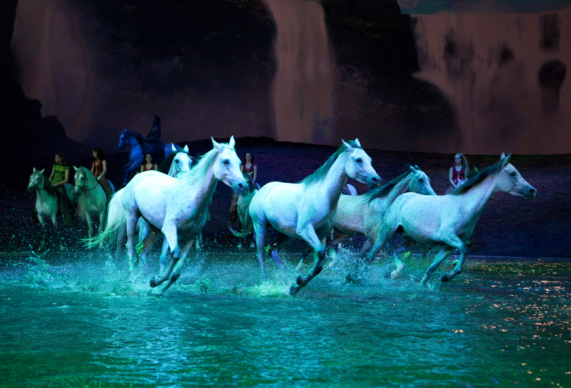
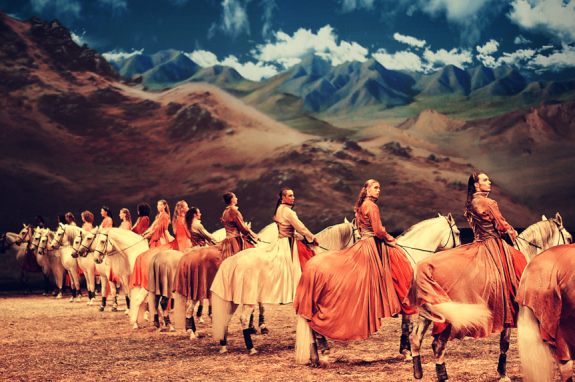
On October 9th the equine extravaganza that galloped into town four years ago will return with an even more spectacular show. Sixty-nine horses ranging from Andalusian and Arabians, Belgians to Appaloosas, and Percherons to Paints along with other exotic horse breeds from around the world will grace a big top the size of two football fields. But you don’t have to be horse crazy to be wowed by the beauty and raw power of these magnificent animals performing on a “stage” the size of two hockey rinks and a surface made of sand.
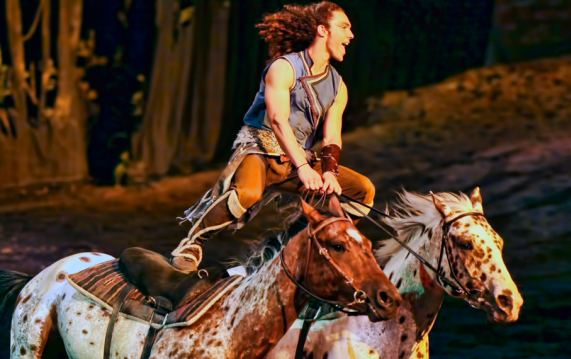
Forty-nine artists (half that number are actual riders) will ride in three major styles. There’s the hell-bent-for-leather “Liberty” style; the side-by-side and in synch for the “Roman” style; and the elegant prancing and posing techniques best known for the elegant “Dressage” style. Watching these massive beauties go through their paces is as riveting, as it is awe-inspiring, and a tribute to the intimate relationship riders and trainers have with their horses.
Grand Cavalia | Credits: Color-ish company
Canadian Marc-Olivier Leprohon, head of artistic and equestrian operations, spoke to the Alexandria Times about Cavalia Odysseo.
Can you describe the development of Cavalia Odysseo?
When we began in Quebec in 2011 we were twelve people. Now there are 130 that are on the tour. Also we bring on an extra one hundred people for seating and food wherever we go and another fifty people to help move the show, tear down the big top, and pack up supplies into one hundred trucks.
That’s a huge production! What’s planned for the future?
There are two distinctly different shows, Cavaliaand Cavalia Odysseo. Our Artistic Director, Wayne Fowkes, has a goal is to create different shows in North America and around the world. Right now it’s the biggest show ever built and includes a huge lake and a hill in the background that the horses run up and down.
What kind of surface do the horses perform on?
We all work in sand. All of the acrobats or aerialists have to adapt, because the ground is not even. Every day we smooth the sand and roll it. It’s soft enough for the horses and compact enough for the artists. In the show there is nothing to obstruct the view of the horses. It’s like bringing nature indoors. In the beginning the horses strut, then jump and canter. We work them into dressage and finally into trick riding. So their warm-up is actually on stage, not backstage.
How are the horses trained and do they perform in every show?
We follow what the horse wants to do and try to understand what they are telling us. Each one is trained to do four different disciplines even though they don’t do the same things every day. In addition we always have some that are in training when we are on the road.
Where do the horses go between cities?
We usually have two weeks in between that’s when we take them to a local farm. Before we open at National Harbor they’ll stay on a farm in Delaware that provides sixty-three stalls with paddocks and fields to run around in with their friends.
Nomads / Nomades | Credits: Pascal Ratthé
Stephanie Evans is one of the artists in the show also spoke to the Alexandria Times about her experiences with the horses. Raised on a horse farm in Canada, she has competed in many international equestrian events and trained in dressage in Lipica, Slovenia, the original home of the Lipizzaner breed. She also learned equestrian skills in Spain at the Real Escuela Andaluza del Arte Ecuestre.
What is the breakdown of horse to rider and how do they get pampered?
Each rider is assigned three to six horses and each horse creates a bond with their rider. We have eleven different breeds – – some are stallions and some are geldings. On site we have round pens and an outdoor stand ring for sun and fresh air. We travel with two vet techs who are in contact with local veterinarians and we have a farrier who travels with us in case a horse throws a shoe.
What are some of the quirks of their personalities?
I have three horses I ride now. One is an Andalusian stallion, who’s super relaxed, super sweet and super lazy. Another Andalusian I ride is very excitable and always looking around for things. Sometimes he is unpredictable!
Do the horses play well together?
No! We have to separate them because we have a lot of stallions, although the geldings get along. There is a group of Arabians that are in a big “Liberty” number and they get turned out together. The oldest is fifteen and the youngest is five.
Why do you have so many stallions?
Stallions have a greater presence and are known for having more muscle tone. Their mane and tail create a more visually impressive horse and they have more character.
Since the artists are from so many different countries how do they communicate with one another?
We mainly speak English and French. You’ll also hear Spanish, Portuguese, and Susu since we have a big group from New Guinea.
UPDATE: For the DC Metropolitan area a 50% discount will apply for a limited time only. This major rebate will apply on all tickets for Cavalia’s newest production Odysseo.
“The shutdown of the national government will affect thousands of employees and businesses in the Washington, DC area,” said Normand Latourelle, Cavalia’s Founder and Artistic Director.“Considering the impact of the shutdown on the local economy,we want to offer a special promotion so everyone can experience the magic of Odysseo.”
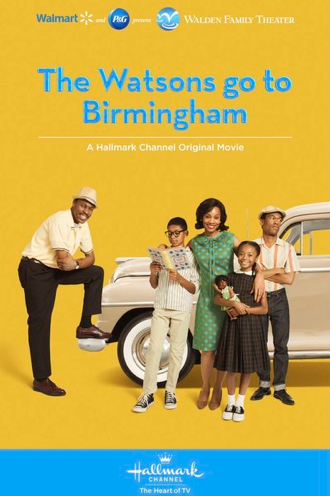
Upon the 50th anniversary of pivotal events in the Civil Rights movement, Hallmark Channel is proud to present “The Watsons Go To Birmingham”
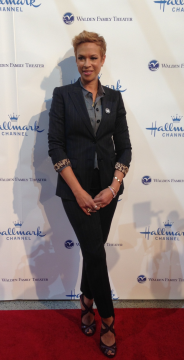
The Watsons Go To Birmingham had a private showing at the Newseum last week upon the 50th anniversary of the pivotal events of the Civil Rights Movement. The Hallmark Channel’s original new family movie is based on Christopher Paul Curtis’ award-winning book with screenplay written by Tonya Lewis Lee (wife of Film Director, Spike Lee) and produced by Ms. Lee and collaborator Nikki Silver. It’s an inspirational story of an all-American family who takes a road trip in the racially charged days of 1963 from Flint, Michigan to Birmingham, Alabama. Their experiences of that historic summer give them newfound courage to stand up for their rights and help to bring the family closer.
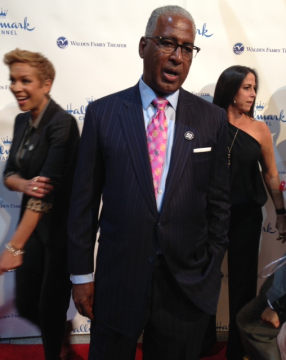
The Honorable William Bell with Producers Tonya Lewis Lee and Nikki Silver (R)
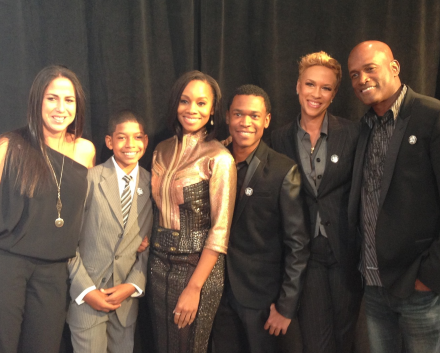
Not only did Director Kenny Leon and lead actors, Anika Noni Rose, Wood Harris, Bryce Clyde Jenkins and Harrison Knight grace the red carpet, but the Honorable William A. Bell, Sr., the current Mayor of Birmingham, was there to answer questions on the history of the Civil Rights Movement and share his childhood memories of the city. Walden Media President and Co-Founder, Michael Flaherty opened the post screening talkback with Bell acting as moderator and fielding questions from the audience.
From left – Nikki Silver, Bryce Clyde Jenkins, Anika Noni Rose, Harrison Knight, Tonya Lewis Lee and Kenny Leon
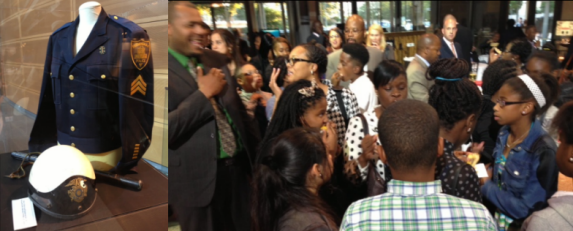
Bell was instrumental in discovering and bringing to Washington a number of iconic artifacts uncovered in the city’s archives and warehouses – a Birmingham Police uniform, helmet and baton; a row of church pews from the 16th Street Baptist Church reminiscent of the church bombing that killed four little girls; “White” and “Colored” segregated water fountains; and arrest records from the historic marches.
Birmingham Police uniform and baton — The 6th and 7th grade students from Whittier Education Campus in DC’s Ward 4 with teacher Keith Gill
Displayed in dioramas around the Newseum’s lobby, you can view them up close until they find a permanent home. It is hoped they will be part of the Smithsonian’s new National Museum of African American Culture and History opening on the National Mall in 2015.
In case you missed last week’s airing you can catch encore showings on 9/27 and 10/11 at 8 PM EST on the Hallmark Channel.
Given its title one might imagine Arena Stage’s Artistic Director Molly Smith deliberately timed this piece to reflect the beginning of the fall season. But The Velocity of Autumn, a play Smith also directs,is not about the calendar. It is a poignant metaphor on the human condition.
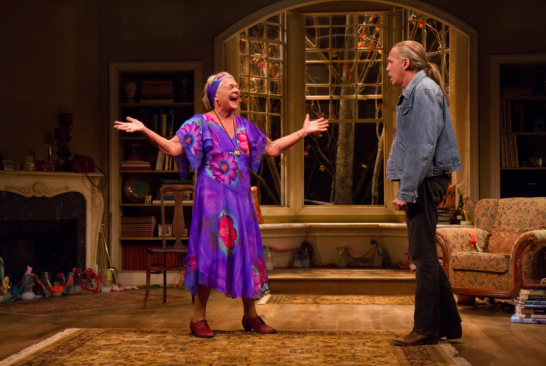
Estelle Parsons as Alexandra and Stephen Spinella as Chris in The Velocity of Autumn – Photo by Teresa Wood
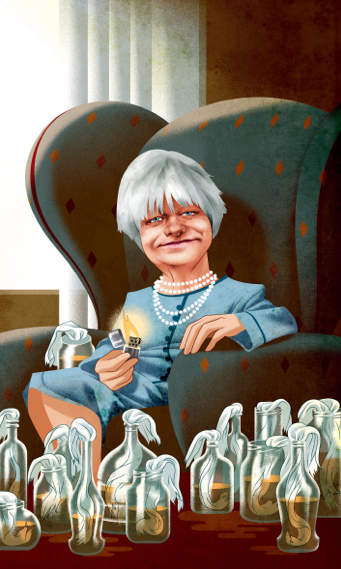
Estelle Parsons plays Alexandra, a crusty old gal living out her days in the Brooklyn brownstone where she raised her three children. She has jerry-rigged her home’s interior with barricades and Molotov cocktails strung together like party lights in order to keep the police, summoned by two of her children, from carting her off to a nursing home. In short she’s preparing to blow herself up and take her Park Slope neighborhood with her.
Once a successful artist Alexandra wants to spend the rest of her life among her books and records in her own home. Her children have other ideas as to where she should live. The two-person play (with phone updates from the panicked siblings), an often-prickly conversation between Christopher and his mother, is weighted with gallows humor. “I will set myself on fire,” she threatens, toying with an old Zippo lighter while grasping a homemade explosive. “Then I’ll bring the marshmallows,” Christopher quips, modeling his mother’s dark sense of humor. I won’t reveal the dramatic early entry of the long absent Christopher, tasked by his overly meddlesome siblings, Michael and Jennifer, to talk their mother down from her end-of-the-world scenario. But I will say it clarifies the autumnal reference.
The story is a tender exercise in patience and reconciliation as Alexandra and her estranged son create new bonds while revealing their darkest fears and reflecting on their lives. Snappy one-liners abound, keeping the dialogue from mawkish sentimentality, “Getting you out of diapers was like the Bataan Death March!” While philosophies on aging keep it real, “Old age is just one big surprise. You never know who you are until you get up!”
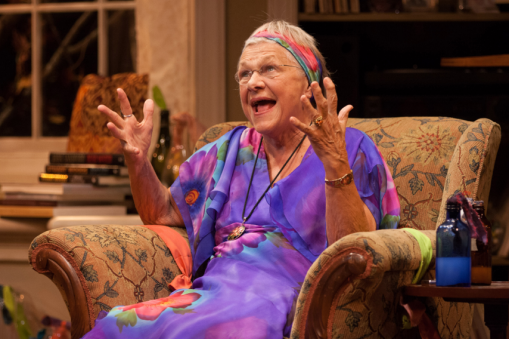
Estelle Parsons as Alexandra in The Velocity of Autumn – Photo by Teresa Wood
Parsons, best known for her Academy Award-winning performance in Bonnie and Clyde and as Mother Bev on TV’s sitcom Rosanne, has kept her theatre presence active, not only by directing, but also by taking roles scripted by the American theatre’s most revered playwrights such as Tennessee Williams, Arthur Miller, Samuel Beckett and Edward Albee. Her portrayal of Alexandra, a woman of fierce determination, complexity and above all a wry sense of humor, proves that she is one of America’s most brilliant, and funniest, actors.
Stephen Spinella comes to the role of Christopher with a shelf’s worth of Tony and Drama Desk Awards. His sensitive performance as the wayward son returning to the fold to mitigate disaster and reconnect with his mother, is genuine and deeply affecting.
Playwright Eric Coble’s The Velocity of Autumn, part of a trilogy of “Alexandra” plays, gives us a memorable night of pure, unadulterated theatre that will resonate mightily – – not only with caregivers and the elderly, but for all those seeking grace and meaning in a fast-moving world.
The Velocity of Autumn at Arena Stage at the Mead Center for American Theater. Illustration by André Carrilho
Through October 20th at Arena Stage, 1101 Sixth St., SW, Washington, DC 20024. For tickets and information call 202 484-0247 or visit www.ArenaStage.org.