Special to Washington Examiner
Up Close With Jordan Wright of Whisk and Quill
October 2010
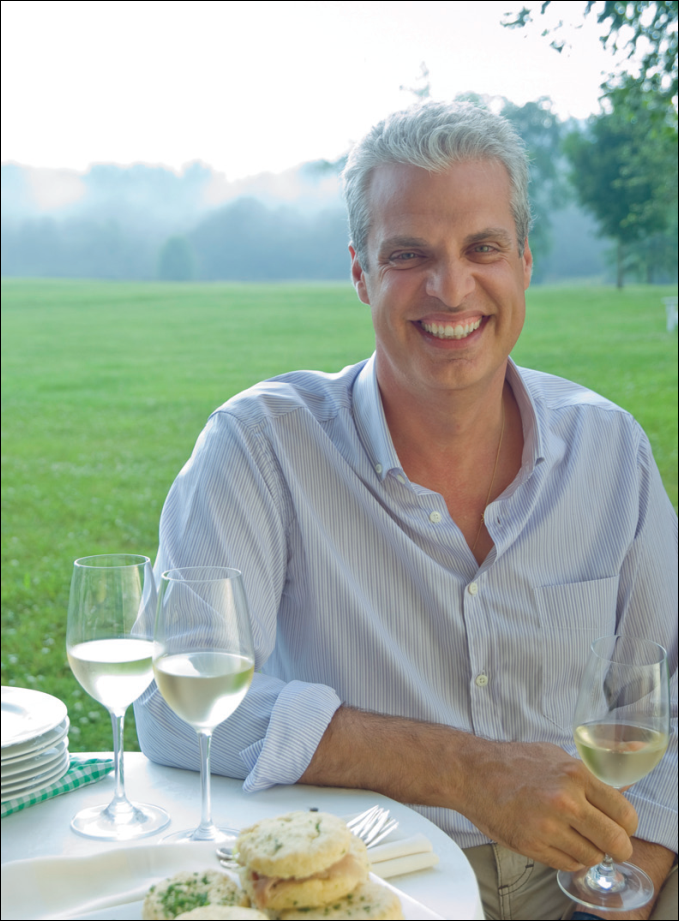
 Eric Ripert - photo credit Angie Mosier Based on his popular eponymous PBS TV program “Avec Eric”, the book follows culinary superstar and top toque, Eric Ripert, as he explores the culture and tradition of select regions of Italy, the Cayman Islands, New York and California. In his quest to celebrate the bounty of the regions to he loves so well, “AVEC ERIC: A Culinary Journey with Eric Ripert, Featuring Over 100 Simple Recipes “(Wiley), mirrors the show’s sense of adventure and Ripert’s deep appreciation for local and seasonal ingredients.
Part travelogue, part cookbook compendium, it contains over 100 new recipes drawn from Ripert’s most recent journeys. It is filled with snapshots from the fields and waters he traversed, and the hunters and watermen he met and cooked with. Handwritten notes and hand-drawn illustrations give the book a uniquely personal feel reflecting his convivial spirit and the inspiration behind his approach to each dish.
His outpost in Washington, DC is West End Bistro by Eric Ripert.
Jordan Wright – I loved your latest book. Reading it I felt as though I had been on a wonderful trip.
Eric Ripert – It is like going on vacation but staying home. It’s a good reflection of what we have done in the last season.
JW – Your Zen approach to food, approaching it by its origin and terroir and visiting its source, heralds the next generation of chefs. How have your recent journeys informed what you do in the kitchen today?
ER – If you consider cooking an art, inspiration has to come from somewhere, from your surroundings as a chef. I am inspired by the products, the seasons and the people I interact with. It’s kind of a strange process but I digest the information and then, when I create, it comes out in a dish. It always works for me and it’s the same for a lot of chefs. I teach my cooks how to be aware and how to be inspired by where they are.
JW – Your previous book, “On The Line”, was an energetic minute-by-minute account of the running of Le Bernardin and its kitchens…a detailed primer for any high-end restaurant, owner or server. With your newest book, you take the reader with you on your culinary journey to share in your travels. What would you like to say about your latest book?
ER – Well, I loved it! I wanted to do a documentary on the life of our restaurant but in book form instead of filming with a camera. I wanted to pay homage to my team at Le Bernardin. The idea was to be inspirational to young people in our industry and to demonstrate what goes on behind-the-scenes.
JW – I understand you began your career at La Tour d’Argent in Paris. Was that under owner Claude Terrail? I knew his nephew, Patrick, in New York when he ran L’Etoile and in Beverly Hills when he owned Ma Maison.
ER – Yes, and Patrick is back in Paris now managing La Tour D’Argent.
JW – What unique products did you discover while writing this book that you now use?
ER – We discovered a lot of products during our experience – especially conch and black fin tuna in the Cayman Islands. [Ripert’s restaurant, Blue, is located on Grand Cayman Island in the Ritz-Carlton Hotel].
JW – Your remarks as a guest judge on “Bravo’s Top Chef” have been informative and useful to the contestants. What sage advice do you have for up and coming chefs? And would you hire any of the cooks from the show?
ER – Sure, if they are looking for a job and we have some openings! My advice is if you are coming into our industry you need to make sure you have the passion for cooking, and not for becoming famous. You have to work hard, be humble and be open-minded.
JW – I saw you in May at the Warner Theatre in Washington, DC with your cohort, Anthony Bourdain, who wrote the forward to this book. It was a fabulous evening – totally sold out. The audience couldn’t get enough of the live Q and A. I learned that night that you have been waiting to get drunk with The Rolling Stones! Has that happened yet?
ER – Not yet. One can only hope.
JW – What international cuisine would you next like to experience in your travels?
ER – I love Japanese cuisine and would love to spend more time in Japan, Thailand and Vietnam.
JW – In what direction do you think in-home cooking is going?
ER – I think it has been lost a little bit in the past decade, but is coming back strongly because of the recession. People are more inclined to cook at home now because of the influence of cooking shows and celebrity chefs. Today we see more and more people looking for sustainable ingredients, good quality ingredients, and being more concerned about their source.
JW – What can we expect in Season 2 of Avec Eric?
ER – You’ll see more inspiration, more cooking and more fun. We shot in the Caribbean, in Virginia and Upstate New York and Italy too. In Virginia we went to Urbanna to see the soft-shell crabs and visited Wallace Edwards and Sons in Surry for the hams. Later we shot an episode with Patrick O’Connell at The Inn at Little Washington.
JW – What would you prepare to seduce a beautiful woman?
ER – First of all I would try to find out if she has allergies! Then I would prepare something savory, flavorful, light and refined, of course.
JW – What historical person would you most like to dine with? And why?
ER – The Dalai Lama.
JW – Didn’t you just cook for him on his recent visit to New York?
ER – Yes, but I didn’t eat with him!
JW – What did you serve?
ER – I gave him wild salmon served in a light broth infused with a lot of herbs and spices and with summer vegetables. And he ate it all!
JW – You had a bit of a mishap during one of your visits in Italy. What are your new and improved plans the next time you run into a wild boar?
ER – To have a gun with me! Though, no, no, no, maybe not, I’m not a hunter. But I’d like to be close to a big tree that I could climb up in.
This interview was conducted, edited and condensed by Jordan Wright.
Recipe for Spice-Crusted Duck Breast by Eric Ripert for “Avec Eric”
SPICE-CRUSTED DUCK BREAST WITH ORANGE-HONEY GLAZE AND CUMIN-SCENTED CARROTS
 Spice-Crusted Duck Breast with Orange-Honey Glaze and Cumin-Scented Carrots My visit to a bee sanctuary in Sonoma, California inspired me to start cooking more with honey. It is a versatile ingredient that adds a nice, fl oral sweetness.
SERVES 4
CUMIN-SCENTED CARROTS
1 ½ pounds baby carrots, peeled
2 tablespoons unsalted butter
1 teaspoon honey
1/3 cup water, approx.
1 teaspoon ground cumin
pinch of cayenne pepper
fine sea salt and freshly ground black pepper
½ lemon
SPICED DUCK BREAST
1 teaspoon ground coriander
½ teaspoon ground cumin
½ teaspoon ground star anise
½ teaspoon ground white pepper
pinch of cayenne pepper
4 (6- to 8-ounce) boneless duck breast halves, trimmed
fine sea salt
1 tablespoon canola oil
2 shallots, thinly sliced
½ cup fresh orange juice
¼ cup fresh lemon juice
1 tablespoon honey
2 tablespoons unsalted butter
Place the carrots in a large skillet with the butter, honey, and about cup of water. Heat over medium-high heat and season the carrots with cumin, cayenne, salt and pepper. Cook, stirring occasionally, until the carrots are lightly caramelized and tender, about 20 minutes. Finish the carrots with freshly squeezed lemon juice.
Stir together the coriander, cumin, star anise, white pepper and cayenne pepper in a small bowl to blend. Season the duck breasts on both sides with salt, then coat the skin side of the duck breasts with the spice mixture, forming a crust.
Divide the canola oil between 2 sauté pans and heat over medium heat. When the pans are hot, gently place 2 duck breasts, skin sides down, in each pan. Lower the heat to medium-low and cook until the skin is golden brown and crispy, 12 to 15 minutes. Turn the duck breasts over and continue cooking for 3 to 4 minutes for medium-rare. Transfer the duck breasts to a cutting board to rest. Return the pans to the stove.
Divide the shallots between the pans and cook over medium heat until soft, about 5 minutes. Add the orange juice, lemon juice and honey, dividing equally. Simmer to reduce by half, about 8 minutes. Finish the pan sauce by whisking in the butter and seasoning to taste with salt. Combine the sauce into one pan.
Thinly slice the duck breasts crosswise and place the duck slices on 4 plates. Spoon some of the sauce over the duck and serve with the roasted carrots.
Special to Washington Examiner
Jordan Wright
October 2010
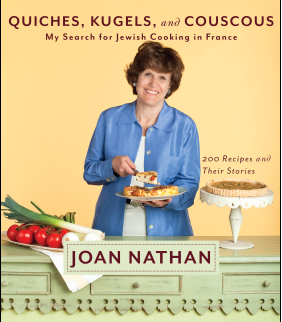 Book cover (Joan Nathan) It was what I call a pajama day. A damp, grey, stay-at-home kind of day. Leaves the color of wet tobacco clung to car windows like parking decals and the fruits of the hackberry and hawthorn trees stained the sidewalks with their juice. The chill of autumn came early, bringing with it a light drizzle after a long night of steady rain. But this was not a day for burrowing beneath the duvet. A visit to the Washington, DC home of Joan Nathan, the great lady of Jewish cookery, was on the calendar and nary a dark cloud would put the squeeze on a much-anticipated luncheon date with the acclaimed author. I was looking forward to discussing her soon to be released eleventh book, “Quiches, Kugels and Couscous – My Search for Jewish Cooking in France” (Knopf).
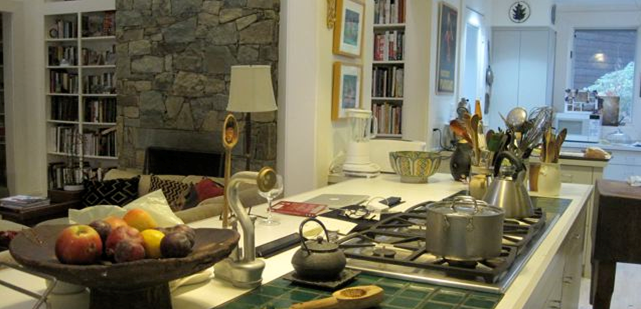
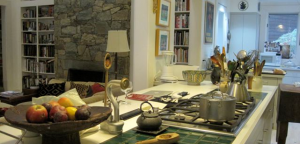 The kitchen at the Washington DC home of Joan Nathan - photo by Jordan Wright I entered her well-appointed kitchen, chock-a-block with family mementoes, children’s drawings, books and artifacts, and immediately was smitten with the aroma of her anise-scented oatmeal bread wafting across the room. I ask you, no, I dare you to tell me that there is anything more welcoming than the scent of freshly baked bread.
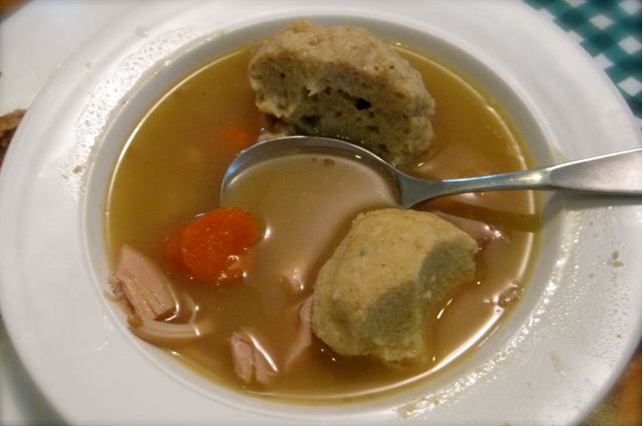
At a long wooden table before my gourmand-weary eyes rested a bowl of Nathan’s homemade chicken soup with two golden orbs afloat. Redolent of carrots, ginger and nutmeg and bathing in a clear broth with chunks of light and dark chicken meat, the matzo balls glistened irresistibly in the wide white bowl. Curiously each one seemed formed by a different hand, the result I assumed of two separate test kitchen efforts.
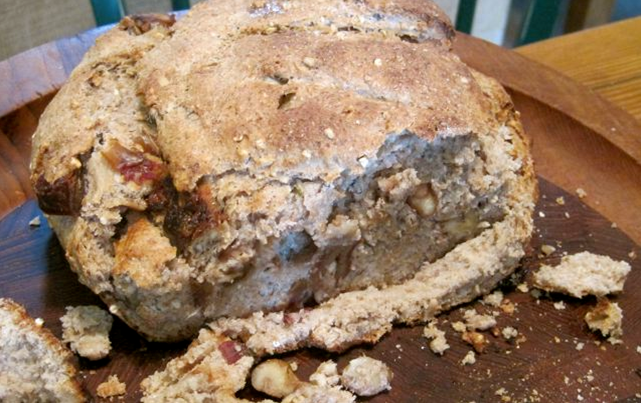
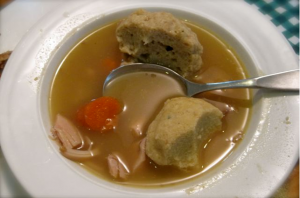 Chicken soup with two types of matzo balls - photo by Jordan Wright One wore the sylvan appearance of a white truffle, all nubbly and crevassed, while the other was smooth and evenly formed – the color of an Asian pear. The matzo balls were the handiwork of the renowned regionalist food writer and they were simple and glorious at the same time. To accompany the soup, a large round loaf of oatmeal bread studded with dates and walnuts was pulled from the oven. “Thump it for doneness.” Nathan cautioned her assistant, and the hollow sound reached into the adjoining dining room. The hot crusty loaf was served with Nathan’s favorite Plugra butter and a green salad with slices of red beets from her local farmers market.
Joan Nathan has been the sole voice of Jewish cooking in America since 1975 when her first book, The Flavor of Jerusalem, was published while she was living and working in Israel for Mayor Teddy Kollek. After she moved to New York City she was one of the founders of the ethnically diverse Ninth Avenue International Food Festival when she worked first under Mayor John Lindsay and later Mayor Abe Beame. Here in Washington her decades-long commitment to local food kitchens like Martha’s Table and DC Kitchen, where she is known for her fundraising “Sunday Night Suppers”, a collaborative dining series with Alice Waters, Tom Colicchio and José Andrés, has endeared her to those in the slow food community.
Many know Nathan from her nationally syndicated PBS show, Jewish Cooking in America with Joan Nathan and as a regular contributor to The New York Times Food Arts Magazine. A two-time James Beard award winner, she is scholar, memoirist and cook in this latest venture.
“France is the link from Israel to America, as far as Jewish food, because Ancient Israel is where all of our foods started before going to Europe and then coming to America. Jewish cooking in France is closer to the original cuisine,” she explained.
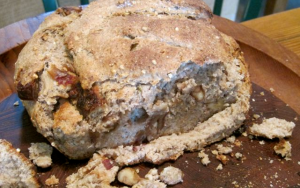 Anise-scented oatmeal bread with dates and walnuts - photo by Jordan Wright She prepares the reader by providing centuries-old historical context for the creation, preservation and tradition of Jewish cookery in France. To understand how certain foods and methods of preparation evolved throughout France, Nathan shows it is necessary to know how the Jewish culture both influenced and was influenced by French cuisine. Not only did they trade in beans, sugar, barley, garlic and other precious foodstuffs, but they brought exotic spices, the art of making fois gras, carp served with sauce verte, and even introduced hot chocolate to the French culinary experience.
Thankfully the book offers far more than the catchy three-dish alliterative title suggests to the reader. Among the more than 200 recipes that have their origin in Spain, Morocco, Portugal, Germany and the Mediterranean, you’ll find such gems as Paul Bocuse’s Black Truffle Soup Elysée, tweaked by Nathan’s kosher re-interpretation; Baba au Rhum from the tiny 16-seat restaurant, Les Arômes outside of Marseilles; and a recipe for a hearty Alsatian Choucroute from a doctor in Strasbourg.
Nathan’s approach to the recipes is very forgiving, allowing the cook to substitute ingredients. “It depends on what’s in the fridge,” she offers. “I think the important thing about cooking is that it should be quick but not processed.” In her mission to find and preserve recipes throughout France, she fills the book with firsthand stories from farmers, shopkeepers, home cooks, professional cooks and Holocaust survivors. This is the sort of treasured cookbook writing that will inspire cooks to experience Jewish food and its culture. The book itself took nearly 4 ½ years of travel, research and recipe testing to deliver to her distinguished culinary and literary editor, Judith Jones, who was also editor to the late Julia Childs.
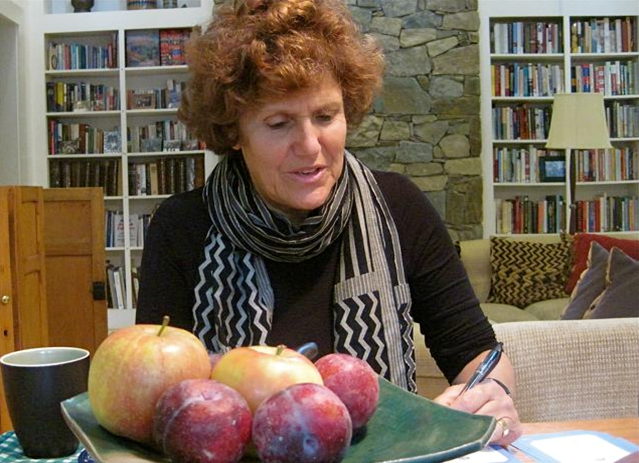
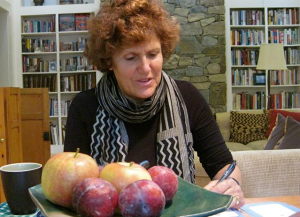 Lunch at Joan Nathan's among the bookplates - photo by Jordan Wright As Nathan hand signed 400 bookplates for an upcoming book tour, we ate and spoke of food, family, religion and politics and the cities in which we have lived, traveled, worked and cooked. And as the day went on we nibbled on a large wedge of Comté accompanied by apples, plums and organic maple honey caramels from Sugar Revolution.
Here is her tasty recipe for Moroccan chicken from this marvelous new book.
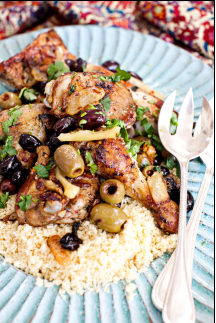 Moroccan Chicken with Olives and Preserved Lemons - photo credit Katie Stoops from the cookbook Moroccan Chicken with
Olives and Preserved Lemons
When Celine Bénitah cooks this dish, she blanches the olives for a minute to get rid of the bitterness, a step that I never bother with. If you keep the pits in, just warn your guests in order to avoid any broken teeth! Céline also uses the marvelous Moroccan spice mixture ras el hanout, which includes, among thirty other spices, cinnamon, cumin, cardamom, cloves, and paprika. You can find it at Middle Eastern markets or through the Internet, or you can use equal amounts of the above spices or others that
you like. To make my life easier, I assemble the spice rub the day before and marinate the chicken overnight. The next day, before my guests arrive, I fry the chicken and simmer it.
4 large cloves garlic, mashed
Salt and freshly ground pepper to taste
1 teaspoon ground turmeric
1 to 2 tablespoons ras el hanout
1 bunch of fresh cilantro, chopped
4 tablespoons olive oil
One 3½- to- 4- pound chicken, cut into 8 pieces
1 teaspoon cornstarch
1 cup black Moroccan dry-cured olives, pitted
Diced rind of 2 preserved lemons
Mix the mashed garlic with salt and freshly ground pepper to taste, the turmeric, the ras el hanout, half the cilantro, and 2 tablespoons of the olive oil. Rub the surface of the chicken pieces with this spice mixture, put them in a dish, and marinate in the refrigerator, covered, overnight. The next day, heat the remaining 2 tablespoons olive oil in a large pan. Sauté the spice- rubbed chicken until golden brown on each side. Stir the cornstarch into 1 cup water, and pour over the chicken. Bring to a boil, and simmer, covered, for about 20 minutes. Add the olives, and continue cooking for another 20 minutes. Sprinkle on the preserved lemon, and continue cooking for another 5 minutes. Garnish with the remaining cilantro. Serve with rice or couscous.
Yield: 4-6 Servings.
Preserved Lemons (Citrons Confits)
Preserved lemons are an indispensable item in my pantry cupboard. I use them all the time and believe they are best made at home. Although I have tasted lemons preserved in water or an equal mix of lemon juice and water, I much prefer them preserved in pure lemon juice. Many people scrape out and discard the pulp when using the lemons, but I often include the preserved pulp. I blend a preserved lemon in with my hummus, sprinkle the rind on grilled fish, and stuff my chicken with a whole lemon, and
I dice preserved lemons and mix them into salads, rice dishes, and vegetables. In addition to regular lemons, you can also use Meyer lemons or, as Irene Weil does, even kumquats.
8 lemons (about 1½ pounds)
About ½ cup kosher salt
,1 cup fresh lemon juice, plus more if necessary 2 tablespoons olive oil
.
Cut off the very ends of each lemon. Cut each one lengthwise into quarters, cutting to but not through the opposite end. Sprinkle
2 tablespoons of salt into the cut sides of each lemon. Put the lemons in a large jar (it’s fine if you have to squeeze them
in, because they will shrink), and cover completely with lemon juice. Let sit for a day. The next day, if they are not covered with lemon juice, pour a thin film of olive oil over the lemons. This will help keep them sealed while they preserve. Put the jar in the refrigerator and allow to cure for 2 to 3 weeks. Before using, scrape off the pulp if desired.
Yield: 8 Preserved Lemons
Jordan Wright to Washington Examiner
September 2010
 Laurent Tourondel’s latest book touts the merits of local farmers markets. (Photo Courtesy of Wiley) Back when dinosaurs roamed the earth, as I like to tell it, we all ate what was in season. It was a time when few people had refrigeration in rural areas in the United States and in many countries around the world they still do not. The home kitchen had its icebox back then, a hulking wooden closet with heavy steel latches, not much more than a cooler really, that kept milk, eggs and butter chilled but wasn’t good for much else. All other foodstuffs were purchased daily at the local market or delivered. Each Monday the iceman would pull into the driveway, snatch a block of ice off his truck with huge iron tongs, and heave it into the icebox through an outside door on the kitchen porch. We still had one back in the 50’s before it was converted into a refrigerator.
It was typical to wait ten months before tucking into a garden-fresh tomato or a handful of cherries. There were no hydroponically grown super-veggies back then and the advent of summer meant more than an end of school days and a dip in the ocean. Winters were devoted to pining for sweet corn and fresh greens and dreaming of ways to prepare them. I know this sounds austere, but such was the way of life.
Before the dawning of the Kelvinator, we could only count on frozen fish or meat and Bird’s Eye peas to tide us over. We spent fall and winter dreaming of what most of us now take for granted in the supermarkets of today. With the advent of refrigerated shipping, transcontinental flights and mega-farms we now live in a world where we can feast on everything from corn and watermelon in winter and spring lamb all year round. While snowflakes fall we cut up fresh papaya and strawberries for breakfast and cook up Chilean sea bass for dinner. Is there anything left for us to dream about?
Now we can turn to Laurent Tourondel for seasonal direction in the kitchen. Known for the popular BLT Restaurants (Bistro Laurent Tourondel), he was named Bon Appetit’s “Restauranteur of the Year” in 2007. He has worked at Relais and Chateaux’s three Michelin-starred La Maison Troisgros in France and at Cello in New York City. This summer he opened the casual outpost, LT Burger, in tony Sag Harbor, NY and still serves as Executive Chef at Brasserie Ruhlmann in New York City. His first two very successful cookbooks were Bistro Laurent Tourondel and Go Fish.
In his third and latest book, penned with Charlotte March, Fresh From The Market – Seasonal Cooking from Laurent Tourondel, (Wiley), Tourondel accords the seasons their respective bounty and exhorts his readers to do the same. He adheres elegantly to the philosophy held by many of our best chefs to let a few choice ingredients drive the attitude of the dish. As a result his book is a primer on cooking in the simple French way of allowing an entire platter of in-season green beans with walnuts, a green salad and baguette with cheese to be a meal. And while dessert may be optional, wine is most assuredly not.
When I first read this book my impulse was to toss out a good chunk of my library, so taken have I been by its merits. But before you think that it is only about what you can grow in your kitchen garden or purchase from your local farmers market, you will need to be more expansive in your thinking. For above all Tourondel is a fine French chef, accustomed to working with truffles, partridge and foie gras. So dream accordingly, if you will.
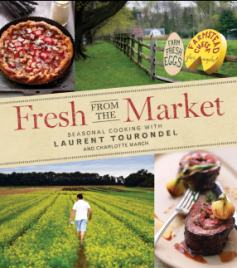 Photo of book cover - All photo credits to Quentin Bacon In a recent conversation with Tourondel he spoke of his new book, a hopeful meeting with Escoffier and the future of the American table.
Jordan Wright – I found your latest cookbook to be beautifully presented and replete with exquisitely tweaked French classics. What was your inspiration?
Laurent Tourondel – Really I like the seasonal product more than anything else. I was trying to create something fun for people to read and cook from.
JW – I understand you like to follow the evolving trends in food. What do you see for dining in the near future? And what ingredients will be driving your dishes?
LT – I think better and fresher products from the market. I think the evolution is about more organic product and to eat in a simpler way, with less preparation…to make dishes with a clean finish. People are asking for healthy food. Not necessarily vegan or vegetarian but healthier.
JW – What are your greatest day-to-day challenges?
LT – To cook for my girlfriend! But seriously, to teach people about what I do. That is the challenge of today.
JW – When you’re at home what do you crave the most?
LT – Cheese…a lot! And peanuts.
JW – If you were trying to impress a beautiful woman what would you prepare?
LT – Something light I think…perhaps my steamed lobster with a ginger lime broth.
JW – What famous or historical personage would you like to dine with?
LT – Henry IV, because he was crazy and he had great parties!
JW – If Escoffier came into your kitchen today what would you like to ask him?
LT – A million questions. I’d want to know what he thought of some of the newer ingredients he would be unfamiliar with and how he would choose to use them. And also I’d like to cook for the guy of course.
JW – What advice would you give to a new restaurant owner?
LT – Try to give people what they want, don’t just do the restaurant for yourself.
JW – What advice would you give to recent culinary graduates?
LT – Give yourself a destination of where you want your culinary career to go. Don’t go everywhere.
JW – Can you tell me about your new cookbook?
LT – I’m very excited about doing a seasonal cookbook. It was a long process because we had to do it season by season to obtain the right ingredients. I think it came out great!
Recipe from Fresh From The Market by Laurent Tourondel
Steamed Lobster in Gingered Lime and Scallion Broth with Baby Bok Choy
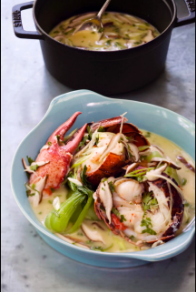 Steamed Lobster in Gingered Lime-Scallion Broth with Baby Bok Choy from Fresh From The Market - photo credit Quentin Bacon The combination of ginger and lime results in a truly enchanting flavor, which is well suited for both savory and sweet dishes alike. This very light broth pairs quite well with other shellfish, such as shrimp and mussels, or firmer white fish.
SERVES 6
6 live lobsters, 2 pounds each
1/2 cup Chablis or another dry white wine
3 cups Vegetable Stock (page 304)
6 shiitake mushrooms, stemmed and thinly sliced
2 tablespoons matchstick-size strips peeled fresh ginger
11/2 tablespoons ginger juice (see page 96)
6 baby bok choy
4 tablespoons cold unsalted butter, diced
4 scallions, thinly sliced on the bias
2 tablespoons chopped fresh cilantro
2 tablespoons freshly squeezed lime juice
Zest of 2 limes
Pinch of cayenne pepper
Prepare the broth
Holding the lobster body in 1 hand and the tail in the other hand, twist the lobster until the body
and tail separate.
Repeat with the remaining 5 lobsters. Using the back of a chef’s knife, crack the claws off the
lobster bodies just below the knuckles. Reserve the bodies for making lobster stock or freeze
them for another use.
Bring a large saucepan of water to a boil over high heat. Add the lobster claws and cook
until the shells become bright red and the claw meat is just barely cooked through, about 8
minutes. Transfer the claws to a bowl of ice water.
Once cool, remove the claw meat from the shells.
Using a chef’s knife, cut the lobster tails in half lengthwise and discard any intestines that
may be clinging to the tail.
Leave the meat in the shells. Bring the Chablis to boil in a large saucepan. Add the lobster tails,
flesh side down, and the vegetable stock. Cover and cook until the lobster meat is just barely
cooked through, about 3 minutes.
Remove the tails from the broth.
Using a fine-mesh strainer, strain the broth into a clean medium saucepan over medium heat.
Add the shitake mushrooms, ginger, and ginger juice to the broth and simmer until the ginger
is soft, about 3 minutes. Strain the broth again through a fine-mesh strainer and into a large
saucepan, reserving the mushrooms and ginger.
Finish the broth
Bring a medium pot of salted water to a boil over high heat. Add the bok choy and cook until
crisp-tender, about 3 minutes.
Immediately transfer the bok choy to a bowl of ice water and allow to cool.
Using an immersion blender, blend the cold butter into the strained broth until emulsified.
Return the reserved mushrooms and ginger, lobster claw meat, and blanched bok choy to the
broth along with the scallions, cilantro, lime juice, lime zest, and cayenne and continue to cook
over low heat for 2 minutes.
To serve
Divide the lobster tails among 6 large shallow bowls. Arrange the claw meat and 1 bok choy
over each lobster tail. Spoon the sauce and vegetables over the lobster tails and claws and serve.
Wine suggestion
Serve this dish with an exotic white Rhone blend that offers rich flavors of guava, minerals,
and Asian spices, such as Tensley, “Blanc,” 2007, Santa Barbara County, California.
Jordan Wright
May 2010
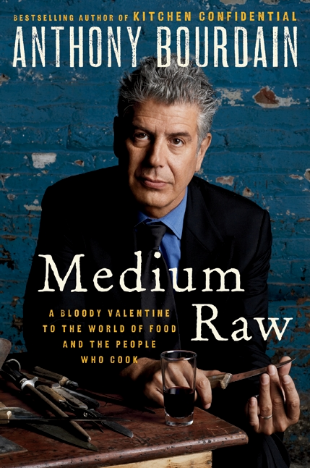 Anthony Bourdain author and host of Travel Channel’s “No Reservations” is the consummate dinner guest. As the host of Travel Channel’s “No Reservations”, Anthony Bourdain is the consummate dinner guest. An endearing enfant terrible, with a peripatetic wanderlust to rival Darwin and a puckish swagger that would make Bluebeard seem as docile as a clam, he slurps and sups the world’s melting pot in dogged pursuit of ethno-gastronomic delicacies. With cheerful I’ll eat-anything-you-put-in-front-of-me sangfroid, he lustily relishes fish brains, ant larvae, pig’s eyeballs, or sparrow liqueur and the like on his adventures to far-flung locales. For his endless curiosity he has garnered a devoted audience, three Emmy nominations and penned eight bestsellers, including the deliciously lurid ”Kitchen Confidential”.
In his latest memoir, “Medium Raw: A Bloody Valentine to the World of Food and the People Who Cook” (HarperCollins), due out next month, he threatens to yank the delicate scrim off noted chefs. Alice Waters, David Chang, and “Top Chef” winners and losers will feel the sting of the provocateur’s barbs.
The gritty and endearing Bourdain, appears at the Warner Theatre on May 21st for one night only with cohort and chef/restaurateur, Eric Ripert of DC’s Westend Bistro and famed NYC’s Le Bernadin for an evening of tale-swapping and secrets of restaurant skullduggery.
In a recent interview he spoke to me about his life, his new book and his upcoming appearance in Washington, DC.
Jordan Wright – You take inordinate pleasure in poking the prevailing food fashionistas, uncovering the raw underbelly of restaurants, and snubbing the establishment. What propels you on to your next adventure?
Anthony Bourdain – I have a restless and curious mind, and as much as I might not like to face it, I’m probably becoming the food establishment at this point. But I do it because I can. It’s my nature. I get angry when I see abuse, and ecstatic when the experience is great.
I enjoy traveling. I like chefs and get paid to do what I like doing. And, thankfully, I’m not expected to behave or be diplomatic. I’m clearly very lucky and very foolish to do what I do and thankfully I can benefit from low expectations. With Eric [Ripert], he and I have a lot in common, but he has the burden of a reputation to protect and I don’t.
JW – Your independent take-no-prisoners style of writing is delightfully anarchic. What makes for a good food writer in your opinion?
AB – Certainly a willingness to step out of one’s comfort zone. If you’re writing about food, it’s very, very important to like and appreciate the people that make your food…also a lack of snobbery, definitely honesty, and to not be willfully disingenuous. If you really enjoy eating food I don’t think you have to know about food. That will come. But you should be passionate about it. Be an honest broker with an open mind and an open heart. I think some of the most dynamic writing on food is obviously coming off the blogosphere.
JW – The chimera is a fabulous fire-breathing monster with the head of a lion, body of a goat, and tail of a serpent. Would you eat it and how would you prepare it?
AB – If I were surprised by it as a guest in someone’s home in a developing country, I would accept it out of politeness, rather than offend my host. Though if I were to prepare it, I’d cook it low and slow with a bottle of good wine.
JW – You’ve eaten your way throughout the four corners of the world what fusion would you create that hasn’t yet been done?
AB – I’m generally not a fan, I think it’s dangerous territory. But two of my favorite restaurants are in New York, Momofuku Ko and Momofuku Saam, which use French, Southern American, Italian and Korean fusion. It’s utterly fantastic, perhaps because it breaks all the rules.
JW – There have been three books written about Louise Brooks. One is her autobiography in which she speaks of my grandfather as her greatest paramour. You said that Louise Brooks would be a preferred dining companion at your last supper? Why did you choose her?
AB – I enjoyed her autobiography “Lulu in Hollywood” and saw two of her films. I think she was a fascinating, and an extraordinarily forward-thinking and independent woman, especially for her times. She struck me as someone with interesting things to say and who would be a powerful presence at the dining table.
JW – On to the more mundane… What are your favorite restaurants in DC?
AB – Any restaurant that Jose Andres is associated with. I love Minibar! I love Michel Richard and Bob Kinkead’s place! Oh my God! Who am I leaving out? Oh, and El Pollo Rico! And Eamonn’s too in Alexandria!
JW – What do you cook at home?
AB – Cooking pasta makes me happy. Maybe a steak, but I like to use one pan and keep it simple. I have so little time to spend with my family. In NYC I just pick up the phone and I can order Japanese, Thai, Chinese, and French…or a human head delivered!
JW – What foods would you like to see more of in the US?
AB – I like bottarga very much and jamon Iberico. And I know it’s a dream, but more unpasteurized raw milk cheeses, especially really stinky ones from France and Italy…and artisanal sausages from Sardinia.
I’m a sushi slut, so, I’d say more high quality sushi…though maybe not, because of the over-fishing. As an institution I would like to see Singapore-style hawkers’ centers. That would be a great development for our country.
JW – What importance do you accord to ambiance, food, and service to define a successful restaurant?
AB – These days I like ambiance and service as unobtrusive and informal as possible. What I really appreciate at Momofuku Ko is you’re getting two-star Michelin food over a counter, directly from a cook who’s wearing a dishwasher’s shirt. That’s awesome!
I don’t need flowers and china and expensive silverware, unless you’re talking about French Laundry or Per Se. I am breathless with admiration for those two. But more often then not it’s about the food. If I’m comfortable without a tie, I’m more likely to be enjoying my food. I’d just as soon be in cut-offs and bare feet.
JW – You’ve experienced foods from cultures that no outsider will ever taste. Please choose from the following answers. If an ivory-billed woodpecker was struck by a car and lay by the roadside, as I was on my afternoon stroll, I would:
A) Try to revive it
B) Call the local bird rehabilitator
C) Fire up the grill
D) Go for the eyeballs first
AB – Call the bird rehabilitator.
JW – Oh my, you are a romantic!
AB – I like cute animals.
JW – What can you tell me about your new book?
AB – I am living in a state somewhere between suspended animation and mortal terror. It comes out June 8th and I have no idea how it will be received. I’m pretty sure there are going to be people pretty angry with me, but it’s too late to stop it now. Talk to me in two months! Right now I’m really looking forward to coming to DC to do this rare gig with Eric.
For tickets to “No Reservations: An Evening with Anthony Bourdain and Eric Ripert” visit www.WarnerTheatre.com
This interview was conducted, condensed and edited by Jordan Wright. For questions or comments contact Jordan@WhiskandQuill.com.
Jordan Wright
Whisk and Quill
January 2010
 Director and Screenwriter Michael Hoffman - photo by Jordan Wright Michael Hoffman’s remarkable twice Oscar-nominated film, “The Last Station” is a sweeping love story-within-a-love story of the life of legendary Russian writer Leo Tolstoy. Coming off his recent documentary, “Out of the Blue – A Film about Life and Football” it is a sea change from this historical work, which Hoffman directed and also wrote the screenplay from Jay Parini’s novel.
With her first Oscar under her belt in 2008 for “The Queen”, Dame Helen Mirren, has again been recognized by the Academy for her role as Tolstoy’s tormented wife and muse, Sofya. This could well be her greatest screen performance ever.
Christopher Plummer, nailing his first ever Oscar nod after a career spanning over 100 films, morphs into the brilliant and conflicted Tolstoy as no other actor could.
I recently met with the very articulate and profound Hoffman, a former Rhodes scholar, in Washington, DC to pose some questions about his research and understanding of Tolstoy’s life, and his experience directing two of film’s most accomplished actors. As for all the acclaim, he has been taken aback, “I honestly thought this film was not going to be distributed in America.”
Jordan Wright – Did you have a target audience when you made “The Last Station”?
Michael Hoffman – The reason that I wanted to avoid making a biopic about Tolstoy is that I thought the target audience was just wrong.
When I first read the novel I couldn’t figure it out. But fourteen years later, and after I had been married for awhile, I saw the difficulty of living with love and the impossibility of living without it. I saw a tragicomedy I could make about marriage, with all the hopes and dreams and all the pain and frustration and atrocities in a relationship, and it fascinated me…and I believed strongly that it would appeal to a lot of people.
JW – The details in the film were remarkable. In the picnic scene I noted one of the guests stirring a spoonful of jam into her tea. Such a Russian idiosyncrasy! How important were these details to you?
MH – We had some great Russian advisers, one of whom was a great-great-grandson of Tolstoy. He told us an interesting story about how the servants would place a boot on top of a samovar and pump air into it to breathe life back into the fire and reheat the tea.
JW – Tolstoy, it seems, had a public face and a private face. Not so very different from some of today’s more notable figures. When you discovered he had three separate diaries, including the super-secret one he kept hidden in his boot, did you have a chance to read them? Also how did his public persona compare to his private one?
MH – Tolstoy was the first real media celebrity. When I went to the Tolstoy family estate and archives they handed me an hour’s worth of footage that was shot on the estate during the last two years of Tolstoy’s life. There were sometimes four film crews shooting them at once. It was like paparazzi gone wild. Everything they did was observed. I think it was one of things he tried to run away from in the end.
JW – Before they were married Tolstoy asked his wife to read her diary. It is known that this mutual reading of their diaries brought about jealousies that perhaps set up the difficult dynamics in their future relationship. How did you portray this in your film?
MH – What’s so great about this is there is so much primary source material because every one of these characters kept a diary of events. It’s all well documented so you can read about the same incidents from six different points of view.
JW – Tolstoy preached sexual abstinence yet he didn’t live up to his own philosophies. Did you find other instances of dichotomy in Tolstoy’s life?
MH – When he was preaching sexual abstinence he wasn’t being profligate. The truth is Chertkov [played by Paul Giamatti]was more impressed with abstinence than Tolstoy, who used it as a sort of spiritual distraction, and then Chertkov would take these principles that Tolstoy talked about and create a dogma box to try to keep Tolstoy inside.
Chertkov and Sofya were engaged in a war for Tolstoy’s affection that was an absolute zero sum game. They both defined their worth in terms of whether or not he was paying attention to them. They weren’t interested in property or ideas they were interested in being loved by this man. And that’s what the movie is about. It all reduces down to ‘love’.
It was as if Tolstoy was a beacon or a mirror standing at the center of a circle, and all these people lived off of whatever was reflected back from him. It’s really a fantastic story.
In the beginning of their relationship Tolstoy gave Sofya a catalogue of all his sexual relationships because he thought, “She really needs to know me.” She in turn gave him hers. Their jealousies of each other stemmed from that exchange.
I discovered he had had an affair with a peasant woman who lived on the estate and had his son, who was semi-retarded, and who later became their coachman. Tolstoy started up that affair again and that’s why Sofya saw him as a hypocrite. She saw the gaps between the press and the man.
JW – How do you get the most from your actors?
MH – Casting people that are not only great actors but are great storytellers and have a deep connection to the story. Actors with a strong theatrical background who understand issues of style and tone in acting, which takes a lot of experience moving between genres…also actors that had done Chekov. That was a great point of reference with these sophisticated actors…to be able to refer to Chekov’s plays. They knew exactly how to pitch it, and they recognized it in each other and modulated their performance, so that they were all living in the same world. You can’t do that with every actor. It was a very risky thing to do stylistically.
JW – What was it like working with both Helen Mirren and Christopher Plummer?
MH – It’s interesting. These actors are such good storytellers. The ideal of the method is all about emotional truth…about becoming the character. Not necessarily about what goes wrong. It’s not just, “What is my narrative function? What is my responsibility to the story as an actor?” These actors are all hyper-aware of why the scene is in the story…the kind of narrative building block that relates to the whole picture…and, “When do I step forward and when do I step back?” Those are the central issues of directing.
Every argument that I had with Helen was when I wanted to change something in the script. And she would say, “No, no, no. You had it right the first time.”
Because I’ve talked to directors who aren’t crazy about actors and they are basically afraid, because they’ve got this vision in their heads about what it should be. I think it’s largely because the director has been living with the film for a long time and imagining it very specifically, and then you have this actor with a point of view that doesn’t match up with what you have in your head.
It’s actually the same problem that goes on in this movie when you’re talking about love and ideal love and love in the world. They don’t necessarily match up. But sometimes you have to go with it because they are part of the world.
JW – What were the some of the challenges you faced filming in Russia and Germany?
MH – It wasn’t easy. Russia is a chaotic improvisation and Germany is the most organized place in the world. For example, we wanted to make the house unkempt and messy and we sent out memos saying we need dirt on things, because it’s a farm you know. And the Germans, before you could turnover, would sweep up the dirt. So we had to hurry up and shoot before they could get to it.
There were a lot of lessons in this movie because we really had no money. Monica Jacobs, the costume designer, thought we could take advantage of that and got many of the costumes from the Berlin Ensemble where she had worked, and that had been used for years and years, and we found worn clothes that people had lived in.
JW – Will your next project be an historically set film as well?
MH – What it should be is something that doesn’t take me five years to do. I think that’s probably key.
This interview was conducted, condensed and edited by Jordan Wright. For comments or questions contact Jordan@WhiskandQuill.com
Jordan Wright
March 2010
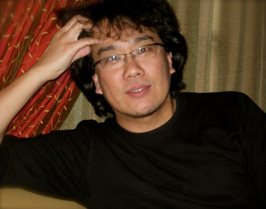 Korean director/screenwriter Bong Joon-ho at the Ritz Carlton in Georgetown - photo by Jordan Wright Korean-born Bong Joon-ho is one of the most seminal and controversial directors and screenwriters to emerge lately onto the international film scene. With two of the highest-grossing films in his country’s history, “The Host” and “Memories of a Murder”, he has enjoyed critical success at major worldwide film festivals, gaining US notoriety with the release of his latest venture, “Mother”, a grisly murder mystery reflecting deep oedipal themes, that was chosen as a Cannes Official Selection along with such notable directors as Ang Lee, Jane Campion, Pedro Almodovar, Werner Herzog and Terry Gilliam. A brilliant craftsman of the suspense genre his work recalls a number of classic filmmakers, yet he shows a remarkable social consciousness rarely addressed by the old masters.
Jordan Wright – I thought I sensed Hitchcock, Tarantino, Japanese director, Kurosawa, and Roman Polanski in your film, “Mother”. Who would you say are your greatest influences?
Bong Joon-ho – I was always inspired by Hitchcock…ever since I was young. I grew up watching so many of his films. He is a big influence of course. As a matter of fact during pre-production of “Mother” I was thinking of “Psycho” and I couldn’t stop wondering if the mother from “Psycho” had still been alive in the film would a little of that twisted mother/son relationship be similar to that relationship in “Mother”.
JW – There were so many different plots, counter-plots and sub-plots presented in your film. Notwithstanding the complexity of action, in the dizzying array of characters, each one was well developed and presented. Would you talk about the broader themes you conveyed in this film?
BJH – The broader theme of my film was how far would a mother actually go to clear her accused son’s name and the second one was the sexual theme in this film. As you know there is a little girl that is missing and throughout the neighborhood there is a whole history surrounding the disappearance of this girl and the sexual scandals revealed. I really wanted to portray that alongside the sexual hysteria of the crime. I thought of how the characters tried to help each other and I wanted to express how they actually end up hurting one another.
Each simple character in this film is powerless. They do not have money or authority. I wanted to portray how these individuals met and mingled and became tangled up through the very tragic force of their meeting. Case in point, the high school girl who sells her body for money to an older man and also the main character, Crazy JP, who has Down’s Syndrome and who is being accused of this crime. The mother knows all the relationships between these individuals and she is in agony trying to make sense of it. I wanted to show how they wind up hurting each other in a very tragic manner.
JW – The opening scene in which the hit-and-run Mercedes driver was discovered at the local country club seemed to touch on the class system still in place in Korea. How did Korea’s “Old Guard” receive your film?
BJH – There wasn’t really any negative feedback [in regards to that]. I think because my previous movie, “The Host”, was more of a parody on the US and I remember that conservatives were not thrilled with that film. But with “Mother” the core story was not controversial.
JW – In American culture we share many of the same social issues you have in Korea. Why was it important to you to highlight societal themes of malaise, lack of education, disenfranchisement, poverty, and the increase of youth violence?
BJH – Even in the past my films would always try to portray these individuals as outside the scope of government assistance. I hoped that by my focusing in on them I could bring attention to the faults or shortcomings of the system and bring awareness to a greater audience. I address this in my previous film, “The Host”. But in “Mother” I feel it is purely about the mother and her relationship with her son.
JW – Talk about your style of directing. Is it hands-on? Do you vary from the script or use the actor’s emotions in a scene to drive the result?
BJH – In my case I always write my own script and then do a storyboard. My storyboard has many details and I already have fixed the set-up position of the cameras and frames. But I always try to do something new and different on set and when I shoot I always hope to give the actors some kind of freedom.
I love the improvisation of the actors and also in regards to lighting and production design. I try to allow as much freedom and vitality for the actors to bring their characters to life. In my opinion the relationship between the actor and director is much more intimate and personal than that between cinematographer and actor, and you can never predict what is going to happen. I like to get to know the actors personally to discover what they’re really like.
JW – In future how do you see bringing your films to the US?
BJH – I enjoy the stable relationship that I have with Magnolia Pictures even though my films are not yet in wide release. Actually they [Magnolia] have recently purchased the copyrights of my very first film.
In my opinion there is currently a limit of how far foreign films can be widely received and appreciated. Hopefully in due time there will be a greater audience for subtitled foreign films and I really want to be a part, even if it is small, of how viewers in the US receive foreign films.
This interview was conducted, edited and condensed by Jordan Wright. For comments or questions contact Jordan@WhiskandQuill.com.
|