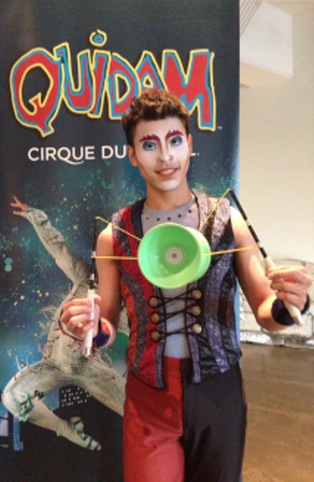
Quidam diabolo performer William Wei-Liang Lin – photo credit Jordan Wright
The critically acclaimed Cirque du Soleilis bringing Quidam to our area next month. The captivating extravaganza which has toured five continents and been seen by millions over its 17-year history, will be at the Patriot Center at George Mason University.
Last week at Georgetown’s newest restaurant and event venue Malmaison, I had a chance to chat with Jessica LeBoeuf and Cirque’s newest performer, William Wei-Liang Lin, the company’s 24 year-old diabolo act who hails from Taiwan.
LeBoeuf, Quidam’s publicist, described the complex logistics of moving the production from city to city via fifteen trucks loaded with the set, costumes and equipment to stage a show consisting of fifty-two world-class performers including singers, acrobats, musicians and characters from twenty different countries and staging it in an arena. “The show has been redesigned for an arena from the usual Big Top. But it’s the same show, just under a different roof. It’s theatre-style seating, which gives us five hundred to a thousand more seats, still with the sound of a live concert. We take about a third of the stage area, think of a hockey rink, for the backstage where there’s a gym, all the props, costumes and a place for the performers to warm up, plus the band pit and the garage. The stage comes out nearly to the front rows,” she explained.
“There are a lot of aerial acts in the show, though we don’t use a safety net or safety line. We use the téléférique, the French word for cable car. It’s an arch that comes halfway across the arena and stops above the audience and then there’s a cable car system on each of the five rails where we fly the performers in and out on their apparatus. It’s all sheer human power.”
For William Lin the journey to Cirque stardom has been as circuitous as it has been auspicious. As a schoolboy his aim was to study tae kwon do, but when the hoped-for class was filled he wound up studying ‘diabolo’, a technique evolved from the Chinese yo-yo that incorporates string and one or more axles that are spun and tossed.
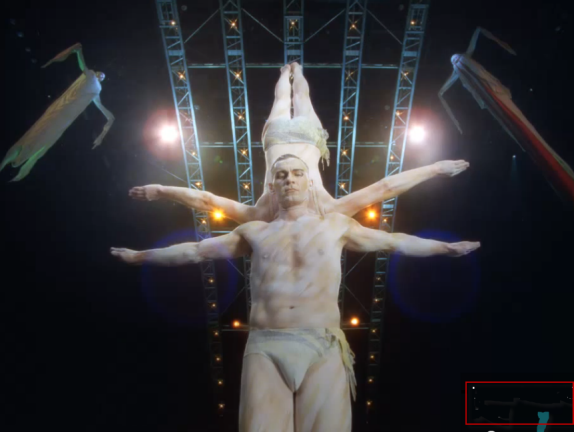
Quidam by Cirque du Soliel
Eventually Lin developed tremendous expertise, winning first prize over all the acts at the Festival Mondial du Cirque de Demain in France, an international competition akin to the Oscars for the Circus Arts. Soon after he was discovered in England by Cirque’s scouts. Although he curtailed his university studies, he still needed to complete mandatory military service. Even so he had to wait a year until a spot opened up in the company this January. “Cirque du Soleil is my dream,” he beams. “My work is my diabolo. I love learning new tricks. Many of my ideas come from videos and movies. For me the possibilities are limitless.” Lin has become wildly popular back home in Taiwan where he is flooded with request for TV interviews.
In a story of a young girl bored by the world and her apathetic parents, young Zoé seeks to fill the void of her existence with the imaginary world of Quidam, which offers characters that encourage her to free her soul. The show is notable for its poetic transitions and beautiful acrobatics that create an exhilarating sensory experience.
As LeBoeuf puts it, “The performers need to keep their bodies in good shape for eight shows a week while performing at the same level. They do Pilates, stretching, yoga, dance classes, conditioning and cross training. To keep them interested and involved local dance teachers are often invited in to do demonstrations. In Detroit we had a famous dancer come in that did hip hop. It was very cool for the foreign performers to learn hip hop. The contortionists said, “I don’t understand how you move!” It was pretty funny coming from them.”
Quidam will hold seven performances from July 17th through July 21st at the Patriot Center at George Mason University 4400 University Drive, Fairfax, VA 22030. For tickets and information visit www.CirqueduSoleil.com or call 703 993-3000.
May 1, 2013 Jordan Wright
Special to The Credits – MPAA
Iceman Director Ariel Vromen
How does an ‘extreme’ special unit Israeli Air Force soldier, law student and world-traveling DJ become a successful director working with some of the country’s biggest stars? Here’s the circuitous route Ariel Vromen took on his path from performing military maneuvers in Israel and reading dense law texts in England to getting behind the camera. Vromen faced an endless string of challenges to get his latest project, TheIceman, onto the big screen. Inspired by real events, the film follows Richard Kuklinski (Michael Shannon), a notorious contract killer who, when not doing his grim work for the mob, was a devoted family man. When he was finally arrested in 1986, Kuklinki’s wife and daughters were stunned by the revelation of what he did for a living.
Vromen played the film in a slew of prestigious film festivals all over the world, tirelessly campaigning to lock down distribution for this passion project. He pulled it off. The film hits theaters on May 3.
We spoke with Vromen about The Iceman, his plight from law school to movie set, and his love for filmmaking.
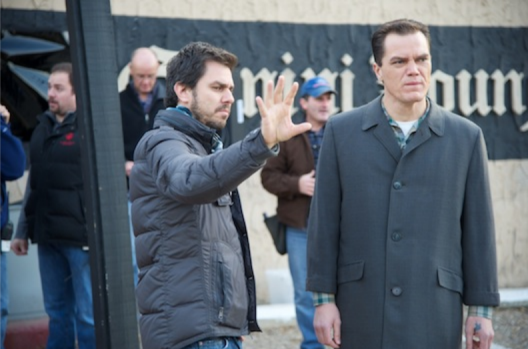
Ariel Vromen on the set of ‘The Iceman.’ Courtesy Millenium Entertainment
How did you go from law school in England to filmmaking in LA?
I was a child of thirteen when I got my first camera at my Bar Mitzvah. I used to do a lot of short films. I was very attracted to film. But then when I went into the army, an extreme special unit in the Israeli Air Force, it shut down the creativity within me. Going to law school afterwards felt more serious for me. In law school, I started to be exposed to music. I started to work on electronic music and became a DJ, traveling around the world. I partnered with a lot of people and worked on soundtracks. That’s what brought creativity back into my life. After law school, when it was time to practice law, I said, “There’s no way!’ I had to try to do something I always wanted to do in my life. I was almost thirty then, I really started pretty late. That was the journey, from being creative to not being creative to returning to that world. When I came back to film, my interest was not in directing or writing…I was passionate about sound design. I did a short film in 2002 (Jewel of the Sahara), but it wasn’t until the mid-2000s that I became more attracted to directing.
How did you get your foot in the door in such a short time?
You know, it’s about perseverance and hard work and luck. As you get older you adjust yourself faster and, if you’re smart enough, you learn from your mistakes. You understand what you did wrong and what you need to do better, and if you’re focused enough, then you just go for it. There are no set rules or one specific journey. At the end of the day, you have to decide what kind of filmmaker you want to be. That happened to me after trying to direct a couple of features. To make your own film, it’s almost a miracle. The hardest part for many people in show business is to control your ego, especially if the film’s good.
Was law school helpful to you once you entered the film world?
Yes. It puts you into that mode of determination, of researching and understanding the material. It takes a lot of discipline to get up in the morning and work every day until 6 a.m. If you have a deadline, you can’t give up and you can’t be lazy. I wouldn’t say it’s fair, but if you really focus and believe in what you want to get out of it, and you’re putting all your energy into it, then anyone can achieve it. Sometimes it’s just a matter of being in the right place at the right time.
How did you develop relationships with fellow filmmakers, as well as distributors like Millennium Entertainment?
It’s funny, because I am much more connected to people that work with me like my editor, Danny Rafic. As for the DP department, I’m still on the search for the same person that will come on again and again for the style that I’m looking for. It would be nice to know that I have one DP that is there for life.
As for distribution, The Iceman was produced and financed by Millenium. It’s complicated. You’ve finished the film and done your screenings at festivals and you think it’s the end. Absolutely not! It’s just the beginning. Being on top of the distributor, doing release planning and strategic marketing, is probably as important as planning your shots and testing your film. Even though not everybody is happy to get your emails in the morning, you’ve got to ask a lot of questions. It’s the only way. You’ve got to be passionate about it. The job is not over when you pick a distributor.
We’ve been touring with Iceman since last September. It was in so many festivals, in Venice, Telluride, Toronto, San Francisco, Los Angeles, Texas, Florida, New York, New Orleans, Haifa. Despite the fact that it is such a controversial, dark film, with a dark subject matter, people really connected to it. They want to see the character redeem himself. It was a big challenge to make people relate. In the end I’m very pleased with the movie.
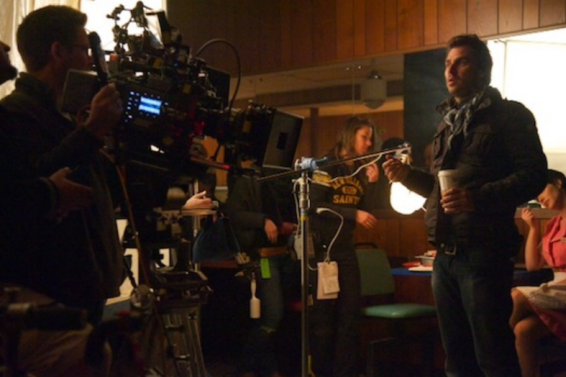
Ariel Vromen talks with his crew on the set of ‘The Iceman’
Can you talk about the challenges you had on The Iceman?
Hmmm…casting, financing, insisting on Michael Shannon to be the lead, nobody wants to give me money, competitive projects, dealing with threatening letters from a legal department on a weekly basis, trying to make Shreveport look like New York and New Jersey. Go figure that out. Shooting it in thirty days and having so much to cover in terms of three time periods. Sixty-eight locations, the post-production time restraints to get it into festivals, marketing, making sure it’s the best timing, and just keeping the momentum going. I think there were a lot of challenges! Ask me if there was anything that went smoothly.
Okay. Did anything go smoothly?
I would say the only thing that went really, really great was the work with my actors and the time I loved the most was editing in post-production. Ultimately it was all about creating, not about fighting.
About to film a scene on the set of ‘The Iceman.’ Courtesy Millenium Entertainment
As an independent filmmaker who works project to project without much of a financial safety net, what are your thoughts on protecting the content you create?
Piracy is absolutely a disease. Unfortunately there is a period of time, as it gets closer to the movie’s release, when the DVDs have been shipped, and you can only do so much for the content protection. However, the whole new way of distribution via the DCPs [Digital Cinema Package] really makes it helpful. But the moment that someone wants to put your work out there to the public, even knowing that essential element that you gave your life for something, it’s like somebody who has a virus they’re carrying and they want to spread it around. They just don’t care. You cannot control it.
What can we do?
I think it’s a matter of education. Like if someone goes to the supermarket and they want a yogurt and a bottle of wine and they take it and decide to just walk out. You can’t just say it’s wrong. You have to educate people and enforce it. Already the industry is suffering so much. Even though the numbers seem high, they can be deceiving. Someday we won’t be able to make these films.
There are so many countries where piracy has become commonplace, because people don’t get those movies, like in Turkey, Russia, China, Thailand and also Israel, where I’m from. They will even put them [pirated copies] on TV. When I was in Russia in 2007, I saw my film Danika playing on National Russian Television and it was a piracy copy. I hope people will understand that at the end of the day, we are just stealing from ourselves.
Featured Image: Director Ariel Vromen works with actor Michael Shannon on the set of ‘The Iceman.’ Courtesy Millenium Entertainment
Jordan Wright November 9, 2012
Special to The Alexandria Times
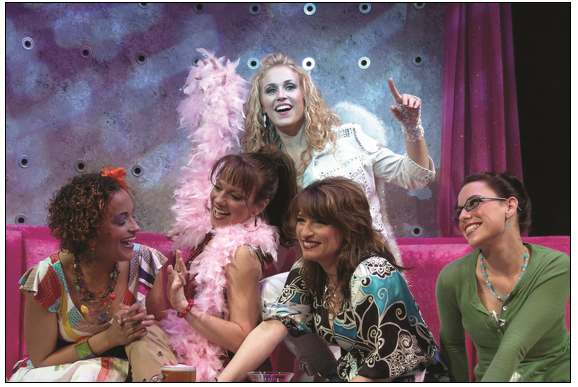
Sisterhood is alive and well and coming to the Carlyle Club in Alexandria. For two nights only the city’s most sophisticated nightclub will be taken by storm by five rip-roaring tell-it-like-it-is women in Girls Night: The Musical!The production, written by British playwright, author and television producer Louise Roche, has toured throughout Britain and the U.S. to rave reviews, with Applause Magazinedescribing it as “Desperate Housewives meets Mamma Mia”. In it the all-female cast including Anita, Carol, Kate, Sharon and Liza, invites gals and their pals to spend a wild girls’ night out, and to sing, dance and sip on cocktails at a karaoke bar.
Director and Production Supervisor, Sonya Carter, whose unique experience as an International Risk Manager for American Express has informed her career, has racked up over 250 performances on tour and Off-Broadway playing one of the women in the production. In a recent interview Carter talked about the show and its effect on audiences.
Jordan Wright – What was the playwright’s original inspiration?
Sonya Carter – Louise Roche saw a musical in London and she saw all these women in the audience laughing and having a good time and thought, “I could do this. I could reach these women.” It’s actually about five women that she knew. She wrote about her own experiences and as a result she created these five characters that everyone can relate to. She’s really quite brilliant and the show has had great success in the UK playing in large venues. When our producer Tim Flaherty saw it, he went out and purchased the US rights.
How long have you been doing this show?
I’ve been with the show since the U.S. premiere in 2007 in Scottsdale, AZ.
You came from an executive position in the corporate world. What prepared you for life as a performer and director?
Oh my goodness! Life is life and people are people. Whether you’re in an executive arena or you’re in theatre, it’s all about reading them. My executive experience gave me a lot of patience and taught me to use my words wisely. That is a very good lesson. I reached a point in my life after I had been in corporate for many years when I wanted to do something else and I auditioned for the show and I got the part. For a while I did both.
What are some of the funniest or most heart-warming stories you have heard from audience members after the show?
Every show is different because we break that ‘fourth wall’ between the performers and the audience. You really get a different response every night. I’ve had so many women come up to me afterwards and say things like, “I was battling cancer and this is the first time I’ve laughed so hard that I’ve cried from happiness.” The show is so much about relationships between girlfriends and sisters and moms. People have told me, “I lost my best friend and you were able to make me laugh. You remind me of her.” It’s very heartwarming to be able to impact people that way to make them happy to bring them joy.
How do the cast members prepare before the show? What revs them up?
We’re dealing with a comedy here and the dressing room shenanigans are pretty funny. Most of these girls are naturally funny. In the dressing room everyone has her own routine. Somebody will do a silly dance or play music or do a chant. They really do have to connect, because on stage they’re best friends. These girls travel together, share hotel rooms and laugh and cry together. They really have learned to love each other and all their idiosyncrasies over 20-plus years. It’s really great to see.
Is there any audience participation?
Plenty! But it’s not intrusive. We allow you to speak back, to dance and sing. We throw out boas and give tiaras to some.
Over the years you have played three of the five roles. Which is closest to your personal experience?
Well, I’m a little bit of each one. But the first part I played was Louisa. She’s always going for the laugh. In that respect I relate to her a lot. Though there are issues Louisa has where I hope I don’t! Kay’s the schoolteacher. She’s shy but during the show she comes out of her shell and really loosens up after a little wine. Anita is the most complicated character. She has such a big heart. I’d like to think that I relate to her loyalty to her friends.
The characters are really universal. Every night people will say, “ I am you, or I am her, or my friend is like Carol.” They go on down the line. Sometimes we get large groups of women, moms and daughters or co-workers and after the show they’ll come around and take pictures with the character they most identify with.
Who are your favorite comediennes?
I really like Tina Fey. I think she’s absolutely brilliant. I love her writing. Loved her book! She’s my standout. From the past I like Carole Burnett and Lucille Ball, who I grew up with and can watch over and over again.
Does Louise Roche have any other productions in the works at this time?
She does have a few. She actually wrote a Girls Night Two that’s currently touring the UK. And we are having the US premiere this week of another show she wrote called Big Pants and Botox. It’s a one-woman show that is very poignant and funny and sweet.
What do you want women to experience with this show?
I want women to have a good time to leave the day-to-day things behind and not to worry about tomorrow! To take time for yourself and bring your sister, your mom, your friends to a really great show, because life is really short and you’ve got to laugh!
Is it only for women?
The show has all the great girl anthems like “I Will Survive”, “It’s Raining Men”, “Lady Marmalade” and more. But men don’t need to be afraid to come. There’s no male bashing. If anything they’ll get a bit of an education. Sometimes when I’m on stage I will hear a man laughing louder than any woman!
Girls Night Out: The Musical! will be at the Carlyle Club on November 29th and 30th at 8 pm. For tickets and dining information call 703 548-8899 or visit www.TheCarlyleClub.com. There will be a special girl’s night drink menu and dinner service begins at 6:30pm. Street parking is available or adjacent garage parking is $5.00 per car. The club is located two blocks from the King Street Metro.
Jordan Wright March 10, 2012
Special to Indian Country Today Magazine
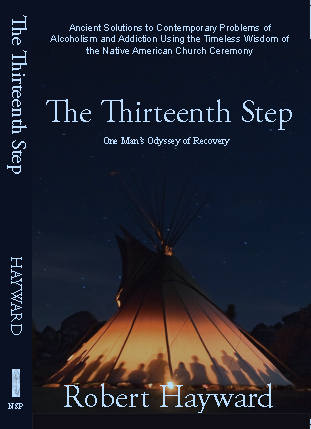
The Thirteenth Step by Robert Hayward - photo credit Mark Chambers
By the time author Robert Hayward (Winnebago) decided to write about his journey to redemption in The Thirteenth Step – One Man’s Odyssey of Recovery, he had been through hell and back. His resume read like a psych report – drug dealer, addict and full-blown alcoholic. After 26 years of self-destruction his physical health had suffered, his mind had deteriorated, and his relationships with his parents, wife and three kids were on a fast track to nowhere.
What makes this revelatory book so compelling is Hayward’s honesty and heartfelt sincerity coupled with his admission of failure and his decision to turn to tribal wisdom to heal. It is an intriguing insight into the Native American Church’s peyote cleansing rituals yet a cautionary tale to all substance abusers. Though the Church’s practice of using peyote as a sacred sacrament in its ceremonies is perfectly legal for tribal members [under the American Indian Religious Freedom Act Amendments of 1994], it is still controversial and fraught with negative connotations since the 1960’s when it was used experimentally by the counter culture.
To this day there are very few members permitted to conduct this sacred religious ritual and they are referred to as ‘Roadmen’. During the lengthy, ritualistic event, Hayward experienced powerful revelations. Eventually with the trust and guidance of the church’s leaders he was granted permission to reveal the ceremony to the outside world and give his profoundly personal account.
Interview with Robert Hayward
Jordan Wright – You seem to have emerged from a nightmare of alcoholism and drug addiction like a phoenix rising from the ashes. What have been the rewards?
Robert Hayward – I started out using at age 14, so for 26 years I was in a daze. Yet immediately after walking out of that tipi my life has been clear. From then on I have been alive.
I knew I was reaching rock bottom. I remember fishing with my sons and I was in a fog. I was looking at them and had an out of body experience like, ‘I’m not participating. I’m just a drunken mess.’ But now I have clarity, plus I developed a compassion for people that have the same problem. I wanted to reach out and help and that’s why I went back to school to study to become a counselor. It really reinforced my need to prevent other people from falling into the same trap.
JW – Why didn’t you succumb to any of the dangers associated with drug and alcohol use?
RH – I was never arrested because I was selling to the cops and I knew when busts were going down. But there was always danger. And the fact that I’m alive is amazing since I’ve been to over 200 funerals over the years and most were related to alcohol or drugs. Most of the people I grew up with are either dead or in jail or still on drugs or alcohol.
JW – It seems almost like a cult of tragedy.
RH – Yes, in a way we loved the drama. We lived for it. It was like – who could be the most distraught.
JW – Do you think there is another way to reach young people or addicts without the use of peyote in a healing ceremony? And as you go forward as a counselor how you think your ways will be most effective?
RH – My primary focus will be the treatment of Native Americans. But on the other hand I still counsel as a volunteer at A Better Tomorrow, a treatment center here, and of course I don’t use peyote there. Basically alcohol addiction is universally a spiritual problem and it only has a spiritual solution. If you look at the twelve-step program, the third step is the key. And I tell people if you can’t take the first two steps of the program, don’t waste your time with the rest of the steps. You have to turn your will and your life over to God as you understand him – you have to have a higher power. And that really is the key and how you go about that is a personal thing.
No matter what race people are, they have indigenous roots and people respond well to simple things like a campfire at night. I’ll take a group of young people and we’ll talk in a circle and it’s a type of spirituality. It has a calming effect. I’ll put the cedar in the fire and bless them with the feathers and we talk using the same rules as the tipi. They open up and talk, as opposed to sitting in a treatment room where they tell you, “You have 45 minutes to spill your guts.” Even a group of strangers will bond. I think the key is to create a bond. We also pass around water to get the four elements going. Once you have shared a night together in a ceremony, you become a relative to everyone there – no longer separated by blood, but bonded by the spirit.
The trend is to turn towards a chemical short-term solution to get the addict through the early stages of abstinence so that they have a better chance at avoiding relapse. The problem is that there’s a 96% or 97% failure rate in the recovery field and which creates a revolving door in some of these treatment centers that charge up to $30,000 per month, so they’re not super anxious to fix it because people keep coming back and the insurance companies keep paying for it. If they can get three cycles out of each person they’re not real motivated for success.
JW – Can you talk about your interest in starting national programs to help addicts?
RH – I’ll work with John Halpern, MD [Associate Professor of Psychiatry, Harvard Medical School and Director of the Laboratory for Integrative Psychiatry, Alcohol and Drug Abuse Research Center] for who is looking for grants for programs for Native Americans.
The model would be to have an area on a reservation with four tipis and separate the sexes. We’d take the hardcore repeaters for the first night and run them through the ceremony – though it’s critical they go through chemical detox first. Then we would have a ceremony for everyone with members of the Native American Church in order to make a complete circle. What you do in a month in a treatment center, you can do in one night in a tipi. This will speed up their recovery and open up their heart. They would live without cell phones or TVs and we’d have drumming and songs and eating outside. Ideally we would have horses too. What I really want to see from this program is real success. I want to see people not identifying themselves as an addict, which I see as incredibly negative affirmation.
What we have in the Native American Church is a support system for Indian people because it becomes a lifestyle. The social aspects are incredible after we go through the ceremonial night – the bonding is incredible. And then the next morning we become as relatives. It has a lasting bond that becomes our identities. The spiritual aspect is important as well. They have to get a sustainable program going whatever group or church they’re in. I want to start a system that is positive for people – to talk about things that are better. There is a huge demand for that.
JW – Can you talk about the importance of spiritual education from our elders?
RH – That was one of the things that really struck me in that ceremony because the way it works is that ‘The Roadman’ runs it and also speaks throughout the night and different people will talk as the medicine leads you. He will give elder wisdom during the night. There is a huge value to it.
When I counsel kids I ask them what is your real tribal name and clan and then I send them to their elders to talk to them. A lot of these guys think the idea of being Indian is hanging a feather on the rearview mirror of their truck. They don’t even know anything about their family or their tribe, so they lost that identity which then becomes games and alcohol and drugs. Once they sit down and talk to their elders, who are dying to talk to these kids, they come back all excited with stories. It totally changes the way they look at themselves.
The elders would teach us and raise us the way we are supposed to be raised. It’s a huge problem that what we do in all of society is put our elders in housing and separate them – let them rot and grow old. But what you can learn from the elders is stuff you can’t get from books or anywhere else. Unfortunately what you see now is that kids have no respect for elders anymore. And it’s sad. You miss the generational connection without that.
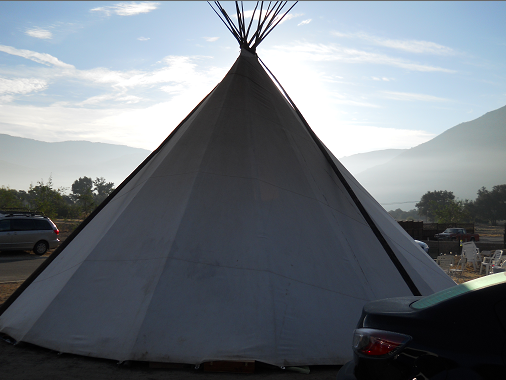
TiPi in Daylight - photo credit Robert Hayward.
In tribal groups I talk about the concept of ‘seven generations’. Seven generations ago my ancestors were praying that I would be alive today and that’s the only reason that I am alive. Our duty is to pray for the next seven generations so that there is still clean air and still clean water and still a place to hide in the trees.
We need to keep that continuous cycle so that we don’t just pray for today or tomorrow and live our life that way. The reason that Indian people are having this problem right now is because we are living in the seventh generation since the conquest. So many Indian people were chased off or diseased that they didn’t have the opportunity to pray for this generation, so the circle was broken at that point. We miss those prayers and a lot of the reason we have these problems now is that our ancestors were unable to pray for us.
So there’s this revival about the seventh generation and it’s in all kinds of prophesies that amongst this current generation young kids will rise up and they will they will have dreams and visions and start to bring back the old ways and start reviving the traditions and I’m seeing that, kids that are learning the songs and how to drum at nine years old and you can see the power coming out of them. The best thing that I see happening is the young kids at the pow wows are starting to dress up again and dance and that’s where you see the connection with their elders who are trying to pass this on to the kids. The kids look up to them and that’s where I see the hope.
JW – What has the response been to your talks?
RH – They are really well received, especially when I start off with the video on my website [www.youtube.com/watch?v=IVP-Z6WcYlo] and the crowd will grow, they really get into the story. Nowadays there is a technological separation because of texting, etc. It’s become a novelty to talk to each other. But for me I feed on the energy of the group. I let them know that it’s time we stood up and became accountable. We owe it to our ancestors to get this right. We have to stop this cycle of drinking. Indian people did not drink. There was no such thing as fermented drink. We lack the enzymes to process alcohol or sugar. It ruins our lives – the abuse and everything. People need to hear that there is hope. We need to start giving them something.
I am realizing that the true niche for this book is all Native Americans, because we haven’t had a book written by one of us with our perspective and way of life fully explained in a long time, if ever. It is fast becoming a book that we as Indians can call our own.
We have the opportunity as spiritual caretakers of this land to hear the words of our ancestors because they [the words] are floating in the wind. Their blood is in these rivers and we are part of this earth. Our ancestors are waiting for us to call on them to heal and we have that opportunity. I hear that drumbeat sitting inside the tipi and I get this incredible feeling. We have to reconnect with that ground because it’s ours – it’s all sacred ground. We all have to put more respect back into the earth.
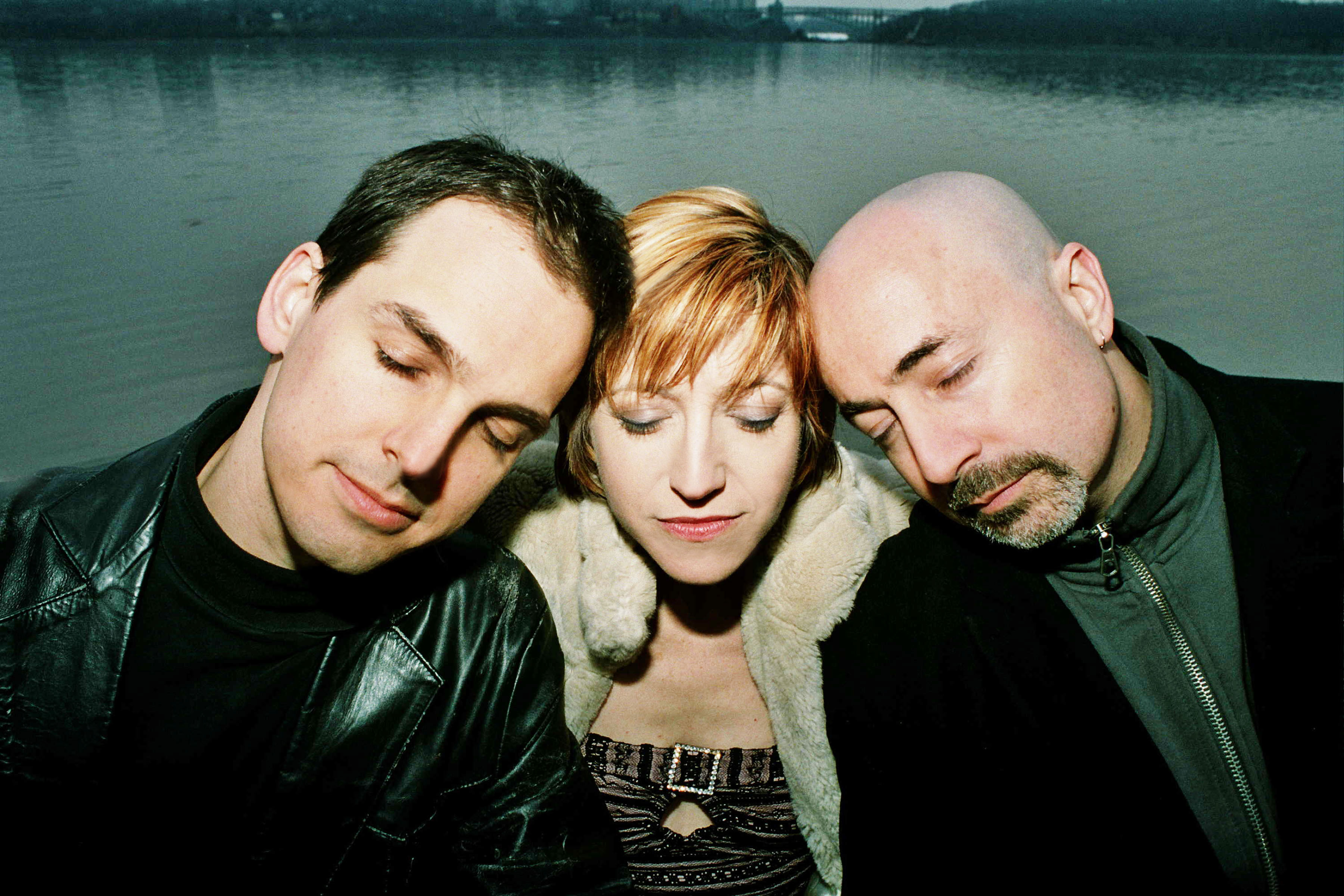
GrooveLily band members (l to r) Brendan Milburn,Valerie Vigoda, and Gene Lewin - photo courtesy of The Wolf Trap Foundation for the Performing Arts
GrooveLily band member and powerhouse electric violinist, Valerie Vigoda, talks with Jordan Wright about the group’s meteoric career and what fans will hear at their March 16th concert date.
Jordan Wright – How do you feel about performing for the first time at Wolf Trap?
Valerie Vigoda – Well, I grew up going to Wolf Trap so I’m very excited.
JW – What does it mean to you as a local?
VV – It’s something I’ve dreamed of doing in my younger days. I grew up going to Wolf Trap. My family and I came to many shows here as well as every Fourth of July. I remember one of my favorite concerts was seeing Jonatha Brooke playing solo at The Barns. I even ushered there one summer. It’s a place that’s been dear to my heart my whole life.
JW – Can you talk about your group’s autobiographical show, Wheelhouse?
VV – It has been on the back burner for many years. The show concerns the events of our lives over ten years ago. It is about the period when we gave up everything to tour in a used RV. It was a bad decision and everything went wrong almost immediately. It turned into a physical and symbolic millstone around our necks. Because after three months it sat at a repair shop and needed a ton of money to fix it. It was like a Catch 22 because we needed it to get to our gigs, which was our main source of income, which could ten pay for repairs. So we just spiraled down to the lowest point we have ever been. It was really tough. Part of what makes the Wheelhouse interesting and funny is that after all these years we now have the distance to look back at the situation and find the humor.
It took us a while to be very honest with ourselves and write about it. And Gene, our drummer whose character arc has always been of someone who had been very cautious with his life has been able to take a leap. Now Wheelhouse is about to be produced and will be directed by Lisa Peterson. We open in Palo Alto on June 6th.
When we come to Wolf Trap to do Sleeping Beauty Wakes we’re hoping to do some numbers from the show. We’ll do a concert version of some of our numbers but not in costume. We’ll also be able to give people a glimpse into the writing process.
JW – Can you talk about your work with Disney?
VV – We have been doing a lot with Disney since we moved to Los Angeles. The first thing was a one-hour musical adaption of the Toy Storyfilm. It’s a story that has always been one of our favorite Disney productions, because it was one of the first dates that Brendan and I went on. That project led us to meet some people that work at DisneyToons and they are the people who are putting out the new Tinkerbell movies. They are coming out with new movies about once a year.
The first one we got involved with was the second movie Tinkerbell and the Lost Treasure. We wrote the opening and closing songs for that as well as Tinkerbell and the Great Fairy Rescue. From there we have written for Tinkerbell and the Secret of the Wings and we wrote two songs for that one as well as Tinkerbell and the Pixie Hollow Gamesthat was a TV special that came out around Thanksgiving 2011. Up until that film the sound they wanted was very Celtic, like Enya, with pennywhistles and Irish bodhran drums. It was very lush. But the songs were not going up on the charts.
Lately they are using more pop songs and we wrote “Dig Down Deeper” for them. It was performed by the very charismatic performer, Zendaya, who sung it on the Build-a-Bear float at the Macy’s Day parade last year. It was very exciting and the song was nominated for our first 2011 Annie Award (industry awards for animated films). We are getting to explore a wider breadth of song styles under the Disney umbrella and we’ve loved working with them over the past six years.
JW – Lately your musical Striking Twelve has been staged by other groups who often perform it by expanding the roles to the size of the cast. Do you think that will continue?
VV – After 2007 we adapted it for larger casts like high schools who could have 25 people in one cast. It depends on the size of their cast and musicians how they put it on. It seems to really work well whether they have a cast of three like we do or many more. This past year there were productions in Helsinki in Finnish as well as Korea and Zimbabwe. We look forward to the opportunity to see other people performing it.
JW – What is the future of your solo performing?
VV – I’m thrilled about it. On a personal level, and in our household, the desire to perform is different between Brendan and myself. He doesn’t miss it but I really need it. In order to make us each be our happiest we put together something that I could perform on my own and we are currently producing a musical we wrote called Ernest Shackleton Loves Me.
JW – Can you tell me about your use of live ‘looping’?
VV – We realized we could take music from Ernest Shackleton Loves Me. We got a copy of Ableton Live which is an incredibly powerful program that people use for looping and deejaying and we put that together with my electric violin and the vocals and out of that what is possible is for me to create from scratch for the audience in real time. I can create soundscapes and full background rhythms and harmonic backgrounds to the vocal as well. It’s as if I have a band behind me that created it. It’s a really interesting way to build a song.
What we realized is that we could take music from Ernest Shackleton… along with mashups and stand alones of cover songs done in a new way I put together a whole solo concert. We plan to add some songs from this show to our March 16th concert.
Using this technology I have done two full-length solo concerts around the country that are on my website, www.ValerieVigoda.com. It’s one of the projects that we are currently juggling.
The group performs together less frequently than we used to since we live on opposite coasts, so when we do get together it’s extra special and extra fun. Now that we’re all parents the central story is even more resonant to us and performing together is one of the most beloved things we do. And in a wonderful venue like Wolf Trap, I can’t think of anything better.
Interview conducted, condensed and edited by Jordan Wright.
MIKE DAISEY - the master storyteller - Photo credit to Daisey Web
Mike Daisey looks like an everyman, but don’t let appearances fool you. He’s a man with a plan and an agenda to boot with a powerful spotlight on workers’ rights that uses comedy and truth-telling in his latest monologue, “The Agony and the Ecstasy of Steve Jobs” playing at the Woolly Mammoth Theatre. As both author and actor of his scriptless theatre verité, he has traveled to China and the South Seas and come away with a firsthand knowledge and what he feels is an obligation to share his story with his audiences. His one-man construct rips the veil off the industry as he rails against “the rise and fall and rise of Apple, industrial design and the human price we are willing to pay for our technology.”
Where are you from?
I grew up in Northern Maine and live in New York.
Where does your storytelling tradition come from?
I’ve been a monologist for the past 13 or 14 years and it has evolved in a way that is a living form of traditional theatre and I am actually communicating on stage so that it is unique experience.
Would you say you’re the Michael Moore of contemporary theatre writers?
No, I don’t write the pieces. They are created extemporaneously. In a better world there would be lots of proactive people that display that sort of citizenship.
Who were your influences? Who is looking over your shoulder when you create your plays?
I am strongly influenced by all sorts of extemporaneous performance. I’m really interested in public speakers, black speakers, and standup comedy. The naked singularity of the theatre is the heart of what I’m compelled by. So I learn a lot by listening to other people. I believe that non-fiction is going to assert itself, and I think that is important for American theaters.
Since your monologue speaks to workers’ conditions in China, would you like to comment on the current challenge to workers’ bargaining rights in Wisconsin, Michigan and Ohio? Do you think it’s any different?
Well it’s quite similar in some ways and widely in different others. What’s similar is of course the people in Michigan are fighting for the rights that people lived and died for 100 years ago. The local government is trying to turn back the clock. Since those battles were fought, we forget what was sacrificed to bring us out of those times. In China the conditions look the same as they always have. It is a place that has never had protections and rights.
Do you see the future of theatre as a socially responsible forum to address current topics?
Certainly the future and present of my theatre! We all have a responsibility to be social citizens. I think it is deeply unnatural to divorce that from our art. It’s bad for art and the theatre to divide those things. There is a drive to believe that the arts should be apolitical and to keep the arts pretty.
Do you consider yourself a radical or a social commentator?
I don’t know the difference.
Would you prefer writer Terry Southern or Tom Wolfe at your dinner table?
I think I would say Tom Wolfe. Ahh, those white suits! I have an affinity for characters.
Where do you eat when you’re in DC?
It’s challenging. I love dim sum in Chinatown and also Teaism and Busboys and Poets. I’m hoping to find a few more restaurants that I feel strongly about this time around.
Do you cook?
Inconsistently and fitfully. My wife [Jean-Michelle Gregory, his longtime director and collaborator] is an excellent cook and I am happy to cede control of it. Recently I cooked a successful dinner and I plan to branch out in the future.
Why is it important to you to perform “The Agony and The Ecstasy of Steve Jobs” in DC?
I’m happy that we’re bringing the show to downtown DC. We are trying to get as many politicians from The Hill to attend because we’re trying to bring attention to the workers conditions in Shenzhen. I feel responsible for telling the story well and I hope I am up to the task of serving the people whose voices are not generally heard.
At the Woolly Mammoth from March 21st through April 17th. For tickets and information visit www.woollymammoth.net.