Jordan Wright
March 11, 2019
Running concurrently with the exhibition First Chefs: Fame and Foodways from Britain to the Americas, is Confection. Commissioned by the Folger Theatre, it is a delightful 17th century romp from the critically-acclaimed Third Rail Projects. This world premiere production is specifically designed to dovetail neatly with playwright Jessica Swale’s Nell Gwynn, which story is also set in the 17th century.
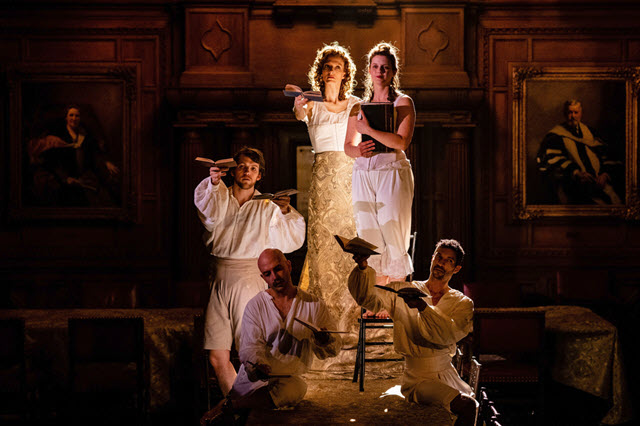 Third Rail Projects were taken by Brittany Diliberto Third Rail Projects performs around the world in site-specific settings and, from what I was told by a woman who came down from New York just for opening night, the ticket prices in NYC are nearly triple and as scarce as hen’s teeth. Described by the creators as a multi-sensory dance and theater performance and defined as immersive/experiential theater, it is held in the private Paster and Sedgewick-Bond Reading Rooms, areas of the Library that are usually off-limits.
The backdrop is an 17th century banquet in all its opulent and decadent splendor – no you don’t get to dine on swans, peacocks, croquembouche and other referenced delicacies – but you will experience the lusty performances of a troupe garbed in period finery expressing their amours for food (and their dining partners!) through dance and mime. Overeating is expressed with humor as are the jealousies and erotic fantasies of the royal courtiers.
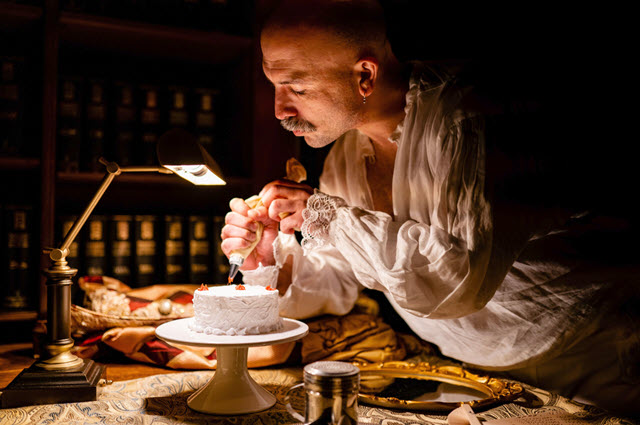 Third Rail Projects were taken by Brittany Diliberto You will learn that there really were such preparations as four-and-twenty blackbirds baked in a pie and such things as the weight, or more specifically the measure, of a man in pounds of sugar. These luxuries came at a great price to those who had to produce these extravagant fêtes, exposing the great disparity between the ‘haves’ and ‘have-nots’. You will experience what it must have been like to watch from afar as the lower classes were had to observe these events from the upper galleries.
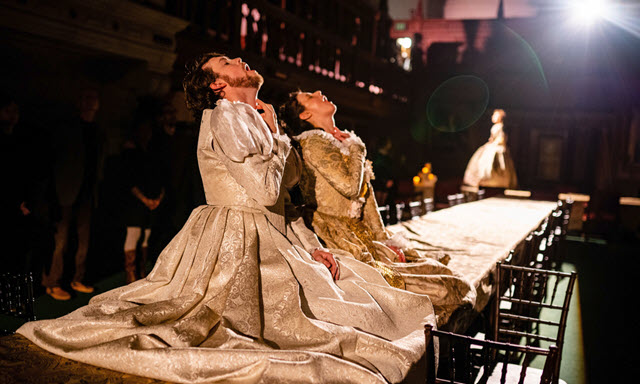 Third Rail Projects were taken by Brittany Diliberto Banquets during this period were so lavish and lengthy that they went on for days with guests passing out or vomiting only to start all over again. The troupe of five also reveal some of the theories and philosophies that were popular in those times – especially the sharing of food and the definition of manliness.
Guests, or should I say participants because you will be led in small groups by costumed guides, will wend their way through velvet curtains to candlelit rooms. There you will see indescribable displays of pastries, watch Baroque period dancing, or hear challenging debates. You may even be encouraged to make decisions as a group. Some of the dances are passionate and fantasy-filled, others are celebratory and playful. In all, it is the ultimate grande bouffe with you as witness.
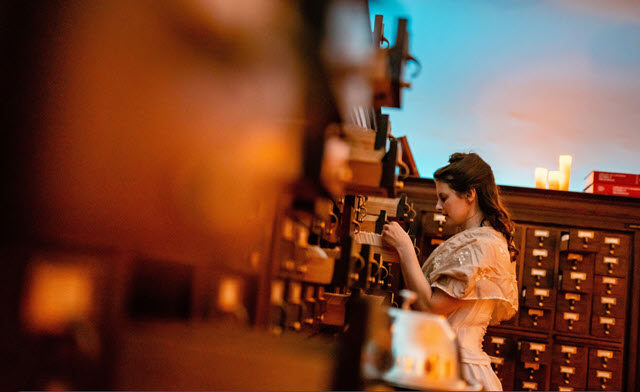 Third Rail Projects were taken by Brittany Diliberto Be sure to leave plenty of time beforehand to tour the First Chefs exhibit and put you in the mood for this splendid evening. And remember to eat before you go. The feast is imaginary.
Immensely entertaining.
Performed by Elizabeth Carena, Alberto Denis, Joshua Dutton-Reaver, Justin Lynch and Marissa Nielsen-Pincus. Written, conceived, directed and choreographed by Zach Morris; Co-directed by Tom Pearson; Artistic Director, Jennine Willett; Sound Design by Sean Hagerty; Costume Design by Karen Young; and Scenic Design by Dan Daly.
Through March 24th at the Folger Theatre at the Folger Shakespeare Library, 201 East Capitol Street, SE, Washington, DC 20003. For tickets and information call 202 544.7077 or visit www.Folger.edu/theatre. www.ThirdRailProjects.com
Jordan Wright
March 9, 2019
Anna Nechaeva is wowing audiences in her Washington National Opera debut. Nechaeva, in the role of Tatiana, hails from Moscow as do several of her leading cast members – Alexey Dolgov as Lensky of the dulcet tenor voice, Igor Glovatenko as Onegin, and Elena Zaremba as Madame Larina. So, it was no surprise that the theater was crawling with Russians who were thrilled to pieces at seeing so much extraordinary Russian talent on an American stage. A few Americans completed the leads with mezzo-soprano Victoria Livengood as Filippyevna, and the marvelous mezzo-soprano Lindsay Ammann in the role of Olga.
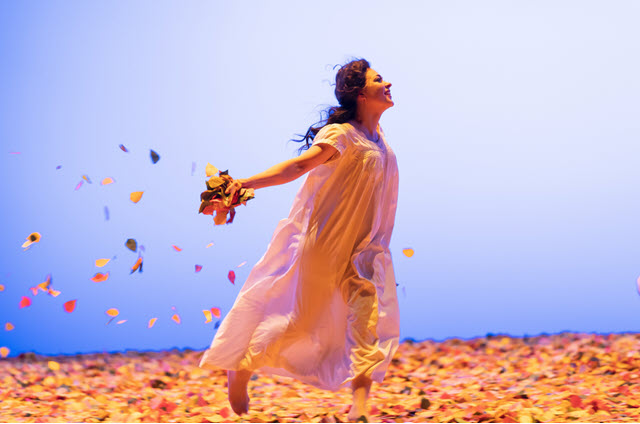 Bolshoi opera star Anna Nechaeva makes her US debut ~ Photo credit Scott Suchman Eugene Onegin, with its beautiful harmonies, dissonance and emotional fervor, hasn’t been produced at the Kennedy Center in 30 years. It was an unusual opera for its time, composed by Pyotr Ilyich Tchaikovsky and based on one of the great works of Russian literature by Alexander Pushkin. In 19th C Russia operas predominantly followed the European model, restricting productions to Italian operas. This was in the early days of Romanticism that had derived from Western civilization. Later Realism appeared which championed creativity and the Arts. Tchaikovsky blended the two to create a new dynamic that had never been heard.
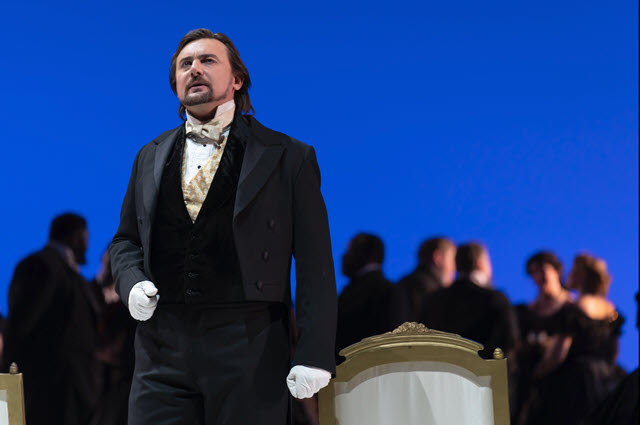 Bolshoi Opera star Igor Golovatenko makes his US debut ~ Photo credit Scott Suchman You can feel the great emotionalism in this opera. These are real people in real life situations. The stories are familiar and as close to a soap opera as you might imagine, yet they are secondary to the universal emotions of the characters, many of whom reflect the lives of both Tchaikovsky and Pushkin who was considered the greatest Russian poet. Pushkin himself died in a duel as does Lensky and the exquisite aria before the duel references Tchaikovsky’s Swan Lake.
The set design is the original minimalistic 1990’s set from the Metropolitan Opera. Changing lighting reflects the time of day, birch trees give a nod to an iconic Russian tree, and autumn leaves show it is harvest season. The dramatic opening in which Onegin appears to be floating above the stage in a pool of white light against a deep blue background, brings to mind the surrealistic paintings of René Magritte or Salvador Dali. The lights soon brighten to a golden hue to reveal a stage covered with falling autumn leaves that show the older ladies singing of their satisfaction in the pleasures of domesticity. “Heaven sends us habit in place of happiness,” they agree.
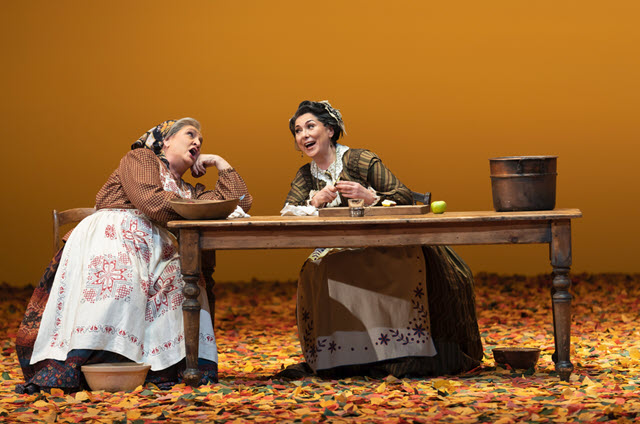 Filippyevna (Victoria Livengood) and Madame Larina (Elena Zaremba) share memories of their youth ~ Photo Scott Suchman As the sisters, Olga and Tatiana, vie for Onegin’s love, Tatiana breaks down and writes him a letter pouring out her love for him. This is one of her most glorious arias, as she vacillates between pure love and the torment of a love that cannot be requited. Tchaikovsky’s music so incredibly portrays this duality of emotions. By incorporating Russian folk music against the grand themes of royal cotillions and military-inspired nationalistic music, he captures the emotional emptiness of high society.
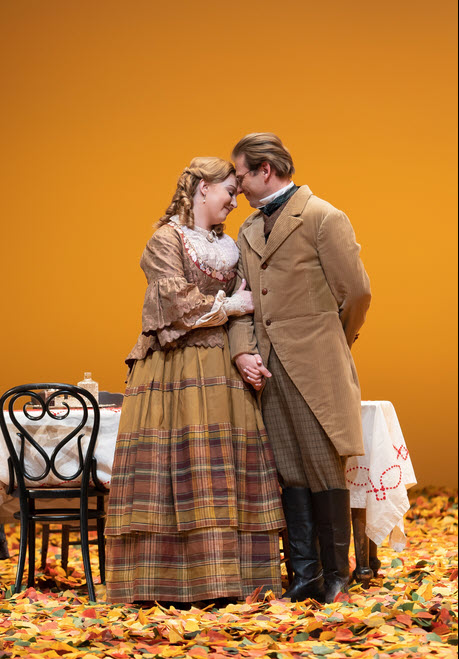 Lensky (tenor Alexey Dolgov) confesses his love to Olga (mezzo-soprano Lindsay Ammann) ~ Photo credit Scott Suchman Three artists from the Domingo-Cafritz Young Artist Program perform. They are Samuel J. Weiser as Captain; Joshua Blue as Monsieur Triquet; and Joshua Conyers as Zaretsky. Eric Halfvarson plays Gremin. With the Washington National Opera Orchestra, WNO Chorus, and WNO dancers.
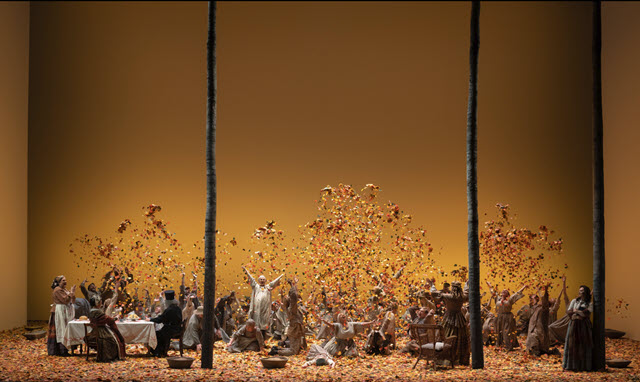 Peasants delight after harvesting fall crops ~ Photo credit Scott Suchman Directed by Peter McClintock with Original Production by Robert Carson. Conducted by Robert Trevino in his WNO debut. Trevino will go on to be Principal Conductor of Malmö Symphony Orchestra. Lighting Design by Christine Binder; Set and Costume Design by Michael Levine; Choreography by Serge Bennathan; and Hair and Makeup by David C. Zimmerman.
Highly recommended.
Performances are March 17th matinee, March 20th, 23rd, 25th and 29th 2019. In the Opera House at The John F. Kennedy Center for the Performing Arts, 2700 F St., NW, Washington, DC. For tickets and information call 202 467-4600 or visit www.Kennedy-Center.org.
Jordan Wright
March 7, 2019
“There are no morals here.” So, buckle up. Kate Hamill’s uproarious comedy delivers a bloomers-up package from the get-go, cribbing from William Makepeace Thackeray’s novel of social climbers.
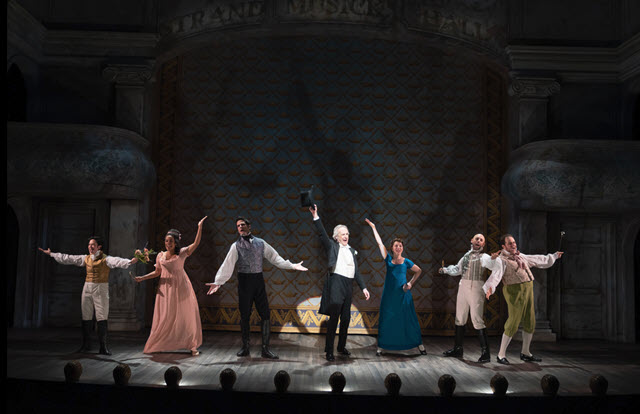 The Cast ~ Photo credit Scott Suchman Dan Hiatt plays the ‘Manager’, emcee of the Strand Music Hall where vaudeville has found a new and popular audience with Victorian burlesque. The characters are introduced to the audience as actors, though they become other characters willy-nilly. Little Becky Sharp, an orphan of sharp tongue and keen wit, is preparing to leave the Pinkerton Academy and assume her position as a nanny in the home of a lecherous baron, but not before she sticks it to the headmistress in a snarky farewell that shows her rebelliousness. Before shoving off, Becky and her well-heeled bestie, Amelia Sedley, promise they will be BFF’s forever.
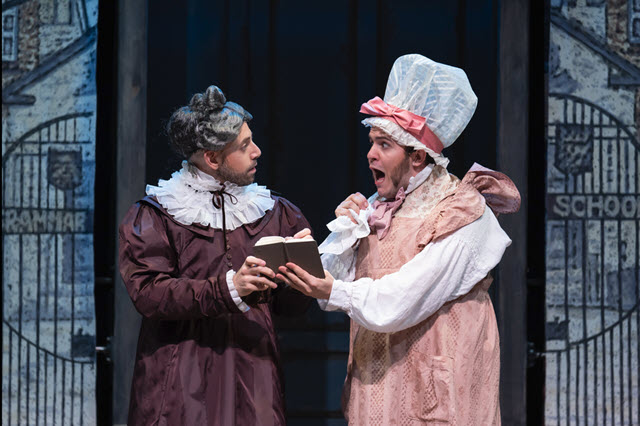 Anthony Michael Lopez as Miss Pinkerton and Vincent Randazzo as Miss Jemima in Vanity Fair by Scott Suchman. Photo credit by Scott Suchman. But to what end? As the Manager asks of the audience, “Do we really mean it when we say we will always be best friends forever?” Here friendships are challenged, ladies are as cavalier as the men, and marrying up the ladder is the goal. A dinner party cleverly lit in freeze frames shows how reckless in relationships they all are. “Licentiousness is the wicked world of the theater,” we are warned. Are we active players in the plot or are we just spectators of a play?
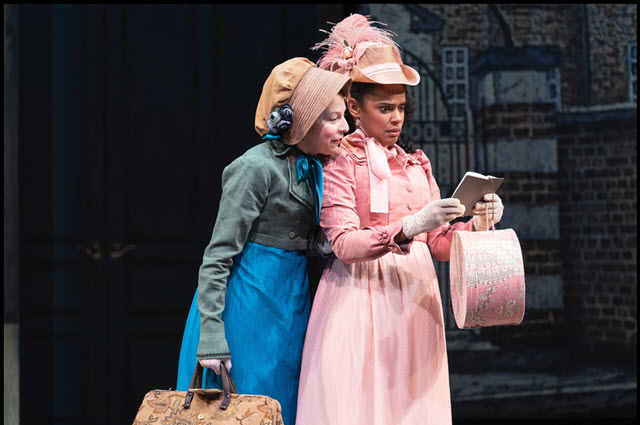 Rebekah Brockman as Becky Sharp and Maribel Martinez as Amelia Sedley in Vanity Fair by Scott Suchman. Photo credit by Scott Suchman. Lines are blurred, both in character portrayals and devious intent (men in drag, cutouts, and puppets figure into this small but mighty cast), and you can’t be assured of anyone’s motives when fortunes are won and lost, and everyone is chasing the money. For this social set cuckolding is the norm, and one person’s misfortunes are fodder for another’s devious gain. “Fortunes change and loyalties follow,” quoth the Manager. Lucky us, we have all the fun watching these topsy-turvy machinations.
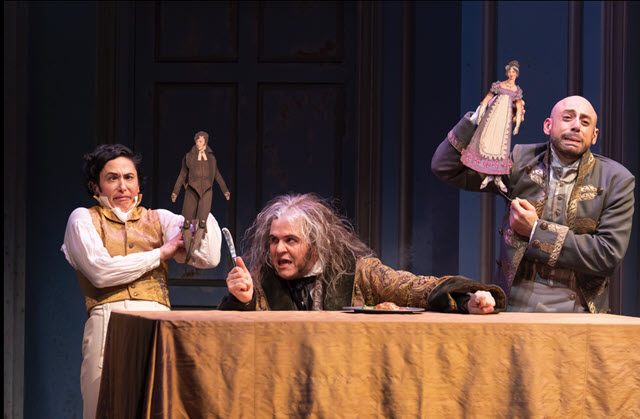 Alyssa Wilmoth Keegan as Lesser Pit, Vincent Randazzo as Sir Pitt and Anthony Michael Lopez as Rose Crawley in Vanity Fair. Photo credit by Scott Suchman. I’ll admit, for the first five minutes in, I had no earthly idea where this comedy was going. And by the end, I had no idea where it had taken me. One minute they play it straight by addressing the audience, and the next it seems like a hilarious farce. No matter. It’s a madcap romp that will keep you in stitches.
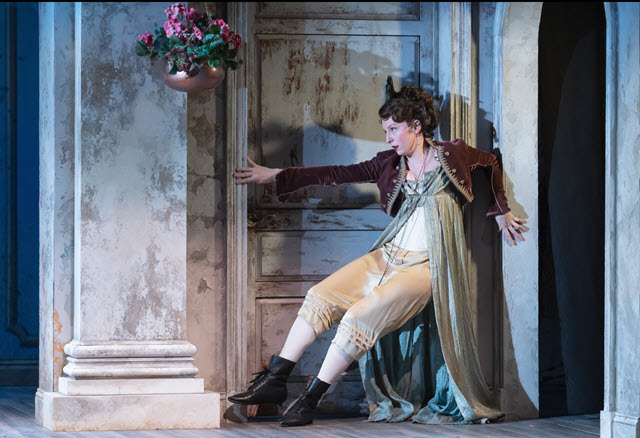 Rebekah Brockman as Becky Sharp in Vanity Fair. Photo credit by Scott Suchman. Rebekah Brockman plays Becky with a delightfully devilish air. Her intrinsic appeal is that she has the ability to morph into a sympathetic character as speedily as one who holds all the cards. Cheers to Maribel Martinez as Amelia Sedley who has to make a total turnaround in character when she discovers true love has been staring her right in the eye, and to Dan Hiatt, as the Manager, plus Miss Matilda and Lord Steyne, who alters his gender like a chameleon changes color.
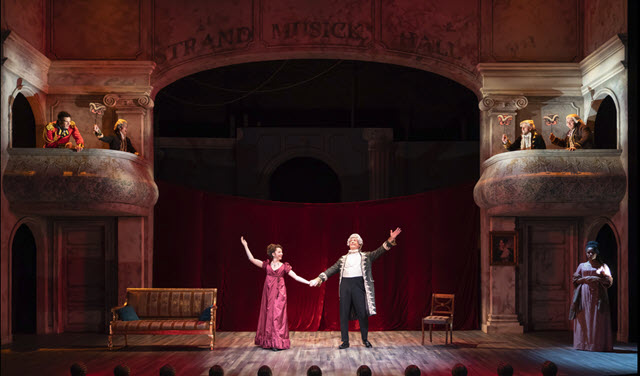 The cast of Vanity Fair. Photo credit by Scott Suchman. Additional cast members – Alyssa Wilmoth as Actor Four (George, etc.); Anthony Michael Lopez as Actor Three (Dobbin, etc.); Adam Magill as Actor Two (Rawdon, etc.) and Vincent Randazzo as Actor Five (Jos, etc.).
Directed by Jessica Stone, Sets by Alexander Dodge, Costumes by Jennifer Moeller, Lighting by David Weiner, Choreographed by Connor Gallagher. Jane Shaw Sound Designer and Composer.
Through March 31st at the Lansburgh Theatre, 450 7th Street, NW Washington, DC 20004. For tickets and information call 202 547-1122 or visit www.ShakespeareTheatre.org.
Jordan Wright
February 27, 2019
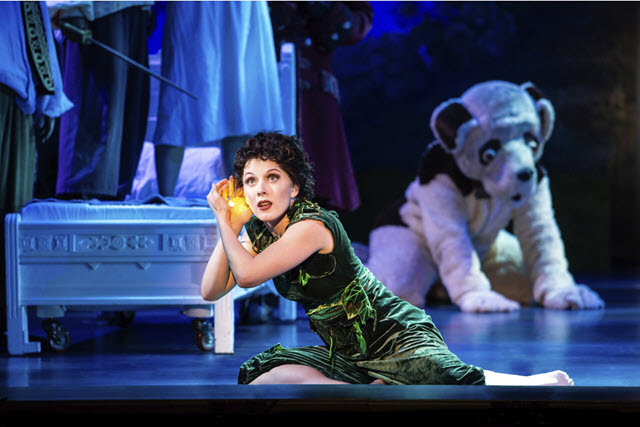 Melody Rose in Finding Neverland ~ Photo Credit Jeremy Daniel Finding Neverland flew into the National Theatre last night, straight from the second star on the right. As the second-oldest theater in America, the National continues to provide us with the Broadway shows we are dying to see plus some that have made their out-of-town debuts right here. Seeing a big show on this smaller stage in this grand historic theater makes it feel as if you’re right on stage with the actors.
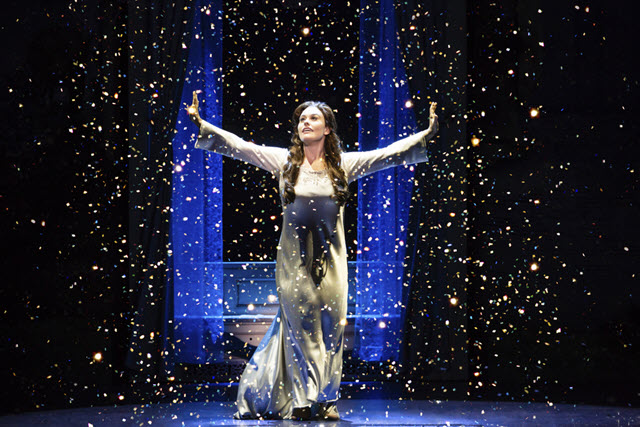 Ruby Gibbs in Finding Neverland ~ Photo Credit Jeremy Daniel This supremely delightful musical takes its cue from the life of author J. M. Barrie and his inspiration for the beloved children’s book, “Peter Pan”. It’s an adventure suitable for all ages – that is if you still believe in fairies. And we do! Written by James Graham with music and lyrics by the composing duo of Gary Barlow & Eliot Kennedy, it is chockful of sweet ballads, rousing Irish jigs and toe-tapping chorus numbers. This song-writing team is solid gold. Barlow has sold over 45 million records with his pop group Take That and is co-writer on the popular musical The Band. Kennedy is a Grammy-Award winning musician/singer/songwriter who has had number-one hits with the Spice Girls, Celine Dion, Aretha Franklin and many more. Altogether, Finding Neverland has twenty original numbers.
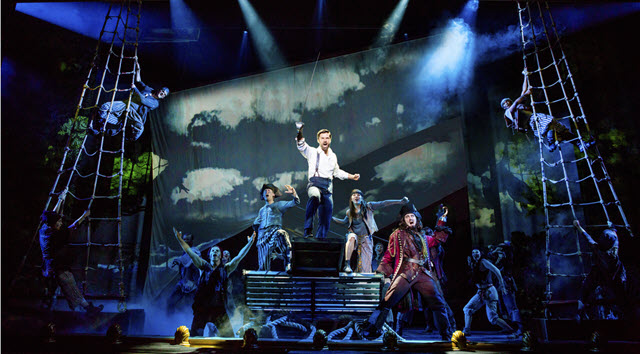 The Company of Finding Neverland ~ Photo Credit Jeremy Daniel Kensington Gardens is where Barrie, a playwright with writer’s block, meets Sylvia, a widow with four boys – George, Peter (of course), Jack and Michael. Trapped in a loveless, childless marriage with his imperious wife, Mary, he soon becomes enchanted with Sylvia and her lively brood, providing fuel to the boys’ imaginations as he recaptures his own inner child with a script heartily disapproved by his dyspeptic producer, Charles Frohman, and a stubborn-minded cast who refuse to play children’s roles.
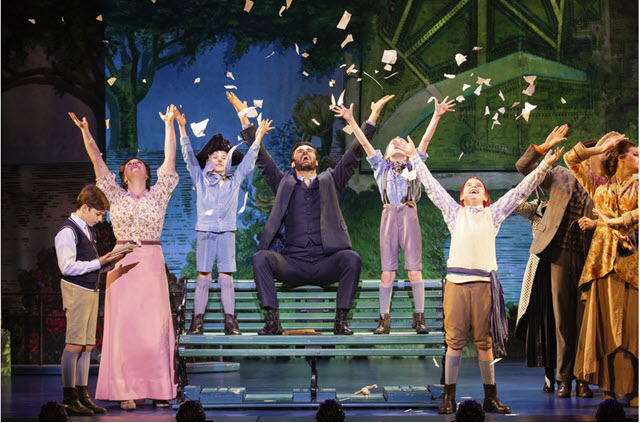 The Company of Finding Neverland ~ Photo Credit Jeremy Daniel Not to be compared with Peter Pan, the 1954 musical with Mary Martin who flew and crowed her way into Broadway history books, this fantasy adventure has equal amounts of appeal. Wonderfully engaging choreography by Mia Michaels, choreographer on So You Think You Can Dance and Cirque de Soleil’s Delirium. Michaels has choreographed for Madonna and Prince and is a three-time Emmy Award-winner. For this production, rather than flights aided by ceiling wire, cast members lift their mates as they ‘soar’ around Neverland. The children (and the adults!) around me were gobsmacked with glee.
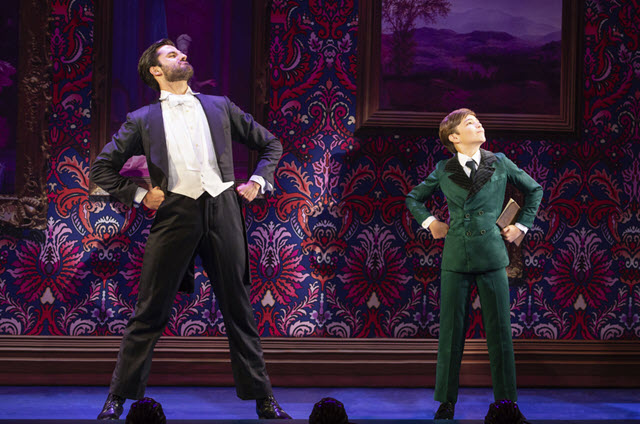 Jeff Sullivan and Seth Erdley in Finding Neverland ~ Photo Credit Jeremy Daniel A large banquet table proves to be a hilarious hiding place for the guests when napkins fly in Barrie’s posh home in “The Dinner Party” and “The Circus of Your Mind” that plays out to the sounds of a calliope as it delves into Mary and James’ private lives. At last, Barrie gets the theater’s troupe to recall their childhood imaginations in “Play”, a wildly animated tavern scene that brings all the imaginary characters together dancing and singing.
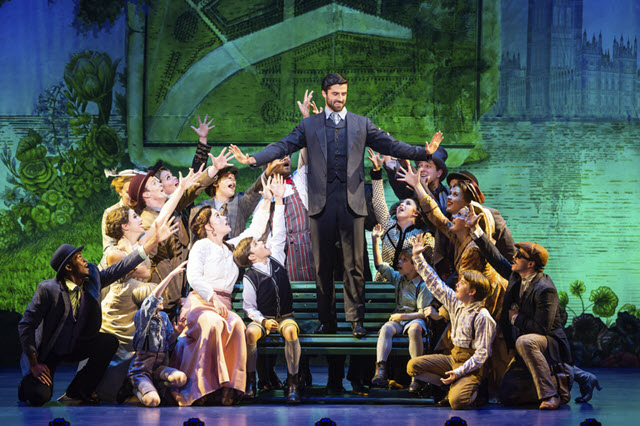 The Company of Finding Neverland ~ Photo Credit Jeremy Daniel A nine-piece band, beautiful voices, adorable children, pirates! and clever projections (How do they create the stardust? Asking for a friend.) is guaranteed to keep this magical musical close to your heart.
Highly recommended for all ages. Hurry! It’s only in town till Sunday.
Through March 3rd at the National Theater, Washington DC – 1321 Pennsylvania Avenue, NW, Washington, DC 20004. For tickets and information visit www.TheNationalDC.org or call 202 628-6161.
With Jeff Sullivan as J. M. Barrie; Ruby Gibbs as Sylvia Llewelyn Davies; Ashley Edler as Mary Barrie; Paul Thiemann as Albert; Conor McGiffin as Charles Frohman and Captain James Hook; Michael Luongo as Lord Cannan; Emmanuelle Zeesman as Mrs. Du Maurier; Joshua William Green as Mr. Henshaw; Spenser Micetich as Mr. Cromer; Kelsey Seaman as Miss Jones; Adrien Swenson as Miss Bassett; Melody Rose as Peter Pan; Marie Choate as Wendy; Daniel S. Hayward as Captain Hook.
Llewelyn Children played by Brody Bett (Jack/Michael); Seth Erdley (George/Peter/Jack); Caleb Reese Paul (George/Peter/Jack); Peter Schoeller (George/Peter/Jack); Josiah Smothers (Jack/Michael); and Ethan Stokes (George/Peter/Jack).
Original Direction by Diane Paulus; Direction Recreated by Mia Walker; Orchestrations by Simon Hale; Scenic Design by Scott Pask, Lighting Design by Kenneth Posner, Costume Design by Suttirat Larlarb, and Sound Design by Shannon Slaton.
Jordan Wright
February 18, 2019
Fans of Henry James will cotton to this period piece that debuted on Broadway in 1947.
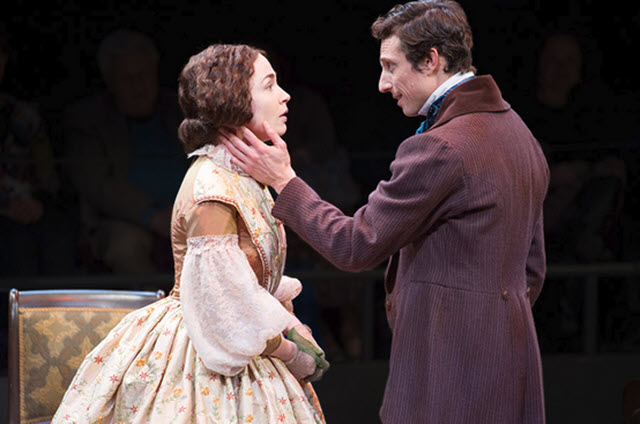 (L-R) Laura C. Harris (Catherine Sloper) and Jonathan David Martin (Morris Townsend) in The Heiress. Photo by C. Stanley Photography. Set in the Victorian era, it is based on James’ novella, Washington Square. The Heiress takes place in the parlor of the prominent Doctor Sloper’s home in New York City circa 1850’s – a time when proper ladies and gentlemen of a certain class comported themselves with the utmost dignity. But minding your P’s and Q’s at a time when a family’s reputation could be destroyed at the drop of a lace handkerchief, took serious adherence to well-circumscribed proprieties.
For the painfully shy doctor’s daughter, who struggles to live up to her late mother’s image in her father’s eyes, every social interaction is torturous. Every slight from her father’s lips remands her deeper into her silent world of embroidery until his sister, Lavinia, encourages Catherine to climb out of her self-imposed shell and reject his autocratic demands.
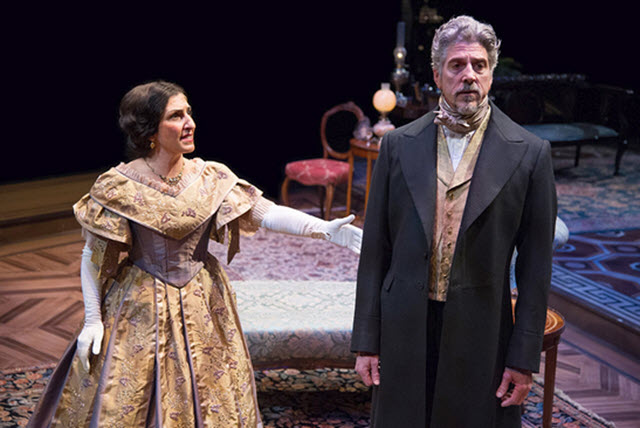 (L to R) Janet Hayatshahi (Elizabeth Almond) and James Whalen (Dr. Austin Sloper) in The Heiress. Photo by C. Stanley Photography. When a cousin brings Morris, an attentive young suitor, to dinner Catherine begins to see how the attentions of an adoring young man can empower her to speak out. Naturally, her father disapproves as Morris is penniless, but Catherine finds her inner strength and, with the backing of her aunt, rebels against his social constraints.
Relatives provide disparaging gossip about Morris that he is a mere mountebank after Catherine’s fortune and the money her father has promised to leave her in his will. It’s easy to imagine how fraught these issues must have been when young women bowed to the demands of their fathers and society’s pressures to conform to the highest standards of conduct were unassailable.
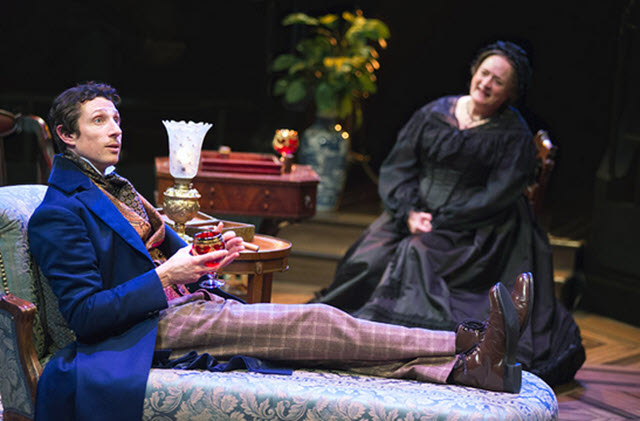 (L-R) Jonathan David Martin (Morris Townsend) and Nancy Robinette (Lavinia Penniman) in The Heiress. Photo by C. Stanley Photography. The great character actress Nancy Robinette as Aunt Lavinia is marvelous, as is Laura Harris as Catherine and Jonathan David Martin as the suspiciously-motivated Morris. It’s a well-balanced cast all around with an all-women creative team that includes Deputy Artistic Director Seema Sueko. Together they produce the precise ambiance to frame this classic period piece which draws upon women’s struggles to supersede their societal constraints.
Fans of period dramas such as Downton Abbey will swoon.
By Ruth Goetz and Augustus Goetz; Directed by Seema Sueko; Set Design by Mikiko Suzuki Macadams; Costume Design by Ivania Stack; Lighting Design by Sherrice Mojgani; Sound Design and Original Music by Emma M. Wilk; and Wig Design by Anne Nesmith.
With Lise Bruneau as Mrs. Montgomery; Lorene Chesley as Marian Almond; Laura C. Harris as Catherine Sloper; Janet Hayatshahi as Elizabeth Almond; Joanathan David Martin as Morris Townsend; Nanacy Robinette as Lavinia Penniman; Kimberly Schraf as Maria; James Whelan as Dr. Austin Sloper; and Nathan Whitmer as Arthur Townsend.
Through March 10th at Arena Stage – 1101 Sixth St., SE, Washington, DC 20024. For tickets and information call 202 488-3300 or visit www.ArenaStage.org.
Jordan Wright
February 15, 2019
Richard, bloody Richard the Third. Thirteen murders for a single crown. The Grim Reaper visits this drama so frequently it’s hard to keep count. Staged in what appears to be a prison somewhere in, oh well, pick somewhere obscure, let’s say Alabama circa 1920’s, where concrete walls and hidden rooms pop out to reveal spotlighted men hanging by chains. Pile on the poisonings, force feedings, hot cauldrons and decapitation and you’ve got no more than you might see in an R-rated flick. Let’s say The Texas Chainsaw Massacre, shall we? Oh, right, there is a chainsaw here too. Is that how we want to see Shakespeare’s prose come to life? That it is well-acted, is not in question. That it is maximumly dark and catering to extreme tastes, is manifestly certain. Is it really necessary to reenact each one of Richard’s gruesome crimes?
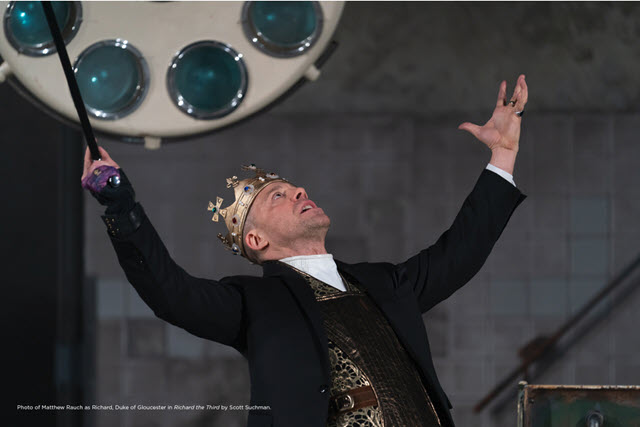 Matthew Rauch as Richard, Duke of Gloucester in Shakespeare Theatre Company’s production of ‘Richard the Third.’ Photo by Scott Suchman. “I am determined to prove a villain,” Richard claims in his opening line, and wow! is he spot on. His threats, killings and demands of loyalty are that of a Mafia kingpin. Director David Muse gives us a chorus of leather strap-snapping executioners and jailers who slick-sharpen their knives while taunting their next victim. And, though they lurk in shadow, his henchmen are always ready to provide their murderous services. Plus, they do an especially good job of mopping up the stage after each bloodbath.
In the Director’s Notes, Muse refers to the play as “…a pantry of tasty ingredients rather than a perfectly put-together recipe.” I can’t say food came to mind when I slogged through these ritualistic killings interspersed with Richard’s nefarious manipulations of his subjects. Maybe I have too delicate a constitution. Couldn’t we leave something to the imagination? In this production, Muse has admittedly condensed acts, changed words and altered characters to adapt to a two-hour time frame for what he refers to as the “modern audience”, but what is left is jam-packed with fratricidal murder and mayhem from beginning to end. As this homicidal maniac admits, “I am in so far in blood that sin will pluck on sin.” These days we might refer to him as a serial killer.
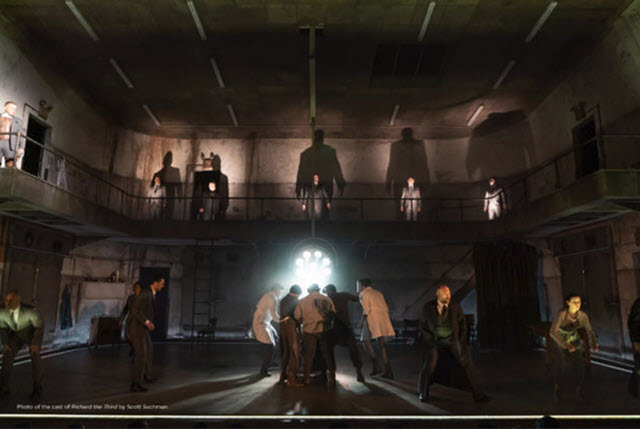 The cast of Shakespeare Theatre Company’s ‘Richard the Third.’ Photo by Scott Suchman. Notwithstanding all the blood and gore, I was particularly taken by certain performances. Most especially the extraordinary Lizan Mitchell as Queen Margaret of Anjou, the prophetess; Sofia Cheyenne as the Mayor of London; and I have to hand it to Matthew Rauch as Richard III. He has to do this for the entire run of the play.
With David Bishins as King Edward IV and Sir Richard Ratcliffe; Cody Nickell as George, Duke of Clarence and James Tyrrel; Sandra Shipley as Duchess of York; Charlie Niccolini as Prince Edward; Logan Matthew Baker as Young Duke of York; Lizan Mitchell as Margaret of Anjou; Cara Ricketts as Lady Anne of Neville; Robynn Rodriguez as Queen Elizabeth; Todd Scofield as Earl of Rivers; Jonathan Feuer as Lord Gray; Christopher Michael McFarland as Duke of Buckingham; Derrick Lee Weeden as Lord Hastings; Michael Rudko as Lord Stanley; Evelyn Spahr as Earl of Richmond; John Keabler as Sir William Catesby; Sam Midwood as Lord Lovel; Harry A. Winter as Archbishop of Canterbury; Ahmad Kamal as Brakenbury; David Ryan Smith as Murderer 1; and Matthew Aldwin McGee as Murderer 2.
Dramaturg, Drew Lichtenberg; Scenic Designer, Debra Booth; Costume Designer, Murell Horton; and Lighting Designer Lap Chi Chu.
Warning: This production includes graphic depictions of violence, including violence against women and children, which may not be suitable for all audiences.
Through March 10th at Sidney Harman Hall 610 F Street, NW, Washington, DC 20004. For tickets and information call 202 547-1122 or visit www.ShakespeareTheatre.org.
|