Jordan Wright
March 7th, 2011
Special to The Alexandria Times
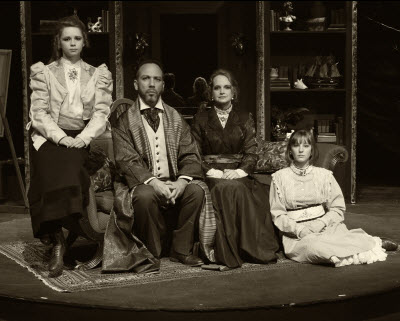 Emily Woods (Constance), Lars Klores (Mr. English), Elizabeth A. Keith (Mrs. English), and Elise Kolle (Felicity) Photo by Shane Canfield
When a Welsh family of four vanishes into thin air from their cozy country manse, leaving no other clue save a slip of paper handwritten with the word “widdershins”, we find two detectives hot on the trail to solve the mystery. In a complex and fascinatingly convoluted Victorian plot replete with Druids, faerie legends, French Impressionists and the occult, “Widdershins”, currently at The Little Theatre of Alexandria, connects these seemingly disparate elements with cohesive aplomb.
Underneath the quaint façade of this turn of the century upper crust family there are darker sides to each member that Inspector Ruffing, and his tippling cohort, McGonigle, aim to uncover. Between pours of the family’s finest scotch, McGonigle attempts to wrest the truth from a series of interviews with the family’s only remaining daughter, Annie, their lame servant girl, Jenny, and Betty, the village sorceress.
Mr. English, as the patriarch of the family, is a man in full who fancies himself a painter, writer and intellectual. Yet he is a dilettante holding his family firmly in his thrall. In a self-absorbed metaphysical quest – “To find the truth one must travel deeper and deeper into the abyss,” he declares – he dabbles dangerously in superstitions and Pagan legends. With the aid of a daft local seer and herbalist with a penchant for young boys, he is lured into the places where the “lost ones” dwell, as she goads him on to visit the spirits that have haunted him in his hallucinations.
“The sacred and the damned are the same,” English declares in a delusional dualist attempt to define God. With such a cavalier philosophy it should come as no surprise that he absolves himself of any responsibility towards his family, and we soon discover that everyone including his wife and children, Constance, Felicity, and their adopted daughter, Ann, has dark secrets and their own private demons. When English describes the world as a turf labyrinth or “mizmaze”, with the boundaries of a chessboard as its metaphor, we see his children, Constance and Felicity, toying with the pieces, in a symbolic reference to God toying with our destinies.
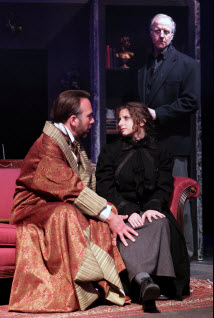 Lars Klores (Mr. English), Rebecca Fischler (Jenny) Photo by Shane Canfield If you’re sensing a dash of Alice in Wonderland and The Wizard of Oz meets the Addams Family, in a story written by Immanuel Kant and Edgar Allen Poe and directed by Fellini, then you’re on to something. Just remember to stage the fantasy in a comfortable Victorian drawing room with a fireplace.
In this carefully crafted whodunit, playwright Don Nigro reaches beyond a simple missing persons crime scene to explore intricate themes of religion, morality and sexuality in a mystery with cosmic mysteries. “God swims in a mysterious soup,” English divines.
To express that the characters’ reappearances are but visits from another realm as they waft in and out of the misty scenes in a time continuum, their visages are cleverly illuminated, by lighting and special effects designers, Ken and Patti Crowley.
The acting is smooth as a bolt of silk with Mike Baker, Jr. playing the bereaved McGonigle, J. Andrew Simmons as Ruffing the lead detective, Elizabeth A. Keith as the aggrieved Mrs. English, Kat Sanchez as the adopted daughter Ann, and Lars Klores as Mr. English. Gayle Nichols-Grimes plays the combo seer/witch in hoary and hilarious fashion (did I neglect to mention there was comedy here too?), while Elise Kolle and Emily Woods as the younger children exceed our expectations as the playful and mischievous foils whose innocence creates chaos.
Flawlessly directed by C. Evans Kirk, this production is highly recommended.
Through March 29th at The Little Theatre of Alexandria, 600 Wolfe Street, Alexandria, VA 22314. For tickets and information call 703 683-0496 or visit www.thelittletheatre.com.
WATCH Awards Reach Out and Touch
Alexandria’s Little Theatre
Jordan Wright
March 6, 2011
Sunday night and the crowd at the Birchmere was explosive. The WATCH Awards, which are to Washington area community theatres what the Tonys are to Broadway, were being presented and it was a pretty amped up crowd. Covering as far East as Annapolis, and south as Prince William County it included Alexandria’s own Little Theatre of Alexandria, which raked in four awards for Outstanding Achievement in Choreography for Amy Carson for her work on “Chicago”; Outstanding Achievement in Hair Design for Paul Morton for “Lady Windermere’s Fan”; Outstanding Achievement in Music Direction for Paul Nash for “Chicago; and Outstanding Achievement in Direction of a Musical for Susan Devine for “Chicago”.
By Jordan Wright
Posted on 21 February 2011
Special to Washington Life Magazine
 From "The Weir" - Kevin Adams (foreground) with Mike Tinder and Susan Marie Rhea - photo credit to Jim Coates The Weir, One Flea Spare and On The Razzle are on our radar for top theatre picks this week. Click HERE.
Jordan Wright
February 2011
Special to The Alexandria Times
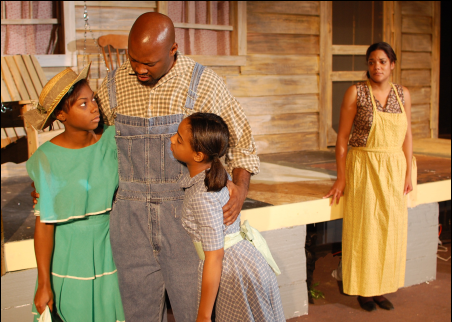 Marissa Moody as Joyce Cheeks, DeJeannette Horne as Rawl Cheeks, Aeshia Brown as Matoka Cheeks, Lolita-Marie as Mattie Cheeks Cal - photo credit Ari McSherry Before you “get all up in my family’s business,” as matriarch Mattie Cheeks is fond of telling Jewish traveling scholar and Holocaust survivor, Yaveni Aaronsohn, there is a perfectly plausible reason why this play uses the “N” word and why its usage, in any other context except historical, is so derogatory.
Brooklyn-born John Henry Redwood, an African-American actor and playwright, aimed to shock his audiences, shock them clear out of their complacency, in order to remind them of the invidiousness of the segregated South, not only for Blacks but for Jews as well.
In his play, “No Niggers, No Jews, No Dogs” presented by Alexandria’s Port City Playhouse, Redwood urges us not to forget the signs of racism, “Coloreds only”, “No niggers”, “Whites only”, and other hate-filled descriptors posted on restaurants, drinking fountains, rest rooms, hotels, gas stations and storefronts in the pre-civil rights South when fear-mongering, lynching, systematic rape and humiliation were promulgated and carried out by the Ku Klux Klan and their sympathetic followers.
The time was summer and the year was 1949 when Aaronsohn shows up in Halifax, North Carolina to study “the negative psychological effects of prejudice” on an African-American family. He finds the Cheeks’ home where husband, Rawl, played with a masterful subtleness by DeJeanette Horne, is a sharecropper and wife Mattie takes in laundry while raising their two girls, Joyce and Matoka during the days of Jim Crow law, and offers to pay them for their participation. Although initially suspicious the family comes to share their story with him and the complexities of their lives are revealed.
Beautifully paced and soulfully delivered this provocative yet tender and funny memory piece presents a cautionary tale…one that should never be forgotten.
In an unforgettably moving performance the beautiful and dulcet-voiced Lolita-Marie as the indomitable Mattie delivers an exquisite portrayal of a woman of grace and strong convictions whose canniness saves her family from certain doom. “You think life started when your life started?” she asks her children.
Also outstanding is ten-year old Aeshia Brown, playing the sweetly precocious daughter, Matoka, with the timing and delivery of a pro. “I’m studying you,” she informs Aaronsohn, as he records her explanation of the world. Her pivotal role, handled with sass and aplomb, providing the necessary comic relief.
The action takes place on or around the front porch – an iconic setting for Southern family life – where doors are slammed, peas are shelled, secrets are revealed and baskets of food are left for the mysterious Aunt Cora. Set Designer Erin Cumbo cleverly employs a clothesline hung with sheets as a projection screen for the opening photographs of racist signage from the South’s painful history.
“My father was an historian who taught me history could be sad,” recalls the playwright’s daughter, Rhonda Redwood-Ray, a federal prosecutor in Washington, DC. “Because he grew up around a lot of strong women, he was innately sensitive to women. Many of his characters were drawn from his own life.”
“Aunt Cora was a younger sister to my grandfather, and Mattie, my father’s mother is still alive at 90 and lives in Halifax, North Carolina,” she explains, acknowledging that her own father was probably the model for Rawl Cheeks.
Redwood-Ray remembers a childhood that included going to the homes of her father’s Jewish friends for supper where she was taught to be respectful of the customs of others and where she witnessed her father’s great sense of humor. “He had a laugh that would shake this whole set,” she told the audience recently in a talk after the show at the company’s newest location.
Weekends through March 6th at The Lab at Convergence, 1819 North Quaker Lane, Alexandria, VA 22302. For tickets and information call 703 838-2880 or visit www.PortCityPlayhouse.com.
By Jordan Wright
Feb. 14, 2011
Special to Washington Life Magazine
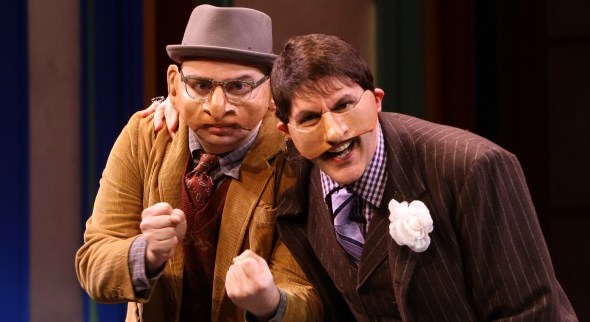 (L-R) Domio of Ephesus (Darius Pierce) with his master, Antipholus of Ephesus (Bruce Nelson), in The Comedy of Errors, on stage at Folger Theatre through March 6, 2011. (Credit: Carol Pratt) Bring on the drama! Our top Washington-area theatre picks for the upcoming week. Click HERE.
Jordan Wright
January 2011
Special to The Alexandria Times
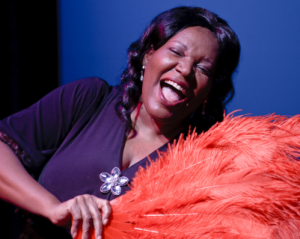 Bernardine Mitchell as Ethel Waters in His Eye is on the Sparrow at MetroStage photo credit: Colin Hovde “It’s important that the truth come out,” insists Bernardine Mitchell, star of His Eye is on the Sparrow, MetroStage’s production of the life and music of Ethel Waters. So why is it that so few know the story of this pioneering icon of American jazz and early black entertainment? Perhaps it’s because it is borne out of a bleak period in American history that carries with it the indelible stain of racism. And perhaps because it was during segregation, when touring black performers were forced to rent rooms in whorehouses or sleep in local stables, to find medical treatment in mental institutions when hospitals were not open to blacks, were refused service in restaurants, and were under constant threat of lynching in the KKK-dominated South.
His Eye is on the Sparrow, by playwright Larry Parr, is a powerful drama threaded throughout with the sassy, suggestive music from the early 1920’s, performed in blues and jazz venues like the legendary Cotton Club, and the uplifting gospel spirituals Waters learned in her youth. It showcases over 15 songs from “Frankie and Johnny” and the 1933 Rudy Vallee/Hoagy Carmichael classic, “Old Man Harlem”, to Fats Waller’s “Cabin in the Sky”, sung by Waters in the hit 1940’s Broadway musical of the same name. Much of Water’s own recordings, considered historically significant by the Grammy Hall of Fame and the Library of Congress and featuring such classics as “Am I Blue?”, “Stormy Weather” and “Dinah”, are included in the show’s repertoire.
The musical drama is based on the heartwrenching tale of Ethel Waters’ early life on Clifton Street in Philadelphia, growing up in what she refers to as a “whore’s alley” and sleeping on grates. Her life was circumscribed by a 13-year old mother, Ma Weasie, who brushed her off with the crack, “I birthed ya’. Ain’t that enough!”, and a grandmother who raised the illegitimate child to follow in her footsteps as a hotel maid. Later an cheating husband drove her into the streets where she began her singing career with the Negro vaudeville circuit known to outsiders as the Theatre Owners Booking Association but to the performers themselves as “Tough on Black Asses”.
Mitchell, who triumphed at MetroStage in another bio-musical, “Mahalia”, for which she won a Helen Hayes Award for her portrayal of gospel singer Mahalia Jackson, dons her roles like a second skin as her lush contralto voice and commanding presence take the audience on a journey of pain, triumph and redemption they are powerless to refuse. In this one-woman show, she channels Waters who despite being battered, disowned, scammed by agents and club owners, and left for dead, rises from the ashes of her trials and tribulations with her indomitable spirit and belief in God.
Waters continued her legacy with television (yes, she was Beulah in the show of that name), the Broadway stage, where she won the New York Drama Critics’ Circle Award for Member of the Wedding with Julie Harris, and ultimate induction into the Gospel Music Hall of Fame and Christian Hall of Fame after she joined the evangelist Billy Graham in the 1950’s on his worldwide crusades.
Contributing to the mood of the piece are Dawn Axam’s smooth choreography, Jessica Winfeld’s lighting design, particularly effective in creating evocative scenes of the Old South and in a strobe-like recreation of an early motion picture, as well as pianist William Knowles skillful jazz and ragtime accompaniment.
Jordan Wright
January 2011
Special to The Alexandria Times
 Mr. Bumble takes in Oliver - photo by Shane Canfield
That Lionel Bart’s “Oliver!” has huge universal appeal and relevancy today is not in question here. And though millions have seen this ubiquitously mounted musical on countless stages, in schools and community theatres around the world, millions more will. Since the spectacular score…sixteen memorable songs…plus a heart-strings pulling story, continues its reign as one of Britain’s most endearing theatre exports.
Our story opens with Oliver Twist, played by the adorable and fresh-faced James Woods as a homeless and penniless orphan wandering the mean streets of 19th Century London town. An orphan longing for a mother’s love, he lives amongst the thieves and scallywags that patrol the lawless warrens of the city. From this familiar Charles Dickens tale Bart crafted his iconic musical, drawing on themes of love, kindness, desperation and redemption to circumscribe the music.
To love Oliver is to have hope and it is well engendered on this stage by a captivating cast of workhouse urchins. These eleven fellow mop-topped orphans are precious to the max. Seeing so many cute children in tatters and newsboy caps swarming the stage and kicking up their heels is utterly irresistible. Quick! Where’s my runcible spoon? Never mind. We’re on meager rations here. In a memorable scene gruel-starved boys test the rules when Oliver boldly prevails upon Mr. Bumble for more slop in his bowl in the well-loved tune, “Food, Glorious Food”.
The young and talented James Woods (Oliver) carves out a convincing portrayal of the innocent child, whose life of imposed deception begins when he is tossed out of the workhouse and sold for a pittance to a couple of crafty undertakers, the dour Mr. and Mrs. Sowerberry. With approval from the greedy Mr. Bumble, they cast the piteous boy as a mute coffin-follower. In the lively ditty “That’s Your Funeral” they triumph their plans to have “mourners in all corners”, marking the start of poor Oliver’s downward spiral into crime.
In the duet, “I Shall Scream” we enjoy Jeffrey Clarke’s roguishly seductive Mr. Bumble who is well matched to Mary Ayala-Bush’s come-hither Widow Corney, oozing coyness and feigned elusiveness to his flowery flirtation.
Soon Oliver meets up with the Artful Dodger, played with swagger and fresh snap by Ben Cherington. He lures the innocent lad into the clutches of the master crook, Fagin, whose hot house of bad boys is a veritable den of iniquity. The smarmy Fagin teaches Oliver to do his dirty work in “Pick and Pocket or Two” and we’re off to a riotous life of crime.
The success of this particular production is a tribute to the skill and direction of Roland Branford Gomez, who coaxes crack performances from the large cast. Fine choreography from Heide Zufall manages to put this passel load of moppets through their paces.
All the little pint-sized poppers claimed my heart, but seven-year-old Joseph Machosky, as the smallest orphan of the lot, took cheek and charm to new heights with double time dancing and a fierce energy on the stage.
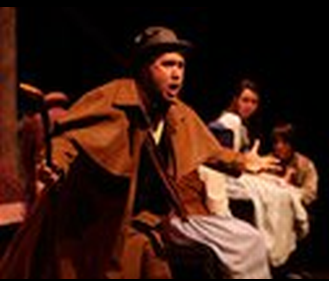
Only Maureen Rohn in the role of Nancy may have been miscast. Though she is a stunning actress with a pitch-perfect voice who portrays the sweet side of Nancy quite capably, it is the abused and broken Nancy that goes missing. In her ballad of despair “As Long as He Needs Me”, we are left without the passion, pride and fury needed to balance out this complex character.
The production features a 12-piece backstage-secreted orchestra and 33 cast members. Terrific performances by all the principals, especially Mike Baker Jr. as the nefarious and avaricious Fagin who brings a sinister dynamic to “Reviewing the Situation”, and Paul Caffrey as the misogynistic con artist Bill Sykes who cuts through the London fog with an interpretation of Sykes that drips with Mephistophelean evil.
All in all, this “Oliver!” deserves kudos as an engaging, energetic and splendiferous production.
|