Jordan Wright
January 2010
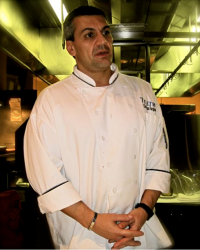 Chef Fargione in the kitchen at Teatro Goldoni - photo by Jordan Wright Chef Enzo Fargione employs a decidedly patrician ethos with his modern Italian cuisine at Teatro Goldoni’s exclusive ‘chef’s table’, conjuring up tantalizing innovations more suitable for Roman Gods than mere mortals.  Cavatelli with roasted garlic cream and smoked lobster served in a silver tin - photo by Jordan Wright This is a chef who twists, tweaks and molds his ingredients, cajoling them into his gastronomic fantasies. Will he caramelize, braise, gelatinize, puree, concentrate, desiccate, smoke, infuse or lacquer with gold leaf? Will he froth, fill, roast, bake or contort his culinary components demanding ever more textures, shapes and essences?
During a 17-course prix-fixe menu with optional wine pairings (perfect for diners disinclined to order half a dozen different complementary selections) Fargione will engineer an encyclopedia of techniques, inventions and tantalizing flavor complexities in presenting his latest gourmand fantasies.
Unlike other chef tables around town, this is a very elegant and intimate spot indeed, and oh so private. The glamorous table features a semi-circular banquette and is stunningly but simply arranged with white Garnier-Thiebaut damask, Limoges china and Fortissimo hand-blown wineglasses. A Napoleonic bee graces the handle of a tortoise-shell patterned steak knife. While under a black-shaded chandelier, twinkling with delicate crystals, the glasses sparkle, the lighting is flattering and, restaurants take note, you can see your food. 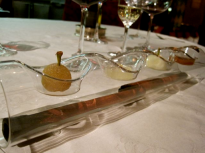 Tea light deconstructed apple flight - photo by Jordan Wright Fargione’s signature style is to present his creations like precious gifts…whether a glass tealight holder for a deconstructed apple flight; sweet crispy cones of smoked tuna, with green olives and a tart cream and nestled in a duet case; glass vases encasing veal cheeks bathed in a huckleberry froth; or an imaginative trompe l’oeil panna cotta ‘fried eggs’ served in a petit gratin dish.
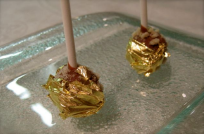 Chocolate coated olive oil mousse dusted with gold leaf - photo by Jordan Wright His enthusiasm palpable, the charismatic Fargione follows each preparation to the table describing the wines, the regions and his inspiration. Wine pairings are personally selected by the chef to balance each dish and carry certain flavors to the foreground. After a chilled glass of prosecco to launch the evening, I experienced no fewer than eight starters, called ‘appetite openers” on the menu, five subsequent entrees and seven or so wines. With small servings for each presentation you won’t be overfull.
The field informs his delicate white corn and Parmesan custard with a ruby-hued red wine caramel sparked with a translucent basil leaf. In another clever presentation, served in a sleek, round silver tin, the sea influences a luscious cavatelli with roasted garlic cream, smoked roasted lobster, porcini, peas and fresh thyme cradled in a single spoon (though cataloguing of the ingredients barely expresses the complexity of this offering).
 Manila clams with candied cherry tomato, spinach foam and pipette of briny clam broth at Teatro Goldonis Chefs Table - photo by Jordan Wright The journey progresses with a miniature Manila clam ragout, strewn with candied cherry tomatoes bursting with a deep sweet intensity, while a plump caper berry acts as counterpoint beneath aeronautical spinach foam. At the table an infusion of briny clam broth squeezed through a miniature pipette, activates the alchemy. The tiny sampling utterly delicious…but you will find your own treasures…there are so many to swoon over.
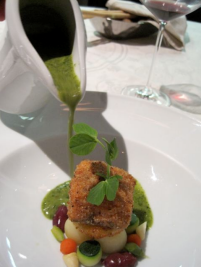 Wild Sockeye salmon with acqua pazza arrucola pesto broth - Photo by Jordan Wright An unforgettable foie gras, studded with mostarda di Cremona (preserved fruits from the Lombardy region), harmoniously balanced the goose liver, mustard and candied cherries. The world melted gently away. Imagine it with a Merlot wine caramel, balsamic vinegar gelato and hazelnut tuile. This is a mere sliver of the evening’s culinary jewelry that takes inspiration from many different regions of Italy.
In all, Fargione challenges earth, wind and fire, revealing sparks of brilliance at every turn. At this extraordinarily sophisticated level of cooking, the desire of the chef to tempt the palate, prepare it for the next bite and dazzle with ever greater gastronomics speaks passionately to the connoisseur. And does that not define the language of love! 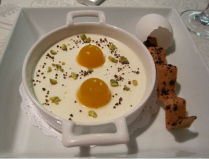 Vanilla pannacotta dessert sunnyside up with virtual bacon - photo by Jordan Wright Bravisssimo, Chef Fargione!
If you go, and I highly recommend it, make your reservations for the Chef’s Table and inquire as to the optional wine pairings.
Teatro Goldoni
1909 K Street, NW
Washington, DC 20006
202 955-9494
www.TeatroGoldoni.com
For questions or inquiries about this article contact Jordan@WhiskandQuill.com
or visit www.WhiskandQuill.com
Jordan Wright
For Local Kicks and Whisk and Quill
January 2010
 Celery root soup with grated apple and Stilton mousse at AGAINN -photo by Jordan Wright Before the trendy nomenclature could sink its British tentacles across the pond and set down its twiny roots in American soil, owners at the two-month-old AGAINN (pronounced ah-gwen) declared it dead…at least as an artful descriptor for their first foray into the world of concept restaurants.
At AGAINN the food is too serious for Yankee sensibilities to be considered “pub food”. Pubs are imagined as the average Englishman’s other living room, serving up greasy newspaper-wrapped fried cod and chips or Branson pickles and ploughman’s cheese sandwiches with a pull of Guinness. This watering hole’s $500-a-year liquor lockers are too committal for the blue-collar worker and its ultra-modern interiors too retro chic for the typical English family’s neighborhood gathering spot, lest it conjure up Gramps and the kids after Sunday service.
No, no, no, they cried before it could catch on. They would hereafter be referred to as a “European bistro”. A concept much tossed around but surely indicating a more sophisticated approach to dining and drinking.
On a recent visit to AGAINN I had the chance to commend their change of heart. For here was a restaurant with a serious chef guarding a strong philosophy and respect for the land, an extensive, worldwide wine list and a penchant for success.
But don’t come here expecting spring mix salad with a tumble of heirloom tomatoes…at least not in the off-season. Chef Wesley Morton is bucking the naysayers and keeping true to seasonal. This writer was mightily impressed by such gastronomic bravery. Swim against the tide, Morton and you will find you can create your own waves.
I found a dreamy celery root soup topped with grated apple and smooth counterpoint Stilton mousse, freshly opened Blue Point oysters, brine intact with shallot mignonette (the dreaded red sauce thankfully nowhere to be found), corned tongue with puntarelle, a lovely winter green similar to chicory and only in season from November to February. Prawns are served with Marie Rose sauce…a delicious throwback accompaniment recently revived by British Chef Andy Waters at his restaurant Edmunds in Henley.
 Maryland Rockfish with winter vegetables, spinach and preserved lemon in a spicy lobster broth - photo by Jordan Wright Morton, assisted by sous-chef and five-year accomplice, Michael Sindoni, has taken an extraordinary route by channeling top Michelin-starred chefs such as Gordon Ramsay and Mark Aikens and award-winning chef, Tom Hix of London’s Oyster and Chophouse fame. Though he counts his Cajun grandmother as his muse, he has embraced and conquered the new British-inflected cuisine and trumpeted the local, organic, sustainably- and humanely-raised cuisine that is the culinary wave of the future.
Morton breaks down whole cows and pigs from neighboring farms to make his soul-stirring charcuterie – blood sausage, potted pork, “brawn” and black pudding, creating homey relishes like pickled mustard seed, piccalilli and onion marmalade to balance the rich meats. This is “nose-to-tail” eating, as described by British chef Fergus Henderson, and it is sublime.
 Charcuterie board with brawn, potted pork, pork terrine, Allan Bentons country ham, piccalilli, pickled mustard seeds and onion marmalade - Photo by Jordan Wright
Within the confines of Morton’s kitchen the beef is corned, the sausage hand-stuffed and the grass-fed Shenandoah lamb from Blue Rooster Farm, a Tuesday special, fabricated in-house. Even such comfort food as a ham and cider pie incorporates house-made ham with heirloom apples and cabbage.
There are nods to pub food with dishes like shepherd’s pie, locally raised Scottish Highland beef rib-eye and Yorkshire pudding, and bangers and mash. But here is a whole new paradigm.
The wine list at AGAINN gave me pause. The wines by the glass were dispiriting and without the usual wine by the glass pairing menu, I couldn’t find anything remotely palatable. With over a hundred wines by the bottle, I sought advice from trusted friend and professional oenophile, Larry Austin. Austin is a Harvard-educated lawyer, banker and conductor of international wine seminars with an unparalleled passion and knowledge of wines, and who, as a serious collector, vowed to provide me with some insight.
He noted stellar wines including the 2003 Antinori ‘Pian Delle Vigne’ Brunello di Montalcino, a slew of top quality premier cru French Chardonnays, a 2005 Nickel and Nickel ‘Harris’ Merlot, a 2006 Miner Family ‘Stage Coach’ from Oakville and a 2006 Sequoia Grove, Rutherford, from what he referred to as the two best parts of Napa Valley. A 2007 Luca Malbec, Mendoza caught his eye along with a 40 Year Tawny Port by Dow’s. To his tally of favorites he added a 2007 Zinfandel, Biale ‘Black Chicken’ from Napa and a 2008 Cloudy Bay from New Zealand, “whose vineyards revolutionized the world’s thinking on Sauvignon Blanc and put New Zealand on the wine map!” he exclaimed. I lost him after that plumbing the depths of a serious collection of Spain’s exemplary riojas. Wine for thought indeed!
 A sumptuous Banofee Pie with bananas, caramelized milk, graham biscuit, cream and ganache - photo by Jordan Wright Two desserts swept me off my feet. Eton Mess, harkening from the English boarding school of the same name, was made with huckleberries, baked meringue and lemon curd, and sticky toffee pudding, a familiar face in the Anglo-crowd, but this version was complete with a surprisingly delicious stout ice cream.
Later in the week I engaged Morton by phone hoping to explore his approach deeper and mine the chef so driven to expose diners to this new cuisine that he traveled throughout the British Isles for inspiration. I expect exciting things to come from this Texas transplant, whether gastro or Euro, it’s an epicurean direction that will break tradition by reclaiming it.
Jordan Wright – What do you hope sets your food apart from other chefs?
Chef Wesley Morton – I try to keep it simple, precise and refined. I get ideas from the best the new British chefs and adapted them to our local ingredients. I try not to do too much…just the let the quality of the ingredients speak for themselves.
JW – What ingredients are inspiring you lately?
WM – It’s all about the season for me. That’s what drives me. Farmers tell me beet greens are in. But pork and pigs are my favorite vegetable.
JW – You speak of your father’s mother as your muse. How did she influence your cooking?
WM – Every Sunday she cooked for the whole family, she’s a Cajun cook through and through, and there would be up to 25 of us at her house for lunch. We always had cattle, chicken and eggs and fresh vegetables from her garden. I always helped out as a kid.
JW – How did your commitment to organic, non-GMO foods and sustainably- and humanely-raised meats arise?
WM – My uncle back home is an environmental consultant and he has taught me how important it is to support the family farm. It means a great deal to me. I have friends in these communities and have seen how important it is to keep these famers in business, even if the costs are higher, because it affects the local economy and at the end of the day you can taste it in the dish.
JW – What are your plans for the future of AGAINN?
WM – Well, we’re still young. We’ve only been open for two months and we’re just beginning to hit our stride. We will push the envelope slowly, always following the seasons. I’m looking forward to having morels, ramps, asparagus and halibut in the spring.
JW – What local farms are you currently sourcing from?
WM – We are really fortunate to have the farmers we have. Garden Path Farms brings us their pigs, purebred all-natural Red Devon beef, chickens and eggs. We use Blue Rooster Farms for lamb and Fresh Link Co-op, a collection of small family farms, for produce. Our fruits come from Fresh Link and Tuscarora.
This interview is conducted, condensed and edited by Jordan Wright of Whisk and Quill. For questions or queries contact Jordan@WhiskandQuill.net or visit www.WhiskandQuill.com
www.againndc.com
Jordan Wright
Whisk and Quill
November 2009
Thoughts on dining:
 The generous nibbles at the bar - photo credit Jordan Wright Is a plate more artful on which rests a lone perfect shrimp or must it be circumnavigated with drizzles and droplets of reduced sauces in contrasting colors?
Since we are traversing land and sea to source our foods and convene with our farmers, greengrocers and fishermen, shouldn’t we display our ingredients with pride?  Colossal Madagascar shrimp - photo credit Jordan Wright Because we are barraged by noise and bright light during our workday oughtn’t we seek a calming atmosphere in which to take solace?
At Kellari recently I found all the elements of a perfect evening and since there is no real critique to speak of I will recount how and why I find this restaurant so very appealing.
Kellari is an elegant Euro-style enclave. Soft lighting flatters the guest (restaurant designers take note), with votives nested in pale aqua milk glass, wrought iron lanterns, silk-shaded table lamps and dimmed chandeliers creating an inviting glow. Something I always take note of is the placement and density of the tables. In this dining room they are lavishly enough apart for the guest to feel spoiled and coddled.
Of course the highlight here is the food. Oysters shucked and iced in neat rows share the bar with platters of house-made crusty bread, great hunks of Graviera cheese and voluminous bowls of olives, their provenance spanning the Greek isles. Green cracked olives from Volos, Kalamatas from Peleponesus on the southern tip of Greece, Amfisas from Northern Greece and Koroneiki from Sparta. From the western side of Mount Taygetus comes the wild oregano that the chef combines with rosemary and thyme and couples with lemons and oranges infusing the olives with a unique and addictive taste. The welcoming gesture is charming, all the better to enjoy an “Hermes” martini or the crystal blue “Aegean” martini, two of the house-crafted cocktails on the menu.
 Wall of fresh fish and produce - photo credit Jordan Wright While we are on the subject of décor a dramatic wall of ice, easily twelve by eight feet, showcases a stunning array of seafood and glisteningly fresh produce. Branzino and Dover sole, Portuguese sea bream and Senegalese barbounia, Maine lobsters and mussels, octopus and squid all appearing to surf the crest of a wave as several dozen varieties of fish and shellfish, including the spectacular nine-inch long Madagascar shrimp, vie for the diner’s decision.
For the “Aegean Feast” the chef selected “mezedes” of perfectly charred lamb riblets, grilled sushi-grade octopus, delicate herbed calamari and the aforementioned Madagascar shrimp. Aside from its gargantuan size…more akin to a lobster…the black sand vein that runs along the dorsal area, is filled with a rich heavenly coral roe. I sampled a fish called “fagri” from Greece, a tender and mild white snapper, prepared whole to capture the rich flavor of the bones and head, and deboned before presentation. It is served with a satiny lemon sauce and the typical Greek lemon potatoes, called “patates”, baked with a crisp golden edge, and plates of steamed “horta” a mélange of wild greens.
It’s no wonder you don’t hear much about their wines. The Greeks don’t want the word to get out and who can blame them. There is a lot more than retsina in their cellars. I tried two delicious examples, the spicy and perfumey Moschofilero, and the well-rounded and soft red, Megapanos, from the Nemea region.
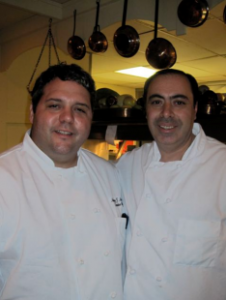 Kellari chefs Gregory Zapantis and Anthony Acinapura - photo credit Jordan Wright Desserts are homey, like the thick yogurt with cherries (which were my favorite) or an almond baklava, a switch-up from the better-known type made with walnuts; or more sophisticated, like a crème brulee with an underlying hint of the unique spice masticha. The traditional galatoboureko, without which no self-respecting Greek would think the meal had concluded, is a custard-filled phyllo. By now you see, you can speak Greek very well.
Before you leave Kellari there is a large white bowl beneath the archway filled with wonderful cookies, kourabiethes, a melt-in-your-mouth shortbread; koulourakia, shaped like a comma, a crisp coffee-dipper with sesame seeds; and melomakarona, dipped in honey and walnuts. The cookies are baked in-house and are not for sale. They are a generous gesture of thanks to their patrons.
The artistry at Kellari is in its simplicity and hospitality. It is a restaurant that bespeaks timelessness, as though it has been in this spot forever and will be for many years to come. The service is graceful and attentive…very Euro…and Chef Anthony Acinapura cooks with the love of his ingredients and his country. I am already looking forward to another visit.
Highly recommended.
www.kellaridc.com
By Jordan Wright
Published: The Georgetowner/Downtowner, October 2009
The St. Regis Hotel in Washington DC, designed to resemble an Italian Renaissance palace, is associated with the posh life of the international jet set and stratospherically successful business traveler. Its gilded portals, marbled floors and orchid-laden tables gently whisper the definition of luxe living.
Most recently the hotel and restaurant have experienced a metamorphosis with the arrival of uber-chef Alain Ducasse’s Adour Restaurant. Interior designer, David Rockwell’s sophisticated blend of Old World elegance and sleek modern cachet have translated the update into a very chic yet laid-back style, greatly enjoyed by the Washington glitterati since its opening last year. 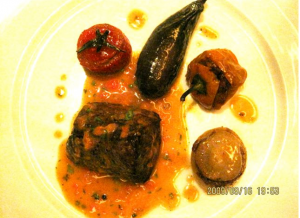 Beef Tenderloin with petits farcis Nicois vegetables at Adour - photo credit Jordan Wright 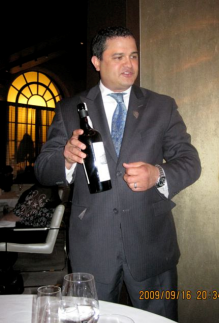 Wine Director Ramon Navaez at Adour - Photo credit Jordan Wright While the lovely original dark wood beams (think Dumbarton Oaks Music Room), opulent rococo appointments and marbled floors remain intact in this stunning hotel they are partnered with edgier Euro-inspired décor in the dining room which features white leather and chrome dining chairs and Venetian starburst sconces in a striking setting. Linen-draped tables are positioned far enough apart for financiers to discuss oil futures and spacious dining alcoves cosset romantic diners with a perfect spot for a tete-a-tete. Continue reading Adour Restaurant in the St. Regis: A Peerless Marriage of Food, Wine and Luxury
By Jordan Wright
The Georgetowner/Downtowner
August 20, 2009
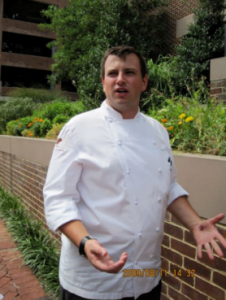 Photo by Jordan Wright - Chef David Varley beside his herb garden at the Four Seasons Georgetown Witnessing the enthusiasm of Chef David Varley talking about his herb and vegetable garden at the Four Seasons is like hearing a proud father wax adoringly about his perfect child. Varley is the Executive Chef at Michael Mina’s Bourbon Steak, the recently launched stylish restaurant in the Four Seasons, Georgetown location. He grew up on a small farm in New Jersey, came to DC via Las Vegas, and is one of our true champions of local, organic and sustainably harvested foods.
Standing in the 500 square-foot garden he designed with Mina, Varley is most inspired. While perched above the canal’s towpath, with runners streaming by and strollers listening in to his demonstration, he plucks, twists and thumbpresses herbs under your nose as you imagine into what gastronomic wonder this plant will be incorporated. With a highly creative ingredient-driven menu that revolves with the seasons, Varley is establishing Bourbon Steak as much more than a steakhouse. In fact that’s a misnomer. His approach is more in line with Michelin-starred French chef, Edouard Loubet who sources all his food seasonally from the fields around his native Provence and who has come to represent the Slow Food movement’s praise of the local farmer.
JW – Recently plans have been approved for a large rooftop garden at the hotel.
What will you plant in it?
DV – All the things that are fragile like green and yellow wax filet beans, Romano beans, eggplants, tomatoes, fennel, peppers, beets, Swiss chard, tender lettuces and squashes. Maybe cardoons.
We’ll keep the small garden for annual herbs that we now grow like lemon basil and thyme, lemongrass, hyssop, lavender, dill, chervil, cilantro, lovage and five kinds of mint…pineapple mint, peppermint, spearmint, “Best” mint and orange mint.
JW – Explain the LEED certification the hotel received and how it applies to the kitchen.
DV – Mainly we have been really proactive with our recycling and composting. We work with a company called EnviRelation that picks up all our “wet waste” including bones from the stocks, coffee grinds and leftover rice, tissue and paper products and transforms it into top soil for our garden. Guests are really responsive to the program too. There are notes around the hotel asking them to turn lights off. They love it. They really like to pitch in.
JW – I have a theory that if your mother or grandmother gardened eventually you’ll come around to it. Who was your biggest influence in the garden?
DV – My mother! I call her the Alice Waters of the East Coast. We grew up in New Jersey. My mother was an old hippie and lived on farms all her life. We had three acres with chickens and a large herb garden and supplied all the local restaurants around Sussex with herbs. She grew everything from beets and Swiss chard, to beans and squash and had ten different kinds of fruit trees. She was big into food production. She taught me about where food comes from. Kids that don’t grow up with that don’t know what a beet’s supposed to taste like when it just comes out of the ground.
JW – Do you ask your growers to grow certain things for you?
DV – Well, when I was in Las Vegas there was a woman who was also a dealer at the casino and she supplied me with my herbs. I told her, Paula, this is fantastic can you grow this and that for me. And before you know it she had 50 different herbs and we set her up with a business license and by the time I left for the East Coast she was supplying all the restaurants and casinos on the strip. We became great friends and the whole experience was really rewarding.
JW – Some chefs are literally foraging in the woods for herbs to use in dishes like wood sorrel for salads, nasturtium for pesto, hyssop infused into syrups, and even catnip in sauces. Do you forage around here?
DV – We do harvest a lot of things like wood ear mushrooms and wild Buckler’s sorrel makes an appearance too. We made carrot pollen with Queen Anne’s lace flowers.
In California I used to harvest wild fennel flowers around Santa Monica. We’d pickle them or dry out the pollen for sauces.
JW – What is the philosophy of Bourbon Steak?
DV – Michael’s (Mina) vision was to create a restaurant that is accessible and interesting, but not so far out that it would alienate our guests. It wouldn’t be pretentious or fancy, but a place to do fun things, like our truffled French fries. I have always wanted to make the most interesting and intricate food possible.
But I also wanted to put the best food on the plate no matter what the critics say. There’s nothing wrong with putting green beans on a plate if they’re the best green beans. I felt that I would have the freedom to do what I wanted to do here.  Photo by Jordan Wright - Passion fruit Panna Cotta at Bourbon Steak In New Jersey I grew up next door to Polish immigrants who also had a great garden. They used to make pierogi for everyone in the neighborhood. Now I can do them here too.
JW – Can you tell me what ingredients excite you now?
DV – I just got in 80 pounds worth of Balaton cherries from Michigan and jarred some in bourbon to use in our manhattans. And last night I did a Cherry in Foie Gras dish for a VIP guest who was drinking a beautiful Gevrey-Chambertin wine that is a perfect pairing with cherries.
And now, here comes my esteemed mixologist, Dwayne, dropping off his experiment of Bourbon and Cherry Cola. Okay, this is a virtual tasting. High five, Dwayne! We’ve got a winner!
JW – Who would you most like to cook for?
DV – My mom, and I wish Julia Childs were around so I could cook for her too. I like to cook for anyone who gets it. Every day I try to hit it out of the park for the real foodies who come in that might be drinking a special bottle of wine or who are having an anniversary or birthday. I’ll send over something special and I feel like Santa Claus whenever I can do that!
JW – What is the sauce that is poured over the top of the magnificent Passion Fruit Panna Cotta you serve at the restaurant?
DV – That was Chef Lincoln Carson’s signature dessert [Mina Group’s Corporate Pastry Chef]. He is one of the great, unsung heroes in the pastry world. He uses a lemongrass consommé. It’s a distilled essence of lemongrass.
This interview was conducted, condensed and edited by Jordan Wright.
For questions or comments contact Jordanwright@whiskandquill.com
By Jordan Wright
July 31, 2009
 The Restaurant 3 Bar and Grill is located at 2950 Clarendon Blvd. in Arlington. Photo courtesy of ThreeLockharts First there was the recession-busting “staycation” concept of staying at home for a week to re-energize and renew, with all the richness of offerings the DC area has to offer.
Now a new word has entered the stay-at-home lexicon: the foodcation; Southern-fried oysters and free-range burgers roasting on the grille, hush puppies as secretagogues and cold wheat ales on ice.
Last week, the Blue Points were roasting on the grill and the “wheaties” were on ice at this surprising outpost, Clarendon’s 3 Bar and Grill, owned by the local Williams and Cahill families and run by son, Jonathan Williams.
The number “3” after its name because the family also owns Whitlow’s On Wilson and the now-shuttered Whitlow’s Downtown.
 Photo courtesy of ThreeLockharts Bleu cheese chips at Restaurant 3.
On a recent glorious summer’s evening, in this casual and down-home roadhouse-in-an-upscale-setting, I began my “foodcation” with the tantalizing offer of a Southern cookout on the restaurant’s Boulevard-facing patio. The aroma of wood smoke and oysters, redolent with garlic, butter and fresh herbs (did I detect the subtle licorice scent of tarragon?), heralded my arrival.
Soulful Chef Brian Robinson has returned of late to his N’awlins roots to create a menu that reflects the dishes of his heritage. Along with the ambrosial oysters we sampled sweet, soft-centered, cast-iron-crusted hush puppies with honey butter, perfectly fried delicate green tomatoes, at the peak of their season, with melted goat cheese crumbles and tomato relish.
 Photo courtesy of ThreeLockharts Grilled brie at Restaurant 3. His Grandpa Dickey’s secret seasonings’ fried boneless chicken sat atop crispy waffles, dripping with bourbon maple syrup. It was followed by seared sea scallops balanced on stone-ground grits that had absorbed the sweet smokiness of morsels of Cajun-country tasso ham.
As a former chef at the beloved Georgia Brown’s, Robinson has captured the best of Southern cuisine. His fried dishes were light and refined…his fish prepared with a skilled wrist, each evocative of the deeply seasoned flavors reminiscent of Southern home cooking. This is the sort of menu you’d expect at a low-country gathering, where folks start the oyster roast fires early in the cool of the day and “visit” past sunset.
I caught up with Brian in his chaotic kitchen, just before dinner service, where he rekindled memories of his Grandpa Dickey, one of the renowned Tuskegee Airmen, while he prepared the dishes of his youth.
“These are the dishes he would prepare, always with the freshest ingredients around, “ Robinson recalls.  Photo courtesy of ThreeLockharts The farm to glass cocktail at Restaurant 3. For beer lovers there was an amazing selection that was carefully chosen for pairing with each course. Craft beers like Piraat Triple from Belgium, a “living beer” that continues to ferment in the bottle and is called an “adventure” because it’s flavors shapeshift in the bottle; Steamworks Kolscha, a crisp ale, with a hint of sweetness from Colorado; Dale’s Pale Ale, “hoppy and malty;” and Bell’s Oberon, an American wheat ale considered both spicy and fruity, sequenced the food.
On the cheese board was Cypress Grove’s Humboldt Fog a creamy, dreamy, surface-ripened blue with its iconic ribbon of ash and Point Reyes Bleu a firmer, yet mild mannered blue made with the raw milk from this Northern California farm’s own grass-fed cows.
They were paired with Abita Purple Haze, which features the after-brew addition of raspberry puree and Brooklyn Brown Ale that evokes raisins, apples, brown sugar and molasses and rounded out the offerings.
Restaurant 3 Bar and Grill features over 70 different beers a long list of wines and hand-crafted specialty cocktails made with farmer’s market fresh herbs and infusions.
Contact the writer at jordan@whiskandquill.com
If You’re Going…
3 Bar and Grill
2950 Clarendon Blvd.
Arlington, VA 22201
(703) 524-4440
http://www.restaurantthree.com/
|