Jordan Wright
December 2, 2014
Special to DC Metro Theater Arts
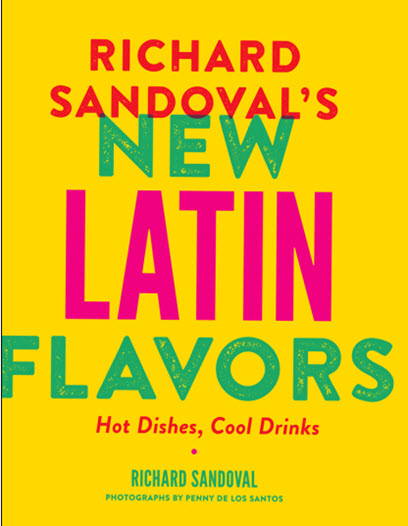
World-renowned chef and international restaurateur Richard Sandoval has penned his latest cookbook, New Latin Flavors – Hot Dishes, Cool Drinks (Stewart, Tabori & Chang) just in time to spice up the holiday season. Most of you will be familiar with his DC Latin/Asian fusion restaurants Zengo, Masa 14, El Centro D. F., but also Ambar with its flavor-forward Balkan dishes, La Sandia in Tyson’s Corner, or the chic, sleek Toro Toro, a churrascaria that opened downtown this April. With thirty-eight successful restaurants worldwide from Dubai to Paris and New York to Mexico, Sandoval’s empire is a testimonial to his delicious contemporary Latin cooking.
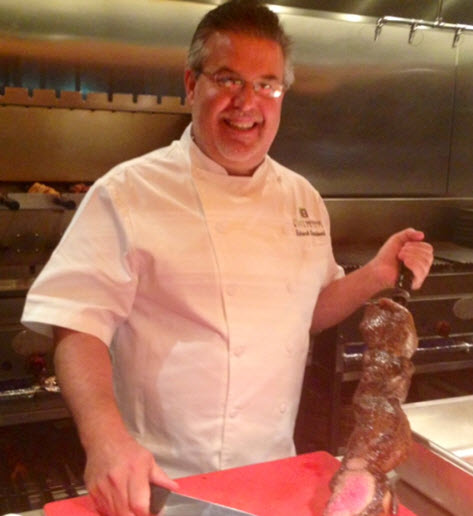 Richard Sandoval serving up churrasco at Toro Toro – Photo credit Jordan Wright In his fifth cookbook Sandoval has given us a collection of 125 inspired recipes that draw from the rich culinary traditions of Mexico, Peru, Venezuela and Argentina. Gorgeous photographs from Saveur photographer Penny De Los Santos grace the pages and highlight the mouth-watering recipes. For the first time Sandoval has tailored a cookbook expressly for the home cook spanning his repertoire of quesadillas, ceviches, arepas and enchiladas plus delicious Latin-inspired cocktails. Think tequila, mescal, cachaça, rum and pisco. Do you feel a party coming on?
Whisk and Quill caught up with Sandoval after he had dodged a blizzard in Denver to get to his DC book launch.
Whisk and Quill – What direction do you think food is going in today?
Sandoval – I think after the recession people’s ways of eating have changed dramatically. The last ten years it went very forward with all these molecular restaurants. I wanted to go retro. You know, back to our roots, back to comfort food and local ingredients, to make people feel comfortable again.
Would you agree that some of the best dishes from the past have been ruined by modernization? Although now I see more chefs returning to the classics but putting their own spin on it.
Absolutely! That’s always been my approach. A lot of my Latin cooking started with my grandmother in her kitchen. I would take dishes, like the mole, and interpret them in my way. I took the roots of these recipes and kept them the way they were meant to be.
What are your favorite ingredients?
I’ve always loved chiles and you’ll always see chiles in my cooking. But as far as cuisines, in the past three or four years I’ve been doing more Peruvian. I love it. And I love Thai food. I’ll be opening a restaurant in mid-January at the new City Center here in DC. It’s called Mango Tree. We brought a chef from Bangkok who worked at one of the other Mango Tree restaurants. I plan to take the roots of their cuisine, tweaking it a little bit as far as my flavor profile and presentation, but leaving the core as it is, maybe just changing the heat level and the balance. I’m incredibly excited. The restaurant already exists in London and Bangkok and Dubai. It’s classic Thai. I’ll just be readjusting it to what I do.
How do you begin to create a fusion dish? Do you start with a single ingredient or do you use your palate’s imagination?
I start with a single dish. The first fusion restaurant I did was Zengo, and Zengo means ‘give and take, back and forth’ in Japanese. It was two chefs, two cultures. First I would do a Latin dish. I hired an Asian chef to work with me and I would give it to him and he would ‘Asianize’ it. Then he would create an Asian dish and give it to me and I would ‘Latinize’ it. It’s two chefs collaborating. It wasn’t just me reinventing Asian, or what I thought it was. This way it made more sense to me.
Why is this book important to you?
When had my first Mexican restaurant twenty years ago, it was doing modern Mexican cuisine – – with more forward thinking. In this book I went retro with more traditional food and more comfort food. It’s very accessible to the home cook. It was very important to me to make sure that when people buy this book, they see it’s about having fun, that it’s not overly complicated where people would look at a recipe and say, ‘Ohmygod, I’ve got to go to Williams Sonoma to get the equipment and will I be able to find the ingredients?’ I wanted to be sure I made it very accessible and very fun.
Who would you most like to dine with living or dead?
I’ve always been very intrigued by Nelson Mandela. How someone can spend so much time in jail and then be able to come out and forgive. Most people would not be able to let go of what happened to them. He just kept moving on with his life and changed his country with his strong spirit and by sharing his ideas.
What if I asked you to name a woman?
Wow! I’ve always liked Shakira! She’s a beautiful woman and a great artist and I love her music.
Maybe she could sing to you.
I don’t think her husband would appreciate that!
We’re fantasizing here.
Okay, I could cook for her and she could sing to me.
Here are a few recipes to spice up any holiday party.
| PONCHE |
Striped Bass Tiradito |
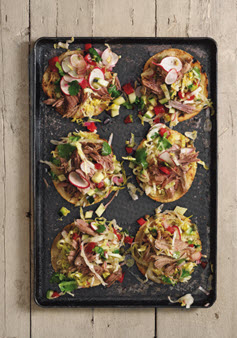
Grilled Tostada with Beef Salpicón |
 |
 |
 |
- 1/2 cup (2.0 g) dried hibiscus flowers
- (jamaica)
- One 3-inch (7.5-cm) cinnamon stick
- 1 cup (200 g) sugar
- 1/2 cup (130 g) tamarind pulp, broken
- into pieces (see Notes)
- Two 4-inch (10-cm) pieces fresh or
- frozen sugarcane, peeled and cut into
- 12 sticks (see Notes; optional)
- 24 fresh or drained bottled tejocotes
- (see Notes)
- 2 ripe guavas, cut into 12 wedges
- (see Notes)
- One 375-ml bottle (1. cups) 100%
- agave tequila, brandy, or light rum
- 1/4 cup (60 ml) orange-flavored liqueur,
- such as Grand Marnier
- 12 pitted dried plums
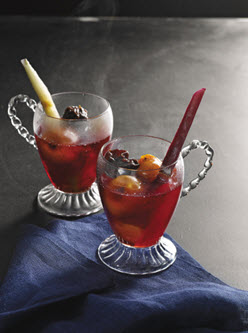
The Mexican warm fruit punch of the holiday season, ponche is sometimes nothing more than spiced syrup with booze. My family recipe is better, and infused with the tropical flavors of hibiscus and tamarind.
Serves 10 to 12
[1] Bring 2. quarts (2.5 L) water to a boil in a large nonreactive saucepan over high heat. Remove it from the heat and add the hibiscus flowers and cinnamon stick. Let them stand for 5 minutes. Add the sugar and tamarind and bring them to a simmer over high heat. Reduce the heat to medium-low and simmer, stirring often to break up the tamarind, for 5 minutes. Strain the liquid into a large heatproof bowl, pressing hard on the solids; discard the solids.
[2] Return the liquid to the pot. Add the sugarcane, if using, and bring the liquid to a boil over high heat, stirring to dissolve the sugar. Reduce the heat to medium and cook the liquid at a brisk simmer for 5 minutes. Strain it again to remove any tamarind debris.
[3] Return the tea to the pot and add the tejocotes and guavas. Simmer until the guavas are tender, about 5 minutes. Stir in the tequila and liqueur and simmer just until the mixture is hot. Remove it from the heat, add the plums, and let them stand for 5 minutes. (Do not add them earlier or they will get too soft.)
[4] To serve, return the pot to very low heat to keep the ponche warm. Ladle the ponche into mugs, adding the fruits to each serving. Serve it hot. Notes You can substitute 1⁄3 cup (75 ml) tamarind concentrate for the tamarind pulp. If neither is available, use . cup (120 ml) fresh lemon juice. Fresh or frozen sugarcane is available at Latin groceries and large supermarkets, and is often sold peeled. If the thick skin needs to be removed, use a large knife to chop the cane into manageable 4-inch (10-cm) lengths. Stand the pieces on end to cut away the peel. Cut the sugarcane lengthwise into thick sticks. Tejocote is a small round stone fruit (that is, with a large seed in the center). It is sold fresh at Mexican groceries around Christmas time, and in jars year-round.Kumquats or crabapples are good substitutes because they are similar in size to tejocotes. You may want to alert your guests that the tejocote seeds can be spit out. Pineapple guava, about the size of a large lime, is the most widely available variety around Christmastime. If it is not available, substitute about one-quarter of a pineapple, peeled, cored, and cut into bite-size pieces. Goya, the leading Latin food product manufacturer, sells a nonalcoholic ponche in a jar with enough tejocotes, sugarcane sticks, and guavas for this recipe. Drain and discard the liquid—you really just want the fruit. Leave the tejocotes intact, but cut the sticks and guavas as needed to yield twelve pieces of each. |
with Ponzu, App le & Radish Tiradito de lubina rayada con salsa ponzu, manzana y rábano
- 1/2 Granny Smith apple, peeled
- 2 large radishes, trimmed
- 14 ounces (400 g) skinless striped
- bass, cut on a diagonal into .-inch
- (6-mm) slices
- 1Ž2 cup (120 ml) Ponzu, homemade
- (page 48) or store-bought, chilled
- Finely grated zest of 1 large lemon
- Sriracha, for serving
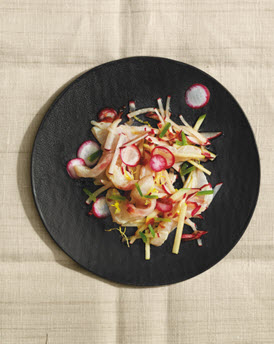
Tiradito is the South American version of ceviche, and it often has Asian influences, such as the ponzu in this recipe. It is one of the lightest (and quickest) first courses you’ll ever make, yet at the same time, it is one of the most flavorful. There are many good brands for sale, but it is also easy to make your own (page 48), and it is worth the minimal effort for this recipe, where it plays such a big role.
Serves 4
[1] Just before serving, use a V-slicer or mandoline to cut the apple and radishes into julienne. (You can also use a chef’s knife.) Combine them in a small bowl.
[2] For each serving, fan the bass on a chilled
serving plate with a rim. Spoon 2 tablespoons of the ponzu around, but not on, the bass.Top each with one-quarter of the apple mixture and the grated lemon zest. Serve immediately, with the Sriracha on the side. |
tostada con salpicón de res
For the Salpicón Dressing:
- 1/4 cup (60 ml) distilled white vinegar
- 3 tablespoons fresh lime juice
- 3 tablespoons minced red onion
- 2 teaspoons dried Mexican oregano,
- crumbled
- 1 teaspoon kosher salt
- 1/2 teaspoon freshly ground black
- pepper
- 3/4 cup (180 ml) olive oil
- For the Grilled Tortillas:
- 6 corn tortillas
- Canola oil, for brushing
- For the Salpicón:
- 1/2 head iceberg lettuce, cored and
- shredded
- 1/2 seedless (English) cucumber,
- cut into 1/2-inch (12-mm) dice
- 2 plum tomatoes, seeded and cut into
- 1/2-inch (12-mm) dice
- 4 radishes, cut into 1Ž4-inch
- (6-mm) dice
- 1/2 cup (90 g) drained nonpareil capers
- 1/4 cup (5 g) coarsely chopped fresh
- cilantro
- 3 cups (645 g) Shredded Beef Filling
- with Tomatoes and Chilies (page 175),
- at room temperature
- 2 ripe Hass avocados, thinly sliced
There are many different versions of salpicón, the hearty salad that is a specialty of both Mexican and Colombian cooks. The constants are shredded meat (or poultry or chopped seafood) and a sharp dressing. I like to serve it on grilled tortillas for a smoky crunch that everyone loves. (The tortillas can also be fried in oil, if you wish.)
Serves 6
[1] Make the dressing: Whisk the vinegar, lime juice, onion, oregano, salt, and pepper together in a medium bowl. Gradually whisk in the oil.
[2] Grill the tortillas: Prepare an outdoor grill for direct cooking over medium-high heat. For a charcoal grill, let the coals burn until they are covered with white ash and you can hold your hand about 1 inch (2.5 cm) above the cooking grate for about 3 seconds. For a gas grill, preheat it on high, then adjust the heat to 450oF (230oC). Or preheat a stovetop grill pan over medium-high heat.
[3] Lightly brush the tortillas on both sides with oil. Place them on the grill and cook, with the lid closed as much as possible, turning them occasionally, until they are crisp and lightly charred, about 2 minutes. Remove them from the grill.
[4] Make the salpicón:
Toss the lettuce, cucumber, tomatoes, radishes, capers, and cilantro with the dressing in a large bowl.
[5] Place a tortilla on each of six dinner plates. Divide the lettuce mixture among them, topped by the beef. Top them with the sliced avocado and serve immediately.
Shredded Beef Filling with Tomatoes & Chilies Ropa vieja con tomates y chiles
- 2 tablespoons canola oil, plus more
- as needed
- One 2.-pound (1.2-kg) beef brisket,
- fat trimmed to 1⁄8 inch (3 mm)
- Kosher salt and freshly ground black
- pepper
- 1 medium yellow onion, chopped
- 4 jalapenos, seeded and coarsely
- chopped
- 4 garlic cloves, minced
- One 28-ounce (785-g) can fire-roasted
- tomatoes
- 2 teaspoons dried Mexican oregano
- . cup (5 g) finely chopped fresh
- cilantro
- 2 tablespoons fresh lime juice
- 1 teaspoon mesquite-flavored liquid
- smoke (optional)
Slowly simmered with tomatoes and jalapenos, this braised brisket is called ropa vieja (“old clothes”) because the shredded meat looks like raggedy clothes. There will be about a cup or so of the cooking liquid left over—be sure to save it as a sauce for pasta or polenta. You may even want to serve this as a main course with Mashed Potatoes with Oaxaca Cheese (page 145).
Makes about 4 cups (910 g)
[1] Position a rack in the bottom third of the oven and preheat it to 350oF (175oC).
[2] Heat the oil in a Dutch oven over medium-high heat. Season the brisket all over with 1 teaspoon salt and . teaspoon pepper. Place it in the Dutch oven, fat-side down, and cook it, turning after 5 minutes, until it is nicely browned, 10 to 12 minutes. Transfer the brisket to a plate.
[3] If needed, add another 1 tablespoon oil to the Dutch oven. Add the onion, jalapenos, and garlic and reduce the heat to medium. Cook, stirring them occasionally, until the onion is softened, about 3 minutes. Stir in the tomatoes and their juices with the oregano and bring them to a boil. Return the brisket to the Dutch oven and add enough hot water to come about three-quarters up the side of the meat. Bring it to a boil over high heat.
[4] Cover the Dutch oven and transfer it to the oven. Bake until the brisket is fork-tender, about 2. hours. Transfer the brisket to a carving board, tent it with aluminum foil, and let it stand for 10 minutes. Set the cooking liquid aside.
[5] Using a sharp knife and your fingers, shred the brisket with the grain. Roughly cut the shredded beef across the grain into bite-size pieces. Transfer it to a bowl. Skim off the fat on the surface of the cooking liquid. Stir in about one-third of the cooking liquid to lightly moisten the shredded beef. Add the cilantro, lime juice, and liquid smoke, if using, and mix it again. Season the beef to taste with salt and pepper. (The beef can be cooled, covered, and refrigerated for up to 2 days or frozen for up to 2 months. Reheat it before using.) |
Jordan Wright
November 30, 2014
Special to DC Metro Theater Arts
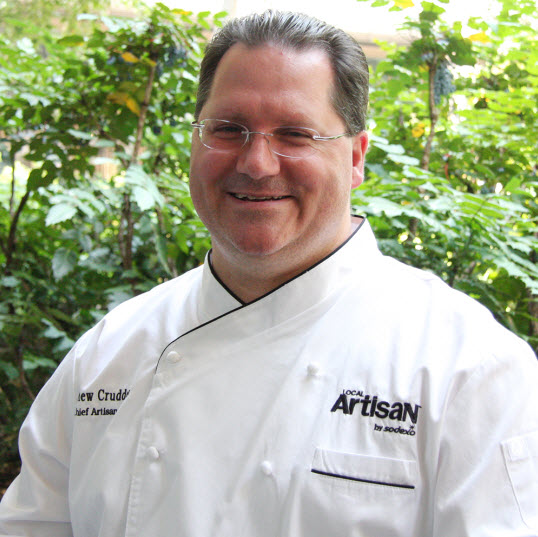 Matthew Crudder – Executive Chef at National Geographics Presiding over National Geographic’s Washington, DC kitchens for over two years, Executive Chef Matthew Crudder draws on his considerable experience. A graduate of the New England Culinary Institute, the 45-year old chef hails from Ann Arbor Michigan, where he briefly attended the University of Michigan before finding his passion for cooking. His resume reads like a primer for aspiring chefs – – The Four Seasons in Las Vegas and Chicago, the Ritz-Carlton in Philadelphia, the Fairmont in Washington, DC and Sodexo clients, AOL, Gannett, USA Today and Fannie Mae. “NatGeo”, as it is fondly called, is currently served by Sodexo who launched their “Local Artisan” program at NatGeo’s headquarters. Crudder had taken a lead role in sustainability throughout his time at Sodexo and eagerly took the lead in this innovative program described as “a locally-sourced sustainable process highlighted by a chef-driven approach to natural cooking”.
On December 4th the Society will host a local, sustainable farm-to-table dinner in its historic Hubbard Hall, the first headquarters of the National Geographic Society, located at 1145 17th St., NW Washington, DC in DC’s Golden Triangle District.
Inspired by the exhibition “FOOD: Our Global Kitchen”, the evening will feature a guided five-course meal with local wine, beer and cider parings. During dinner Archivist Renee Braden will share the history of National Geographic and discuss its rich relationship with food. To purchase tickets go to http://events.nationalgeographic.com/special-events/2014/12/04/farm-table-hubbard-hall/
Earlier this week Whisk and Quill took the opportunity to speak with Crudder in advance of NatGeo’s exciting event.
What are your earliest food memories?
Growing up my family kept gardens and I started my involvement at home when I’d hear, “The water is about to boil go and get the corn or go pick the string beans.” Or “If you’d like jam on your toast tomorrow, here’s a bucket. Go collect the blackberries on down by the road.” So my grandmother and mother were big influences in terms of really fresh all-American cooking. I mean in the more traditional sense as opposed to the concession stand or freezer aisle.
What was your first professional experience?
I started off in an Italian kitchen and fried zucchini was my specialty for the first two days of my training. But the first real dish I learned to prepare from start to finish was osso buco. And it’s still a dish that I love to prepare.
I like Marcella Hazan’s recipe for osso buco.
Well, actually on many occasions when people say they want to learn to cook, the first thing I do is hand them Marcella Hazan’s Essentials of Classic Italian Cooking!
Before I’d even been to cooking school I remember making the first couple of recipes from her book, which gave just four ingredients – – although the results were so much more than that.
Her description of the techniques is what makes her recipes so exceptional. It really helps you to understand how the process should be looking and smelling so you know what you’re supposed to be doing. And then there’s that sense of risk that comes with doing the braise! You put it in the oven and you can’t do any more. You just have to wait.
What style of cooking is your favorite?
I really like what we’re doing now with the “Local Artisan” – – the farm-to-table style program that allows simple cooking techniques and the product itself to showcase the quality of the food. A bit of salt and pepper, olive oil and lemon juice with a properly sautéed or roasted item is maybe all you need – – not hiding things under heavy sauces and sugars and things like that. The food is just so honest and recognizable the flavors really shine through. And it’s healthier too – – if you’re careful with the oil!
We did a small test for the dinner we’ll be doing next Thursday and we’ve been passing it around the kitchen today to let everybody sample it. It’s just unadorned goat’s milk ricotta. There are only four ingredients to making it. But before we drizzled it with olive oil or added salt and pepper, the response we got, that it was so fresh and creamy and wonderful, was so rewarding.
Can you describe the types of events typical to NatGeo that you create dinners for?
The part of what I love about working for National Geographic is that whatever they’re involved in we’re going to be doing themes based on their event schedules. Everyday I practice and focus on our cuisine using natural products and techniques and then I get to use these adventures on our special events.
We’ve done a man-on-Mars themed dinner and a Spinosaurus themed dinner as well as different cultural menus. For South America we focused on the Amazon and Peru for the “Peruvian Gold” exhibit. There are a lot of opportunities to be creative. I do research to learn about cuisines I might not know about. For example, for a group from Durban, South Africa, I got to dig around on the Internet and source some products to make it as authentic as possible, and our guests really got into the spirit of it.
Can you tell me a bit about the plans for the upcoming dinner on December 4th?
The house made goat’s milk ricotta I mentioned will be paired with roasted and pickled beets. Some of the other elements I want to hold in surprise. In terms of the event it will be a farm-to-table event. But here we are in the beginning of December in the Mid-Atlantic and many things are not growing at this time of year. When we found out about the event we made up some tomato jam at the height of the season for heirloom tomatoes.
I’m not going to serve a local hothouse tomato that doesn’t taste like anything just because it’s local. And I’m not going to say we can’t have tomatoes because they’re not growing in the field near here now. That wouldn’t be what was done in a more traditional setting either. Back then you would have to take the bounty and preserve it in as many ways as you could. So we have a number of items sprinkled around the menu that are taken from this summer’s bounty which we have prepared and preserved – – whether it was by drying or canning or freezing or pickling – – to hold on to the peak of freshness.
We’ll be featuring key ingredients in every dish that have been locally sourced. We have a direct relationship with farmer/owner Greg Keckler of Orchard County Produce in Gardeners, PA who comes here nine months out of the year on Tuesdays. He supplies subscriptions for a CSA we have in the building and holds a farmers market in our courtyard. His quinces, apples, root vegetables, Swiss chard and kale will be incorporated into the menu.
Will there be other local providers involved in the dinner?
I work very closely with my meat and fish providers to select products that will be readily available locally. The beef we’ll use is Certified Angus Beef but it’s differentiated from other Certified Angus Beef by the fact that the product comes from a “single stream” from a particular small group of farms in Pennsylvania, so the animals are born and raised there. The people that raise the animals also grow the feed for the animals and they’re processed and shipped locally. That’s different from the standard way most Angus cattle are raised. Their entire life span, as well as what they’ve been fed, is all along the line of sight of the ranchers that handle them. So that’s very exciting.
We also will feature some wonderful seafood from the Chesapeake region. And we are working with J. Q. Dickinson Salt-Works from the Kanawha Valley in West Virginia using their wonderful salt. The fact that something so basic can be a hand made product, I think is really special.
We’re not going to say, oh, that product is one county away, so we can’t use it. What we try to share with our guests is the evolution and story of how the food supply evolves and ebbs and flows through the course of the year.
One of the things that we’ve done here is to compare food miles, something I’ve shared on National Geographic Live. We don’t really track it, but we did compare how many miles food travels – – showing how near or far products have to travel when they are purchased from standard sources. So if you are basing it on the availability of food, the radical difference in terms of the miles traveled by the food is a factor of, not tens, but hundreds of miles and we’re very aware of that.
Jordan Wright
November 25, 2014
Special to The Alexandria Times
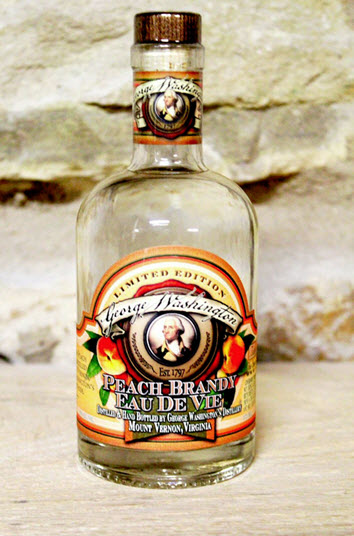 Peach Brandy launch – Photo credit DISCUS Eight hundred eagerly-anticipated bottles of George Washington’s limited edition Peach Brandy Eau de Vie (translation: “water of life”) went onto the shelves of the Mount Vernon Estate gift shop just in time for Christmas. Produced at the restored distillery this huge undertaking dwarfed Washington’s eight gallons in sales recorded back in 1798, reflecting a more than two-century price increase from $1.00 a gallon to a considerably adjusted $150.00 per 375ml bottle.
It’s an elegant pour, meant to be sipped, and one Washington didn’t expect to be chug-a-lugged. Not exactly a teetotaler himself, he wrote a letter to an employee, whom he both chastised and cautioned for drinking excessively.
When it first opened in 1798, the distillery was run by a canny Scotsman, James Anderson, and his son John. James had convinced Washington to produce whiskey later introducing the eau de vie, which are made today according to the early recipes. Producing 11,000 gallons of whiskey in its heyday, it became the largest distillery in America, providing two distinct grades of whiskey, which became available throughout the country, including in Alexandria’s many taverns.
Thanks to the efforts of archaeologists who discovered the foundations in 1997 and working off a grant from the Distilled Spirits Council of the United States, the distillery was restored in March of 2007 after being destroyed by fire in 1814. Following ten years of research and construction, the distillery now produces one hundred gallons of rye whiskey in small batches twice a year. Brandy is made every other year.
Both are made the old-fashioned way using 18th century distilling techniques. Workers hand-cut up to 51 cords of wood per month to stoke the direct wood fires beneath the still, and giant wooden paddles are used to stir the mash, which then is transferred to a series of hogsheads. “Manning the paddles is like steering a cement canoe down the river,” says Mount Vernon’s Master Distiller Steven Bashore.
 Mount Vernon Master Distiller Steven Bashore – Photo credit Jordan Wright To achieve 300 gallons of whiskey, 8,000 pounds of rye, corn and malted barley from grains are sourced from Virginia farms. Locally grown Virginia peaches become the base for the Peach Brandy Eau de Vie that George and Martha served at the mansion. Ledger entries from 1798 show sales of eight gallons to the public. But by 1799 with production in full swing, the First Couple were graciously serving 60 gallons of the precious peach elixir to their many guests.
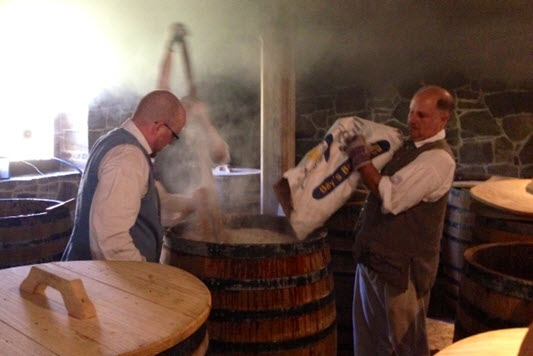 Adding the grains to the make the mash – Photo credit Jordan Wright To recreate this “new” product two of America’s leading brandy distillers were brought in, Ted Huber of Starlight Distillery in Indiana who procured five 55-gallon drums of very fine peach juice, and Thomas McKenzie of Finger Lakes Distilling in New York. Both men assisted Bashore in the production and bottling of the historic brandy, which has been described as having tasting notes of candied peaches and peach cobbler with a hint of cinnamon and which I can personally attest to.
Dedicated in 2007 by Britain’s Prince Andrew, the reconstructed distillery featuring the distilling process “from seed to still” is open to the public 365 days of the year. Located at 5513 Mount Vernon Memorial Highway, Alexandria, VA 22309, the distillery is three miles south of Mount Vernon Estate and Gardens. For hours of operation go to www.MountVernon.org
To get you in the holiday spirit, or spirits as the case may be, here is a recipe for Martha Washington’s Rum Punch.

Martha Washington’s Rum Punch
Makes 6 -10 servings
- 3 oz. of White Rum
- 3 oz. of Dark Rum
- 3 oz. of Orange Curaçao
[or Peach Brandy Eau de Vie]
- 4 oz. of Simple Syrup
[equal parts sugar to water, warmed till sugar is dissolved]
- 4 oz. Lemon Juice
- 4 oz. of Fresh Orange Juice
- 3 Lemons quartered
- 1 Orange quartered
- ½ Tsp. Grated nutmeg
- 3 Cinnamon sticks (broken)
- 6 Cloves
- 12 oz. Boiling water
In a container, mash the orange, lemons, cinnamon sticks, cloves, and nutmeg. Add the syrup, lemon, and orange juices. Pour the boiling water over the mixture in the container and let cool for a few minutes.
When cool, add the White Rum, Dark Rum, and Orange Curaçao [You may substitute for Peach Brandy]. Strain well into a pitcher or punch bowl (to remove all of the spice marinade) and serve over ice in goblets and decorate with wheels of lemon and orange.
Dust with a little nutmeg and cinnamon and enjoy a sip of American history.
Cary Pollak for Whisk and Quill
November 5, 2014
On November 8th and 9th the MetroCooking Show will make its ninth appearance in the nation’s capitol at the Walter E. Washington Convention Center and each year it has outdone itself. Last year over 200 vendors displayed and sold their wares at the show. This weekend the number of specialty food exhibitors will exceed 300, offering everything from cookies and scones from A Bit More Sweets and Specialties to coffee products from the Zen Den. An exciting new development this year is the debut of natural and organic foods at the Natural Foods Pavilion.
 Guy Fieri Marketplace General Admission is good for one day and allows access to the Tasting & Entertaining Workshop Area, as well as cooking demonstrations on the James Beard Stage and the Exhibitor Marketplace. For an additional fee celebrity chefs will be demonstrating their culinary talents on the Celebrity Stage. Check out Guy Fieri host of Diners, Drive-Ins and Dives who will appear on stage Saturday and Bobby Flay of Food Network and the Cooking Channel who has some surprises for his fans on Sunday. Both will be preparing a few of their favorite dishes.
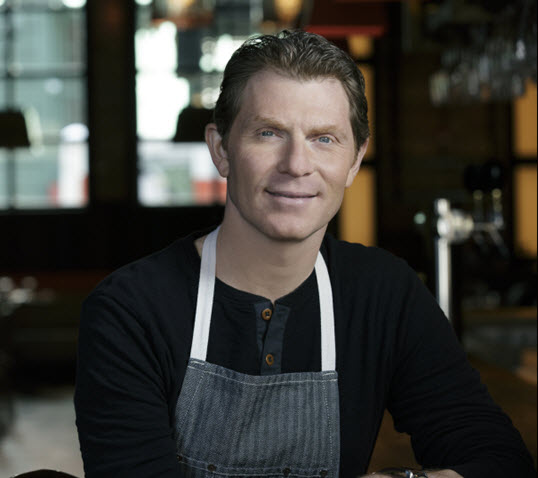 Bobby Flay Throughout the day professional instructors from the renowned cooking school of L’Academie de Cuisine will hold classes on holiday dishes, hors d’oeuvres, knife skills, cake decorating and more, and demonstrations on the James Beard Cooking Stage will feature eleven notable local chefs including Cathal Armstrong of Restaurant Eve, Vikram Sunderam of Rasika, Bertrand Chemel of 2941 and Luigi Diotaiuti of Al Tiramisu. Tasting and Entertaining Area workshops will focus on Turkish and Italian cuisines, nutrition, cocktails, spices, gluten-free desserts and more.
On Sunday from 12:30 pm to 3:30 pm, the Restaurant Association of Metropolitan Washington (RAMW) will host the Grand Tasting Pavilion to present samples of specialties from over 50 of Washington’s most distinguished chefs and restaurants. The ticket for this event includes complimentary Marketplace General Admission valid on Sunday only.
There is plenty to see – – and buy. So bring along your Christmas shopping list and get cookin’!
Saturday, November 8th and Sunday, November 9th at the Walter E. Washington Convention Center, 801 Mount Vernon Place, NW, Washington, DC. 20001
Saturday from 10 – 6 pm and Sunday from 10 – 5pm
General Admission – $20.00 in advance; $24.50 at the door.
Children ages 4 to 12 – $10.00 in advance; $13.50 at the door, Children under 4 free.
Tickets to celebrity theater performances, cooking classes and the Grand Tasting Pavilion are sold separately. For more information visit www.MetroCookingDC.com
Jordan Wright
October 8, 2014
Special to DC Metro Theater Art
Photo credit – Jordan Wright
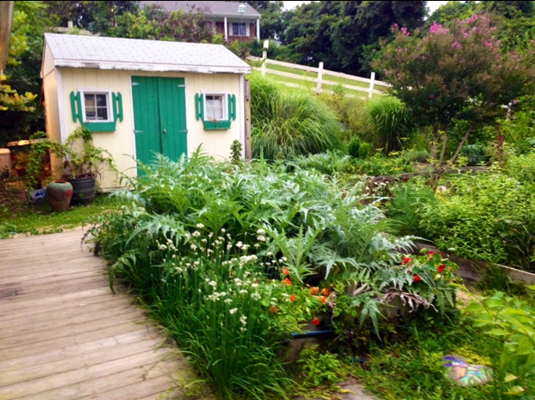 The potager For many years Ferran Adria’s now shuttered elBulli held the title of “The Best Restaurant in the World”. Since then the fiercely sought after accolade has gone to his former student Rene Redzepi, Chef/Owner of Noma in Copenhagen, Denmark. Four years ago Redzepi’s publisher Phaidon sent me a copy of his coffee table size cookbook. “Time and Place in Nordic Cuisine”, which at the time I included in my “Best Cookbooks of 2010”. The book continued my interest in the science and artistry of elegantly prepared wild foods. In 2002 I’d read French chef and forager extraordinaire Michel Bras’s book “Essential Cuisine” and saw how a Michelin-starred chef could elevate wild local plants, locally caught seafood and humanely raised animals to their highest culinary purpose while at the same time employing a flower-strewn, naturalistic style.
A grazer since childhood, I munch on violets, honeysuckle and the early blossoms of the redbud tree. And if I’m lucky enough to find them I still chomp on wild ramps, dandelion leaves and the tender watercress that pops up along small streams and culverts in the spring. I consider it homeopathic and secretly believe it’s what keeps me from seasonal allergies.
Tarver King is a chef who answers the call of the wild too. When we first met he was cooking at the Ashby Inn in Paris, Virginia where he wedded molecular gastronomic techniques to simple, local ingredients and spent many hours putting up jars of glistening cantaloupe jelly, pickled vegetables and berry jams from ingredients he picked from the bounty of a small garden behind the inn.
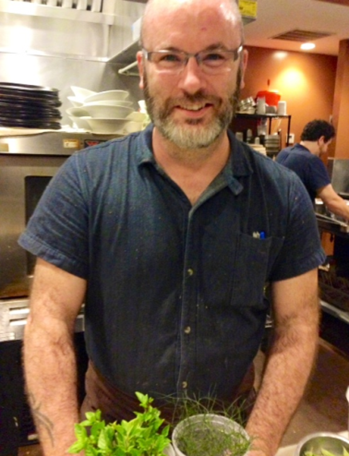 Chef Tarver King After gaining experience in such legendary kitchens as The French Laundry, Le Bec Fin, The Inn at Little Washington and the Woodlands Inn & Resort in South Carolina. King now has found is roost in the kitchen at the Restaurant at Patowmack Farm where he is the architect of the menu. Using the bounty from owner Beverly Morton Billand’s vegetable and herb gardens, wildcrafting “weeds” and morels from the nearby woods and sourcing from the 40-acre farm where Billand raises chickens, ducks and beef cattle, he has a myriad of options at his command, including fish from the sustainable catches of local East Coast fishermen.
King’s commitment to local, seasonal and organic, as well as his compelling artistry has not gone unnoticed by the industry. He was named “Grand Chef” of the year by Relais and Chateau, received the RAMMY award as “Chef of the Year” 2013 and this year earned the coveted title of “Best Chef – Mid-Atlantic” from the James Beard Foundation.
Reflecting his keen attention to land, sea and farm, the menu is divided into “Found”, heavier on seafood, “Grown”, some meat but largely paleo, and “Raised”, which leans more towards meat protein. Each affords the diner with amuses bouche, noted as “snacks”, and a five-course progression menu of the chef’s design.
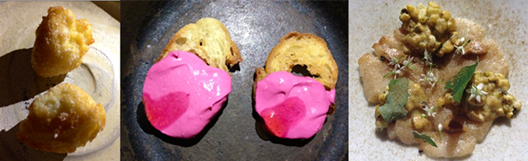 Snacks before dinner – Gougeres – Beet Cream Some of the menu’s descriptors – smoked kraut, cicely gastrique, lambs quarters, sorrel soda, chicory root custard and hyssop ice cream – reveal the adventure.
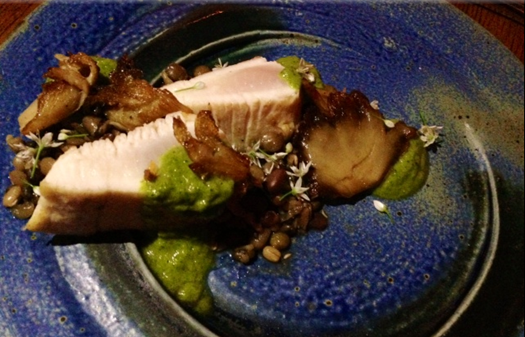 Seared Wahoo with ramp chimichurri King, who spends three days a week cooking and the rest experimenting, started us off with delicate gougeres and a beet cream toast, followed by Scallop Mi-cuit, a semi-cooked scallop enhanced by creamed corn, chanterelle puree, and lambs quarters, a wild edible. Crispy Shrimp is sauced with cicely gastrique, ratatouille puree, fennel fronds and mustard cream – each element contributing to the nuanced whole of the dish. My dinner partner who opted for “Raised” was busy devouring the Pork Fried Chicken with whey and mustard butter, smoked kraut and pole beans, which preceded Beef Cheek with whipped grits, grilled beets, horseradish and nasturtium leaves. A happy carnivore, indeed.
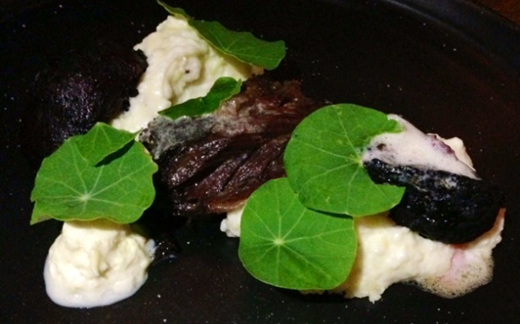 Beef Cheeks with whipped grits and nasturtium leaves The dining room is an enormous brick-paved, all-glass greenhouse (sans plants). A separate white-tented space for outdoor dining features a view of the river and Harpers Ferry Bridge beyond and is decorated with nosegays and candles. Very romantic.
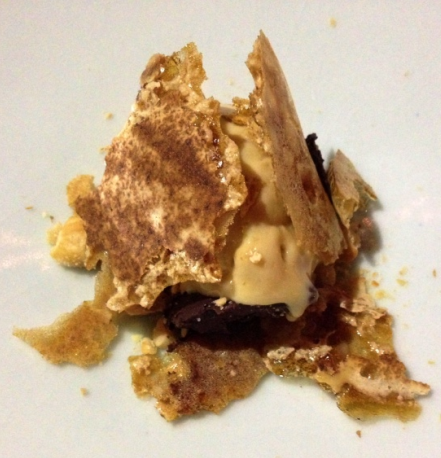 Chicory root custard with cocoa nib crumble, puffed rice and whipped fromage blanc Courses came swiftly delivered by attentive and gentile wait staff, who re-described each dish as it was set forth. We finished a spectacular evening of gastronomic delights and surprises with a lovely Silver Needle Jasmine white tea from local purveyor Shab Row Tea Emporium in nearby Frederick, Maryland.
Reservations, of course. www.PatowmackFarm.com
Cary Pollak for Whisk and Quill
August 17, 2014
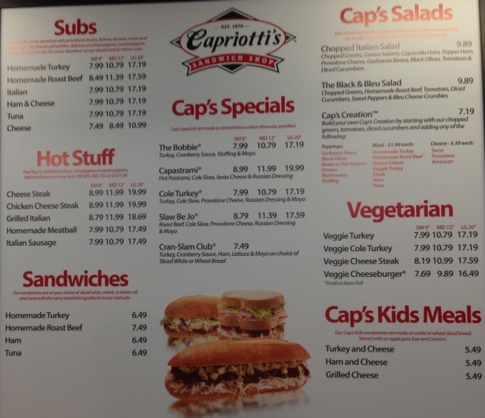
The first Capriotti’s Sandwich Shop opened in Wilmington, Delaware in 1976. Lois Margolet and her brother Alan started their business in Wilmington’s Little Italy section, but it was turkey that put them on the map. Building their menu around the freshly roasted bird set them apart from the many sandwich shops in the area, and soon they were beating the stuffing out of the competition. Today there are more than 105 company-owned and franchise locations in 14 states across the country. Their unique menus feature subs in three sizes, as well as sandwiches and salads comprised of various meats, cheeses and vegetables. Highlights among their offerings include three types of spicy peppers and vegetarian options with soy-based meat substitutes.
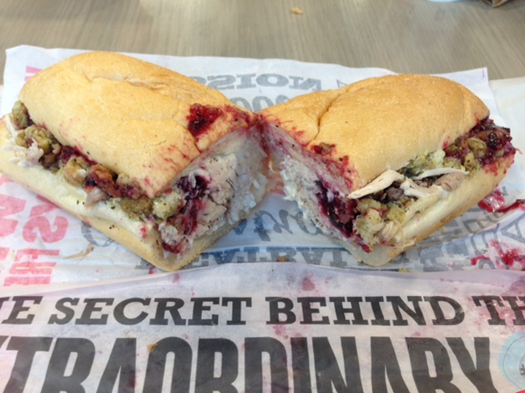 “Bobbie” Sub sandwich Capriotti’s second location in the Washington Metro area (in addition to the shop at 18th and M Streets, NW in the District) opens on August 25th at 11:00 am at 1500 Wilson Boulevard in Rosslyn. The first 100 patrons in line will receive a free “Bobbie” sandwich, with the first 50 of those also receiving certificates for “Bobbies” for a year. This “Thanksgiving on a Roll” sub sandwich is the most popular item on the menu and consists of slow-roasted turkey, their special recipe cranberry sauce and an herbed dressing (Northerners know it as stuffing), and mayo. This comfort food combo is known as Vice President Joe Biden‘s favorite sandwich, and has earned “Best Of” awards in Las Vegas, San Diego, Delaware, Dallas and other cities around the country.
 L to R : Joe Combs, Director of Operations.
Paul Rothenburg, Rosslyn BID. George Vincent, Jr.,the owner.
Jordan Schneider, Director of Catering George Vincent, Jr. is the 33 year-old local businessman who introduced Capriotti’s to the DC area, and he plans to open a dozen outlets in the next two years. Mr. Vincent is off to a good start and clearly intends to earn our thanks, giving us some of the best and most interesting sandwiches available in the metro area. For more info visit www.capriottis.com.
Photo credit to Cary Pollak
|