Jordan Wright
January 2010
I was nearly raised in a palace in the rugged highlands of Northern India.  A palace in India When my model/artist/writer/socialite mother found herself smack-dab in the throes of a divorce in the swinging ‘60’s, she threw herself Eva Tanguay-style into New York’s social whirl attending the opera, ballet and nightly galas. Invitations by the handful would appear daily on heavy vanilla card stock from every hostess and charity committee in town. It was at one such soiree that she met a very distinguished man who began to ardently court her.
 Narendra Singh Sarila at the Harry Ransom Center, University of Texas, where he gave a presentation based on his book about the partition of India. Enter the Maharajah Narendra Singh from the Princely State of Sarila, who had still retained his palace with its many lands and servants, though along with many other rulers when independence ended the days of The Raj, he had been stripped of a great deal of the usual privileges and status. I was fifteen, wildly impressionable and safely ensconced in an all-girls boarding school. On holidays I would often see the elegant maharajah when his trusty manservant would fill the kitchen with the alluring aromas of exotic curries in our East Side apartment. This was my first introduction to Indian cuisine aside from the occasional tandoori chicken my mother would whip up in her small clay pot when the cooking spirit moved her.
On my tiny bunk bed in a frigid dormitory in New England I dreamed of life in a palace. I conjured up halcyon days of jewels and robes, elephant hunts and lavish parties. What fodder for a young girl’s fecund imagination! As it happened he had a handsome son about my age. Now I had a vested interest.
In letters home I began my indelicate campaign of pleading and cajoling, hoping to sway my mother to marry him. Eventually the maharajah returned to India pressing my mother through the mails to accept his proposal. One day a massive tiger-skin rug, postmarked Sarila, arrived. I felt certain such an extravagant gift would seal the deaI, but my mother was far less moved, and alas, it was not to be after a prince showed up on our doorstep and trumped the dear maharajah. But that’s another story for another day.
It’s a curious thing how memories will come flooding back after so many years, triggered by a mere morsel, but this is what happened to me, in a most unlikely place, as I sampled the Indian cooking sauces produced by a small company named Stonehouse 27 Spice Company on the cement floor of a convention hall in Washington, DC where I occasioned to meet the owner of a fledgling company out of Germantown, Tennessee.
 Sharon Fernandes creator of Stonehouse 27 Indian cooking sauces - photo by Jordan Wright Sharon Fernandes descends from a family accustomed to bridging cultural divides. A trained engineer, she was born in what is now called Mumbai of a British father and Portuguese mother who worked as a caterer. Later she made her home in Dubai and Australia where she received her degree from the Royal Melbourne Institute of Technology.
A few years ago she had a slap-to-the-forehead moment. “My right brain and left brain finally hooked up,” she says of her epiphany and decision to start the company. “I created the line for my family. I wanted them to have the best.”
Her six beautiful sauces made using stone-ground spices reflect her combined heritage. In a recent phone call she told me that she grew up eating steak and potatoes. “A part of India is all Christian and we love our pork and beef,” she explained. “With that in mind, I made my line of sauces compatible with meats and seafood.”  Gourmet sauces from Stonehouse 27 Spice Co - photo by Jordan Wright Working daily on-site from start to finish in the cooking process she explains, “Everything is done in a very staged approach – one step at a time. At first I tasted over a dozen types of onions before selecting the perfect one for its flavor and consistency. I now get all my onions from Oregon and we sauté them for two hours, allowing them to achieve just the right texture and deepest flavor, before the garlic is added. It all gets just the right amount of cooking as it would in a home or restaurant.”
Her mild Tamarind and Garlic sauce for shrimp and vegetarian dishes and a more delicate Cilantro and Coconut sauce for fish like tilapia, flounder and cod reflect the care she puts into the sauces. A hotter Cashews and Cream sauce, a medium heat Tomato and Chiles sauce and the more spicy Dates and Tamarind sauce are designed to go with meats like beef, lamb and pork. I like that the dishes take only minutes to prepare but taste as though you have been slaving away all day.
Sharon is very proud of the fact that only agave nectar and California dates are used for sweetening and no salt is added keeping sodium levels very low unlike other prepared curry sauces on the market. “People try to compensate for bad-tasting products by adding salt. So I don’t use any salt and there is only the naturally occurring sodium from the lemons, limes and tamarinds in the sauces.”
Stonehouse 27 Spice Company’s Indian Cooking Sauces are not yet available in our immediate area though plans are underway. In the meantime Sharon has kindly offered Whisk and Quill readers free shipping on three jars or more if purchased online. Use the code WhiskandQuill10 to get a dollar off too.
 Chef Willis Underwood of McNulty's 7 Fruit Chutney - photo by Jordan Wright To complement your curry, do try McNulty’s 7 Fruit Chutney, another recent discovery of mine. Fifty years ago North Carolina native Margot Walser started making this condiment during the holidays in her home kitchen from an 80-year-old family receipt. Chockfull of fresh-picked peaches, plums, golden raisins, honeydew, apples, grapes, pineapples and spiced with ginger it is hand-made in small batches as it has always been. Distinctive, flavorful and toothsome it has no preservatives or additives. Toss out the syrupy and gelatinous jelly-like chutneys. This is the gold standard. Find it in Dean & De Luca and some Whole Foods or online.
So here’s my plan…a Bollywood-inspired party. Just ring up your friends, slip in a DVD and whip up some curry in the comfort of your own home. Pretty soon you’ll be having dreams of India too.
For cooking ideas and to order the all-natural Indian sauces, go to:
www.stonehouse27.com
For the heavenly chutney:
www.mcnultyschutney.com
For questions or comments on this article email Jordan@WhiskandQuill.com or visit www.WhiskandQuill.com
Jordan Wright
January 25, 2010
Whisk and Quill
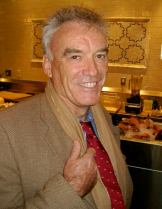 Chef Jean-Pierre Moulle of Chez Panisse in Berkeley, CA - photo by Jordan Wright An early morning trip to the White House with a tour by White House Chefs Sam Kass and Cristeta Comerford were just desserts for some of the country’s top toques who flew into Washington, DC this weekend for a noble cause.  Visiting Chef Charles Phan of San Franciscos The Slanted Door - photo by Jordan Wright Their goal: To raise money for local charities, Martha’s Table and DC Central Kitchen.
The visit proved auspicious. After torrential rains last night, the dark skies parted and all were greeted with a warm, sunny morning to tour the White House private kitchens and vegetable garden. Alice Waters, who had no small hand in influencing the First Lady to plant the organic garden as a teaching tool for local schoolchildren, was part of the group of stellar chefs. Along the way she noted the small size of the wine closet in comparison to an enormous refrigerator holding a vast supply of soda. She tsk-tsked and a suggestion was made that sodas be done away with in the presidential manse. Do I detect a new initiative?
The previous evening they were paired up with local chefs like Jose Andres, a longtime supporter of DC Central Kitchen; Kaz Okochi of Kaz Sushi Bistro; Bryan Moscatello of Zola and Potenza; Michel Richard of Citronelle; Cathal Armstrong of Restaurant Eve; Nora Poullion of Restaurant Nora’s; Nick Stefanelli of Bibiana; Fabio Trabocchi of DC’s Four Seasons; and DC resident, Joan Nathan, who used her not unsubstantial sway to organize the event she is calling “Sunday Suppers”, pairing up chefs to create their signature dishes at private homes throughout town. 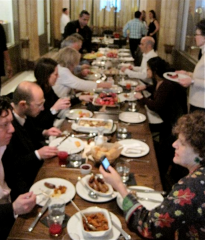 Top toques chow down at the celebration brunch at Potenza - photo by Jordan Wright Wine selections were arranged by Italian wine journalist Filippo Bartolotta of Le Baccanti, whose suppliers donated dozens of wines (although I heard that some gracious hosts opened up their personal wine cellars to amp up the festivities). Grass-fed Dorset-cross lamb was provided by John and Sukey Jamison from their farm in Latrobe, PA.  Rustic egg bake at Potenza's Brunch Celebration - photo by Jordan Wright From Berkeley, California, came Alice Waters of Chez Panisse and Co-Chef Jean-Pierre Moulle, who has been cooking beside her for 35 years; from Martha’s Vineyard Chef/Caterer/Culinary Instructor Jan Buhrman of The Kitchen Porch; from The Modern in New York City, Executive Chef Gabriel Kreuther and his Pastry Chef Patrick Clark; and from San Francisco, Charles Phan of The Slanted Door. Chef Elisabeth Bourgeois of Le Mas Tourteron brought her Provencal style from her iconic restaurant in Vaucluse, France. In all there were 23 participating celebrity chefs.
It all culminated in a lavish Italian-style brunch at Potenza where owner/host Dan Mesches and Chef Bryan Moscatello, marshaled their forces to put on a fabulous spread and thank the chefs for their donation of time and talent. It was all very collegial. You just had to be there.
For questions on this story contact Jordan@whiskandquill.com or visit www.WhiskandQuill.com
Jordan Wright
Whisk and Quill
February 2010
 From left Cynthia Tsai with 'Whisper', Neil Livingston with 'Flake' and Stephanie Woods at the Washington Humane Society's Sugar and Champagne - photo credit Jordan Wright It was cheek-to-muzzle last week as hosts Todd and Ellen Gray of DC’s Equinox Restaurant put on the dog for all those who love their four-legged friends. The 9th Annual Sugar and Champagne Affair benefiting the Washington Humane Society at the Ritz-Carlton showcased area chefs, mixologists, and their fans, who showed their sweetest support at the scrumptious event. There were treats for canine guests and their escorts as pastry chefs like Amanda Cook of City Zen and Sou-Wester whipped up dog biscuits and profiteroles. “This is the first batch of dog treats I’ve ever made,” she admitted. “It has peanut butter and other natural ingredients in it. Let me know how your dog likes it!”
 Alexandria's Barkley Square handed out home made dog biscuits with a little help - photo credit Jordan Wright Some chefs were cooking savory delights a la minute, partridge consommé from Brabo Chef Robert Wiedmaier and ravioli over Napa cabbage from Equinox Chef and the evening’s host, Todd Gray, while others had prepared lavish pastries, molecularly-crafted ice cream ‘dots’ and precious marzipan animals gallivanting across grass-lined displays.
Pastry chef extraordinaire David Guas was signing his new cookbook, DamGoodSweet, an homage to his youth in New  Pastry Chef of the Year David Guas signs his new cookbook Dam Good Sweet - photo credit Jordan Wright Orleans and replete with stories of Hubig’s Pies and Café du Monde. He brought dozens of melt-in-your-mouth pecan pralines (the recipe is thankfully in the book). Can you guess who he’ll be rooting for come this Sunday? Who dat!
Don’t fret if you and your pet missed this one. The Fashion for Paws Runway Show will be at the Embassy of Italy on April 10th and the 23rd Annual Bark Ball follows on June 5th where the four-on-the-floor crowd goes black tie. Book your grooming appointments now.
In a little horn-tooting, our little Shih-Tzu, Inspector Foo Foo, (he’ll have his report on your desk in the morning) was selected from over half a million dogs with the distinction of having one of the 10 Wackiest Pet Names and featured on the Today Show. Eat your hearts out Spot and Fido!
See the rest of the list including favorite pet names.
For questions or comments on this story contact Jordan@WhiskandQuill.com.
Jordan Wright
The Georgetowner/Downtowner
December 2009
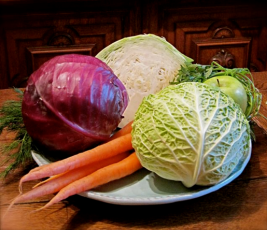 Cabbages and carrots with dill and Granny Smith apple - photo by Jordan Wright Consider the humble cabbage. After a soul-stirring dish of sarmale lovingly prepared by my Romanian acquaintance, Madame Pourchot, I thought long and hard on its cross-cultural worth. Sarmale are simple fare, cabbage rolls, stuffed with ground pork, beef or veal and rice then slow-cooked with tomatoes and herbs. A vegetarian version replaces the meat with carrots, mushrooms and Parmesan and loses nothing in tender sublimity. The pilgrimage-worthy menu began with Hungarian mushroom and potato soup cradling a dollop of sour cream, then latkes, crisp potato pancakes with applesauce on the side, then both the meat and vegetarian versions of sarmale and plenty of hearty oat bread and sweet butter. The meal was crowned with a fluffy rum-infused ginger marmalade bread pudding with sultanas.
Madame Pourchot served this simple yet elegant dinner last week to over thirty guests whose eyes grew wide with amazement, with several pleading in earnest to be adopted by her, before the last fork was set down. Oh, yes, I was one of the potential adoptees!
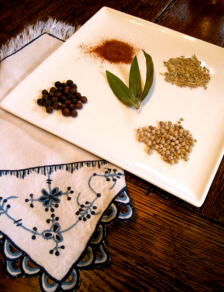 Spices frequently used in preparing cabbage - Juniper berries, Hungarian paprika, fennel seed, white pepper and bay leaves - photo by Jordan Wright There is a place for cabbage in nearly every culture. Syria calls cabbage rolls mihshi malfuf and uses lamb, seasoned with allspice, mint and pomegranate molasses. Ukranians call it holubtsi and top it with a cheesy béchamel sauce. In the late 14th C the legendary chef Taillevent convinced King Charles V to eat his first cabbage – a matter of historical significance and recordation. One of France’s most traditional dishes showcases the earthy flavors of choucroute, the hearty Alsatian dish made with pork, duck, sausages and sauerkraut. Scented with bay leaves, caraway seeds and juniper berries and served with grainy pommery or tarragon mustard it is a peasant’s dish fit for a king.
Contemporary cooks can claim a working knowledge of Asian cabbages like bok choy and Napa. But sauerkraut can be traced back to Chinese “sour cabbage”, cabbage soaked in rice wine in order to preserve it for the winter. Think Korean kimchi, with its infinite pickled varieties. Health magazine named it as one of its top five, “World’s Healthiest Foods”.
 Hearty crusted breads - photo by Jordan Wright From Lorenza de’ Medici’s cookbook, “The Renaissance of Italian Cooking” I found cabbage rolls from the Lombardy region called involtini di verza, from Marcella Hazan, salsicce col cavolo nero, sausages with black cabbage, though she translates that to red cabbage for the American cook. In the Tuscan region of Italy cavolo nero, the rare black cabbage or kale, is much preferred. It is a prehistoric wild plant. When the central stalk is harvested mini-black cabbages are produced on it resembling a corsage.
“Please to the Table – A Russian Cookbook” by Anya Von Bremzen and John Welchman describe Moldavian verza cu brinza, green cabbage baked with feta, and kislosladkaya krasnaya kapusta, a dish of sweet and sour red cabbage stewed in cherry vinegar with onions, cloves, apples and nutmeg…the perfect accompaniment to roast goose or pork.
To some the bouquet of cabbage cooking is anything but beckoning. Corned beef and cabbage comes to mind. But to others it harkens the origins of gastronomic civilization when meats were flung onto the fire and vegetables added in communal ritual to fill out the stewpot. Now ethno-botanical research has shed light on Bronze Age lake dwellers around Lake Zurich who ate cabbage.
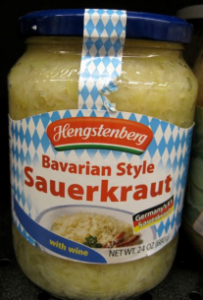 German-style sauerkraut with wine - photo by Jordan Wright Cabbage was thought to have originated in the Mediterranean regions where Egyptians raised altars to it, and Greeks and Romans believed it cured every disease from paralysis to pleurisy, including hangovers, a suggestion not to be ignored! In fact there are more myths and mysteries surrounding cabbages dating as far back as the third century B.C. Babies are said to have been found under the spreading leaves and we all know the fairy tale depictions of the stork in mailman’s cap, beak clamped down on a cloth sling wrapped around a newborn, and flying over the proverbial cabbage patch. Do Cabbage Patch Kids ring a bell?
Thomas Jefferson raised twenty-two varieties of cabbage in his magnificent gardens at Monticello. But his pride and joy was the Savoy cabbage. I’ll raise a toast to that! A more noble vegetable can hardly be found and I recommend it to the cook, as that is the preferred variety in Europe.
So enjoy your brassica oleracea capitata any way you prefer. One of my recipes, and the meat version of Madame Pourchot’s, follows.
CABBAGE AND GREEN APPLE SLAW
Chef Jordan Wright
1 ½ pounds of Savoy or green cabbage trimmed and shredded by knife into ¼ inch strips
2 Granny Smith apples, cored and thinly sliced or chopped
1 or more tablespoons of caraway seeds
1 cup of golden raisins or dried cranberries
¼ cup of chopped Italian flat leaf parsley
Sea salt and fresh cracked white pepper to taste
Make a vinaigrette of apple cider vinegar, honey and light olive oil or canola and a bit of lemon juice. Pour over slaw and refrigerate for an hour. Toss with parsley and serve cold with pork, duck, sausages or turkey.
MADAME POURCHOT’S SARMALE
1 large jar of pickled cabbage leaves * or one large head of cabbage plus one package of sauerkraut (half to place on the bottom of the pot and half over the top of the rolls)
1 pound each of ground pork, beef and veal from the farmers market
1 large onion, chopped
4 or more garlic cloves, minced
2 tablespoons each of thyme, oregano and parsley (less if using dried)
1 cup of rice, rinsed
2 tablespoons of Celtic salt
2 tablespoons of fresh cracked black pepper
1 large 28 oz. can of crushed tomatoes or, in summer, three cups of fresh chopped tomatoes, peel and all
* Pickled cabbage leaves are sold at the Cosmopolitan Grill on Route 1 south of Old Town Alexandria or the Russian Gourmet in Reston, Rockville, McLean and Alexandria.
Mix these ingredients together for the first stage.
Stuff into pickled cabbage leaves (or you can make your own). Take about a tablespoon of the mixture and place it into the cabbage leaf. Wrap the leaf around the filling, turning in the sides as you roll up, and place tightly together into a deep pot that has been prepared with oil and a layer of shredded cabbage and chopped bacon or ham. Line them up around the pot in layers. When you are done cover with additional shredded cabbage or sauerkraut (the sourer the better) and ½ cup of oil and bacon or ham and peppercorns, oregano and thyme. Cover and boil for two hours over low to medium heat.
Taste one and, if the rice is done, add the tomatoes and simmer over low heat, or in the oven without a lid, until the top caramelizes. Serve with sour cream or plain, thick yogurt.
Sarmale are the traditional dish for all holidays, especially Christmas. According to Madame Pourchot, the smaller the sarma the more skilled you are as a cook! “Poftat buna!” she says, Romanian for bon appetit!
For questions, comments or additional recipes contact Jordan@WhiskandQuill.com or visit www.WhiskandQuill.com.
Jordan Wright
The Georgetowner and Downtowner
November 2009
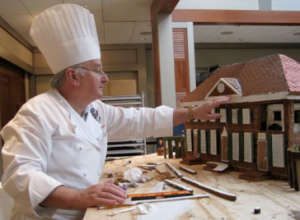 Chef Mesnier with his gingerbread house - photo credit Jordan Wright “And had I but one penny in the world, thou should’st have it to buy gingerbread.”
So penned Shakespeare in Love’s Labours Lost back in the holly jolly days of the 16th Century. But a pretty penny indeed it would cost him when the heady and alluring cardamom, nutmeg, cinnamon, and allspice used to make gingerbread were far less affordable and available to the masses than they are today.
But it wasn’t until its first publishing on December 20, 1812, when Die Gebruders Grimm spun their fable of Hansel and Gretel with its lure of candy cottages in the Bavarian forest that gingerbread houses began to emerge as a symbol for Christmas.
From the Black Forest of Germany to within ten miles of The White House there lies another famous colonial white house with an older provenance—George Washington’s beloved Mount Vernon, an especially enchanting destination over the Christmas holidays.
When I arrived last week I met up with Roland Mesnier, formerly the White House Pastry Chef for 25 years. Chef Mesnier, the uber sweetsmeister and cookbook author who launched the first pastry course at L’Academie de la Cuisine in Bethesda, Maryland, has been called upon to craft a gingerbread replica of Mount Vernon in perfect detail. Chef Mesnier employed the same level of perfection to this house as he did as The White House Pastry Chef. “The White House was a big production place. Everything should be the very best. If it’s not the best at The White House where else is it going to be the best!” exclaims Chef Mesnier.
The grounds of this gingerbread house features the estate’s farmyard animals, a tree with an American eagle roosting in it, and the iconic dove of peace weathervane—even George and Martha decked out in Colonial attire—all chiseled out of marzipan. Here are some fascinating facts about the Mount Vernon gingerbread house replica:
The 5 x 8 foot replica began last month. 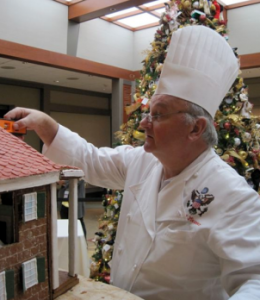 Chef Mesnier checks the angles of his gingerbread house at Mount Vernon - photo credit Jordan Wright It took 325 pounds of gingerbread and 70 pounds of chocolate to glue the house together. A full pan of gingerbread is baked and cut, after it cools, according to a pattern.
“Equatorial Noir” chocolate from Valrhona with 55 percent of cocoa solids is employed. Every piece of gingerbread is slathered with melted chocolate over its interior side using an offset spatula. This gives it strength.
To achieve a perfect edge-to-edge fit an industrial band saw is used to cut the gingerbread. In any event, the vagaries of humidity can change the properties of the gingerbread causing it to shrink. “There are so many simple things that can totally change the outcome of your dessert,” he offers. (Sound of forehead slap here.)
No interior support system is employed. No cardboard or underpinnings are utilized whatsoever.
Marzipan roof shingles are first tinted terra cotta and flattened with a rolling pin, then cut with a cookie cutter into small circles. Modeling marzipan is used.
Shredded phyllo dough is used to replicate straw.
Handyman’s tools are de rigeur. A level is used to check the slant of the edges.
The gingerbread is made from scratch using the finest ingredients: flour, butter, eggs, baking powder, honey, ginger, molasses, cloves, and cinnamon. (Long ago rosewater and ground almonds were sometimes added. My tasting determined Mesnier’s gingerbread to be divinely delicious—especially with the chocolate backing.) He exclaims, “If I have to use anything less, I’m not doing it!”
Marlene Roudevush, his former White House assistant pastry chef, assisting him with the Mount Vernon gingerbread house replica, creates her figures using Confiseur D’Or Swiss modeling marzipan and applies the royal icing to the house. For that she uses a pastry bag made out of parchment paper with a little hole nipped out by scissors. “We always make our own, ” she asserts. Her research tells her that President Washington bred American Foxhounds and was fond of camels. Martha also claimed a parrot as a favored pet. All of which Chef Roudevush will add to the menagerie.
Many years ago I designed a gingerbread house for Grandma’s House for a fundraising auction in advance of a gala at the Four Seasons Georgetown. There were twenty or so entrants, the preponderance of them, architects. I decided upon Noah’s Ark, replete with wildlife duos and gummy fish aswim in the surrounding sea. Arriving with my humble ark, I saw gingerbread houses featuring minutely detailed colonial buildings with mullions and cobweb windows that could have been registered with the National Trust for Historic Preservation. It seems my cohorts had chosen a more traditional route.
But it was all about the attempt, I reckoned, and moreover, I learned that gingerbread shrinks…a lot…and buckles with the heat of baking, and no amount of royal icing can cure that. I had a few unresolved personal baking queries for the President of Pastry, and I wanted them on the down low. Monsieur Mesnier was only too delighted to oblige.
I collected a few pearls of pastry wisdom from the master:
“My philosophy on baking is very simple. Measure everything the night before and leave it out on your kitchen counter, even the eggs and the butter. The next morning you will mix your cake in a few minutes because everything is the same temperature, and it will be the best blending you ever had in your life.”
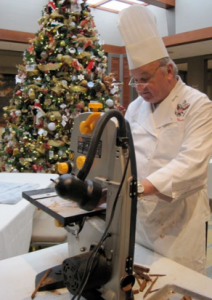 Chef Mesnier cuts the gingerbread with a band saw - photo credit Jordan Wright “A lot of chefs love to complicate their recipes with unnecessary instructions. Half of it you can throw out. They just put it in there because the more complicated it is the more they think they look like geniuses!”
“So many chefs use all these gimmicks to try to make it seem good. What I have done in my books is simplify the language.”
“Buy the best ginger you can buy and check out the strength. You have to watch out because even from year to year it may change in strength. Make a sample of dough, bake it, and test it. There are so many different kinds of ginger and each type makes a difference in the outcome.”
“If you make enough dough in advance you can roll the cookies out and cut them and freeze them raw. Then, without defrosting, you can bake them off and eat them fresh that day.”
“We made 120,000 pieces of cakes and cookies for Christmas in The White House. Most of our cookies were shaped and frozen raw, and later taken out and baked.”
“We had such a small kitchen and very little staff. We started baking for Christmas in the White House in June. We made half a ton of fruitcake, orange cake, chocolate cake, German stollen and applesauce cake, Italian panettone, and yule logs, too. Our Christmas was based on Old World Christmases, like my Bananas in Raspberry Cream (Dessert University, Roland Mesnier, Simon and Schuster 2004). “People would hunt me down for that recipe.”
“We had a lot of diplomats over the holidays and I wanted them to find their own cakes and cookies from home on the table. We wanted to please as many people as we could. That’s the key…to have that special something for everyone.”
Like families today, the Washingtons were not strangers to the tragedies of war, death, and illness, even over the holiday season. In those days, a trip to rendezvous with loved ones could last days, or even weeks, over rugged hills and rutted roads, and might result in a stay of a fortnight or longer. So it was all the more imperative to celebrate the homecoming of family members and friends from afar. Therefore all hands were pressed into service to welcome the guests. You will find that the Mount Vernon of today reflects the warmth and spirit that emanates from the venerable estate.
Chef Mesnier’s gingerbread house will be on display all day at Mount Vernon throughout the Christmas season. You will need to call ahead for tickets for evening tours.
www.chefrolandmesnier.com
www.mountvernon.org
www.grandmashouse.org
For questions or comments on this article contact Jordan@whiskandquill.com or visit www.whiskandquill.com .
Jordan Wright
December 2009
 Starting the evening's champagnes with Voirin-Jumel Blanc de Blanc NV Grand Cru Cramant - photo by Jordan Wright This New Year’s celebratory festivities may pose a challenge to the connoisseur…to find a good quality champagne on stifled cash flow. While bumps and grinds to the wallet may crush our choices like grapes in a wine press, we seek to secure an auspicious future by raising a glass of pirouetting bubbles to presage better days. But how to achieve this glamorous tradition without sacrificing the children’s college fund?
 Pan seared Maine scallop with onion puree, ruby red grapefruit and ginger butter - photo by Jordan Wright At a recent dinner at Brabo I was introduced to some wonderful and affordable sparklers from the province of Champagne. Each one of these limited offerings was 100% grower produced and bear the recoltant manipulant code, “RM” on the label, ensuring the grapes come from this vineyard alone. Since only sparkling wines from this region of France, amounting to 86,500 acres of prime terroir, may be properly designated as “champagne”, one might expect they would be gustatorily competitive. I found three to be smart, polished and sophisticated, and two, to precisely mirror my most favorable profile of an excellent champagne.
In his distinguished paean to French regional cuisine, “The Food of France”, gourmand extraordinaire, Waverly Root, claims that, notwithstanding ham en croute, “There is no cuisine of note in the Champagne region.” Therefore it is no minor feat for a chef to pair an entire five-course menu with a selection of champagnes. Who better than a chef with roots in Belgium could prepare a meal representing this historic province geographically located in the north of France beside the Belgian border?
 Flemish Oyster Stew with puff pastry fleurons at Brabo - photo by Jordan Wright Enter Chef Robert Wiedmaier, up to this culinary challenge, creating a glorious menu, beginning with Flemish oyster stew with Swiss chard topped with puff pastry fleurons, sheer bliss captured in a cream-colored bowl nestled in a linen rose fold, and pairing it with Voirin-Jumel Blanc de Blanc NV Gran Cru, Cramant. Known as a Champagne family, not merely a brand, sibling scions Alice and Patrick Voirin Jumel, and Patrick’s wife, Valerie, have been supplying this wonderful wine to the Inn at Little Washington as their house brand. I give it three cheers! A clearly auspicious beginning.
Priced around $48.00 a bottle.
 Venus works the Agrapart et Fils vineyard Our second course, a plump pan-seared Maine scallop was accompanied by red onion puree, morsels of ruby red grapefruit and ginger butter echoing the 90% chardonnay and 10% pinot noir grapes used in the 100% organic Agrapart at Fils Brut Rose NV Premier Cru, Avize. So pretty in pink! This vineyard employs a beloved horse named “Venus” to help around the farm. Think of her sweet demeanor as you sip your way into a rosier New Year.
Priced around $61.00 a bottle.
 The Gatinois Brut 2002 a perfect pairing for the turbot with chanterelles - photo by Jordan Wright From the vineyards of Pierre Cheval-Gatinois, which lies at the foot of the Montagne de Reims, one of the four great vineyard regions, came a Gatinois Brut 2002 Grand Cru, Ay. The property lies beside the hallowed Bollinger estates, whose blends from the late 1980’s can reach an astonishing $500.00 per bottle! Eleven generations of the Gatinois family, dating back to 1696, have produced champagne from their ancestral lands. They use a 100% pinot noir cuvee to make this wine. Priced at around $70.00 a bottle it was le plus cher wine of the evening. Yet how perfectly it escorted a Parmesan-crusted turbot with rock shrimp, potato gnocchi and woodsy chanterelles with an aromatic shellfish emulsion.
The following foray trumpeted my personal favorite from R. H. Coutier, a non-vintage brut Grand Cru, Ambonnay. Our esteemed chef had paired this opulent, well-balanced bubbly with roasted veal tenderloin, crispy sweetbreads, lardoons of bacon and natural jus. At a mere $48.00 a bottle, it is like taking candy from a baby. Miss this winning wine at your peril!
 Three cheers for this selection! - photo by Jordan Wright I always serve champagne with dessert at a dinner party. I feel it revitalizes the festive nature of the gathering, and this bold, slightly floral, champagne with its tiny bubbles from Domaine Dehours “Grand Reserve” Brut NV was an admirable selection to stand up to the tartness of a crème fraiche cheesecake with honey-roasted pineapple. Another 100% organic champagne (those highly sensitive to sulfites will thrill to this news), it is made from 50% pinot meunier, 25% pinot noir and 25% chardonnay grapes. Aged in new and old oak barrels, it develops a timeless bouquet that evokes the notable chalky terrain of the region.
Priced around $42.00.
All these fine champagnes, suitable for ushering in a more prosperous 2010, can be purchased at The Butcher’s Block on King Street in Alexandria. www.butchersblockrw.com.
Brabo, the elegant restaurant, and Brabo Tasting Room, with more informal dining, are on the same street.
|