Jordan Wright
May 2010
 Three-star Michelin mixologist Brian Van Flandern with hostess, Lani Hay - photo by Jordan Wright On a balmy evening last week at the home of Lani Hay, President and CEO of Lanmark Technology, guests gathered around Michelin three-star mixologist, Brian Van Flandern, for a lesson in margarita-making. On the white croc-skin topped bar Van Flandern had laid out all the necessary accoutrements for professional bartending: jiggers, shakers, strainers, ice scoops, crystal pitchers of fresh-squeezed lime juice and freshly-cut lime wedges, including his preferred Don Julio Tequila and light agave syrup. Large silver bowls of ice were ready for eager guests who lined up to measure, ice down, shake, pour and garnish the perfect classic margarita in preparation for their own summer parties.
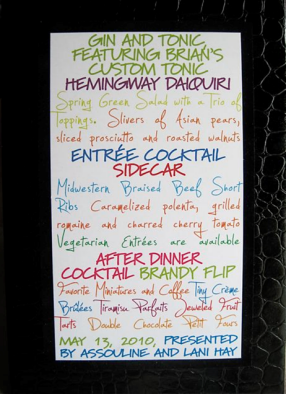
The natty and knowledgeable consultant, Van Flandern, who creates cocktails for the iconic Bemelmans Bar at New York’s posh Carlyle Hotel, Thomas Keller at Per Se, Michel Richard at Citronelle, and Chef Mario Batali, had arrived at Ms. Hay’s chic Palisades home for a private dinner and launch of his book, “Vintage Cocktails” by Assouline Publishing.
Prosper and Martine Assouline, whose elegant imprint of luxury books and works of art are found in boutiques in Paris, New York, Los Angeles and Las Vegas, were on hand to celebrate the moment with a dinner menu that was designed around a progression of dishes paired with classic cocktails from the book.
 Pairing cocktails with dinner courses - photo by Jordan Wright “Acid, alcohol and sugar,” Van Flandern instructed his mixologists-in-training. “It’s all about the balance,” he advised while the sloshing and clacking sounds of a battery of Boston shakers filled the room. Everyone had their own Hawthorne strainer to hold back the ice for the straight-up margaritas. A quick tasting was recommended to perfect the balance, and it was down the hatch. “Bottoms up!” he exhorts.
In an interview, the debonair Van Flandern, who grew up in nearby Chevy Chase, described a few of his techniques and ingredients for some of his spectacular cocktails. A purist to the bone, to craft his exquisite “Tonic and Gin”, designed for New York’s Per Se, he uses ground chinchona bark from the Amazon rainforest. And he makes his own maraschino-style cherries, using dehydrated Bing cherries reconstituted in hot water, “They taste just like cherry pie! “ counseling me to “Be sure to save the liquid, add sugar and reduce to make a simple syrup for infusing spirits.”
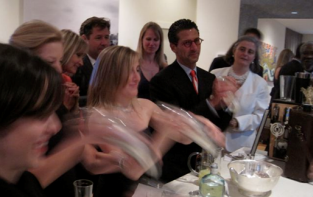 Guests mixing margaritas with Brian Van Flandern - photo by Jordan Wright I wondered where the word “cocktail” originated and why some cocktails are referred to as “vintage” or “classic”. He explained that, “at one point in history a certain cocktail gained global popularity and becomes a classic or is destined to become one because of all the publicity it has garnered.”
The term, “mixologist” has been usually regarded as pretentious and taboo in the industry, but since a renaissance of the cocktail, he assures me bartenders are embracing the coinage.
“2004 was the 200th anniversary of when the word “cocktail” first appeared in print. And now great bartenders around the world are looking to chefs for direction and focusing on balancing acid to sugar. They are using fresh ingredients, hosting spirits education, and researching the histories of the specific distillation techniques. Even the terroir and culture behind where different spirits are made are taken into consideration in developing flavor profiles to create delicious and original cocktails.” A trend likely to continue.
While working with Chef Thomas Keller at Per Se in New York City, Van Flandern lowered the ethanol content of the spirits and paired his cocktails with dinner courses creating food-friendly cocktails and earning a four-star rating from noted New York Times food writer and wine critic, Frank Bruni.
Designer Cocktails
Since I misspent some of my salad days at the Bemelmans Bar in the Café Carlyle where Van Flandern reigns, I asked him to share an original cocktail he has created for the iconic watering hole in the past.
“Sex in the City” Cocktail – On the cover of “Vintage Cocktails” is a photograph of a pretty pink sugar-frosted rim cocktail he calls, “The Bradshaw”, named after Carrie Bradshaw of “Sex in the City”. Little known is that real life actress, Sarah-Jessica Parker and husband, Matthew Broderick, had their first date here. To mark the occasion and the drink was designed for her using Don Julio Blanco Tequila, fresh lime juice, simple syrup and the pink-colored passion fruit-infused spirit X-Rated Vodka. The recipe is just in time for, “Sex in the City 2”, and should be served at all the private screenings around town.
Here are a few more of his creations to add to your repertoire:
Tiffany and Co. Cocktail – For his design of “The Official Cocktail” for Tiffany and Co. he mixes blue Alize, fresh lime juice, pear vodka, a drizzle of cane sugar syrup and Moscato d’Asti. When presented it was served in a champagne flute and tied with a white silk ribbon around the base.
Dolce and Gabbana Cocktail – For the launch of their “Light Blue” perfume, he mixed Ciroc Vodka with Granny Smith apple cider and citrus peels, adding cedar wood from a distillation he created using the shavings from a cedar wood clothes hanger.
Van Flandern’s advice at what to expect when imbibing at a bar serving hand-crafted cocktails, “We’re entering into a new “Golden Age” of the cocktail. If you order a cocktail and it’s not to your liking you should let the bartender correct it.”
For question or comments on this article contact Jordan@WhiskandQuill.com .
Jordan Wright
May 2010
Ritz-Carlton’s Twentieth Anniversary Celebration
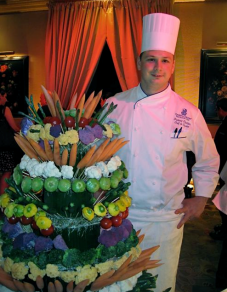 Ritz-Carlton Executive Chef Fredric Chartier with his vegetable tower - photo by Jordan Wright When the Ritz-Carlton opened its elegant doors in Arlington twenty years ago, they were a pioneering luxury hotel  Ritz-Carlton's Anniversary Celebration cake - Photo by Jordan Wright in their Pentagon City neighborhood. Since then they have become an important destination hotel for high level diplomatic and military visits, a home to Presidential Inauguration events and VIP guests from around the globe.
Last week they invited their loyal clientele to join them in celebrating two decades of success, with a sumptuous reception in the ballroom that featured signature cocktails and the glories of the kitchen prepared by recently appointed Executive Chef, Frederic Chartier. The baby-faced Chartier, who has staged at The Four Seasons and George V in Paris, brings Modern French cuisine to the hotel’s fyve Restaurant Lounge. The evening capped off with Pastry Chef Dallas Marsteller’s divine desserts, including scrumptious mini-strawberry shortcakes.
www.RitzCarlton.com/PentagonCity
Jordan Wright
May 2010
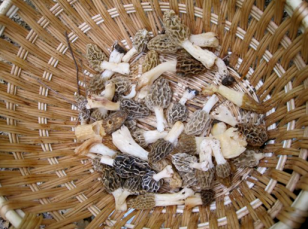 A cache of the elusive morel - photo by Jordan Wright The season for morels is upon us, and the only way in God’s creation I was going to collect and eat a wild mushroom was to go into the woods accompanied by an expert mycologist. Anything else was a deal-breaker. I put the thought of the odd copperhead out of mind and prepared for my orientation with the President of the Mycological Society of Washington (MAWDC), Ray LaSala; Forays Chair, Mitch Fournet; and a couple of the club’s “shroom” experts. It was no small feat to tamp down my excitement at the possibility of discovering morels less than thirty miles from my front door, but there is nothing like mystery and adventure to fire up the spirit, and morels have a certain earthy allure to a chef.
With samples of chanterelles and morels spread out on a picnic table for viewing and instructions on how to cut the mushroom…pick first then cut off at the base…we signed waivers releasing MAWDC from our possible imminent demise due to picking and eating dangerous fungi.
A soft rain was beginning to fall when our group of fifteen neophytes tromped off with our group leaders. We had come armed with field compasses, net bags or woven reed baskets, magnifying loupes, and pocketknives for collecting the precious specimens. I chose Culinary Chair, John Harper, hoping to gain some insight as to how to prepare my much-anticipated cache.
There are certain distinctive characteristics regarding terrain, weather conditions and flora, that entice the spores of the morel to spring up out of the leaf litter, fully formed and reveal themselves to the novice forager.
The most auspicious time of year for collecting morels is when local cherry trees drop their blossoms, the black locust is flowering, and the purple pink flowers of the Eastern redbud dot the landscape. One should look for tulip poplars and the soft carpet of leaf litter beneath the trees. Old apple orchards in flower, and decaying elms, both Slippery and American, especially when the tree is rotting out, can provide an excellent habitat for morels.
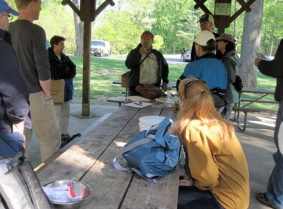 Orientation by MAWDC President Ray LaSala - photo by Jordan Wright Another clue can be the ash tree (fraxinus species) with its white-splotched diagonal bark carved with deep furrows. When identifying the ash, Dr. David L. Roberts of the Michigan State University Extension writes, “Very few trees in our landscapes and forests have opposite branching. The predominant types are maple, ash, dogwood and horsechestnut. A simple phrase to remember when identifying trees with opposite branching is to use the acronym ‘MAD Horse’ which represents Maple, Ash, Dogwood & Horsechestnut.” That sounds like a helpful tip to me.
As for optimum climactic conditions, temperatures should be in the high 50’s and there should be rain or overnight dew. Precisely the conditions we had last week.
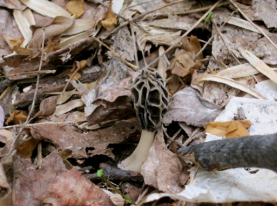 The elusive morel - photo by Jordan Wright LaSala told us, “Morels grow in a sight line like telephone wires.” So if you spy one, chances are you can find more in a row stretching out on either side. He describes its appearance as “a hollow swayed stem, “felty” in feel and with no overhang.” He warned us that it is poisonous if eaten raw. Dried they can last for years (LaSala has a stash of morels he regularly taps into) and they are easily rehydrated.
Within minutes of our setting off, cries of, “I found one!” and “Is this a morel?” echoed throughout the woods and groups converged to investigate the sight line for more treasures nearby. LaSala said that before picking, “Australian Aborigines do a tap-tap-tap with their feet to spread the spores for future hunters.” And he advised, “Not to spread the leaves or rake as it disturbs the natural environment.”
As we foraged through likely habitats, heads bent and eyes trained laser-like to the ground, it became abundantly clear that there were some novices in the group that were far better at spotting morels than others. And after two hours of searching and finding only one tiny morel, I must confess I resorted to botanizing.
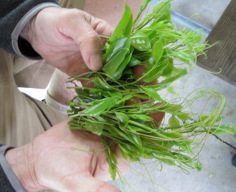 Edible greenbrier vine tendrils - photo by Jordan Wright Pleasantly distracted by spring ephemerals, I spied delicate Virginia claytonia, mayapples, numerous fern species, Solomon’s seal, and Jack-in-the-Pulpits peppering our path. Along with chomping on the early garlic mustard leaves, we cut off the tender shoots, leaves and tendrils of the greenbrier vine for salads. They taste like asparagus, only better, if you can imagine that!
In the end I decided that my astigmatism didn’t allow for more precise deciphering of the beiges and tans of the leaf litter and consoled myself with the successes of my fellow foragers who were over the moon dreaming of their trophies in their dinner plans.
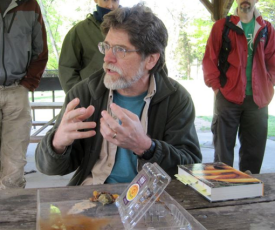 MAWDC Culinary Chair, John Harper instructs the novice foragers - photo by Jordan Wright If you decide to purchase morels you can get them dehydrated – one ounce for $16.99 at Balducci’s and at Whole Foods for $19.99. If you’re luckier than I was, ½ pound of fresh morels is approximately the equivalent of one ounce.
Here is a delicious recipe to try that uses one ounce of dried morels. It’s from Sous Chef Matt Finarelli of Open Kitchen in Falls Church.
Red Wine Morel Cream Sauce
Yield: 1½ cups
Ingredients:
• 1 oz dried morels
• 1½ cups heavy cream
• 1 ea shallot – small dice
• 2 cloves garlic – minced
• ¾ cup red wine – Zinfandel or Syrah work nicely
• 1 Tbsp Cognac
Method:
– If you have fresh morels, dry them in a paper bag on your counter top for a few days. It’s important to start with dried morels so they can absorb the cream.
– Rehydrate the dried morels in the cream for about 2-4 hours
– In a saucepan over medium heat, sweat shallots in a small amount of oil until translucent, then add the garlic and cook until fragrant.
– Add the red wine, and reduce gently until it has almost all evaporated.
– Add the morels and the cream they soaked in and gently reduce the mixture to about 1 cup in total volume.
– Remove some morels from the sauce to save for garnish if desired, puree rest of sauce to a smooth consistency in a blender or with an immersion blender.
– Return sauce to pan, place back on heat, add the Cognac and reduce slightly.
Serve this sauce with game bird (like pheasant, guinea fowl, quail or partridge) or on top of rabbit. Also, be sure to add any accumulated roasting juices (fat removed) from the meat to the sauce – it only helps the final flavor that much more!
www.openkitchen-dcmetro.com
This article in no way suggests or promotes consuming wild mushrooms of any kind without an expert guide. Contact the Mycological Society of Washington for guided forays, pot luck mushroom dinners and membership information. www.MAWDC.org
For questions or comments on this article contact Jordan@WhiskandQuill.com.
The Georgetowner/Downtowner
From Wright on Food
Jordan Wright
April 2010
 Chef/Owner Joel Thevoz of Main Event Caterers - photo by Jordan Wright Swiss-born and raised, Joel Thevoz, hit Washington in the mid-80’s with a business degree and a briefcase full of fresh ideas. Coming off la vida loca in Costa Rica and Mexico, where his on-the-fly dinners were highly praised by friends and neighbors, he had decided to settle down to a serious culinary career.
With his wife and partner, Nancy Goodman, they launched Main Event Caterers in 1995 on K Street in Georgetown. Ten years later they were to bring their ever-expanding operations into Arlington, VA, where their stunning cuisine and lavish events garner rave reviews and an ever-increasing upscale clientele.
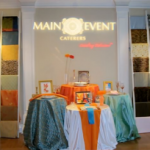 Main Event Caterers - 2010 Caterer of the Year award winner by Catering Magazine - photo by Jordan Wright They ran their company like every other top-tier caterer until three years ago, motivated by Al Gore’s groundbreaking film, “An Inconvenient Truth”, they had a epiphany and took their successful company to higher level…one with a conscience…where green is the new black. It would hail a new dynamic for Main Event Catering and reflect their growing ecologic awareness.
Now in the vanguard of a new aesthetic, where style meets substance, this sophisticated caterer is a leader in the green revolution, as they continue to be recognized with a growing list of local and national green business awards that reflect their commitment and the calibre of their cuisine. To add to their accomplishments, this year they won the coveted “Caterer of the Year” award from industry giant, “Catering Magazine”.
I spoke with the passionately eco-knowledgeable, Joel Thevoz, and toured the 20,000 sq. ft. facility with its gleaming stainless steel demonstration kitchen-in-the-round, 25-foot floor-to-ceiling wine wall and extensive culinary library featuring a precious archive of leather-bound Gourmet Magazines dating from 1946.
Jordan Wright – How long have you been on the green bandwagon?
JT – We started out being aware of our impact in this world about 3 years ago. The Green Movement was just getting started here and, for us, that set the pitchfork in the ground in terms of thinking about what we do and how we do it.
There was one very impactful moment for us. It was a day when we were winding up after an event that used disposables. And at the time I was very proud of using the best quality plastics. I took a look at our truckload worth of waste and plastic garbage from this one event and I was literally sick to my stomach. I thought this stuff is going to last forever. What can we do better?
JW – What did you do to change your company’s way of doing business?
JT – That moment set the tone for a period of discovery. We wondered, “Can we find products that are biodegradable?” It was right about the time when cups made from cornstarch by-product became available. I had seen them used in an airport in England and brought some back with me. 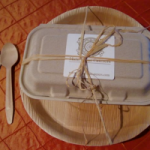 For events using disposables - Balsa wood cutlery, palm frond plate and recyclable box from Main Event Caterers - photo by Jordan Wright But it was a real challenge to find these things in the US. We started digging around and discovered they were making plates from dead palm fronds in India. They are sandwich-pressed using steam into these flat shapes with a bit of curvature to make a plate. Then they are hand-scissored to size.
Finally we could eliminate all plastics from our catered service, and now we only use biodegradable palm plates, balsa wood cutlery, washable glassware and other biodegradable products for our events using disposables. Also we use purified water in jugs in place of mini plastic bottles.
JW – How do you recycle?
JT – We bring large recycling cans onsite, and all our staff is trained to separate out recyclables like paper, cardboard, tin, glass and plastic. Then it gets brought back here where we take it to the recycling center. It does add to the workload of an event, but we still do it effectively.
We also decided to add solar concentrators to the roof over the individual offices to bring in light and we are now replacing all our metal halide lights with T5 lights that use a minimal amount of electricity and are motion-sensitive. This way they shut off when someone leaves the room. The floors here are bamboo, the ice machines use filtered water and we clean and press all our linens to lessen our carbon footprint.
To be carbon-neutral we buy carbon credits to offset all the energy that is used, as with our trucks going to and from events. Also we calculated the approximate employee commute for the whole team and buy carbon credits to offset all those greenhouse gases, so that now we are 100% carbon-neutral. We’ve been doing that for three years.
JW – What other ways have you found to save energy?
JT – For one thing we compost our food matter to make high-quality soil that we distribute to our community, and we collect and store all of our used cooking oil, that we donate to a local biodiesel cooperative.
Also we wanted to subsidize wind power. So we purchase an equivalent amount of electricity from a wind farm. And though it is off-site, it gives us the advantage of being technically wind-powered. It tells the energy company that we are serious and we want to spend our money on clean energy…because unless you prove with dollars that there is a desire to purchase alternative energy, they won’t listen. We’ve seen how it creates momentum when a lot of companies get involved.
JW – Have you figured out how much more it costs to do business in this way?
JT – We have a general idea, and of course the start-up costs were quite high, but it is far outweighed by the amount of business we receive from clients that are like-minded. Companies and individuals who like what we are doing eventually gravitate to us and we feel rewarded.
We live happy and it has paved the way to the next stages in our development. It’s given us the knowledge and the confidence and introduced us to organizations that have things to offer us that are above and beyond anything else that we’ve done so far.
JW – What are some of the newest technologies that you’ll be using?
JT – Lately we find we are becoming a sort of incubator for green solutions.
Not long ago we had a visit from a gentleman based in Florida and began to talk about using geothermal. I mentioned how our dishwasher pushes out gallons of 180 degree water and it just goes down the drain. He told us we could divert it and harness it. Ultimately his company designed a product for us using heat exchange and we’ll be testing it here. The plan is to have it up and running in a few weeks.
In a nutshell we will be running “grey” water alongside the city water pipes to super-heat municipal water. The fresh and “grey” water don’t mix together. There are membranes between the two of them. But in this way we can take the 65 degree water from the county and introduce it through our ”grey” water cisterns before it goes into the pipes. Eventually it will raise the temperature of our instant hot water for our washing machines two-fold to 130-160 degrees. It will save us a lot on gas usage.
JW – Is that a cost to the city?
JT – No, we handle it all from here. We’ll build a tank and the city water will go right through it.
We’re also looking at placing these huge cisterns beside our buildings to gather and harness the rainwater from our roofs. Imagine! They can collect up to 40,000 gallons per month of water. What we want to do is use those tanks for latent energy.
We subscribe to a train of thought that the future of this world is based upon communities building vertical farming. We have these flat roofs here and we are in the process of designing a rooftop garden with greenhouses to grow all our own vegetables and herbs. We have at least 6,000 square feet of roof space. We want to prove that it can be done and share the plots with the community.
The greenhouse will be hydroponic and aeroponic which is a system NASA developed that uses an oscillator that is introduced into a water tank. You create a certain vibration and it renders the water into a mist. You can then push that vapor, with pressure, into a system of canals or closed chambers in which the roots of your vegetables thrive without soil. Every intermittent three minutes the pipes are filled and then flushed. It works like a rainforest. The plants grow at 2-3 times the speed.
JW- What about the “terroir” – the taste imparted to the vegetables from the soil and its minerals? Won’t that be missed?
JT – We can introduce that into the water by making a slurry from our compost and extracting the minerals out in liquid form to fortify the water, or we can buy organic feed to add to it.
Our last initiative will be to crush our glass and smelt it in kilns and create recycled glass slabs to use for platters and bowls. We are interested in inviting others, even our competitors, to see how we are doing this. We look to inspire others.
JW – What do you see for the future of catering?
JT – I foresee in the next few decades that we’ll move towards a more vegan and a more raw diet and a more healthful nutritious diet. So we’re making a small push to increase our vegetarian options and training ourselves to be better at cooking those options for our clients that want them, and for the future of our planet too.
This interview was conducted, condensed and edited by Jordan Wright.
Jordan Wright
March 2010
 Local advocate and Weston A. Price Foundation publicist Kimberly Hartke of hartkeisonline.com - photo by Jordan Wright Hartkeisonline published my story on the NICFA small farm lobby day on Capitol Hill.
Take a host of committed small farm advocates and add one part farmer to one part grower. Recruit a panoply of top chefs from Washington, Virginia and Baltimore, who graciously volunteered their time. Using all-natural ingredients donated by the participating local farms, passionately blend to create a delicious dish. The result: An inspiring and delightful event.
We begin with the language of organic, GMO and sustainable farming and the laws, like the very unsexy-sounding “S-510”, that govern food products and the farms they’re grown on. It’s enough to leave a layperson scratching their head and it’s easy to feel out of the lettered loop. There’s NICFA (National Independent Consumers and Farmers Association), HAACP (Hazard Analysis & Critical Control Points), LGMA (Leafy Greens Marketing Agreement), and UNCED (United Nations Conference on Environment and Development)…a puzzling jumble of acronyms to sort out…but this is a story of ourselves, the consumers, our farmer friends, and the restaurants that use the food they grow.
Last week farmers and believers organized by NICFA headed up to Capitol Hill to do some lobbying against a proposed bill entitled “S-510” that would impose draconian measures on the small farms that we, as consumers, overwhelmingly support. The bill, known innocuously as the “Food Safety Modernization Act”, favors large industrial farms and threatens the ability of the small farmer to do business. In its broad scope it would afford the FDA and USDA ever greater powers, needing only “reason to believe”, in order to quarantine or shut down a farm, and fine or imprison the farmer.
Don’t we all want our food to be safe? Well, of course we do…though the proof is in the pudding that less than one half of one percent of all foodborne illnesses originates on small farms.
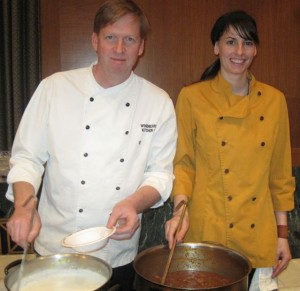 Spike Gjerde (L) with sous chef of Woodbury Kitchens Restaurant at the NIFCA reception - photo by Jordan Wright Frequent news reports reveal that it is the operations of large industrial farms that cause most food safety issues. Note: In the month of March alone dozens of food recalls were issued as a result of salmonella in hydrolyzed vegetable protein used pervasively in a multitude of food products such as pretzels and chips (several varieties of Pringles and Herr’s were on the list); seasoning mixes and dips (some from the ubiquitous T. Marzetti); and boullion cubes from grandma’s old stand-by Herb-Ox.
In addition thousands of pounds of such disparate products as pecans, pet foods, black pepper, and over 95,000 pounds of beef from North Carolina’s, Randall Packing, contaminated with E. coli, were recalled or voluntarily removed from grocery shelves. Just last month over 5 million pounds of veal and beef were recalled from one California meat packer. The list seems endless, the challenges insurmountable. I wonder if restaurants using these products will either care enough or be aware enough to remove them from their pantries.
A recently introduced new standard known as LGMA, Leafy Green Marketing Order, and written by industrial distributors, sounds docile and concerned about the safety of our veggies. Yet it is another burden on our small farms that has resulted in zero increase in food safety and has doubled costs to farmers within one year’s time. Its implementation has caused the closure of small slaughterhouses, causing farmers to ship their meat hundreds of miles back and forth to distant abatoirs for processing. As demand grows from consumers concerned about humane slaughter, we hope to see an increase in processing plants.
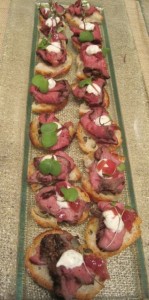 Beef Roasts from JuJo Acres farm prepared by Restaurant Nora's - photo by Jordan Wright Translation to consumers like you and I: Higher costs for food produced by farmers, driving some out of business and limiting our options to purchase local foods at our farmers markets. This encourages “factory food” from farms run by huge agri-business conglomerates featuring genetically-modified and trademarked grain and industrially-raised and slaughtered cows, pigs and chicken.
On to HAACP, Hazard Analysis and Critical Control Points. It sounds as creepy as it is. As Joan Veon suggests, “This legislation will stymie small farms. It is a huge onus.”
If passed, HACCP would demand that all food producers, to include small jam and jelly preservers, picklers, local bread bakers and artisanal cheese makers, put together highly detailed production plans. These plans are often prohibitively expensive to a small independent farmer.
After a day of heavy lobbying on the Hill, guests, including Senator Mark Warner of Virginia and Senator Testor of Montana, were treated to a host of impassioned speakers. Iconic Virginia farmer, author and rock star of the sustainable food movement, Joel Salatin; David E. Gumpert, author of “The Raw Milk Revolution”; Chef Spike Gjerde of Baltimore’s highly rated Woodberry Kitchen Restaurant; and Joan Veon, Executive Director of The Women’s International Media Group, spoke about the impact of the restrictive S-510 on small farms.
From Gumpert, who also writes for Business Week Magazine, we heard about the economic impact S-510 could bring to bear on small businesses in general.
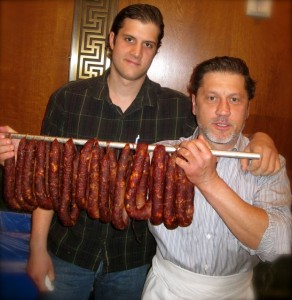 Jamie Stachowski and son, Josef with some of their charcuterie - photo by Jordan Wright “Jobs in this economy come from the smallest businesses. Ninety percent of all jobs are from businesses with 20 or less employees,” he said, and raised the alarm that “since 1970 we’ve lost 80% of our dairy farms.”
But he also spoke encouraging of the resurgence of the small farm. “Smaller farms have been creating new jobs and we have added 18,000 new farms in recent years.”
In a stirring speech, Joan Veon addressed listeners on a broader scale about the multi-dimensional nature of these harsh plans on the international community of nations. She talked of the World Food Summit Plan of Action, and about “being serfs on a global plantation.” She warned, “It is all about control [of our resources] so that we will have no freedom and no rights.”
I left this ominous thought to ponder the bounty of the evening’s offerings.
Here’s what the chefs created from the farm products that were donated:
* A delicious deboned roast pig, from Salatin’s Polyface Farm in Swoope, VA. Filled with an aromatic apple stuffing, roasted on a spit till its skin crackled, and served with apple bourbon broth, it was courtesy of Chef Joel Thevoz of Main Event Caterers in Arlington, VA. Apples and potatoes used in the stuffing were from Rabbit Hill Farm, kale from Two Acre Farm and prosciutto biscuits from Meat Crafters.
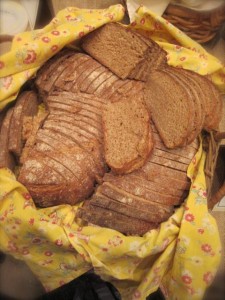 Artisanal breads from Maureen Diaz with spelt flour from Small Valley Mill - photo by Jordan Wright * Sous Chef Jenn Flynn of Poste Brasserie prepared goat from Pecan Meadow Farm.
* Eric Johnson of Krishon Chocolates made chocolate truffles from donated Amish cream and butter.
* Executive Chef/Owner Tom Przystawik of Food Matters prepared Amish Chicken sandwiches on mini biscuits.
* Sonoma Restaurant did a veal stew with veal from Smith Meadow Farm.
* Charcutier Jamie Stachowski served up some of his pates, sausages, cured meats and terrines with his son, Josef. Jamie sources his meats from local farms.
* Chef Nick Sharpe of Sonoma Restaurant and Wine Bar prepared veal from Smith Meadows Farmer’s Markets.
* Lavender Moon Cupcakery’s heavenly all-organic cupcakes made, as always, with eggs and butter from Polyface Farm.
* Coppi’s Organic Restaurant prepared leg of lamb donated by Baer Farm.
* Restaurant Nora served JuJo Acres’ beef filet on mini toasts.
* Anna Saint John Catering prepared quiche using eggs and cheese from local Amish farms and bacon from Cedar Run Cattle.
* Executive Chef Spike Gjerde of Woodberry Kitchen Restaurant prepared cranberry skillet cornbread and bison chili from Gunpowder Bison Farm and oyster stew from Circle C Oysters.
* Alchemy Caterers cooked a turkey from Springfield Farms.
There were artisanal cheeses from Keswick Creamery, Cherry Glen Goat Cheese and Chapel’s Country Creamery; coffee from Zeke’s Coffee, Amish-made vanilla and chocolate ice cream and artisanal bread by Maureen Diaz with spelt flour from Small Valley Mill.
It was a fitting ending for a very enlightened gathering assembled with love and passion for a very worthy cause.
For more information visit the sites listed below. For questions or comments email me at Jordan@WhiskandQuill.com or visit www.WhiskandQuill.com.
www.usrecallnews.com
www.womensgroup.org
www.thecompletepatient.com
www.slowfoodusa.com
www.certifiedhumane.org
Jordan Wright
March 2010
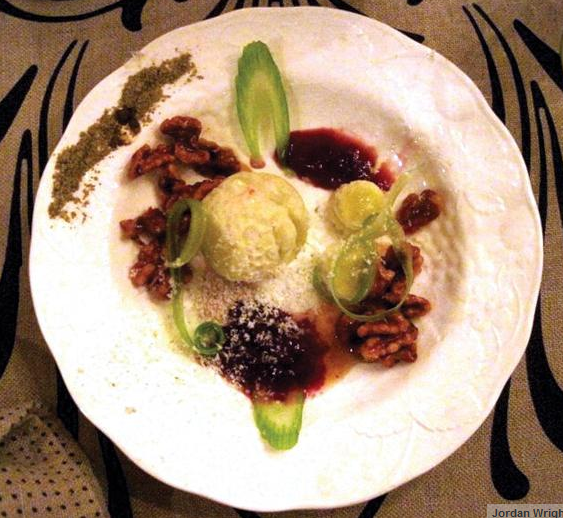 Photo credit Jordan Wright After two and a half months of anticipation, several blizzards and a flurry of back and forth emails, I was armed with the event’s protocol. It consisted of guest photo op restrictions and apparel parameters from the hosts of a local super-secret dining club. Five couples had agreed to let me cover one of their monthly themed dinners.
The Hosts: Anonymous members of a private supper club.
The Location: Somewhere in metropolitan Washington DC on a hilltop.
The Plan: A Japanese Harajuku evening with six courses and countless complex accompaniments.
The Inspiration: Recipes sourced from New York’s Momofuku and Chicago’s Alinea restaurants.
The Guest List: Serious foodies, gourmands, amateur chefs and wine connoisseurs.
The Required Dress: Creative outfits from the Harajuku movement.
On the appointed day I rushed to google it up. Isn’t that how we inform ourselves these days? I learned that Harajuku, which loosely translated means Halloween, originated with Japanese teens meeting up on Sunday afternoons in their neighborhood parks and sporting clothing and makeup inspired by specific themes. There’s the over-the-top Lolita, look replete with baby doll dresses and large bows or barrettes clipped into brightly-dyed pink, blue or purple pigtails, Japanese Anime character look-alikes, period Victorian garb and colorful punk gear with Goth-inspired hair and makeup. Matchy-matchy is very uncool, and plaids are routinely mixed with stripes and floral patterns.
“Hello Kitty” and “Pokemon” purses and lunch boxes are favored accessories, as are carrying or wearing small “Totoro” stuffed animals or creatures from Japanese animator Takashi Murakami’s line of plush toys. Some styles are straight from high-end designer ateliers, but for the most part it is cobbled together from mismatched thrift shop or boutique finds. It sounds totally anti-fashion but is actually spectacularly artistic in a bizarre and inventive way. Many current high-fashion runway looks have evolved from this genre.
I hastily pulled together a shocking pink Japanese brocade frock coat over a cream-colored Victorian lace blouse with jabot and paired it all with plaid knee socks over black leggings and a black schoolgirl’s kilt. I left the stuffed dinosaur at home, skipped the Kabuki makeup for a smear of lip gloss, and topped it all off with an assortment of rhinestone hair clips. I felt completely off-kilter but ready to channel my inner Japanese teen.
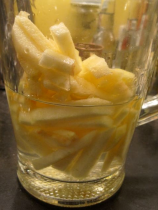 Welcoming cocktail with Japanese sho-chu vodka and Asian pears - photo by Jordan Wright I arrived at a large restored colonial with a hawk’s eye view of the city where my hosts, their children, and an on-duty Papillon greeted me enthusiastically. I planned to come early to take some food photos and offer assistance to my hosts, but the preparations were well underway. My host, and chef for the evening, handed me a welcoming cocktail, an infusion of Asian pears with sho-chu vodka, and invited me on a tour.
The 19th Century high-ceilinged home had two kitchens and a butler’s pantry with ten-foot high shelves filled with all manner of exotic spices, condiments and a working kitchen’s necessaries. The upstairs kitchen, large and rustic, had a wall of well-used copper pots, another featured a large contemporary oil painting. On the lower level another workspace housed state-of-the-art equipment befitting the molecular gastronomy necessary to achieve our much-anticipated dinner.
There was a Pacojet Puree Machine, an Excalibur Food Dehydrator, a Minipack Torre Vacuum Chamber Sealer for shrink-wrapping, and a Poly Science Sous Vide Circulating Bath for cooking or chilling. Freezer drawers held silicone molds filled with spherical frozen mousse. It immediately became clear that this was more than just a passing interest for my host…and the Iron Chef-style excitement ratcheted up a few more notches.
As guests filtered in and out of the bustling kitchen and drawing room and the conversation turned lively, the children, clad in their own versions of the “look”, wandered off to wherever it is that children go when they are bored with adult conversation. After a few rounds of champagne, we gathered at the long dining table where food and wine began to consume the conversation and we, in turn, them.
The first course presented was a frozen sphere of Maytag Blue cheese ice cream surrounded by walnuts in grape syrup, a port wine gelee, grape foam, walnut milk, celery and celery salt made from stalks dried in the dehydrator…a sort of mad scientist’s Waldorf salad and our host’s nod to Chef Grant Achatz of Alinea Restaurant. It was an inspired, playful and delicious adventure and I ate my way in circles around the plate repeating the yin-yang flavors by turns.
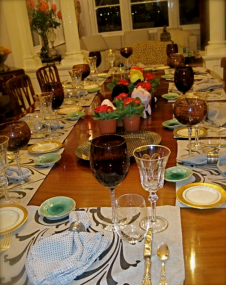 Before the guests arrive for the Harajuku evening - photo by Jordan Wright A subsequent course proved to be a sensuous dish of Riesling gelee over lychee nuts with pine nut brittle and shaved frozen fois gras – a tribute to Momofuku and the genius of Chef David Chang. The mouth feel of this combination was luxurious…the tiny wriggly cubes of late harvest Riesling jelly; tender globular floral-fragrant lychees; crunchy pine nuts with their sap-like aroma encased in hardened caramel; and buttery-smooth Hudson Valley duck foie gras raining down over the whole. I was pleased this evening was a secret for I had no impetus to reveal its mysteries to outsiders just yet.
Irresistible slabs of crispy pork belly glistened, and in yet another triumph borrowed from Chang, Bo Saam, a ten-pound braised pork shoulder, its skin rendered bronze and lacquered with saam. Platters of just-shucked oysters appeared alongside of sauces and condiments like kimchi, chiles, fermented bean curd, pickled mustard seed sauce, scallion and ginger compote, pickled vegetables and fish sauce dotted the table.
The wines for the evening were carefully selected and exquisite. A Carlisle Zinfandel from the Russian River Valley, a double magnum of Poizin Reserve in the skull and crossbones etched bottle from Armida Winery in Sonoma’s Dry Creek Valley, a fine 2007 Sea Smoke Pinot Noir from Santa Barbara County and an extraordinary 2007 Saxum from James Berry Vineyard Proprietary Blend…100 points from Robert Parker! A wine of such splendor and amplitude begged silent contemplation of its marvels, every sip bespeaking its provenance and development. As my imagination concocted its journey, I envisioned its beautiful grapes slowly ripening on the vine and the experienced decisions of its vintner shepherding its path from birth passage to aging process.
With deep regret I had to take my leave for a prior engagement before dessert was served, so I will never know the ending to this evening’s meal. But in a way, like all great meals and all great wines, we stand at the precipice, lured by the siren’s song and the promise to our most fragile selves to relive that evanescent moment when all the gastronomic stars align.
To start your own private supper club:
There are widely varying degrees of group size and culinary skill levels in each supper club. To start your own, you just need to round up friends of like mind for a once-a-month evening, decide on a theme (My hosts’ club did a multi-course fennel dinner the previous month (Yes, fennel cake and fennel ice cream for dessert!) then decide if it’s “pot luck” or if the host couple will prepare the entire meal. Guests can bring wines but need to consult the host as to the proper pairing.
Themes:
The fun is in the planning and using your imagination. Single ingredients, ethnic cuisine or holidays can drive the theme of your gathering. I recall once coming upon a group of 20 or so Ukrainians picnicking in Fort Hunt Park last summer. Their party was more of a “pot luck” in that the guests each brought a dish, but it was marvelous in its variety of homemade pickled cucumbers and mushrooms, potted meats, borscht, a grill laden with skewered lamb shashlyks, salads, homemade breads and cakes and, of course, large bowls of fresh cherries. The clear liquid of choice to wash it all down was most decidedly not branch water.
For questions or comments on this story contact Jordan@WhiskandQuill.com. And if you decide to host your own supper club let me know how it turned out. Better yet I’d be delighted to help!
|