Accompanied by a phalanx of golden shield-carrying gladiators, The Goddess of Pop strode onstage last night in a massive afro and shimmering turquoise and silver ensemble that exposed one singular, very buff, perfectly rounded butt cheek. Seventy is the new twenty, if it’s Cher we’re talking about. Glamorous, fit and fierce, she seized the night with style and purpose, opening to deafening cheers with, “This Is a Woman’s World”.
A two-tiered Moroccan palace with central dome served as backdrop for a myriad of cultural themes as Cher took her fans through an intimate tour of her life before during and after the Sonny Bono years in her latest show, CLASSIC CHER. Projected above the stage were vintage videos of her childhood interspersed with film clips from her movies and bits from her three CBS variety shows – TheSonny & Cher Comedy Hour, Cher and the short-lived The Sonny & Cher Show. For fans of the raven-haired beauty this was solid gold. (Sony’s Get.TV runs the shows on Monday nights)
Just as riveting were snapshots of the clothes she wore – the bejeweled Bob Mackie gowns, the Op Art Mary Quant miniskirts and white go-go boots of the mid-60’s, the tie-dyed shirts and bell-bottoms of the psychedelic era – that brought back memories of Cher’s major influence on the pop fashion scene. There was no mistaking that this show was as much about her spectacular wardrobe as her Grammy-winning pop songs, as she took us through the history of the music, costumes and wigs from the mid 1960’s and throughout the history of her meteoric career.
As the pop diva regaled fans with personal stories about her life and times both on stage and off, she sang duets with Sonny on video of some of their most fondly remembered songs – “The Beat Goes On”, the 1965 hit “All I Really Want to Do” and “I Got You Babe”, the closing number in the pair’s first show and a song she’s been reluctant to sing in the past, fearful she’d break down in tears.
Surrounded by nine dancers, some doubling as acrobats perched high above the stage, Cher made as many as ten costume changes to dovetail with her greatest hits. There were grass-skirted African dancers, a burlesque scene from a Berlin cabaret, Cher in hot pink veils a la Scheherazade, a life-size faux elephant that emerged for the circus-themed “Gypsies, Tramps and Thieves”, and of course, the full-feathered Indian headdress that she wore for the 1973 song, “Half-Breed” which was only her second US solo number.
Between snippets of songs, laser lights, Pop Art graphics and video footage, the Oscar-winning actress told of her musical influences – Tito Puente, Hank Williams and ultimately Elvis who above all inspired her to take risks. And isn’t that what this show is all about. Cher, backed by five musicians, proving that the beat does indeed still go on.
Cher performed on March 20, 2017, at The Theater at MGM Grand National Harbor – 101 MGM National Ave, in Oxon Hill, MD.
Remaining performances are on March 23, 25, and 26, 2017, and she returns on August 31, 2017 and on September 2, 3, 7, 9, and 10, 2017. For tickets and information visit their website.
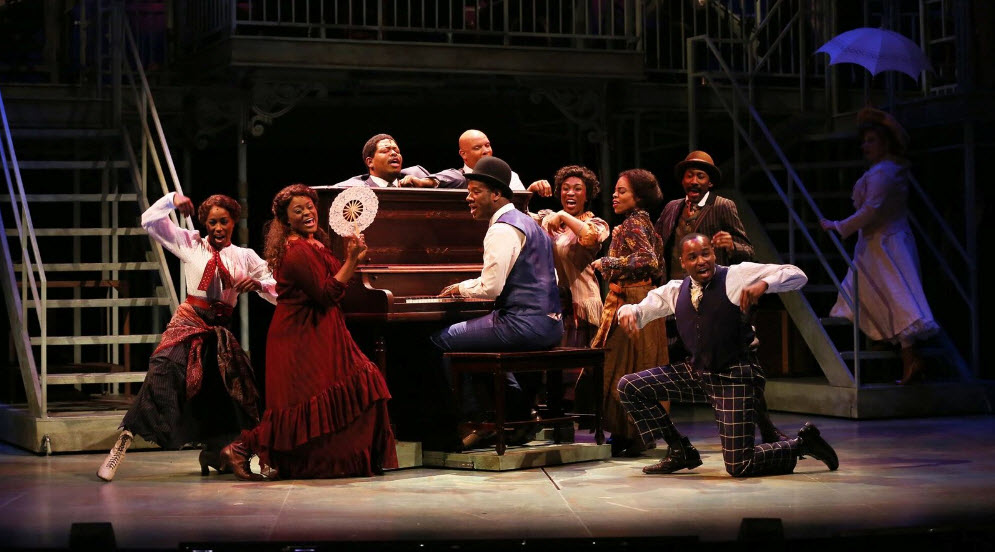
Cast of the musical “Ragtime” at Ford’s Theatre, directed by Peter Flynn. Photo by Carol Rosegg
The Ford’s Theatre Society delivers a heart-meltingly tender Ragtime by gifting the audience with twenty-seven extraordinarily talented performers in this portrait of intersecting American lives. Taken from E. L. Doctorow’s eponymous novel we become willingly immersed in a sweeping 20th century saga of three distinct elements of American society – Black America, on the rise as a strong middle class in Northern cities; middle and upper class White Americans; and Jewish and Irish immigrants bent on hard work and rapid assimilation in their new found country. Director Peter Flynn masterfully takes the reins of this award-winning Broadway lollapalooza that pairs Terrence McNally’s book with Lynn Ahrens’ emotionally stirring lyrics and Stephen Flaherty’s indelible music. A drop dead amazing cast takes us the rest of the way.
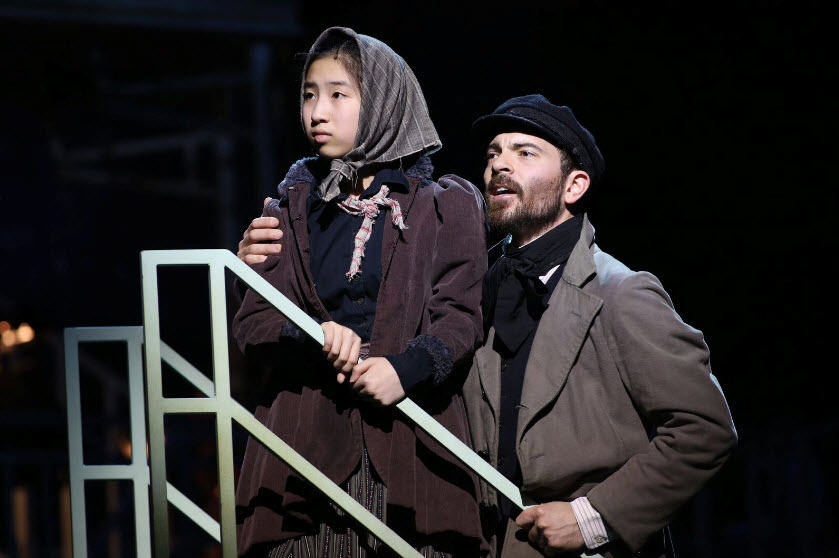
In this period of America’s rapid advance, the country was forced to confront the underlying causes of racism and an unprecedented influx of immigrants. Ragtime brings us face to face with the headliners of the day – Emma Goldman (Rayanne Gonzales) an early labor reformer and union organizer; financier J.P. Morgan (Christopher Bloch); Harry Houdini (Christopher Mueller) the Jewish immigrant who became the world’s most famous magician; and Evelyn Nesbitt, the great beauty who carved out her vaudeville career on a velvet swing while paramour to millionaire architect Stanford White (Elan Zafir). It also introduces us to the fictional character of Tateh (Jonathan Atkinson), a first-generation Jewish immigrant and silhouette maker and his little girl (Dulcie Pham).
DulciePham and Jonathan Atkinson in the Ford’s Theatre production of “Ragtime,” directed by Peter Flynn. Photo by Carol Rosegg.
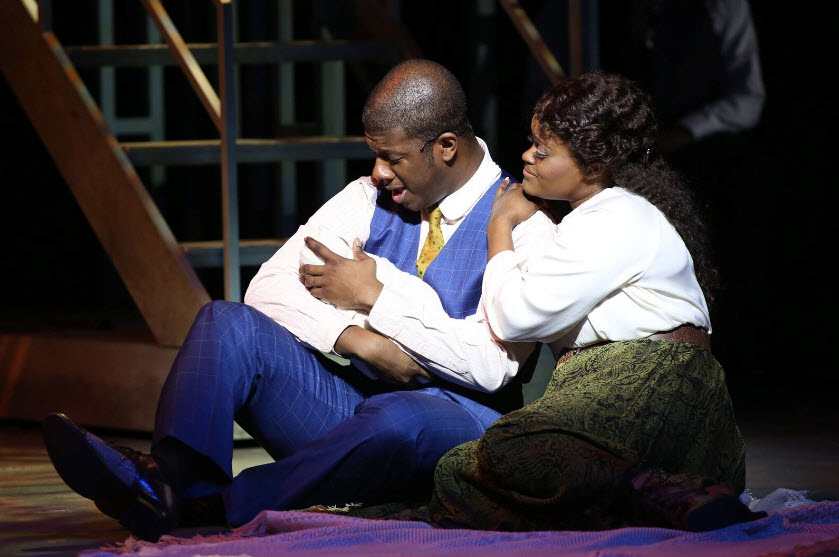
It harkens back to a period that both blossomed and suffered under the rapidly changing landscape of industrialization and growing civil unrest, when Ragtime music was sweeping the country and Coalhouse Walker, Jr. (Kevin McAllister), a fictional version of Scott Joplin, was creating a new sound that crossed over into White high society. Booker T. Washington (Jefferson A. Russell) the great African-American orator and Presidential advisor guided and inspired Black Americans and Henry Ford (John Leslie Wolfe) hired them. In Doctorow’s sweeping saga ordinary people become extraordinary people as their lives intersect and their humanity is tested.
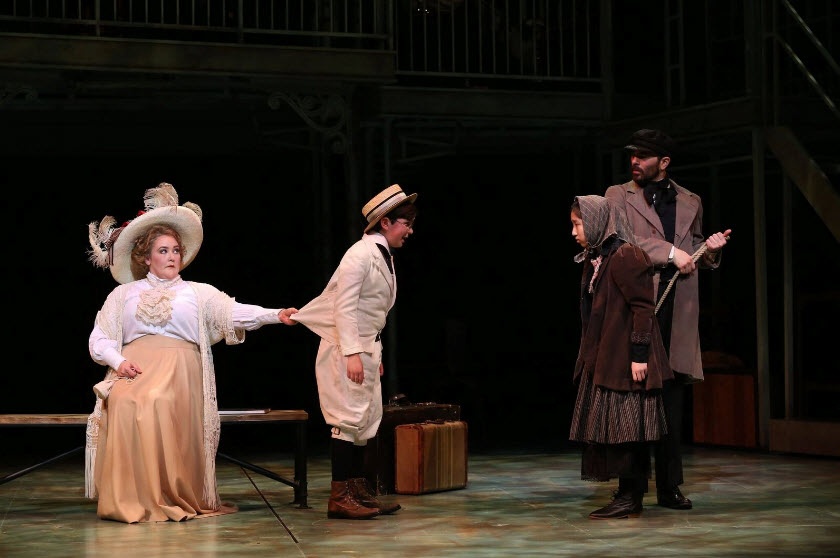
A very proper Victorian family of Father (James Konicek) and Mother (Tracy Lynn Olivera) live with their Little Boy (Henry Baratz). While Father is off on a polar expedition Mother discovers a Black newborn abandoned in her garden and goes about finding the boy’s mother. “I never thought they had lives besides our lives,” she confesses while searching for the baby’s mother. When at last she finds Sarah (Nova Y. Payton), she offers her the comfort of their home – allowing her humanity to overtake her Victorian rigidity.
Tracy Lynn Olivera, Henry Baratz, Dulcie Pham and Jonathan Atkinson in the Ford’s Theatre production of “Ragtime,” directed by Peter Flynn. Photo by Carol Rosegg
Scenic designer Milagros Ponce de Leon gives us three levels of verdigris wrought iron staircases on which the cast can be highlighted for their separate numbers while on stage throughout the show. The orchestra remains in full view on the central level, remaining an integral part of every scene. The blending of the human form on stage comes from Choreographer Michael Bobbit. In one particular scene the characters perform a ragtime dance, until they realize they are dancing with someone of another race and promptly change partners.
Kevin McAllister and Nova Y. Payton in the Ford’s Theatre production of “Ragtime,” directed by Peter Flynn. Photo by Carol Rosegg.
Twenty-eight songs come at you with such passion and such emotion, I had goosebumps more times than I could count as the ensemble acted out a poignant story of hope, redemption, human rights and justice.
Highly recommended. Grab your tickets now!
Through May 20th at Ford’s Theatre, 511 Tenth Street, NW, Washington, DC 20004. For tickets and information visit www.fords.org or call 202 347-4833.
Interview with John Flahavan – CEO of Flahavan’s
March 14, 2017 Jordan Wright
Not all of us will be guzzling Guinness or Harp while wearing shamrock beads and green Pilgrim hats on St. Patrick’s Day. I leave that to those cookie-baking elves. As fanciers of Irish beer, Kerrygold butter and Irish cheddar (how did we ever live without these?), there are other ways to celebrate the Auld Sod. Recently Flahavan’s Oatmeal hit the US market. Their non-GMO and gluten-free products are now readily available in our area and around the country. The company, based in Ireland, boasts a seven-generation provenance. Surprisingly, this is the pre-eminent oatmeal in Ireland, and rated Ireland’s favorite food brand. I loved hearing that it is also Ireland’s oldest family-owned company. Another little-known fact is that Quaker Oats and John McCann’s – the so-called “Irish oatmeal” we see in our supermarkets – are completely unknown there. Oddly enough McCann’s is processed and packaged in the US. So if you want real Irish oatmeal, I urge you seek this product out.
Yesterday I spoke with CEO John Flavahan by phone who rang me from Waterford County, Ireland where the company is based. Due to the blizzard, his flight to the US was cancelled and unfortunately we would not have the opportunity to meet in person. Still I was ready to learn more about his company and hoped to seek clarification of the sometimes-confusing types of oatmeal. John’s Irish lilt was a joy to hear as he lovingly spoke of his ancestors and the history of their centuries-old mill. He is especially proud of the mill’s award-winning approach to sustainable production and renewable sources. Our conversation below is followed by fantastic several recipes to try at home.
Whisk and Quill – As the oldest mill in Ireland, your mill is a veritable anthology of the history of milling in Ireland. How excited are you to introduce your oatmeal to America?
Flahavan’s is the oldest grain mill that is still working in Ireland. Given my family’s long history in milling, I have a great personal interest in history and have enjoyed tracing back the history of the company to 1785. This is when my great, great, great grandfather took over the mill, and it is quite likely that the mill was operating before that. There are records in the 1656 Civil Survey showing that there were two mills in the village of Kilmacthomas, and we believe that the Flahavan’s mill could be one of those mills.
In my quest to know more, I discovered old letters from America dating back to the 1850s and 1860s from a family member (Matthew Kelly) in Chicopee Falls, MA, USA to my great grandfather, Thomas Flahavan. One of these references the political climate among the States following the election of a new US president: Abraham Lincoln, when he described with the ultimate understatement that “The South don’t like him” Matthew went on to describe the taking of Fort Sumter which was the first act of the Civil War and mentioned the rebels attacking towards Washington.
So you can see how our family has been engaged with the USA throughout our history.
We often hear stories of Irish people travelling back to the States with Flahavan’s packed into their suitcases or asking family at home to send care packages over to them in the US. Equally many American visitors to Ireland have discovered our creamy oats while visiting Ireland and contact us to find out if they can purchase our products in the States.
Today, I see great synergy between our values of wholesome, delicious wholegrain goodness and the growing foodie / health trends that America is currently valuing, perhaps more today than ever.
Can you describe the difference between instant, steel-cut or pinhead oats, rolled oats, quick oats, and old fashioned?
Steel Cut Oats are produced at one production stage back from the rolled oats. They are produced using the whole roasted groat, cut with a steel blade just two or three times to preserve a nuttier, richer texture. Steel cut would have the lowest GI.
Quick-to-Cook Steel Cut Oats are the same as Steel Cut Oats, but cut into smaller pieces to enable quicker cooking.
Rolled Oats are the Steel Cut Oats, steamed and rolled into the flat flakes with which you might be most familiar. This process also enables a quicker cooking time of just 3 minutes.
Pinhead oats are effectively the same as steel cut oats. They are known as Pinhead oats in Ireland and as Steel Cut Oats in the US. We do not sell “instant oats” in the US. Our rolled and quick to cook options are so wholesome, unsweetened, quick and simple to make that we believe they suit the busy but health-conscious lifestyles of American consumers well.
What’s the difference between Scottish oats and Irish oats?
One key difference – between not just Irish and Scottish oats, but oats from Ireland’s South East and elsewhere – is the unique microclimate of the South East of Ireland. We use specially selected oat varieties that are perfectly suited to the exceptionally long, damp, mild growing seasons which allow for more complex flavor development.
What do you do with the bran part of the oat?
Our oatmeal is sold as a whole grain without the bran removed. However, we can actually separate out the bran to produce a product called oatbran, which we sell in small quantities in Ireland. It is most commonly used in baking wholesome Irish brown bread but can also be used as a porridge.
What are “oatlets”?
“Oatlets” is not a term that is relevant to the US market. In the Irish market we brand the equivalent of the Rolled Oatmeal US product as “Progress Oatlets”. This is an historical term that dates back to 1935 when Flahavan’s were the first mill in Ireland to begin rolling the steel cut/pinhead oatmeal into flakes in order to reduce cooking times and make the product more relevant to modern living trends. This was seen as very progressive at the time, hence the phrase “Progress Oatlets” was coined. We have registered it as a trademark. In the US, these rolled oats are simply called Flahavan’s Irish Oatmeal.
Most Americans are familiar with Quaker Oats and John McCann’s. Tell us why Flahavan’s is a better choice.
Well, Flahavan’s is still a 100% family owned company with an historic milling tradition and 235 years of experience. We’ve been sourcing our oats from local family farms within 50 miles of the mill for generations. Everyone knows Ireland as having a mild damp climate, particularly in the South East and our local oat growers use specially selected oat varieties that are perfectly suited to these ideal oat-growing conditions. The oat grain therefore develops and ripens more slowly which produces a plumper grain filled with more natural starches thus enabling us to produce a distinctive naturally creamy Flahavan’s oatmeal, with a delicious wholegrain texture.
Smaller scale, sustainable production is also at the heart of Flahavan’s 230-year old milling process. Over 60% of our mill energy comes from our own renewable sources. The millstream was originally channeled along the valley of the River Mahon and was used to power the mill wheel is still used to this day, but we are now using a water turbine installed in 1935 to generate a proportion of our electricity. We also burn the outer shell (the husk) of the oat to generate the steam used in our cooking process and use our own large scale wind turbine to generate electricity to help power the mill.
Flahavan’s produce, package and ship Irish oats worldwide from here. It’s also worth noting that Irish oatmeal consumers would not be very familiar with Quaker or John McCann’s. Flahavan’s is the most popular brand of oatmeal in Ireland, where people eat more oatmeal (60 portions) per capita than in any other country.
Do you process your oats on grinding stones or with steel blades?
Even though we’re a small company we are still relatively modern and use steel blades to produce our oat flakes.
What will I discover about the taste of your Irish oatmeal vis a vis American oatmeal?
You’ll find Flahavan’s oats have a more wholesome texture and a naturally creamier taste than oats grown elsewhere, thanks to the unique Irish microclimate and our distinctively small-batch, slow-roasted, sustainable production methods.
What’s your favorite way to eat oatmeal?
I would sometimes soak the oats overnight for an extra creamy bowl of porridge but I would always use some raisins pre-soaked in apple juice as a topping.
Which of your products is the most popular in Ireland?
Our most popular product continues to be our Flahavan’s Progress Oatlets, which is the very same product that can be found in our Irish Rolled Oatmeal box in the US.
What is baobab powder? I see it listed as an ingredient in one of your recipes online.
Baobab powder is a superfood gaining in popularity in health food circles for its high levels of vitamin C, other vitamins and minerals and a supposed immunity-boosting value. It comes from the raw fruit of the baobab tree, which grows in Africa and some parts of Australia.
In our recipes, we like to maintain a balance between the enjoyment of traditional oatmeal preparations and innovations that authentically reflect the globalizing popularity of our oats. For example, Flahavan’s oats have become popular in South Korea as a healthy source of whole grains and so we have enjoyed developing recipes that honor South Korean flavors, such as Turmeric Kimchi Oatmeal with a Fried Egg.
Do you use oat groats to process your oatmeal?
There is essentially a groat in each individual grain of oat. We slowly kiln these groats twice, while still in their husks, to optimize their flavor and naturally creamy texture. We then remove the husks and cut the groats using a steel blade. To make rolled oats, we then steam and roll the cut pieces into flakes. We power the steamer using our own renewable energy, which has been generated by burning the discarded husks.
What products are available here in the States?
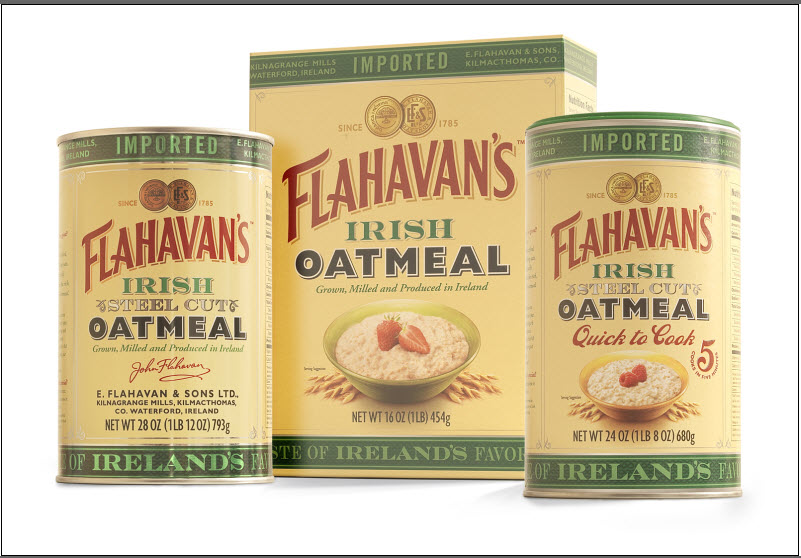
Our product range in the US consists of Flahavan’s Irish Steel Cut Oatmeal; Flahavan’s Irish Quick to Cook Steel Cut Oatmeal (cooks in 5 minutes); and Flahavan’s Irish Oatmeal – our rolled oats that cook in just 3 minutes. In your area, we are in Harris Teeter, some Wegman’s markets and Giant in Landover, MD. It is also available to order from Mybrands.com and amazon.com
What else would you like our readers to know.
We are committed to innovation and sustainability. Flahavan’s is one of the founding members of the Irish Food Board’s Origin Green Programme, the only sustainability program in the world that operates on a national scale, uniting government, the private sector and food producers through Bord Bia, the Irish Food Board. This independently verified program enables Ireland’s farmers and producers to set and achieve measurable sustainability targets – reducing environmental impact, serving local communities more effectively and protecting the extraordinarily rich natural resources that our country enjoys.
We are proud to say Flahavan’s has been recognized on numerous occasions by Irish green industry leaders for our sustainable approach to milling, which in February saw Flahavan’s winning 3 awards at the Green Energy Awards 2017 (Green Food & Beverage Award, Sustainable Green Energy Award and Green Medium-Sized Organisation of the Year).
For us, it’s all about wind, fire and water. Investing in a wind turbine in December of 2015 reinforced our commitment to a sustainable future. We also use a special technique of burning the discarded oat husks that fuel the boiler used in the steamrolling process to make rolled oats. This eliminates the use of diesel fuel. Also, the mill captures the power of the local River Mahon, just as it has done for over 230 years. We are a seventh-generation family company. I am the sixth generation, and my son James and my two daughters, Annie and Ellen, also work in the company.
Flahavan’s St. Patrick’s Day Oatmeal with Irish Whiskey, Honey and Cream Serves 3-4
Ingredients
3¾ cups (900ml) of milk
1 cup (130g) of Flahavan’s Irish “Quick to Cook” Steel Cut Oatmeal
Drizzle of honey
1 tbsp. cream
1 tbsp. Irish Mist Liqueur (or any Irish Whiskey)
Method
Place the oats and milk in a saucepan and bring to a boil.
Reduce heat and simmer for 5-7 minutes until cooked.
1 1/3 cups Flahavan’s Irish Oatmeal (rolled oats)
8 oz. almond milk
1 Tbsp. cocoa powder
1 tsp. ground cinnamon
Agave syrup or honey to taste
1 small banana, sliced and frozen overnight
Handful of popcorn (optional)
Method
Mix the Flahavan’s Organic Irish Porridge Oats, almond milk, cocoa powder, cinnamon and agave syrup/honey in a re-sealable bowl and leave in the fridge overnight.
In the morning, add the banana to the oat mixture, then place in a blender and blend until completely smooth.
If the shake is too thick, add more milk for a thinner consistency. If it’s not sweet enough, add more of your preferred sweetener.
Top with popcorn for some extra-special froth.
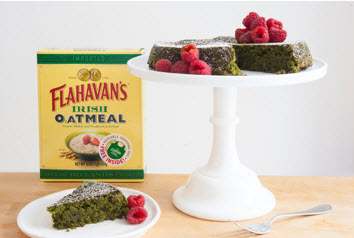
Matcha Green Tea Oat Cake Makes one 9-inch cake
Ingredients
Cake Batter
1 cup coconut flour
2 cups coconut sugar
1 tablespoon cornstarch
1 ¼ cups warm water
½ cup coconut oil, melted
1 cup Flahavan’s Oatmeal
1 cup almond meal
1 ½ teaspoon baking soda
1 ½ teaspoon baking powder
½ teaspoon kosher salt
¼ cup orange juice
½ teaspoon orange blossom extract
4 Tablespoons dried matcha (green tea) powder
Jordan Wright March 15, 2017
Photo credit ~ Jordan Wright
The National Museum of African American History and Culture
Jerome Grant is exactly where he’s supposed to be. And for that he exudes gratefulness. As the first Executive Chef of the National Museum of African American History and Culture (NMAAHC), the young chef had long dreamed of working at the newest museum on the Mall. In the works for the past hundred years, the museum at finally opened to the public last September. It seems unfathomable that we ever lived without it. The building’s unique architecture rises both in tribute and testimonial to African Americans and their indelible contributions upon the fabric of this nation. For Grant, its opening was timely, completing his own truly American story of his rise to success at the helm of a new icon to African American culinary roots.
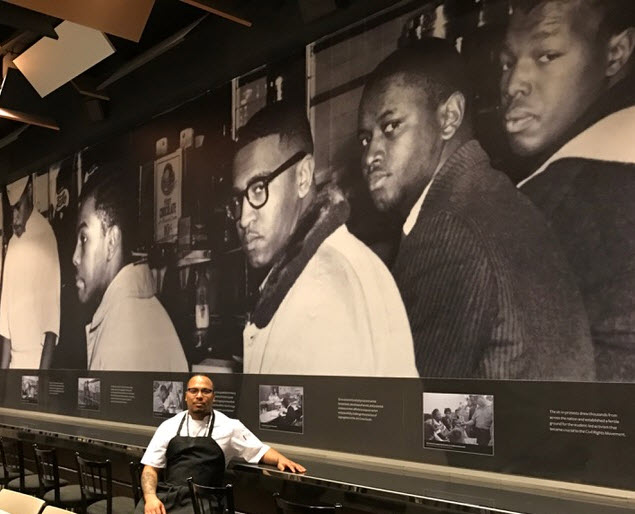
Jerome Grant takes a break at the Sweet Home Cafe
Seven years ago Grant began his Washington area career with Restaurant Associates serving as Sous Chef to Richard Hetzler at the Mitsitam Native Foods Café, the award-winning restaurant ensconced in the National Museum of the American Indian (NMAI). Grant was there when Hetzler’s much lauded cookbook, The Mitsitam Café Cookbook, was published. Here he found a mentor in Hetzler who prepared him for the job of running large scale food operations. When Hetzler moved on, Grant took the helm, developing his own approach to seasonal and regional Native American dishes.
Jerome Grant takes a break at the Sweet Home Cafe
In 2013 Restaurant Associates gave Grant a promotion to work at theCastle Café. He wasn’t particularly looking forward to preparing soups and sandwiches, “I went through the motions”, but he accepted with the guarantee of moving over to Sweet Home Café in 2016. Last year under the guidance of RA Culinary Supervisor Albert Lukas and BravoTop Chef finalist, Co-Host of ABC’s The Chew and NMAAHC Culinary Ambassador Carla Hall, Grant began taking the reins in the pristine 10,000-square foot kitchen.
But before all that the chef watched the museum rise slowly out of the dirt and reflected on his own story. A parallel tale of ancestors making their way to America. In his case two grandfathers who emigrated from the island of Jamaica and came by boat to Philadelphia.
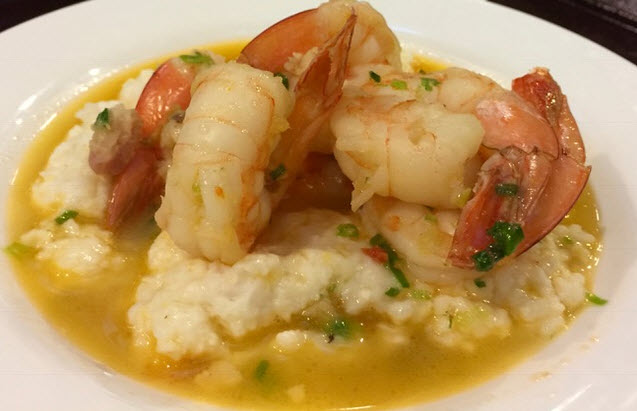
Shrimp and Anson Mills Grits
In the beginning Grant worked alongside Lucas to identify the separate regions represented in the café – the Agricultural South, the Creole Coast, the Northern States and the Western Range – each featuring their own historically-influenced dishes. To her credit Hall was positive and supportive, offering suggestions and critiques while texting encouragement as the menu began to take shape.
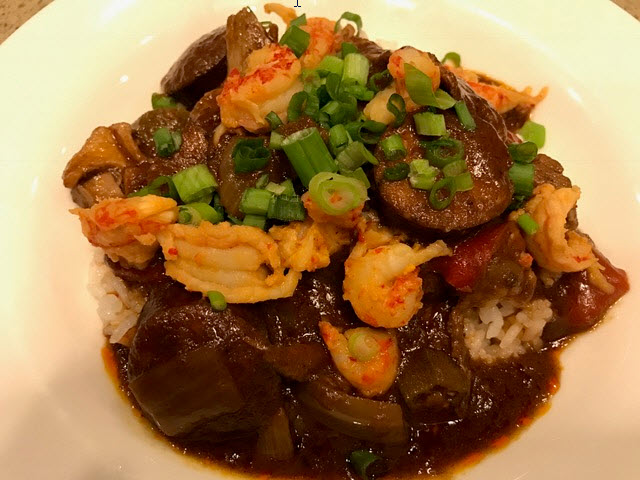
Duck, Andouille and Crawfish Gumbo
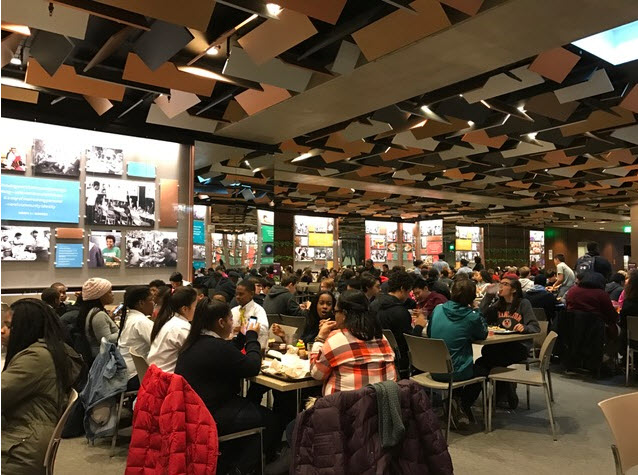
“People came to eat at Mitsitam more than tour the museum,” he told me. (A 2012 RAMMY Award to the Native American café didn’t hurt.) “Here we have coincided the café to be part of the whole museum experience.” (n. b. The NMAAHC now reports that visitors spend an average of six hours touring the property and 25% of visitors dine at the Sweet Home Café.)
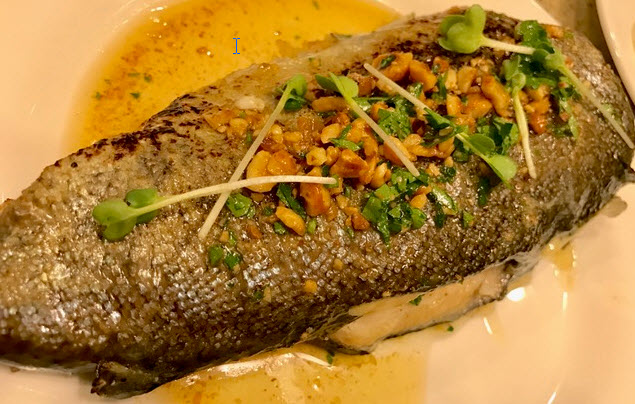
Pan Fried Trout with Hazelnut Butter
Before the museum opened its doors Foodways Curator, Joanne Hyppolite asked Grant and Hall for donations to the Gallery. Hall is donating her mother’s cast iron skillet and Grant’s giving his chef’s jacket from opening day. “It means a lot to me to be here. I’m a local kid. I grew up in Fort Washington,” he proudly says. “I believe my position here shows that you can set goals and achieve them,” adding, “Sometimes when I ride my bike here in the morning I get emotional being a part of the history of the culture. I learned to cook for my grandmother and mother and I never thought I’d do something so historical. It’s been a dream come true.”
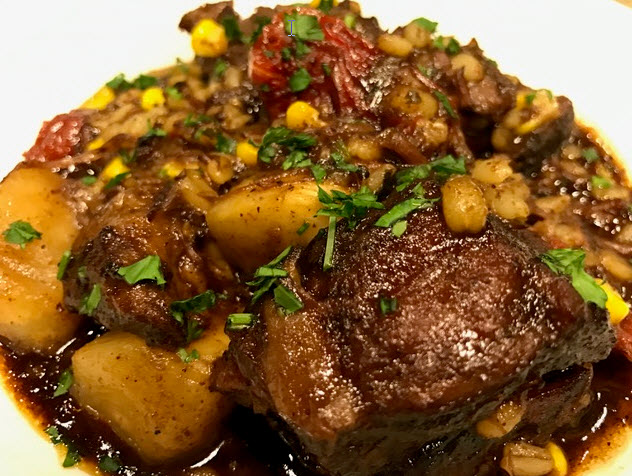
“Son of a Gun Stew”
From the start Grant and Lucas set a goal of “low and slow”, taking small batch cooking and expanding it to accommodate larger crowds. The 400-seat cafeteria style restaurant goes through 1,000 lbs. of oxtail every week for its Jamaican Pepper Pot Stew and 200 lbs. of catfish every two days. An Oklahoma made smoker handles 900 pounds of brisket, pork, chicken and cold smoked haddock. When it comes to crackling good fried chicken, it’s made three times daily. And Miss Deon, who heads up cold prep, provides the café’s potato salad recipe.
Smoked Haddock and Corn Fish Cakes
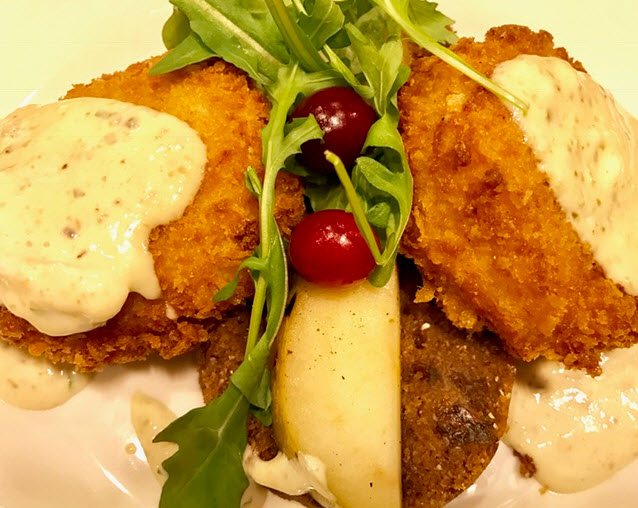
You’ll find dishes that evoke the South like Brunswick Stew with chicken and rabbit, Lexington Style BBQ pork, and familiar delicacies like pickled watermelon rind and sweet corn pudding. The Creole menu is even more expansive with Duck, Andouille & Crawfish Gumbo, Pan-fried Catfish Po’boys, Shrimp & Grits, Candied Yams and Red beans & Rice. The Northern States menu features Oyster Pan Roast, a dish inspired by Thomas Downing, a New Yorker whose tavern doubled as a stop along the Underground Railway. From the Western Range are two dishes I’ve become enamored of. “Son of a Gun” Stew made of braised short ribs and root vegetables and Pan Roasted Rainbow Trout with Hazelnut Brown Butter that I’d swear comes from a cast-iron skillet cooked over a campfire. Go West, pioneer, if you want the High Mesa Peach and Blackberry Cobbler.
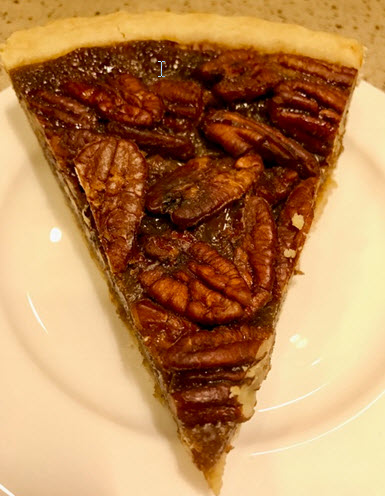
Chocolate Pecan Pie
There are exciting new changes on the horizon for the café – an expanded retail operation was successful last Thanksgiving with guests able to purchase whole dinners for takeout. As of this writing you can take home several in-house baked goods including Sweet Potato Pie, Banana Nut Cakes, Corn Loaf Cakes and cornbread. I’m particularly partial to the mouthwatering Chocolate Pecan Pie.
Though it’s a challenge to secure a timed ticket, I have been fortunate enough to have eaten at the café three times, trying nearly every main dish and a few of the desserts too. The dishes are inspiring and rich with the history of African influences on the American culinary culture. And though I’m certain you will find your personal favorites, mine is the best version of Shrimp and Grits (made with Anson Mills grits), I have ever wrapped my mouth around. Soon everyone will be able to avail themselves of all these delicious dishes without timed entry tickets.
(L to R) Hannah Yelland as Valerie Plame and Lawrence Redmond as Joseph Wilson. Photo by C. Stanley Photography.
“Hung out to dry” is the phrase that popped into my head regarding the case of Valerie Plame, the CIA covert operative who was outed by a conservative newspaper columnist in 2003. Third in the series of Arena Stage’s “Power Plays”, this cautionary tale focusses on politics and power, and by nature, those that abuse or are abused by the dark forces that control the political climate. Written by Jacqueline E. Lawton, “I write to bear witness”, and ably directed by Daniella Topol, it is set primarily at CIA Headquarters, Langley, Virginia; Plame and Wilson’s Georgetown home; Amman, Jordan; and various locations in Baghdad, Iraq. The haunting set design of massive grey rotating columns is by Misha Kachman.
L to R) Ethan Hova as Dr. Malik Nazari, Nora Achrati as Leyla Nazari and Hannah Yelland as Valerie Plame. Photo by C. Stanley Photography.
The backstory of Plame, who was later outed by conservative news columnist Bob Novak, was well-known. Plame was involved in securing “assets” in the Middle East. One in particular, Dr. Malik Nazari (Ethan Hova), was the nuclear scientist who provided her with raw intelligence on the development of the Iraqis’ nuclear weapons capabilities. She got to him through his niece Leyla (Nora Achrati), a couturière in Georgetown. Plame directed Nazari to gather intel on the Iraqi scientists he worked with, expecting him to lend credibility to the Bush administration’s reasons for mounting the Iraq war. But that’s not how it went down.
(L to R) Aakhu TuahNera Freeman as Elaine Matthews and Hannah Yelland as Valerie Plame. Photo by C. Stanley Photography
The beautiful spy, played compellingly by the equally stunning Hannah Yelland, led a glamorous life among the Washington cognoscenti where she lived with husband Joseph Wilson (Lawrence Redmond), former U. S. Ambassador to Iraq and later an oversharing TV talking head and Senior Director for African Affairs. If you’ll recall, Wilson’s connection to Africa was crucial to an administration pressed for time and making its case for war with Iraq. Sent by the CIA to confirm Saddam Hussein’s efforts to purchase uranium for WMDs, Wilson reported back that no such transaction had ever taken place. He shared this knowledge with his wife. This inconvenient truth – inconvenient for Bush, Powell, Cheney and Rumsfeld who needed to justify the war – was ultimately Wilson’s, and by default, Plame’s, undoing.
(L to R) Ethan Hova as Dr. Malik Nazari, Lawrence Redmond as Joseph Wilson, Hannah Yelland as Valerie Plame, Nora Achrati as Leyla Nazari and Aakhu TuahNera Freeman as Elaine Matthews. Photo by C. Stanley Photography.
Yelland provides us with a credible picture of an agent whose mission was to protect her assets and get at the truth. Taut, compelling and powerful, the play confronts the realities of gathering the sort of intelligence that rubberstamps what those in a position of deciding the direction of our country’s military, want to hear. Aakhu Tuahnera Freeman portrays Plame’s bloodless boss, a woman who turns on Plame colluding with then CIA Director George Tenet force Plame out and scuttle her intel.
Highly recommended.
Through April 9th at Arena Stage, 1101 Sixth St., SE, Washington, DC 20024. For tickets and information visit www.ArenaStage.org or call 202 488-3300.
: Debra Monk as Mrs. Elva Miller ~ Photo Credit is Margot Schulman
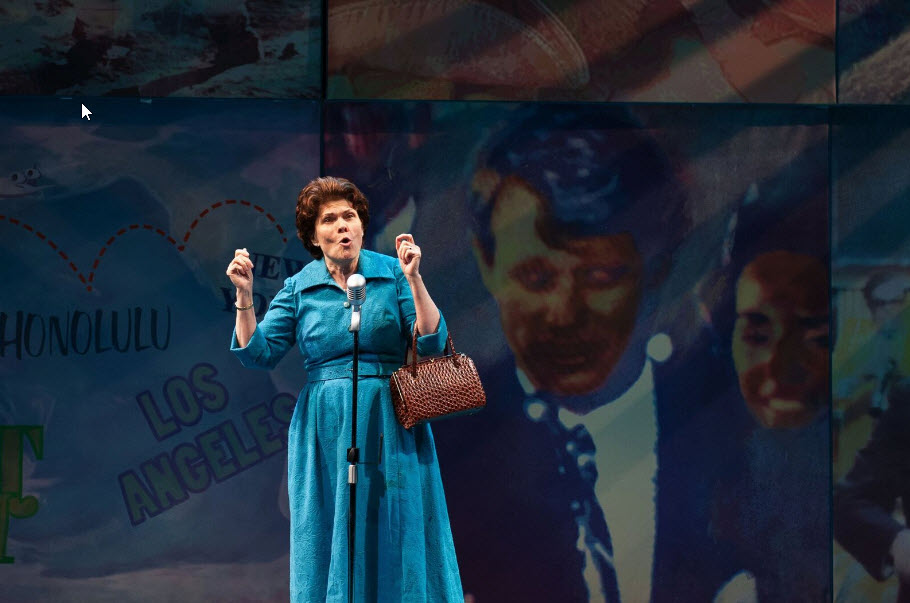
James Lapine’s latest opus, a story about the housewife with the caterwauling voice who becomes an overnight success, may be a metaphor to showcase how everyone’s wildest dreams can come true…or not. With this latest work, Lapine, best known for Sunday in the Park with George and Into the Woods, both co-written with composer Stephen Sondheim, has given us an undistinguished anomaly to his earlier masterpieces. His world premiere musical based on the life of Mrs. Elva Miller (Debra Monk), centers around a church lady who was “discovered” by a record producer who pegged her for a comedic diversion. This was in the mid-1960’s when comedians like Allan Sherman and Victor Borge were wittily parodying or satirizing familiar songs and the record-buying public was easily amused during an unpopular war. But Mrs. Miller, as she preferred to be called, was unaware the joke was on her. Or so she is portrayed. “I might have been off on one or two notes,” she allows.
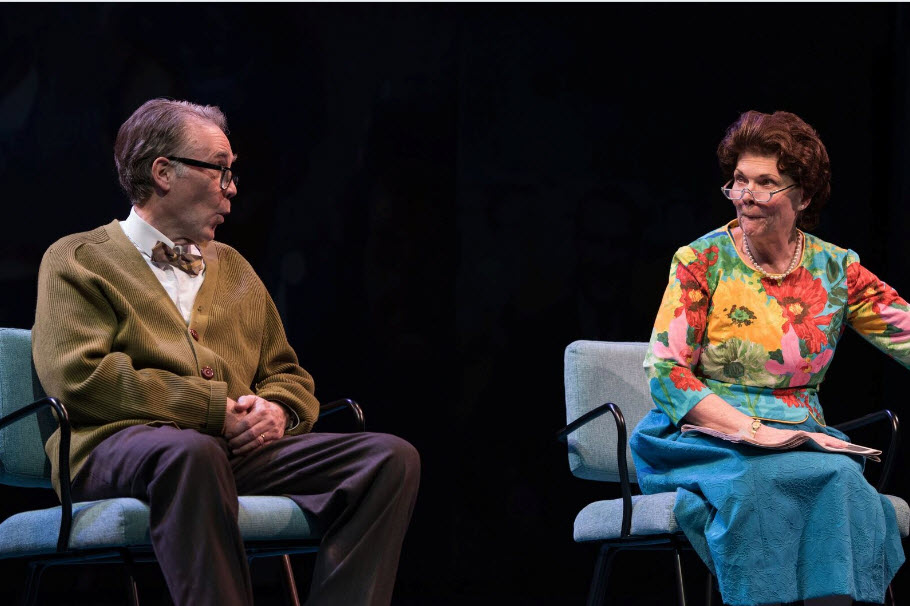
The story begs comparison to this year’s Oscar-nominated film, Florence Foster Jenkins, that features a delusional New York heiress with an equally appalling voice. The movie stars the brilliant Meryl Streep as Foster Jenkins and the eternally soigné Hugh Grant as her adoring gentleman and enabler. Grant plays a winning charmer in a film set a few decades earlier in 1940’s New York, whereas Miller’s husband is a wheelchair-bound, crotchety old gent who resents Mrs. M’s success. Lapine sets his piece in small town Claremont, a bedroom community outside of Los Angeles. Similarly, both women are clueless about their lack of vocal abilities.
Boyd Gaines as Mr. John Miller, Debra Monk as Mrs. Elva Miller ~ Photo Credit is Margot Schulman
The plot takes us through a three-year span of Miller’s short-lived yet meteoric career against the backdrop of her niece Joelle (Rebekah Brockman) and Joelle’s romance with Miller’s accompanist Simon Bock (Corey Mach) and, later, Simon’s looming draft service. Unfortunately, there is not enough heft to carry an hour and forty-five minutes of pop music covers sung in a screeching voice with a trio of backup singers drawn from predictable stereotypes – one groovy African American gal, Denise (Kimberly Marable, who pulls off arguably the best scene in the show), one fluffy blonde, Carol Sue (Kaitlyn Davidson), and one gay guy, Bobby (Jacob ben Widmar doubling as Tiny Tim) who runs off to Greenwich Village in search of sexual diversion. I won’t fault the actors. They did a fine job given the material.
Photo Credit is Margot Schulman ~ Photo Credit is Margot Schulman
Monk is superb in the role of Elva Miller. Despite the thin plot and hackneyed script, she’s totally believable as the ditsy, maniacally cheery Miller with her ingratiating manners and off-key, nails-on-a-blackboard howling. There’s even a bit of toggling back and forth to her actual singing voice in a few dream sequences. And character actor Will LeBow is exceptional in all seven roles – among them a stoner record producer, Ed Sullivan, Mr. Miller’s Jewish doctor and a snooty salesman at Tiffany’s.
Those under fifty may be clueless as to the obscure references to Tiny Tim, Ed Sullivan and Topo Gigio as well as many of the songs of that era. Millennials won’t fare any better. But if the 50’s, 60’s and 70’s are in your wheelhouse, you’ll feel right at home.
Through March 26th at Signature Theatre (Shirlington Village), 4200 Campbell Avenue, Arlington, VA 22206. For tickets and information call 703 820-9771 or visit www.sigtheatre.org.