There’s nothing like a rip-roaring, old school, Broadway musical to get the heart pumping and the toes tapping. In Hello, Dolly! the music and lyrics of Jerry Herman, one of the greatest composers of the Great White Way, will do just that. You just have to refrain from singing along… out loud.
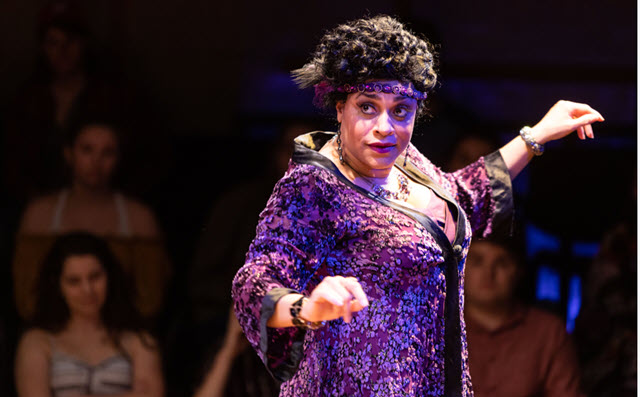
Betty Buckley in Hello, Dolly! National Tour ~ Photographer Julieta Cervantes 2108
Dolly Gallagher Levi (Betty Buckley), a Jill-of-all-trades and matchmaker extraordinaire, was the supreme marketeer and an independent working woman in the 1880’s, well before Women’s Liberation. Handing out different business cards like peppermints, she became whatever the situation called for. You need silhouettes, a dozen eggs, ear piercing, a husband or a wife? Dolly will provide. “I arrange things,” this savvy yenta explains.
Betty Buckley and Lewis J. Stadlen in Hello, Dolly! National Tour – 2018, Photographer Julieta Cervantes
When she sets her cap on Horace Vandergelder (Lewis J. Stadlen), a well-to-do hay and feed shop owner, this clever lady uses all her trump cards. Now you may think that catching a husband using feminine wiles, is sexist, and there is that to consider, but Dolly’s glamour, craftiness and kindness, is what makes her a believable character trying to survive as a down-at-the-heels widow. She’s got gumption, chutzpah and charm all wrapped up in one swell package.
Analisa Leaming in the Hello Dolly National Tour2018 -Photographer Julieta-Cervantes
If there’s any sexism here, it’s from the gents. Mr. V.’s tune, “It Takes a Woman”, sung with the Instant Glee Club, insists only a fragile woman can care for home and husband, rhyming femininity with “work till infinity”. Oh heck. All’s fair in love and war.
Situational comedy is at its best when Dolly foils Vandergelder’s meeting with the lovely Irene Molloy, a milliner who has different ideas of the perfect man. Irene and her assistant Millie fall for Mr. V.’s clerks, Cornelius and Barnaby, who have convinced the ladies they’re tycoons, when in fact they are counting their dimes. In the scene at the tony Harmonia Gardens Restaurant where the couples sup to pheasant and paté in private booths, Buckley shows off her indelible comedic skills in a silent solo dinner while Vandergelder fumes and the handsomest waiters on any stage perform a highly choreographed, frenetic dance to the “The Waiters’ Gallop” replete with flaming dishes, bottles of champagne, silver cloches and dinner plates piled to the rafters, all cleverly conducted by Rudolph the Maître d’.
Hello, Dolly! National Tour Company – 2018 – Photographer Julieta Cervantes
Betty Buckley, one of Broadway’s legendary leading ladies, stars as Dolly to Lewis J. Stadlen’s Vandergelder. Stadlen is another award-winning veteran of stage and screen who does schtick to perfection. You’ll relish the jokes, the colorful Victorian costumes, the catchy tunes (you probably know most of them), and the Kennedy Center Opera House Orchestra backing it all up.
Hello, Dolly! National Tour Company – 2018 – Photographer Julieta Cervantes
With Colin LeMoine as Ambrose Kemper, Morgan Kirner as Ermengarde, Nic Rouleau as Cornelius Hackl, Sean Burns as Barnaby Tucker, Kristen Hahn as Minnie Fay, Analisa Leaming as Irene Molloy, Jessica Sheridan as Ernestina, Beth Kirkpatrick as Mrs. Rose, Wally Dunn as Rudolph, Scott Shedenhelm as Stanley, Timothy Shew as Judge, Daniel Beeman as Court Clerk.
Directed by Jerry Zaks, Choreographed by Warren Carlyle, Conducted by Robert Billig, Book by Michael Stewart, Music and Lyrics by Jerry Herman, Scenic and Costume Design by Santo Loquasto, Sound Design by Scott Lehrer, Lighting by Natasha Katz, and Orchestrations by Larry Hochman.
Highly recommended. This is classic, old school Broadway razzamatazz.
Warning: Extremely high doses of wacky irreverence could result in uncontrollable hilarity.
Playwright Matt Minnicino’s adaptation, he calls it a new “distillation”, of Molière’s classic The Misanthrope tore the house down at its world premiere last night. A re-interpretation of the 17th century farce skewering French aristocracy, Minnicino delivers in spades with a band of frivolous, self-centered snobs, oblivious to the hoi polloi (Tag yourselves, Gwyneth Paltrow, Kim Kardashian, James Franco, Russell Crowe, Tom Cruise, et alia). This booze-swilling brat pack speaks in rhyming couplets, mixing formal dialogue and philosophical musings with modern American slang. Set in the posh environs of the South of France, it is fall-down-dead hilarious and monumentally clever.
Alceste is a cynical, smitten preppie whose target is the alluring, and self-adoring Celimene. He hates deceit yet craves the company of the most deceitful of them all. Swanning luxuriantly around the pool deck in luxuriantly revealing garb, she teases and taunts the men while insulting her female competition, especially the prudish Arsinoe, a woman of a certain age who’s got the hots for Alceste. “I’ve been programmed to pussyfoot around,” she admits.
(l-r)Patrick Joy (Clitandre), Thais Menendez (Celimene), Jenna Berk (Philinte), Chloe Mikala (Eliante) ~ Photo credit JD Corey
Unfortunately, Miss C. prefers her trendy pals and glam lifestyle far more than an angst-ridden, lovesick dweeb and pits him against Oronte, a sophomoronic wannabe poet who’s got plenty of dough to satisfy Miss C. and is suing Alceste for slander. For those wondering if Alceste will get his comeuppance (although we secretly cheer his irreverence) there is Philinte, Alceste’s gal pal and reality check, who challenges his insincerity at every turn. “We are living in a society of vacuity, fatuousness and folly,” she admonishes.
Sara Barker (Arsinoe), Elliott Kashner (Alceste). Photo credit DJ Corey
Minnicino’s earlier forays into classical adaptations have included Chekhov, Strindberg, Shakespeare, Homer, and Sophocles (no mean feat). But you needn’t have read any one of these literary titans to enjoy this snarky funfest.
(l-r) Matthew Sparacino (Oronte), Thais Menendez (Celimene), Patrick Joy (Clitandre), Tendo Nsubuga (Acaste), Elliott Kashner (Alceste). Photo credit DJ Corey
Director Megan Behm expertly wrangles this fierce cast led by Elliott Kashner as Alceste, Thais Menendez as Celimene, Jenna Berk as Philinte, Matthew Sparacino as Oronte, Sara Barker as Arsinoe and Patrick Joy as Clitandre. with Tendo Nsubuga as Acaste, Chloe Mikala as Eliante and Hannah Sweet as Basque/DuBois.
Costumes by Alison Samantha Johnson, Set Design by Megan Holden, Lighting Design by Elizabeth Roth, Properties Design by Liz Long.
A veritable verbal slugfest with a mountain of the funniest zingers since the Marx Brothers took on high society in “A Night at the Opera”.
Highly recommended.
Through June 30th at Gunston Arts Center, 2700 South Lang Street, Arlington, VA 22206.
Avant Bard tickets are $40.00, and available online at avantbard.org/ticketsor by calling 703-418-4808. For every Avant Bard performance, a limited number of tickets are Pay What You Will, which means you can name your price. You can reserve PWYW tickets online the Monday before each performance for a small service minimum, or at the door with no minimum. All Avant Bard tickets including PWYW are General Admission; seating is first-come first-served.
Saturday matinees are followed by Unscripted Afterchats with members of the creative team.
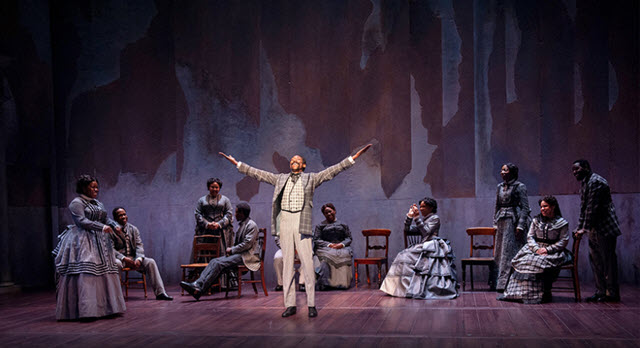
Jubilee harkens back to the American Reconstruction era when White audiences were beginning to listen to Negro spirituals in concert settings. Songs sung on plantations, in Black churches and on chain gangs – spiritual songs, work songs, songs of the underground railroad and traditional folk tunes – became more widely heard. These were not minstrel shows. They were African American choirs who sang the songs that told of escape, redemption, struggle, and faith, and that later became the foundation for American Jazz, R&B and Blues.
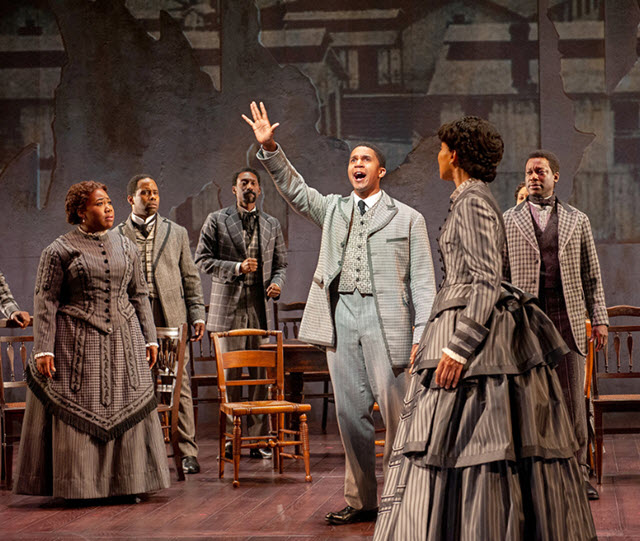
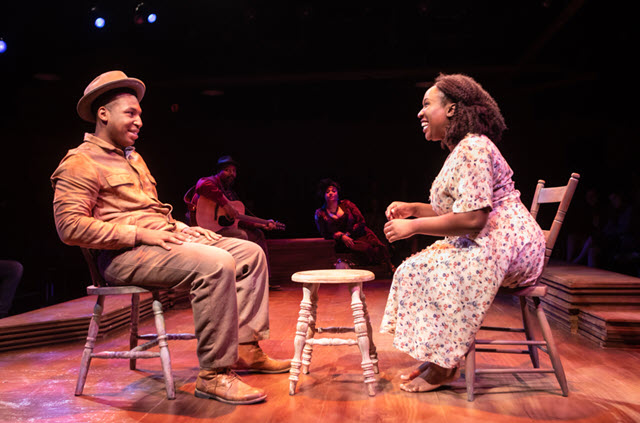
(L to R) Simone Paulwell (America Robinson), V. Savoy McIlwain (Thomas Rutling), Sean-Maurice Lynch (Frederick Loudin), Jaysen Wright (Edmund Watkins), Lisa Arrindell (Ella Sheppard) and Greg Watkins (Benjamin Holmes) in Jubilee running April 26 through June 2, 2019 at Arena Stage at the Mead Center for American Theater. Photo by Margot Schulman.
In the hands of veteran director and playwright, Tazewell Thompson, that period comes alive with the musical strains of a thirteen-person a capella choir, like the one that had its origins at a historically Black college. The story of Fisk University (HBCU), founded in Nashville, Tennessee for the education of freemen and women after the Civil War, could be the story of many Black universities that have struggled financially, except in its early years Fisk formed a student choir with the sole purpose of raising funds to keep the school from financial disaster. Led by a stern choir director, the group of young former farmworkers was able to achieve international recognition with their widely sought-after performances.
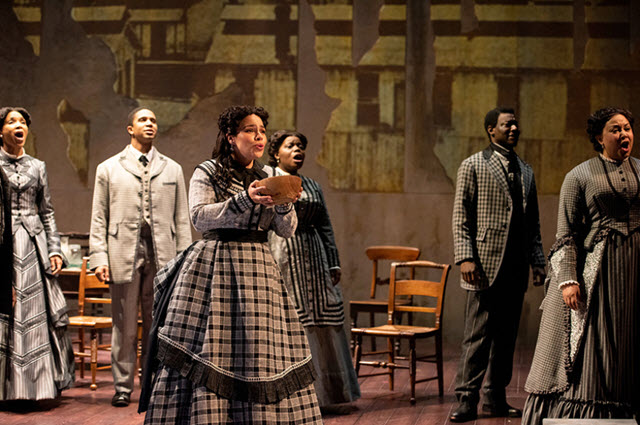
(L to R) Lisa Arrindell (Ella Sheppard), Jaysen Wright (Edmund Watkins), Katherine Alexis Thomas (Minnie Tate), Zonya Love (Georgia Gordon), Greg Watkins (Benjamin Holmes) and Shaleah Adkisson (Mabel Lewis) in Jubilee running April 26 through June 2, 2019 at Arena Stage at the Mead Center for American Theater. Photo by Margot Schulman.
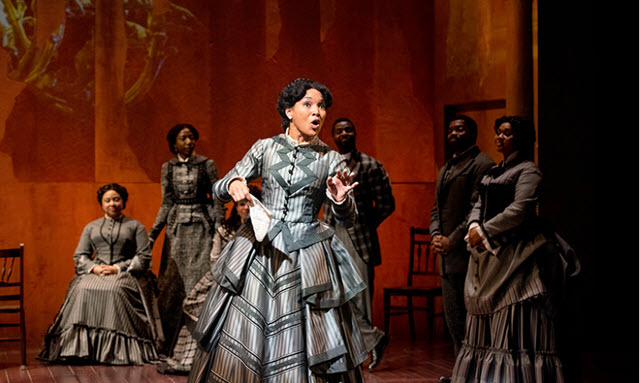
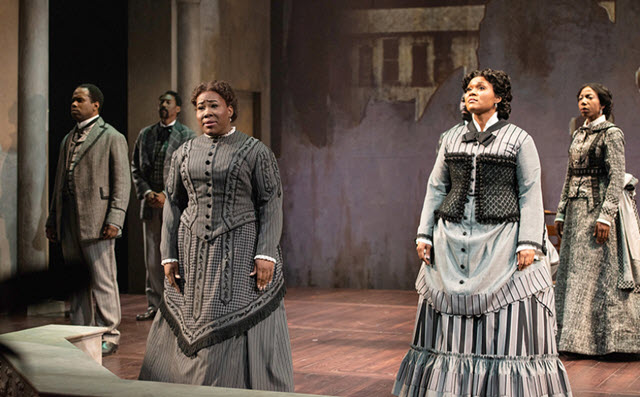
Soaring operatic solos by Lisa Arrindell in multiple roles including Ella Sheppard, one of the students, coloratura soprano, Zonya Love as Georgia Gordon, and Aundi Marie Moore as diva Maggie Porter will give you goosebumps. Evoking visions of the 19th-century rural revival camp meetings of The First Great Awakening, male baritones, tenors and basses seem to blend effortlessly on popular spirituals like “Dem Bones (Gonna Rise Again)”. Costume Designer Merrily Murray-Walsh dresses the singers in beautiful Victorian-era fashions – the ladies in elegant wide-skirted silk dresses, the gentlemen in frock coats and cutaways – all in shades of black and grey.
(L to R) Shaleah Adkisson (Mabel Lewis), Joy Jones (Jennie Jackson), Katherine Alexis Thomas (Minnie Tate), Lisa Arrindell (Ella Sheppard), Bueka Uwemedimo (Greene Evans), Travis Pratt (Isaac Dickerson) and Aundi Marie Moore (Maggie Porter) in Jubilee running April 26 through June 2, 2019 at Arena Stage at the Mead Center for American Theater. Photo by Margot Schulman.
Jubilee is a beautiful story of perseverance and self-determination – of surviving racism, both internal and external, violence, and poverty – told in exquisite harmonies. Soul-stirring, traditional songs – “Wade in the Water” (sung in Gregorian unison), “Thou Art Great”, “Go Down Moses”, “Swing Low, Sweet Chariot”, and “There Is A Balm in Gilead” – lend meaning and gravitas to this stellar production that weaves thirty-six mellifluous songs into this inspiring musical.
(L to R) V. Savoy McIlwain (Thomas Rutling), Sean-Maurice Lynch (Frederick Loudin), Simone Paulwell (America Robinson), Aundi Marie Moore (Maggie Porter) and Joy Jones (Jennie Jackson) in Jubilee running April 26 through June 2, 2019 at Arena Stage at the Mead Center for American Theater. Photo by Margot Schulman.
Gorgeously sung and deeply inspirational.
Written and directed by Tazewell Thompson with Vocal Direction and Music Direction by Dianna Adams McDowell, Set Design by Donald Eastman, Lighting Design by Robert Wierzel and Sound Design by Fabian Obispo.
The cast of Jubilee running April 26 through June 2, 2019 at Arena Stage at the Mead Center for American Theater. Photo by Margot Schulman.
With Shaleah Adkisson as Mabel Lewis, Joy Jones as Jennie Jackson, Sean-Maurice Lynch as Frederick Loudin, V. Savoy McIlwain as Thomas Rutling, Aundi Marie Moore as Maggie Porter, Simone Paulwell as America Robinson, Travis Pratt as Isaac Dickerson, Katherine Alexis Thomas as Minnie Tate, Bueka Uwemedimo as Greene Evans/Fight Captain, Greg Watkins as Benjamin Holmes and Jaysen Wright as Edmund Watkins.
Through June 9th at Arena Stage 1101 Sixth St., SE, Washington, DC 20024. For tickets and information call 202 488-3300 or visit www.ArenaStage.org.
For further study of Fisk University and its distinguished alumni who include Congressman John Lewis, Supreme Court Justice Thurgood Marshall, NAACP co-founder W.E. B. Du Bois, Poet Nikki Giovanni, Educator and Presidential advisor Booker T. Washington, and Civil Rights activist Ida B. Wells, visit www.Fisk.edu
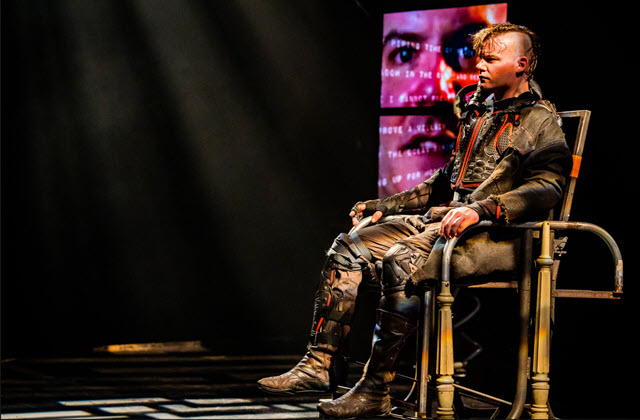
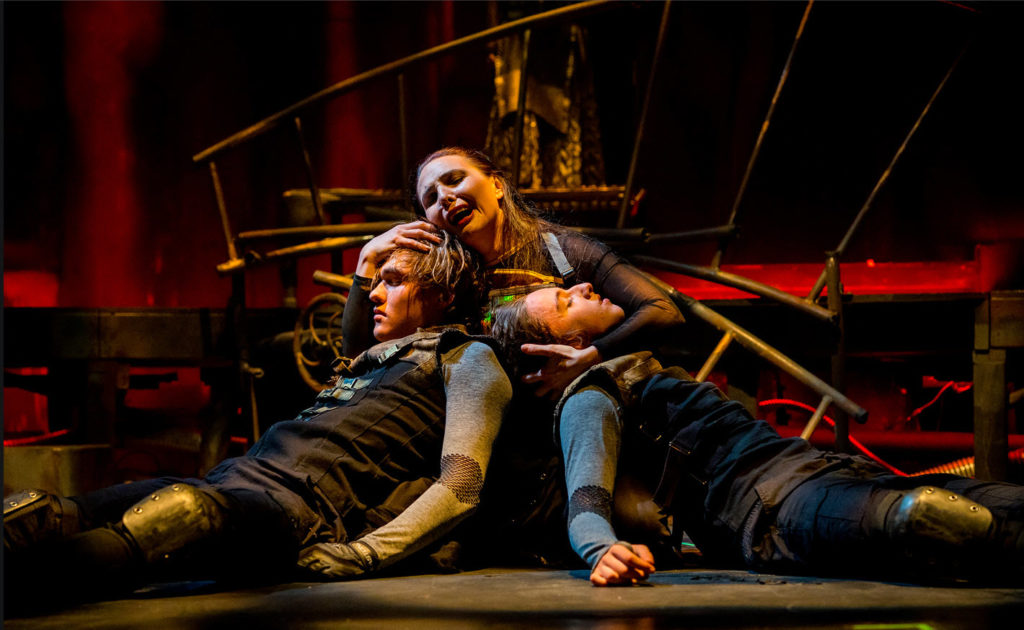
Alex Mills as Richard iii ~ Photo Credit Brittany Diliberto
Artistic Director Paata Tsikurishvili calls this Richard iii “the most challenging production ever.” That may well be an understatement, because since the company’s inception nearly 20 years ago, they have consistently broken ranks with theatrical stereotypes through their uniquely unparalleled, highly creative productions. For his vision of Shakespeare’s Richard iii (note the lower case “I”), Tsikurishvili returns to the company’s “wordless Shakespeare”.
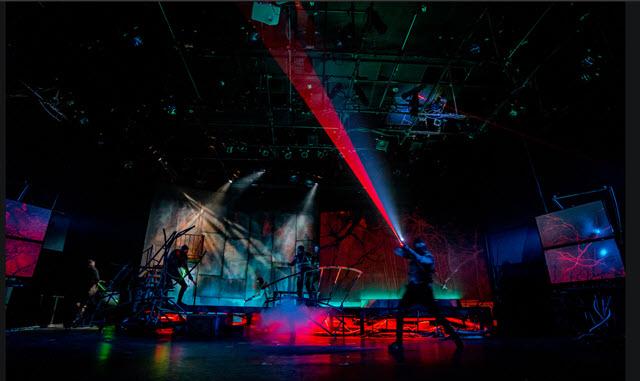
Richard iii ~ Photo Credit Brittany Diliberto
It is the fourteenth they have employed this silent technique to ground-breaking effect and the first time it has been used to create a new story-telling style wherein disembodied voices occasionally speak by video projection grounding the plot by illustrating certain important moments. Magnified by a powerful surround sound system to background Richard’s murderous reign, this production becomes a virtual, multi-media, full-on techno experience that is eerily bloodless.
Richard iii ~ Photo Credit Brittany Diliberto
After a serious battle injury and subsequent reconstruction, Richard accustoms himself to his new cyber body by using controls implanted into his robotic arm. Using digital combat technology, he is able to kill his victims (all thirteen of them) by projecting them onto giant touchscreens where he can then drag and drop their images effectively vaporizing them. I’ll skip the plot synopsis, that’s what CliffsNotes are for, but you can easily follow through the continuous video projections, as well as the performers’ interactions that show Richard evolving into the cruel, soulless monster he has been programmed to be.
Irina Tsikurishvili as Queen Elizabeth ~ Photo Credit Brittany Diliberto
Emotionally disconnected, his Orwellian rampage continues. No one is spared – not his cohorts, nor his royal family. “Deformed, unfinished… I am determined to prove a villain,” he asserts. In Tsikurishvili’s futuristic world of cyborgs, zombies and warrior droids, Richard is a far more efficient killer than Shakespeare could ever have imagined.
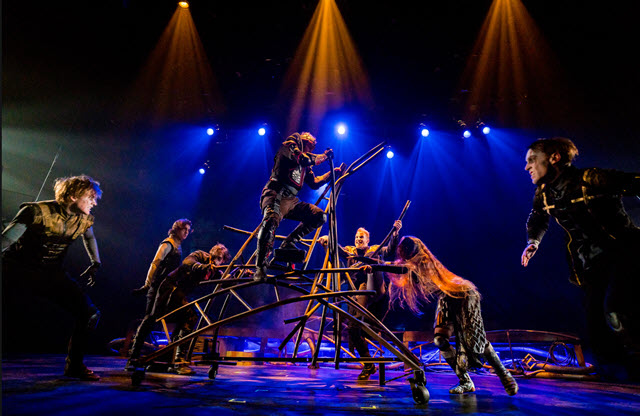
The transformation of King Richard ~ Photo Credit Brittany Diliberto
As we have come to expect from this Georgian troupe’s dazzling performances, there are mind-blowing displays of sheer physicality, intricately choreographed dances, gravity-defying fights, touches of wry humor (the Duke of Buckingham vapes pot), as well as classic pantomime. Award-worthy performances by Alex Mills as Richard, Phillip Fletcher as King Edward and Irina Tsikurishvili as Queen Elizabeth.
Artistically brilliant, visually riveting and provocative. A five-star production with a flawless cast.
With Matt R. Stover as Buckingham, Maryam Najafzada as Lady Anne, Thomas Beheler as Clarence, Jordan Clark Halsey as Richmond, Tim Proudkii as Prince, Aaron Kan as Younger Prince, Nutsa Tediashvili as Princess Elizabeth, Ana Tsikurishvili as Tyrell, Scean Aaron as Ratcliffe.
Directed by Paata Tsikurishvili, Choreography by Irina Tsikurishvili, Resident Composer Konstantine Lortkipanidze, Scenic and Multimedia Design by Tennessee Dixon, Adapted by Nathan Weinberger, Lighting Design by Brian S. Allard, Costume Designs by Erik Teague, Sound Design by Thomas Sowers, Video Producer & Editor Scott Brown.
Through June 16th at Synetic Theater, 1800 South Bell Street, Arlington, VA in Crystal City. For tickets and information call 800.494.8497 or visit www.synetictheater.org.
Zora Neale Hurston’s exuberant play-with-music, Spunk, takes us into the African-American experience of America’s Deep South. It’s like gaining admission to a private club, not just to witness, but to experience full-on a sense of place that no longer exists. It doesn’t hinge on racism nor rely on oppression to tell its stories, though Hurston makes clear the characters have suffered from their legacy. Three distinctly different tales provide a glimpse into the colorful characters that peppered the African American communities of the 1930’s and 40’s. Part celebration and part revelation, part history and part Black culture, Spunk is the spinning of tales that claim a deep appreciation of a particular time and place.
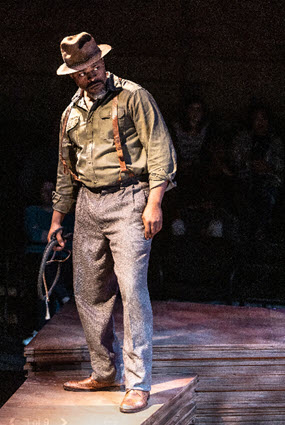
KenYatta Rogers (Folk Man 1) in Spunk at Signature Theatre. Photo by Christopher Mueller.
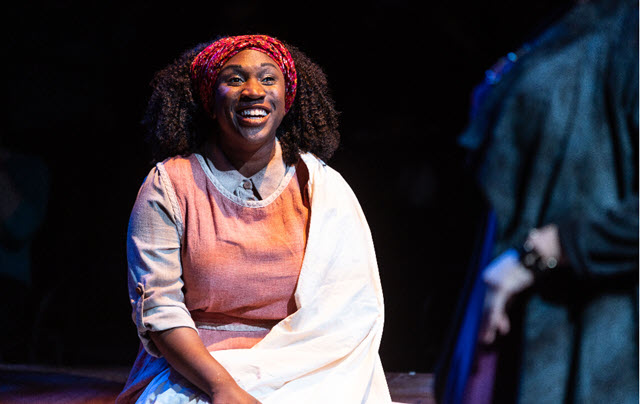
“Blues, grits, spit, spunk and pain” describe the colorful activities and lively characters who weave in and out of one another’s lives. In Tale Number One: “Sweat”, there’s Delia, a washerwoman married to Sykes, a cruel drunkard whom she supports through “blood, sweat and tears” while he’s out messin’ with another woman. You can almost feel the steamy Florida summer heat when Delia sings “Dirty Water” as she exacts her revenge.
Ines Nassara (Folk Woman) in Spunk at Signature Theatre. Photo by Christopher Mueller.
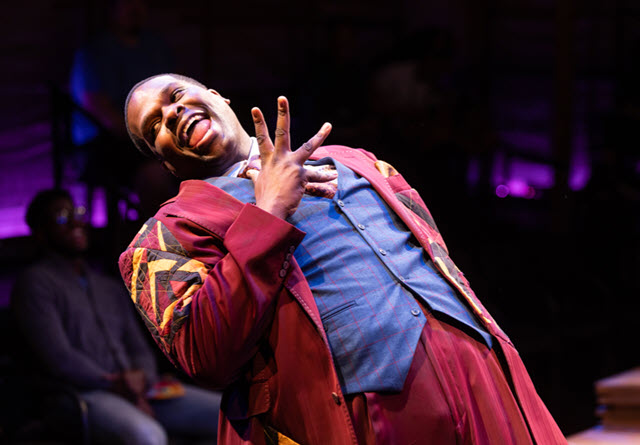
In Tale Number Two: “Story in Harlem Slang”, we find Slang Talk Man and his cronies, Jelly and Sweet Back – zoot-suited men, called “Harlem pimps” whose only thoughts were of money, the lack of it, the allure of it, and how to get the domestics who bring their paychecks home on a Friday night to give it to them. Sweet Back, who’s always broke and “bug-a-booin’” while looking to score a fine lady, struts around in his finery with his pal, Jelly. The two are like a couple of banty roosters sizing up the barnyard.
Tale Number Three: “The Gilded Six-Bits” is a love story and by then we’re ready for it. Set in Chicago Missy May and Joe have their differences, but when a fast-talking grifter comes to town he turns Missy May’s head with the promise of riches, and the two lovers have to decide if they’ll stay together. “If you burn me down, you won’t get nothin’ but a pile of ashes,” Missy May warns him.
Marty Austin Lamar (Folk Man 2) in Spunk at Signature Theatre. Photo by Christopher Mueller.
Hip expressions and street corner colloquialisms keep the humor moving at a rapid clip. And between all the movin’ and groovin’, struttin’ and slipslidin’, there is music, wonderful bluesy music played by Guitar Man and sung by the players. Written by Chic Street Man a musician and Psychology grad who runs his own youth center and scored the music to this Broadway sensation, it uses some classic tunes as well as stylistically apropos music to reflect the period.
Iyona Blake (Blues Speak Woman) in Spunk at Signature Theatre. Photo by Christopher Mueller.
In granting these characters ethnically correct vernacular, Hurston gifts them with the unique personalities she knew and cherished – though if any writer but an African-American writer had told these stories, they would be tarred and feathered and run out of town on a rail. Hurston endured criticisms of these Black “caricatures”, even though she was steadfast in her belief that this time and place should not be forgotten. In the end, she chronicled a period in American folklore that is both historic and universal.
Sweet as cane sugar, sassy and funny with a polished and perfect cast.
With Iyona Blake as Blues Speak Woman, Jonathan Mosley-Perry as Guitar Man, KenYatta Rogers as Folk Man One and Fight Choreographer, Marty Austin Lamar as Folk Man Two, Drew Drake as Folk Man Three, and Ines Nassara as Folk Woman – all playing multiple roles.
Adapted & Originally Directed by George C. Wolfe. Current direction under Timothy Douglas with Musical Direction by Mark Meadows, Choreography by Dane Figueroa Edidi, Costume Design by Kendra Rae, Lighting Design by Sherrice Mojgani, Scenic Design by Luciana Stecconi, and Sound Design by Ryan Hickey.
Through June 23rd in the ARK at Signature Theatre (Shirlington Village), 4200 Campbell Avenue, Arlington, VA 22206. For tickets and information call 703 820-9771 or visit www.signature-theatre.org.
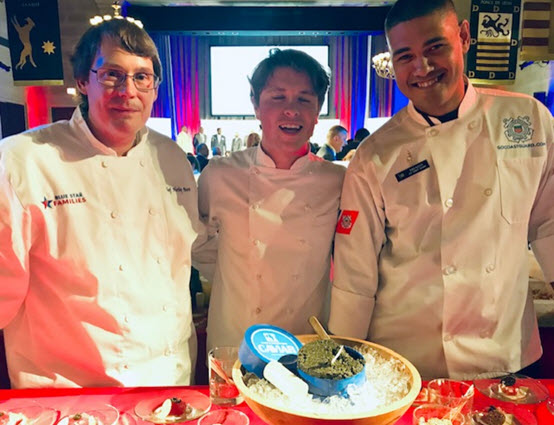
Top chefs from a collection of our area’s best restaurants came together earlier this week for the 10th Annual Blue Star Families Celebration. Paired with chefs from the different branches of the military, together they created unique and scrumptious nibbles and sips. This singular arrangement encourages the importance of and solidifies BSF’s mission to bridge the gap between civilian and military communities. Awards were presented by General and Mrs. Joseph F. Dunford, USMC and Brianna Kellar, Anchor of CNN’s Right Now and Blue Star Ambassador.
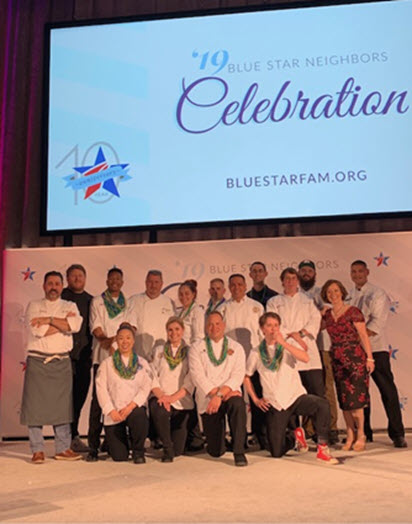
Blue Star Chefs and Partners with winning chef Shamon Hill (Top Row – third from the left)
With a view of the White House across Lafayette Park as a backdrop, guests were treated to an array of fabulous food and colorful cocktails created by Todd Thrasher who, alas, was busy at his new distillery and bar, Tiki TNT & Potomac Distilling Company. The red-carpet event was Co-Chaired by General George W. Casey, Jr. USA (ret) and his wife, Sheila Casey and attended by military VIPs and their wives, many of whom donate their time to support military families in need.
Dog Tag Bakery’s Strawberry Rhubarb Pie
A step-and-repeat was offered to guests whose photos were posted to the Blue Star Families’s website and colorful bead necklaces were given to guests to vote on the chefs whose dishes they liked most. Young chef Shamon Hill, ‘Military Brat’ of the USMC who partnered with Chris Clime of PassionFish, were the winners of the competition with their delicious ‘Smoked Salmon Pizzelle’ served with an everything bagel crisp, Coleman mustard aioli, pickled red onions, chopped eggs and capers.
The winning dish ‘Smoked Salmon Pizzelle’
A bit of background on this amazing organization: Through their All-Volunteer Force 50 chapters around the world serve military families, providing assistance through education, empowerment and employment programs in civilian communities. Chapters partner with the general public and other services to address the daily challenges of military life. Over 1.5 million military families are helped every year. Can I get a hooray?
During the event, Susan Masser received the 2019 Blue Star Neighbors Award. Masser was nominated by friends Major Steven Brewer and his wife Chelle Brewer for saving their daughter’s life and for her unconditional friendship and support. General Joseph F. Dunford Jr., Chairman of the Joint Chiefs of Staff, and his wife, Mrs. Ellyn Dunford presented the award. The star-studded affair was attended by the highest decorated military leaders, business executives, celebrities, Congressional delegates, and government leaders who are dedicated to strengthening opportunities for military families through Blue Star Families. A few of those high-level military leaders and VIPs in attendance included General H. R. McMaster – National Security Advisor; Robert “Bob” Gates – Former US Secretary of Defense and current Director of Starbucks; and Dr. Lynda Davis – U. S. Department of Veterans Affairs.
Guests were serenaded by the Washington Performing Arts Men and Women of the Gospel Choir and entertained by military spouse and comedian, Maggie Phillips of the Armed Services Arts Partnership.
The 2019 celebrity chefs and culinary partners with their tastings included:
Chef Chris Clime of PassionFish Restaurant with USMC “military brat” Shamon Hill – ‘Smoked Salmon Pizzelle’ with an everything bagel crisp, Coleman mustard aioli, pickled red onions, chopped eggs and capers.
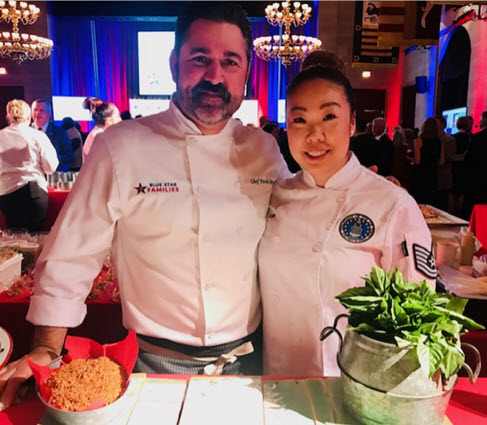
Chef David Guas with TSgt Claire Kim
Chef David Guas of Bayou Bakery, Coffee Bar & Eatery with TSgt Claire Kim of the Air National Guard – ‘South Meets East’ Spicy Chilled Crawfish Etouffée with puffed rice chip
Chef Harley Peet (left) with CSCS James Swenson (right) and an assistant (center)
Chef Harley Peet of Bas Rouge in Easton, MD with CSCS James Swenson of the Coast Guard – Ahi Tuna Tartare with preserved lemon, crème fraiche and osetra caviar
Chef Kyle Bailey of The Salt Line with SSG John Densham of the Army – Pork Belly Slider with Asian pear BBQ, broccoli rabe, fennel-apple slaw on an onion roll
Chef Ris Lacoste of RIS Restaurant with CS1 Sierra Tyler – Miso Salmon Tartare with fried wontons, Napa cabbage slaw, sriracha aioli
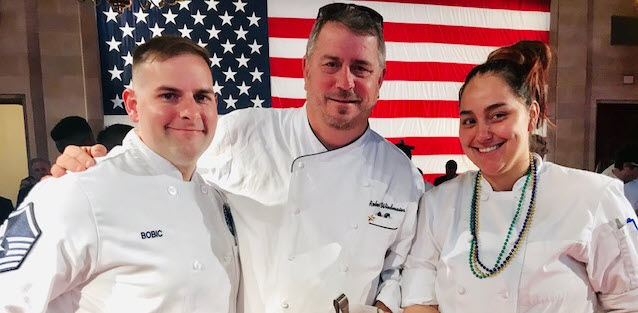
Chef Robert Wiedmaier (center) with TSgt Kristi Jackman (right)
Chef Robert Wiedmaier of Marcel’s with TSgt Kristi Jackman of the Air Force – Roasted Herb Barley with peas, fava beans, toasted cashew hummus, black truffles
Chef Todd Gray of Equinox with SSgt Hiram Carrion of the Marine Corps – Medjool Date Tabbouleh Salad with spiced carrots and green tahini
Todd Thrasher’s ‘JCS Cooler’
Mixologist Todd Thrasher of Tiki TNT – ‘Code Red’ and ‘JCS Cooler’ cocktails
Awards for their service and inspiration were given out to the following people and organizations.
The Walt Disney® Company — Corporate Neighbor Award
Craig Newmark, Founder of Craigslist and Craig Newmark Philanthropies — Constance J. Milstein Philanthropic Award who donated $1M to the New York Chapter
Susan Masser, Civilian Hero — 2019 Blue Star Neighbors Award
Ian Bohen, American Actor and Director of Paramount Pictures’ Yellowstone – Master of Ceremonies