|
|
Jordan Wright
The Georgetowner and Downtowner
November 2009
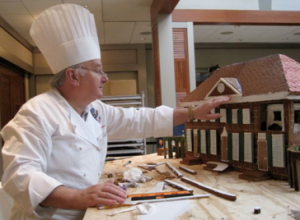 Chef Mesnier with his gingerbread house - photo credit Jordan Wright “And had I but one penny in the world, thou should’st have it to buy gingerbread.”
So penned Shakespeare in Love’s Labours Lost back in the holly jolly days of the 16th Century. But a pretty penny indeed it would cost him when the heady and alluring cardamom, nutmeg, cinnamon, and allspice used to make gingerbread were far less affordable and available to the masses than they are today.
But it wasn’t until its first publishing on December 20, 1812, when Die Gebruders Grimm spun their fable of Hansel and Gretel with its lure of candy cottages in the Bavarian forest that gingerbread houses began to emerge as a symbol for Christmas.
From the Black Forest of Germany to within ten miles of The White House there lies another famous colonial white house with an older provenance—George Washington’s beloved Mount Vernon, an especially enchanting destination over the Christmas holidays.
When I arrived last week I met up with Roland Mesnier, formerly the White House Pastry Chef for 25 years. Chef Mesnier, the uber sweetsmeister and cookbook author who launched the first pastry course at L’Academie de la Cuisine in Bethesda, Maryland, has been called upon to craft a gingerbread replica of Mount Vernon in perfect detail. Chef Mesnier employed the same level of perfection to this house as he did as The White House Pastry Chef. “The White House was a big production place. Everything should be the very best. If it’s not the best at The White House where else is it going to be the best!” exclaims Chef Mesnier.
The grounds of this gingerbread house features the estate’s farmyard animals, a tree with an American eagle roosting in it, and the iconic dove of peace weathervane—even George and Martha decked out in Colonial attire—all chiseled out of marzipan. Here are some fascinating facts about the Mount Vernon gingerbread house replica:
The 5 x 8 foot replica began last month. 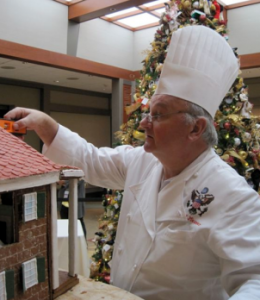 Chef Mesnier checks the angles of his gingerbread house at Mount Vernon - photo credit Jordan Wright It took 325 pounds of gingerbread and 70 pounds of chocolate to glue the house together. A full pan of gingerbread is baked and cut, after it cools, according to a pattern.
“Equatorial Noir” chocolate from Valrhona with 55 percent of cocoa solids is employed. Every piece of gingerbread is slathered with melted chocolate over its interior side using an offset spatula. This gives it strength.
To achieve a perfect edge-to-edge fit an industrial band saw is used to cut the gingerbread. In any event, the vagaries of humidity can change the properties of the gingerbread causing it to shrink. “There are so many simple things that can totally change the outcome of your dessert,” he offers. (Sound of forehead slap here.)
No interior support system is employed. No cardboard or underpinnings are utilized whatsoever.
Marzipan roof shingles are first tinted terra cotta and flattened with a rolling pin, then cut with a cookie cutter into small circles. Modeling marzipan is used.
Shredded phyllo dough is used to replicate straw.
Handyman’s tools are de rigeur. A level is used to check the slant of the edges.
The gingerbread is made from scratch using the finest ingredients: flour, butter, eggs, baking powder, honey, ginger, molasses, cloves, and cinnamon. (Long ago rosewater and ground almonds were sometimes added. My tasting determined Mesnier’s gingerbread to be divinely delicious—especially with the chocolate backing.) He exclaims, “If I have to use anything less, I’m not doing it!”
Marlene Roudevush, his former White House assistant pastry chef, assisting him with the Mount Vernon gingerbread house replica, creates her figures using Confiseur D’Or Swiss modeling marzipan and applies the royal icing to the house. For that she uses a pastry bag made out of parchment paper with a little hole nipped out by scissors. “We always make our own, ” she asserts. Her research tells her that President Washington bred American Foxhounds and was fond of camels. Martha also claimed a parrot as a favored pet. All of which Chef Roudevush will add to the menagerie.
Many years ago I designed a gingerbread house for Grandma’s House for a fundraising auction in advance of a gala at the Four Seasons Georgetown. There were twenty or so entrants, the preponderance of them, architects. I decided upon Noah’s Ark, replete with wildlife duos and gummy fish aswim in the surrounding sea. Arriving with my humble ark, I saw gingerbread houses featuring minutely detailed colonial buildings with mullions and cobweb windows that could have been registered with the National Trust for Historic Preservation. It seems my cohorts had chosen a more traditional route.
But it was all about the attempt, I reckoned, and moreover, I learned that gingerbread shrinks…a lot…and buckles with the heat of baking, and no amount of royal icing can cure that. I had a few unresolved personal baking queries for the President of Pastry, and I wanted them on the down low. Monsieur Mesnier was only too delighted to oblige.
I collected a few pearls of pastry wisdom from the master:
“My philosophy on baking is very simple. Measure everything the night before and leave it out on your kitchen counter, even the eggs and the butter. The next morning you will mix your cake in a few minutes because everything is the same temperature, and it will be the best blending you ever had in your life.”
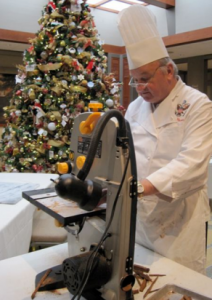 Chef Mesnier cuts the gingerbread with a band saw - photo credit Jordan Wright “A lot of chefs love to complicate their recipes with unnecessary instructions. Half of it you can throw out. They just put it in there because the more complicated it is the more they think they look like geniuses!”
“So many chefs use all these gimmicks to try to make it seem good. What I have done in my books is simplify the language.”
“Buy the best ginger you can buy and check out the strength. You have to watch out because even from year to year it may change in strength. Make a sample of dough, bake it, and test it. There are so many different kinds of ginger and each type makes a difference in the outcome.”
“If you make enough dough in advance you can roll the cookies out and cut them and freeze them raw. Then, without defrosting, you can bake them off and eat them fresh that day.”
“We made 120,000 pieces of cakes and cookies for Christmas in The White House. Most of our cookies were shaped and frozen raw, and later taken out and baked.”
“We had such a small kitchen and very little staff. We started baking for Christmas in the White House in June. We made half a ton of fruitcake, orange cake, chocolate cake, German stollen and applesauce cake, Italian panettone, and yule logs, too. Our Christmas was based on Old World Christmases, like my Bananas in Raspberry Cream (Dessert University, Roland Mesnier, Simon and Schuster 2004). “People would hunt me down for that recipe.”
“We had a lot of diplomats over the holidays and I wanted them to find their own cakes and cookies from home on the table. We wanted to please as many people as we could. That’s the key…to have that special something for everyone.”
Like families today, the Washingtons were not strangers to the tragedies of war, death, and illness, even over the holiday season. In those days, a trip to rendezvous with loved ones could last days, or even weeks, over rugged hills and rutted roads, and might result in a stay of a fortnight or longer. So it was all the more imperative to celebrate the homecoming of family members and friends from afar. Therefore all hands were pressed into service to welcome the guests. You will find that the Mount Vernon of today reflects the warmth and spirit that emanates from the venerable estate.
Chef Mesnier’s gingerbread house will be on display all day at Mount Vernon throughout the Christmas season. You will need to call ahead for tickets for evening tours.
www.chefrolandmesnier.com
www.mountvernon.org
www.grandmashouse.org
For questions or comments on this article contact Jordan@whiskandquill.com or visit www.whiskandquill.com .
Jordan Wright
December 2009
 Starting the evening's champagnes with Voirin-Jumel Blanc de Blanc NV Grand Cru Cramant - photo by Jordan Wright This New Year’s celebratory festivities may pose a challenge to the connoisseur…to find a good quality champagne on stifled cash flow. While bumps and grinds to the wallet may crush our choices like grapes in a wine press, we seek to secure an auspicious future by raising a glass of pirouetting bubbles to presage better days. But how to achieve this glamorous tradition without sacrificing the children’s college fund?
 Pan seared Maine scallop with onion puree, ruby red grapefruit and ginger butter - photo by Jordan Wright At a recent dinner at Brabo I was introduced to some wonderful and affordable sparklers from the province of Champagne. Each one of these limited offerings was 100% grower produced and bear the recoltant manipulant code, “RM” on the label, ensuring the grapes come from this vineyard alone. Since only sparkling wines from this region of France, amounting to 86,500 acres of prime terroir, may be properly designated as “champagne”, one might expect they would be gustatorily competitive. I found three to be smart, polished and sophisticated, and two, to precisely mirror my most favorable profile of an excellent champagne.
In his distinguished paean to French regional cuisine, “The Food of France”, gourmand extraordinaire, Waverly Root, claims that, notwithstanding ham en croute, “There is no cuisine of note in the Champagne region.” Therefore it is no minor feat for a chef to pair an entire five-course menu with a selection of champagnes. Who better than a chef with roots in Belgium could prepare a meal representing this historic province geographically located in the north of France beside the Belgian border?
 Flemish Oyster Stew with puff pastry fleurons at Brabo - photo by Jordan Wright Enter Chef Robert Wiedmaier, up to this culinary challenge, creating a glorious menu, beginning with Flemish oyster stew with Swiss chard topped with puff pastry fleurons, sheer bliss captured in a cream-colored bowl nestled in a linen rose fold, and pairing it with Voirin-Jumel Blanc de Blanc NV Gran Cru, Cramant. Known as a Champagne family, not merely a brand, sibling scions Alice and Patrick Voirin Jumel, and Patrick’s wife, Valerie, have been supplying this wonderful wine to the Inn at Little Washington as their house brand. I give it three cheers! A clearly auspicious beginning.
Priced around $48.00 a bottle.
 Venus works the Agrapart et Fils vineyard Our second course, a plump pan-seared Maine scallop was accompanied by red onion puree, morsels of ruby red grapefruit and ginger butter echoing the 90% chardonnay and 10% pinot noir grapes used in the 100% organic Agrapart at Fils Brut Rose NV Premier Cru, Avize. So pretty in pink! This vineyard employs a beloved horse named “Venus” to help around the farm. Think of her sweet demeanor as you sip your way into a rosier New Year.
Priced around $61.00 a bottle.
 The Gatinois Brut 2002 a perfect pairing for the turbot with chanterelles - photo by Jordan Wright From the vineyards of Pierre Cheval-Gatinois, which lies at the foot of the Montagne de Reims, one of the four great vineyard regions, came a Gatinois Brut 2002 Grand Cru, Ay. The property lies beside the hallowed Bollinger estates, whose blends from the late 1980’s can reach an astonishing $500.00 per bottle! Eleven generations of the Gatinois family, dating back to 1696, have produced champagne from their ancestral lands. They use a 100% pinot noir cuvee to make this wine. Priced at around $70.00 a bottle it was le plus cher wine of the evening. Yet how perfectly it escorted a Parmesan-crusted turbot with rock shrimp, potato gnocchi and woodsy chanterelles with an aromatic shellfish emulsion.
The following foray trumpeted my personal favorite from R. H. Coutier, a non-vintage brut Grand Cru, Ambonnay. Our esteemed chef had paired this opulent, well-balanced bubbly with roasted veal tenderloin, crispy sweetbreads, lardoons of bacon and natural jus. At a mere $48.00 a bottle, it is like taking candy from a baby. Miss this winning wine at your peril!
 Three cheers for this selection! - photo by Jordan Wright I always serve champagne with dessert at a dinner party. I feel it revitalizes the festive nature of the gathering, and this bold, slightly floral, champagne with its tiny bubbles from Domaine Dehours “Grand Reserve” Brut NV was an admirable selection to stand up to the tartness of a crème fraiche cheesecake with honey-roasted pineapple. Another 100% organic champagne (those highly sensitive to sulfites will thrill to this news), it is made from 50% pinot meunier, 25% pinot noir and 25% chardonnay grapes. Aged in new and old oak barrels, it develops a timeless bouquet that evokes the notable chalky terrain of the region.
Priced around $42.00.
All these fine champagnes, suitable for ushering in a more prosperous 2010, can be purchased at The Butcher’s Block on King Street in Alexandria. www.butchersblockrw.com.
Brabo, the elegant restaurant, and Brabo Tasting Room, with more informal dining, are on the same street.
Jordan Wright
Georgetowner/Downtowner
November 2009
 The rare white rhino from MSNBC's 100 Heartbeats Setting the stage for extinction: Every twenty minutes a distinct species of plant or animal throughout the world becomes extinct.
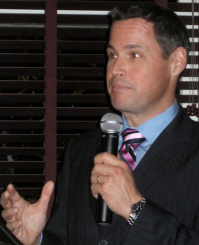 Jeff Corwin speaks about his new book and MSNBC special 100 Heartbeats - photo credit Jordan Wright There is an aura surrounding Jeff Corwin. It is the peaceful intent of a man who has witnessed fierce struggle, mortal threats, man’s inhumanity, heart-pounding danger and crushing heartbreak and emerged to dedicate his life to saving the planet’s rare and endangered species. This is not your son or daughter’s jocular Animal Planet guide tiptoeing through the friendly jungles with weird and eclectic animals, nor the boyish rake abandoning all sensibility to get just a bit too close to an unpredictable viper. This is a man committed through thought, word and deed to altering the predicted fate of our planet’s endangered animals. In my encounter with Corwin I could read the intensity and conviction on his face as he spoke of his up-close-and-personal encounters with the cheetahs and white rhinos whose days appear numbered.
100 Heartbeats – The Race to Save Earth’s Most Endangered Species is Corwin’s paean to the animals. He has found a powerful voice after 15 years of television as an Emmy-award winning producer and host of over a dozen television series for Discovery, Disney, the Food Network, NBC, CNN and the Travel Channel. The two-hour special on the book’s subject is the second program in MSNBC’s epic Future Earth series scheduled for launch this week on November 22nd.
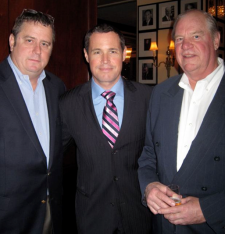 Chef Robert Wiedmaier, Jeff Corwin and Prime Seafood's Jim Chambers - photo credit Jordan Wright In honor of sustainability the book launch at the Occidental Grill showcased a number of wines that foster sustainable and environmentally responsible practices. Naked by Snoqualmie vineyards, Ste Michelle and Yealands of New Zealand, noted DC Chef Robert Wiedmaier gave their sauvignon blanc the nod. Wild-caught Coho salmon and wild Georgia white shrimp from Prime Seafood, and heritage beef and turkey from Ayrshire Farm in Upperville, VA became luscious hors d’oeuvres in the creative hands of Chefs Rodney Scruggs and Robert Townsend.
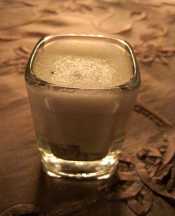 Sustainably-raised oyster stew shooter created for the evening by Chef Rodney Scruggs - photo credit Jordan Wright I had an opportunity to speak with Jim Chambers, manager and owner of Prime Seafood of Kensington, MD who as a marine biologist spent 20 years with the government agency, National Marine Fisheries Service (NMFS). While on the board of the Marine Stewardship Council he was instrumental in setting up the standards for the industry. Jim is the only wholesaler in our area selling exclusively sustainably raised seafood to select local restaurants. Poste, 701, Proof, Johnny’s Half Shell, Corduroy, Firefly, Restaurant Nora, Cashion’s Eat Place and the Occidental Grill and Seafood are some of his DC clientele.
From April through December he sells wreckfish that is similar in flavor and texture to grouper, but sustainable through controlled fishing. Only four boats are licensed to capture these fish off the coast of Charleston, SC in deep water at the base of a “wrecked” submarine wall.
Chambers really enjoys way the fish is being prepared sous-vide at Blue Duck Tavern. “They cook it low and slow in a vacuum-sealed pouch and finish it off with a quick browning. It’s so delicious…tender and succulent, ” he said.
 New Zealand's Yealands Sauvignon blanc - photo credit Jordan Wright Science Magazine recently reported that, if we keep destroying habitat, the world’s fisheries will collapse by 2048. “With unrestrained overfishing we are racing pell-mell towards the destruction of our seas. We now catch the top predators, bottom predators and everything in between with massive fishing trawlers equipped with huge drag nets and sophisticated electronics such as sonar and GPS,” Chambers warned. “We are fast working our way through what is left.”
We talked about the interdependency of the species…how the little fish sustain the bigger fish and how bottom-dragging nets take out 100% of the herring leaving the predator tuna without sustenance and faced with extinction along with their tiny friends.
Our conversation then turned to the darker side of farm-raised fisheries. A recent study concerning farm-raised salmon vs. Chilean vs. Scottish salmon sold in US supermarkets, compared their contaminant load…the amount of chemicals measured in the fish. All of them rated poorly.
“Fish are fed with other fish containing PCBs, DDT, and other organic toxic compounds. In fact only one meal per month of farm-raised salmon, often misleadingly labeled organic, poses a substantial cancer threat to the consumer. They receive growth hormones to make them grow faster while being constantly doused with chemicals to keep the disease level manageably low,” he related.
“You’re creating a sewer in the water where they are being raised. And the parasites, like sea lice, that live on the outside of the nets are getting to the salmon in the net pens where they are being fed dyes to achieve the proper color,” Chambers told me.
This is the tragic underbelly of the fishing industry and a real eye-opener. “It takes about four pounds of juvenile species of wild fish to make one pound of farm-raised salmon. It’s totally unsustainable.”
Chambers takes heart with the appointment of NOAA’s new administrator, Jane Lubchenco, who is also in charge of the NMFS. As one of the most highly cited ecologists in the world, Lubchenco is considered a world expert on marine eco-systems.
Chambers suggests that, “Consumers and chefs in particular can become the solution by what they choose to eat and serve.” With the Blue Ocean Institute’s “Guide to Ocean Friendly Seafood”, a copy of which he graciously gave me, and will be my new seafood-buying bible, he hopes that those who enjoy fish will make better and more informed choices.
For more information visit these websites:
www.FutureEarth.MSNBC.com
www.PrimeSeafood.com
www.BlueOcean.org
www.MSC.org
www.ScienceMagazine.org
For questions and comments on this story contact me at Jordan@whiskandquill.com or visit www.whiskandquill.com .
Jordan Wright
Whisk and Quill
November 2009
Thoughts on dining:
 The generous nibbles at the bar - photo credit Jordan Wright Is a plate more artful on which rests a lone perfect shrimp or must it be circumnavigated with drizzles and droplets of reduced sauces in contrasting colors?
Since we are traversing land and sea to source our foods and convene with our farmers, greengrocers and fishermen, shouldn’t we display our ingredients with pride?  Colossal Madagascar shrimp - photo credit Jordan Wright Because we are barraged by noise and bright light during our workday oughtn’t we seek a calming atmosphere in which to take solace?
At Kellari recently I found all the elements of a perfect evening and since there is no real critique to speak of I will recount how and why I find this restaurant so very appealing.
Kellari is an elegant Euro-style enclave. Soft lighting flatters the guest (restaurant designers take note), with votives nested in pale aqua milk glass, wrought iron lanterns, silk-shaded table lamps and dimmed chandeliers creating an inviting glow. Something I always take note of is the placement and density of the tables. In this dining room they are lavishly enough apart for the guest to feel spoiled and coddled.
Of course the highlight here is the food. Oysters shucked and iced in neat rows share the bar with platters of house-made crusty bread, great hunks of Graviera cheese and voluminous bowls of olives, their provenance spanning the Greek isles. Green cracked olives from Volos, Kalamatas from Peleponesus on the southern tip of Greece, Amfisas from Northern Greece and Koroneiki from Sparta. From the western side of Mount Taygetus comes the wild oregano that the chef combines with rosemary and thyme and couples with lemons and oranges infusing the olives with a unique and addictive taste. The welcoming gesture is charming, all the better to enjoy an “Hermes” martini or the crystal blue “Aegean” martini, two of the house-crafted cocktails on the menu.
 Wall of fresh fish and produce - photo credit Jordan Wright While we are on the subject of décor a dramatic wall of ice, easily twelve by eight feet, showcases a stunning array of seafood and glisteningly fresh produce. Branzino and Dover sole, Portuguese sea bream and Senegalese barbounia, Maine lobsters and mussels, octopus and squid all appearing to surf the crest of a wave as several dozen varieties of fish and shellfish, including the spectacular nine-inch long Madagascar shrimp, vie for the diner’s decision.
For the “Aegean Feast” the chef selected “mezedes” of perfectly charred lamb riblets, grilled sushi-grade octopus, delicate herbed calamari and the aforementioned Madagascar shrimp. Aside from its gargantuan size…more akin to a lobster…the black sand vein that runs along the dorsal area, is filled with a rich heavenly coral roe. I sampled a fish called “fagri” from Greece, a tender and mild white snapper, prepared whole to capture the rich flavor of the bones and head, and deboned before presentation. It is served with a satiny lemon sauce and the typical Greek lemon potatoes, called “patates”, baked with a crisp golden edge, and plates of steamed “horta” a mélange of wild greens.
It’s no wonder you don’t hear much about their wines. The Greeks don’t want the word to get out and who can blame them. There is a lot more than retsina in their cellars. I tried two delicious examples, the spicy and perfumey Moschofilero, and the well-rounded and soft red, Megapanos, from the Nemea region.
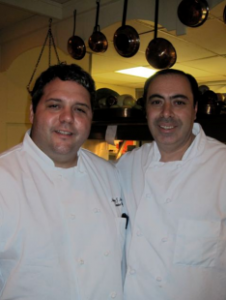 Kellari chefs Gregory Zapantis and Anthony Acinapura - photo credit Jordan Wright Desserts are homey, like the thick yogurt with cherries (which were my favorite) or an almond baklava, a switch-up from the better-known type made with walnuts; or more sophisticated, like a crème brulee with an underlying hint of the unique spice masticha. The traditional galatoboureko, without which no self-respecting Greek would think the meal had concluded, is a custard-filled phyllo. By now you see, you can speak Greek very well.
Before you leave Kellari there is a large white bowl beneath the archway filled with wonderful cookies, kourabiethes, a melt-in-your-mouth shortbread; koulourakia, shaped like a comma, a crisp coffee-dipper with sesame seeds; and melomakarona, dipped in honey and walnuts. The cookies are baked in-house and are not for sale. They are a generous gesture of thanks to their patrons.
The artistry at Kellari is in its simplicity and hospitality. It is a restaurant that bespeaks timelessness, as though it has been in this spot forever and will be for many years to come. The service is graceful and attentive…very Euro…and Chef Anthony Acinapura cooks with the love of his ingredients and his country. I am already looking forward to another visit.
Highly recommended.
www.kellaridc.com
Jordan Wright
November 2009
 Ayrshire proprietor Sandy Lerner talks turkey for CBS - photo credit Jordan Wright I returned to Ayrshire Farm in Upperville sooner than I could have imagined. An infusion of farm life soothes the spirit and inspires the chef and I accepted the invitation with delight to join in a turkey tasting sponsored by Ayrshire Farm, The American Livestock Conservancy, Humane Farm Animal Care, Slow Foods USA and Chef’s Collaborative. The surprise guests were the CBS News crew there to document the experience for “The Early Show”.
 Judging begins in earnest - photo credit Jordan Wright This time the judges were Anya Fernald, Founder and Director of Live Culture Co., who works with food producers on sustainable food projects in over 30 countries; Lisa Brefere, Founder and CEO of GigaChef and recent recipient of the American Culinary Federation’s Presidential Medallion for outstanding dedication to the culinary profession; Ed Matthews, Chef/Owner of One Block West whose eclectic seasonal cuisine in Winchester, VA features products from local farms; and Christopher Edwards Executive Chef of Patomack Farm Restaurant in Lovettsville. VA. Edwards brings his culinary experience from under the wing of Ferran Adria who taught him to forage the hillsides of Spain for wild herbs, fruits and other ingredients for his guests at what is considered the “World’s Greatest Restaurant”, elBulli.
The day’s event featured nine heritage breeds. They were as follows: Chocolate, once common in the antebellum South; Narragansett, known in 17th C Rhode Island; Black, known in England and Spain since the 16th C; Bourbon Red, first bred in Kentucky by Mr. J. F. Barbee in 1909; Midget White, a more recent hybrid developed at the University of Massachusetts; Standard Bronze, in America since the 18th C; Royal Palm, a stunning bird bred in Lake Worth, FL in the 1920’s; Slate, another 19th C hybrid; and the White Holland, a white-feathered variety that is one of the rarest and most difficult ancestries to trace.
 Heritage turkeys at Ayrshire Farm - photo credit Jordan Wright Anya Fernald told me how she feels about how Ayrshire Farm is changing the industry model. “Ayrshire is an incredibly inspirational model for a fully vertically integrated farm. I think that Sandy Lerner’s vision is amazingly ahead of its time. Heritage breeds can literally stand on their own two legs, unlike most of our modern raised breeds, and don’t need the same level of inputs, like hormones, antibiotics and chemicals that conventional livestock systems do.”
These are not the steroid-breasted birds with big-as-a-baby’s-leg thighs that consumers have come to expect. Rather they are more favorably compared with wild game. Less familiar to the American palate than to the European connoisseur, they have an elegant and deeper flavor finish.
Panorama at the Peak restaurant in Berkley Springs, West Virginia began using Ayrshire Farm’s turkey for their popular turkey croquettes that they serve over local apple cranberry compote.
Owner Patti Miller tells me, “We have been serving Ayrshire Farm heritage turkey year-round for the past two years. Our guests are crazy about it. “ She adds, “The difference between their heritage bird and a commercial counterpart is nothing short of amazing.”
 Chef Robert Townsend with Thanksgiving turkey at Ayrshire - photo credit Jordan Wright The day began in the farm’s kitchens where Executive Chef Rob Townsend prepared the birds, along with his assistants. Numbered toothpicks were placed beside prepared samples of the different turkey breeds, votes were cast and favorites were selected. The winner was the Royal Palm turkey, with the Midget White and Chocolate coming in third place. Personally I preferred the Bourbon Red for flavor, texture and appearance.
Three varieties of certified organic, certified pasture raised and certified humane raised turkeys are now available from Ayrshire Farm for the holidays, Midget White, Bourbon Red and Bronze. If you decide to try one of these birds over the holiday season, please do let me know which breed you decided upon and how your family enjoyed its unique flavor.
 Turkey Croquettes from Panorama at the Peak, Berkeley Springs, WV
Panorama at the Peak, Berkeley Springs, WV
1/3 cup butter
1/2 cup flour
1 1/4 cups chicken or turkey stock
2 farm-fresh egg yolks
3/4 cup half & half
2 stalks of celery finely chopped
2 large leeks finely chopped
4 cups finely diced turkey. (Ayrshire Bourbon Red Turkeys both white & dark meat)
fine bread crumbs
olive oil for frying
Melt butter over medium heat. Whisk in flour until smooth.
Add turkey stock, stirring slowly and constantly to keep smooth, until
sauce is thick. Remove from heat.
Mix beaten egg yolks into cream. Add egg mixture, stirring into
butter and stock mixture, until smooth.
Stir in diced turkey, leeks and celery. Mix well.
Place over double boiler on high heat and cook about 20 minutes,
stirring occasionally.
Refrigerate until well cooled…at least 2 1/2 hours or overnight.
Form mixture into 2 oz balls and roll in breadcrumbs.
Cover bottom of saute pan with oil. Heat oil over medium high heat.
Place croquettes in pan and press with spatula. Saute both sides
until golden brown.
Place browned croquettes on cookie sheet in 350 degree oven, 10 to 15
minutes.
Apple Cranberry Compote
5 apples, peeled, cored and diced
1 cup dried cranberries
1 cup apple cider
1 cup cranberry juice
Sugar, cinnamon and nutmeg to taste
Cook all ingredients together just until apples are softened but not
mushy.
If necessary, thicken with cornstarch and water slurry.
Serve warm under croquettes.
Recipes provided by Executive Chef, Scott Collinash
www.AyrshireFarm.com
www.HomeFarmStore.com
www.slowfoodusa.com
www.LiveCultureCo.com
www.GigaChef.com
www.OneBlockWest.com
www.patomackfarm.com
www.PanoramaAtThePeak.com
For comments or questions on this story contact jordan@whiskandquill.com or visit www.whiskandquill.com
November 2009
Jordan Wright
Special to the Georgetowner and Downtowner
 Embassy of Tribal Nations WDC After 40 years of planning the Embassy of Tribal Nations opened its doors on P Street in Washington, DC this week with an open house celebration.
 Sarah Hicks - NCIA Director of Policy and Programs in Alutiig native dress - photo credit Jordan Wright The event ushers in a great moment in our history that will culminate in the First Annual Obama Administration’s Tribal Nations Conference. This historic summit, with all tribes represented, will be hosted at the U.S. Department of Interior this Thursday, November 5th.
Ever since the Ford Administration’s recognition of the need for a permanent home for tribal representation in the nation’s capitol, the National Congress of American Indians (NCIA) has been excitedly awaiting this transformative occasion. With over 250 member tribes out of 564 federally recognized tribes represented by this new embassy, issues relating to all tribes will be addressed and advanced from these offices.
We were so excited to be a part of this day and enjoy the traditional foods, dress and dance of the Native Americans who convened this week from around the country to participate in this celebration. Mitsietam Native Foods Cafe, the excellent restaurant in the National Museum of the American Indian whose delicious dishes represent the diversity of Native American cuisine, catered the event. Executive Chef Richard Hetzler was on hand to see that everything went as planned.
 Mother and daughter prepare to perform the bell dance - photo credit Jordan Wright  New NCIA president, Jefferson Keel (far right), talks with guests at the Embassy's open house - photo credit Jordan Wright His interpretation of Native American dishes included maple-brined turkey sliders from the Northern Woodlands, with Three Sisters wild rice salad bursting with cranberries and pumpkin seeds and flavored with a delicate apple cider vinaigrette.
Cedar-planked wild salmon from Quinault Pride Seafood (who donated all the seafood, including the quickly-devoured Alaskan King Crab legs) was served with wild berry relish and lavender honey-roasted beets.
Tiers of toothsome sweets like pumpkin cookies with currants and pumpkin seeds; pine nut rosemary tartlettes; and cinnamony churros satisfied the crowds who filtered in all day and night.
For questions and comments contact Jordan@whiskandquill.com
|