|
|
Celebrating Cinco de Mayo at Home
Jordan Wright
April 2010
Deborah Schneider was smitten the first time she ever sunk her teeth into a taco. “Wow! I thought it was the best thing I ever had in my life.“ For a Canadian growing up on “ham steaks with pineapple  Amor y Tacos by Deb Schneider—Executive Chef of SOL Cocina in Newport Beach rings”, it was a revelation and a call to arms.
In “Amor y Tacos”, her third and latest book on Mexican cuisine (her 2009 “Cooking with the Seasons at Rancho de la Puerta” was nominated for a James Beard award), Schneider brings her love of fresh, street-style Mexican food infused with a modern twist. “I love the immediacy of this food,“ she told me in a recent interview.
“What really got me interested was working alongside Mexican cooks from Puebla or Michoacan in a restaurant where we were made classical French and Italian dishes. They told me fascinating stories about their mothers and grandmothers and the villages they came from. I got interested in the history and evolution of Mexican cuisine, looking at it as an anthropologist would.”
As the Executive Chef and partner of Sol Cocina, a Baja-influenced restaurant in Newport Beach, CA, Schneider developed the authentic easy-to-make recipes while Manny Hinojosa, a friend and local rep for Corzo and Cazadores tequilas who set up the bar program at her restaurant, shared some of his personal drink recipes for the book.
In a section designed to help you plan everything from a Cinco de Mayo celebration to summer barbeques, she shows you how to pair her authentic recipes for tacos and antonitos (“little bites”) with her outrageous margaritas (Pineapple Serrano and Tangerine Ginger got my attention), sangritas and mojitos.
Tips Schneider gave me for products and resources she prefers are: pickled jalapenos from La Victoria; a crumbly goat cheese in log form, like Laura Chenel, and Mexican chorizo. “It’s like a paste. You have to cook it for a long time till it’s brown and crumbly, to release the garlic and pepper flavors,” she advises.
For lard she recommends the pork lard found in Latin grocery stores that stays in liquid form even when cold. “It tastes like smoked pork.”
Make sure to check out the section on decorating your cocktails to really make them stand out. I love her idea of spearing shrimp or scallops on a skewer with a cherry tomato and lime or chile on the tip. Dinner and a drink in one!
Here are Schneider’s suggestions for your Cinco de Mayo celebration.
Shrimp Tacos Dorado
Carne Asado Tacos Vampiro (her favorite)
A few different salsas (the Mango Habanero sounds great!)
Guacamole
Black Beans and Rice
Margaritas, Sangria, Mexican Beer
Shrimp Taco Dorado
from “Amor Y Tacos”
Makes 12 substantial tacos, enough for 6 hungry people. The dorado taco is a supertaco—a new trend in which the basic taco is elaborated upon by adding more salsas, cheese, and garnishes; adding layers; toasting and frying; and generally pushing the taco to its limit. (See also the Taco Vampiro, page 107.) A good dorado is gooey, substantial, and filling—a corn tortilla fried on the griddle with a little butter or oil until golden and half crisped, then stuffed with cheese and any number of fillings and sauces.
This taco, a favorite of mine, tops melted cheese with garlicky shrimp, guacamole, and chipotle salsa, then finishes with a spoonful of sweet-hot mango habanero salsa and fresh cilantro sprigs. It all comes together quickly, so make sure everything is ready to serve before you start cooking the shrimp.
Ingredients
1 tablespoon plus 2 teaspoons butter or olive oil
1 teaspoon chopped garlic
1 pound medium shrimp, peeled, tails removed, and cut in half if large
1 teaspoon finely chopped chipotles in adobo
1⁄4 teaspoon salt
Large corn tortillas
11⁄2 cups grated Jack cheese
Chipotle salsa (page 138)
Guacamole (page 77)
Mango habanero salsa (page 136)
Cilantro sprigs
1. In an 8-inch sauté pan, melt 1 tablespoon of the butter or oil over medium heat.
When it is heated, but not brown, add the garlic and shrimp, and cook, stirring, until the shrimp are pink. Stir in the chipotles and salt and remove from the heat.
2. Preheat a heavy pan or griddle over medium heat and brush it lightly with some of the remaining butter or olive oil. Set a corn tortilla on the griddle and scatter 2 tablespoons of shredded Jack cheese evenly over the tortilla. Set 3 or 4 shrimp on one side of the tortilla. When the cheese starts to melt, fold the tortilla in half over the shrimp, and continue to cook on both sides until the cheese is melted and the tortilla is lightly crisped and golden brown.
3. Open the taco. Dollop 1 teaspoon of chipotle salsa on top of the shrimp and follow with a tablespoon each of guacamole and mango habanero salsa. Tuck a couple of cilantro sprigs into the opening and serve right away.
If you decide to visit her restaurant on the Balboa Marina in Newport Beach go to www.SolCucina.com for menus and reservations.
Jordan Wright
April 2010
A café-style spot in McLean, Joe’s Amazing Burgers, is making killer burgers with local dry-aged all natural Angus beef, turkey, bison, lamb and Berkshire pork from next-door neighbor and supplier, The Organic Butcher of McLean. And the toppings are crazy.  Al Laroussi, owner of Joe's Amazing Burgers in McLean - photo by Jordan Wright Twelve types of gourmet cheese, like Bel Paese, aged Gruyere, triple cream Brie or smoked Gouda for starters, and twelve sauces that go light years beyond mayo, like Asian barbeque, smoky Romesco, creamy truffle or wasabi lime aioli. Served on brioche-style toasted (Is there any other way?) buns, they come with sweet potato or regular fries.
The sweet potato fries are done just right – skinny, crispy and herb-coated with a tender interior. Skip the Mac-N-Cheese, which is gloopy, not terribly cheesy and full of too many inharmonious ingredients.  Millionaire burger at Joe's Amazing Burgers - photo by Jordan Wright Start with the yummy fried jumbo olives stuffed with chorizo and try the Lamburger with feta cheese, tzatziki, green olive relish, melted onions and baby spinach, or the over-the-top Millionaire’s Burger made with Kobe beef, seared Hudson Valley foie gras, black truffle Sottocenere cheese, in-house pickled onions and truffle oil aioli.
This is a cozy neighborhood hangout, whose former incarnation was a French bistro…then Joe’s Burgers for a while. Al Laroussi, a young Morrocan-born US educated banker, added the “Amazing” part to the name when he took it over. He revamped the menu and ratcheted up the burger profile with top grade meats. In the process he has become a bona fide restaurateur with thoughts of opening a French bistro in the area.
When you visit order the local Holy Brew Purgatory Pilsner from Leesburg or the very popular Louisiana dark beer, Abita’s Turbodog. There are a smattering of desserts but, better yet, finish with an adult milkshake made with Haagen-Daz ice cream and a shot of bourbon and caramel, Bailey’s Irish Cream combo or the pina colada with rum. And just kick back.
For comments or queries on this article contact [email protected].
Jordan Wright
April 2010
It was just after the first big snow, and everyone was struggling to navigate around the snow dunes created by the plows. I was slipping and sliding around the icy streets in Georgetown with plans to meet a friend at Bistrot Lepic for hearty French fare.
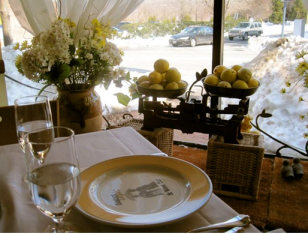 Bistrot Lepic - Georgetown's cozy French retreat - photo by Jordan Wright The restaurant has been offering a three-course prix fixe lunch for $20 to celebrate their 15th anniversary and the menu items were inviting. But as I scanned the menu I spied “Rognons de Veau”, veal kidneys with roasted potatoes and a Dijon mustard sauce, and I was on my way to French comfort food heaven.
My longing for this childhood dish, made by our beloved French cook we named “Nana”, has been as forceful and evocative as Proust’s reflections on madeleines, and in this cheery yellow-hued retreat I would recapture my memories. This restaurant has been a fixture in Georgetown for many years and I recall lunches with my mother, who wished to revisit its charms whenever she was in town.
Head Chef Simon Ndjiki-nya has kept all the bistro classics to warm the cockles of your Francophile heart. The Camaroon-born chef, who grew up in Paris from the age of five, has worked at Bistrot Lepic for eight years with a brief stint mid-way to cook with Gerard Pangaud, no stranger to Michelin stars. 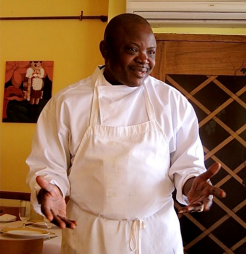 Executive Chef at Bistrot Lepic, Simon Ndjiki-nya - photo by Jordan Wright An endearingly charming, but unfussy place with a Parisian sensibility, you will find all your favorites like roast lamb and ratatouille, calves’ liver Provencale-style and coquilles Saint-Jacques, tweaked ever so modernly by its ginger broccoli mousse accompaniment.
Desserts are everything you would expect when you’re dreaming up favorites like pear tarte, chocolate mousse and the ambrosial ile flottante, a feathery-light sweet egg dish floating on crème Anglaise.
Drift up the townhouse stairs to the wine bar where cheese is paired with wines…Roquefort from Aveyron with sauterne or port, a Tomme de Savoie with a light Burgundy, or perhaps, Montbriac with a glass of Cotes de Rhone. Small dishes are served here and the country pate is made in house with Armagnac. The upper level has comfortable sofas and chairs and is decorated like a private salon, intimate with an air of decadence. A floor to ceiling Toulouse-Lautrecesque mural places you in the turn-of the-century Moulin Rouge cabaret.
This precious bistrot is the sort of rare jewel that one finds less and less in France and almost never in the States. Keep it close to your heart.
www.bistrotlepic.com
For questions or comments on this story contact [email protected].
Jordan Wright
Whisk and Quill
April 2010
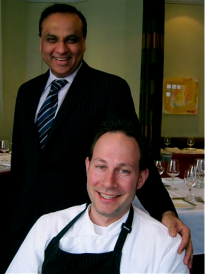 James Beard Nominees, Restaurateur Ashok Bajoj and Chef Tony Conte at The Oval Room - photo by Jordan Wright Ashok Bajaj, Washington DC restaurant dynamo, is a 2010 recipient of a prestigious James Beard Foundation nomination for “Outstanding Restaurateur”. That no other owner has as many successful outposts in Washington, DC with seven diverse and prestigious restaurants in his empire, it is no surprise that he has achieved a status that others might easily envy.
On Connecticut Avenue, a stone’s throw from the White House, reside two of his especially patrician establishments, The Bombay Club and The Oval Room, both a draw for DC’s fine dining-driven elite.
I trotted off last week to visit two of Bajoj’s Executive Chefs, Tony Conte, at The Oval Room, noted for his clean-lined “Modern American” food, and Nilesh Singhvi who reigns over the kitchen at The Bombay Club and is known for his authentic regional Indian cuisine.
The Oval Room – Modern American Cuisine
“Modern American Cuisine” – the terminology gives pause for thought. It evokes everything from corn dogs to apple pie to Aunt Molly’s pickled beans. Even a lowly rib joint considers their food American cuisine, so it seems a convoluted coinage to slap the word “modern” on the front end for clarification. I remember when Betty Crocker was considered “modern”.
A far cannier descriptive to my mind is “Modern French” or “French Fusion”. It translates more accurately into an individual chef’s interpretation of the new French cuisine, that uses French techniques and incorporates American, Asian and Italian ingredients. Well, it’s too late for that now. The terminology is ubiquitous. I can’t change it and I won’t try, but I do feel it comes up short to express the beauty and innovation of what American chefs with French culinary training and global influences are creating in the better restaurants today.
Across Connecticut Avenue to another of Bajaj’s outposts, The Oval Room is a culinary paradigm shift with the cuisine of Chef Tony Conte and his stellar interpretation of the French dynamic. Conte has gotten the nod from the James Beard Foundation as well and is a semi-finalist for “Best Chef: Mid-Atlantic” 2010. Though the restaurant bills itself as “Modern American”, Conte has a light-hearted, eclectic, predominantly Euro sensibility in which I intuited a delicious blend of Thomas Keller and Jean-George Vongerichten, Conte’s former boss and muse, with a soupcon of Alain Ducasse. Conte however, has his own distinct interpretations.
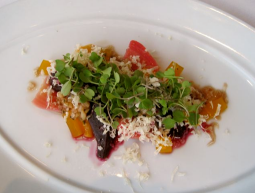 Roasted Baby Beets with Passion Fruit, Shaved Horseradish and Icewine Dressing from The Oval Room - photo by Jordan Wright His roasted baby beet salad uses a tangy-sweet passion fruit gelee with delicately earthy red, golden and purple beets, zingy fresh horseradish shavings, micro-greens and a sweet drizzle of ice wine mignonette.
In salads today most chefs incorporate elements of sweetness…fresh or dried fruits perhaps…and earthiness…as with multi-colored beets, radishes and artichokes, or legumes such as French lentils, lending a certain piquant rusticity and serving to balance out the bitterness in field greens. Conte’s design goes one better with its clean preparation and clever addition of fresh horseradish.
The food at The Oval Room is stylish and understated, echoing its décor. It is a pretty room but unfortunately I experienced one of my restaurant pet peeves…banquette seats so much lower than table height my chin was nearly grazing the plate.
I focused on the food instead…its flavors, textures and techniques. Whether preparing a Berkshire pork rack and belly with briny little neck clams, sweet peppers and lime; or a dish of Pennsylvania duck with red cabbage traced by an alluring persimmon and mustard sabayon sauce, Conte is able to tweak his ingredients to achieve something new yet quite un-twee. In these and some of the other dishes the combinations take their cues from the Asian kitchen and reflect a decidedly unorthodox direction.
Although the menu reads like a gourmand’s shopping list of intriguing, multi-ethnic ingredients (What, pray tell, is shrimp chorizo?), you can put your trust in the outcome when Conte is at his creative best.
Crudo of hamachi, a raw tuna appetizer oft-experienced elsewhere, is gotten right when dressed with a green apple mustard and yuzu vinaigrette to create a vivid flavor and color interplay.
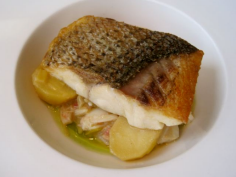 Chef Tony Contes Crispy Rockfish - photo by Jordan Wright Rockfish, as served here, crisped up and perched over slices of fingerling potatoes, nestled in a sheer peekytoe crab “chowder” and balanced by pancetta and licorice root, was perfection. The fish itself was lauded by Conte’s skillful balancing of his components, and never losing sight of his prevailing ingredient. Nothing is flashy, over-wrought or contrived here. In fact, although he incorporates a multitude of global ingredients in his cuisine, the result is quite harmonious, delightful and unexpected.
Pastry Chef Adrienne Czechowski helped draw the veil for us with a dessert of caramelized peanuts and hazelnuts, puddled beside a chocolate glazed hazelnut dacquoise, layered with peanut butter mousse, and served with salted caramel ice cream bringing the salty-sweet thing to a heavenly convergence. Another reinvention of a classic is her Asian pear tart served with homemade honey ginger ice cream.
If this is Conte’s “Modern American” call-it-what-you-will experiment, then I offer myself up as the thoroughly “Modern American” guinea pig!
Highly recommended.
www.ovalroom.com
The Bombay Club – An Ayurvedic Tradition
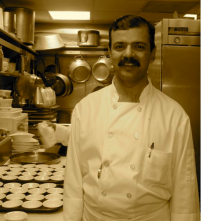 Bombay Club Executive Chef Nilesh Singhvi - photo by Jordan Wright At Bombay I discovered that Chef Singvi pulls 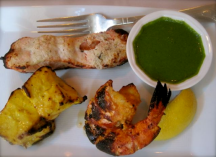 Malabari Shrimp, Chicken Tikka and Tandoori Salmon at Bombay Club - photo by Jordan Wright no punches in his use of lively spices, chilies and herbs; a kitchen that has neither chamber vacuum packers nor a thermal immersion circulator, but does have an ancient Indian coconut meat grinder and deep charcoal-fired tandoori clay ovens for baking off the delicious naan, paratha and kulcha breads. You could live on the goat cheese and tomato kulcha with its scattered bright green mint. Warm, grill-smoky, sassy and alluring.
Exploring the kitchen I saw boxes of cashew nutmeats waiting to be pureed into creamy curry sauces. Mace and fenugreek seeds in clear containers stacked beside whole black cumin seeds and nutmeg pods. More boxes stretching up to the ceiling were filled with cloves, bay leaves, cinnamon, ginger, mustard seeds and green cardamom pods, while dates and tamarind stood ready to transform into fruity chutneys. All chutneys and curries are concocted in-house, ground from these raw ingredients, and familiar Indian dishes are ratcheted up stratospherically with Singvi’s experienced hand.
Ancient Coconut Meat Grinder - photo by Jordan Wright 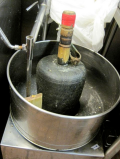 www.bombayclubdc.com
The Georgetowner/Downtowner
From Wright on Food
Jordan Wright
April 2010
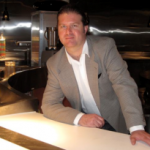 Chef/Owner Joel Thevoz of Main Event Caterers - photo by Jordan Wright Swiss-born and raised, Joel Thevoz, hit Washington in the mid-80’s with a business degree and a briefcase full of fresh ideas. Coming off la vida loca in Costa Rica and Mexico, where his on-the-fly dinners were highly praised by friends and neighbors, he had decided to settle down to a serious culinary career.
With his wife and partner, Nancy Goodman, they launched Main Event Caterers in 1995 on K Street in Georgetown. Ten years later they were to bring their ever-expanding operations into Arlington, VA, where their stunning cuisine and lavish events garner rave reviews and an ever-increasing upscale clientele.
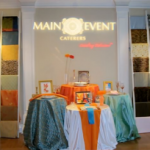 Main Event Caterers - 2010 Caterer of the Year award winner by Catering Magazine - photo by Jordan Wright They ran their company like every other top-tier caterer until three years ago, motivated by Al Gore’s groundbreaking film, “An Inconvenient Truth”, they had a epiphany and took their successful company to higher level…one with a conscience…where green is the new black. It would hail a new dynamic for Main Event Catering and reflect their growing ecologic awareness.
Now in the vanguard of a new aesthetic, where style meets substance, this sophisticated caterer is a leader in the green revolution, as they continue to be recognized with a growing list of local and national green business awards that reflect their commitment and the calibre of their cuisine. To add to their accomplishments, this year they won the coveted “Caterer of the Year” award from industry giant, “Catering Magazine”.
I spoke with the passionately eco-knowledgeable, Joel Thevoz, and toured the 20,000 sq. ft. facility with its gleaming stainless steel demonstration kitchen-in-the-round, 25-foot floor-to-ceiling wine wall and extensive culinary library featuring a precious archive of leather-bound Gourmet Magazines dating from 1946.
Jordan Wright – How long have you been on the green bandwagon?
JT – We started out being aware of our impact in this world about 3 years ago. The Green Movement was just getting started here and, for us, that set the pitchfork in the ground in terms of thinking about what we do and how we do it.
There was one very impactful moment for us. It was a day when we were winding up after an event that used disposables. And at the time I was very proud of using the best quality plastics. I took a look at our truckload worth of waste and plastic garbage from this one event and I was literally sick to my stomach. I thought this stuff is going to last forever. What can we do better?
JW – What did you do to change your company’s way of doing business?
JT – That moment set the tone for a period of discovery. We wondered, “Can we find products that are biodegradable?” It was right about the time when cups made from cornstarch by-product became available. I had seen them used in an airport in England and brought some back with me. 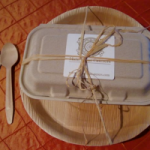 For events using disposables - Balsa wood cutlery, palm frond plate and recyclable box from Main Event Caterers - photo by Jordan Wright But it was a real challenge to find these things in the US. We started digging around and discovered they were making plates from dead palm fronds in India. They are sandwich-pressed using steam into these flat shapes with a bit of curvature to make a plate. Then they are hand-scissored to size.
Finally we could eliminate all plastics from our catered service, and now we only use biodegradable palm plates, balsa wood cutlery, washable glassware and other biodegradable products for our events using disposables. Also we use purified water in jugs in place of mini plastic bottles.
JW – How do you recycle?
JT – We bring large recycling cans onsite, and all our staff is trained to separate out recyclables like paper, cardboard, tin, glass and plastic. Then it gets brought back here where we take it to the recycling center. It does add to the workload of an event, but we still do it effectively.
We also decided to add solar concentrators to the roof over the individual offices to bring in light and we are now replacing all our metal halide lights with T5 lights that use a minimal amount of electricity and are motion-sensitive. This way they shut off when someone leaves the room. The floors here are bamboo, the ice machines use filtered water and we clean and press all our linens to lessen our carbon footprint.
To be carbon-neutral we buy carbon credits to offset all the energy that is used, as with our trucks going to and from events. Also we calculated the approximate employee commute for the whole team and buy carbon credits to offset all those greenhouse gases, so that now we are 100% carbon-neutral. We’ve been doing that for three years.
JW – What other ways have you found to save energy?
JT – For one thing we compost our food matter to make high-quality soil that we distribute to our community, and we collect and store all of our used cooking oil, that we donate to a local biodiesel cooperative.
Also we wanted to subsidize wind power. So we purchase an equivalent amount of electricity from a wind farm. And though it is off-site, it gives us the advantage of being technically wind-powered. It tells the energy company that we are serious and we want to spend our money on clean energy…because unless you prove with dollars that there is a desire to purchase alternative energy, they won’t listen. We’ve seen how it creates momentum when a lot of companies get involved.
JW – Have you figured out how much more it costs to do business in this way?
JT – We have a general idea, and of course the start-up costs were quite high, but it is far outweighed by the amount of business we receive from clients that are like-minded. Companies and individuals who like what we are doing eventually gravitate to us and we feel rewarded.
We live happy and it has paved the way to the next stages in our development. It’s given us the knowledge and the confidence and introduced us to organizations that have things to offer us that are above and beyond anything else that we’ve done so far.
JW – What are some of the newest technologies that you’ll be using?
JT – Lately we find we are becoming a sort of incubator for green solutions.
Not long ago we had a visit from a gentleman based in Florida and began to talk about using geothermal. I mentioned how our dishwasher pushes out gallons of 180 degree water and it just goes down the drain. He told us we could divert it and harness it. Ultimately his company designed a product for us using heat exchange and we’ll be testing it here. The plan is to have it up and running in a few weeks.
In a nutshell we will be running “grey” water alongside the city water pipes to super-heat municipal water. The fresh and “grey” water don’t mix together. There are membranes between the two of them. But in this way we can take the 65 degree water from the county and introduce it through our ”grey” water cisterns before it goes into the pipes. Eventually it will raise the temperature of our instant hot water for our washing machines two-fold to 130-160 degrees. It will save us a lot on gas usage.
JW – Is that a cost to the city?
JT – No, we handle it all from here. We’ll build a tank and the city water will go right through it.
We’re also looking at placing these huge cisterns beside our buildings to gather and harness the rainwater from our roofs. Imagine! They can collect up to 40,000 gallons per month of water. What we want to do is use those tanks for latent energy.
We subscribe to a train of thought that the future of this world is based upon communities building vertical farming. We have these flat roofs here and we are in the process of designing a rooftop garden with greenhouses to grow all our own vegetables and herbs. We have at least 6,000 square feet of roof space. We want to prove that it can be done and share the plots with the community.
The greenhouse will be hydroponic and aeroponic which is a system NASA developed that uses an oscillator that is introduced into a water tank. You create a certain vibration and it renders the water into a mist. You can then push that vapor, with pressure, into a system of canals or closed chambers in which the roots of your vegetables thrive without soil. Every intermittent three minutes the pipes are filled and then flushed. It works like a rainforest. The plants grow at 2-3 times the speed.
JW- What about the “terroir” – the taste imparted to the vegetables from the soil and its minerals? Won’t that be missed?
JT – We can introduce that into the water by making a slurry from our compost and extracting the minerals out in liquid form to fortify the water, or we can buy organic feed to add to it.
Our last initiative will be to crush our glass and smelt it in kilns and create recycled glass slabs to use for platters and bowls. We are interested in inviting others, even our competitors, to see how we are doing this. We look to inspire others.
JW – What do you see for the future of catering?
JT – I foresee in the next few decades that we’ll move towards a more vegan and a more raw diet and a more healthful nutritious diet. So we’re making a small push to increase our vegetarian options and training ourselves to be better at cooking those options for our clients that want them, and for the future of our planet too.
This interview was conducted, condensed and edited by Jordan Wright.
Jordan Wright
April 2010
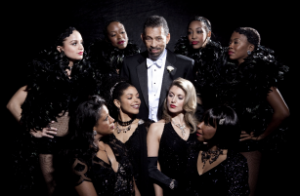 The Manzari brothers are a couple of cool dudes. So low key and under-the-radar that during a master class at the Duke Ellington School the great dancer and choreographer, Maurice Hines himself, didn’t intuit they were from the same family. It wasn’t until he singled them out from dozens of dancers that he discovered that the teens were in fact brothers. The following day Hines invited them both to an open audition at the Lincoln Theatre. It was during the third day’s callback that they were cast alongside leading man, choreographer and virtuoso performer, Hines, in the newest production of “Duke Ellington’s Sophisticated Ladies”. The Manzari brothers are a couple of cool dudes. So low key and under-the-radar that during a master class at the Duke Ellington School the great dancer and choreographer, Maurice Hines himself, didn’t intuit they were from the same family. It wasn’t until he singled them out from dozens of dancers that he discovered that the teens were in fact brothers. The following day Hines invited them both to an open audition at the Lincoln Theatre. It was during the third day’s callback that they were cast alongside leading man, choreographer and virtuoso performer, Hines, in the newest production of “Duke Ellington’s Sophisticated Ladies”.
In the world of dance improvisational tap scenes are called “trading”…a friendly challenge in which the dancers trade tap licks and push the percussive envelope ever higher. In a recent YouTube video Hines narrates his encounter with the amazing and adorable prodigies, John Manzari, 17, and his brother, Leo, 15, and the three do a tap-off together. You can see it here: http://www.youtube.com/user/arenastage1  (l-r) Leo Manzari, Maurice Hines and John Manzari in the Arena Stage production of Duke Ellington’s Sophisticated Ladies Growing up in DC they danced around the living room watching PBS’s “Sesame Street” and “Zoom”, shows that presented rhythm tapper Savion Glover, doing his “free-form hard core” tap, and veteran pioneers like Maurice and Gregory Hines. Their mother, Mary Manzari, told me they started dancing when they were just tots, though none of their relatives had ever been performers.
Last fall they heard about the master class at the Duke Ellington School from Leo’s best friend’s mother who rang up Mary. They both decided to go.
While they have performed the Nutcracker with the Washington Ballet and the American Ballet Theatre at the Kennedy Center and, later worked with Debbie Allen in her Kennedy Center production of “Brothers of the Knight” and the world premiere of “Walking the Winds: An Arabian Tale”, this show will be a professional regional theatre debut for the boys, who take classes five days a week from 5 till nearly midnight. Yes, folks, that’s what it takes.
Their style is both similar and different. John describes it as, “Leo, takes the role as creator and I manipulate it so it fits with what I’m doing till we find common ground. It’s a complicated process but it makes sense.”
“We still want to stay as a brother act. My main goal is to bring tap into the R&B world of music. I want to combine the two,” says the younger Leo. “Everyone talks about how revival tap is coming up, but I want it to be a new thing that we’ll do as a brother act. When we’re dancing to music we like Michael Jackson and Stevie Wonder.”
John graduates in June from The Field School on Foxhall Road, which both boys attend, and will enter college this fall.
Wright – Tell me what it was like to work with as highly respected and accomplished a star as Maurice Hines.
John – Mr. Hines has taught me versatility. He taught me to dance to the crowd, make your movements bigger.
You never know what to expect from him. His character stays the same but it’s what he does with it that’s fun and when we have fun the crowd has fun. When it comes to step-wise with all the technical stuff, he “gives” it to us, but even more so the performing stuff…cause that’s his main thing.
Leo – Mr. Hines is a great mentor. I’ve learned a lot and I can’t wait to start performing. Just working with a legend and being part of the whole experience just makes me happy, I guess.
John – I’m really excited about the show. I was intimidated at first but then everyone was very, very kind…the whole cast, the director, the stage manager, everyone. We’re just a family…we blend together. It’s very heart-warming.
Wright – How has your ballet training helped your style and endurance?
John – Mr. Hines told me that age doesn’t matter and watching him it’s true. I forget that he’s not 17. Also I do feel that if you have ballet training you can dance a lot longer because you know how to control your body and take care of it and what muscles to build. Tap is very, very, very demanding of strength and stamina because you’re constantly pounding into the floor. You have vibrations going through your legs and even though you need to build muscle, you have to relax those muscles at the same time. So I can’t really say that one style of dance is more strenuous than the other.
Catch the break-out Manzari brothers captivating audiences in “Sophisticated Ladies”, the hot and sassy musical featuring the life and music of local legend Duke Ellington.
From April 9th till May 30th at Arena Stage at the Lincoln Theatre. For tickets and information visit www.arenastage.com
This interview was conducted, edited and condensed by Jordan Wright. For questions or comments contact [email protected]
|