Jordan Wright May 24, 2012
Special to Indian Country Today Media Network
Red Earth Festival in Oklahoma City, OK
Before the doors open at the Cox Convention Center in downtown Oklahoma City to more than 30,000 visitors, before the drum keeper touches stick to hide and dancers twirl their four-foot buckskin fringe and minutes before the first handwoven basket is purchased or warm fry bread tasted, the day will begin with the ritual smudging of sage leaves.
From Friday, June 8th through Sunday, June 10th, American Indian art and culture will be on display at this year’s 26th Annual Red Earth Native American Cultural Festival where more than 1200 artists and over 500 of the country’s finest dancers come together to compete in one venue and visitors will witness one of the country’s leading cultural events.
Thirty-nine sovereign tribes are headquartered in Oklahoma, each with their own language. Combine that with over a hundred tribes that will be represented here plus journalists and visitors from places as far-flung as Japan, Great Britain and Germany, you can expect to hear more languages spoken here than throughout all of Europe. National Geographic and Good Morning Americahave covered Red Earth, and last yearUSA Today named it one of 10 Great Places to Celebrate American Indian Culture by.
Partnering with the Oklahoma City Museum of Art, which houses a permanent collection of about 1700 historical artifacts and contemporary art, the Red Earth Master Artist Show will display the festival’s winning artwork from the previous 25 years. In addition the highly selective juried show and separate art market will exhibit works from celebrated artists along with beadwork, basketry, jewelry, pottery, sculpture, paintings and cultural attire, allowing visitors to purchase both contemporary and traditional examples of American Indian arts and crafts.
“Over the past five years we have seen about a 20% growth each year in our event,” reports festival spokesperson Eric Oesch. “I think it shows that it appeals to people from every walk of life. Red Earth is for the purpose of sharing cultures and so we attract people, both Indian and non-Indian, from not only Oklahoma and all over the United States but also from around the globe to experience our unique cultures.”
On Friday morning amid 50-story skyscrapers the Grand Parade will kick off the weekend with an explosion of tribal culture featuring dancers, floats, Indian princesses, a football field-sized flag, honor guards, Indian firefighters, horse-drawn stagecoaches and brilliant regalia. This year the Navaho Nation Marching Band from Window Rock, Arizona will perform.
During the all-indoor festival children’s activities will be sponsored by a different tribal museum each day. Lots of hands-on activities as well as beadwork, keepsake boxes, musical performances and storytelling will be conducted by the Comanche National Museum and Cultural Center in Lawton OK, the Citizen Potawatomi Museum in Shawnee, and the Big Brothers Big Sisters organization.
Two other exciting events will take place in Oklahoma City over the same weekend. The seven-acre Myriad Botanical Gardens, which recently underwent a $43 million dollar renovation, will be the backdrop for the first Red Earth Invitational Sculpture Show featuring 12 monumental sculptures of bronze, glass and water. The pieces are designed by some of the nation’s most reknowned Native sculptors including Janice Albro, Denny Haskew, John Free, Bill Glass, Jr., and former Oklahoma Senator and former Chief of the Seminole Nation of Oklahoma, Enoch Kelly Haney.
From June 6th through the 10th film buffs will flock to the deadCENTER Film Festival to see more than 150 films. Known as one of the “20 Coolest Film Festivals in the World” by MovieMaker Magazine, the avant garde festival will screen two important American Indian films including the world premiere of the 1920 historic filmDaughter of Dawn, a recently restored film with an all-Native cast. Screenings for this film will be held at the Oklahoma City Museum of Art’s Noble Theatre. The Dome of Heaven, an indie film by Oklahoman Diane Glancy (Cherokee) starring actor Wes Studi (Cherokee), will be shown at the Harkins Bricktown Cinemas. Visit www.Deadcenterfilm.org for screening times and places.
Beginning Sunday, June 10th the weeklong Nike N7-sponsored Jim Thorpe Native American Games will be held at sporting venues throughout Oklahoma City, where teams participate in the All-Star Native American High School Football and Basketball Tournaments, as well as in nine other sports categories from golf, swimming and wrestling to stickball, martial arts and track and field. The Olympic-style Games will play host to 3,000 student athletes representing 70 different tribes throughout Canada and the United States.
This year’s Games will commemorate the 100th anniversary of Thorpe’s gold medal-winning performances at the 1912 Stockholm Olympics. Thorpe (Sac and Fox) who played both Major League baseball, basketball and professional football, was voted “The Greatest Athlete of the 20th Century” by the Associated Press and was the first president of the National Football League (NFL).
Executive Director, Annetta Abbott told ICTMN, “This will be our largest event ever and will have a Parade of Nations, Indian dancers and fireworks.” For additional info and event schedules visit www.jimthorpegames.org.
Jordan Wright April 18, 2012
Special to Indian Country Today Media Network.
A good surfer must be in complete harmony with the vagaries of nature. Surfing is a unique sport in that its skilled athletes must alternately strive to conquer and surrender and must be emboldened and yet chastened by the force and changeability of both wind and water. Those requirements are non-negotiable. To succeed on a big wave a surfer must strike a perfect balance between physical strength and humility.
The business of modern surfing has evolved into a multi-billion dollar industry, Surfboards, wet suits, fashionable surfwear and more fuel an increasingly powerful market. Upping the ante, niche travel agencies now offer hardcore surfers vacations to exotic oceanside destinations around the globe. And though prices average $1,000 for a starter longboard, one New Zealander handcrafts paulownia wood boards that sell for over half a million dollars. But it has not always been a dollar-driven pastime.
Around 2000 B.C. indigenous populations began migrating out of Asia and into the Eastern Pacific. During that period ancient Polynesians journeyed to the area defined by New Zealand (Aotearoa) at the southernmost point, Tonga and Samoa along the western boundary, and the Marquesas to the east, eventually making their way to Hawai’i in the fourth century A. D.
Evidence contained in Captain James Cook’s log of his third trip to Hawai’i in 1778 record the existence of standup surfboard riding as practiced by Hawaiian kings at Kealakekua Bay on the Kona Coast of the Big Island where they rode standup olo boards. But for Papua New Guineans who had been riding the waves on their stomachs and referred to their belly boards as “splinters”, surfing took on a bold new dynamic in the 1980’s when an Australian pilot came there on holiday in search of the perfect wave. It was then that “Crazy Taz”, as he was known, left his surfboard behind and the cultural landscape was forever altered.
For Californian Adam Pesce who honed his passion for surfing on the legendary Rincon Beach in his hometown of Santa Barbara, a proposed trip to Papua New Guinea (PNG) was the dream of a lifetime. Inspired by an article in a surfing magazine, he took off with friends in 2004 to Papua New Guinea (PNG) part of a string of islands off the east of the Malay Archipelago in the South Pacific. He had taken a simple documentary film course and was eager to shoot the local surfing scene for a film he planned to make while hitting the waves along the island’s famous sea breaks.
After three months of research shooting he returned to California and seeing the video he had shot, he realized the travelogue-style footage did not have the makings of a film. He abandoned the project until 2008 when he got a call from Andrew Abel, President of the Surfing Association of Papua New Guinea. Abel told him they were planning their first national surfing championships in PNG and the trials would determine who would represent the country at the world surfing games in Australia. When Pesce heard this he realized the upcoming event could be the center of his movie and he returned to PNG in 2009 to begin shooting.
Armed with nothing but camera gear, a few surfboards and a degree in diplomacy from Occidental College in L.A., Pesce lived among the natives for seven months where he would become director, producer, editor and cinematographer on his first film, Splinters.
Of the 850 languages spoken throughout this Indonesian island chain of 5 million people, the most common is Melanesian Pidgin (Tok Pisin). Pesce began his stay by learning the language without a translator. He moved into an old shack with one of the local surfers who planned to compete in the surfing championship, and started shooting between bouts of malaria. His goal wasn’t to make a “surf movie” –- he wanted to tell the story of how one surfboard changed a culture.
The seaside community of Vanimo in Papua New Guinea where Pesce set up production is not as idyllic as it appears at first glance. The small village and surrounding country are a shape-shifting and complex culture clinging desperately to a primitive past. Up until recently, cannibalism and “cargo cults” were still practiced in the more remote outposts and today its citizens maintain a strict patriarchal society even as it becomes increasingly westernized through mining and fishing.
Caught between ancient taboos and emerging cultural changes, the country’s struggles are often more sociological than economic. For example brides are still bought by men through a “bribe price” or dowry, in which payment to the bride’s family allows the husband to physically abuse his wife. Domestic abuse is part of the film’s portrayal of family life on PNG, which includes strong scenes of men abusing their wives and even children in full view of the other villagers.
Splinters is the first feature-length documentary about the evolution of indigenous surfing in the South Pacific and the near fanatical obsession of the island’s surfers. But it is also a highly compelling story filmed in cinema verité style and told by the subjects themselves. It is their personal struggles and triumphs set against the backdrop of a lush tropical paradise that is at the heart of the film.
The film focuses on surfers from two competing surf clubs – the Sunset Surf Club and Vanimo Surf Club. Angelus, the son of the first native surfer in Vanimo, and Ezekiel, his protégé, are surfing rivals in the remote seaside community of Vanimo Village, where nearly everyone is related by birth or marriage. They dream of achieving prestige in their village by competing in the local surfing championships and ultimately competing against world-renowned surfers in Australia. For both the men and women, it’s their only ticket off the island and a chance to see the world.
The film also follows two of the island’s most accomplished female surfers, Lesley and Susan, who are sisters. Both need to gain acceptance into one of the all-male surf clubs in order to enter the competition. Lesley is the bolder of the two women. Alternately capitulating to the men or standing her ground, she cannily walks a social tightrope, using maneuvering techniques as deft as those she excels in when riding a wave. Susan on the other hand is more conventional and accepts the subservient role women are taught to assume. Yet each becomes instrumental in altering the current culture’s groupthink.
In a pivotal scene Abel tells the men that in order to compete nationally the women must be accepted into the clubs. Despite centuries of culturally sanctioned male dominance, the men must learn to sublimate their egos and accept the women as equal participants. For the men an even greater challenge than compromising ancient societal rules, is the simple act of getting along with one another as old clan rivalries flare up and threaten their chances of entering the contest. It is only when the teams begin to work together and the women are included that they begin to see what they can achieve.
Interspersed with the surfing and breathtaking scenery are flashes of violence. In one incident a woman is severely beaten by her husband to the encouragement of his neighbors, in another the men threaten each other in a drunken nighttime road rage incident. The scenes are brutal and graphic, but Pesce felt it vital to portray the reality of life in PNG.
Splinters brings to the screen an intimate and emotional portrait of a culture tragically trapped in a violent past. By showing how surfing can serve as a catalyst for social change and gender equality, the film attempts to prove the axiom that society can only advance when each and every citizen is inherently invested in its future success.
Last month ICTMN spoke with Adam Pesce by phone from his home in Santa Barbara, California.
ICTMN: How long ago had the people of Papua New Guinea been surfing?
Adam Pesce: The elders told me that as long as they can remember they were belly surfing on broken pieces of their dugout canoes. When that surfboard was left behind in PNG on the 1980’s, they first transitioned from belly-boarding to standing up.
What attracted you to make a film on surfing involving indigenous people?
It was a mix of several interests. I grew up surfing in California where I was studying international relations and had an interest in travel. I decided to go explore in Vanimo. I was definitely interested in the Western values associated with the surfboard and how they would mesh with local traditions.
When you began shooting in PNG were you surprised by the harsh traditions still practiced there?
I didn’t know how ingrained these traditions were going to be and once I was on the ground there were these walls they put up. I saw women butting up against them and these women were definitely the trailblazers.
Were you ever afraid?
I definitely was afraid for myself. The threat of violence was always there. Things can always turn on a dime.
Have you gone back to show the film yet?
I’m looking forward to bringing the film to Vanimo and showing it to the people and planning an event around it. There’s talk of bringing it to the championship [World Qualifying Series] surfing event in Vanimo in 2013. However Andy and Ezekiel [one of the surfers in the film] were able to come to New York and to see it at the Tribeca Film Festival this spring.
How did it affect them?
It was an overwhelming experience for Ezekiel who ended up in New York doing a press event at the screening of a film he had starred in but never seen. I was very concerned that he might not like the film or how he was being portrayed or that it would be inaccurate in his mind. In PNG men will hold hands as they talk or walk around the village, so we held hands throughout the screening and after the credits he turned to me and said, “Thank you”. It was a very special moment for me — knowing that he enjoyed the film.
Did you ever speak with him about male to female relationships on PNG and how their society might evolve as a result of the surfing competition?
I didn’t have that conversation with Ezekiel, but I did speak to Andy at length following the screening of the film and he was really taken aback with the seriousness of the way surfing could really elevate the status of women in PNG. And I know he is doing his best to make sure that women have access to surfboards and have opportunities to compete and travel.
I would like to add that I’m looking to collaborate with a domestic violence shelter in Vanimo, where people will be able to contribute to a place for women seeking legal aid and physical refuge, and that the film will be screening at the Human Rights Arts and Film Festival this spring in Melbourne, Australia.
Splinters has been a huge hit on the indie film circuit and has been the Official Selection in film festivals from London to Warsaw to Newport Beach and was voted “best Documentary” by Surfer Magazine. It is available for rent or purchase on iTunes or go to www.splinters.com for 2012 screenings in your area.
Jordan Wright June 11, 2012
Special to The Alexandria Times
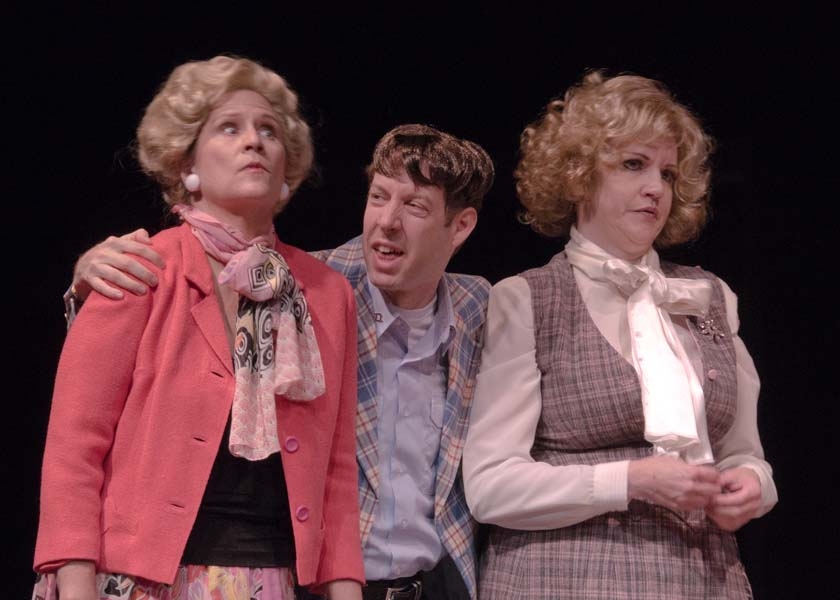
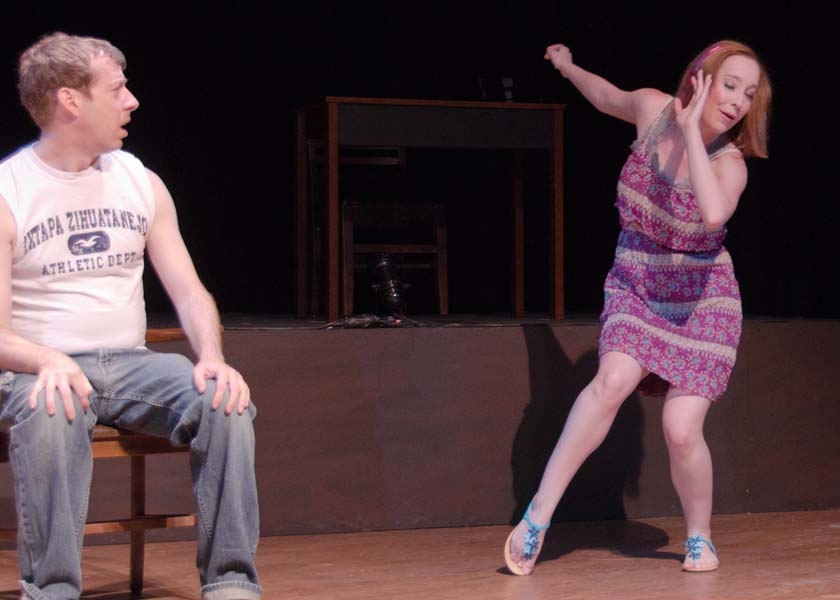
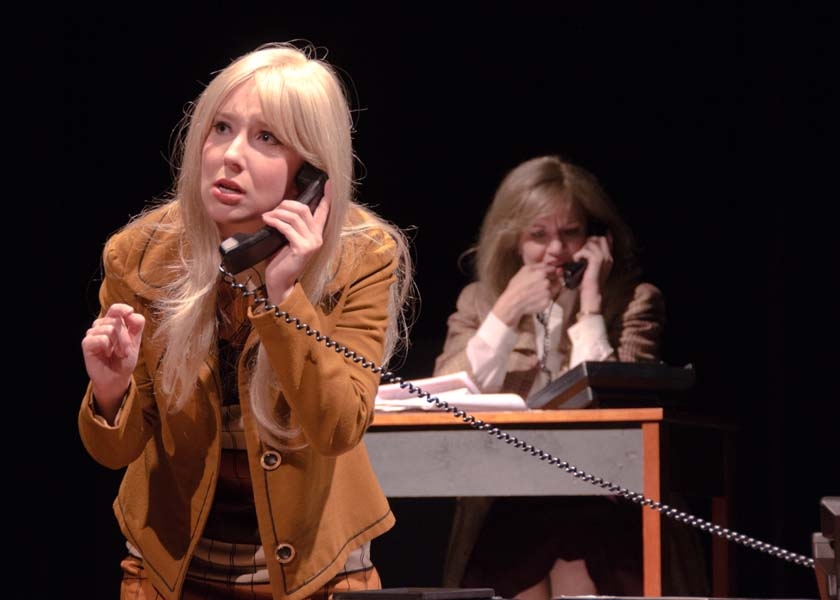
Sarah Holt, Ric Anderson, and Robin Parker Photos by Doug Olmsted
Everybody loves Elvis. The man was larger than life. “The King of Rock and Roll”, who helped shape a mid-century pop culture and was a distinct influence on American music, is still with us today. Rent-an-Elvis impersonators in cheek-hugging sideburns make pilgrimages to Memphis, Tennessee to gawk at his stately colonial mansion. Graceland, the holiest of rock and roll shrines, where wife Priscilla, the envy of bobbysoxers everywhere, along with the King, raised their only child, Lisa Marie. So naturally a show about Elvis’s women would include them, right? Well no, not in this imaginary retelling.
All the King’s Women is an homage to Elvis Presley played out in vignettes by ordinary people Elvis came in contact with at different points in his life. And despite the title they are not the most important women in his life, as you might surmise. Priscilla, Lisa Marie, and mother, Gladys have no roles. So don’t expect a love story here. And in a bit of a misnomer there are four male characters in the play and no hip shakin’ goin’ on.
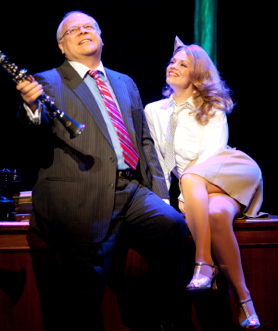
Ric Andersen and Jennifer Finch – Photos by Doug Olmsted
The play opens in Mississippi at the Tupelo Hardware Company. It’s 1946, Elvis’s 11th birthday, and a virtual Gladys has taken him shopping for a twelve dollar Kay guitar in place of the rifle he was promised. Sarah Holt plays the shop girl who drips with that peculiar combination of good manners and behind-your-back gossip called Southern charm. Holt has the inflections and mannerisms down pat. In fact every character she plays will endear you to her. Heads up for her hilarious three a.m. banana-and-peanut butter scene with Elvis in the supermarket.
Eight short vignettes are told though the eyes of the unknown women and men that drifted, if only temporarily, into his sacred sphere – the nameless secretaries, saleswomen, assistants and shoppers whose worlds were rocked by a chance encounter.
During scene changes photo slides from the 50’s, 60’s and 70’s are splashed onto a screen mounted on the back of the stage – iconic photos of Elvis’s pink Cadillac along with movie stills and a photo collage by Andy Warhol – providing a visual scrapbook of the King’s celebrity life and images of the day. But it does seem strange not to have an actual Elvis in the play.
Instead four actors tackle seventeen roles including the auspicious hardware store purchase, a confab among Warhol’s effete staff and a well-publicized meeting in the White House with then president Richard Nixon in which Presley offered his service to the country as a federal agent while dressed in a purple velvet cape with matching slacks and a flashy 6-inch belt buckle.
Jennifer Finch and Robin Parker – Photos by Doug Olmsted
One scene describes an early appearance on the Steve Allen Show. Although Presley had yet to appear on television his scandalous hip gyrations were renowned and nearly got him banned from The Ed Sullivan Show, the most popular family variety show of the 1950’s. In a meeting between Elvis’s press secretary, the network censor’s assistant and Allen’s secretary, Presley is instructed to wear top hat and white gloves. He agreed to those conditions but insisted on wearing his blue suede shoes. Allen finally demurred telling the censor’s assistant, “As long as his shoes are nailed to the floor!”
The cast works well together and the jokes are lighthearted. A simply furnished set focuses the attention on the characters while familiar hits like Hound Dog and Amazing Grace are heard playing in the background.
See it if you want your funny bone all shook up.
Through June 30th at The Little Theatre of Alexandria, 600 Wolfe Street. For tickets and information call the box office at 703 683-0496 or visit www.thelittletheatre.com
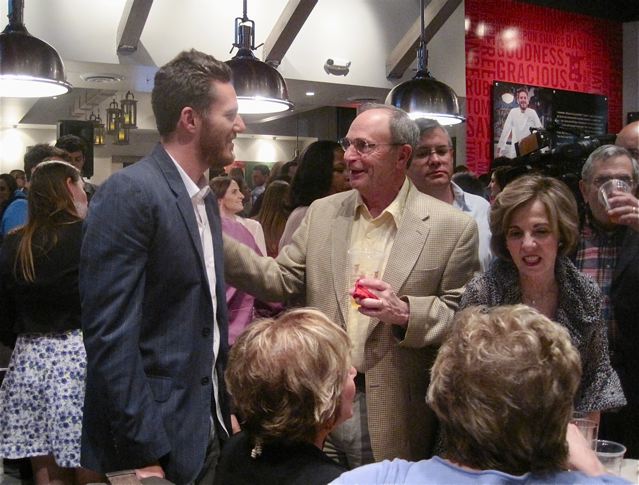
Spike's opening of Good Stuff Eatery in Crystal City - photo credit Jordan Wright
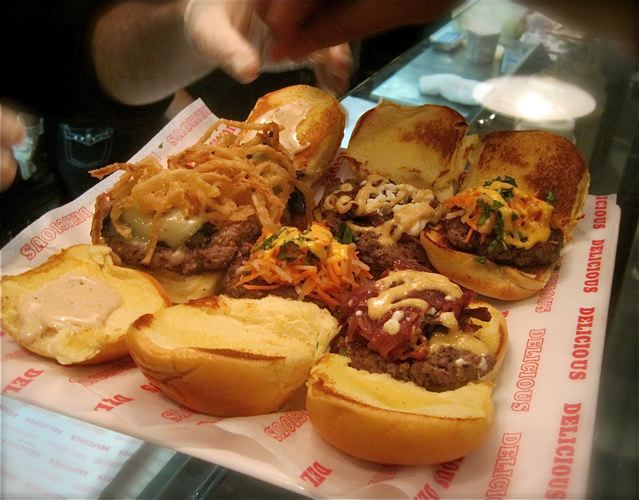
A klieg-lit opening for Spike Mendelsohn’s Good Stuff Eatery in Crystal City brought out family, friends and TV crews earlier this month. Bravo’s film crew has been trailing Spike for his upcoming show Life After Top Chef– and apparently his guests too. An all-who-enter-within waiver was tacked to the wall outside the front door, warning guests they might make the final cut. Wannabes and the rest of us were undeterred, especially from inhaling his juicy burgers, cups of fiery hot chili and sweet potato fries. Champagne and beer made the rounds but were bested by those addictive Toasted Marshmallow milkshakes. P.S. The ultra-rich shakes get their creaminess from the addition of a daily house-made custard. I know. I asked… in the interest of my readers of course.
The posted release at Good Stuff Eatery - photo credit Jordan Wright
An assortment of burger sliders at Good Stuff Eatery - photo credit Jordan Wright
Spike has come a long and much-televised way from burger-flipping pool parties at the Rubell family’s Capitol Skyline Hotel (Remember the giant rubber duckies in the pool?) when the film crew from MTV”s Real World was shooting the young and restless and he was the ever-gracious host. Did I mention how telegenically cute he is? What’s next from the celeb chef? Could be another Good Stuff Eatery opening on M Street in Georgetown later this year.
La Forchetta is Roberto Donna’s New Playground
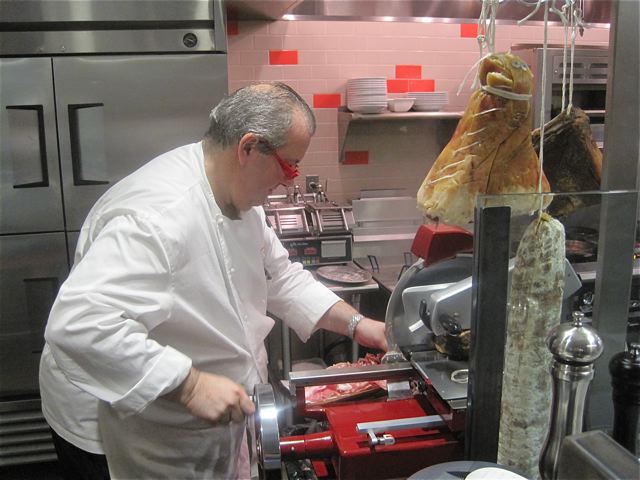
Maestro Donna slicing salumi at La Forchetta - photo credit Jordan Wright
When it became known that Roberto Donna, cookbook author, restaurateur and James Beard Award-winning chef, would be cooking again after years of legal and financial hurdles, including the shuttering of his short-lived Galileo III experiment, gourmands began salivating for his signature Italian cuisine. La Forchetta, which shares patio space with Chef Geoff’s in the nicely wooded neighborhood of Wesley Heights close by American University, is Donna’s new laboratory. Owner Hakan Ilhanwho was aware of Donna’s woes as well as his talents has hired him to cook, not handle the finances. Crisis averted.
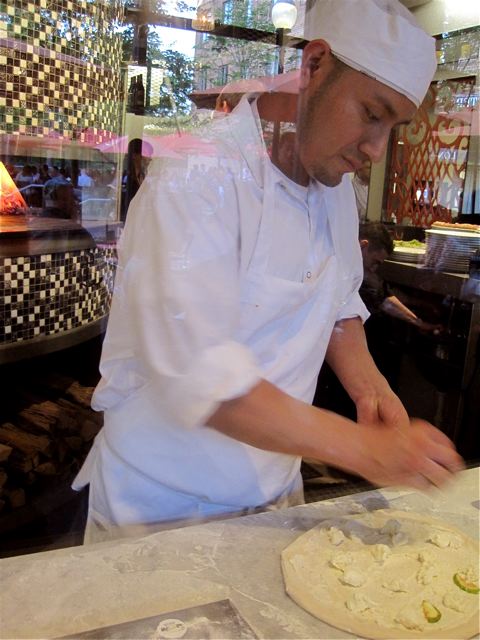
Pizza maker at La Forchetta - photo credit Jordan Wright
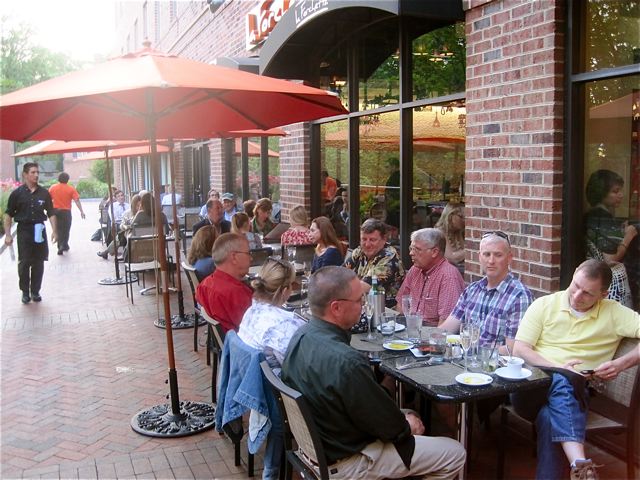
Patio at La Forchetta - photo credit Jordan Wright
The tangerine-accented resto features a square-shaped bar surrounding a large brick oven for wood-fired pizzas. Should be cozy in winter. For now a cheery patio was the draw and most diners were outdoors the night we dined. We tried Donna’s signature risotto with truffles, spinach pizza, rockfish with pesto and Swiss chard, a dish of house made veal and pork sausages over polenta, and papardelle with ragu.
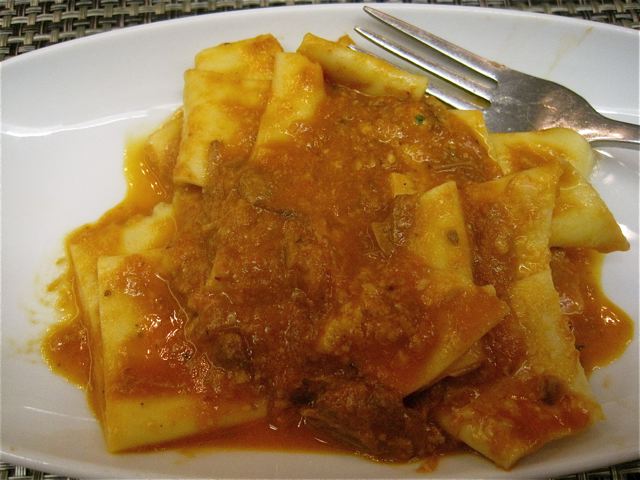
It took awhile to get our cocktails, which arrived at the same time as the food followed by the wine several courses later. A request to debone the fish didn’t pan out as hoped and in the darkening room I gave up plucking out the bones myself and put it aside. Also disappointing were the house made sausages – unexpectedly dry and without the hoped for juiciness to ooze into and flavor the polenta. Thankfully the pasta was up to Donna’s standards – light and tender – and served with wild boar ragu that had clearly benefitted from the low and slow cooking the sauce demands.
Pasta with wild boar ragu at La Forchetta - photo credit Jordan Wright
The pizza was a puzzlement. It comes uncut – a not well thought out decision. For the diner, who may not have in mind dividing their own pie without the benefit of a pizza cutter and work surface, it was flat-out annoying trying to cut a pizza with a steak knife while it slid around a small glass plate. As for its execution, instead of a mound of arugula the small pie sported a few leaves, sparse cheese, little sauce (though it was tasty), and a wide-edged underdone toppingless crust. We gazed wistfully at our neighbor’s salumi platter and wished we had ordered it with a bottle of chianti and a plate of pasta.
Would we return? Yes, now armed with foreknowledge. Sit outside on a balmy evening, order drinks, wait till you’ve finished those before ordering food, and stick to the simplest preparations. Note well: We saw the maestro hard at work shaving meats, not slaving over a hot oven.
Isabella Goes South of the Border
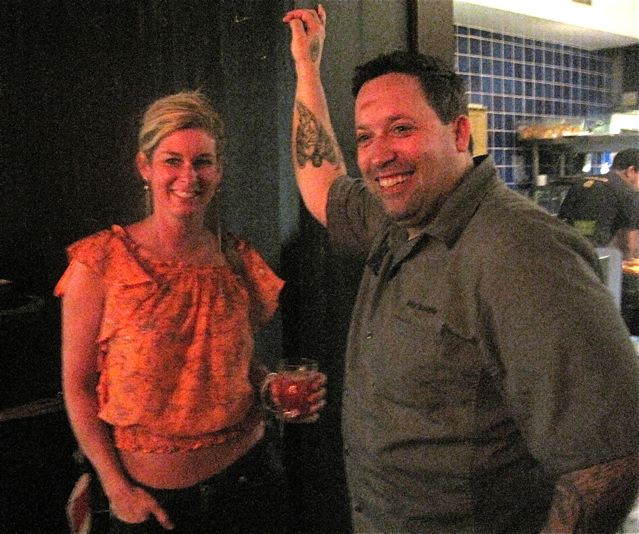
Top Chefs Jen Carroll with Mike Isabella at the opening of his new restaurant Bandelero - photo credit Jordan Wright
Mike Isabella has the Georgetown bar scene figured out. Cheek-to-jowl with the Modern and Rhino Bar and across from J. Paul’s, Isabella’s newest outpost after Graffiato is Bandolero, a low-key high intensity No Country For Old MenMexican hangout, which is primed to go head to head with those well-known watering holes. The former Top Chef from Season 6 and 2010 Top Chef All-Starshad a totally rockin’ opening and former Top Chef fellow contestant, Jen Carroll, was there to cheer him on.
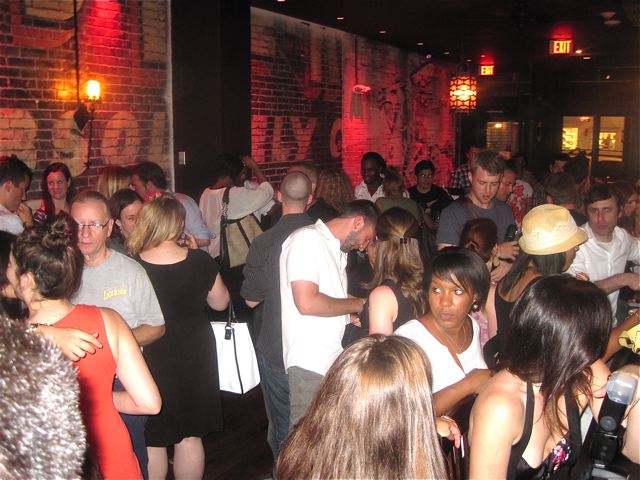
The scene at Bandelero - photo credit Jordan Wright
To keep up with the fast pace of a hot bar, Isabella has put some pre-made designer margaritas on tap. The “El Bandolero Margarita” and “El Mata Amigos” cocktails (“Mata” can mean bushy hair, a grove or the mastic tree? Clarification needed here.) flowed freely at the press opening last week. Currently the bar features over 65 tequilas and a dozen mezcals to choose from. Assistant General Manager, Ryan Jones, told me they’ll soon be off to Mexico in search of some obscure small-batch tequilas to ratchet up the inventory.
The décor, an intriguing hybrid of Mexican bordello meets medieval dungeon, is Elvis on black velvet dark with colonial era brick walls. But forget about the cave mood lighting, (Jones told me the lights were turned up for the event.) and order some food. You won’t be disappointed.
Start with orange infused pumpkin seed spread with jalapenos or chunky guacamole made with salsa roja and served with masa chips and chicarrones. On to Taquitos and Tostados. I couldn’t get enough of the Maryland blue crab tacos with coconut, red chili and purple potatoes – and I’m still craving the tuna, ginger and sweet potato. Fabuloso! And though I delighted in the mahi mahi taco, I noted there’s one made with lobster to try another time. A perfect balance of smoky and spicy was revealed in tacos of suckling pig, apple and habanero mustard, and succulent pork cheek flautas to dip in queso anejo.
In any case Isabella knows the basics of Mexican cooking from his early days on the line. “I used to cook in a Mexican restaurant in New Jersey,” he told me. As for his reinvention of Mexican street food he says, “It’s Mexican with a twist!” Viva la révolution!
Frenchify Me
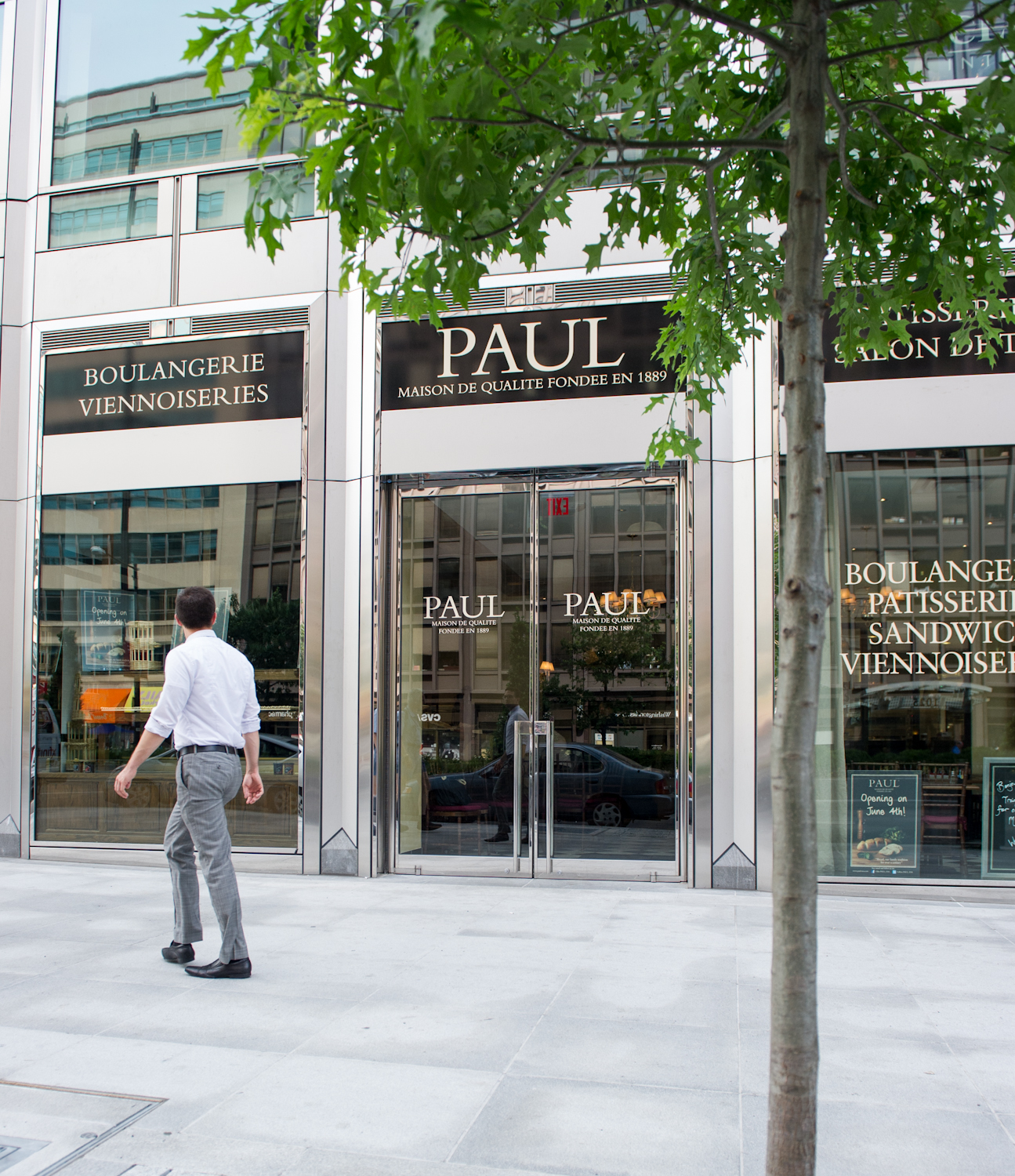
PAUL opens 3rd Bakery in Heart of DC at 1000 Conn Ave NW on Mon June 4, 2012 - Photo credit to Jason Colston
Paul Bakery opened another of their traditional boulangerie cafés, this one in a stunner of a building on Connecticut Avenue near Dupont Circle. Now you can get your café au lait and croissant or sack of macaronson your way to work. Working lunch in the conference room during déjeuner? Impress your K Street clientele with crépes and tartes for lunch.
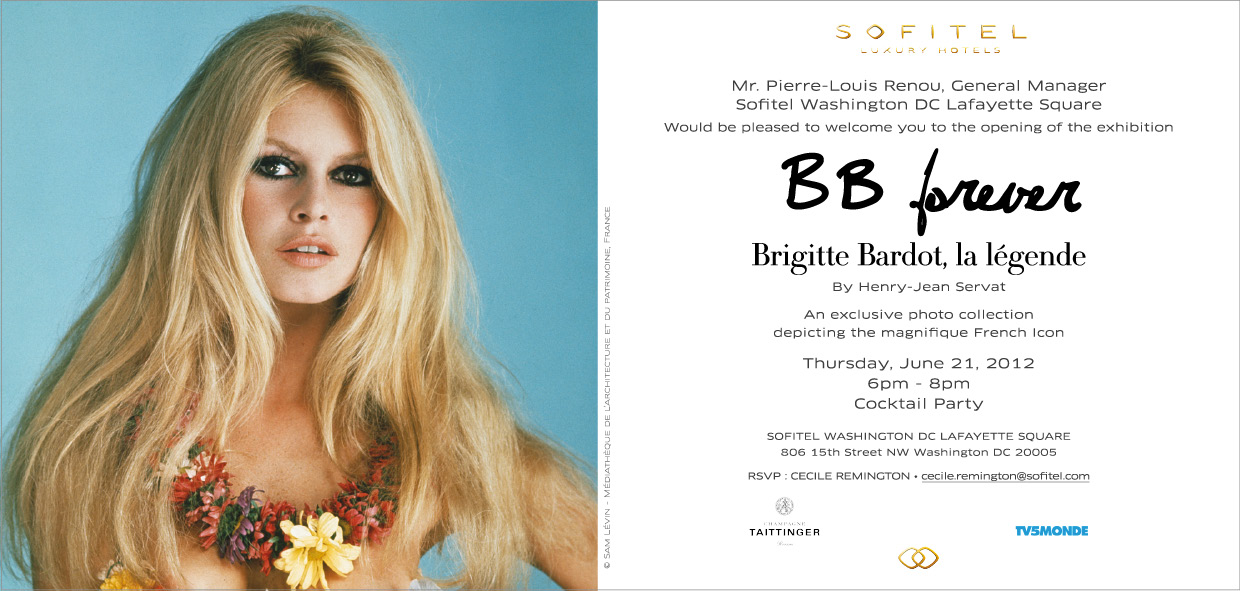
B B forever
Brigitte Bardot is coming to Washington! Well, virtually anyway. The photo exhibit “BB Forever – Brigitte Bardot, The Legend” features France’s most alluring sex kitten and opens June 21st through September at the Sofitel Washington. Concurrently the hotel will offer a special ”French Icon” package, which includes luxury accommodations, daily breakfast for two in iCi Urban Bistro, and dessert for two in Le Bar. It’s the first time an exhibit about the iconic movie star and animal advocate will appear in North America. Sofitel has also created a special collector’s edition catalogue for the exhibit that includes rare photos, accompanied by commentary and anecdotes by journalist and author Henry-Jean Servat, as well as an editorial by the legend herself.
New Chef New Menu at Alexandria’s Morrison House
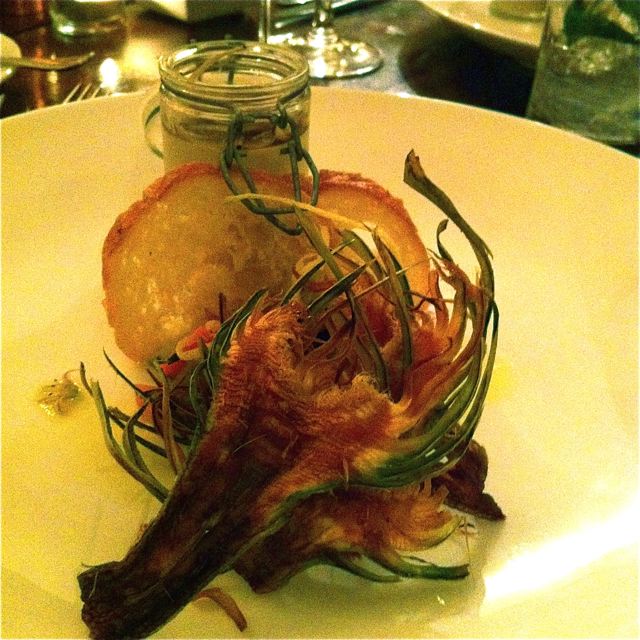
Artichoke puree with truffles served in a mason jar with artichoke chips at The Grille at Morrison House - photo credit Jordan Wright
Brian McPherson, former executive sous chef at Poste is now heading up the kitchens at The Grille at Morrison House, the tony boutique hotel in Alexandria’s Old Town. McPherson recently crossed the Potomac where he worked as executive sous chef under Rob Weland for the past five years.
The Grille has a well-known piano bar scene on Thursday nights and cast members as well as talented local songsters from the area drop by to trill show tunes and light opera for guests.
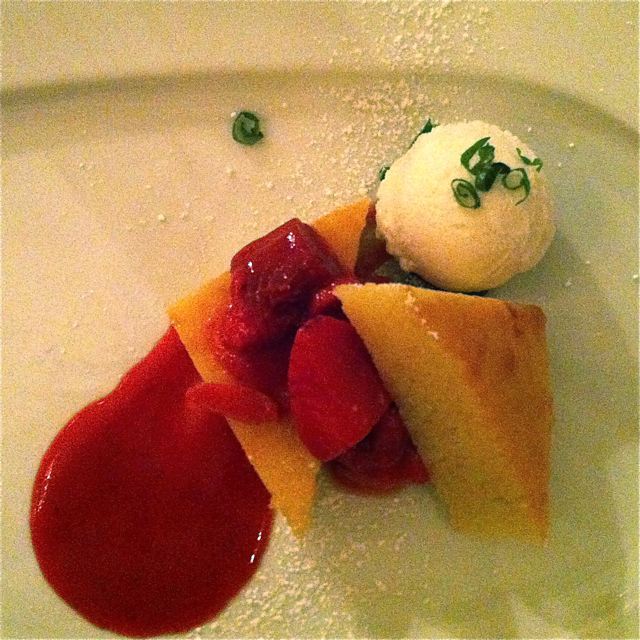
Olive oil cake with strawberries and basil ice cream at The Grille at Morrison House - photo credit Jordan Wright
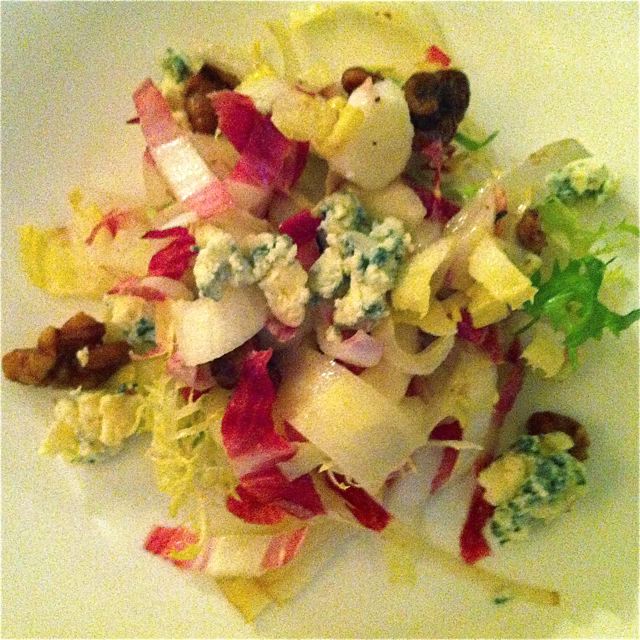
Radicchio, curly endive, walnut salad with Cashel blue cheese at The Grille at Morrison House - photo credit Jordan Wright
McPherson is already doing great things with both upscale and foraged ingredients and at last week’s spring-inspired dinner there was no exception. Opt for the clubby Grill Room (the formal dining room desperately needs a makeover) and start with the artichoke paté with black truffles, marinated artichoke hearts and artichoke chips. Follow with English pea pistou with hedgehog mushrooms and pea shoots or asparagus and nettle soup with crème fraîche, radishes, asparagus tips and ramps. Take it from me, it was like grandmere’spotager. Rosy lamb filets served with a bordelaise jus are rich and meaty, and a salad of radicchio, curly endive, pecans and Cashel Bleu cheese is one I’ll try to recreate at home.
But the pièce de résistance for me was the most heavenly bouillabaisse I’ve ever eaten outside of Marseille. Served with a proper rouille sur baguette and floating in saffron broth were tender pieces of lobster, halibut, mussels and scallops. Formidable!
For dessert we shared McPherson’s insouciant nod to strawberry shortcake with lightly macerated strawberries over a delicate olive oil cake with a rose-infused sauce and basil ice cream on the side, as well as raspberry panna cotta with fresh raspberries and sorbet made from the juice of the same.
If you aren’t up for ditties from the Washington Opera’s off-duty supernumeraries, skip Thursdays – otherwise book a table as fast as you can.
Wolfgang Puck Expands His Empire to National Harbor
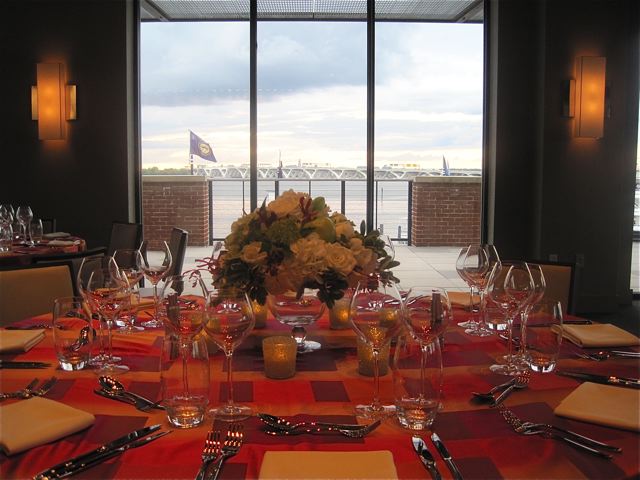
Tablescape with the Wilson Bridge beyond at the Sunset Room at National Harbor - photo credit Jordan Wright
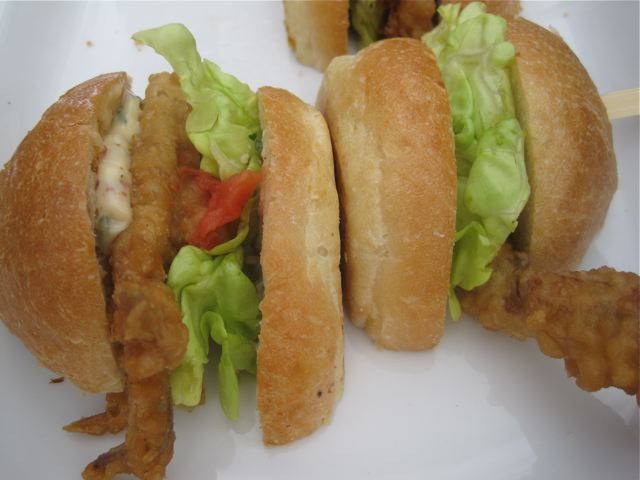
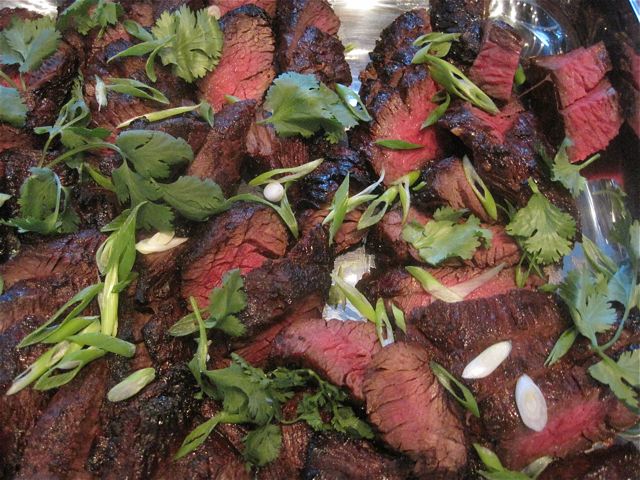
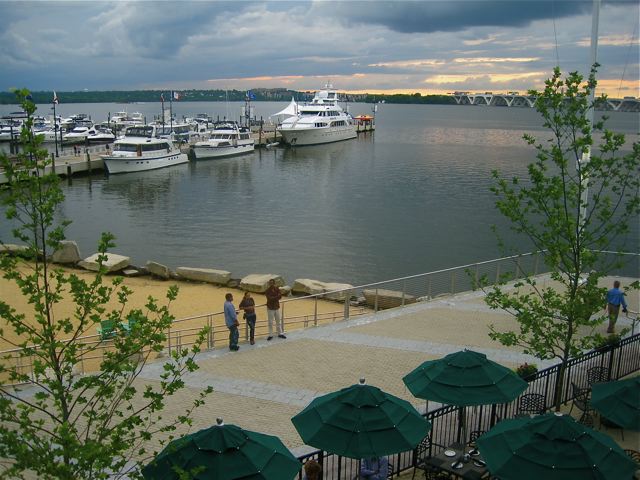
The swank press opening of Puck’s new catering space at National Harbor was an event worthy of the innovator himself. A breathtaking view of the Potomac River coupled with Puck’s stylish cuisine and artisanal cocktails gives this event space an advantage unlike many others in the area. We dined on fresh ravioli, soft shell crab sliders, warm asparagus soup, those legendary pizzas (prosciutto and arugula was the clear winner for me) and Korean short ribs served with half a dozen toppings from scallions to house made kimchee.
Soft shell crab sliders at the Sunset Room - photo credit Jordan Wright
Korean Beef at Wolfgang Puck's Sunset Room
Puck installed a brand new state-of-the-art kitchen in the unused space and trained his staff to reflect the same high standards one comes to expect at his DC resto, The Source, which also has a successful catering division in the Newseum.
Sleek and chic is the dynamic. Oscar-worthy cuisine is the result. The Sunset Room at National Harbor promises to be a premiere destination for conventions, weddings and other social occasions. With a capacity to host private events of up to 2,000 guests and do it in elegant innovative style, Puck’s mantra of “Eat! Love! Live!” translates into LA style parties for the East Coast.
The view from Wolfgang Puck's Sunset Room at National Harbor - photo credit Jordan Wright
Jordan Wright May 21, 2012 Special to The Alexandria Times
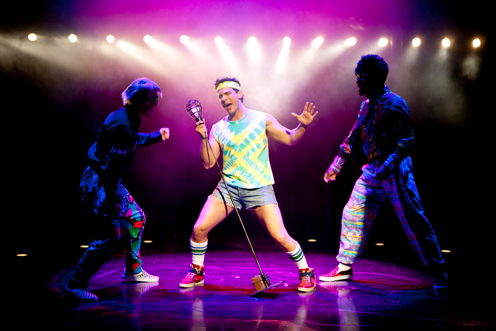
Sonny (Charlie Brady, center) goes 1980’s glam rock. Mark Chandler (left) and Nickolas Vaughan. "Xanadu" Virginia’s Signature Theatre. Photo: Scott Suchman
Dial back to the ‘80’s and Venice Beach, Cali. It’s the days before auto-tuned singers and earbuds, a simpler time when listening to music meant cassette tapes and a boombox the size of carry-on luggage. Scrunch a pair of leg warmers over your roller skates (in-lines had yet to be invented) and channel your inner Olivia Newton-John or John Travolta. Remember that now much maligned era of disco fever and mirrored balls – when dancing to Donna Summer fast tracked your life? Well, it’s back with the pop musical Xanadu to the tune of fourteen huge hits like I’m Alive, Evil Woman, Strange Magic, Suddenly and Have You Never Been Mellow.
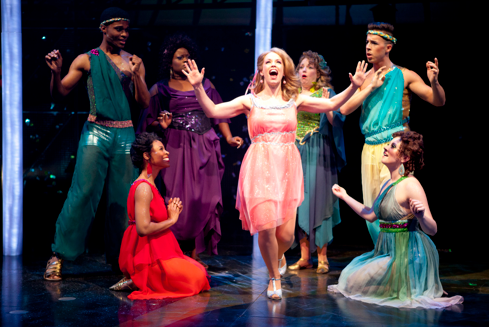
Erin Weaver (center, as Kira) with her Greek Muses (from left to right) Nickolas Vaughan, Kellee Knighten Hough, Nova Y. Payton, Sherri L. Edelen, Mark Chandler, and Jamie Eacker. The musical comedy "Xanadu". Photo: Scott Suchman
In a mix and match of muses, roller disco and a World War II female quartet, Sonny and Kira fall in love. That’s the easy part. Plot-wise the musical tosses in everything but the kitchen sink and throws out more wacky punch lines than Laugh-In. But it’s the electrifying, feel-good musical score by composers Jeff Lynne and John Farrar that provides the Krazy Glue that holds it all together when mythical gods and goddesses conspire and partyers in silver Lurex and platform heels camp it up on a stage designed to send skaters sailing straight through the aisles. In Misha Kachman’sset, complete with soaring catwalk and palm trees silhouetted against an amber sunset, there’s a bigger-than-life backdrop to this eponymously titled send-up of the 1980 cult classic film.
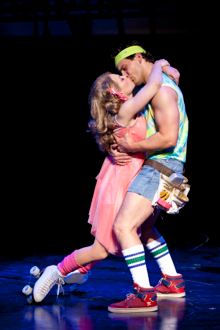
Kira (Erin Weaver) goes weak in the knees in the arms of Sonny Malone (Charlie Brady). Photo: Scott Suchman
Sonny is an untalented sidewalk chalk artist who can’t even conjure a compelling suicide note. In the midst of his desperation he meets Kira, a Grecian muse, aka Clio, on the Santa Monica Pier. She vows to help the disconsolate Sonny become successful. But following her father Zeus’s edict to all muses, she must not fall in love with a mortal. Bummer, right? In all of the great Greek tragedies the infighting muses have an axe to grind – and this one’s got Kira’s name written all over it.
Harry A. Winter (as Danny Maguire) and Erin Weaver (as Kira) sing “Whenever You’re Away From Me”. Photo: Scott Suchman
As in the original Broadway production a cast of nine handles, what by quick count appears to be, an astonishing 25 different roles. Are they up to it? “True dat!” as the slang-prone muses say. Credit Costume Designer Kathleen Geldard and a wardrobe mistress as speedy as Mercury who manage some lightning quick wardrobe changes as the cast goes from diaphanous togas to skintight spandex and back again.
Hunky actor Charlie Brady plays the hapless Sonny Malone to adorable Erin Weaver’s Kira. Weaver is utterly winsome and creates a force field all her own, breathing mega-energy into the familiar show.
The script has plenty of audience-conscious lines. When Kira asks her former boyfriend, now real estate tycoon Danny Maguire (played by Harry A. Winter), to let them turn his old theater into a roller disco, he agrees telling her, “Nothing turns around a crappy neighborhood like the Arts.” Knowing laughs from the Shirlington audience who remember when the theater was in an auto shop. But the line of the night goes to Hermes, played with perfect comedic timing by Nickolas Vaughan who when Kira asks him, “Why does Zeus accuse me?” – he cracks, “Bitch, I don’t know your life!”
Sherri Edelen (Calliope/Aphrodite) who recently appeared in Signature’s multi-awarded Hairspray is a riot as is Nova Y. Payton (Melpomene/Medusa) whose rich voice and sass put the show in the “Memorable Evening” category.
Through July 1st at Signature Theatre (Shirlington Village), 4200 Campbell Avenue, Arlington, VA 22206. For tickets and information call 703 820-9771 or visit www.signature-theatre.org.
Summer Cookbooks, Celebs, Book Giveaway and A Sri Lankan Pop-Up Dinner
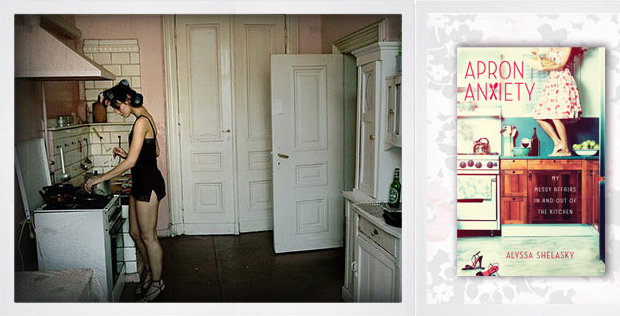
Apron Anxiety Giveaway – Alyssa Shelasky’s hot new tell-all cookbook will be given away to a lucky subscriber of WhiskandQuill.com. Go to CONTEST to register and enter to win your own copy. See my write up in last week’s column. Giveaway ends June 1, 2012.
In between bites we’ve been trying to catch up with the recent crop of cookbooks. This week’s report that the Washington Metro area, Alexandria and Arlington in particular, are the most well-read cities in the country was indeed exciting – so let’s stay on top with a great summer read.
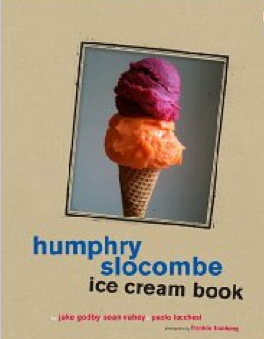
What’s summer without ice cream? Since National Ice Cream Week is from May 30th to June 5th this year, you’ll have just enough time to practice wowing your peeps with these unique formulas from San Francisco’s coolest ice cream chefs. In the Humphrey Slocombe Ice Cream Book (Chronicle Books) the shop’s owners Jake Godby and Sean Vahey have partnered with San Francisco Chronicle’s Inside Scoop columnist, Paolo Lucchesiin a book chockfull of beat-a-path-to-your-door sweet treats. In a small Mission District shop they prepare their sometimes pot- more often alcohol-inspired ice cream concoctions each day and fans line up to try their latest whimsies. The Gabba Gabba Hey Sundae was inspired by The Ramones and uses the recipe for Balsamic Caramel ice cream. I can hardly wait to try the one for Sweet Summer Corn or Strawberry Candied Jalapeno.
Lorraine Wallace - Mr. Sunday's Saturday Night Chicken
Best-selling New York Times author, Lorraine Wallace, has come out with her second cookbook, Mr. Sunday’s Saturday Night Chicken (Wiley). Lorraine is the wife of Fox News journalist Chris Wallace. In a journalistic nod to full disclosure, I went to school with Chris’s sister, Pauline Dora, who was the former president of New York’s tony The Conran Shop and now owns Design Collection, a swank home accessories shop in New Canaan, CT. The siblings are both children of the late 60 Minutesanchorman Mike Wallace. Still with me? Lorraine, a resident of Washington, DC and mother of six, has chosen to cast chicken in the starring role in her tribute to her husband’s favorite dinner choice. There are 130 recipes featuring poultry including one from her pal, Art Smith, Oprah’s former private chef, for his legendary Art and Soul’s Fried Chicken, her sister-in-law Pauline’s Easy Roast Chicken, and the recipe for Brined Organic Pheasant from my dear friend Rob Townsend, former chef at Upperville’s Ayrshire Farms. Lots of Wallace family photos and intimate snippets of their lives grace the pages between recipes.
British author Jane Hornby’s follow-up to What to Cook & How to Cook Itis entitled Fresh & Easy(Phaidon Press). The stunning tome features 75 step-by-step recipes with helpful photos for dishes perfectly suited to outdoor entertaining.
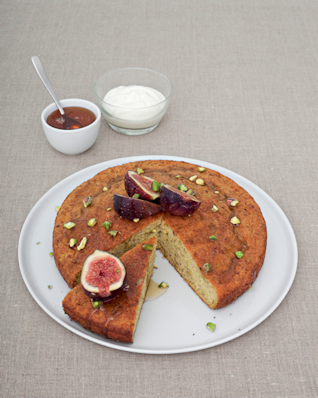
Pistachio Yogurt Cake with Figs & Honey from Fresh & Easy
Jane Hornby’s Pistachio Yogurt Cake
Preparation time: 45 minutes, plus cooling
Cooking time: 45 minutes
Serves at least 8
Note: I love the unique texture that yogurt gives to cakes and baked goods; sort of dense but light at the same time. Here I’ve mixed it with olive oil and pistachios to make a moist and tasty Middle-Eastern-style cake that’s ideal for dessert with coffee or a glass of mint tea.
Ingredients 7 tbsp unsalted butter, plus extra for greasing
scant ½ cup olive oil
3 eggs, at room temperature
scant 1 cup Greek yogurt, plus extra to serve
1 ¾ cups shelled pistachios
1 ¼ cups all-purpose flour
2 tsp baking powder
¼ tsp fine salt
¾ cup superfine sugar
6 fresh figs, or more if you like
2 tbsp honey, plus extra to serve
Instructions
Butter the inside of a deep 8-inch round cake pan, then line the bottom with a circle of parchment paper. Preheat the oven to 325°F.
Melt the butter in a pan, then pour it into a large mixing bowl. Pour in the oil and let cool for a few minutes.
Add the eggs and yogurt to the bowl and whisk until smooth and even.
Put 1¼ cups of the pistachios into a food processor with 1 tablespoon of flour and process until fine and sandy. If you don’t have a food processor, the next best thing is to put the pistachios into a food storage bag, squeeze out the air, then bash the nuts with a rolling pin until fine.
Add the nuts, flour, baking powder, salt and sugar to the buttery mixture, then fold together using a spatula or metal spoon until thoroughly combined. Pour the batter into the pan and even out the top.
Bake the cake for 45 minutes, or until evenly risen and golden and a skewer or toothpick inserted into the middle comes out clean. Cool the cake in its pan for 15 minutes, then transfer it to a cooling rack.
When ready to serve (it can be warm or cold, but is best warm), put the cake onto a serving plate. Slice the figs in half and sit a few pieces on top of the cake. Drizzle 2 tablespoons honey over the top of the cake and fruit, then sprinkle with the remaining whole nuts. Serve with the rest of the figs and more yogurt on the side. The cake will still be very good to eat a few days after baking*
Kim Barnouin - Skinny Bitch Book of Vegan Swaps
From the Skinny Bitch series best-selling author and holistic nutritionist Kim Barnouin, we get her umpteenth guide to a healthier lifestyle – (HarperOne). We knew she was headed there sooner or later. Barnouin’s R-rated banter intends to strip away the fear of an inaugural trip to Whole Foods. Seriously? “Swap Hostess Twinkies for X’s and O’s Vegan Bakery Canoe Boats,” she counsels the culinary naif. That should be a snap with bankrupt Hostess Brands laying off all 18,500 employees this week. Read this if you don’t know the difference between Kellogg’s and Kashi.
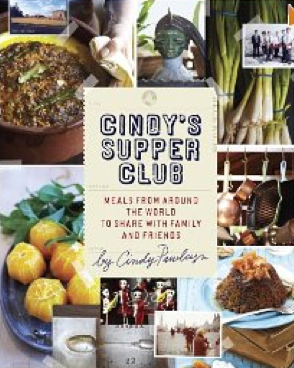
On a more serious note, Napa Valley’s award-winning chef and restaurateur, Cindy Pawlcyn’s new book, Cindy’s Supper Club – Meals From Around the World to Share with Family and Friends(Ten Speed Press) got us planning our next dinner party. Pawlcyn takes us to exotic locales – think Turkey, Peru, Korea and South Africa – without ever leaving the sanctity of our own kitchen. Twenty-five complete menus plus luscious photos from Alex Farnum. Take note of the Hawaiian Pork Katsu and grab your market basket to prepare the refreshing Forager’s Salad from Ireland with ten veggies, a clutch of herbs, hazelnuts and blue cheese. Wildflowers optional.
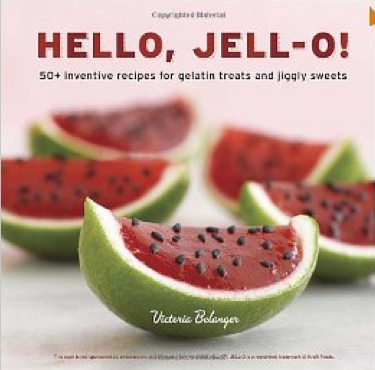
Also from Ten Speed Press is Brooklyn native Victoria Belanger’s Hello, Jell-O, a cutesy summer-useful book of gelatin treats. You might try serving her Pear and Lychee Martini or a minty Mojito mold at your next cookout. I like the Petite Watermelons made with blended vodka-infused strawberries, decorated with tiny black sesame seeds and served in a scooped-out lime wedge. These are not your grammie’s potluck supper recipes, it’s upmarket throwback fun.
When Anthony Bourdain filmed an episode of No Reservationsin Sri Lanka his guide was Baltimorean S. H. Fernando, chef/author of the new cookbook Rice & Curry (Hippocrene). “Skiz”, as everyone callshim, whose first effort cookbook is enthusiastically endorsed by both Bourdain and Bizarre Foods host Andrew Zimmern, has compiled authentic recipes from his homeland into a highly engaging book. Using spices that have applications in the ancient Ayurvedic system of holistic health, Fernando takes the home cook into a world few have ever written about. As a graduate of Harvard University and Columbia University’s School of Journalism, the multi-dimensional renaissance man is also a film director, record producer and music journalist having written for The New York Times, Rolling Stone, Vibe and Spin. He’ll be hosting (and cheffing!) a 12-course pop-up dinner called The Sri Lankan Supper Club at Montserrat House in Washington, DC on June 8th. For details and ticket info visit his blog at www.riceandcurry.wordpress.com.
If you’re watching your figure, or maybe someone else is, NBC’s Today Show Diet and Fitness Guru, Joy Bauer has a new book for you. The Joy Fit Club – Cookbook, Diet Plan & Inspiration (Wiley) is Bauer’s entry into the world of before-and-after success stories. This super user-friendly at-home approach to weight loss ratchets up the inspiration with thirty transformative stories and photos from men and women who have followed her expert advice while losing up to 300 pounds. The easy to follow 21-day diet plan includes yummy snacks like Lime Ginger Baby Cakes with Coconut Frosting (only 5 grams of fat each).