Jordan Wright
January 2010
I was nearly raised in a palace in the rugged highlands of Northern India.  A palace in India When my model/artist/writer/socialite mother found herself smack-dab in the throes of a divorce in the swinging ‘60’s, she threw herself Eva Tanguay-style into New York’s social whirl attending the opera, ballet and nightly galas. Invitations by the handful would appear daily on heavy vanilla card stock from every hostess and charity committee in town. It was at one such soiree that she met a very distinguished man who began to ardently court her.
 Narendra Singh Sarila at the Harry Ransom Center, University of Texas, where he gave a presentation based on his book about the partition of India. Enter the Maharajah Narendra Singh from the Princely State of Sarila, who had still retained his palace with its many lands and servants, though along with many other rulers when independence ended the days of The Raj, he had been stripped of a great deal of the usual privileges and status. I was fifteen, wildly impressionable and safely ensconced in an all-girls boarding school. On holidays I would often see the elegant maharajah when his trusty manservant would fill the kitchen with the alluring aromas of exotic curries in our East Side apartment. This was my first introduction to Indian cuisine aside from the occasional tandoori chicken my mother would whip up in her small clay pot when the cooking spirit moved her.
On my tiny bunk bed in a frigid dormitory in New England I dreamed of life in a palace. I conjured up halcyon days of jewels and robes, elephant hunts and lavish parties. What fodder for a young girl’s fecund imagination! As it happened he had a handsome son about my age. Now I had a vested interest.
In letters home I began my indelicate campaign of pleading and cajoling, hoping to sway my mother to marry him. Eventually the maharajah returned to India pressing my mother through the mails to accept his proposal. One day a massive tiger-skin rug, postmarked Sarila, arrived. I felt certain such an extravagant gift would seal the deaI, but my mother was far less moved, and alas, it was not to be after a prince showed up on our doorstep and trumped the dear maharajah. But that’s another story for another day.
It’s a curious thing how memories will come flooding back after so many years, triggered by a mere morsel, but this is what happened to me, in a most unlikely place, as I sampled the Indian cooking sauces produced by a small company named Stonehouse 27 Spice Company on the cement floor of a convention hall in Washington, DC where I occasioned to meet the owner of a fledgling company out of Germantown, Tennessee.
 Sharon Fernandes creator of Stonehouse 27 Indian cooking sauces - photo by Jordan Wright Sharon Fernandes descends from a family accustomed to bridging cultural divides. A trained engineer, she was born in what is now called Mumbai of a British father and Portuguese mother who worked as a caterer. Later she made her home in Dubai and Australia where she received her degree from the Royal Melbourne Institute of Technology.
A few years ago she had a slap-to-the-forehead moment. “My right brain and left brain finally hooked up,” she says of her epiphany and decision to start the company. “I created the line for my family. I wanted them to have the best.”
Her six beautiful sauces made using stone-ground spices reflect her combined heritage. In a recent phone call she told me that she grew up eating steak and potatoes. “A part of India is all Christian and we love our pork and beef,” she explained. “With that in mind, I made my line of sauces compatible with meats and seafood.”  Gourmet sauces from Stonehouse 27 Spice Co - photo by Jordan Wright Working daily on-site from start to finish in the cooking process she explains, “Everything is done in a very staged approach – one step at a time. At first I tasted over a dozen types of onions before selecting the perfect one for its flavor and consistency. I now get all my onions from Oregon and we sauté them for two hours, allowing them to achieve just the right texture and deepest flavor, before the garlic is added. It all gets just the right amount of cooking as it would in a home or restaurant.”
Her mild Tamarind and Garlic sauce for shrimp and vegetarian dishes and a more delicate Cilantro and Coconut sauce for fish like tilapia, flounder and cod reflect the care she puts into the sauces. A hotter Cashews and Cream sauce, a medium heat Tomato and Chiles sauce and the more spicy Dates and Tamarind sauce are designed to go with meats like beef, lamb and pork. I like that the dishes take only minutes to prepare but taste as though you have been slaving away all day.
Sharon is very proud of the fact that only agave nectar and California dates are used for sweetening and no salt is added keeping sodium levels very low unlike other prepared curry sauces on the market. “People try to compensate for bad-tasting products by adding salt. So I don’t use any salt and there is only the naturally occurring sodium from the lemons, limes and tamarinds in the sauces.”
Stonehouse 27 Spice Company’s Indian Cooking Sauces are not yet available in our immediate area though plans are underway. In the meantime Sharon has kindly offered Whisk and Quill readers free shipping on three jars or more if purchased online. Use the code WhiskandQuill10 to get a dollar off too.
 Chef Willis Underwood of McNulty's 7 Fruit Chutney - photo by Jordan Wright To complement your curry, do try McNulty’s 7 Fruit Chutney, another recent discovery of mine. Fifty years ago North Carolina native Margot Walser started making this condiment during the holidays in her home kitchen from an 80-year-old family receipt. Chockfull of fresh-picked peaches, plums, golden raisins, honeydew, apples, grapes, pineapples and spiced with ginger it is hand-made in small batches as it has always been. Distinctive, flavorful and toothsome it has no preservatives or additives. Toss out the syrupy and gelatinous jelly-like chutneys. This is the gold standard. Find it in Dean & De Luca and some Whole Foods or online.
So here’s my plan…a Bollywood-inspired party. Just ring up your friends, slip in a DVD and whip up some curry in the comfort of your own home. Pretty soon you’ll be having dreams of India too.
For cooking ideas and to order the all-natural Indian sauces, go to:
www.stonehouse27.com
For the heavenly chutney:
www.mcnultyschutney.com
For questions or comments on this article email Jordan@WhiskandQuill.com or visit www.WhiskandQuill.com
Jordan Wright
The Georgetowner/Downtowner
December 2009
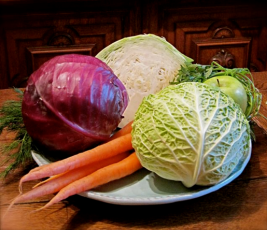 Cabbages and carrots with dill and Granny Smith apple - photo by Jordan Wright Consider the humble cabbage. After a soul-stirring dish of sarmale lovingly prepared by my Romanian acquaintance, Madame Pourchot, I thought long and hard on its cross-cultural worth. Sarmale are simple fare, cabbage rolls, stuffed with ground pork, beef or veal and rice then slow-cooked with tomatoes and herbs. A vegetarian version replaces the meat with carrots, mushrooms and Parmesan and loses nothing in tender sublimity. The pilgrimage-worthy menu began with Hungarian mushroom and potato soup cradling a dollop of sour cream, then latkes, crisp potato pancakes with applesauce on the side, then both the meat and vegetarian versions of sarmale and plenty of hearty oat bread and sweet butter. The meal was crowned with a fluffy rum-infused ginger marmalade bread pudding with sultanas.
Madame Pourchot served this simple yet elegant dinner last week to over thirty guests whose eyes grew wide with amazement, with several pleading in earnest to be adopted by her, before the last fork was set down. Oh, yes, I was one of the potential adoptees!
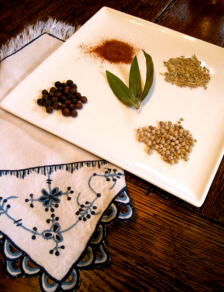 Spices frequently used in preparing cabbage - Juniper berries, Hungarian paprika, fennel seed, white pepper and bay leaves - photo by Jordan Wright There is a place for cabbage in nearly every culture. Syria calls cabbage rolls mihshi malfuf and uses lamb, seasoned with allspice, mint and pomegranate molasses. Ukranians call it holubtsi and top it with a cheesy béchamel sauce. In the late 14th C the legendary chef Taillevent convinced King Charles V to eat his first cabbage – a matter of historical significance and recordation. One of France’s most traditional dishes showcases the earthy flavors of choucroute, the hearty Alsatian dish made with pork, duck, sausages and sauerkraut. Scented with bay leaves, caraway seeds and juniper berries and served with grainy pommery or tarragon mustard it is a peasant’s dish fit for a king.
Contemporary cooks can claim a working knowledge of Asian cabbages like bok choy and Napa. But sauerkraut can be traced back to Chinese “sour cabbage”, cabbage soaked in rice wine in order to preserve it for the winter. Think Korean kimchi, with its infinite pickled varieties. Health magazine named it as one of its top five, “World’s Healthiest Foods”.
 Hearty crusted breads - photo by Jordan Wright From Lorenza de’ Medici’s cookbook, “The Renaissance of Italian Cooking” I found cabbage rolls from the Lombardy region called involtini di verza, from Marcella Hazan, salsicce col cavolo nero, sausages with black cabbage, though she translates that to red cabbage for the American cook. In the Tuscan region of Italy cavolo nero, the rare black cabbage or kale, is much preferred. It is a prehistoric wild plant. When the central stalk is harvested mini-black cabbages are produced on it resembling a corsage.
“Please to the Table – A Russian Cookbook” by Anya Von Bremzen and John Welchman describe Moldavian verza cu brinza, green cabbage baked with feta, and kislosladkaya krasnaya kapusta, a dish of sweet and sour red cabbage stewed in cherry vinegar with onions, cloves, apples and nutmeg…the perfect accompaniment to roast goose or pork.
To some the bouquet of cabbage cooking is anything but beckoning. Corned beef and cabbage comes to mind. But to others it harkens the origins of gastronomic civilization when meats were flung onto the fire and vegetables added in communal ritual to fill out the stewpot. Now ethno-botanical research has shed light on Bronze Age lake dwellers around Lake Zurich who ate cabbage.
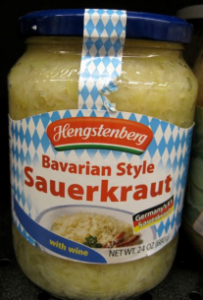 German-style sauerkraut with wine - photo by Jordan Wright Cabbage was thought to have originated in the Mediterranean regions where Egyptians raised altars to it, and Greeks and Romans believed it cured every disease from paralysis to pleurisy, including hangovers, a suggestion not to be ignored! In fact there are more myths and mysteries surrounding cabbages dating as far back as the third century B.C. Babies are said to have been found under the spreading leaves and we all know the fairy tale depictions of the stork in mailman’s cap, beak clamped down on a cloth sling wrapped around a newborn, and flying over the proverbial cabbage patch. Do Cabbage Patch Kids ring a bell?
Thomas Jefferson raised twenty-two varieties of cabbage in his magnificent gardens at Monticello. But his pride and joy was the Savoy cabbage. I’ll raise a toast to that! A more noble vegetable can hardly be found and I recommend it to the cook, as that is the preferred variety in Europe.
So enjoy your brassica oleracea capitata any way you prefer. One of my recipes, and the meat version of Madame Pourchot’s, follows.
CABBAGE AND GREEN APPLE SLAW
Chef Jordan Wright
1 ½ pounds of Savoy or green cabbage trimmed and shredded by knife into ¼ inch strips
2 Granny Smith apples, cored and thinly sliced or chopped
1 or more tablespoons of caraway seeds
1 cup of golden raisins or dried cranberries
¼ cup of chopped Italian flat leaf parsley
Sea salt and fresh cracked white pepper to taste
Make a vinaigrette of apple cider vinegar, honey and light olive oil or canola and a bit of lemon juice. Pour over slaw and refrigerate for an hour. Toss with parsley and serve cold with pork, duck, sausages or turkey.
MADAME POURCHOT’S SARMALE
1 large jar of pickled cabbage leaves * or one large head of cabbage plus one package of sauerkraut (half to place on the bottom of the pot and half over the top of the rolls)
1 pound each of ground pork, beef and veal from the farmers market
1 large onion, chopped
4 or more garlic cloves, minced
2 tablespoons each of thyme, oregano and parsley (less if using dried)
1 cup of rice, rinsed
2 tablespoons of Celtic salt
2 tablespoons of fresh cracked black pepper
1 large 28 oz. can of crushed tomatoes or, in summer, three cups of fresh chopped tomatoes, peel and all
* Pickled cabbage leaves are sold at the Cosmopolitan Grill on Route 1 south of Old Town Alexandria or the Russian Gourmet in Reston, Rockville, McLean and Alexandria.
Mix these ingredients together for the first stage.
Stuff into pickled cabbage leaves (or you can make your own). Take about a tablespoon of the mixture and place it into the cabbage leaf. Wrap the leaf around the filling, turning in the sides as you roll up, and place tightly together into a deep pot that has been prepared with oil and a layer of shredded cabbage and chopped bacon or ham. Line them up around the pot in layers. When you are done cover with additional shredded cabbage or sauerkraut (the sourer the better) and ½ cup of oil and bacon or ham and peppercorns, oregano and thyme. Cover and boil for two hours over low to medium heat.
Taste one and, if the rice is done, add the tomatoes and simmer over low heat, or in the oven without a lid, until the top caramelizes. Serve with sour cream or plain, thick yogurt.
Sarmale are the traditional dish for all holidays, especially Christmas. According to Madame Pourchot, the smaller the sarma the more skilled you are as a cook! “Poftat buna!” she says, Romanian for bon appetit!
For questions, comments or additional recipes contact Jordan@WhiskandQuill.com or visit www.WhiskandQuill.com.
Jordan Wright
The Georgetowner/Downtowner
October 2009
 Ayrshire Farm Manor House - photo credit Ayrshire Farm I recently received an intriguing invitation to judge a beef tasting competition at the magnificent Ayrshire Farm in Upperville, VA. Participating would be the American Livestock Breeds Conservancy, Humane Animal Care, Slow Foods USA, Chefs Collaborative and dozens of cattle ranchers, who brought their heirloom beef for the tasting, would be in attendance. It was all to be held at Ayrshire Farm, a picture perfect farm that is a working model for the sustainable breeding and natural raising of farm animals.
Ayrshire Farm, which prides itself on raising rare and endangered breeds on 800 rolling acres that most pigs, cows, turkeys and chickens could only dream of, is owned by Sandy Lerner, the co-founder of Cisco Systems, the networking systems giant. They employ strict organic farming methods and their livestock and vegetables are raised without hormones, pesticides or antibiotics. In 2004 they became the first farm in Virginia to meet Certified Humane Raised and Handled standards.
Although the trip fell on the same days as our tenth anniversary plans, we hoped to combine the two events. We were invited to overnight in the manor house a country mile from the two spots we wanted to revisit…the church where we wed, and Welbourne, a neighboring estate where our wedding party had stayed and celebrated on that memorable weekend.
So on a sparkling fall day with a suitcase full of nuptial reveries and a palate for beef, we set off from Alexandria to the foothills of the Blue Ridge Mountains to experience Ayrshire Farm as guests in this private home and connoisseurs of beef.
On our first evening we were hosted at the Hunter’s Head tavern in the town of Upperville. The pub serves delicious organic steaks, pork and chicken from the farm and authentic British pub fare like “bangers and mash” and “bubble and squeak”, and a not-to-be-missed dessert called sticky toffee pudding. Executive Chef Rob Townsend oversees the tavern, the Home Farm Store in Middleburg, a posh catering division called Home Farm Catering, and the myriad of events hosted by Ayrshire Farm and Lerner herself.
 Calico companions at Ayrshire Farm- photo credit Roy Wright We returned to the fieldstone manor under a starry sky and tumbled into an antique silk-draped bed with two affectionate calico cats as our companions…nuzzling and purring us to sleep. (The walls of the manor are covered with venerable American and English oil paintings of horses and other animals. A small hand crafted leather book placed bedside told the provenance of the charming feline portraiture in our bedroom.)
 Heritage cattle at Ayrshire Farm The following morning we toured the farm along with some of the ranchers and their spouses and viewed the pristine conditions under which the livestock are kept. We walked across fields where the endangered 13th century breed of Ancient White Park cattle and Scottish Highlands and Holsteins grazed contentedly, down lanes with hoop houses that held late-season tomatoes, past row upon row of newly planted winter vegetables, barns housing massive Shire horses and filled with antique carriages. The turkeys were as curious to see us as we them and they ratcheted up their barnyard cacophony as we went by. On another lane we saw mountains of rich, natural compost that any gardener would give their eyeteeth for, thirteen different breeds of chickens and some rare breed 19th century Gloucester Old Spot hogs with their suckling piglets. And a partridge in a pear…well, not really.
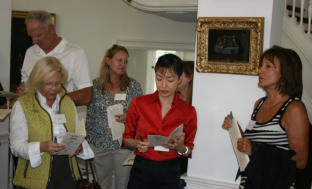 The judges deliberate - from left - Jordan Wright, Akiko Katayama and Nora Poullion - photo credit Roy Wright Back at the manor the tasting was set out and I met my fellow judges. Nora Poullion, a pioneer and champion of environmentally conscious cuisine in our area and who helped develop our area’s earliest farmers markets (In 1999 her eponymous Washington, DC, Restaurant Nora, became the first certified organic restaurant in America.) and Akiko Katayama, the pretty and petite judge from Food Network’s “Iron Chef America”. Katayama is a Japanese food writer and expert on the Japanese and American beef industries. She writes for 17 different outlets in her native Japan.
Selected New York strip steaks were prepared identically and small pieces were threaded onto skewers and placed in warming trays for the tasting. There was keen anticipation in the air as everyone filed into the grand dining hall. We judges went first, filling our plates with the secret numbered samples and retiring to the conservatory to deliberate on the beef’s merits or inadequacies based on flavor and texture. Most of the beef proffered was grass-fed, though Ayrshire Farm prefers to finish off the feeding cycle with grain for the last few months.
Some beef was too lean or earthy tasting, some chewy and some lacking tenderness. It was an interesting exercise but my hands down favorite was breed number three on my list of ten entrants. We returned with our findings to learn the name of the winner.
 Ayrshire Farm heritage Bronze turkey - photo credit Ayrshire Farm Visiting ranchers, who had sampled their own, as well as their competitors’ product, computed their findings. When the tally was in Ayrshire Farm’s Ancient White Park and Highland beef came out the over-all winners.
After a simple but lovely lunch beneath the portico and amidst late-flowering roses we enjoyed the fading light and conversation with our fellow guests. It was an uplifting experience to be in the company of these enlightened farmers who respect animals and how they are raised for our consumption. I met fellow concerned chefs who source local and organic food, humane butchers who sell only organically raised meats and poultry and founders and preservers of the sustainable food movement. And so it was with a renewed regard for the dedicated guardians of our food supply that we trotted down the road in celebration of our tenth year anniversary and our hope for the future of the American farm.
Ayrshire Farm has three breeds of heritage turkeys pre-brined and ready for Thanksgiving, Midget Whites, Bronzes and Bourbon Reds. You can pick them up at the Home Farm Store at the light in Middleburg or
online at the address below.
www.homefarmstore.com
www.huntersheadtavern.com
For Home Farm Catering contact: Rob Townsend
www.ayrshirefarm.com
www.certifiedhumane.org
www.slowfoodusa.org
For questions or comments on this article contact Jordan Wright or visit www.whiskandquill.com
By Jordan Wright
Published – LocalKicks.com
September 2, 2009
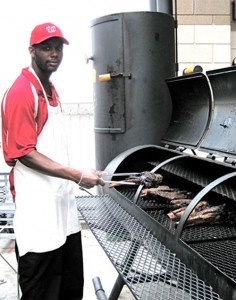 Photo by Jordan Wright/Local Kicks Our first stop was Teddy’s Barbeque, where all the meats are hickory smoked. Pulled pork, pulled chicken and beef brisket sandwiches compete with “The Rough Rider Rib,” a monster beef short rib prepared in true Carolina style…brined for 12 hours and then slow-smoked for another 12 hours.
Today’s ballparks have become strike zones with batting and pitching cages, food destinations, Build-A-Bear Workshops, sports arenas, PlayStation pavilions and baseball venues all in one.
Did I mention baseball? Yes, they have that too.
If you haven’t been to a game lately I highly recommend it. Sports fan or not, you’ll be a convert by the time the game’s over. It’s great for a family (very unlike the rowdy and often R-rated crowds at a football game) or whiling away an evening with a date.
I had a chance to sample the food at Nationals Park last week and it was a real eye opener. Professional chefs are creating some wonderful and imaginative stadium food…so delicious that people are showing up at the ticket office and buying the cheap seats ($5), just to get into the park, for some of this mouth-wateringly smokin’ food.
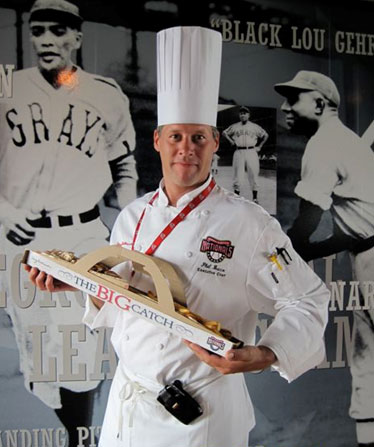 Photo by Jordan Wright/Local Kicks In earnest we approached the foot-long Crab Louie. At $18 a pop it may seem a little pricey until you realize that it’s all lump crabmeat. If you’re accustomed to the greasy $7 slices of pizza at FedEx Field, you are in for a complete overhaul of your sports venue mindset.
Unlike FedEx Field, which has private high-end ticket holder restaurants within the stadium for their club seat and sky-box patrons only, Nationals Park has fabulous choices for food all over the stadium. Most of these spots even have a direct view of the game with outdoor awning-covered seating or indoor and air-conditioned with a sight line enjoyed through sliding glass panels.
While FedEx offers in-seat service for their pricey club seat ticket holders, Nationals Park encourages all its guests to walk around and enjoy the game from a number of different viewing areas and to eat your way around the park. With so much to choose from it’s great fun to get there early and eat at your leisure.
Since it is necessary to have kid approval for ballpark food, my grandson, Jacob, a perpetually hungry 11 year-old, was recruited for the sake of this review.
Our first stop was Teddy’s Barbeque, where all the meats are hickory smoked. Pulled pork, pulled chicken and beef brisket sandwiches compete with “The Rough Rider Rib,” a monster beef short rib prepared in true Carolina style…brined for 12 hours and then slow-smoked for another 12 hours. I am challenging all readers to let me know if they have ever had better anywhere.
Did I mention the smoked corn on the husk, baked beans, slaw and potato salad sides? We are just getting started here.
In earnest we approached the foot-long Crab Louie. At $18 a pop it may seem a little pricey until you realize that it’s all lump crabmeat (Try making this at home. I priced a pound of lump at $33 today!), and four people could share this for a lovely lunch. Comes with extra crispy Old Bay seasoned french fries too.
Next we tried a Cuban sandwich that fit right into my “foodcation” concept. Skip the flight to Miami and cab to Calle Ocho, you can enjoy a “medianoche” right here.
We continued our street fair approach to dining with a stop at a recent addition, The Kosher Grill. Along with kosher hot dogs it features falafel, knishes and Middle Eastern shwarma. Are you still with me?
If you’re wistful for the annual summer Feast of San Gennaro, now in its 90th year, in New York City’s Little Italy (the sentiment always floods over me at this time of year), you couldn’t do better than to have the Italian Sausage sandwich here. It is one of my all-time favorites and they hit it out of the park…fennel-infused sausage, sautéed red peppers and onions, soft Italian roll and all.
 Photo by Jordan Wright/Local Kicks Did I mention the smoked corn on the husk, baked beans, slaw and potato salad sides? We are just getting started here.
In case you thought ballpark food was all hotdogs and peanuts, at this hip stadium they have healthy snack alternatives like veggie burgers, shrimp burgers, boxes of carrot and celery sticks, fresh fruit bowls, fruit smoothies and more. Makes a parent feel almost nutritionally religious taking the little ones to see a game.
Here you’ll find so many different locations to pause, eat, drink and watch the game you needn’t sit in your seat at all and some fans never do. At the Red Porch, a restaurant open to all ticket holders, they carry beer on tap from around the country…like Dogfish from Delaware, Bell’s Kalamazoo Stout from Michigan and Flying Dog Old Scratch Amber from Maryland to mention a few.
With different food from the rest of the park, this sit-down menu has everything from Bacon Blue Cheese Burgers and Quesadillas to Chinese Chicken Salad and Jerk Chicken Wings.
Not to miss dessert our adventure took us onward to two DC faves, Gifford’s Ice Cream and Edy’s Grand Ice Cream stands for a sweet treat. We both loved the park’s, made in Italy and shipped over fresh, Italian gelati. “One mocha chocolate chip, one strawberry, please.” Later we kept our cool with frozen lemonade. It just couldn’t get any better.
Kid verdict: a lot of lip-smacking, barbeque sauce finger licking, more than a few “Oh yeah, that’s what I’m talking about!” responses, juicy-cool refreshing fruit snack smiles and a big thumbs up for all the food.
By the way, the Nats crushed their opponents that day…9-2.
Email the writer at jordan@whiskandquill.com
By Jordan Wright
March 2009
A quick jaunt to Richmond this past weekend to meet our Virginia vintners and witness the Governor’s gold medal awards ceremony, delivered more than expected…so much more! New wineries medaled along with those who have been winning and garnering attention for years.
The three-day event featured a blind wine tasting with importer and famed wine critic and Bartholomew Broadbent who chose a Virginia wine to be compared with an import. Broadbent, named by Decanter Magazine as one of the “fifty most influential people in the wine world…the faces to watch in the new millennium”, was a most erudite host who guided the guests at this Sit-Down Reserve Tasting as they were asked to distinguish between the pair of wines and name their preference. After 12 wines were tasted the votes were equally split, proving that Virginia wines can and do stand up to the best from around the world, including those he selected from Germany, New Zealand, France and Portugal. Continue reading VIRGINIA WINE EXPO

By Jordan Wright
A splendid collection of vintners, savvy insiders, Washington oenophiles and a bona fide wine guru savored the grape at “A Taste of Virginia” wine event presented by Domasoteca and Domaso Trattoria on Oct. 29 at very posh Hotel Palomar in Rosslyn.
The event, a benefit for the Northern Virginia AIDS Ministry, drew those who know and appreciate their Virginia wines. Seven wineries from the Charlottesville/Monticello area were on hand including several of the very knowledgeable vintners themselves.
Hosting the event was Christianna Sargent, manager of Domasoteca, the wine shop and salumeria on the ground floor of the Palomar.
This destination shop, which bills itself as a “global wine experience,” provided the beautifully arranged table of fresh berries, international cheeses, “salumi” (cured artisanal Italian meats), and house baked breads that aided the tasters in their wine quest. Continue reading Restaurant Scene/ Getting a Taste of Virginia
|