Jordan Wright
April 10, 2014
Special to The Alexandria Times
 Photo credit to City of Alexandria staff The British are coming! The British are coming! It’s been 200 years since the British Royal Navy invaded the Port of Alexandria, but this time they’ll be here by invitation.
As event organizer and resident, Peter Pennington explains, “The festival really commemorates two things. The 1814 war, which was vital to the founding of the U. S as one country, and secondly the fact that enemies can become the firmest of friends!”
![Master and Commander: The Far Side of the World premiered in 2003 and received 10 nominations for Academy Awards, including best picture. It was directed and co-written by celebrated Australian director Peter Weir, famous for movies The Truman Show and Dead Poets Society. The movie was drawn from the 20-volume series of seafaring novels by Patrick OBrian, following the exploits of Captain Jack Aubrey [Russell Crowe] and his close friend, surgeon Stephen Maturin [Paul Bettany]. - Photo credit to 20th Century Fox, Miramax Films and Universal Studios](https://whiskandquill.com/wp-content/uploads/2014/04/commander.png "Photo credit to 20th Century Fox, Miramax Films and Universal Studios") Master and Commander: The Far Side of the World premiered in 2003 and received 10 nominations for Academy Awards, including best picture. It was directed and co-written by celebrated Australian director Peter Weir, famous for movies The Truman Show and Dead Poets Society. The movie was drawn from the 20-volume series of seafaring novels by Patrick OBrian, following the exploits of Captain Jack Aubrey [Russell Crowe] and his close friend, surgeon Stephen Maturin [Paul Bettany]. – Photo credit to 20th Century Fox, Miramax Films and Universal Studios To kick off Alexandria’s Bicentennial Commemoration of the War of 1812 organizers are holding a “Film Gala” in the newly restored Old Town Theater. The fundraiser, which will donate part of its proceeds to the Wounded Warrior Project as well as the British equivalent Help for Heroes, will begin with a cocktail reception to be followed by a screening of the Oscar-winning naval classic Master and Commander: The Far Side of the World starring Russell Crowe. A pre-screening discussion about the shooting of the film will include a talk by Kyle Dalton, who worked on the replica HMS Surprise, the 18 th Century Royal Navy frigate used in the movie. Special guest USMC Sergeant Brendan O’Toole, the 2007 T. C. Williams High School grad who recently ran 3,600 miles across the country to raise funds for the Wounded Warriors, will speak about the charity. On display will be some of the costumes from the film along with naval artifacts of the period that have been provided by local Alexandria museums.
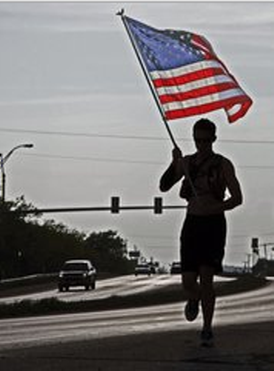 Alexandria resident Brendan O’Toole carries a U.S. flag during his run through West Texas in honor of the victims of the Boston Marathon bombing earlier – Photo by Tim Dwyer Now you might think after torching our Nation’s Capitol and burning down the Executive Mansion in 1814, then several days later storming Alexandria’s harbor and occupying our city, that we wouldn’t be particularly pleased to roll out the red carpet and hoist up the Union Jack for the British Royal Navy. But indeed we will. We have a good deal to be grateful for, not least of all that their soldiers didn’t burn down our city. That most of our historic buildings are still intact is due to a capitulation pact made between the invading British troops and Alexandria’s Common Council who reluctantly granted the marauders free rein to clean out the city’s storehouses of spirits, tobacco, armaments and tasty comestibles, taking with them twenty-one ships from our fair harbor.
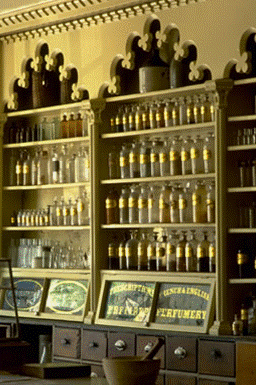 Edward Stabler sold to a variety of city and country residents – from Martha Washington to Robert E. Lee, the local doctor to the local farmer. The typical products Stabler sold included medicine, farm and garden equipment, surgical instruments, dental equipment, soap, perfume, Buffalo and Bedford mineral water, cigars, window glass, paint and varnish, artists’ supplies, combs and brushes. Much of the medicine he sold was created on-site, using plant and herb materials. – Photo Credit: Ben Fink Apothecary owner Edward Stabler, whose pharmacy still stands, described the surprise incursion like this, “Their conduct was respectful and decorous; and instead of that exultation and triumph which expands the heart of a soldier when he encounters and overcomes a force like his own, these [men] were evidently dejected and adverse to what they were doing.”
But they are not entirely off the hook. Ever since last December when an invitational challenge from Mayor Bill Euille was tendered to the British Royal Navy, the city has been planning a myriad of activities. Representatives of the British Defence staff, led by Royal Marine Major-General Buster Howes, CB OBE, will participate in the sporting events.
Throughout the spring and summer there will be lectures sponsored by the Alexandria Historical Society, boat tours on the Potomac, and living history events culminating with a large outdoor festival on the final weekend in August when both a cricket match and a yacht race under sail up the Potomac River will take place. The race will feature the captains of the British team competing against the Old Dominion Boat Club who will represent the city.
Some events are ticketed. To purchase tickets to the Film Gala visit https://shop.alexandriava.gov/ For information on all other events go to www.visitalexandriava.com/1812.
Jordan Wright
April 6, 2014
Special to The Alexandria Times
 Marcus How would you like to be a French gendarme? In Carol Wolf’s whirligig of a play The Thousandth Night, the audience is addressed as such by Guy de Bonheur, a hapless Frenchman separated from a roving troupe of performers and caught up in the web of World War II and the Nazi occupation of France. The production is the first of a duet of In Rep one-man shows at MetroStage and a celebration of its 30th anniversary.
It is 1943 at a railway station, 50 miles outside of Paris, and Guy is alone having lost his fellow performers to the clutches of the German officers. He is fighting for his life, trying to convince the local constabulary to let him board a train to spirit him away from the Nazis and the ultimate penalty – – a trip to a death camp. He carries a single suitcase filled with the troupe’s props.
The premise of this play is promising. Guy must convince the police he is a harmless actor, a man whose life’s work is only to entertain. But the Third Reich’s enforcers believe his work to be “subversive”, and that he is a saboteur. To convince them otherwise and gain his freedom he reenacts the troupe’s performances to the French police in hopes they will not turn him over to the authorities. To this end Guy performs 38 separate characters in a series of plays from the classic stories of “The Arabian Nights: Tales From a Thousand and One Nights”.
As Guy (Marcus Kyd) segues from donkey, to sultan to wife and baker, to hunchback, dead body and soldier in the first tale, he dons different hats and scarves in order to depict the separate characters. Unfortunately the pathos of the play is lost in schtick and campy banalities – talking hats as puppets and women speaking with a swishy effeminacy – the only drama a series of trains arriving at the station with ever more SS officers hunting down the “saboteurs”. The stories are stale and the characters trivialized, filled with goofy genies, doomed lovers and feisty sultans. Kyd tries his damnedest to pull it off, but it just doesn’t work.
Not even James Kronzer’s spectacular set design of a full-stage train station replete with dusty windows and period architecture, Alexander Keen’s clever lighting using searchlights and silhouettes of moving trains, or Robert Garner’s electrifying sound design, can bail this one out.
Through May 18th at 1201 North Royal Street, Alexandria, 22314. For tickets and information visit www.metrostage.org.
Jordan Wright
April 4, 2014
Special to The Alexandria Times
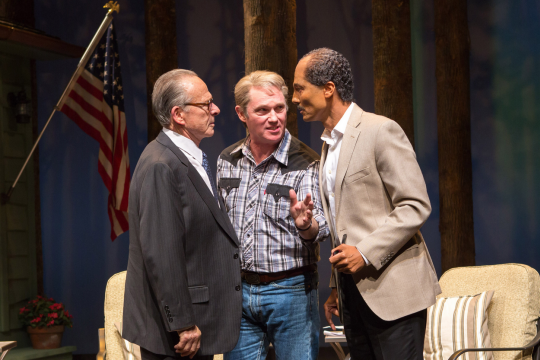 (L to R) Ron Rifkin as Menachem Begin, Richard Thomas as Jimmy Carter and Khaled Nabawy as Anwar Sadat – Photo by Teresa Wood. Theater history was made Thursday night at Arena Stage’s premiere of Camp David when former U. S. President Jimmy Carter and his wife, Rosalynn Carter, were in attendance. Little known is the fact that it has taken thirty years for TV Producer and former White House Communications Director in the Carter administration, Gerald Rafshoon, to convince Carter to give his permission to do this play.
Mideast History 101 – In September of 1978 Menachem Begin, Prime Minister of Israel, Anwar Sadat, President of Egypt, and Jimmy Carter met at Camp David, the presidential retreat in Maryland’s scenic Catoctin Mountains. For thirteen harrowing and contentious days and nights as the world waited with bated breath, the three men attempted to iron out a treaty to bring peace to the Middle East. It is important to note that the Camp David Accords have stood the test of time.
Camp David is playwright Lawrence Wright’s fictionalization of this historic meeting – an intellectual struggle for power wrapped in a clash of egos. A fourth character is present among the men, that of Rosalynn Carter (Hallie Foote) – – an important figure in the construct who brings Southern charm and levity to the play’s riveting tension.
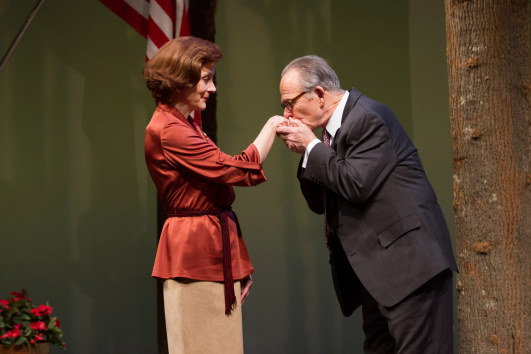 (L to R) Hallie Foote as Rosalynn Carter and Ron Rifkin as Menachem Begin – Photo by Teresa Wood. The production opens with a graphic video reminder of the four wars that raged between Egypt and Israel within a 30-year time frame. Using a combination of news footage and photos to depict the horrors of those wars and their subsequent effect on our oil prices as a result of Mid-East conflicts, serves to remind us of our investment in peace and stability in this tumultuous region.
Richard Thomas plays Carter. Thomas may perhaps, be best known for his long-running role as John-Boy in The Waltons. Since those days he has performed in dozens of film and television roles as a dramatic actor and can currently be seen on the much-acclaimed FX series The Americans. Thomas’ Carter is a spot on depiction of the folksy, homespun Southern politician with the instincts of a Coonhound treeing a possum. (Carter has since revealed that before the talks he had studied a weighty briefing on both Begin’s and Sadat’s personalities.) He was savvy enough to know when to press them and when to back off.
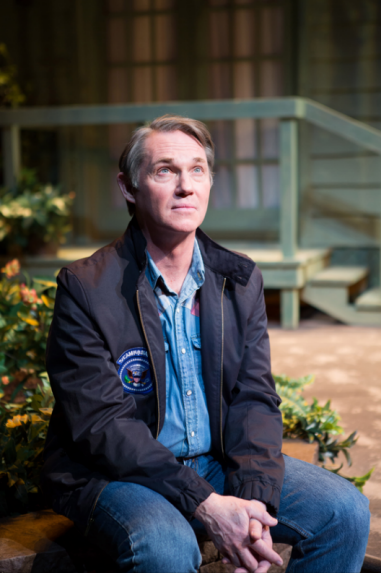 Richard Thomas as Jimmy Carter – Photo by Teresa Wood. Director Molly Smith shows a stroke of brilliance by casting one of Egypt’s leading actors, Khaled Nabawy, as Sadat. Nabawy plays him with a high-minded and sophisticated air. “Whatever you decide I will sign,” Sadat says agreeably. “I am flexible on everything except land and sovereignty.” Sadat has brought along a copy of the United Nations Security Council Resolution 242 that had been agreed to and signed in 1967. It called for Israel to retreat from occupied lands, compensate for lost properties, return natural resources, grant access to holy places, terminate Arab boycotts and sign a treaty on non-proliferation. Begin tears it in half. Carter insists he stick to it as the basis for their talks.
Begin (Ron Rifkin) proves to be as intransigent as a mule, quibbling over formalities and procedural points like a schoolboy. He doesn’t trust Carter or Sadat. “You have a way of turning words upside down,” Carter accuses him. But Begin is a tough negotiator, there to represent his people’s interests. “One third of all the Jews in the world were annihilated in my generation,” he says. And as each man calls out to his own God, Muslim, Jewish and Christian, for advice and succor, Carter reminds them, “The future doesn’t have to be like the past.”
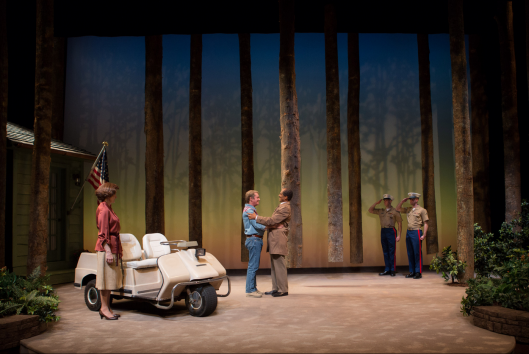 Hallie Foote as Rosalynn Carter, Richard Thomas as Jimmy Carter and Khaled Nabawy as Anwar Sadat with Will Beckstrom and Will Hayes – Photo by Teresa Wood. Set Designer Walt Spangler uses old-growth trees in a mountain setting with a rustic cottage off to one side. A drop section in the stage floor changes the scene, alternating between patio chairs and log-hewn garden benches, keeping the focus on the actors and the constantly shifting dynamics, while Lighting Designer Pat Collins uses sunrises and sunsets helps us to count the days.
Highly recommended.
Through May 4th at Arena Stage, 1101 Sixth St., SE, Washington, DC 20024. For tickets and information on performance times and dates call 202 488-3300 or visit www.ArenaStage.org.
Jordan Wright
March 31, 2014
Special to The Alexandria Times
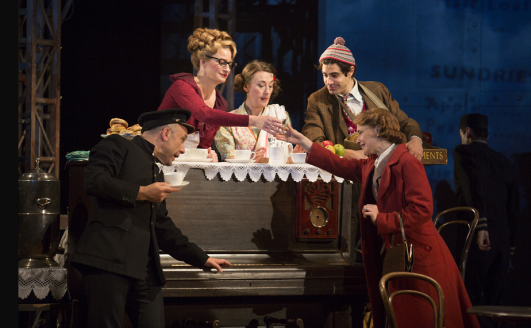 Hannah Yelland as Laura, Joe Alessi as Albert, Annette McLaughlin as Mrytle, Dorothy Atkinson as Beryl and Damon Daunno as Stanley in Kneehigh’s U.S. tour of Brief Encounter by Jim Cox Perhaps writer Noel Coward wouldn’t have conjured up this captivating version of his one-act play, but surely he would have swooned over it. Based on the 1945 film of the same name, Adaptor/Director Emma White has created an innovative and charming version that blends both film and theater mediums. Kneehigh productions, a Cornish theatre company, who have already garnered two Tony Award nominations for this touring musical takes the audience into the realm of the silver screen and the age of witty repartee Coward and his sophisticated coterie were known for.
The love story of Brief Encounter, determined in a recent poll by Britain’s The Guardian to be the most romantic of all time (beating out Gone with the Wind and Casablanca), involves three couples. Laura (Hannah Yelland), a wife with two young children takes the Thursday train into town to do her shopping while Alec (Jim Sturgeon), a country doctor takes the same train to do his once-a-week rounds at a city hospital. They meet and quickly fall in love when he offers to take a speck of coal dust from her eye on the station’s platform and their relationship blossoms with each week’s encounter.
Another romance is between the stationmaster, Albert (Joe Alessi), a cocky chap with eyes on Myrtle Bagot (Annette McLaughlin) the sassy tearoom’s manager, where much of the action takes place. The third liaison is between Myrtle’s assistant, Beryl (Dorothy Atkinson), a childlike sprite and Stanley (Damon Daunno), her ardent admirer, who is a candy vendor.
The action is underpinned with music, some from Coward’s own repertoire and other pieces, like a sweeping Rachmaninoff concerto to show how Laura and Alec are swept off their feet, from other sources. Each piece is intrinsic to the mood and serves to heighten the tension in the developing romances. Composer Stu Barker contributes several pieces of original music that subtly modernize the whole.
Projection & Film Designers Gemma Carrington and Jon Driscoll create a lovely vintage quality with black and white footage of train stations and dream sequences of crashing waves and underwater scenes, which the actors themselves often transition into by walking through a seam in the screen. In fact there are so many innovative choreographics, atmospherics by Malcolm Rippeth, and complex sound effects by Simon Baker that blur the line between reality and fantasy.
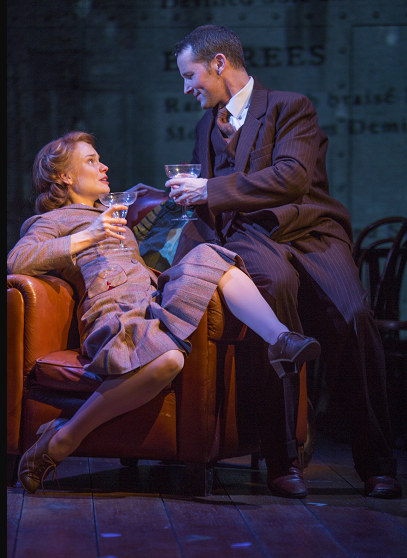 Hannah Yelland as Laura and Jim Sturgeon as Alec in Kneehigh’s U.S. tour of Brief Encounter by Jim Cox A particularly memorable moment in Laura and Alec’s romance is when they show their passion by swinging on chandeliers while film footage projected onto the backdrop shows falling stars, whirling planets and rising champagne bubbles. In another lively scene marked by Albert’s increasing bravado, he engages Myrtle with a bit of “slap-and-tickle” to the audience’s great delight.
Costume Designer Neil Murray cleverly adds touches of painterly red – – a velvet coat, Beryl’s pumps, Myrtle’s dress, Stanley’s vest, a red rose – – to accentuate the drably colored world of British tweeds.
In a scene where Laura and Alec are hoping to consummate their love, a musician strums a ukulele singing “Go Slow, Johnny”, a haunting ballad from Coward’s songbook and one of the highlights of this tender, hilarious and extraordinarily original show.
Highly recommended.
Through April 13th at the Lansburgh Theatre, 450 7th Street NW, Washington, DC 20003. For tickets and information contact the Box Office at 202 547-1122 or visit www.shakespearetheatre.org.
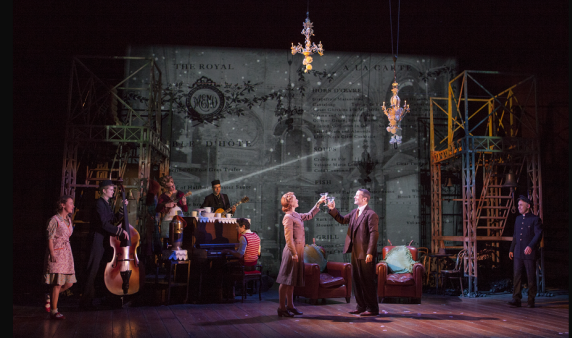 The cast in Kneehigh’s U.S. tour of Brief Encounter by Jim Cox
Jordan Wright
March 23, 2014
Special to The Alexandria Times
 Laura C. Harris and Elan Zafir – photo credit Teresa Wood. Two characters known as “Man” and “Woman” are the sole performers in this complex and powerful drama by British playwright Philip Ridley. It is both a love story of two young Londoners who have experienced an extraordinary loss, and a hypothetical time warp deep into the heart of a relationship fraught with all the perils and passions of youth.
The East Enders meet at a lavish party in the grandiose gardens of a spectacular mansion where their courtship unfolds in a relatively straightforward fashion. But as Director Matthew Gardiner foreshadows in his introduction to the play, “To be in love with another person is to feel a wide range of emotions: enchantment, ecstasy, animosity, fear and doubt.” Ridley uses intense physicality and a made-up fantasy language to convey all of these conflicting emotions in Tender Napalm.
Elan Zafir, who has a huge almost superhero physicality, plays Man to Laura Harris’s sylph-like Woman – – a deliberate choice that depicts the lovers as not only emotionally opposite but physically opposite as well. But it’s not a competition of brawn over beauty, our heroine is just as intense and savvy an opponent as her lover.
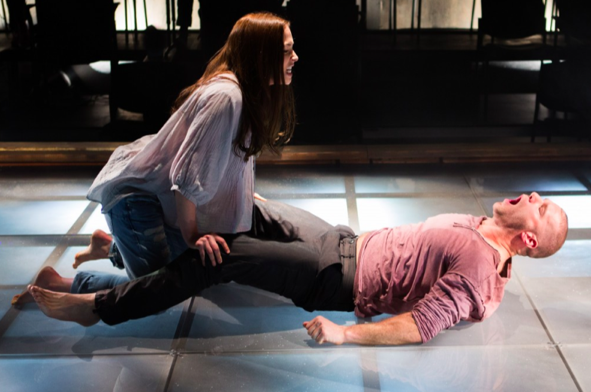 Laura C. Harris and Elan Zafir – photo credit Teresa Wood. The play is presented in snippets and flashbacks of their relationship. In one bumbling effort to express his desires Man tells Woman, “I could squeeze a bullet between those lips,” a crass sentiment later co-opted by Woman, who suggests a hand grenade to achieve the same effect. Calling her ”my muse” and expressing his love he tells her, “I’d like to be a tree full of doves pushing my branches around you.” She responds by referring to him as “my snare” and blowing him off. Push and pull. Back and forth.
In their drive to establish their separate identities and assert their dominance over the other, Woman invents a desert island where she is Queen of the Monkeys. She threatens Man telling him the monkeys will do her bidding to establish her power. Not to be challenged, Man counters with the same desire to be in charge and they fight over who rules their fantasy island – – each looking to gain the upper hand.
The play is seeded with symbols – – a cave where Woman can control Man, unicorns as escapism, UFOs as the unknown, and a man-eating sea serpent to represent the concept of death and rebirth. Ridley portrays Man as the conqueror, an unrelenting warrior, protector of Woman and slayer of the serpent. While Woman uses her powers as controller, consoler and arbiter in the battle of the sexes. In one scene Man tells her of imaginary aliens who abduct him, claiming it is not in their DNA to kill. They give him a spaceship filled with atom bombs and he regales Woman with his courageousness. “Bombs away! I’m killing everything I see,” he brags to her rat-a-tat-tatting his way around the stage.
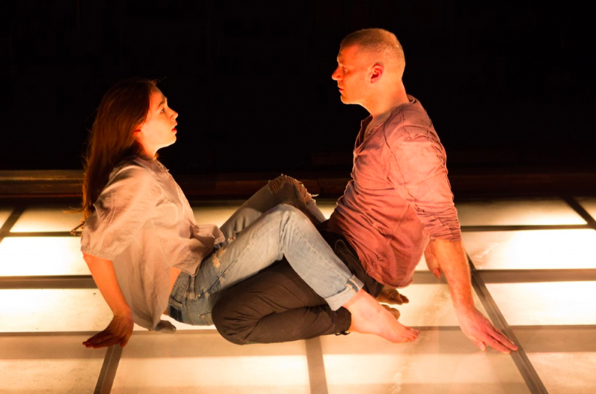 Laura C. Harris and Elan Zafir – photo credit Teresa Wood. Yet the play has deeply affecting moments of tenderness and surrender when the lovers step away from their egos and submit to one another. Sounds of explosions, earthquake rumblings and the screech of a futuristic rewind help to reset the action as the lovers’ emotions swing wildly from love and lust to hate and envy. But ultimately it is the force of Ridley’s extraordinary play performed by two brilliant performers’ on a simple stage with no props and no scenery that captivates.
Raw, erotic and riveting. It is a must see.
Through May 11th at Signature Theatre (Shirlington Village), 4200 Campbell Avenue, Arlington, VA 22206. For tickets and information call 703 820-9771 or visit www.signature-theatre.org.
Jordan Wright
March 23, 2014
Special to The Alexandria Times
 Ann Randolph in Loveland at Arena Stage at the Mead Center for American Theater. Photo by Teresa Wood. Welcome to the wonderfully wacky world of Frannie Potts. You’ll meet her in Loveland at Arena Stage as part of the Kogod Cradle Series for American Voices.
Frannie is a “thought bubble” come to life, a woman who actually verbalizes the socially unacceptable things we think but are conditioned by society not to say out loud. Her ADHD is cringe-worthy. She’s the crazy lady with no filter – – the one shouting out her philosophy of the world to strangers – – the one we dismiss. In writer/performer Ann Randolph’s Loveland we enter the world of Frannie Potts in her hilarious one-woman show.
On a stage set with a single chair and a shopping bag containing a few props, we find Frannie seated on a plane on her way from LA to the Midwest for her mother’s funeral. In Frannie’s world “dead” is dead – not “passed away” or “gone”. She brooks no euphemisms and no platitudes, and we love her all the more for it.
In a series of flashback portrayals, Randolph takes on the identities of a number of characters, not least of all her irreverent chain-smoking mother, a wisecracking pistol of a woman who delights in egging her daughter on.
Randolph also channels the pilot, whom she fantasizes about; a stereotypically snooty flight attendant; her seatmates, who are none to pleased to listen to her ramblings; a condescending funeral home saleswoman; a smarmy nursing home administrator; and a sanctimonious yoga instructor named Shanti. None are spared Frannie’s sharp-tongued, sharp-eyed, invariably outraged, retorts. If you’ve ever enjoyed the screwball humor of Erma Bombeck, Ruth Buzzi or Lily Tomlin, the satirical black humor of British comedies like The Wrong Box or The Loved One, or the wry wit of Fran Lebowitz, Loveland is certain to rattle all your funny bones.
In one of the skits Frannie tries frantically to reach her mother at the Crane Lake Country Manor, a nursing home with, you guessed it, no cranes and no lakes. The irony of it all is compounded when she is subjected to the “on hold” strains of Mozart’s Requiem Mass for the Dead.
Randolph has created Frannie, a hugely sympathetic character, with depth and dimension, and she does it with floor-dropping humor.
Highly recommended.
Through April 2nd at Arena Stage, 1101 Sixth St., SE, Washington, DC 20024. For tickets and information on performance times and dates call 202 488-3300 or visit www.ArenaStage.org.
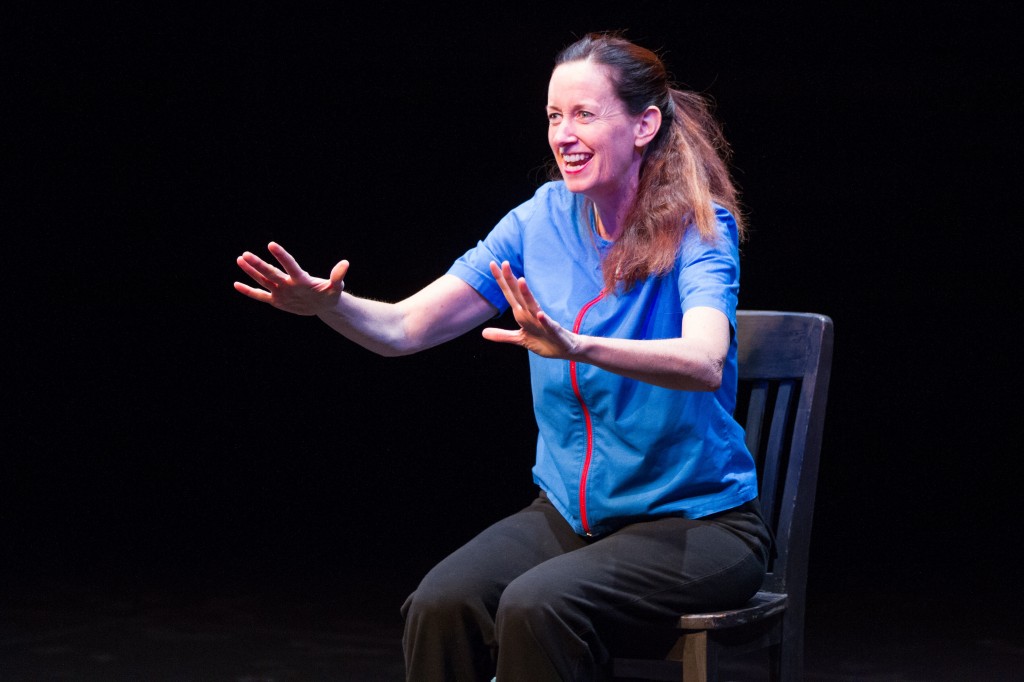 Ann Randolph in Loveland at Arena Stage at the Mead Center for American Theater. Photo by Teresa Wood.
|