Jordan Wright
April 25, 2016
Special to The Alexandria Times
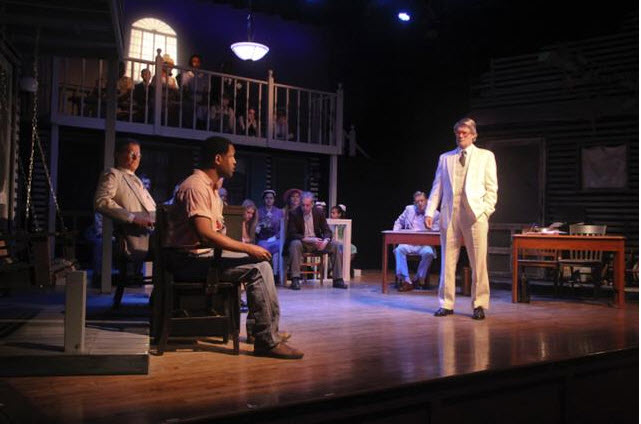 Richard Fiske (Atticus) and Larry Boggs (Tom Robinson) – Photos by Matt Liptak It’s been fifty-six years since Harper Lee’s classic To Kill a Mockingbird was published and less than one year since its re-conceived version Go Set a Watchman hit the bestseller lists to a flood of controversy. Much has changed since 1960. Or has it? A quick glance at today’s headlines reveal that bigotry, the murder of unarmed Black men, and racial intolerance continue unchecked both on the streets and in certain presidential campaigns. Given the current political climate and the emergence of the Black Lives Matter movement, it is particularly timely that we find opportunities to re-examine the role of racism in America. And how better to revisit these issues than with this cautionary tale? To that end LTA’s Producers, Rachel Alberts, Bobbie Herbst and Robert Kraus, have chosen well to select Frank Pasqualino to direct this well-crafted and impressively cast production.
As you may recall, the story, narrated on stage by Jean Louise “Scout” Finch as Scout thirty years later (Melissa Dunlap), is set in a small town in the Deep South, where Jim Crow laws were still firmly set in stone. Black families lived on one side of town and whites, another.
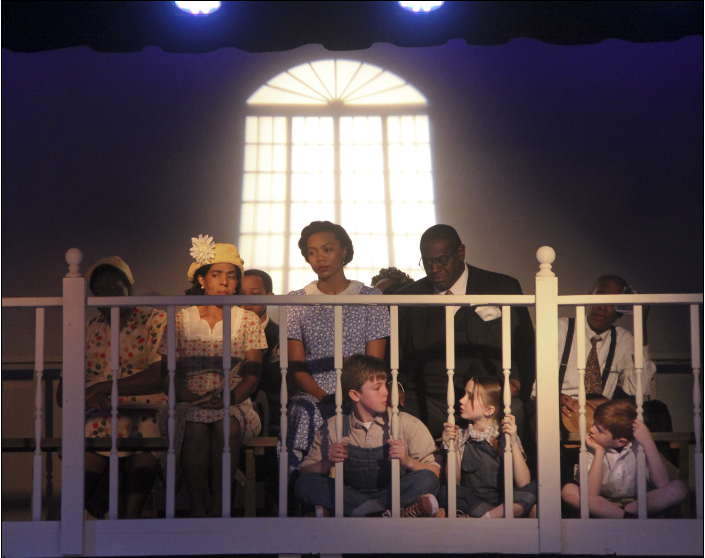 Courtroom scene with cast. Photos by Matt Liptak Atticus Finch (Richard Fiske), a liberal lawyer in a town of bigots, nosy parkers and those best described as adherents to the Klan, is a wise and calming presence in an otherwise lightning hot moment in time. His young daughter, Scout (Olivia McMahon), is an outspoken child with a wealth of curiosity about everything, especially the peculiar nature of prejudice and intolerance. Her slightly older brother Jem (Jack Kearney) does his best to keep her innocent queries in check as does their trusted housekeeper, Calpurnia (Brenda Parker), who cares for them with a no-nonsense attitude and a guiding hand.
When their young friend, Dill (Nathaniel Burkhead), comes from Mississippi to live with them their world grows a little larger and their adventures a little bolder. As they roam the town together the children become targets of racist slurs about their father, who is defending a field hand against the rape of a white woman. Atticus urges them to turn the other cheek. “If you want to understand someone, you gotta walk around in their skin,” he cautions them.
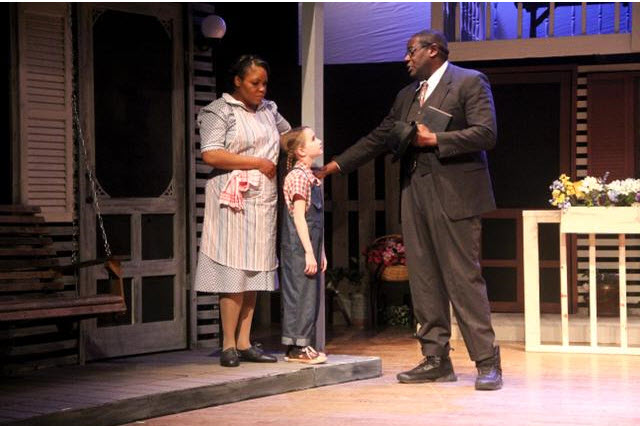 Brenda Parker, Olivia McHahon and Richard Fiske. Photo by Matt Liptak The first act explores their small family, the mysterious “Boo” Radley (Derek Bradley), an elusive neighbor who’s been holed up in his house for thirty years, and their relationships to the townspeople of Maycomb, setting the stage for the trial, and attempted railroading, of Tom Robinson (Larry Boggs) that unfolds in Act Two. The townsfolk present a polyglot of opinions on race – those that are educated and liberal, those of the hardworking Black families, and, in sharp contrast, their antagonists who are White, poor, uneducated and bigoted. Bob Ewell (Paul Donahoe), Tom’s accuser, and his daughter Mayella, the presumed victim (Skye Lindberg), fall into the category of the latter.
The trial and its aftermath are the most gripping aspects of this story. It is here in a small, segregated courtroom that the viciousness and brutality of racism is revealed in the cold, harsh light of day.
An excellent cast delivers humor and pathos with brilliance and dignity. Especially outstanding are Olivia McMahon, Brenda Parker, Richard Fiske, Paul Donahoe, Tony Gilbert as Judge Taylor, and Skye Lindberg.
Highly recommended.
Through May 14th at The Little Theatre of Alexandria, 600 Wolfe Street. For tickets and information call the box office at 703 683-0496 or visit www.thelittletheatre.com
Jordan Wright
April 19, 2016
Special to The Alexandria Times
As a former BBC comedy writer, award-winning playwright and graduate of Showtime’s Masters of Sex, Bathsheba Doran can turn a phrase as merrily as she can turn the screw – so it’s no surprise that her tightly crafted dramedy gifts an audience with two plus hours of solid laughs. Director Stella Powell-Jones, a veteran of numerous, stellar Off-Broadway productions, knows precisely where and how to take us on this bumpy ride, affectionately described in the playbill as a “love story”.
 Shayna Blass (Charlotte) and Xavier Scott Evans (Jonny) in The Mystery of Love and Sex. Photo by Margot Schulman. In The Mystery of Love and Sex Doran offers up four angst-riddled characters for comedic dissection. Charlotte and Jonny are recent college grads on the cusp of nowhere. That they are besties since childhood is revealed, but what they struggle with is if a lifelong friendship translates to marriage. Lucinda (Emily Townley) and Howard (Jeff Still), Charlotte’s parents, hope so, and though their own marriage is on the rocks they have buckets of encouragement for the young couple who share everything but a bed.
 Jeff Still (Howard), Xavier Scott Evans (Jonny), Emily Townley (Lucinda) and Shayna Blass (Charlotte) in The Mystery of Love and Sex. Photo by Margot Schulman. Jones takes us on a journey led by stereotypes, a liberal New York Jewish intellectual writer father, Howard, and his genteel southern Christian wife, Lucinda, fondly called ‘Lulabelle’. As mundane as that seems on the surface, it provides the anchor to a story that takes us far beneath what may be superficially assumed.
Jonny (Xavier Scott Evans), an English Lit major, and Charlotte (Shayna Blass) are not your average young couple beaming with the promise of the future and following a predictable path to parenthood. They have issues. Tons, as we soon see. Those involve, but are not limited to, race, sexuality, religion and jealousy. Hot topics and even hotter wellsprings for situational comedy. And in this age of torturous self-examination and serial introspection, they are in no way assured a shared future.
 Xavier Scott Evans (Jonny) and Shayna Blass (Charlotte) in The Mystery of Love and Sex. Photo by Margot Schulman. In their exploration of an honest relationship, the pair alternately mock and comfort each other, seeking a scapegoat for their insecurities. There’s a moment when Charlotte strips naked and offers herself up to the virginal Jonny. “We are in love, Jonny. We should get married,” she implores. But Jonny has secrets, and Charlotte is still trying to puzzle out her own. Confessing his newly discovered sexuality to Charlotte, Jonny reveals his dilemma. “It’s like ear wax. It’s in so deep you don’t know it’s there, but it makes everything fuzzy.”
 Emily Townley (Lucinda) and Shayna Blass (Charlotte) in The Mystery of Love and Sex. Photo by Margot Schulman. It could prove maudlin, but assuredly it is not, especially as other people’s neuroses are a sure passage to the funny bone, and dysfunctional families have become comedic fodder for tweaking millennials.
 Xavier Scott Evans (Jonny) and Shayna Blass (Charlotte) in The Mystery of Love and Sex. Photo by Margot Schulman. When Howard tries to keep them together despite their differences he explains to Jonny, “Life is weird. Look at a fish.” Lucinda has her own issues. In trying to combat the stress of her family and quit smoking at the same time, she she snaps her fingers and blows into the air – an oft-repeated response delivered in delicious deadpan by Townley. There are scads of scathing one-liners and enough personality quirks to sentence the lot of them to a lifetime on a psychiatrist’s couch. But those are the funny bits, skillfully delivered by a fantastically confident, gleefully quirky, utterly lovable cast.
 Emily Townley (Lucinda) and Xavier Scott Evans (Jonny) in The Mystery of Love and Sex. Photo by Margot Schulman. Highly recommended with a caveat. Wear loose clothing, lest you burst your buttons.
Through May 8th at Signature Theatre (Shirlington Village), 4200 Campbell Avenue, Arlington, VA 22206. For tickets and information call 703 820-9771 or visit www.sigtheatre.org.
Jordan Wright
April 11, 2016
Special to The Alexandria Times
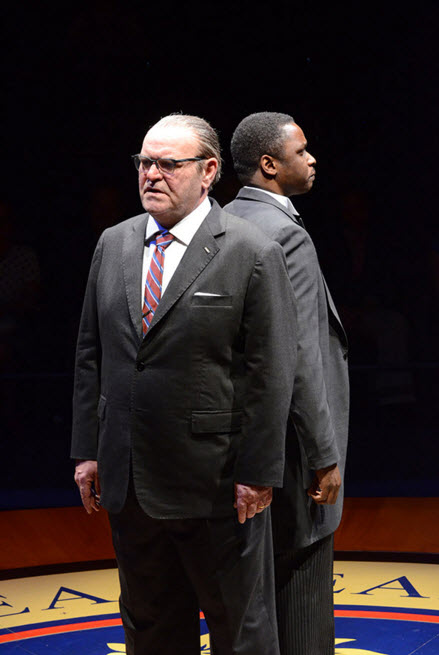 (L to R) Jack Willis as President Lyndon Baines Johnson and Bowman Wright as Martin Luther King, Jr. Photo by Stan Barouh. Robert Schenkkan’s exhilarating play, All the Way, allows us to step into the very large Texas boots of our 36th President. Set between November of 1963 and November of 1964, it is set in the time of Lyndon Baines Johnson’s sudden and untimely ascension to the presidency and his efforts toward passage of the Civil Rights Act of 1964.
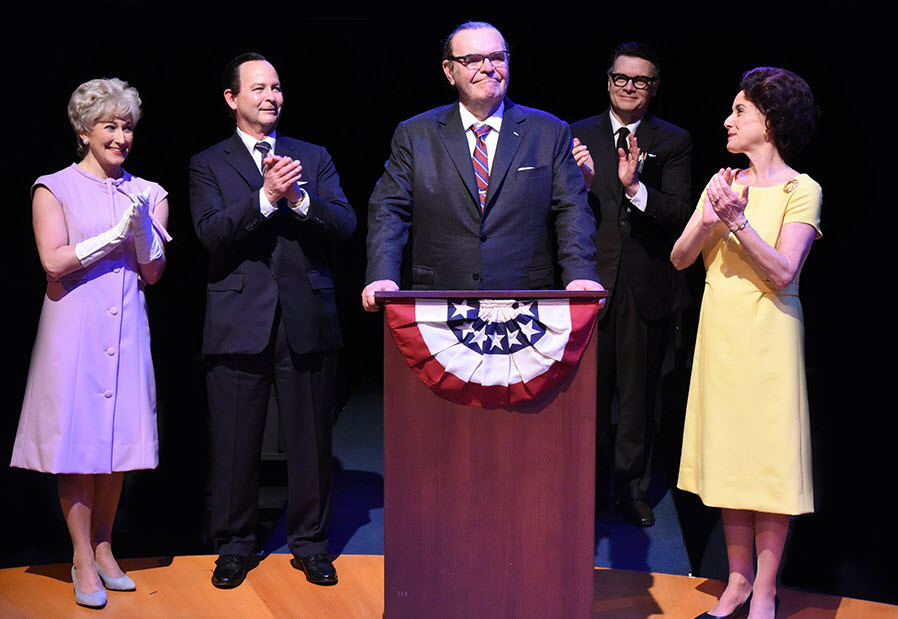 (L to R) Adrienne Nelson as Muriel Humphrey, Richard Clodfelter as Hubert Humphrey, Jack Willis as President Lyndon Baines Johnson, John Scherer as Walter Jenkins and Susan Rome as Lady Bird Johnson. Photo by Stan Barouh. All the pivotal players of the period are represented and the cast adopts many roles in filling in for the lesser characters. Jack Willis offers up a formidable LBJ, strident, bullying, oftimes terrifying yet indelibly effective, larger-than-life president at the peak of his powers. Then there’s Lady Bird (Susan Rome), Walter Jenkins (John Scherer), George Wallace (Cameron Folmar) and his wife Lurleen Wallace (Adrienne Nelson), Richard Clodfelter as Hubert Humphrey, Richmond Hoxie as the slithery, red-baiting J. Edgar Hoover and Stephen F. Schmidt as his henchman Cartha DeLoach, David Bishins as Defense Secretary Robert McNamara and Tom Wiggin as Stanley Levison, the white civil rights activist.
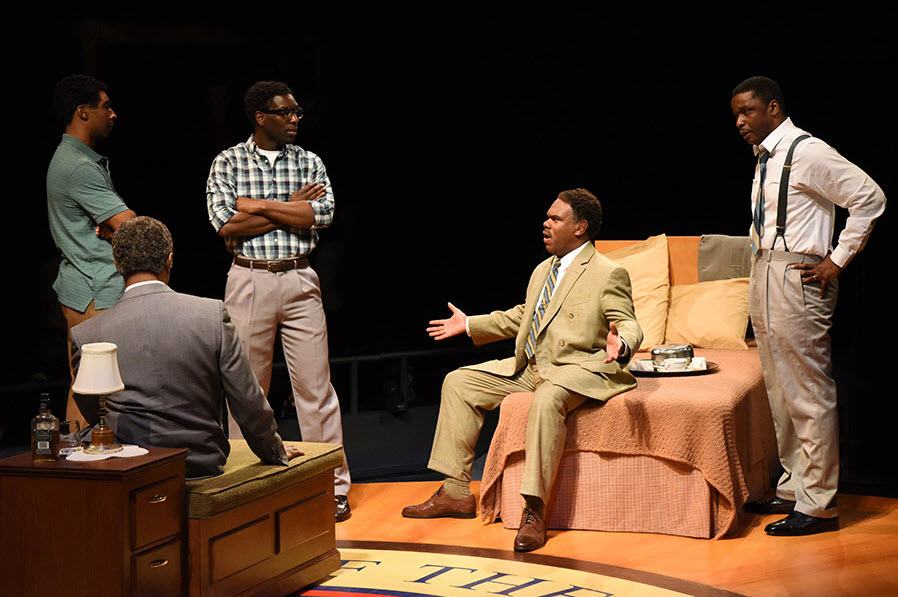 (L to R) JaBen Early as Stokely Carmichael, David Emerson Tony as Roy Wilkins, Desmond Bing as Bob Moses, Craig Wallace as Ralph Abernathy and Bowman Wright as Martin Luther King, Jr.. Photo by Stan Barouh. Pitted against the lawmakers, influence peddlers and power brokers were those black Americans who had been lobbying tirelessly for voting rights and anti-discrimination laws. Maintaining peace between the activists, the protesters and church representatives were Martin Luther King, Jr. (Bowman Wright), NAACP leader Roy Wilkins (David Emerson Toney) and Ralph Abernathy (Craig Wallace) who kept the younger, more outspoken SNCC student activists, led by Stokely Carmichael (Jaben Early) and Bob Moses (Desmond Bing), from squandering an opportunity to change the course of history. Shannon Dorsey becomes an integral part of this flawless cast as Coretta Scott King.
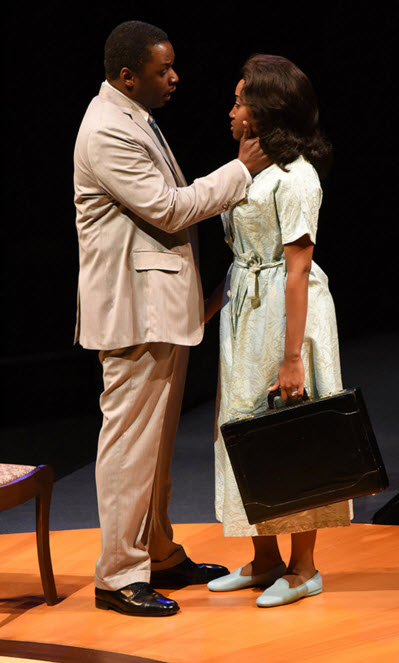 (L to R) Bowman Wright as Martin Luther King, Jr. and Shannon Dorsey as Coretta Scott King. Photo by Stan Barouh. There are so many knock-out performances to chronicle, but most memorable are LBJ, MLK, Lady Bird and Wallace, whose stump speech echoes a few of today’s presidential candidates and will throw chills up your spine.
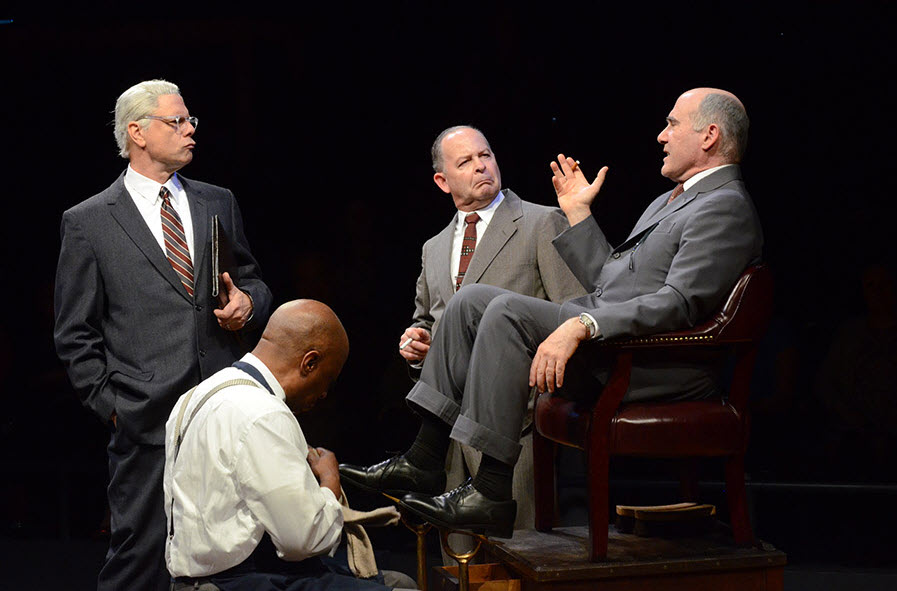 (L to R) Stephen F. Schmidt, David Emerson Tony, Richard Clodfelter and Lawrence Redmond. Photo by Stan Barouh. Under Kyle Donnelly’s superb direction this groundbreaking production emerges as a riveting tale of back door dealings, arm-twisting, personal threats and bullying, ameliorated by a hefty dose of schmoozing, drinking and ego-stroking in the Oval Office. LBJ made it his business to find everyone’s Achilles’ heel and capitalize on it, even brutalize it if he needed to. As to succeeding at passing the Civil Rights Act, he declares, “I’m gonna out-Roosevelt, Roosevelt!” The story presents Johnson warts and all – from Southern charm and foul language to his innate political savvy.
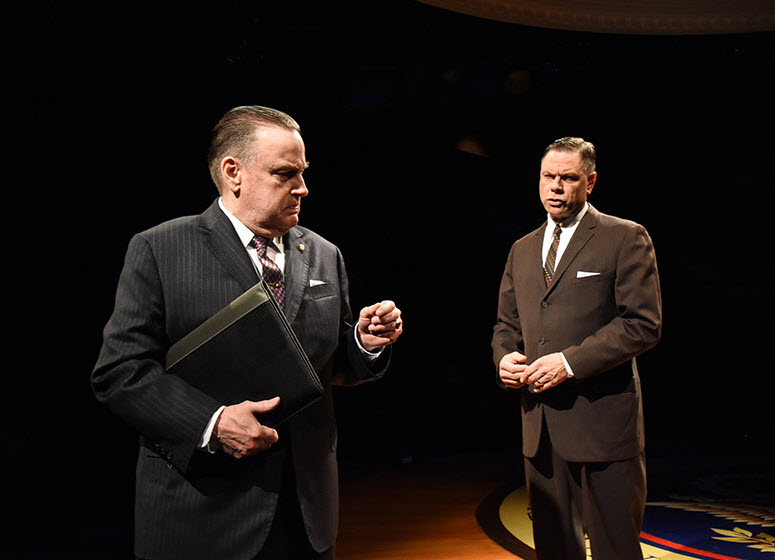 (L to R) Richmond Hoxie as J. Edgar Hoover and Stephen F. Schmidt as Cartha “Deke” DeLoach. Photo by Stan Barouh. No interaction between the characters is stagnant with Set Designer Kate Edmunds’ rotating presidential seal depicting the Oval Office. Players step on and off, circulating, converging and dispersing. It is hugely effective lending an intense and immediate energy. Less effective are the multiple TV screens above the stage, so compelling is the action on stage.
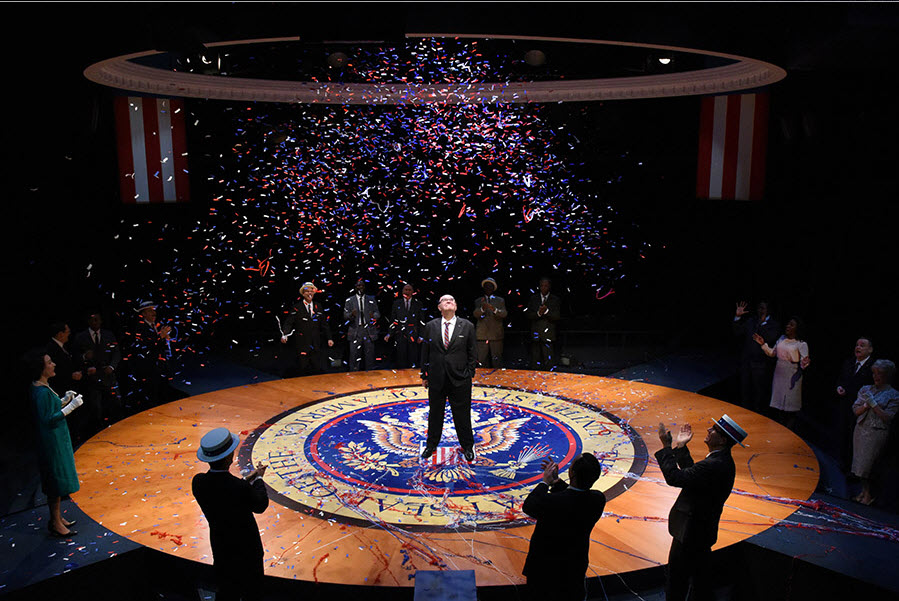 Jack Willis as President Lyndon Baines Johnson and the cast. Photo by Stan Barouh. When at last the bill sees passage after all Johnson’s wrangling, he admits, “There’s no gracious losers. There’s no sore losers – just the walking dead.” There’s a whiff of the Gulf of Tonkin incident, a memorable speech by civil rights leader Fannie Lou Hamer, and a dramatic turn in recalling the tragedy of the three murdered students, killed while trying to register black voters registered in Mississippi.
Highly recommended. (N. B. There is a wealth of salty language, inappropriate for children.)
Through May 8th at Arena Stage, 1101 Sixth St., SE, Washington, DC 20024. For tickets and information call 202 488-3300 or visit www.ArenaStage.org.
Jordan Wright
March 29, 2016
Special to The Alexandria Times
Israeli playwright Motti Lerner’s world premiere production, After the War, is set in the two weeks following the end of the Second Lebanon War which began in July 30, 2006 following an airstrike by the Israeli military on Lebanon’s Hezbollah. A time of fear, vulnerability and ambiguity by both sides, it hardly mattered who cast the first stone, since good fences don’t necessarily translate into good neighbors, and war comes easier to these eternal enemies.
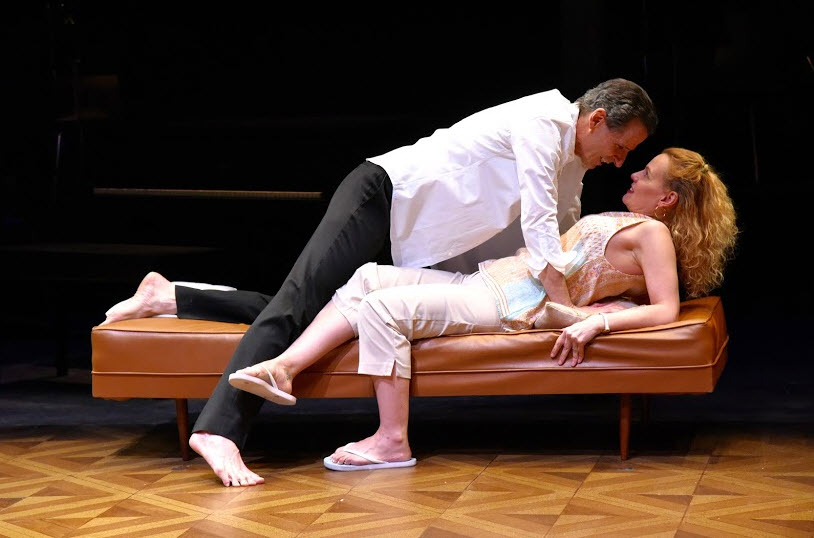 Paul Morella as Joel and Tonya Beckman as Trudy in After. Photo by Stan Barouh. For Joel (Paul Morella), a world renowned concert pianist, it’s his duty as an artist to speak out. Unfettered by his country’s jingoist politics, he takes a broader view of war’s toll on humanity, speaking out to anti-war and human rights groups to draw attention to the suffering of those affected – even if it is against his own country. In this instance he agitates for aid for the Lebanese orphans – a political position unimaginable in Israel. “The person is also his conscience,” Joel insists.
When he returns after 18-years to make amends to his family for his absence, he is received as a traitor. Joel has returned to give a concert to raise funds for the orphans and they are determined to undermine it. Living in Tel Aviv they have endured the wrath and excommunication of neighbors and a government that condemns Joel’s outspoken beliefs. His brother Freddie (James Whelan) has had his business destroyed and his son Izzy (Guy Kapulnik) has fought in this war and hold an entirely different view based on their war zone experiences.
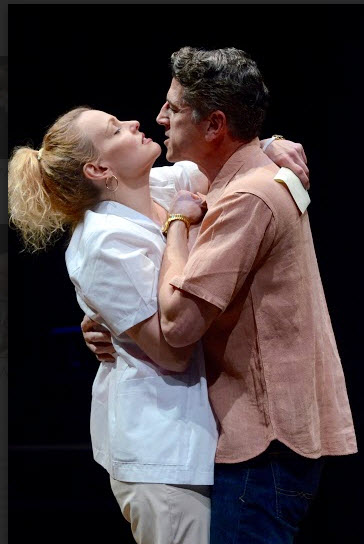 Tonya Beckman as Trudy and James Whalen as Freddie in After the War. Photo by Stan Barouh. With all the elements of a Greek tragedy that pits brother against brother, mother (Barbara Rappaport) against son, and son against his own son, the story reveals the conflict burning within as each betrays Joel. It is described in a press release as such, “The play speaks of the artist’s responsibility in an embattled society and illustrates the entrenched divisions between elite cultural purveyors and working class pragmatists; between right-wing and left-wing Israelis: and be extension, between conservative and liberal forces in a divided American Jewish community.”
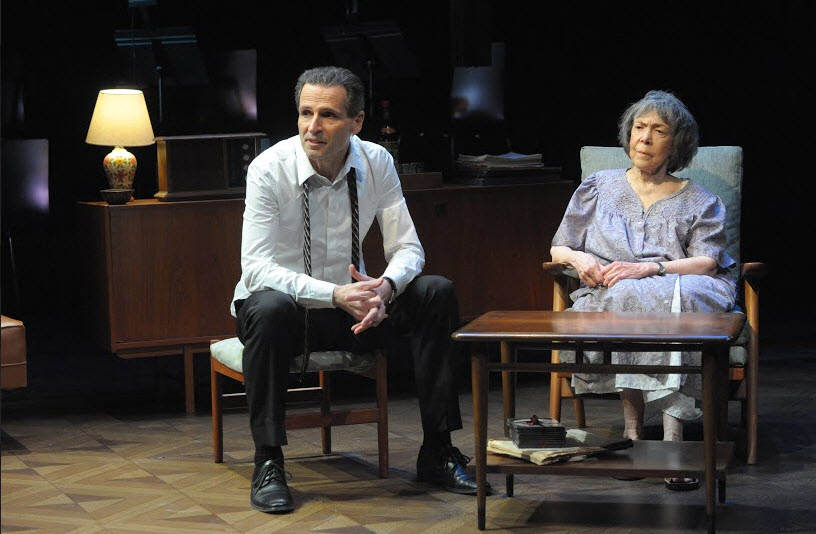 Paul Morella as Joel and Barbara Rappaport as Bella in After the War. Photo by Stan Barouh. At times Director Sinai Peter’s staging seems over-dramatized, but there is raw passion at hand and a fierce commitment to tell a story of how a family’s faith in one another can be destroyed by war. Bear in mind too that Lerner, who describes this play as autobiographical, cannot mount this play in his own country where free artistic expression is challenged by the right-wing government.
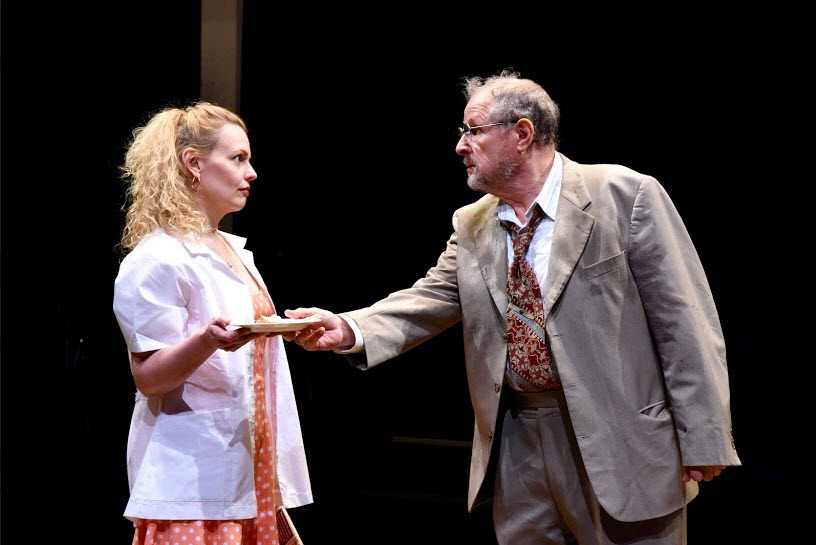 Tonya Beckman as Trudy and Michael Tolaydo as Bernard in After the War. Photo by Stan Barouh. An exceptional cast puts this play on the must-see list.
Note: This week Mosaic Theater Company announced an extraordinary one million dollar grant from the Reva and David Logan Foundation, allowing the two-year old company to continue to present its series of groundbreaking plays.
Through April 17th at the Atlas Performing Arts Center, 1333 H Street, NE, Washington, DC 20002. For tickets and information call 202 399-7993 ext. 2, or visit www.MosaicTheater.org.
Jordan Wright
March 21, 2016
Special to The Alexandria Times
 Photo by Ben Gibb, courtesy Headlong George Orwell’s classic dystopian tale is as relevant today as it was when it was written in 1948. We don’t call them the “Thought Police” today, but the concept of controlling the thoughts and behavior of the masses by government through the media, the message (cue Marshall McLuhan) and mind control still has an eerie, somewhat familiar, ring to it. We saw it recognized in The Eternal Sunshine of the Spotless Mind, a film about erasing memories; The Truman Show where hidden cameras were used to track thoughts; and in the film adaptations of The Hunger Games books.
In this version of 1984 Directors/Adaptors Robert Icke and Duncan Macmillan construct an imaginative theatrical retelling of the book – further intensified by Video Designer Tim Reid’s haunting projections and film sequences shown in wide screen above the actors. The combination of the filmed offstage events and in-the-moment onstage acting, serves to confuse the viewer as to what is real and what is imagined – the very same question protagonist Winston Smith ponders about his life. For the audience it’s equally as chancy to draw any conclusions. To add to the complexity, the plot swings back and forth like a pendulum, from World War II to 2050. It is both evocative and immediate, making for a most exciting piece of stagecraft.
 Photo by Ben Gibb, courtesy Headlong Winston (played by the extraordinarily talented Matthew Spencer) works in the Ministry of Truth. Under the radar, he keeps a diary for the “future unborn”. In it he hopes to record his memories and thoughts before they are discovered, deleted and denied by Big Brother – the all-seeing, all-knowing, government agency charged with the destruction of language and memory and the obliteration of newspaper accounts and photographic evidence. In this way personal memory is supplanted by government approved memory. Citizens are kept in constant fear that they will be turned in by their neighbors, family members or even the “thought police” who surveil all activity and broadcast to citizens by way of telescreens. As a government agent of mind control O’Brien (played by the convincingly terrifying Tim Dutton) puts it, “The price of sanity is submission. We do not tolerate a rebellion.” Cue Edward Snowden.
In this brave, new world of Oceania, policies are enforced through fear tactics. There is even a “Newspeak” dictionary, containing freshly minted words to diminish thought. More draconian is that, in this ruthless ideology, love and sex are forbidden and could land someone in Room 101 in the Ministry of Love – a place of terror and torture. Yet Winston finds a kindred spirit and lover in Julia played magnificently by Hara Yannas. Together they bond in their shared hatred of the system while fulfilling their desires in a love nest away from the prying eyes of the government – or so they think.
 Photo by Ben Gibb, courtesy Headlong This is intense theatre, thought-provoking, brave and electrifying with a bold supporting cast. Expect vividly portrayed violence enhanced by explosive special effects lighting by Natasha Chivers, and hair-raising sound design by Tom Gibbons.
Highly recommended, yet not for the faint of heart.
At the Shakespeare Theatre Company’s Lansburgh Theatre through April 10th at 450 7th Street, NW Washington, DC 20004. Presented in collaboration with British theatre companies –Headlong www.headlong.co.uk, Nottingham Playhouse www.NottinghamPlayhouse.co.uk and Almeida Theatre www.almeida.co.uk. For tickets and information call 202 547-1122 or visit www.ShakespeareTheatre.org.
Jordan Wright
March 16, 2016
On March 8th The John F. Kennedy Center for the Performing Arts announced its 2016-2017. The Center announced plans for a yearlong celebration of the centennial of President Kennedy’s birth, offering a wide range of programs reflective of Kennedy’s vision, ideals, and legacy.
 Yo Yo Ma ~ Photo by Jason Bell In addition they have announced three newly appointed roles and key relationships with legendary cellist and humanitarian Yo-Yo Ma (Artistic Advisor At Large), superstar soprano and arts advocate Renée Fleming (Artistic Advisor At Large), and renowned Hip Hop artist and cultural pioneer Q-Tip (Artistic Director for Hip Hop Culture).
 Hip Hop – Q-Tip, Courtesy of the Artist As artists, curators, and thought leaders, these three new advisory roles will advance important institution-wide initiatives and explore new facets of the arts.
 Renee Fleming ~ Decca Photo by Andrew Ecoles The Kennedy Center’s diverse theater season features the work of some of the most acclaimed directors working in theater today, including Sulayman Al Bassam (Petrol Station), Peter Brook (Battlefield), Carlos Díaz (Antigonón, Un contingente épico), Lev Dodin (Three Sisters), Robert Lepage (Needles and Opium), Sam Mendes and Rob Marshall (Cabaret), Richard Nelson (The Gabriels: Election Year in the Life of One Family), Jack O’Brien (Rodgers and Hammerstein’s The Sound of Music), Bartlett Sher (Rodgers and Hammerstein’s The King and I), and Susan Stroman (The Last Two People on Earth: An Apocalyptic Vaudeville), among many others. The season also includes an array of hit musicals and plays, including The Curious Incident of the Dog in the Night-Time, Into the Woods, Wicked, Chicago, and Hedwig and the Angry Inch.
The Performances for Young Audience season includes seven new Kennedy Center commissions, highlighting work from icons in the fields of jazz, classical music, Hip Hop, dance, poetry, and theater, as well as a wide variety of other performances that will present young audiences with challenging ideas in an accessible and entertaining setting.
|