Sandra L. Holloway’s searing production of Black Pearl Sings opens to the haunting strains of a Negro chain gang singing in cadence as they swing their pickaxes to the dirge-like rhythm. This eerie chant leads us to Alberta ‘Pearl’ Johnson who has spent ten dismal years in a swamp-surrounded prison in southeast Texas for the murder of her abusive husband. The story is inspired by Library of Congress folklorists John and Alan Lomax’s real-life discovery of the legendary folk singer and guitarist, Huddie ‘Lead Belly’ Ledbetter.
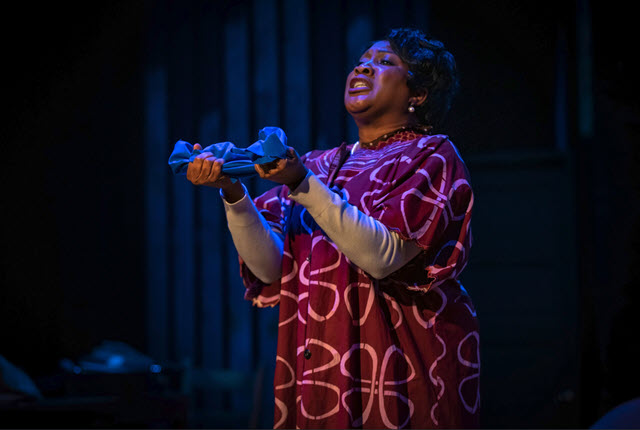
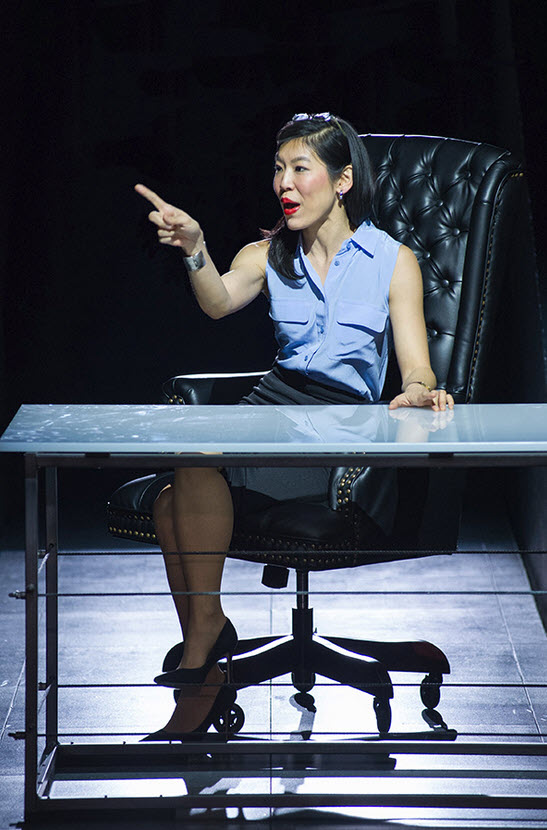
Roz White ~ Credit is Thom Goertel.
In this telling, Johnson is discovered by Susannah Mullally, an ambitious, and not incidentally, Irish-American ethnomusicologist employed by the Library of Congress to uncover America’s earliest indigenous music, and, by deduction, its African roots. “You are an authentic doorway to our past,” Susannah pleads. Playwright Frank Higgins, whose previous work has starred such notable actresses as Blythe Danner and Gwyneth Paltrow, gives pathos and humor to this sensitive portrait of a woman hardened by a segregationist South and the cruel-hearted men in her life.
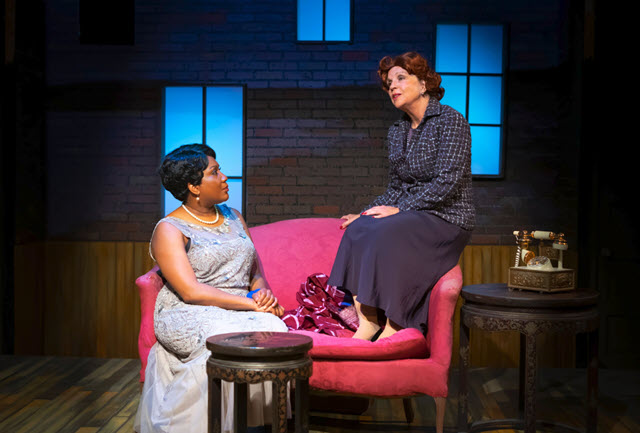
Roz White & Susan Galbraith ~ Credit is Thom Goertel.
At first Susannah’s attempts to coax out the early plantation songs Pearl learned from her slave ancestors are met with a steely rebuke. But after a considerable period met with Susannah’s description of her country’s suppressed Gaelic language, the two women form a partnership with Susannah gaining Pearl’s pardon from the governor and eventual management of Pearl’s burgeoning music career. “When do-gooders wanna do you a favor, let ‘em,” Pearl decides.
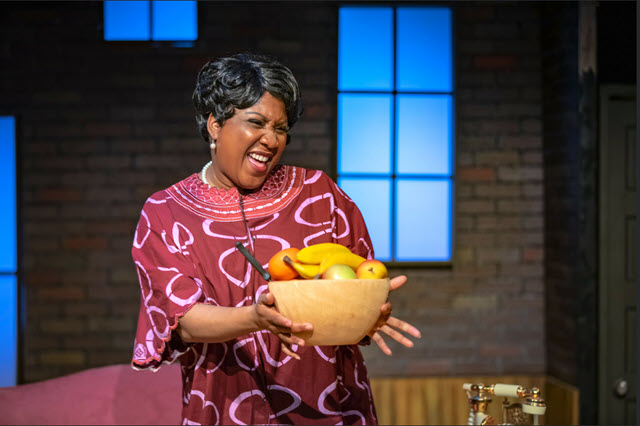
Roz White ~ Credit is Thom Goertel.
Memorable American folk songs and spirituals weave in and out of this musical, performed entirely in a capella by Roz White’s sinuous contralto and Susan Galbraith’s lilting Irish mezzosoprano, and directed by Thomas W. Jones II. Their shared struggles, Pearl’s to earn money to track down her missing daughter, and Susannah’s to find scholarly recognition as a woman in a man’s world, eventually bring the women together culminating in a heart-wrenching duet with “Six Feet of Earth”. Other familiar numbers include “Down on Me”, later made famous by Janis Joplin (also called “Pearl”), “This Little Light of Mine”, the Gospel favorite “Do Lord, Remember Me”, the sultry “Don’t You Feel My Leg”, and the universal spiritual, “Kumbaya”.
In one particularly humorous scene Pearl makes reference to her birth home on the Gullah island of Hilton Head, which back then was a desolate island off the coast of South Carolina populated by the descendants of African slaves. After hearing a developer recount his vision of a golf course and condos on the tiny island, she decides to use it to motivate her to follow Susannah’s vision for her success.
Roz White & Susan Galbraith ~ Credit is Thom Goertel.
Roz White and Susan Galbraith are a powerful match-up. Galbraith’s lilting Irish soprano on autoharp contrasted with White’s earthy, sultry voice accompanied by Afro-American rhythms are wonderful as is the contrast of their physicality and personalities – fire and ice on steroids.
A searing drama. White and Galbraith are brilliant together.
Music Director/Arranger, S. Renne Clark; Set & Projections Design by Patrick W. Lord; Lighting Design by Hailey LaRoe; and Costumes by Mary Larson and Michael Sharp.
While in the lobby, be sure to check out the photographs and stories of the Gullahs of South Carolina’s Low Country (Pearl’s ancestral home. It includes the early culture of African-American families and is compiled by students from the Duke Ellington School of the Arts.
Through May 4th at Universalist National Memorial Church in the Spooky Action Theater, 1810 16th Street, NW, Washington, DC 20009. For tickets and information visit www.newmusictheatre.org or call 202 256.7614
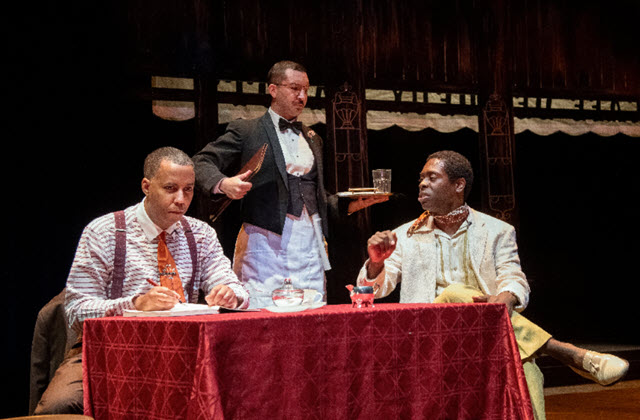
When two famous writers – one heterosexual, one homosexual, both controversial – square off in a Paris café there are bound to be fireworks. Set in the intellectual cosmos that was Paris in 1953, Les Deux Noirs is playwright Psalmayene 24’s imagined conversation between notable novelist, Richard Wright of Native Son fame, and writer and activist James Baldwin, known for his semi-autographical novel Go Tell It on the Mountain (or whatever your favorite one is).
(l-r) Musa Gurnis as (Ludivine) and Jeremy Hunter as (James Baldwin) ~ Photo Stan Barough
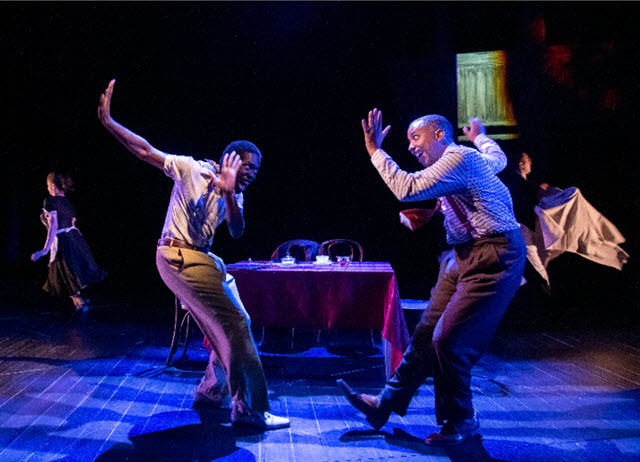
It opens with their meeting at Les Deux Magots after provocateur and enfant terrible Baldwin had written a scathing review of Native Son, calling Wright a racist. Wright demands the younger writer recant his critiques in a public forum. “You’ve insulted my legacy,” Wright rages. “Sociology is not literature,” Baldwin counters. It doesn’t go well. They verbally spar. Then it gets physical. Thrust and parry. Rinse and repeat.
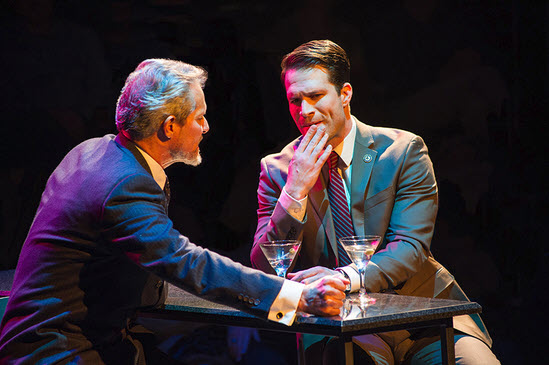
(l) James J. Johnson (Richard Wright) (c) RJ Pavel as Jean-Claude (r) Jeremy Hunter (James Baldwin) ~ Photo by Stan Barough
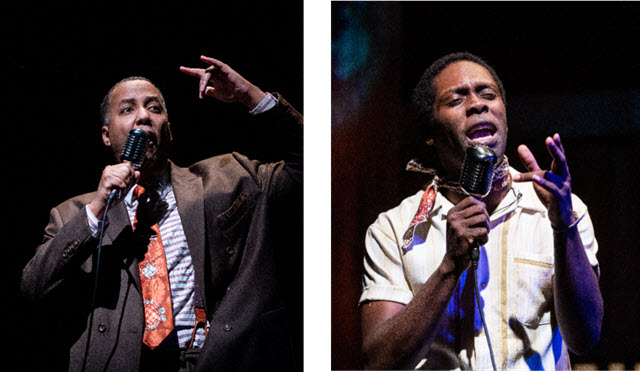
Interwoven with rap and rhyme, Psalmayene 24 gifts us with a spellbinding interpretation of their relationship by creating imagined exchanges laced with political diatribes and withering barbs. But there are plenty of funny bits too, as when Baldwin flirts with Jean-Claude the waiter star struck by the literary luminaries who frequent the legendary café, and Wright who charms Ludivine, a pretty waitress who falls for him. For Baldwin, who is broke, it’s a chance at a free meal, though Wright refuses to pick up the tab. For Wright, it’s a chance to disparage the young upstart and redeem himself.
(l-r) Jeremy Hunter (James Baldwin) and James J. Johnson (Richard Wright) ~ Photo by Stan Barough
Wright had his own problems. He’d come out as a Communist – it was very au courant among intellectuals of the period – and he feared his movements were being monitored. Nonetheless they both felt that by living in Paris they were safe from persecution. “Paris is freedom. America is prison.” They both agreed on that.
(l-r) James J. Johnson (Richard Wright) and Jeremy Hunter (James Baldwin) ~ Photo by Stan Barough
James J. Johnson who plays Wright and Jeremy Hunter who plays Baldwin are well-matched and prove exceptionally appealing in these challenging roles. I am more familiar with Hunter, a chameleon of a performer I recently reviewed in Top Dog/Underdog from Avant Bard, who is superb. It was mind-boggling to see him morph from a tough guy grifter to a sashaying, pinky-out, ascot-sporting intellectual. He is extraordinarily versatile.
(l-r) James J. Johnson (Richard Wright) and Jeremy Hunter (James Baldwin) ~ Photo by Stan Barough
Director Raymond O. Caldwell (Artistic Director of Theatre Alliance) finds the perfect pitch to highlight the men’s differences, ratcheting up their machismo by perching them on chairs and tabletops where they can eloquently rap out their sociological viewpoints while cruising the local talent.
With RJ Pavel as Jean-Claude and Musa Gurnis as Ludivine. Isaiah M. Wooden, Dramaturg; Amy MacDonald, Costume Design; Brandi Martin, Projections; Tiffany Quinn, Choreographer.
Electrifying, imaginative and compelling.
Originally part of Mosaic’s Season Four Workshop Reading Series, Les Deux Noirs has become a fully developed, world premiere production that is currently being performed in repertory with Native Son through April 27th at the Atlas Center for the Performing Arts 1333 H Street, NE, Washington, DC 20002. For tickets and info on post show discussions, special rates and discounts visit www.MosaicTheater.org or call the box office at 202.399.7993 ext. 2. (Parking lot at 1360 H Street, NE.)
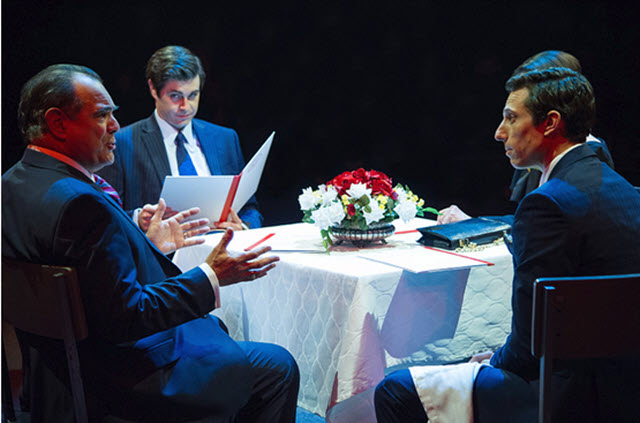
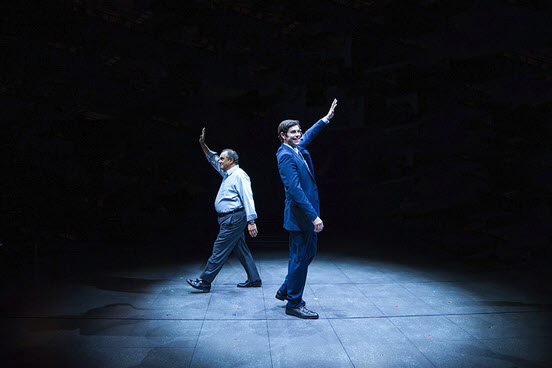
If you didn’t live through the junk bond scandal of the mid-80’s you may need a primer before seeing Junk. Though much unfolds through the plot, it’s still a bit complex as to how they committed such monumental financial chicanery in plain sight. The drama centers around the period when hostile corporate takeovers by young high-flying Wall Street players gamed the system to turn debt into dollars in order to line their pockets. They made some people money, but ultimately it was a Ponzi scheme that took down our financial system, robbed tens of thousands of workers out of their jobs and retirement benefits, and pretty much destroyed American manufacturing. The story mirrors the rise and fall of Michael Milkin the junk bond king.
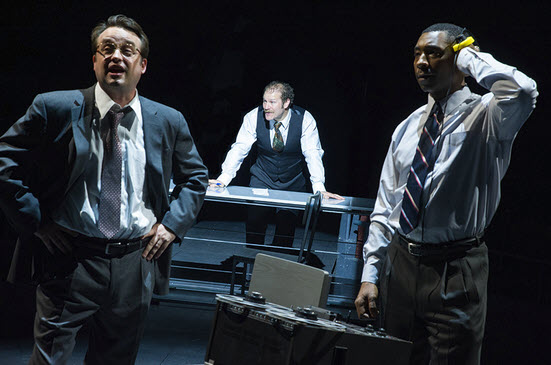
(L to R) Edward Gero (Thomas Everson Jr.), Thomas Keegan (Robert Merkin) and Jonathan David Martin (Israel Peterman). Photo by C. Stanley Photography.
A lot of these guys got caught up in insider trading, selling secrets used to manipulate stock prices – raising a stock to make it look appealing to investors, then lowering it and turning it into debt when they wanted to force the owners out. It’s complicated. In fact, so complicated that it was over the heads of most people which is how they got away with it for so long until the Feds and the SEC eventually caught on. As the young reporter, Judy Chen, puts it, “The age of speaking truth to power was coming to an end.”
Nancy Sun (Judy Chen). Photo by C. Stanley Photography.
Pulitzer-winning playwright, Ayad Akhtar(Disgraced) draws us into this sleazy, greedy, nether world of characters with warning lights flashing while investors reaped untold millions through mergers and acquisitions as companies tanked. It’s fascinating and revealing, all at once – a cautionary tale of greed and deception.
(L to R) Edward Gero (Thomas Everson Jr.) and Thomas Keegan (Robert Merkin) in Junk. Photo by C. Stanley Photography.
Thomas Keegan plays Robert “Bob” Merkin, a. k. a. “the White Whale”, who Time Magazine named “America’s Alchemist”. Keegan is riveting as the kingpin of the bond market and the titan who everyone fears and obeys. His plan is to take over a three-generation-owned American steel manufacturer run by Tom Everson, Jr. However, there are subplots that lurk beneath the surface. Judy Chen is writing a book on the Merkin phenomenon and switches sides, Murray is an investor whose wife is suspicious of Merkin’s shady deals, Boris Pronsky works behind the scenes as an unscrupulous trader in debt to Bob, and Israel Peterman is Bob’s front man. Oh, and there’s a mole. I won’t say who. That ought to get you started.
(L to R) Michael Glenn (Mark O’Hare), Elan Zafir (Boris Pronsky) and JaBen Early (Kevin Walsh/Curt) in Junk. Photo by C. Stanley Photography.
For Bob who thinks “debt signifies new beginnings,” he believes, “the law belongs to those who break the rules.” When he finally gets his comeuppance for a host of felonies laced with triple damages, and everyone starts ratting each other out, we begin to see the inkling of an idea forming in Bob’s mind for his next racket – the mortgage crisis that sent the country into a tailspin. But there are lots more twists and turns to keep you guessing who will come out on top.
(L to R) David Andrew Macdonald (Leo Tresler) and Nicholas Baroudi (Giuseppe Addesso) in Junk. Photo by C. Stanley Photography.
Clever, intense and a forewarning. Highly recommended.
Starring Thomas Keegan as Robert Merkin; Nancy Sun as Judy Chen; Edward Gero as Thomas Everson, Jr.; Jonathan David Martin as Israel Peterman; David Andrew Macdonald as Leo Tresler; Shanara Gabrielle as Amy Merkin; Michael Russotto as Murray Lefkowitz/Maître d’/Counsel; Elan Zafir as Boris Pronsky; Amanda Forstrom as Charlene Stewart/Lawyer; Jaben Early as Kevin Walsh; Kashayna Johnson as Jacqueline Blount; Lise Bruneau as Maximilien Cizik; Perry Young as Raúl Rivera; Michael Glenn as Mark O’Hare/Curt; Dylan Jackson as Devon Atkins/Waiter; Nicholas Baroudi as Giuseppe Addesso; and Elliott Bales as Union Rep/Corrigan Wiley/Fight Captain.
Directed by Jackie Maxwell; Set Design by Misha Kachman; Costume Design by Judith Bowden.
Through May 5th at Arena Stage in the Fichandler Theater – 1101 Sixth St., SE, Washington, DC 20024. For tickets and information call 202 488-3300.
The ensemble of Grand Hotelat Signature Theatre. Photo by Margot Schulman
Dapper men in dinner jackets and ladies luxuriously swathed in furs and jewels has a certain mysterious fascination for us all. In Playwright Ayad Akhtar’s Grand Hotel, guests of this deluxe Berlin hotel reveal that there is more to glamour than meets the eye. In the hotel’s opulent Art Deco era lobby we meet aging prima ballerina Madame Elizaveta Grushinskaya arriving for her final grand tour with her faithful companion, Raffaela; Flaemmchen, a pretty down-at-the-heels ingénue; Baron Felix von Gaigern, a handsome grifter; Colonel-Doctor Otternschlag, a world-weary doctor; General Director Preysing, a corporate tycoon with an uncertain future; and Otto Kringelein, a big-hearted Jewish accountant with a terminal illness. For these peripatetic travelers, it’s all about money – keeping it or finding it – and enjoying the luxe life. What they all have in common is the need to be loved.
Solomon Parker III (Jimmy 2), NickiElledge (Flaemmchen), Ian Anthony Coleman (Jimmy 1) and the ensemble of Grand Hotelat Signature Theatre. Photo by Margot Schulman
Twenty-one musical numbers backdrop both their amours and their tragedies as they find themselves in ever-threatening financial circumstances. Will Otto live to find happiness, will Elizabeta revive her career, will the Baron find deeper meaning, and will Flaemmchen find stardom? How they evolve as people is the real story behind this glamorous idyll.
Natascia Diaz (Elizaveta Grushinskaya) in Grand Hotelat Signature Theatre. Photo by C. Stanley Photography.
Director Eric Schaeffer pulls out all the stops with a fabulous set graced with two winding staircases, top-notch dancers and character actors with Broadway-worthy voices that fulfill his vision of transporting us to the age of the Roaring 20’s in a city well known for sophistication and decadent excess.
Nicki Elledge (Flaemmchen) and Nkrumah Gatling (Baron Felix von Gaigern). Photo by C. Stanley Photography
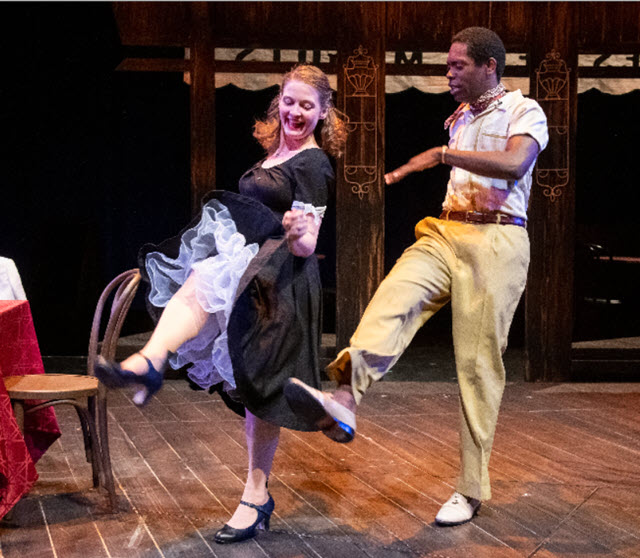
Some of the most memorable musical scenes come during moments of truthfulness and tenderness as between Elizaveta and the Baron in the number “Love Can’t Happen” and her solo dance in “Bonjour Amour”. And, not to be understated, is the sensational dancing of the two Jimmys in Act One’s “Maybe My Baby Loves Me” with Flaemmchen, and Act Two’s “The Grand Charleston” with the ensemble and “We’ll Take a Glass Together” performed alongside Kringelein, the Baron and the ensemble.
Bobby Smith (Otto Kringelein) and Nicholas McDonough (Erik) in Grand Hotelat Signature Theatre. Photo by C. Stanley Photography
The darker side of working at this posh hotel is not left out but circumscribed by the gritty reality of below stairs workers engulfed in steam heat rising from on-stage grates, and by the precarious job security of Erik, a young concierge forbidden from leaving his post as he awaits the birth of his son.
It’s a big story with multi-dimensional characters who surprise us at every turn. See it for the music, the dancing and the glitz.
Starring Bobby Smith as Otto Kringelein; Natascia Diaz as Elizaveta Grushinskaya; Kevin McAllister as General Director Preysing; Nkrumah Gatling as Baron Felix von Gaigern; Lawrence Redmond as Colonel-Doctor Otternschlag; Crystal Mosser as Raffaela; Nicki Elledge as Flaemmchen; Ian Anthony Coleman as Jimmy 1 and Zinnowitz; Solomon Parker III as Jimmy 2; Ben Gunderson as Erik; Victor Kempski as Rohna and Witt; Marie Rizzo as Trude and Tootsie 1; Gregory Matheu as Sandor; and ensemble.
Book by Luther Davis; Music and Lyrics by Robert Wright & George Forrest; Based on Vicki Baum’s Grand Hotel; Additional Music & Lyrics by Maury Yeston; Scenic Design by Paul Tate DePoo III; Costume Design by Robert Perdziola; Lighting Design by Colin K. Bills; Sound Design by Ryan Hickey; Choreography by Kelly Crandall D’Amboise. Conducted by Evan Rees.
We all want to “stay woke”. Right? To be up on the issues of racial injustice and political correctness we need to keep current and stand up when it’s called for. For Dorian Belle, a Canadian pop star with a huge, fan-based, reality TV show, it’s more than that. He wants to stay woke while being black and get in on the black music scene. Unfortunately for Dorian, he’s white. Think Eminem and other white hip-hop celebs who have appropriated black culture in both music and style. It goes much further back than that with blackface, Elvis, the Rolling Stones and musicians who adopted (or outright stole) black music genres as their own. In truth, it’s complicated and that debate is the undercurrent of playwright Tearrance Arvelle Chisholm’s Pygmalion-inspired play.
Gary L. Perkins III, Simon Kiser, and Seth Hill in P.Y.G. or the Mis-Edumacation of Dorian Belle. Photo: C. Stanley Photography
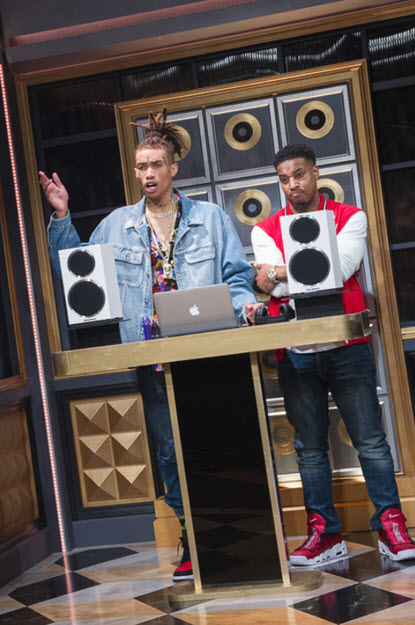
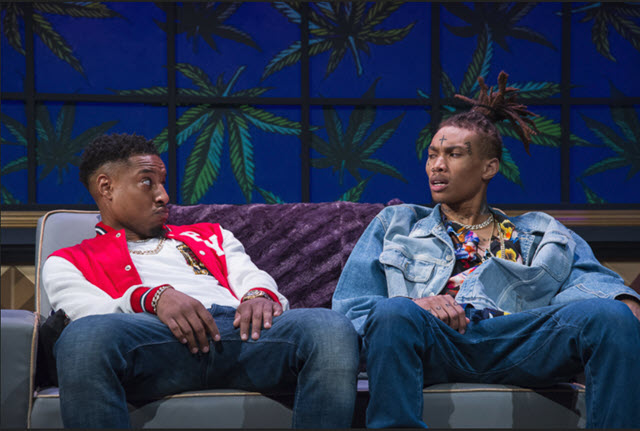
Dorian believes that taking on more of a black identity, would add to his street cred. To that end he invites rappers, Alexand Da Great and Blacky Blackerson of P. Y. G. (Petty Young Goons), to his posh pad in hopes he can sign them to his record label, learn their fly moves and adopt their southside of Chicago brand of gangsta rap. There’s a reference to building your narrative while using someone else’s and Blacky is accused of fostering black stereotypes to please Dorian. You have to stay woke, because the humor and the irony come at you with hurricane-like force.
Seth Hill, Simon Kiser, and Gary L. Perkins III in P.Y.G. or the Mis-Edumacation of Dorian Belle. Photo: C. Stanley Photography Photo: C. Stanley Photography
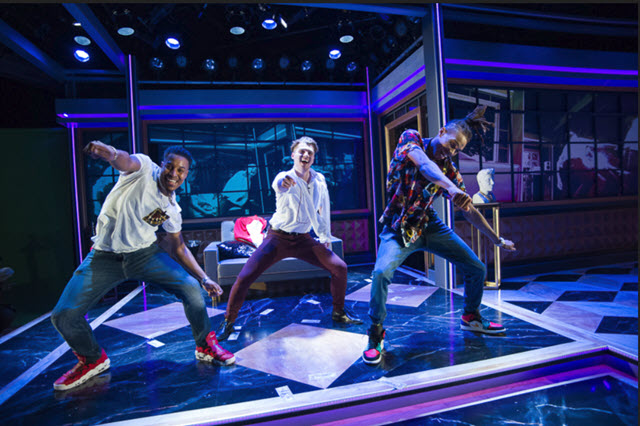
Alexand and Blacky are eager to get their hands on “white people’s money” but have their limits as to how much they are willing to take from this rube, especially Blacky who teases Dorian unmercifully when he pontificates on what he thinks it means to be black while taking notes on how they demand he defer to them. It’s hysterical watching the three men analyze what’s blacker, what’s outright appropriation, and why Dorian may not use the “N” word, but they can. Blacky says it so often that Alexand gives him a pocket beeper to substitute a beep for each time he wants to use it. There’s a lot of beeping.
Seth Hill and Gary L. Perkins III in P.Y.G. or the Mis-Edumacation of Dorian Belle. Photo: C. Stanley Photography Photo: C. Stanley Photography
When the men finally buy into Dorian’s experiment, Blacky finds he likes all the things he never experienced in the hood and he becomes bros with Dorian, much to Alexand’s dismay. After all their attempts to “mis-edumacate” Dorian, they start to drift into Dorian’s white world. Question: Will Dorian ever truly relate to black culture and the racial injustices that come along with it, or does he just want to appropriate the style and the music to be cool? “You need to sound like the joy and the suffering of slaves,” Blacky tells him in no uncertain terms.
Gary L. Perkins III and Seth Hill in P.Y.G. or the Mis-Edumacation of Dorian Belle. Photo: C. Stanley Photography Photo: C. Stanley Photography
Rap and dance are a big part of this production especially in the explosive scene where the “brothas” demonstrate the hip-hop and breakdancing styles by region from New York to California and Senegal to Zambia. Their dance demos are epic.
Impressive direction from Tearrance Arvelle Chisholm who also wrote last year’s Helen Hayes Award-winning play, Hooded, or Being Black for Dummies. Add to that, super fantastic performances by Seth Hill as Blacky Black, Gary L. Perkins as Alexand Da Great, and Simon Kiser as Dorian Belle.
Assistant director Mari Andrea Travis, fantastic projections by Kelly Colburn, costumes by Danielle Preston, lighting by Jesse Belsky, sets by Richard Oullette, and sound design by original music by composer Gabriel Clausen, make this world premiere play a must-see.
Outrageously funny, insightful and provocative. Highly recommended.
Through April 28th at Studio Theatre – 1501 14th Street, NW, Washington, DC 20005. For tickets and information visit Studio or call 202 232.7267
Opening night for the New York City Ballet offered a delectable selection of music and dance backed by the Kennedy Center Opera House Orchestra. It was a thrill for the audience to see the dancers bring to life original choreography from George Balanchine, Jerome Robbins and Gianna Reisen to the music of Lukas Foss, Paul Hindemuth, Sergei Prokofiev and George Bizet.
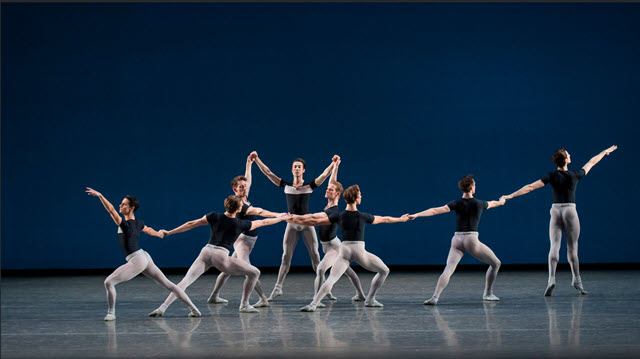
New York City Ballet in Gianna Reisen’s Composer’s Holiday. Photo Credit Paul Kolnik
The program, which will be repeated on April 3rd and April 7th, highlights many of the troupes’ most notable dancers – Mary Thomas MacKinnon, Emma Von Enck, Kennard Henson and Roman perform in “Composer’s Holiday”, a Reisen design that heralds modernism. Abi Stafford, Teresa Reichlen, Joseph Gordon and Russell Janzen take the leads in “Kammermusik No. 2”, with Sterling Hyltin and Gonzalo Garcia taking leads in “Opus 19/The Dreamer.
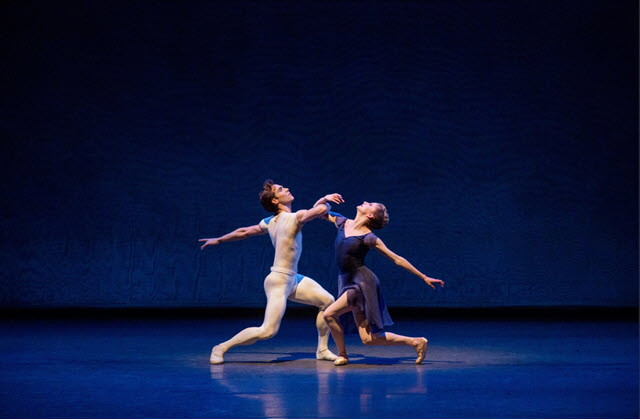
New York City Ballet in George Balanchine’s KammermusikNo. 2. Photo Credit Paul Kolnik
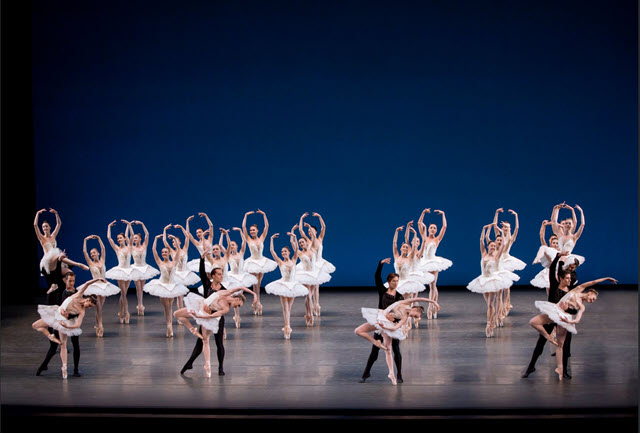
The final piece “Symphony in C” by Bizet is on four movements and showcases the talents of Ashley Boulder, Tyler Angle in the 1st an Allegro Vivo; Sara Mearns and Jared Angle in the 2nd an Adagio; Baily Jones and Anthony Huxley in the 3rd movement an Allegro Vivace; and Erica Pereira and Andrew Scordato in the 4th movement an Allegro Vivace which took us back to classical ballet with original Balanchine choreography performed with over 50 dancers. The costumes for this final piece were a contribution from SWAROVSKI and you could see the twinkling crystals adorning their tutus from the back row.
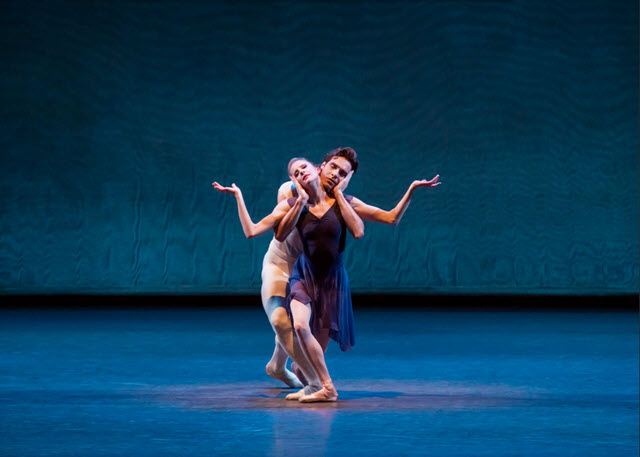
Sterling Hyltin and Gonzalo Garcia in Jerome Robbins’ Opus 19/The Dreamer. Photo Credit Paul Kolnik
Artistic Director of the NYCB, Jonathan Stafford reminded the audience that the NYCB has been performing at the Kennedy Center since 1974 and mentioned that Gianna Reisen wrote her first ballet last year when she was only 18 years old.
Sterling Hyltin and Gonzalo Garcia in Jerome Robbins’ Opus 19/The Dreamer. Photo Credit Paul Kolnik.
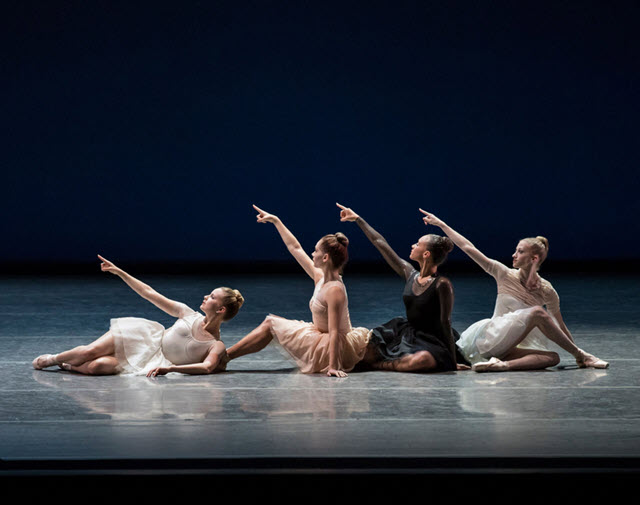
“Composer’s Holiday” uses precision and smooth movement to get its point across and there are a lot of heel-to-toe steps which seem like a country dance. But it is the elegant fluidity and angularity of the motions that elevate it. In “Kammermusik No. 2” we see many sections performed in delayed mirrored sequence as if the dancers are continuously unfolding.
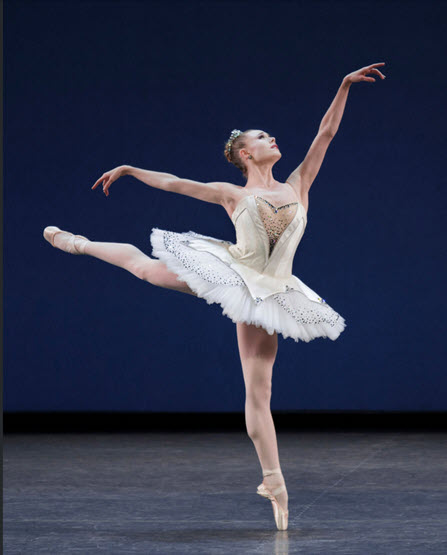
Sara Mearns in George Balanchine’s Symphony in C. Photo Credit Paul Kolnik.
“Symphony in C” allows Tyler Angle to show off his magnificent form and gravity-defying leaps with Ashley Bouder. His brother, Jared Angle, follows in an equally memorable performance with Sara Mearns, my favorite dancer of the night.
New York City Ballet in George Balanchine’s Symphony in C. Photo Credit Paul Kolnik.
The following, “New Works and New Productions” are scheduled to be performed on the evenings of April 4th, 5th, and 6th with a matinee added on the 6th.
“Easy” (Leonard Bernstein/Justin Peck)
“In the Night” (Frédérik Chopin/Jerome Robbins)
“The Runaway” (Nico Muhly, Kanye West, Jay-Z, James Blake/Kyle Abraham)
“Something to Dance About” Jerome Robbins, Broadway at the Ballet (Bernstein, Bock, Gould, Rodgers, Styne/Robbins, direction and musical staging by Carlyle)
Two Kennedy Center premieres, created for the centennial of Jerome Robbins, include Justin Peck’s “Easy” set to the music of Leonard Bernstein, and Tony Award-winning choreographer/director Warren Carlyle’s “Something to Dance About” featuring notable dance sequences from On the Town, West Side Story, and more. Also by Robbins, “In the Night” features three couples of distinct personality set to four of Chopin’s elegant nocturnes.
Kyle Abraham’s “The Runaway”, another Kennedy Center premiere that fuses modern and classical technique with imaginative costumes by Giles Deacon, is set to an eclectic soundtrack that includes hip-hop giants Jay-Z, Kanye West, and others.