Jordan Wright
November 2010
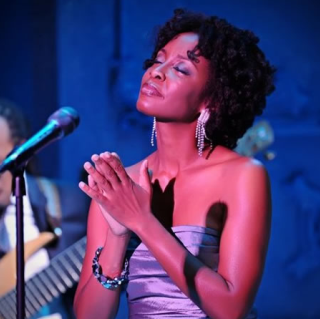
 Sylver Logan Sharp - photo credit to Roy Cox Photography  Lori Williams at her CD launch of Healing Within at MetroStage- photo by Phelan Marc Three separate CD launches this month took me from Alexandria, VA’s MetroStage to Easton, MD’s Avalon Theatre.
Lori Williams has performed with the greats – Keter Betts, Jerry Butler, Jazzmaster Slide Hampton and Ben E. King to cull but a few from a long list of collaborations. In this recent concert she performed the numbers from her debut CD, “Lori Williams, Healing Within” at MetroStage earlier last month to a hugely receptive audience.
William’s sensually sophisticated style is nuanced with her gospel roots. Watching her slink across the stage you just have to lean back and wonder how such tremendously complex and rhythmic vocals can come from her tiny frame.
In a twofer Sylver Logan Sharp, a flaming redheaded minx formerly of the disco band Chic, opened for longtime friend Williams. The sizzling Sharp performs Tuesday nights throughout November at the Bohemian Taverns. She will make you jump out of your seat and root for every impossible note she hits.
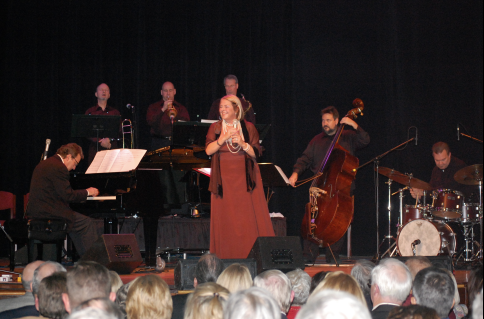
 Erin Dickins at the Easton's Avalon Theatre Break out the martinis and the silver cocktail shaker for song stylist Erin Dickins who thrilled the packed house at the art deco Avalon Theatre in Easton with songs from her newest CD, “Nice Girls”. Dickins sophisticated scat, swing and ballads remind the listener that she was one of the founding members of Manhattan Transfer. With a nine-piece backup band that has more industry awards than an evening’s worth of Grammies, Dickins tore the place up, tossing her signature pearls to the crowd. She has performed with the likes of James Taylor, Linda Ronstadt, Bette Midler, James Brown, Randy Neuman, Roberta Flack, Peabo Bryson, Barry Manilow, Leonard Cohen, Dr. John, Paul Butterfield and Levon Helm.
Special to the Alexandria Times
Jordan Wright
November 6, 2010
 Oklahoma! Illustration by Douglas Fraser Arena Stage at the Mead Center for American Theater’s choice of Oklahoma! as its inaugural show for its glamorous new theatre complex has been questioned around town for weeks. I’ve heard comments ranging from, “I can’t imagine why they would do that old show for their first big spectacle!” to “It’s been staged in every high school in America!” Well, all that is true and irrelevant too.
Oklahoma! set on the Great Plains of the Midwest, is certainly one of Rodgers and Hammerstein’s quintessential American musicals and it is only fitting that Arena Stage would choose such a theme to reflect their American Theater nomenclature. With its sweeping score and themes of land rushes and pioneer settlements (who doesn’t know its theme song “where the wind comes sweepin’ down the plains”), this production seeks to reflect those times with a multi-racial cast that is, as the playbill instructs us, more in keeping with early frontier demographics.
At the Fichandler Stage, a theatre-in-the-round built to accommodate 683 seats, there is no waiting for the curtain to rise. The view to the stage is both immediate and intimate. This is both good and bad for the performers, sets, and props, as every glitch is magnified. As well actors must execute four turns during their lines and numbers in order to play to the 360 degree audience, and there is much east, west, south and north-ing in order to achieve this style of presentation. But as no seat is more than eight feet from the stage the audience’s response is visceral.
The incomparable and multi-award-winning performer E. Faye Butler brings her soaring voice and powerful stage presence to the character of the country-wise, no-nonsense Aunt Eller who’s both gentle as a mother lamb and mean as a snake when crossed. Though we meet her on the steps of her porch churning butter, believe me, you would not want to be in her sights when she’s toting a gun.
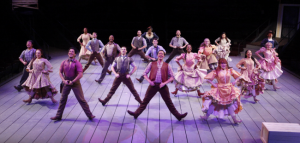 The company of the Arena Stage at the Mead Center for American Theater production of Rodgers and Hammerstein’s Oklahoma! October 22-December 26, 2010. Photo by Carol Rosegg. And while there is no doubt in anyone’s mind that Eleasha Gamble has one of the most tender and beautiful voices around, a perfectly modulated honey-toned sound that could challenge a nightingale, I found her portrayal of Laurey to be one-dimensional and without subtlety. She lacks the coy factor necessary for us to believe she gives a hoot about Curly. (In all fairness she jumped into this role with two day’s notice.) Yet her voice shines in the duets “Surrey with the Fringe On Top” and “People Will Say We’re in Love”.
But much of the strength of this production’s success comes from the supporting cast. Nicholas Rodriguez as Curly was vocally outshone by secondary cast members, Aaron Ramey as Jud Fry and Cody Williams as Will Parker, whose voice was resonant and expressive. Williams, slim as a minute, ripped up the stage with back flips, leaps, high kicks and soft shoe along with the cast’s other crack dancers. This reviewer thought he and local high school junior June Schreiner, who plays Ado Annie like a fierce and adorable little minx, were captivating together.
Aaron Ramey’s Jud, the dark and brooding farmhand, showed both depth of emotion and breadth of vocal range. Another standout was Nehal Joshi’s comic relief as Ali Hakim, the Persian peddler and ladies’ man.
There are no sets in this version of Oklahoma! leaving it to the audience’s imagination, a tall order for the seasoned theatergoer who has seen spectacular sets designed “as high as an elephant’s eye”. Yet gratefully, this production embodies vitality and high energy, including breathtaking choreography, thanks to Parker Esse and David Leong’s brilliantly executed fight scene.
Special to the Alexandria Times
Jordan Wright
November 9, 2010
 The actors in the first photo are, left to right, Diane Linton Sams, James McDaniel and David James. Photo by Ari McSherry. My memories of the Academy Award-winning Kurosawa epic film of the same name, gave me pause that this could be pulled off as a one-act play on a stage whose size looked more like an afterthought. What could the theatregoer divine from a stark black backdrop ornamented by a smattering of floor to ceiling stalks of bamboo? I meant not to prejudge but to pack a suitcase full of curiosity.
In this pared down production James McDaniel, David James and Diane Linton Sams seamlessly portray nine characters. McDaniels as priest, deputy, husband and mother; James as woodcutter and bandit; and Sams as wigmaker, wife and shaman weave an intricate tale full of truths, half-truths and outright lies in this powerful story reminiscent of Japanese Noh theatre.
In the ancient city of Kyoto a trial is underway for the murder of a Samurai warrior and the rape of his wife. Suspicion hangs over the bandit, the Samurai and his wife in this elegant and stark thriller. Motives are debated and self-serving explanations are rampant. Events flow backward and forward in time while each character explains their version. Yet there is only one real witness, the bandit. And his version of the events, along with the real or imagined tales from the other participants, is in question.
The wigmaker, priest and woodcutter devise their individual theories on the murder and rape based on their egotistical and self-serving views of life. In “The Films of Akira Kurosawa” by Donald Richie, the great director once said of his film version of Rashomon, “Human beings are unable to be honest with themselves about themselves. They cannot talk about themselves without embellishing.” The sentiment is echoed by the Holy Man, “A man doesn’t look for his soul in a mirror.”
An exchange between the Wigmaker and the Woodcutter informs the audience.
Wigmaker: Which one of these stories do you believe?
The Woodcutter: None makes any sense.
The Wigmaker : Don’t worry about it. It isn’t as if men were reasonable.
 The Actors, from left to right, David James, Diane Linton Sams and James McDaniel. Photo by Ari McSherry This small but tightly acted play is further enhanced by two Hayashi musicians, played by Randy Sena and Jung Weil who sit cross-legged on opposite sides of the stage paralleling the shifting roles with a series of percussive sounds. Sena and Weil use a collection of instruments to dramatic effect, among them a Cuban drum, a gavel, a recorder, a child’s lyre, Japanese wooden clappers and a copper gong as spotlighting and kimono costume changes cue the audience to the changing characters.
Rashomon was adapted for the Broadway stage by husband-and-wife collaborators Faye and Michael Kanin in 1961. Michael was the brother of Garson Kanin and worked with Ring Lardner Jr. After a long career writing screenplays, Faye went on to be president of the Academy for Motion Picture Arts and Sciences. At 93 years young she lives in Baltimore, MD.
Rashomon is a compelling production that explores the mysteries and foibles of human interaction and its subsequent interpretation. Perfectly cast and dramatically directed and costumed by Howard Vincent Kurtz, it is highly recommended.
Weekends through November 21st at The Lab at Convergence, 1801 North Quaker Lane, Alexandria, VA 22302. For tickets and information call 703 838-2880 or visit www.PortCityPlayhouse.com.
Special for Alexandria Times
Jordan Wright
November 2010
 Andrew Long, Holly Twyford and Jeff McCarthy. Photo by Chris Mueller. If you’ve never hit a golf ball, picked up a club and have no plans to…this play’s for you. Whether your membership to a posh country club, where “A Fox on the Fairway” is set, has expired or you neglected to send in your application, you will love this crazy, frothy, throwback to early Hollywood comic cinema. In an everything-old-is-new-again vein, playwright Ken Ludwig has mined the funny bone in this screwball comedy reminiscent of the days of the Marx Brothers; Cary Grant and Claudette Colbert; and Spencer Tracy and Katherine Hepburn all rolled into one.
When we meet Richard, the urbane manager of Quail Valley Country Club, the mood is dire. Quail Valley has never won the annual golf tournament against rival Crouching Squirrel Club. But the debonair Bingham, as expertly played by Jeff McCarthy, has plans for a reversal of fortune with the entry of a new member with an ace handicap. His counterpart and nemesis from Crouching Squirrel, Dickie, has a surprise of his own and the old archenemies bet the farm on the outcome.
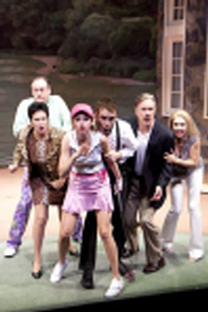 The Cast of Ken Ludwig's A Fox on the Fairway. Photo credit Scott Suchman. Andrew Long plays Dickie, a veritable Mr. Malaprop who sports appliquéd golf attire and mixes metaphors with aplomb. Holly Twyford as the champagne-swilling, “I would drink water but there’s so much fish in it.” much-married Pamela, slinks through her role so seamlessly and with such universal appeal that we feel we know her. She is sharp, witty and charmingly snide. In a swipe at her ex-husband, Dickie, she tells him, “Never use box tops to buy wearing apparel.”
Swirling around the breakneck action are our young romantics. The fragile, neurotic waitress Louise, played fetchingly by the adorable Meg Steedle, and her hapless (also neurotic) beau, Justin played with puppy dog pathos by Aubrey Deeker. Their on-again off-again engagement keeps them in a dither as their breakups mount and the club’s chances for the cup dwindle.
Enter Bingham’s wife Muriel, full of frustration and cool anger. Valerie Leonard has a firm grip on the character’s hot-and-cold personality. In fact the entire cast performs with such unanimity and slick precision it will take your breath away.
Signature Theatre is blessed to have the world premiere of “A Fox on the Fairway”. Here internationally-acclaimed playwright Ken Ludwig, in a production more in line with his long-running Broadway play “Lend Me a Tenor”, revives the art of the sophisticated farce full of high anxiety. It’s madcap mayhem replete with high jinks and snappy repartee.
Tony award-winning director John Rando, who worked with Ludwig on “Be My Baby”, carves up a dazzling choreography full of leaps and bounds and canoodling and cavorting worthy of a New Yorker cartoon.
Take this under advisement: Make sure your belt is buckled and your buttons are sewn on tight, this riotous romp will split your sides in two! And do not, I repeat, do not under any circumstances leave the theatre before the cast takes their bows. I will not play the spoiler, but believe me it is a delicious surprise full of theatrical brilliance.
For tickets and information visit www.signature-theatre.org or call 703 820-9771. The play runs until November 14th.
Special for Alexandria Times
Jordan Wright
Monday, October 25th 2010
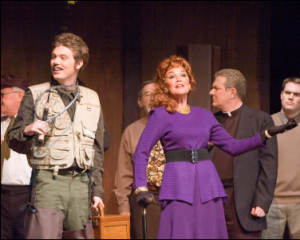 Lloyd Bittinger (Conductor, background), Erik Harrison (Husband), Margaret Bush (Claire), Bernard Engel (Mayor, behind Margaret), James Ginther (Priest), Robert King (Teacher) Photography: Doug Olmsted “The Visit” opens on a scene remarkable for its drabness. The decaying town of Gullen, German for “manure”, is awash in Dickensian poverty. Buildings are crumbling and its coffers are empty. The entire town is on the dole…its starving citizenry collectively points the finger of blame at everything from communism to a freemason’s plot.
Yet they soon unite around an impending visit from a beautiful yet imperious billionairess known for her largesse. Enter Claire Zachanassian, commandingly played with stunning vitriol by Margaret Bush, who continues to endear local audiences with her stellar performances. As the story unfolds Claire is returning to her childhood home on a quite different mission…to seek revenge. And it is a dish best served cold…very, very cold.
The village, with the mayor at its helm, appoints her childhood sweetheart, Anton Schill, to coax the grande dame into parting with some of her loot. Bernard Engel plays the manipulative mayor with great aplomb, corralling its townsfolk with promises of a prosperous life through Claire’s generosity. Conversely, Anton, slated to become the town’s next mayor, is an altruistic gentleman who runs the local general store. His popularity among his customers is notable and enhanced by allowing them their purchases on credit.
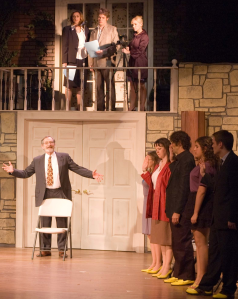 Left to Right (Balcony) Megan Murphy (Announcer), Erik Harrison (Announcer), Kristi Faye (Reporter) Left to Right; Back to Front (stage) Bernard Engel (Mayor), Rebecca Fischler (Doctor), Lori Brooks (Person of Gullen), Bret Alexander (Person of Gullen), Kea Allis (Person of Gullen), Robert King (Teacher) Photography: Doug Olmsted The maudlin and very married Anton is portrayed by Steve Lada, who serves as the perfect foil for Claire’s chilling vixen. He regales Claire with hazy remembrances of their youthful romancing, but she sets him straight and the bizarre plot twists and turns with a collection of characters that would give Charles Addams a run for his money. But Director William Parker keeps the interactions on track in this complex play riddled with the ghosts of the past.
Teddy Gron in the role of Claire’s butler Boby, is remarkable for his ability to exhude Sturm und Drang and arched eyebrow at all the salient moments.
Erik Harrison, a veritable newcomer to the local theatre scene, plays Claire’s three latest husbands and segues seamlessly into his different identities.
And look for Robert King, playing it very close to the vest as the Teacher, who emerges from the morass of injustice by Gullen’s citizens to erupt in a sea of rectitude and emotion near the play’s end.
Written in 1956 playwright Friedrich Dürrenmatt’s “The Visit” was initially adapted for American audiences by Maurice Valency. It had its first Broadway incarnation in 1958 and was directed at that time by Peter Brook starring Alfred Lunt and Lynn Fontanne. The cautionary tale continues to enjoy popularity both in Germany and in the States.
At the Little Theatre of Alexandria from October 23rd till November 13th. For tickets and information call 703 683-0496 or go to www.LittleTheatre.com
Review by Jordan Wright for Alexandria Times
September 2010
MetroStage’s worldwide premiere of “Glimpses of the Moon” is based on social commentarian Edith Wharton’s witty and incisive novel of the same title. It focuses on a hilarious hustle set in Manhattan and the posh watering holes of Maine, the Hamptons and Newport, Rhode Island during the rip-roaring Jazz Age.
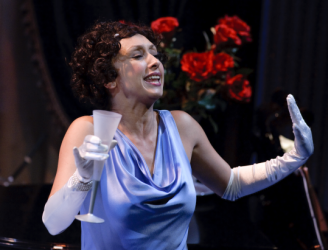 Natascia Diaz as flapper Susy Branch in Glimpses of the Moon - photo credit Colin Hovde Down-on-her-luck flapper, Suzy Branch, and brainy but flat-busted Harvard archaeologist, Nick Lansing, have caviar tastes on a bathtub gin budget. Together they concoct a calculated subterfuge to platonically wed and amass enough pawn-worthy wedding swag, and visits to the palatial digs of their well-heeled friends, to last an entire year. During that time the unscrupulous but adorable duo expect to divorce and marry up. But, ah, here’s the expected rub. They fall madly in love…with each other.
Notwithstanding the predictability of such familiar characters, this fast-paced musical is a clever, sophisticated and captivating dish served up with a huge scoop of humor.
The music, on a par with Sondheim’s best, supports the plot with 16 dazzling numbers like, “Cigars”, a moralistic musing on whether or not to pawn a host’s box of Havana cigars. It’s an uproarious conundrum filled with catchy lines. In the song their host, Streffy, retorts, “You drank gin from my bar. Why not take my cigars!”
“Dinner Party with Friends”, a jaunty ensemble piece, channels Noel Coward and F. Scott Fitzgerald and his East Egg swells with a riotous seated dance as guests chronicle the social pressures of pretense and how to maintain it.
In a timely exchange from the opening number, “Living in this Modern Age”, Suzy pleads, “Don’t you believe in love?” Ellie replies cynically, “I believe in Lehman Brothers!”
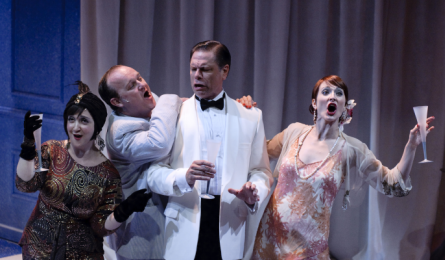 The swells whoop it up in Glimpses - photo credit by Colin Hovde Outstanding are Helen Hayes award-winner Natascia Diaz as the spunky and sensitive Suzy, whose singing and dancing are pitch perfect; Gia Mora, as the well-married seductress, Ellie Vanderlyn, who brims with polish and stylish snap; Stephen Schmidt, as the suave and cuckolded Nelson Vanderlyn, who tackles the part so effortlessly it seems as though the part was written just for him; and Lauren “Coco” Cohn a veteran of “Legally Blonde 2” and “Desperate Housewives”, who as a hugely talented comedic character actor plays three roles including the awkward heiress, Coral Hicks, and the conspiratorial maid.
Another winning performance comes from Matthew Anderson as Winthrop “Streffy” Strefford. Anderson is a blonde-haired, blue-eyed version of Nathan Lane who tears up the stage with his hoofing and vamping. Look for him to return in MetroStage’s “A Broadway Christmas Carol” beginning its run on November 18th.
Although Sam Ludwig’s portrayal of Nick Lansing appeared a bit tentative in the frothy pace, he ditched his hesitancy in his duets, and his pure voice was a perfect harmonic counterpoint.
The catchy songs are supported by the cool flourishes of veteran musicologist and pianist, Darius Smith; woodwind/reed doubler, Brent Birkhead who this summer gained recognition from Downbeat Magazine as Best Blues/Pop/Rock soloist; and Washington DC native, Greg Holloway on percussion, who recently backed Pam Parker at DC’s Blues Alley.
Most recently the partnership of John Mercurio’s music and Tajlei Levis’s book and lyrics had only showcased their numbers at New York’s famed Algonquin Hotel, where it was performed in the Oak Room over a period of several months. The hotel, which was the daily lunch spot of the illustrious “Round Table”, a coterie of elite writers, editors and witheringly wry wits who gathered there in the ‘20’s, has a cabaret where “Glimpses of the Moon” was first shown and explains the appearance in the second act of the dazzling torch singer, played by Rosalind White. White, whose reputation as blues singer in such shows as “Dream Girls” and “Eubie!” netted her a Helen Hayes award for “Bessie’s Blues”, rivets the audience with “Right Here, Right Now”.
“Glimpses of the Moon” runs till October 17th. For tickets and information for the 2010-2011 season call: 1 800 494-8497 or visit www.metrostage.org
|