Jordan Wright
February 4, 2014
Special to The Alexandria Times
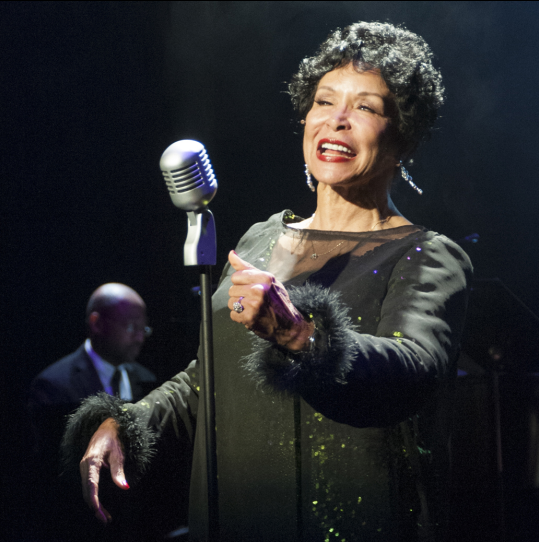 Freda Payne as Ella Fitzgerald – photo credit Chris Banks Maurice Hines wants to entertain you, in the same way he’s entertained audiences through seven decades from Broadway to Vegas, and most recently at DC’s Arena Stage where his show Maurice Hines is Tappin’ thru Life opened recently to rave reviews. This time Hines is back in town directing Ella, First Lady of Song a show he conceived and choreographed.
The musical-on-steroids spans Ella Fitzgerald’s hard life and good times. Beginning in 1934 during The Great Depression through her halcyon days on France’s Cote D’Azur and her famed Philharmonic concerts, the story traces her childhood days singing on the streets of Harlem and her success at an amateur night contest at the Apollo Theatre, the historic venue that launched many an African-American performer’s career. As you might expect, to properly express the eight-decade career of this greatest of American Jazz singers, there’s a lot of material, both musical and personal, to draw from and a lot to gloss over. Hines spends less time on Ella’s struggles and insecurities, than on the music. In fact the show could be more accurately described as a concert, rather than a biography. And that would be most appropriate, since it’s been said Ella didn’t dwelled on her disappointments.
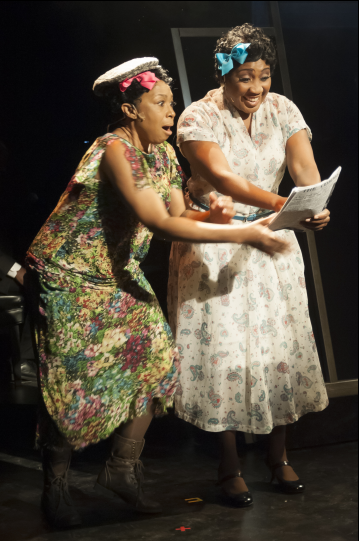 Roz White as Georgiana and Wynonna Smith playing Young Ella – Photo credit Chris Banks Hines has cast iconic pop singer Freda Payne to play the diva’s counterpart. The successful recording artist, who herself has eighteen albums and a pair of gold records under her belt, proves an irresistible choice to channel Ella’s voice and gestures, trading eights and fours with the band like a hot knife through butter.
Tom Wiggin plays Ella’s agent, Norman Granz, a white man who fought for her career through the years of prejudice towards a black performer playing on white stages. “I’m in the long shot business,” Granz explains pushing to book Ella into “Whites Only” venues. Wynonna Smith does double duty as young Ella and Ella’s sister Frances. Rounding out the four-member cast is Helen Hayes Award-winning actress Roz White who plays Ella’s cousin and long-time personal assistant, Georgiana. Together their first-rate voices and moving portrayals make up this strong supporting cast.
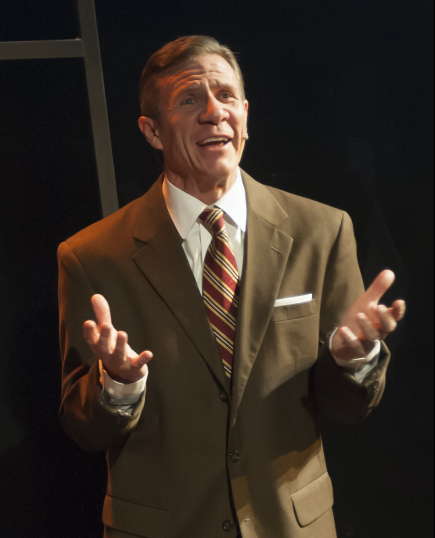 Tom Wiggin as Norman Granz, Ella’s manager – photo credit Chris Banks William Knowles conducts the sizzlin’ hot five-piece band on piano, sax, trumpet, bass and drums as Payne hits the heights with a vocal range that sends chills up your spine. Covering twenty-seven songs, from Duke Ellington’s “It Don’t Mean a Thing if it Ain’t Got That Swing” to George and Ira Gershwin’s “Oh, Lady Be Good”, and from Harold Arlen’s “Come Rain or Come Shine” to Kurt Weill and Bertolt Brecht’s “Mack the Knife”, the music span forty years of the best in Swing, Bebop, Scat and Jazz.
Highly recommended.
To get your groove on swing on down to MetroStage. Through March 16th at 1201 North Royal Street, Alexandria, 22314. For tickets and information visit www.metrostage.org.
Jordan Wright
January 30, 2014
Special to The Alexandria Times
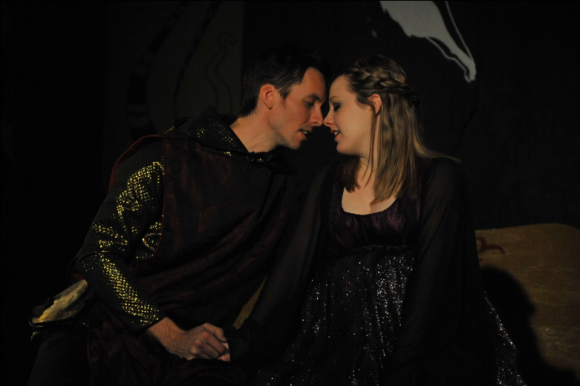 Red Knight & Fanglett
As I took my seat on press night I overheard that The Ballad of the Red Knight producers had recommended parents bring along their children. It explained why all four little ones behind me were chattering like monkeys and wriggling in their seats before the first line was uttered. “I don’t want to be here,” one of them said. “You’re gonna love it,” a patient parent assured. And from the moment the knights-in-tights burst out onto the stage they all fell as silent as tiny mice, except of course for the communal roars of laughter.
It seemed writer Scott Courlander had gotten exactly the reaction he’d expected. His “Director’s Note” urges the audience to, “Think of this as a Saturday morning cartoon come to life….as in Rin Tin Tin, The Lone Ranger…or Ninja Turtles.”. Though I can’t for the life of me explain his reference to the famed German Shepherd, we were certainly a rapt audience for Courlander’s crazy fable that seems more like Monty Python and the Holy Grail meets The Rocky and Bullwinkle Show’s “Fractured Fairy Tales” than canine TV.
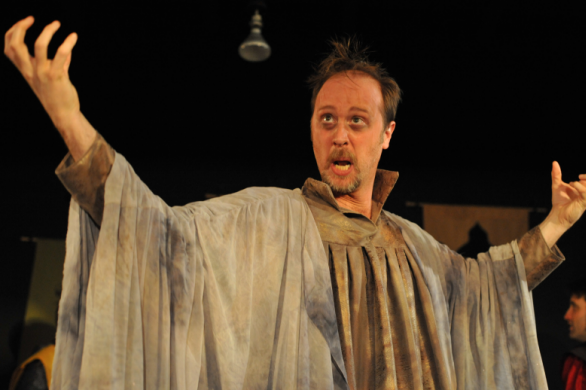 Gloom Mage If you’ve a predilection for wizards and heroes, sword fights and a princess who happens to be a bat, you’re going to love this, but first you’ll need to disabuse yourself of any Arthurian preconceptions. In a tale that caters to the funny bone – where knights sport Lurex and carry logoed lunchboxes, the Red Knight (Christopher Herring) is the hero crusader. His mode of conquering his kingdom’s foes is to shower them with absurd compliments until they surrender to his charms. He and his brother Prince Richard (Kyle McGruther) must seek revenge on Lord Fango (Charles Boyington) and his vampire Bat People for the murder of their father, King Marthur. But the nefarious Lord Fango has dire plans of his own and captures the bumbling Prince Richard, tossing him into the dungeon and forcing the Red Knight to go on a quest with the aid of The Gloom Mage (John Stange) an untrustworthy sorcerer while Fango tries to marry off his pretty but blood-sucking daughter Fanglett (Katie Zitz) to the Red Knight in order to produce an heir. Got it? Bring on the Fertility Mages!
Three hapless Bat Guards in thrall to Fango and a trio of colorful knights – Yellow, Green and Blue – faithful to the brothers, keep the swords clacking throughout. Boyington plays Fango to the hilt with a performance, and a physical appearance, reminiscent of Austin Powers’ Dr. Evil and Flash Gordon’s Ming the Merciless. Fanglett, the only female in the production, sums it up nicely. “It was suggested that the playwright struggled with writing fully developed female characters.”
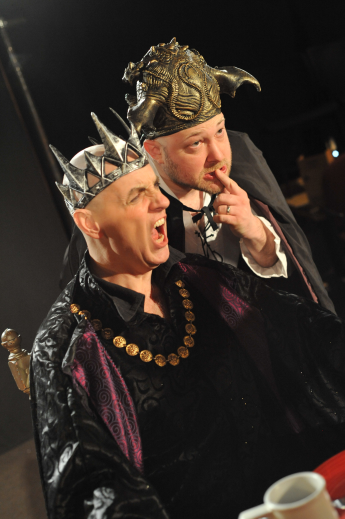 Lord Fango & Bat Guard The madcap adventure features a Narrator, an adorably silly court jester, played captivatingly by Stephen Mead, who in Richard’s words, “does this stupid bit where he says what everyone is doing”. This device is of particular assistance to the audience in order to keep the mayhem sorted out for those of us who are reeling from the sorcery, wizardry, teleportation and passel of knights in this over-the-top comedy top-loaded with a constant stream of puns (“good cop, bat cop”) and double entendres.
I’d advise suspending logic – a suggestion that comes too late for one of the tykes behind me who remarked, “But, Daddy, you can’t turn a man into a bowl!”
Fun for children and grownups who still are.
At Port City Playhouse at The Lab at Convergence, 1819 North Quaker Lane, Alexandria, VA 22302. Remaining performances are on the following dates – February 1, 7, 8, at 8:00 p.m. Matinees on February 1 & 8 at 2pm. For tickets and information visit www.portcityplayhouse.org.
Jordan Wright
January 28, 2014
Special to The Alexandria Times
 Siân Phillips as Lady Bracknell in the Shakespeare Theatre Company’s production of The Importance of Being Earnest, directed by Keith Baxter. Photo by Scott Suchman. It is always satisfying to while away the hours at the theater, but it is most especially pleasurable to let playwright and poet Oscar Wilde remind us of the imbroglios of the Upper Class in Victorian England. In this delightful piece of froth we are allowed a glimpse behind the looking glass of London society.
Algernon Moncrieff is a terminably bored dandy with a grand sense of getting up to no good. His avatar is a naughty character he calls “Bunbury”. Algy’s equally ne’er-do-well friend Jack Worthing, trumps himself up as “Earnest”, a man caring for a beautiful young ward, Cecily, whose care has been entrusted to him by a relative.
 Gregory Wooddell as Jack and Vanessa Morosco as Gwendolen in The Importance of Being Earnest, directed by Keith Baxter. Photo by Scott Suchman. The merriment begins when Algy’s aunt, Lady Bracknell and her niece Gwendolyn Fairfax arrive at his fashionable West End home for a visit. When Jack declares his intention to marry Gwendolyn, who prefers the name Earnest, “It produces vibrations,” she admits, the frolic begins. Lady Bracknell, who delivers all of her high-minded remarks as pronouncements, feels it is her duty to grill him on his social standing. Discovering that he was a foundling discovered ignobly in a railroad station, she gives him short shrift, despite his fortune.
When Algy races off behind his friend’s back to woo Cecily, he portrays himself as Earnest too. Cecily assures him that she too could only marry a man named Earnest to which he replies, “What if my name were Algernon? It’s a very aristocratic name. Half the chaps that get into bankruptcy courts are named Algernon!” Yet both she and Gwendolyn remain firm in their convoluted determination.
 Gregory Wooddell as Jack and Patricia Conolly as Miss Prism in The Importance of Being Earnest, directed by Keith Baxter. Photo by Scott Suchman. The how, when, and wherefore of the gentlemen’s love lives may be what turns the plot. But it’s the steady repartee, quaint in its moralistic rhetoric and added to the hilarious misunderstandings, that renders the play irresistible. Forgetfulness is referred to as “mental abstraction” and arguments are considered “vulgar and often convincing”. It’s a topsy-turvy Wodehouseian world.
Sian Phillips, a veteran of the BBC’s “I, Claudius” series, imbues Lady Bracknell with the steely demeanor of a true Victorian matriarch; Anthony Roach crafts a delightfully whimsical Algernon; Gregory Wooddell plays Worthing effortlessly and Patricia Conolly, as Cecily’s governess, the self-righteous Miss Prism, creates the perfect foil for the rest of the cast.
Flawless and fabulous.
Though March 9th at the Lansburgh Theatre, 450 7th Street NW, Washington, DC 20003. For tickets and information contact the Box Office at 202 547-1122 or visit www.shakespearetheatre.org.
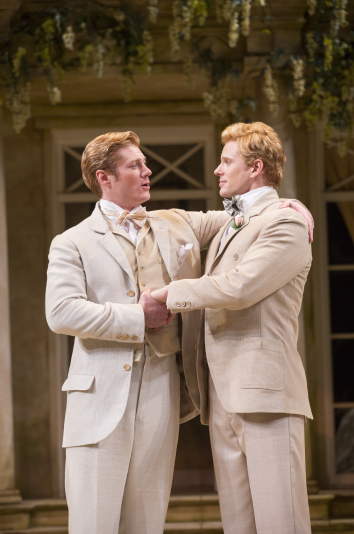 Gregory Wooddell as Jack and Anthony Roach as Algernon in The Importance of Being Earnest, directed by Keith Baxter. Photo by Scott Suchman.
Jordan Wright
January 27, 2014
Special to The Alexandria Times
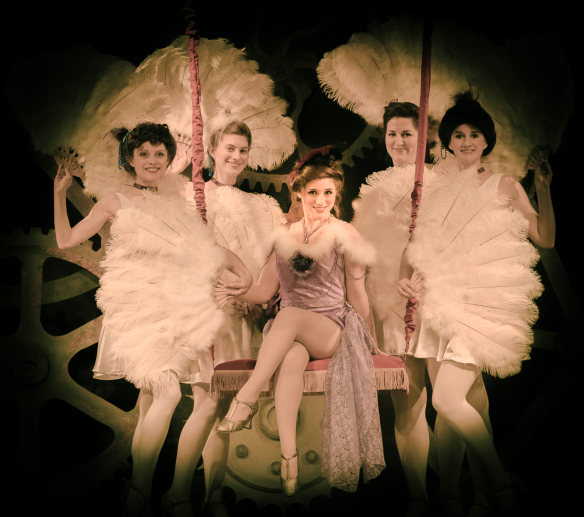 “Crime of the Century” featuring Dana Cass, Sarah Gale, Claire O’Brien, Holly McDade, and Rebecca Phillips – Photos by Keith Waters for Kx Photography Thirty-seven performers make up the tremendous ensemble in this touching story of intersecting lives. Set in the early part of the 20th century author E. L. Doctorow focused his novel on three distinct elements of American society – – Black America, on the rise as a strong middle class in Northern cities, middle and upper class White America, and Jewish immigrants bent on hard work and assimilation to their new found country. The Little Theatre of Alexandria has chosen Director Michael Kharfen to express a story where Terrence McNally’s book blends so beautifully with Lynn Ahrens lyrics and Stephen Flaherty’s music.
The characters here are familiar to us all. There’s capitalist foe and union organizer, Emma Goldman, a reformer from the days when child labor was the norm and harsh working conditions prevailed; Harry Houdini, the Jewish immigrant who became the world’s most famous magician; and Evelyn Nesbitt, the great beauty who carved out her vaudeville career on a velvet swing while paramour to a millionaire. Iconic Americans Booker T. Washington, the great African-American orator and Presidential advisor, the financier J. P. Morgan and even Henry Ford make cameos in this story too. In Doctorow’s sweeping saga of the landscape of America, ordinary people become extraordinary people as their lives intersect and they are tested for their capacity to love.
It harkens back to the turn of the 20th Century, a time when ladies of a certain class carried parasols and wore stiff corsets under voluminous dresses. Ragtime music was sweeping the country and a certain Coalhouse Walker, Jr. (Malcolm Lee) a Scott Joplin avatar, was creating a new sound that crossed over into White high society.
Father is off on a polar expedition with Admiral Peary when Mother discovers a Black newborn abandoned in her garden and goes about finding the boy’s mother. “I never thought they had lives besides our lives,” she confesses while searching for the indigent unwed mother. When at last she and her son Edgar find Sarah (Aerika Saxe), she offers Sarah the comfort of their home – – allowing her humanity to overtake her Victorian rigidity.
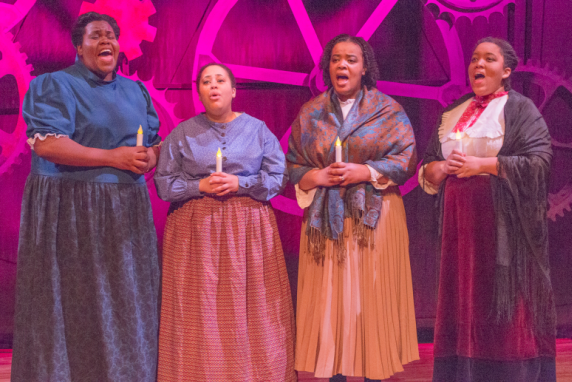 “Harlem Women” featuring Kadira Coley, Tiara Hairston, Corisa Myers, and Jessica Pryde – Photo credit Keith Waters Shaun Moe plays the stiff Victorian era “Father” secure in his position and his marriage. Jennifer Lyons Pagnard is “Mother”, a wife learning to have her own say.
Scenic designer J. Andrew Simmons has created a dramatic Industrial Age backdrop of massive connecting clock gears to express the passage of time, while scene changes are cleverly accomplished by painted panels that unfurl from the rafters to denote a sense of place. The Lighting Design team of Ken and Patti Crowley sets the tone with a wide array of colors and effects to change the mood and heighten the drama.
Known as one of the most important musicals ever to grace Broadway, this production does the author’s material (twenty-eight brilliant tunes!) justice with a strong and interconnected cast who sing their faces off. Jennifer Lyons Pagnard demonstrates that she can infuse a leading role with fresh vigor much as she did as Mrs. Lovett in Sweeney Todd for which she won “Best Leading Actress in a Musical” with a WATCH Award last year. The ensemble’s voices reflect the powerful emotions of this poignant story of hope, redemption, human rights and a call for justice. Of particular note is the exquisite voice of “Sarah’s Friend” played by Corisa Myers who does a brief but deeply affecting solo turn in “When We Reach That Day”.
There is a beautiful flow to the dancing choreographed by Ivan Davila. Keep an eye peeled for Sherrod Brown who is a standout.
The Little Theatre has taken on one of its most ambitious productions to date with Ragtime and from the “Sold Out” sign on press night, it’s already proven to be a great success.
Through February 15th at The Little Theatre of Alexandria, 600 Wolfe Street. For tickets and information call the box office at 703 683-0496 or visit www.thelittletheatre.com
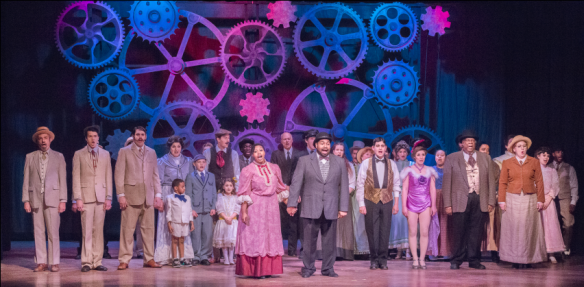 The Ragtime Cast Photos credit Keith Waters
Jordan Wright
January 21, 2014
Special to The Alexandria Times
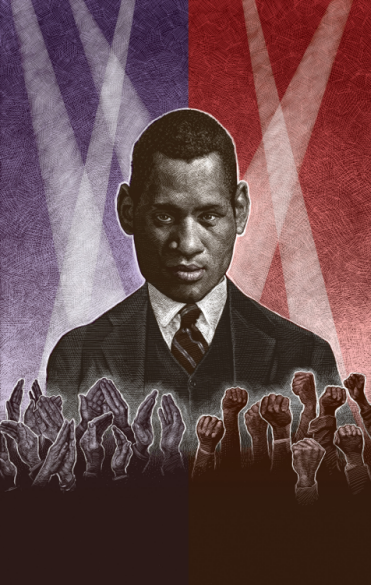 The Tallest Tree in the Forest. Illustration by Ricardo Martinez. Paul Robeson is a name that many may not recognize in modern day America. If you’re among those wracking your brain to recall his legacy, you can thank J. Edgar Hoover who did everything in his considerable power to erase the memory of this brilliant performer in the American conscious. In Arena Stage’s latest production, The Tallest Tree in the Forest, the reason becomes very clear as to why one of our once most lauded African-American icons is remembered by so few.
For Actor/Playwright Daniel Beaty, the history and legacy of Robeson has become a mission – – for Director Moises Kaufman, who originally commissioned this one-man show as its Artistic Director, its page-to-stage reality is a dream come true.
As the show opens Beaty enters from the top of what appears to be a backstage fire escape leading down to a simply dressed stage. He is singing “Ol’ Man River”, the great Negro ballad penned by Jerome Kern and Oscar Hammerstein for Showboat, the iconic production that was Robeson’s Broadway debut. Beaty’s voice is a rich bass-baritone, deeply etched with emotion and suffering, a true reflection of the artist. There will be twelve more songs, plucked from the pantheon of Negro spirituals and Harlem heyday Jazz tunes, to echo the highlights of Robeson’s life and career.
Robeson was a big man in every way. The famous educator and Civil Rights leader, Mary McLeod Bethune, once referred to him as “the tallest tree in the forest”, and it stuck. Well respected as a stage and screen performer, he was also known as a scholar, an athlete and political activist, and to his enemies, a “firebrand”.
Early New York friends with connections to the theatre led him to a life on the stage. And there he might have stayed, if not for his commitment to use his celebrity to fight for human rights and against racism. His experiences put him in solidarity with the oppressed who found a sympathetic voice in Robeson, who had been Valedictorian of his class at Rutgers University where he was their first African-American graduate – – the outspoken student later receiving his law degree from Columbia University. Later, through his worldwide concert tours, he used his influence to rally for social change wherever he went.
In Lenin’s idyllic Bolshevik Russia of the 1920’s, where he witnessed Blacks, Jews and Chinese working together for under Communism, he claimed to have experienced real freedom. “For the first time in my life I was treated as a man. Not just as a Negro,” he would say, though he found things quite different during Stalin’s reign.
The music in this production played by Pianist/Conductor Kenny J. Seymour and backed by two musicians on multiple instruments is rich with meaning and the history of Black America’s struggle. “Go Down Moses”, “Battle of Jericho” and other powerful spirituals echo the pre-Civil Rights era and serve to highlight Robeson’s life and times.
When he brought his experiences and idealism back to America in the early 1950’s he came up hard against Hoover and McCarthyism and the “Red Scare”, a repressive movement that was just beginning to gain steam in tandem with Robeson’s powerful ascent as an activist and performer. Outspoken and fearless, he was branded a traitor. Ultimately it was his unapologetic stance at the House Un-American Activities Committee’s trials that blacklisted him destroying his reputation and costing him his career. “The artist must take sides. He must elect to fight for Freedom or for Slavery,” he had declared.
Beaty plays 40 different roles in this riveting production, segueing effortlessly from male to female, black to white, young to old, and American to foreigner, imitating his family, friends and considerable enemies. Told through sketches and vignettes, the course of Robeson’s life and career are highlighted by projections from actual newsreels of the day. You’ll revel in Beaty’s Robeson, as complicated and vibrant and larger-than-life as the man himself.
Highly recommended.
Through February 16th at Arena Stage, 1101 Sixth St., SE, Washington, DC 20024. For tickets and information call 202 488-3300 or visit www.ArenaStage.org
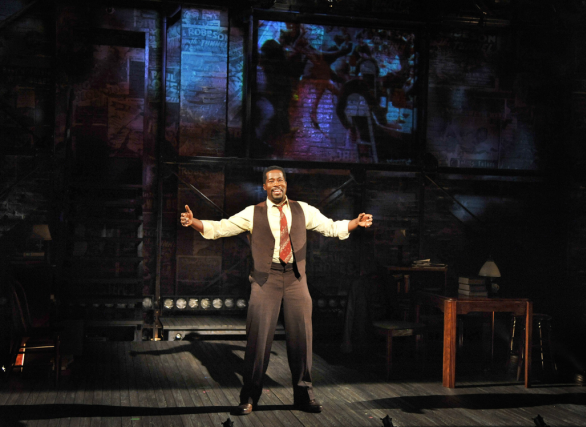 Daniel Beaty as Paul Robeson in Tectonic Theater Project’s The Tallest Tree in the Forest. Photo by Don Ipock.
Jordan Wright
January 13, 2014
Special to The Alexandria Times
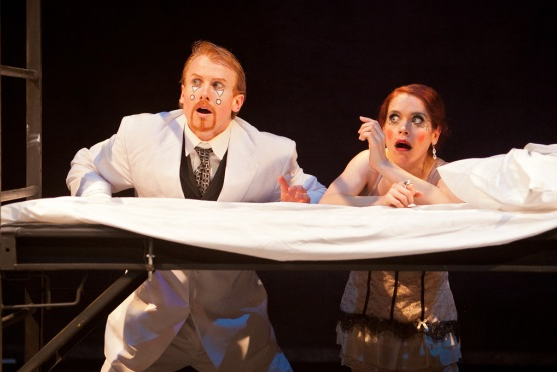 Philip Fletcher as Orsino and Kathy Gordon as Olivia. Photo by Koko Lanham. If you’re planning on seeing Twelfth Night, the tenth production in Synetic Theater’s “Silent Shakespeare” series, you’d better dust off your Shakespeare. Because though the plot is predictable, this production will not recall any Shakespeare play in theatre history. In a drop dead fabulous re-interpretation of the 1920’s movie era, Director Paata Tsikurishvili has chosen a cinematic theme as his unconventional backdrop for pantomime, slapstick, killer dance sequences and a highly eclectic music score.
Picture a movie set replete with klieg lights, pulleys, ladders, a giant scrim, a camera dolly, and vintage Moviola editing equipment. On stage left there’s an upright piano concealing a secret bar and Scott Joplin rags play on a Victrola. It’s the Roaring 20’s when the Charleston was king, Chaplin ruled the silver screen, and the Lindy Hop lured partiers high on bathtub gin onto dance floors across America.
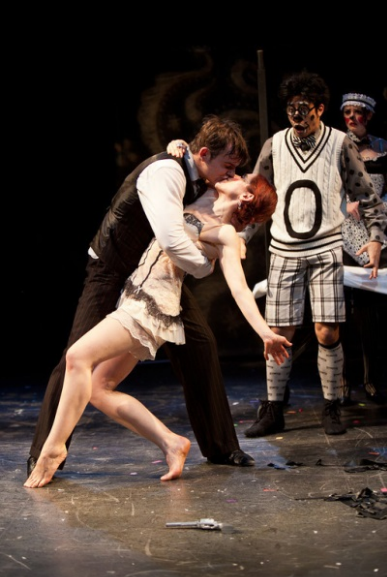 Alex Mills as Sebastian, Kathy Gordon as Olivia and Dallas Tolentino as Sir Andrew Aguecheek. Photo by Koko Lanham Scene One opens with two white-faced clowns in their satins arguing in mime over the Twelfth Night script. The lead clown, a sort of John Huston/Orson Welles mashup, is the director of this film-within-a-play who cuts the action with his clapperboard. Along with his comic cohort they monitor the performers, while seeming to capture the action on film.
And what action it is. Jazz Age flappers cavort with drunken Casanovas in zoot suits and, as per Shakespeare’s best follies, the characters’ intentions get pretty well muddled up. Subtle references translate into major devices as in a complex number in which the dancers become entrapped in an unspooling reel of film. The use of the large scrim to separate the scenes is clever, but when it’s used to show occasional quotes from the play, projected in the style of the silent film era as intertitles, the words often become obstructed by the actors and props and ultimately serves only as a distraction.
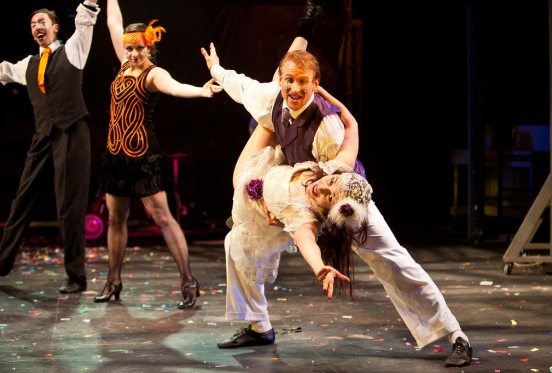 Philip Fletcher as Orsino and Irina Tsikurishvili as Viola. Photo by Koko Lanham. Assistant Director/Music Director Irakli Kavsadze has selected some astonishingly varied pieces to accompany the dancers. I recognized “Santa Lucia”, “Yes, Sir! That’s My Baby!”, “It Don’t Mean a Thing (If it Ain’t Got that Swing)” and even the “Mexican Hat Dance” tossed in among jazz era tunes, classical music, opera, and an original score by award-winning Composer Konstantine Lortkipanidze.
Set Designer Phil Charlwood and Lighting Designer Colin K. Bills have meticulously channeled the era placing Viola (Irina Tsikurishvili), Orsino (Phillip Fletcher), Malvolio (Irakli Kavsadze), Olivia (Kathy Gordon), Feste (Ben Cunis), Sebastian (Alex Mills), Sir Toby Belch (Hector Reynoso), Fabian (Vato Tsikurishvili), Maria (Irina Kavsadze), and Sir Andrew Aquecheek (Dallas Tolentino) into this stylishly romantic farce. The cast is beyond marvelous – – utterly in synch and balance. You’ll see no scene-stealers here, though Fletcher’s Orsino is perhaps the most adorably absurd of the Lotharios.
Costume Designer Kendra Rai punctuates the theme using a black, white and silver palette to convey the dazzling period.
Highly recommended.
Through February 16th at Synetic Theater, 1800 South Bell Street, Arlington in Crystal City. For tickets and information call 1-866-811-4111 or visit www.synetictheater.org.
|