Inherit the Wind at Arena Stage Defies Gravitas
Inherit the Wind
Arena Stage
Jordan Wright
March 20, 2026
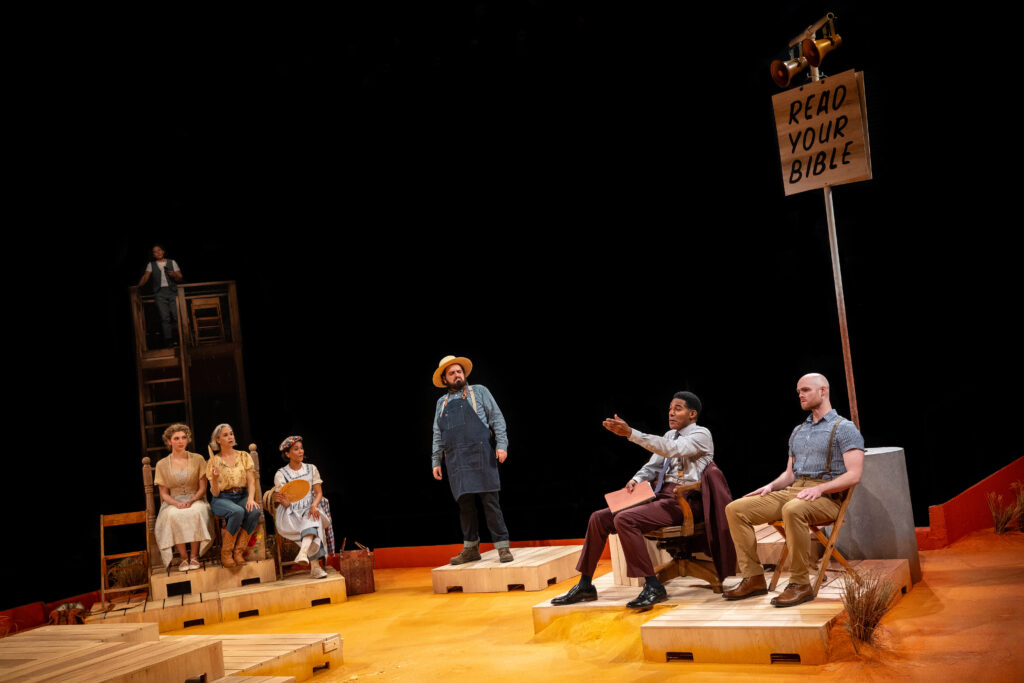 The company of Inherit the Wind at Arena Stage. (Photo/Daniel Rader)
In a time when political tensions couldn’t be more fraught and the country seems to be devolving into fearmongering and racist stereotypes, a new staging of Inherit the Wind opens at Arena Stage. Just when we need to remind our citizenry that the bravest of activist attorneys bucked the Old Guard while the bell was tolling, along comes a corny version of one of America’s most important legal cases – one which defined the country’s identity, forced a sea change in the laws of the land and elevated an unknown White attorney to historic legal prominence.
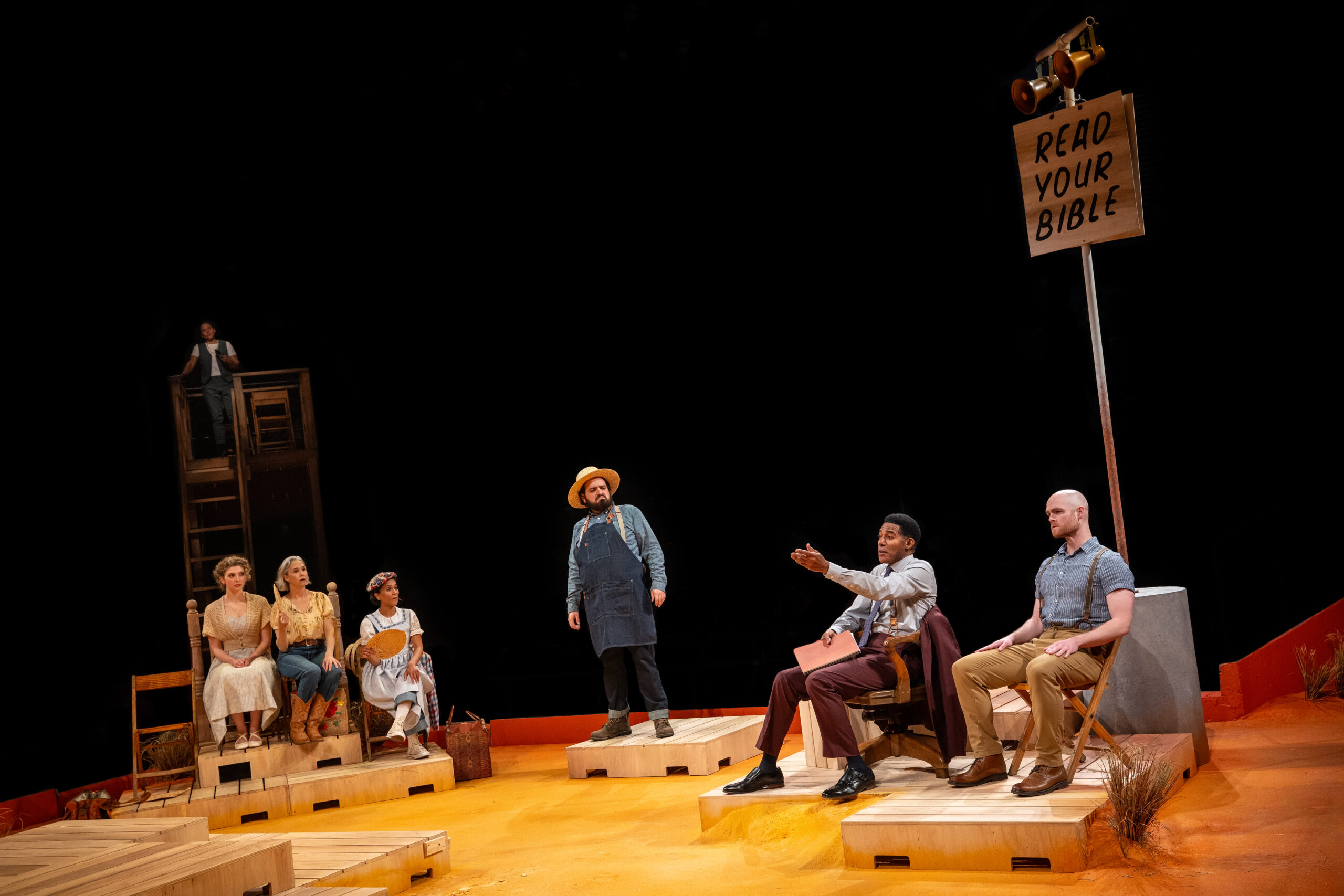
Unfortunately, this version seems to downplay its significance or, shall I say, highlights comedy over a transformative national event. I felt as though I was at a hoedown instead of a courtroom. Haystacks, swaths of white fabric indicating a tent revival, and light-colored wooden pallets form the spare set, serving as the only visual aids. Costumes are more in line with Minnie Pearl’s straw hat, while musical interludes serve only to denigrate the weight of the subject matter.
 Noah Plomgren (Cates) and Billy Eugene Jones (Drummond). (Photo/Daniel Rader)
Where am I? Why, Ma! Pa! it’s Hokey Land in Hee-haw County where ordinary country folk are depicted in an insulting and insensitive manner. We count on Arena to deal fairly, or humorously, in the most salient political issues and to present a thinking person’s wakeup call when necessary. And it is necessary now. The importance of the Scopes trial of Darwinism (i.e. accepted science) versus a Tennessee backwoods, church-driven, moralistic position is not a topic to make light of – – most especially today when the country’s intellectuals, artists and scientists are under siege and pitted against bible-toting Christian fundamentalists eager to return to the Dark Ages.
In its favor is a willingly flexible cast who take on numerous roles and multiple quick costume changes in earnest. Standout performances by Broadway royalty Billy Eugene Jones as Drummond in the Clarence Darrow role, Noah Plomgren as Cates the reluctant defendant, Dakin Matthews as Brady the Prosecutor, and Alyssa Keegan as the Baltimore journalist covering the trial, elevate what could have been, and should have been, one of the most important and timely plays of the season.
 Dakin Matthews (Brady), Rebecca Madeira (Rachel), and the company of Inherit the Wind. (Photo/Daniel Rader)
If only the fabulous and brilliantly choreographed Chez Joey had been done in the round in the more expansive Fichandler Stage, and this production been mounted in the smaller, more intimate Kreeger stage, switching the theater spaces, I think it might have come off better. Then again, maybe not, when the gravitas of this play is drowned out by pure unadulterated cornball.
With Rebeca Madeira as Rachel; and Jordan Friend, Natalya Lynette Rathnam, Todd Scofield, Tristan Turner and Holly Twyford fulfilling the ensemble’s multiple roles.
Written by Jerome Lawrence and Robert E. Lee and directed by Ryan Guzzo Purcell. Set Design by Tanya Orellana; Costume Design by An-Lin Dauber; Lighting Design by Xavier Pierce; Composer & Sound Designer Paul James Prendergast.
Through April 5th at Arena Stage, 1101 6th Street, SW, Washington, DC 20024. For tickets and information call the box office at 202.488.3300 or visit www.ArenaStage.org.
You’ll Laugh, You’ll Cry with the Families of Fremont Ave. at Arena Stage
Fremont Ave.
Arena Stage
Jordan Wright
October 21, 2025
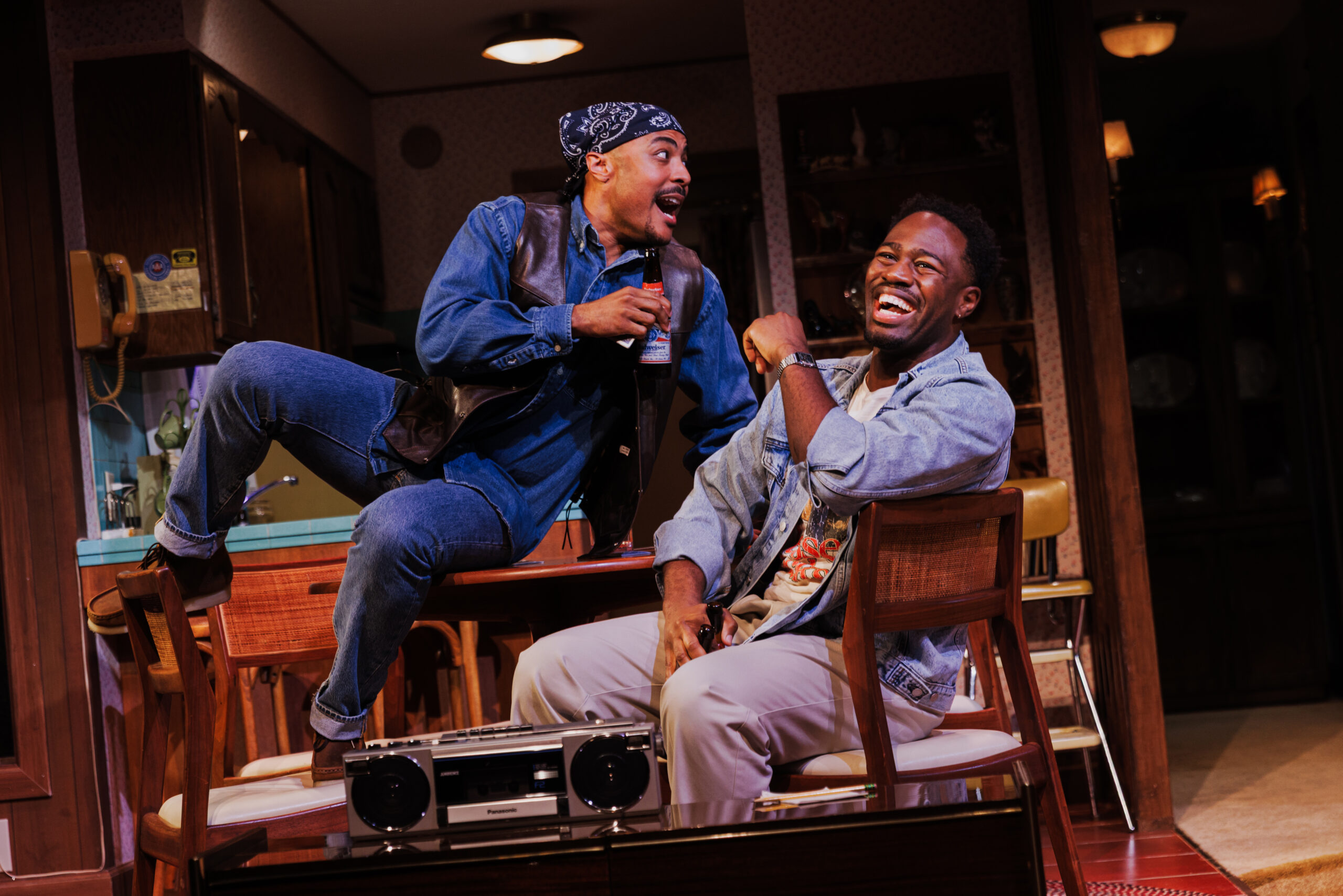
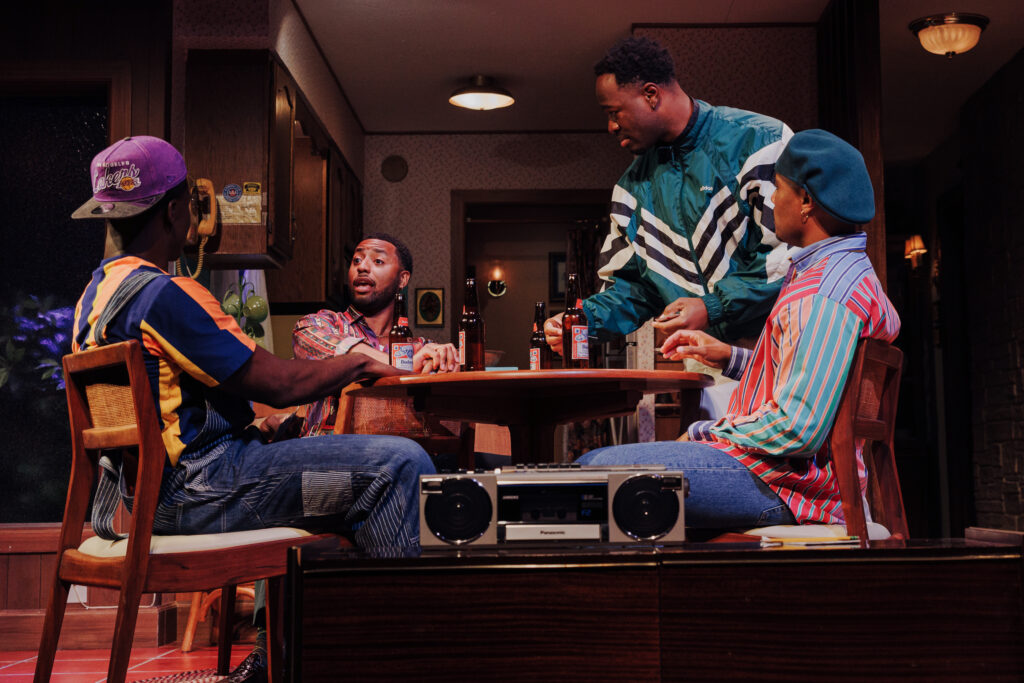 Bradley Gibson (George/Robert/Joseph), Stanley Andrew Jackson (Walter), Wildlin Pierrevil (Frank), and Jeffrey Rashad (Tony) in Fremont Ave. at Arena Stage. (Photo/Marc J. Franklin)
Reflect on any TV all-Black cast comedy series, then go deep, then deeper. In a richly complex and cleverly funny three-generational play, we meet George, a newly rich, music therapist with a PhD living in his mid-century modern home. It’s 1968 and George is living alone. He’s interviewing a woman in his living room, barely furnished save for an upright piano. During an overly familiar conversation (Audrey is there for a housekeeping position), he tells her his personal story and propositions her. Audrey tells him she’s married with a son, and he lets it drop… temporarily. He plays “Blue Skies” for her, and they cuddle. Things happen quickly. He hires her, she divorces her husband and marries George. There are three acts and three generations to follow, so it all kicks off with a bang.
Playwright Reggie D. White, who is also the Senior Director of Artistic Strategy and Impact at Arena Stage under Artistic Director Hana S. Sharif, wrote Fremont Ave. based on conversations with his own family. It is raw, humorous, honest and believable – a real-life reflection of one family living in a Southern California suburb and a truth-telling world premiere production affording an insightful glimpse into the impossible struggles and indelible bonding within these African American families.
When the next generation appears, we are introduced to four young Black lawyers who speak in street jive when they hang out together. George’s stepson, Robert, plus the children of George’s friends and family who have become best friends. As they convene, they reference Loving v. Virginia – the seminal civil rights case in which bans on interracial marriage were found to be unconstitutional – and news of the Rodney King beating comes on the radio. The political references hit hard, and you begin to sense both the stresses and successes in their young lives.
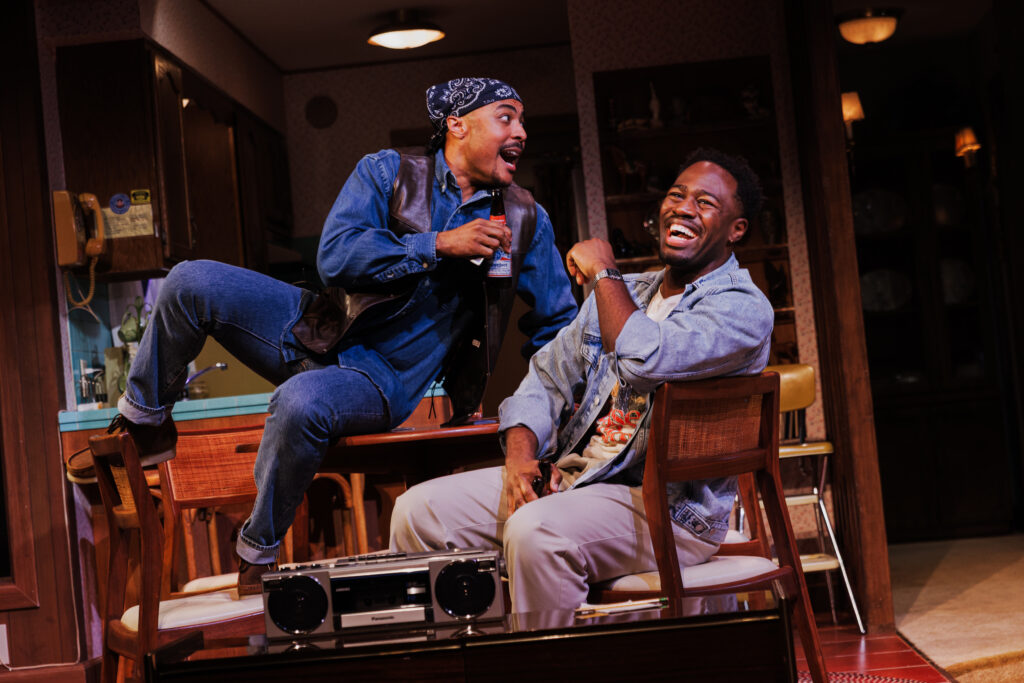 Jeffrey Rashad (Tony) and Wildlin Pierrevil (Frank). (Photo/Marc J. Franklin)
As the music switches to Rap, the men drink, play cards, trash talk and dance to the latest hits. Robert is despondent. He has failed to pass the bar exam – nine times – and he feels he is letting down his father as well as his friends. Interspersed with the hilarity and the drama are musical snippets reflecting each generation. These transitions mirror the changing cultures and each generation’s tastes. From George composing on the piano or playing the hits to serenade Audrey, to the men breakdancing to the sounds from a boombox in the 1990’s, to the youngest generation busting moves in the 2020’s.
In the final act, when the third generation is introduced, we meet Damon, Walter’s son and Joseph’s significant other. They fight and love and stretch the dynamic to the nth degree. It’s explosive, raw, R-rated and wildly hilarious as the three generations assemble to show wisdom, tolerance, acceptance and faith.
There are fine performances by the entire cast who infuse their characters with distinctly engaging personalities. I wished Audrey’s character had a greater part – Jerrika Hinton was terrific. Credit to the brilliant direction of Lili-Anne Brown for this seminal piece.
 Bradley Gibson (George/Robert/Joseph), Doug Brown (Older George), Kevin Mambo (Older Robert), and Galen J. Williams (Damon). (Photo/Marc J. Franklin)
This flawless cast stars Bradley Gibson as George/Robert/Joseph; Jerrika Hinton as Audrey/Voice of Hazel; Wildlin Pierrevil as Frank; Jeffrey Rashad as Tony; Stanley Andrew Jackson as Walter; Doug Brown as Older George; Kevin Mambo as Older Robert; Galen J. Williams as Damon.
Directed by Lili-Anne Brown; Set Design by Tim Mackabee; Costume Design by Jos N. Banks; Lighting Design by Kathy A. Perkins; Original Music and Sound Design by André Pluess; Wig and Hair Design by LaShawn Melton; Assistant Director and Intimacy Consultant, Greg Geffrard. Original Song “Somewhere Someone’s Waiting Just for You” by George R. Plick, Sr.
A conversation for the ages. You’ll laugh. You’ll cry. You’ll identify with these real-life personal stories.
Through November 23rd at Arena Stage, 1101 Sixth Street, NW, Washington, DC. For tickets and information call the box office at 202.488.3300 or visit www.ArenaStage.org.
Arena Stage’s Sensational Revisal of Damn Yankees Hits It Out of the Park
Damn Yankees
Arena Stage
Jordan Wright
September 21, 2025
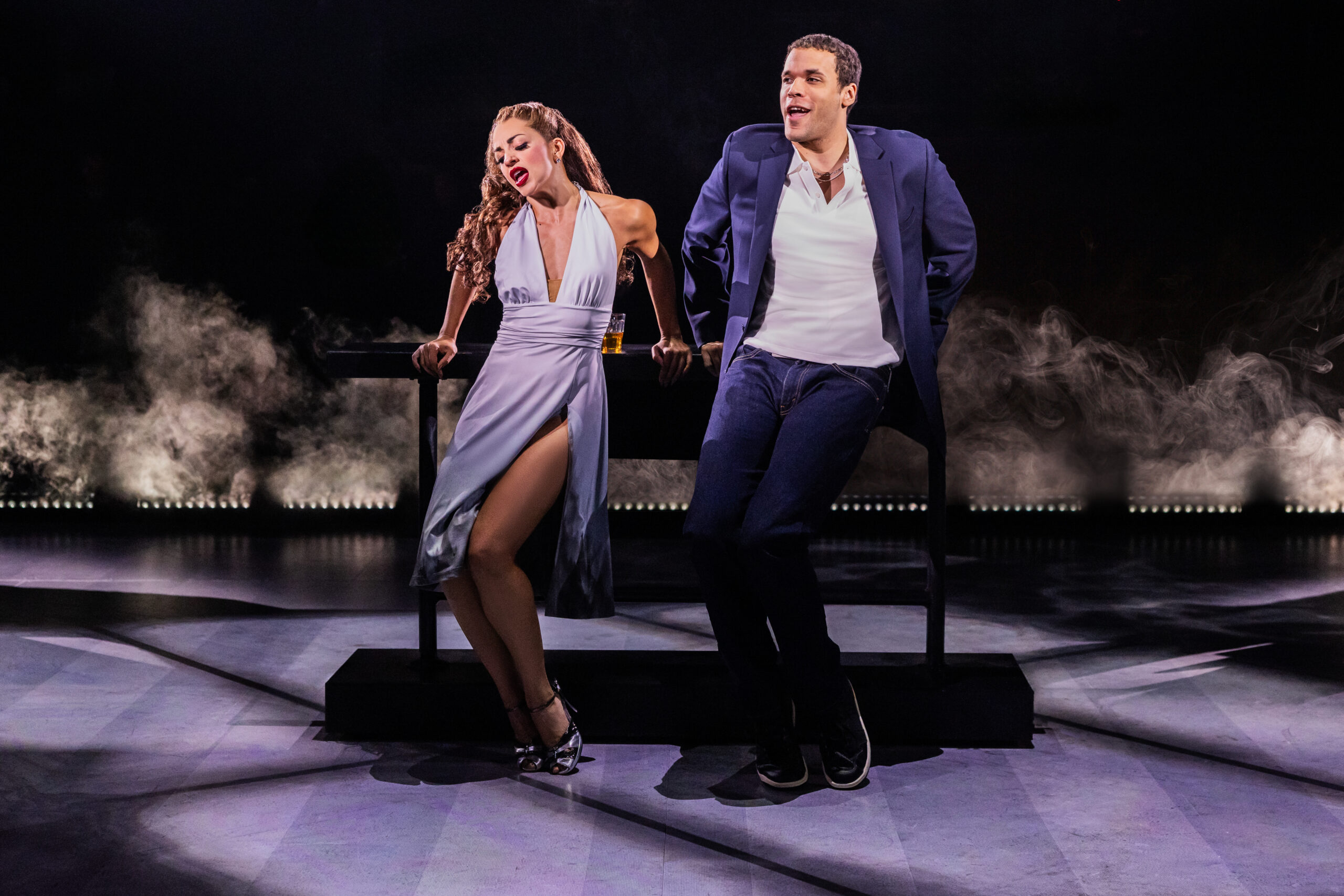
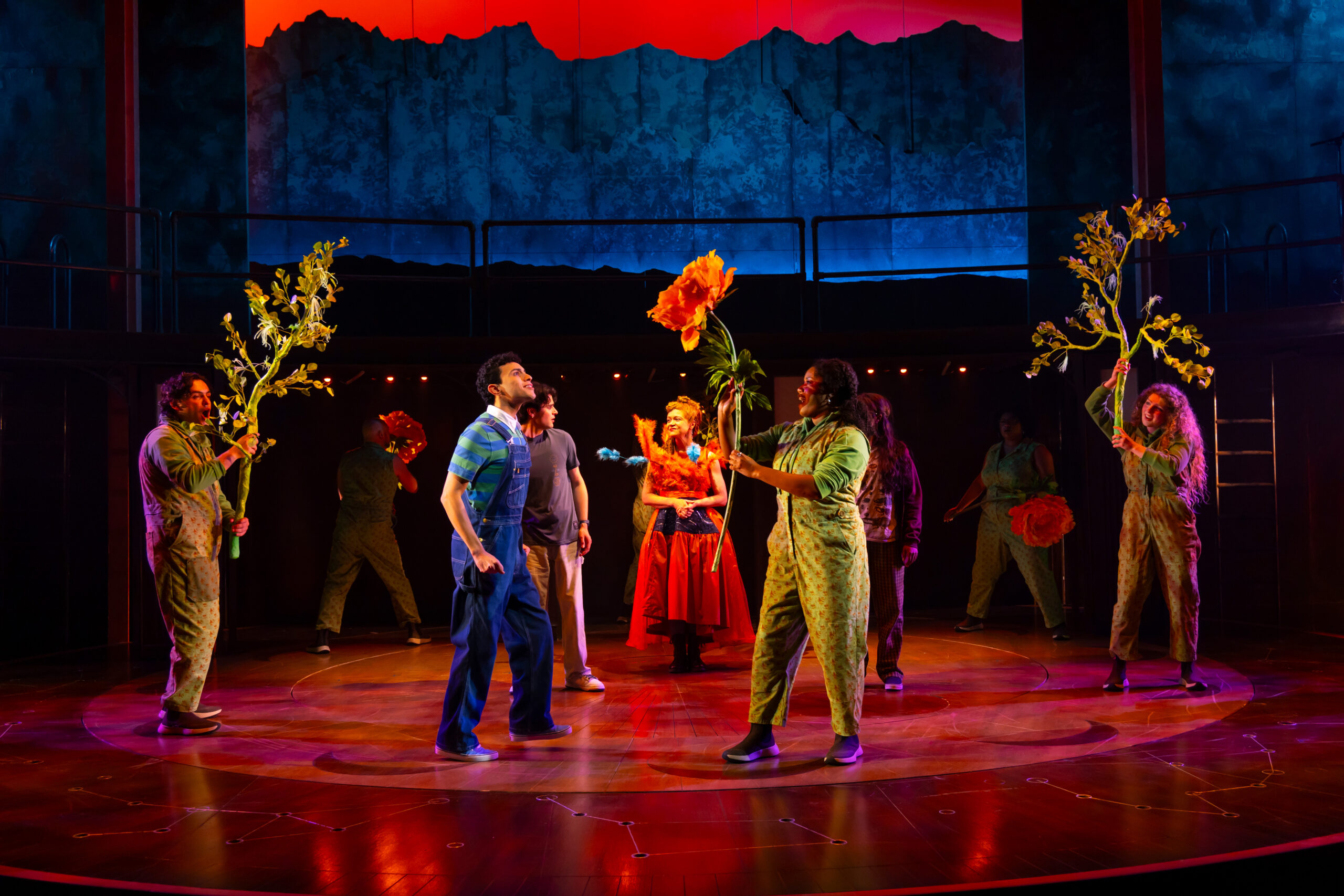
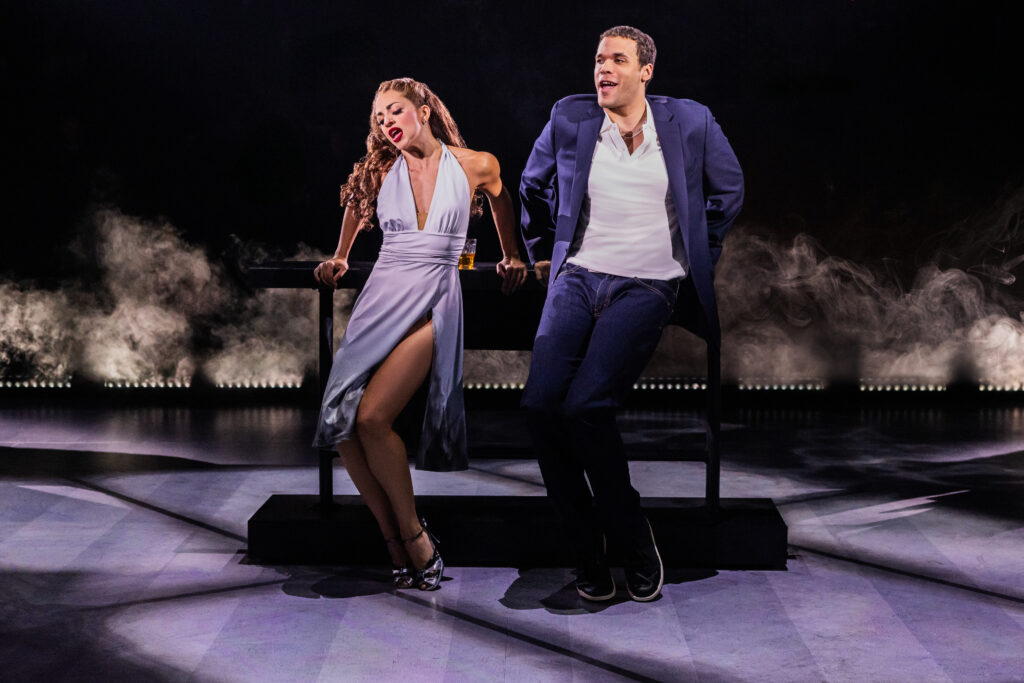 Ana Villafañe (Lola) and Jordan Donica (Joe Hardy) in Damn Yankees at Arena Stage. (Photo/Matthew Murphy and Evan Zimmerman)
Call it a “revisal” as Artistic Director Hana S. Sharif did on opening night or call it a revival which those familiar with the 1955 musical might say. Whatever term of art you choose, I recommend getting off the bench now, because there was a ‘producers’ performance’ last week and there is a hot chance it will go to Broadway, so you can say you saw it here first.
Remember Dear Evan Hansen? It started its B’way journey at Arena Stage. So did groundbreaking shows such as The Great White Hope, Sweat, Next to Normal, Looped and A Night with Janis Joplin. Celebrating its 75th Anniversary Season, Arena has always been a nexus for groundbreaking theatrical exploration.
So, why revive Damn Yankees? It’s simple. Do not doubt the power of a story about baseball, the devil, a sexy siren with a conscience, a loving wife and a desire to be more than your past all underpinned by a brilliant score. This fresh reimagining brings heavy hitters to the stage. Will Power and Douglas Wallop collaborated on the adaptation and Lynn Ahrens brightened original composers Richard Adler’s and Jerry Ross’ music and lyrics with modernized lyrics and slips in a few snappy zingers to reflect our fraught political times. Not only does this iteration have an exceptional cast (more on that later) but its staging dazzles in every way. From special effects and lighting to video projections, clever illusions and choreography, it absolutely slays.
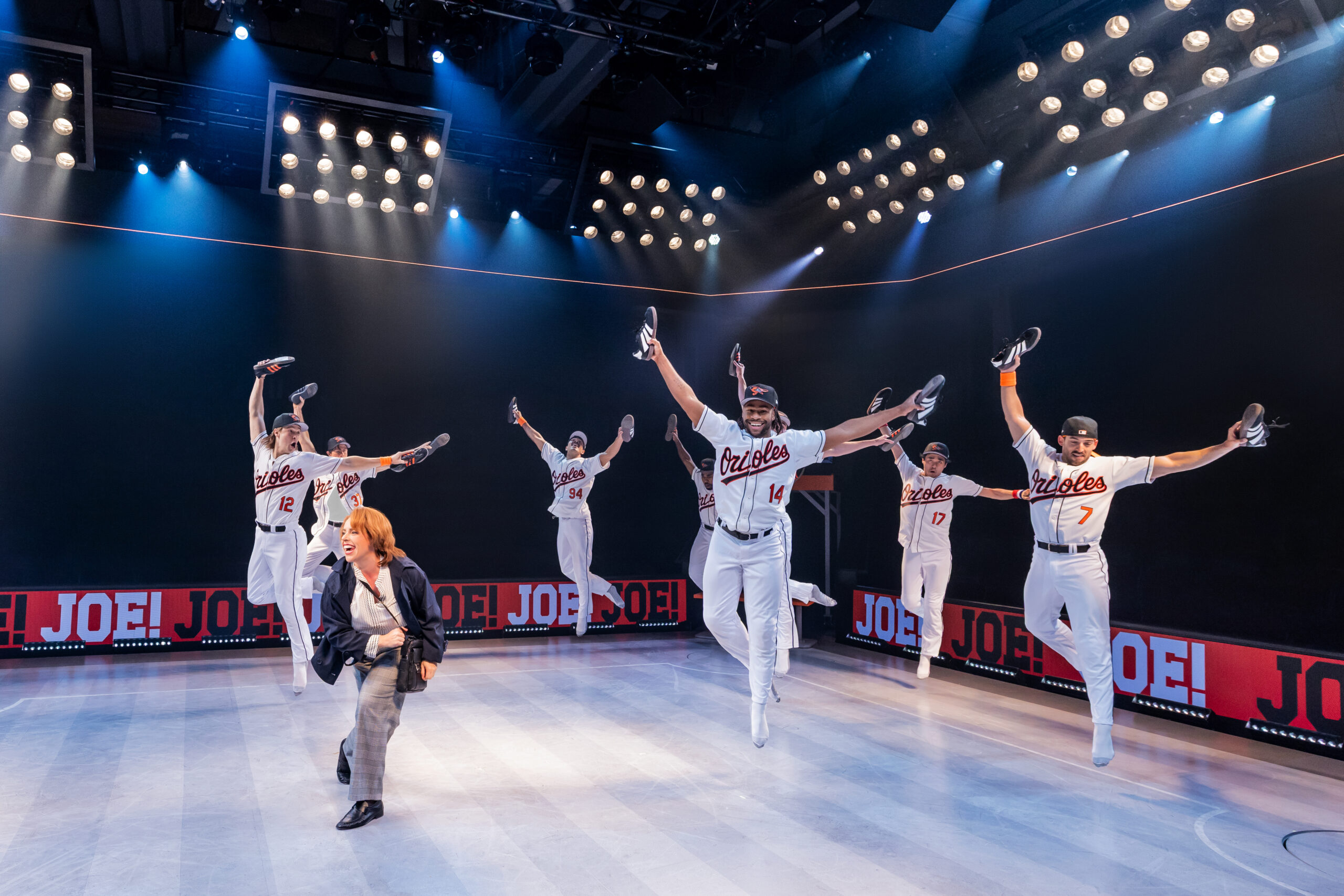
One of the script tweaks here is in the original production the team was the Washington Senators. They’re now the Baltimore Orioles. Look for the “Oriole Bird” who makes a brief onstage appearance to pump up the audience. As Applegate wisecracks, “Baltimore is like Newark, but with crabs.”
There are plenty of sports franchises who regard athletes’ agents as the devil incarnate. Here the devil is Applegate, – a con artist, evil grifter and all-around hustler who convinces our hero, Joe Boyd, to sell his aging body and leave his wife to become a star slugger with the Orioles. “And that’s why it’s called the art of the deal,” Applegate tells Joe. Joe’s dad had suffered racism in professional baseball when Black players could only play in the Negro leagues until Jackie Robinson broke the color barrier to play for the NY Giants in 1955. Joe is determined to right this wrong and avenge his father’s limited career. His impulse becomes a powerful motive for his decision to sell his soul to Applegate.
 Rob McClure (Applegate). (Photo/Matthew Murphy and Evan Zimmerman)
To convince Joe, Applegate enlists his wily partner Lola, who is as convincing as a henchman with a shiv and as alluring as whipped cream on a banana split. As Lola sings in the tango number when she seduces Joe, “Whatever Lola Wants”, she gets.
Applegate is played wicked slick by Broadway veteran Rob McClure known for roles in Mrs. Doubtfire and Beetlejuice. The diverse cast includes a hunky-hot chorus of ballplayer dancers delivering extra sizzle and swing alongside the notorious siren, Lola, played by luscious Broadway star Ana Villafañe known for her award-winning roles of Gloria in B’way’s On Your Feet and Roxie in Chicago. Young Joe Hardy is played by the extraordinary Jordan Donica a baritenor with superb range and movie star looks who will steal your heart if you let him. I did. Quentin Earl Darrington shines as the elderly Joe Boyd on the crux of a life-changing decision in a perfect counterpoint casting to his adoring wife Meg, played by the superb honey-voiced actress, Bryonha Marie, whose impressive bio is as long as your arm.
Highly recommended!!! With 25 memorable numbers, a full orchestra and an historic nine Tony Awards for the original, this splashy new production hits it out of the park!
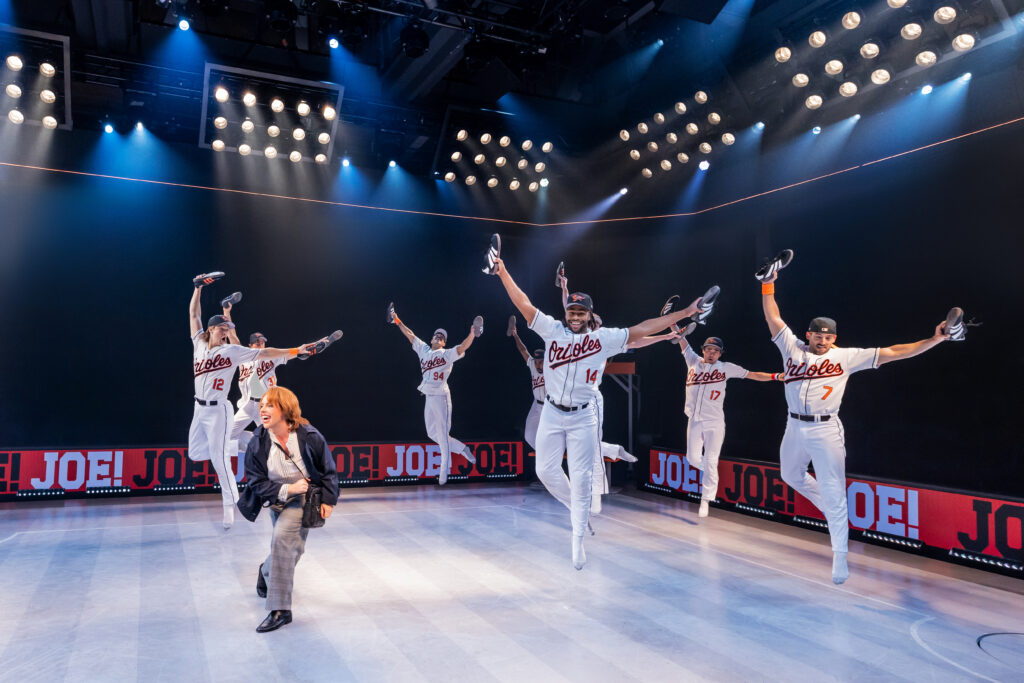 Alysha Umphress (Gloria Thorpe) and the company of Damn Yankees. (Photo/Matthew Murphy and Evan Zimmerman)
With Alysha Umphress as Gloria Thorpe; Giuseppe Bausilio as Fuzzy/Ensemble; Raúl Contreras as Peña/Ensemble; Deanna Cudjoe, Ensemble; John Michael Fiumara as Gonzalez/Ensemble; Rayanne Gonzales as Sister/Ensemble; Danielle Marie Gonzalez, Ensemble; Michael Harmon as Smokey/Ensemble; Nehal Joshi as Ito/Ensemble; Ryo Kamibayashi as Ito/Ensemble; Georgia Monroe, Ensemble; Keenan McCarter as Welch; Kevin Munhall as Commissioner/Ensemble; J Savage as Sohovik/Ensemble; Justin Showell as Rocky/Ensemble; Sarah Anne Sillers as Doris/Ensemble; Jordyn Taylor, Ensemble.
Brilliantly directed and choreographed by world renowned creative, Sergio Trujillo; Music Supervision and Arrangements by Greg Anthony Rassen; Set Design by Robert Brill; Costume Design perfection by Linda Cho; Lighting Design by Philip S. Rosenberg; Sound Design by Walter Trarbach; Score Supervisor, David Chase; Projection Design by Peter Nigrini; Wig & Hair Design by Charles G. LaPointe; Illusion Design by Paul Kieve.
Through November 9th at Arena Stage, 1101 Sixth Street, SW, Washington, DC 20024. For tickets and information call the box office at 202.554.9066 or visit www.ArenaStage.org.
A Wrinkle in Time – a New Musical is a Must See Cosmic Adventure
A Wrinkle in Time – A New Musical
Arena Stage
Jordan Wright
June 28, 2025
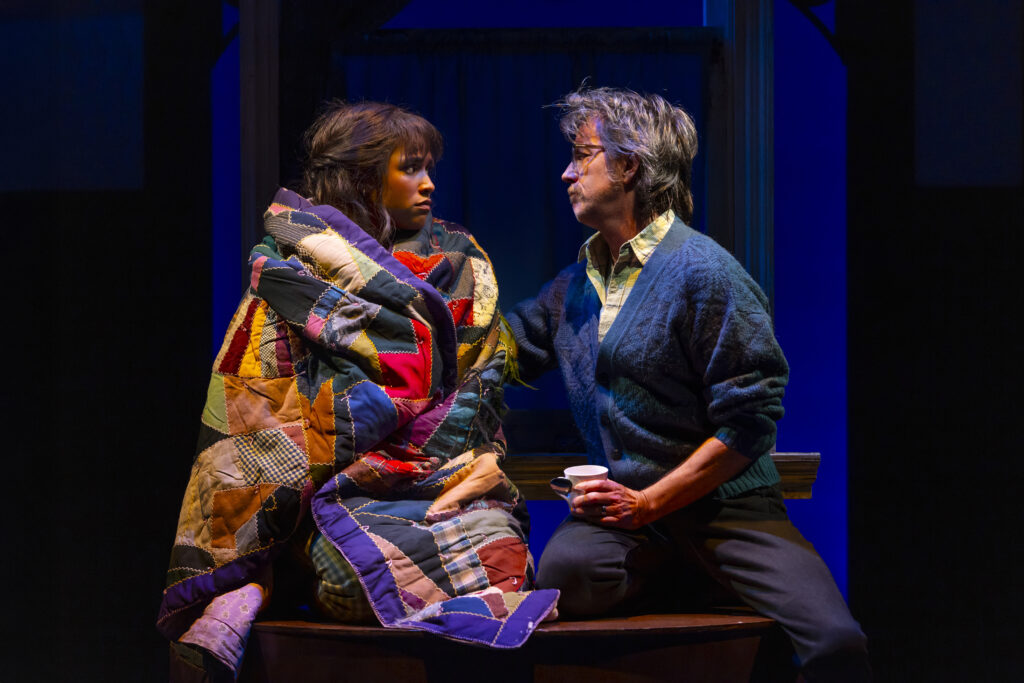 Taylor Iman Jones (Meg) and Jon Patrick Walker (Father) in A Wrinkle in Time at Arena Stage at the Mead Center for American Theater. (Photo/T Charles Erickson Photography)
“I got blown off course on the tail end of a tesseract,” explains Mrs Whatsit, describing traveling through time and space by wrinkling the fabric of the universe. And, boom! Off we go, as prolific novelist Madeleine L’Engle’s tale of space travelers comes to life. Three teens, the awkward and gutsy Meg Murry, Calvin O’Keefe, her poetry-loving boyfriend and her mindreading brother Charles Wallace Murry, “I get these convulsions”, begin their cosmic adventure through the fifth dimension to find their scientist father, Dr. Alex Murry, who has teleported to the dark planet of Camazotz where he is being held captive by an evil ruler. These kids have their work cut out for them – logically, mathematically and emotionally.
You probably saw A Wrinkle in Time listed in my monthly “What’s Onstage in the DMV” column. Since its opening, the most frequent query I’ve received has been, “Is this for kids or adults?” Millions have seen the movie and millions more have read L’Engle’s book and that’s useful, because it’s tricky to follow if you don’t know you’ll be traveling to different universes. It was for me. To guide me through the megaverse (or should I say, multiverse, I am not well-versed in these things), I brought along a friend who is a huge fan of the book and knew both the characters and the story. But to answer who should see this? Everyone!
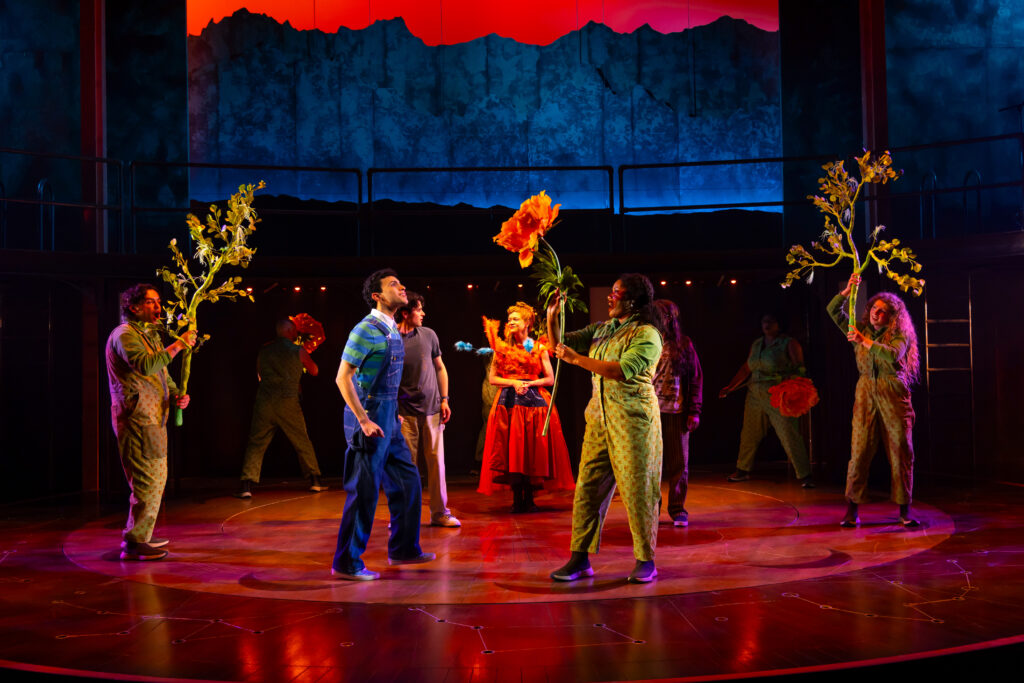 The company of A Wrinkle in Time. (Photo/T Charles Erickson Photography)
Apart from some sound issues on opening night, this is a highly imaginative production in both story and score written by Heather Christian, a highly acclaimed composer, performer and librettist. It is structured as a sung-through with little spoken dialogue. The music is extraordinary – otherworldly and humanly harmonic – and the cast is fire! I promise you’ve never heard anything like it.
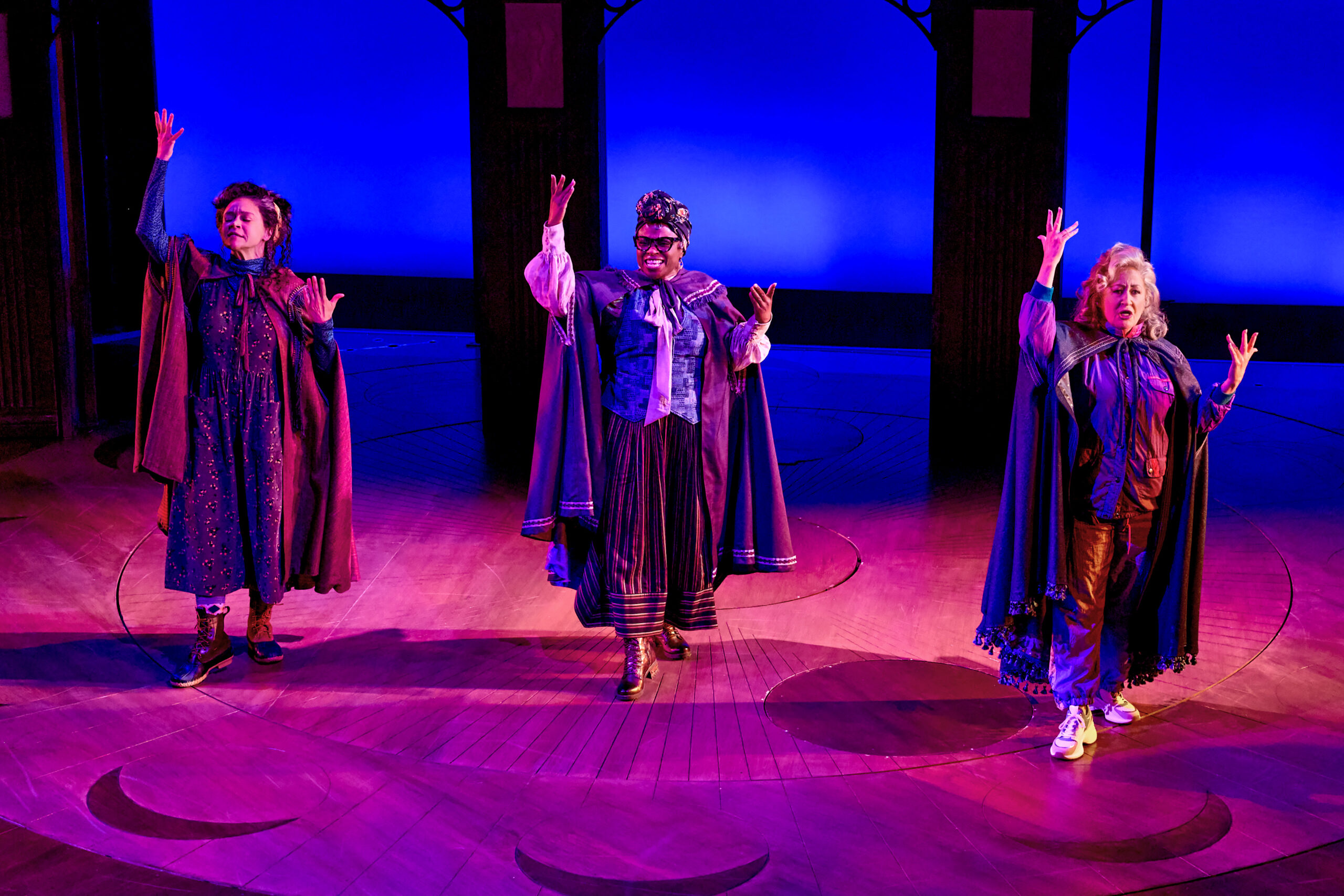
We do meet the children’s mother who has been anxiously awaiting her husband’s return, three muses, or shall we call them seers – Mrs Whatsit, Mrs Who and Mrs Which – there is no Mrs Whatchamacallit. The three guide the children through the cosmos with hot tips, urgings and comforting malaprops. These kids most assuredly need their help to navigate 5.3 million light years through the shifting galaxies and bizarre characters and creatures they encounter along the way.
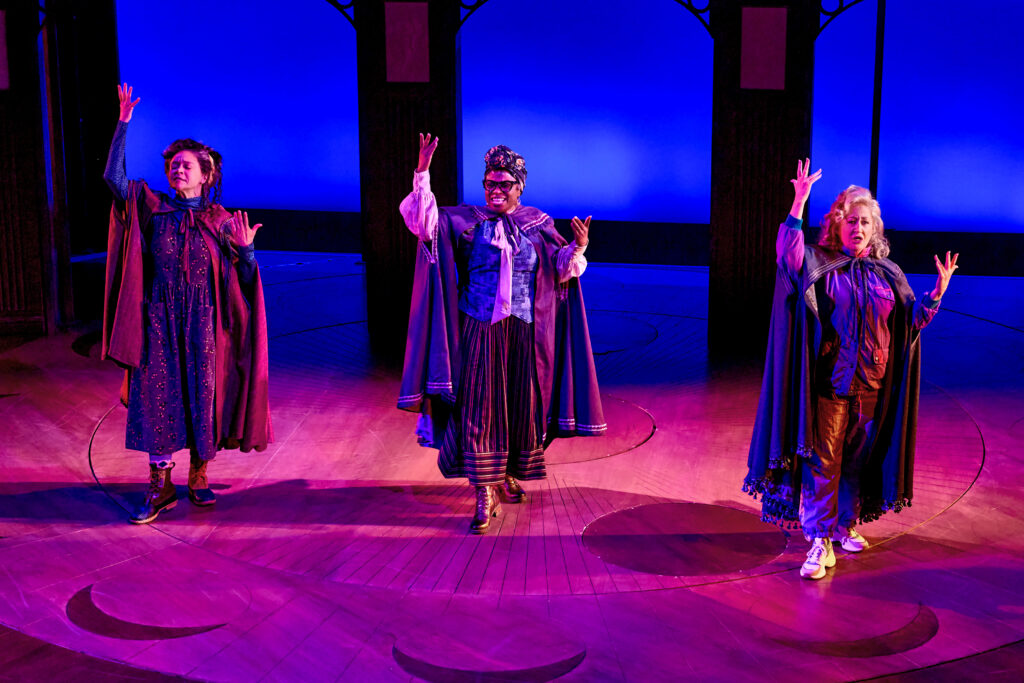 Amber Gray (Mrs Whatsit), Stacey Sargeant (Mrs Who), and Vicki Lewis (Mrs Which). (Photo/DJ Corey)
There are political undertones to the story and it’s fun and challenging to grok them as they pop up like ghost stars – totally unpredictable and oh, so clever. Through storms and dark matter, aliens, heroes and colorful no-nothings, Meg finds her voice and takes charge of the maelstrom threatening to consume them. The sets by dots, costumes by Sarafina Bush, and puppet design and puppetry by James Ortiz converge to create this masterfully designed universe where we can all be transported as we dance and sing our way through the cosmos. “And in the end, the love you make, is equal to the love you take.” – – Paul McCartney, composer/lyricist from “The End” on the Abbey Road album.
Highly recommended! Fresh, captivating, and extraordinary!!!
With Taylor Iman Jones as Meg; Nicholas Barrón as Calvin; Mateo Lizcano as Charles Wallace; Jon Patrick Walker as Father/Ensemble; Andrea Jones-Sojola as Mother/Aunt Beast; Amber Gray as Mrs Whatsit; Vicki Lewis as Mrs Which; Stacey Sargeant as Mrs Who; Leanne Antonio as Paper Girl/Ensemble; Kimberly Dodson as Happy Medium/Beast/Ensemble; Aidan Joyce as Camazotzian Brother/Ensemble; Gabrielle Rice as Beast/Ensemble; Jayke Workman as Affirmations Man/Ensemble; Michael Di Liberto as Man with the Red Eyes/Ensemble; Rebecca Madeira, Ensemble; Ronald Joe Williams, Ensemble.
Book by Lauren Yee; Directed by Lee Sunday Evans; Choreographed by Ani Taj; Lighting Design by Jeanette Oi-Suk Yew; Sound Design by Nick Kourtides; Wig and Hair Design by Alberto “Albee” Alvarado; Makeup Design by Kirk Cambridge-Del Pesche; Orchestrations by StarFish; Arrangements by Heather Christian; Music Direction by Ben Moss; Fight Consultant, Robb Hunter; Dance Captain, Leanne Antonio.
Through July 20th at Arena Stage, 1101 Sixth Street, SW, Washington, DC 20024. For tickets and information call the box office at 202 488-3300 or visit www.ArenaStage.org.
Playwright Larissa Fasthorse’s Zany Farce Reveals an Insider’s Guide to American Indian Identity and How to Become Native as a Pastime
Fake It Until You Make It
Arena Stage
Jordan Wright
April 12, 2025
Special to The Zebra
 Noah Bean (Theo) and Shyla Lefner (Wynona) in Fake It Until You Make It at Arena Stage at the Mead Center for American Theater running April 3 – May 4, 2025. (Photo/Daniel Rader) Fake It Until You Make It is a wildly funny farce that provides us with a modern-day interpretation of Indian Country vis à vis White America with all its struggles and challenges. It is a co-production with Los Angeles’ Center Theatre Group.
For a wonderfully fascinating eight years, I became immersed in the heart of Native culture for Indian Country Media Network, and as beautiful, fascinating and historical it is, it can be a tangled web. No one is quite certain of the racial or cultural definition of what it means to be American Indian, for example how much ancestral Indian blood allows membership in a tribe, or if a White person can properly represent their interests. This raucous comedy addresses all those familiar controversies with lampooning, caricatures and cheeky humor.
 Burgandi Trejo Phoenix (Grace), Noah Bean (Theo), Shyla Lefner (Wynona), Eric Stanton Betts (Mark), and Brandon Delsid (Krys) (Photo/Daniel Rader) Playwright Larissa Fasthorse, who defines herself as a DC-born nonbinary Two Spirit Afro-Indigenous (Quechua-Kichwa) Latine actor, writer, director and musician, tackles these thorny issues with extraordinary humor, a side eye and a wink. Her six characters have differing viewpoints as to what makes an Indian an Indian, as they go head-to-head in a political farce that is wacky and wonderful with a cat (Yes, a cat!) that takes star turns in the women’s catfights.
Five of the characters have offices in a building dedicated to Native American Organizations. River (Amy Brenneman) is White, yet she’s ingratiated herself among the tribal elders with her non-profit group “Indigenous Nations Soaring”, and like the other NGO directors she is fighting for grants. Wynona (Shyla Lefner) runs N.O.B.U.S.H, a non-profit that promotes native plants and shuns the invasive butterfly bush. Thus, the ‘no bush’. She calls people who appropriate her native culture “Pretendians”. In her spare time, she is having a hot and heavy romance with Theo (Noah Bean) who’s an invasive plant remover and, as Wynona calls him, her “ecological warrior and undercover spy. She knows Theo is White but chooses to ignore that little detail to keep him as her lover.
 Shyla Lefner (Wynona) (Photo/Daniel Rader) Grace (Burgandi Trejo Phoenix) is an attorney whose concept of being Native American she describes as a personal choice. She calls it “race shifting”. In other words, you can be whatever race and culture floats your boat. To that end she morphs into Japanese, Middle Eastern and even White. And then there’s Krys (Brandon Delsid), an out gay man who goes to powwows with Grace and is a scene stealer and heart stealer in the very best way.
There are feuds and cock-ups as they challenge each other as to who is Native and who will snag the big grant. In one scene River does a TED talk and screws up her message by performing a slinky belly dance thinking she’ll charm her way to the top. She most decidedly does not. Theo pretends to be Native American in order to spy on River for Wynona. River needs a real Indian to front her organization. When the suave and handsome Mark (Eric Stanton Betts) shows up for his interview to be River’s Executive Director, Theo, who’s pretending to be Indian, gets caught out as a poser and everything goes utterly off the rails.
Describing the characters and their relationships does not in any way detract from the over-the-top high jinks, the chases, the spying, and the alliances. In the end, there are DNA tests that stun everyone as to who is a real Indian.
 Burgandi Trejo Phoenix (Grace), Brandon Delsid (Krys), Eric Stanton Betts (Mark), Noah Bean (Theo), and Shyla Lefner (Wynona) (Photo/Daniel Rader) Designer Sara Ryung Clement has created very effective moving sets of offices with doors and plate glass windows designed for us to see and hear everything that goes on inside. It’s a little bit like the TV show, “The Office” with mayhem and freakouts at every turn and I loved every bit of it.
With great respect local theaters have been paying homage to the American Indian tribes in our region, acknowledging they are sitting on their indigenous lands. On press night, several Native ambassadors were present to address the audience showcasing their music, language and culture and singing the Navaho national anthem.
A terrific cast directed by Michael John Garcés reveals an insider’s guide to American Indian identity and how to become Native as a pastime.
With Costume Design by E. B. Brooks, Lighting Design by Tom Ontiveros, Sound Design by John Nobori, Fight Director Edgar Landa.
Through May 4th at Arena Stage, 1101 Sixth Street, SW, Washington, DC 20024. For tickets and information call the box office at 202 554-9066 or visit www.ArenaStage.org.
Winning Cast in a Must-see, Superbly Designed and Brilliantly Written Play at Arena Stage
The Age of Innocence
Arena Stage
Jordan Wright
March 9, 2025
Special to The Zebra
 Delphi Borich (May Welland), A.J. Shively (Newland Archer), and Shereen Ahmed (Countess Ellen Olenska) in The Age of Innocence at Arena Stage at the Mead Center for American Theater running February 28 – March 30, 2025. (Photo/Daniel Rader) Karen Zacarías’s brilliantly imagined stage adaption of Edith Wharton’s classic novel is an absolute gem with Tim Mackabee’s elaborate set replete with floating chandeliers, theatre boxes that jut out above the stage from all four corners to reveal high society opera attendees dressed to the nines in Victorian splendor, and a separate center stage that rises and falls with each new intimate scene. If you are wistful to see this novel come alive, you’ll swoon for it. It’s sophisticated and elegant, as expected, wrapped around a tragic story of unrequited love.
The Age of Innocence is brilliantly cast with huge Broadway actor and local beloved Felicia Curry in the starring role of Granny as well as serving as the story’s narrator, the ravishing Shereen Ahmed, another Broadway luminary as femme fatale Countess Ellen Olenska and the very debonair and impressive actor A. J. Shively as the impassioned lover, Newland Archer. He will sweep you off your feet!
 A.J. Shively (Newland Archer) and Delphi Borich (May Welland) (Photo/Daniel Rader) Intrigue abounds in the salons of New York high society and this story has it in spades. The “Old Four Hundred” as they were known in the Gilded Age, ruled like royalty. Four hundred families set the tone for proper manners and acceptable behavior in society. These strict societal edicts were etched in stone like the sermon on the mount and impossible to adhere to due to the vagaries of love and human emotion.
Slimy mountebanks with questionable titles swept in from overseas to relieve these august families of their wealth or young heiresses of their dowries. Pretentious fops and empty-headed debutantes fill out the inner circle. It wasn’t as unruffled as it seemed to those looking in from outside the gates. And that’s exactly what makes this fast-moving plot so delicious. Because in this microcosm of the well-to-do, gossip reigned supreme and these elegant dowagers are superb at taking each other down.
 Shereen Ahmed (Countess Ellen Olenska) and Delphi Borich (May Welland) (Photo/Daniel Rader) Only Newland Archer seems to rail at society’s hypocrisies “Women ought to be free,” he announces to one and all. Everyone else just goes along with the unspoken rules imbuing Granny as the arbiter of all family disputes. When Ellen appears at a dinner Granny refers to her parents as “Continental wanderers” (Heaven forfend!) alluding to her failed marriage to a brutal Count. You may recall Newland’s sister, Janey, who poses the query, “We can’t behave like people in novels, can we? We can’t be vulgar.”
Fabio Toblini’s costumes are drop dead fabulous. Outstanding is Ellen’s full-length red satin dress that calls to mind John Singer Sargent’s portraits of the period.
This is a winning cast in a must-see, profoundly creative, superbly designed and written play.
Highly recommended!
 Shereen Ahmed (Countess Ellen Olenska) and A.J. Shively (Newland Archer)(Photo/Daniel Rader) With Regina Aquino as Mrs. Archer and Others; Delphi Borich as May Welland; Lise Bruneau as Mrs. van der Luyden; Anna Theoni DiGiovanni as Janey Archer and Others; Paolo Montalban as Julius Beaufort and Others; Noah Mutterperl as Valet and Others; Anthony Newfield as Sillerton Jackson and Others; Natalya Lynette Rathnam as Mrs. Welland and Others; and Jacob Yeh as Dallas Archer and Others.
Expertly directed by Hana S. Sharif; Lighting Design by Xavier Pierce; Wig and Hair Design by Tommy Kurzman; Original Music and Sound Design by Charles Coes & Nathan A. Roberts; Dramaturg Otis-Ramsey-Zöe.
Through March 30th at Arena Stage, 1101 6th Street, NW, Washington, DC 20024. For tickets and information call the box office at 202 488-3300 or visit www.ArenaStage.org.
|